child seat Seat Exeo ST 2012 Owner's Guide
[x] Cancel search | Manufacturer: SEAT, Model Year: 2012, Model line: Exeo ST, Model: Seat Exeo ST 2012Pages: 325, PDF Size: 5.56 MB
Page 140 of 325
138Seats and storage compartments
Controls
Seat adjustment
Backrest adjustment
Lumbar support*
WARNING
● The electrical seat adjustment also works when the ignition is off or
when the key is not in the ignition. To avoid accidental injuries, never
leave children unattended in the vehicle.
● For safety reasons, the seat must only be adjusted when the vehicle
is at a standstill. Failure to do so could result in an accident.
● Be careful when adjusting the seat height. Injuries can be caused if
the seat height is adjusted without due care and attention.
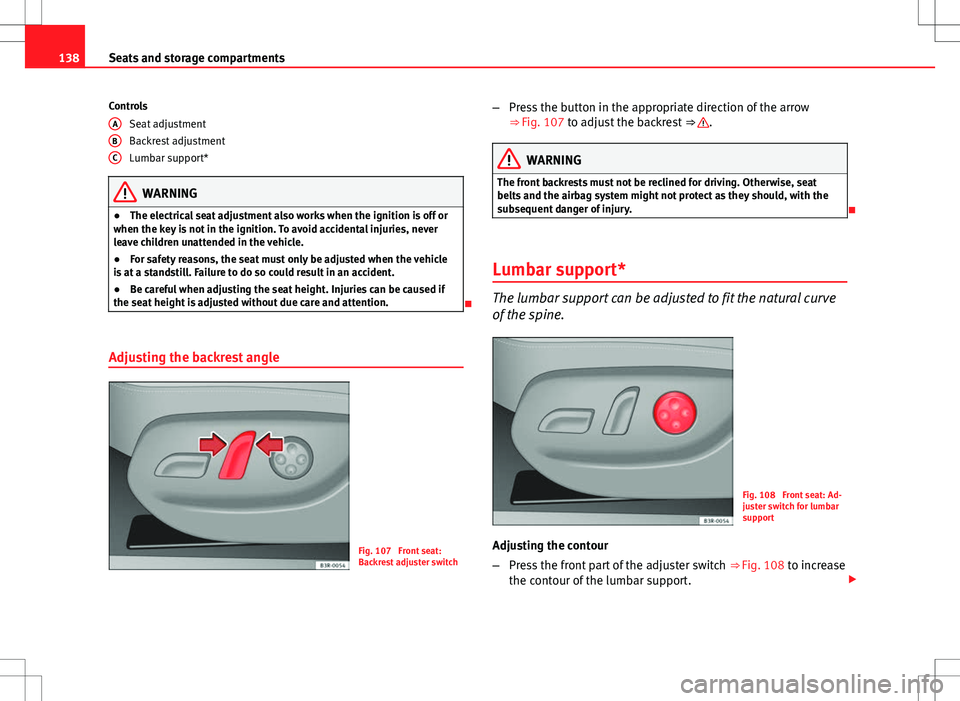
Adjusting the backrest angle
Fig. 107 Front seat:
Backrest adjuster switch
A
BC
–
Press the button in the appropriate direction of the arrow
⇒ Fig. 107 to adjust the backrest ⇒ .
WARNING
The front backrests must not be reclined for driving. Otherwise, seat
belts and the airbag system might not protect as they should, with the
subsequent danger of injury.
Lumbar support*
The lumbar support can be adjusted to fit the natural curve
of the spine.
Fig. 108 Front seat: Ad-
juster switch for lumbar
support
Adjusting the contour
– Press the front part of the adjuster switch ⇒
Fig. 108 to increase
the contour of the lumbar support.
Page 159 of 325
157
Seats and storage compartments
WARNING
The power points, and any accessories connected to them are also func-
tional with the ignition switched off or the key removed. To avoid the risk
of injury, never leave children unsupervised in the vehicle.
CAUTION
Always use the correct type of plugs to avoid damaging the sockets.
Note
The use of electrical appliances with the engine switched off will cause a
battery discharge.
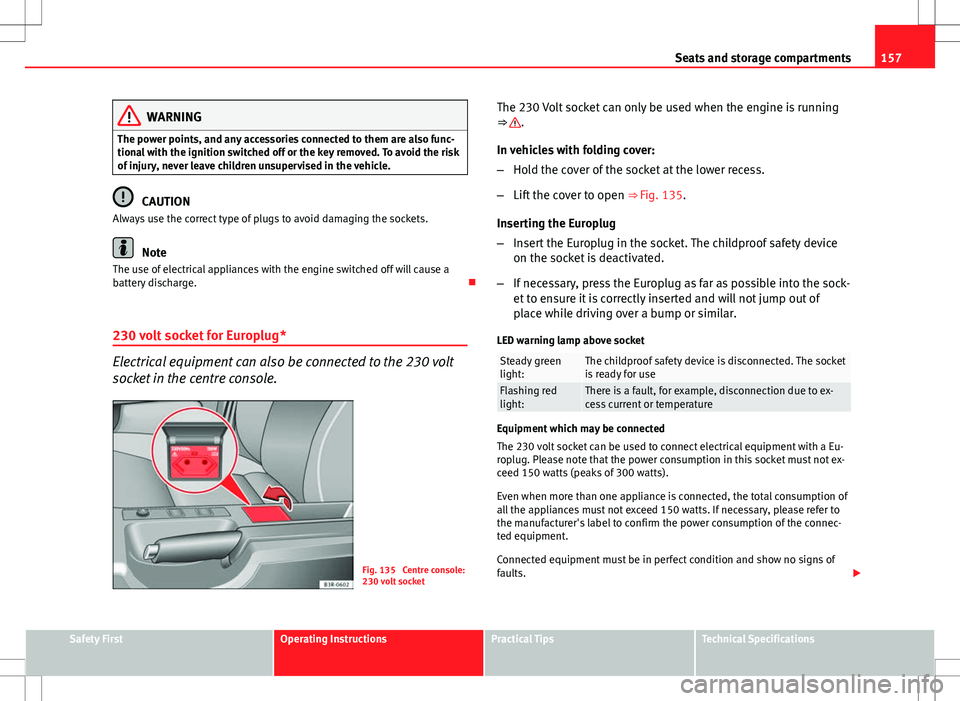
230 volt socket for Europlug*
Electrical equipment can also be connected to the 230 volt
socket in the centre console.
Fig. 135 Centre console:
230 volt socket The 230 Volt socket can only be used when the engine is running
⇒
.
In vehicles with folding cover:
– Hold the cover of the socket at the lower recess.
– Lift the cover to open ⇒ Fig. 135.
Inserting the Europlug
– Insert the Europlug in the socket. The childproof safety device
on the socket is deactivated.
– If necessary, press the Europlug as far as possible into the sock-
et to ensure it is correctly inserted and will not jump out of
place while driving over a bump or similar.
LED warning lamp above socket
Steady green
light:The childproof safety device is disconnected. The socket
is ready for use
Flashing red
light:There is a fault, for example, disconnection due to ex-
cess current or temperature
Equipment which may be connected
The 230 volt socket can be used to connect electrical equipment with a Eu-
roplug. Please note that the power consumption in this socket must not ex-
ceed 150 watts (peaks of 300 watts).
Even when more than one appliance is connected, the total consumption of
all the appliances must not exceed 150 watts. If necessary, please refer to
the manufacturer's label to confirm the power consumption of the connec-
ted equipment.
Connected equipment must be in perfect condition and show no signs of
faults.
Safety FirstOperating InstructionsPractical TipsTechnical Specifications
Page 160 of 325
158Seats and storage compartments
WARNING
● Heavy appliances or connectors (for example, adapters) which hang
down directly from the Europlug socket may damage the socket with the
resultant risk of injury.
● Ensure that appliances connected to the socket are secure to prevent
them from being thrown around the vehicle in the event of sharp braking
or an accident. This could result in severe injury or loss of life ⇒ page 16,
Storing objects.
● Never spill liquid over the power socket– there is a risk of death. If
any moisture enters the socket, ensure that it is thoroughly dry before
using.
● Improper use of the sockets or electrical accessories can lead to seri-
ous injuries or cause a fire, with the resultant risk of injury.
● Children must never be left alone in the vehicle with the engine run-
ning. They could cause an accident.
● Appliances connected to the socket do not behave in the same way as
when they are connected to the mains power supply. They may overheat
during use and cause injury.
● When using adapters and extension leads, the childproof safety de-
vice on the 230 volt socket is disconnected and the socket is live. Risk of
injury!.
● Never insert objects which conduct electricity, such as a needle, in
the pins of the 230 volt socket. There is a risk of death.
● Always switch off electrical appliances connected to the socket if the
inverter goes off as a result of overheating. Failure to comply could result
in injuries.CAUTION
● The instructions for handling appliances connected to the socket must
be observed.
● If the power consumption of the appliances connected exceeds 150
watts, the socket inverter will overheat. If the temperature exceeds a certain
value, the inverter will switch off. It may also switch off if the outside tem-
perature is very high, even if the power consumption is normal. The inverter
will switch on again automatically after it has cooled down. Appliances con-
nected to the socket, and which have been left switched on, will automati-
cally come back on ⇒
.
● Do not connect neon lamps to the socket. For technical reasons, these
could break down.
● Do not connect 115 volt appliances to the 230 volt power socket, as
they could be damaged. If you have any queries, please check the manufac-
turer's label for details of the power supply accepted by the appliance.
● With some adapters, for example for laptops, their built-in overload dis-
connection system prevents the equipment from switching on in the event
of an excessive start-up current. In this case, disconnect the adapter from
the power supply and try to reconnect after ten seconds.
Note
● Non-insulated equipment may cause interference to the radio or vehicle
electronics.
● The Europlug socket has a built-in childproof device and only carries live
current when the Europlug is correctly plugged in.
● Some appliances may not operate correctly in the absence of adequate
power (watts).
Page 176 of 325

174Driving
Position 1
The ignition key is inserted in this position. To
engage the steering wheel
lock, take out the key and turn the wheel until you hear the pin engage. You
should always engage the steering lock when you leave the vehicle. This
will help to deter thefts ⇒
.
Switching on the ignition/pre-heating glow plugs 2
If the key is difficult to turn in the lock, move the steering wheel (to take the
load off the steering lock mechanism) until the key turns freely. In the case
of vehicles with a diesel engine, the key is turned to this position to preheat
the glow plugs.
Starting the engine 3
The engine is started in this position. Electrical components with a high
power consumption are switched off temporarily.
After the engine has started, the ignition key returns to position 2
by itself.
The ignition key has to be turned back to position 1
before re-starting the
engine. The starter inhibitor in the ignition lock prevents the starter motor
from engaging when the engine is running, as this could cause damage.
Switching off the ignition 1
Turn the ignition key to this position.
WARNING
● Never remove the ignition key until the vehicle is stationary! Other-
wise the steering lock could engage suddenly, which could cause an acci-
dent.
● Always take the key with you when leaving the vehicle, even if you
only intend to be gone for a short time. This is particularly important if
there are children in the vehicle, as they might otherwise be able to start
the engine or use power-operated equipment (e.g. the electric windows),
which could cause injuries.
Note
● If the battery has been disconnected and then reconnected, it will be
necessary to leave the key in position 2
for about 5 seconds before start-
ing the engine.
● Vehicles with automatic gearbox: After switching off the ignition, you
can only remove the ignition key if the selector lever is in position “P” (park-
ing lock). The selector lever is locked after the ignition key has been re-
moved.
Starting and stopping the engine Starting the engine
The engine can only be started with an original SEAT key.
Fig. 146 Ignition key po-
sitions
Vehicles with a petrol engine:
– Use the foot brake.
Page 183 of 325

181
Driving
Parking aid acoustic system
General notes
Various systems are available to help you when parking or manoeuvring in
tight spaces, depending on the equipment fitted on your vehicle.
The SEAT Parking System gives an acoustic warning if there are any obsta-
cles behind your vehicle ⇒ page 181.
When you are parking, SEAT Parking System Plus warns you acoustically
and optically about obstacles in front of and behind the vehicle
⇒ page 182.
Note
To ensure the acoustic parking aid works properly, the sensors must be kept
clean and free of snow and ice.
SEAT Parking System*
SEAT Parking System is an acoustic parking aid.
Sensors are located in the rear bumper. When the sensors detect an obsta-
cle, you are alerted by acoustic signals. The measuring range of the sensors
starts at approximately:
RearSide0.60 mCentre1.60 m
The acoustic signals sound with increasing frequency as you approach the
obstacle. When the vehicle is less than 0.30 m away from the obstacle, the
warning tone will sound continuously. Do not drive on! The volume of the warning beeps will be gradually reduced after about 4
seconds if the vehicle remains at a constant distance from a detected obsta-
cle (it does not affect the permanent acoustic signal).
The parking aid is switched on automatically when reverse gear is engaged.
You will hear a brief confirmation tone.
WARNING
● The parking aid is not a replacement for driver awareness. The driver
is personally responsible for safe parking and other manoeuvres.
● The sensors have blind spots in which obstacles are not registered.
Always look out for small children and animals because the system will
not always detect them. Always pay attention when reversing to avoid ac-
cidents.
● Always keep a close eye on the area around the vehicle and make full
use of the rear view mirrors.
CAUTION
Please note that low obstacles detected by the system may no longer be
registered by the sensors as the vehicle moves closer, so the system will not
give any further warning. Certain kinds of obstacles (such as wire fences,
chains, thin painted posts or trailer draw bars, etc) may not always be de-
tected by the system, so take care not to damage the vehicle in such cases.
Note
● Please refer to the notes on towing ⇒ page 183.
Safety FirstOperating InstructionsPractical TipsTechnical Specifications
Page 185 of 325
183
Driving
WARNING
● The parking aid is not a replacement for driver awareness. The driver
is personally responsible for safe parking and other manoeuvres.
● The sensors have blind spots in which obstacles are not registered.
Always look out for small children and animals because the system will
not always detect them. Always pay attention when reversing to avoid ac-
cidents.
● Always keep a close eye on the area around the vehicle and make full
use of the rear view mirrors.
CAUTION
Please note that low obstacles detected by the system may no longer be
registered by the sensors as the vehicle moves closer, so the system will not
give any further warning. Certain kinds of obstacles (such as wire fences,
chains, thin painted posts or trailer draw bars, etc) may not always be de-
tected by the system, so take care not to damage the vehicle in such cases.
Note
● Please refer to the notes on towing ⇒ page 183.
● There is a slight delay in the picture display.
Towing bracket*
In towing mode, the rear parking aid sensors are not enabled when you se-
lect reverse gear or press the switch . This function may not be guaran-
teed on towing brackets that are not factory fitted. This results in the follow-
ing restrictions:
SEAT Parking System*
There is no distance warning. SEAT Parking System Plus*
There is no rear distance warning. The system will still give a warning when
obstacles are detected while driving forward.
Fault messages*
If you hear a long beep for a few seconds and the LED on the button*
starts flashing when you switch on the parking aid, a system fault has oc-
curred. Please have the fault corrected by a Technical Service or specialised
workshop.
Note
If the fault is not corrected before you switch off the ignition, it will only be
indicated by the flashing LED on the switch * the next time you switch on
the parking aid.
Cruise speed* (Cruise control system)
Introduction
The cruise control system allows you to maintain a constant
speed. Using this system, any speed over 30 km/h can be kept constant, as long as
the engine power allows it. This is subject to power output and braking abil-
ity of the engine. This helps to reduce fatigue, especially on long journeys.
The indicator lamp on the instrument panel lights up when the cruise
control system is operating.
Safety FirstOperating InstructionsPractical TipsTechnical Specifications
Page 225 of 325

223
Vehicle maintenance and cleaning
WARNING
Vehicle care products may be toxic and hazardous. Using unsuitable car-
care products or, using them in the wrong way, may cause accidents, se-
rious injury, burns or intoxication.
● Keep your car-care products in their original containers.
● Read the instructions.
● Never keep car-care products in empty food containers, bottles or
other similar containers, other people may confuse them.
● Keep all car-care products out of the reach of children.
● Some products may give off harmful vapours during use. Therefore,
they should be used outdoors in well-ventilated places.
● Never use fuel, turpentine, engine oil, nail-varnish remover or any
other volatile product for washing, maintenance or cleaning. These are
toxic and highly flammable.
WARNING
Unsuitable maintenance and cleaning of vehicle components may impair
proper operation of safety equipment and cause serious injury.
● Maintain and clean vehicle components according to the manufactur-
er's instructions.
● Only use approved or recommended cleaning products.
CAUTION
● Cleaning products which contain solvents have a corrosive effect and
may damage the material irreparably.
● Stains and dirt containing aggressive substances or solvents attack the
material and may damage it irreparably, even when they are cleaned quick-
ly. ●
Dirt and stains should not be allowed to dry and should be cleaned as
quickly as possible.
● In the case of stubborn stains, take the vehicle to a specialised work-
shop to avoid damage.
Treating your upholstery
Checklist
To treat and maintain your seat upholstery, keep the following in mind ⇒
:
Before entering the vehicle, close any velcro fasteners that might
snag on the upholstery or trim fabric. Any open velcro fasteners may
damage the trim or upholstery fabrics.
To prevent damage, avoid direct contact between sharp decorative
objects and the upholstery and trim fabrics. Decorative objects in-
clude zips, rivets and rhinestones on clothing and belts.
From time to time, clean the dust that gathers in the perforations,
folds and seams so that the surfaces of the seats are not damaged
by its abrasive effect.
Make sure clothes are colour-fast to avoid them running and staining
the upholstery. This is especially important if the upholstery is light
in colour.
CAUTION
If you ignore this checklist, which is important for maintaining your seat up-
holstery, the fabric may be damaged or stained.
● Consult the checklist and carry out the operations it describes.
Note
SEAT recommends you take the vehicle to a specialised workshop to treat
any stains on the upholstery caused by the discolouration of clothing.
Safety FirstOperating InstructionsPractical TipsTechnical Specifications
Page 247 of 325
245
Checking and refilling levels
Topping up and changing the brake fluid
It is best to have the brake fluid changed by a professional. Brake fluid absorbs moisture. Therefore, in the course of time it will absorb
water from the air. If the water content in the brake fluid is too high, the
brake system could corrode. In addition, the boiling point of the brake fluid
will be considerably reduced. This could adversely affect the braking ability
in certain circumstances.
For this reason the brake fluid must be changed periodically.
Your vehicle's Service Plan will tell you when the brake fluid has to be re-
newed.
We recommend you have the brake fluid changed as part of a regular In-
spection Service at a Technical Service. They are familiar with the procedure
and have the necessary special tools and spare parts as well as the proper
facilities for disposing of the old fluid.
Be sure to always use the correct brake fluid. Only use brake fluid that ex-
pressly meets VW 501 14 standards.
You can buy VW 501 14 standard brake fluid in a SEAT dealership or SEAT
Official Service. If none is available, use only high quality brake fluid that
meets DIN ISO 4925 CLASS 4 standards, or USA Standards FMVSS 116 DOT
4.
Using any other kind of brake fluid or one that is not of a high quality may
affect operation of the brake system and reduce its effectiveness. Never use
a brake fluid if the container does not state that it complies with VW 501 14,
DIN ISO 4925 CLASS 4 standards, or USA standards FMVSS 116 DOT 4.WARNING
● Brake fluid must always be kept closed in its original container. Keep
out of the reach of children. Failure to comply could result in poisoning.
● If the brake fluid is left in the system for too long and the brakes are
subjected to heavy use, vapour bubbles may form in the brake system.
This would seriously affect the efficiency of the brakes and the safety of
the vehicle, leading to the risk of accident.
CAUTION
Please note that brake fluid will attack the paintwork on contact.
For the sake of the environment
The brake pads and fluid must be collected and disposed of according the
applicable regulations. The SEAT Technical Service network has the neces-
sary equipment and qualified personnel for collecting and disposing of this
waste material.
Vehicle battery General notes
All work on batteries requires specialist knowledge.
The battery is virtually maintenance-free and is checked in the Inspection
Services.
We recommend replacing the battery after 5 years.
Safety FirstOperating InstructionsPractical TipsTechnical Specifications
Page 269 of 325
267
If and when
The sealing compound must not be used in the following cases:
● If the cuts and punctures on the tyre are longer than 4 mm ⇒ Fig. 200 1
●
If the wheel rim has been damaged 2●
If you have been driving with very low pressure or a completely flat tyre
3
How to use the TMS (tyre mobility system) is described in the section Re-
pairing a tyre ⇒ page 268 and in the instructions supplied with the tyre
sealant can.
The TMS (tire mobility system) can be used at outside temperatures down
to - 20°C.
WARNING
After repairing a tyre please note the following points:
● Do not drive faster than 80 km/h.
● Avoid heavy acceleration, hard braking and fast cornering.
● Vehicle handling could be impaired.
● Tyres which have been sealed using the Tyre Mobility System are only
suitable for temporary use over a short period.
● After using the tyre sealant the tyre pressure monitoring system* may
malfunction. Therefore, please drive carefully to the next available speci-
alised workshop.
● The Tyre Mobility System must NOT be used:
– If the cuts and punctures on the tyre are longer or wider than
4 mm.
– if the wheel rim has been damaged.
– if you have been driving with very low pressure or a completely flat
tyre.
● Seek professional assistance if the repair of a tyre puncture is not
possible with the sealing compound.
WARNING (Continued)
● Do not allow the sealant to come into contact with your eyes, skin or
clothing.
● If you do come into contact with the sealant immediately rinse the
eyes or skin affected with clean water.
● Change clothing immediately if it becomes soiled with the tyre seal-
ant.
● Make sure you do not breathe in the fumes!
● If any of the tyre sealant is accidentally ingested, immediately rinse
the mouth thoroughly and drink lots of water.
–Do not induce vomiting. Seek medical assistance if needed.
● If any allergic reactions should occur get medical help immediately.
● Keep the sealant away from children.
For the sake of the environment
If you have to dispose of a sealant can, go to a specialised waste service or
to a SEAT Technical Service, where the product can be recycled in an appro-
priate waste container.
Note
● If sealant should leak out, leave it to dry. This way you can pull it off like
a piece of foil.
● Observe the expiry date stated on the sealing compound can. Have the
sealing compound exchanged by a specialised workshop.
Safety FirstOperating InstructionsPractical TipsTechnical Specifications
Page 316 of 325
Bonnet . . . . . . . . . . . . . . . . . . . . . . . . . . . . . . . 233Closing . . . . . . . . . . . . . . . . . . . . . . . . . . . . 235
Opening . . . . . . . . . . . . . . . . . . . . . . . . . . . 234
Releasing . . . . . . . . . . . . . . . . . . . . . . . . . . 233
Brake light Failure control . . . . . . . . . . . . . . . . . . . . . . . . 83
Brake pads . . . . . . . . . . . . . . . . . . . . . . . . . . . . 201
Brakes . . . . . . . . . . . . . . . . . . . . . . . . . . . . . . . . 201 Brake assist system . . . . . . . . . . . . . . . . . . 196
Brake fluid . . . . . . . . . . . . . . . . . . . . . . . . . 244
Worn brake pads . . . . . . . . . . . . . . . . . . . . . 84
Brake servo . . . . . . . . . . . . . . . . . . . . . . . . . . . . 201
Brake system Brakes . . . . . . . . . . . . . . . . . . . . . . . . . . . . . 198
Brake servo . . . . . . . . . . . . . . . . . . . . . . . . . 198
Malfunction . . . . . . . . . . . . . . . . . . . . . . . . . 80
Braking distance . . . . . . . . . . . . . . . . . . . . . . . 201
Bulb change general notes . . . . . . . . . . . . . . . . . . . . . . . 272
C
Car care Exterior . . . . . . . . . . . . . . . . . . . . . . . . . . . . 217
Catalytic converter . . . . . . . . . . . . . . . . . . . . . . 202
CCS . . . . . . . . . . . . . . . . . . . . . . . . . . . . . . . . . . 183
CD-ROM player . . . . . . . . . . . . . . . . . . . . . . . . . 150
Central locking . . . . . . . . . . . . . . . . . . . . . . . . . 101 Manual locking . . . . . . . . . . . . . . . . . . . . . . 105
Sunroof: opening and closing . . . . . . . . . . 116 Central locking system
Anti-theft security system . . . . . . . . . . . . . 103
Locking . . . . . . . . . . . . . . . . . . . . . . . . . . . . 102
Locking and unlocking the vehicle from in-side . . . . . . . . . . . . . . . . . . . . . . . . . . . . . 103
Opening and closing the windows . . . . . . 114
Rear lid . . . . . . . . . . . . . . . . . . . . . . . . . . . . 106
Security central locking . . . . . . . . . . . . . . . 104
Switch on the driver door . . . . . . . . . . . . . . 103
Unlocking . . . . . . . . . . . . . . . . . . . . . . . . . . 102
Cetane number . . . . . . . . . . . . . . . . . . . . . . . . . 232
Changing the main headlight bulb Main headlight . . . . . . . . . . . . . . . . . . . . . . 276
Changing the main headlight bulbs Dipped beam headlight . . . . . . . . . . . . . . . 277
Changing the tail lights Luggage compartment lights . . . . . . . . . . 292
Changing windscreen wiper blades . . . . . . . . 242
Chassis number . . . . . . . . . . . . . . . . . . . . . . . . 301
Checklist Seat upholstery . . . . . . . . . . . . . . . . . . . . . 223
Childproof lock Rear doors . . . . . . . . . . . . . . . . . . . . . . . . . . 107
Child safety . . . . . . . . . . . . . . . . . . . . . . . . . . . . . 47
Child safety seat ISOFIX system . . . . . . . . . . . . . . . . . . . . . . . . 53
Child seat . . . . . . . . . . . . . . . . . . . . . . . . . . . . . . 49 Categorisation in groups . . . . . . . . . . . . . . . 49
Group 1 . . . . . . . . . . . . . . . . . . . . . . . . . . . . . 50
Group 2 . . . . . . . . . . . . . . . . . . . . . . . . . . . . . 50
Group 3 . . . . . . . . . . . . . . . . . . . . . . . . . . . . . 50
Groups 0 and 0+ . . . . . . . . . . . . . . . . . . . . . . 49 Safety notes . . . . . . . . . . . . . . . . . . . . . . . . . 47
Securing . . . . . . . . . . . . . . . . . . . . . . . . . . . . 52
Child seats on the front passenger seat . . . . . . . . . . . . . 30
Cigarette lighter . . . . . . . . . . . . . . . . . . . . . . . . 155
Cleaning alloy wheel rims . . . . . . . . . . . . . . . . 221
Cleaning chrome . . . . . . . . . . . . . . . . . . . . . . . 220
Cleaning engine compartment . . . . . . . . . . . . 222
Cleaning steel wheel rims . . . . . . . . . . . . . . . . 220
Cleaning windows . . . . . . . . . . . . . . . . . . . . . . 219
Clock, setting . . . . . . . . . . . . . . . . . . . . . . . . . . . 63
Coat hooks . . . . . . . . . . . . . . . . . . . . . . . . . . . . 160
Cockpit . . . . . . . . . . . . . . . . . . . . . . . . . . . . . . . . 59 Overview . . . . . . . . . . . . . . . . . . . . . . . . . . . . 59
Compartments . . . . . . . . . . . . . . . . . . . . . . . . . 159 In the door trim . . . . . . . . . . . . . . . . . . . . . . 160
In the front seats . . . . . . . . . . . . . . . . . . . . 161
Coolant Checking the level . . . . . . . . . . . . . . . . . . . 239
Coolant fluid Topping up . . . . . . . . . . . . . . . . . . . . . . . . . 240
Cooling system Coolant temperature gauge . . . . . . . . . . . . . 62
Malfunction . . . . . . . . . . . . . . . . . . . . . . . . . 81
Correct adjustment of front seat head re- straints . . . . . . . . . . . . . . . . . . . . . . . . . . . . . . . 13
Correct adjustment of rear seat head restraints In-use and non-use positions . . . . . . . . . . . 14
Correct sitting position Front passenger . . . . . . . . . . . . . . . . . . . . . . 12
Incorrect sitting position . . . . . . . . . . . . . . . 14
314 Index