lights Seat Exeo ST 2012 Manual Online
[x] Cancel search | Manufacturer: SEAT, Model Year: 2012, Model line: Exeo ST, Model: Seat Exeo ST 2012Pages: 325, PDF Size: 5.56 MB
Page 289 of 325
287
If and when
– Position the bulb holder on the tail light and align it so that it is
securely seated.
– Press the bulb holder into the tail light until it engages.
– Check that all four retaining tabs ⇒ Fig. 228 -arrows- have en-
gaged.
– Re-install the tail light unit ⇒ page 287.
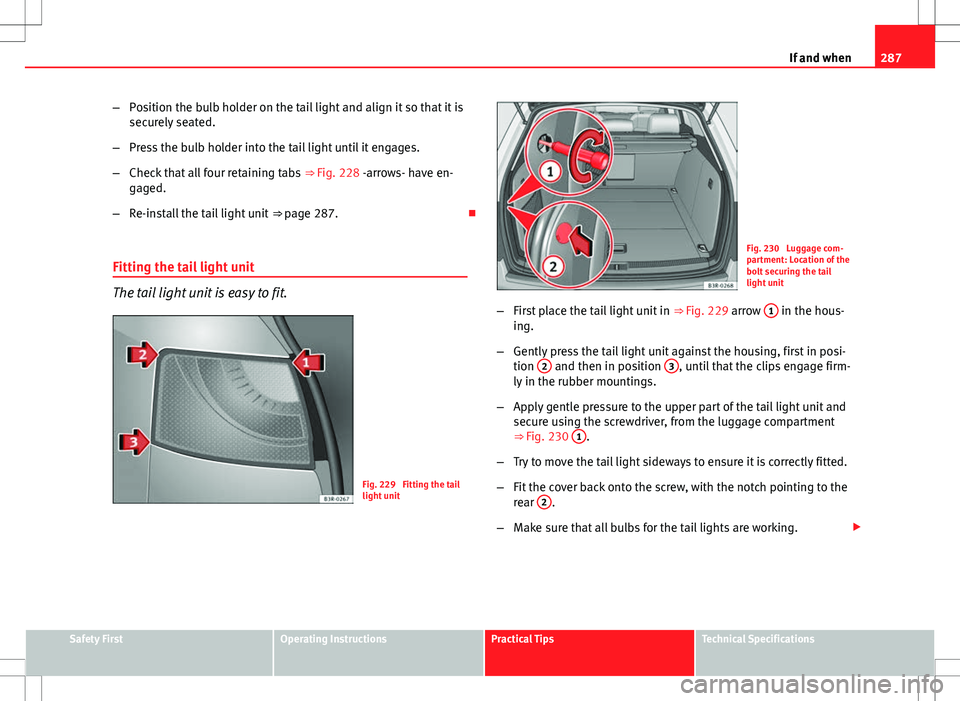
Fitting the tail light unit
The tail light unit is easy to fit.
Fig. 229 Fitting the tail
light unit
Fig. 230 Luggage com-
partment: Location of the
bolt securing the tail
light unit
– First place the tail light unit in ⇒ Fig. 229 arrow 1
in the hous-
ing.
– Gently press the tail light unit against the housing, first in posi-
tion 2
and then in position 3, until that the clips engage firm-
ly in the rubber mountings.
– Apply gentle pressure to the upper part of the tail light unit and
secure using the screwdriver, from the luggage compartment
⇒ Fig. 230 1
.
– Try to move the tail light sideways to ensure it is correctly fitted.
– Fit the cover back onto the screw, with the notch pointing to the
rear 2
.
– Make sure that all bulbs for the tail lights are working.
Safety FirstOperating InstructionsPractical TipsTechnical Specifications
Page 290 of 325
288If and when
CAUTION
Take care when fitting the tail light unit to make sure there is no damage to
the paintwork or any of its components.
Changing tail light bulbs (on rear lid)
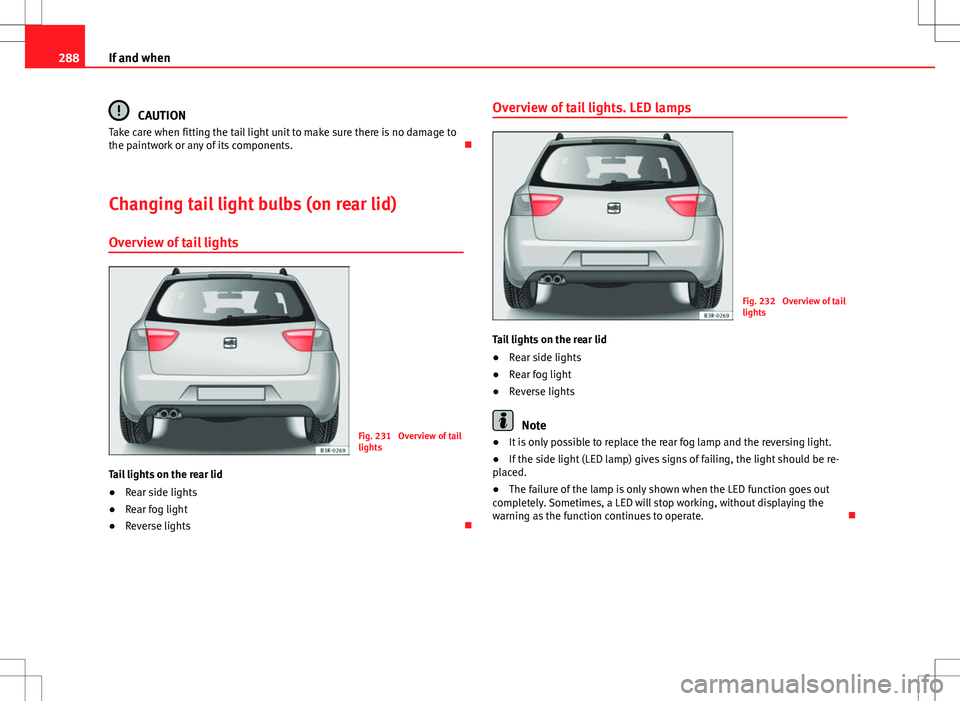
Overview of tail lights
Fig. 231 Overview of tail
lights
Tail lights on the rear lid
● Rear side lights
● Rear fog light
● Reverse lights Overview of tail lights. LED lamps
Fig. 232 Overview of tail
lights
Tail lights on the rear lid
● Rear side lights
● Rear fog light
● Reverse lights
Note
● It is only possible to replace the rear fog lamp and the reversing light.
● If the side light (LED lamp) gives signs of failing, the light should be re-
placed.
● The failure of the lamp is only shown when the LED function goes out
completely. Sometimes, a LED will stop working, without displaying the
warning as the function continues to operate.
Page 291 of 325
289
If and when
Remove the bulb holder
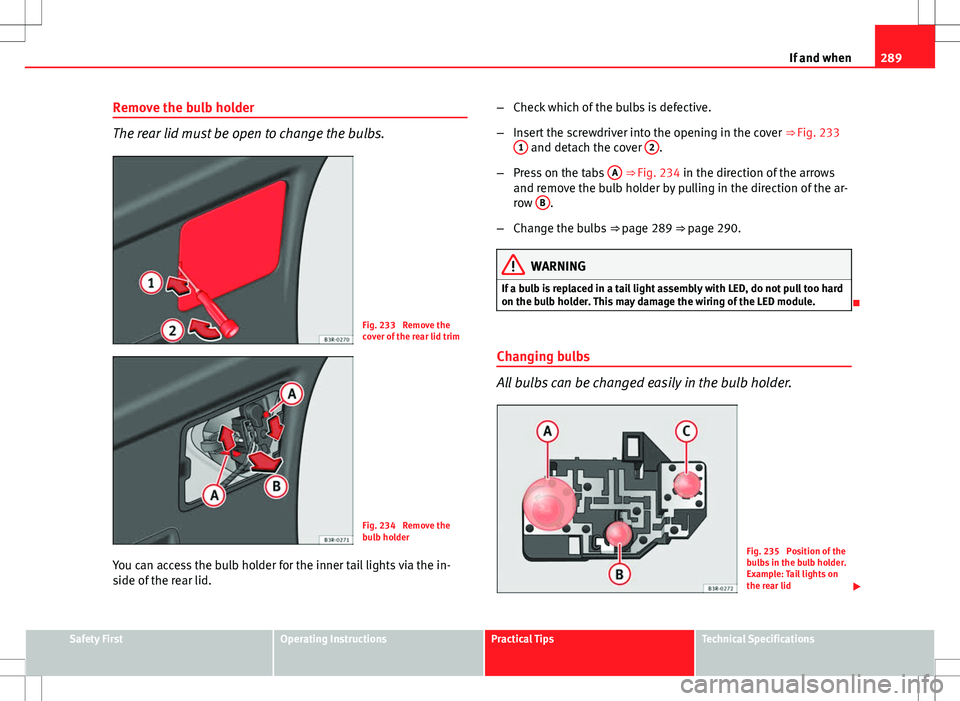
The rear lid must be open to change the bulbs.
Fig. 233 Remove the
cover of the rear lid trim
Fig. 234 Remove the
bulb holder
You can access the bulb holder for the inner tail lights via the in-
side of the rear lid. –
Check which of the bulbs is defective.
– Insert the screwdriver into the opening in the cover ⇒ Fig. 233
1
and detach the cover 2.
– Press on the tabs A
⇒ Fig. 234 in the direction of the arrows
and remove the bulb holder by pulling in the direction of the ar-
row B
.
– Change the bulbs ⇒ page 289 ⇒ page 290.
WARNING
If a bulb is replaced in a tail light assembly with LED, do not pull too hard
on the bulb holder. This may damage the wiring of the LED module.
Changing bulbs
All bulbs can be changed easily in the bulb holder.
Fig. 235 Position of the
bulbs in the bulb holder.
Example: Tail lights on
the rear lid
Safety FirstOperating InstructionsPractical TipsTechnical Specifications
Page 292 of 325
290If and when
The bulbs are secured with a bayonet fastener. The table below
gives an overview of the bulb positions.
–Lightly press the defective bulb into the bulb holder, then turn it
to the left and remove it.
– Fit the new bulb, pressing it into the bulb holder and turn it to
the right as far as it will go.
– Use a cloth to remove any fingerprints from the glass part of the
bulb.
– Check whether the new bulb is working.
– Re-install the bulb holder ⇒ page 291.
Position of the bulbs
Pos.
⇒ Fig. 235Bulb function
AReverse lightsP21W LLBRear side lightsW5W LLCRear fog lightH21W Changing bulbs. LED lamps
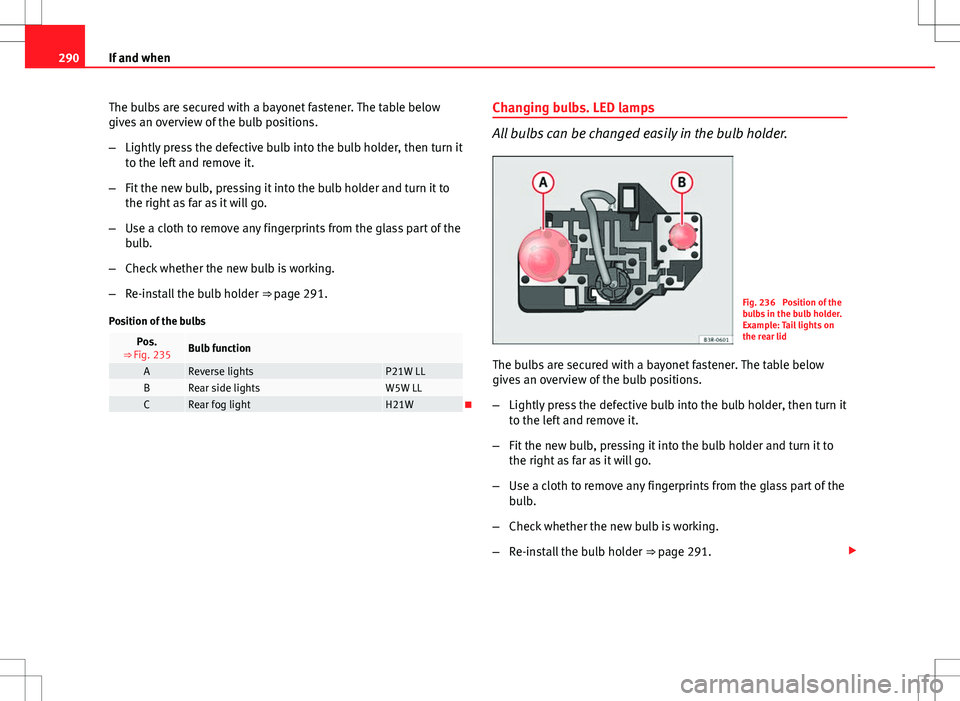
All bulbs can be changed easily in the bulb holder.
Fig. 236 Position of the
bulbs in the bulb holder.
Example: Tail lights on
the rear lid
The bulbs are secured with a bayonet fastener. The table below
gives an overview of the bulb positions.
– Lightly press the defective bulb into the bulb holder, then turn it
to the left and remove it.
– Fit the new bulb, pressing it into the bulb holder and turn it to
the right as far as it will go.
– Use a cloth to remove any fingerprints from the glass part of the
bulb.
– Check whether the new bulb is working.
– Re-install the bulb holder ⇒ page 291.
Page 293 of 325
291
If and when
Position of the bulbs
Pos.
⇒ Fig. 235Bulb function
AReverse lightsP21W LLBRear fog lightH21W
Fitting the bulb holder
The bulb holder is easy to fit. – Position the bulb holder on the tail light and align it so that it is
securely seated.
– Press the bulb holder into the tail light until it engages.
– Fit the cover back in the interior trim so that it engages.
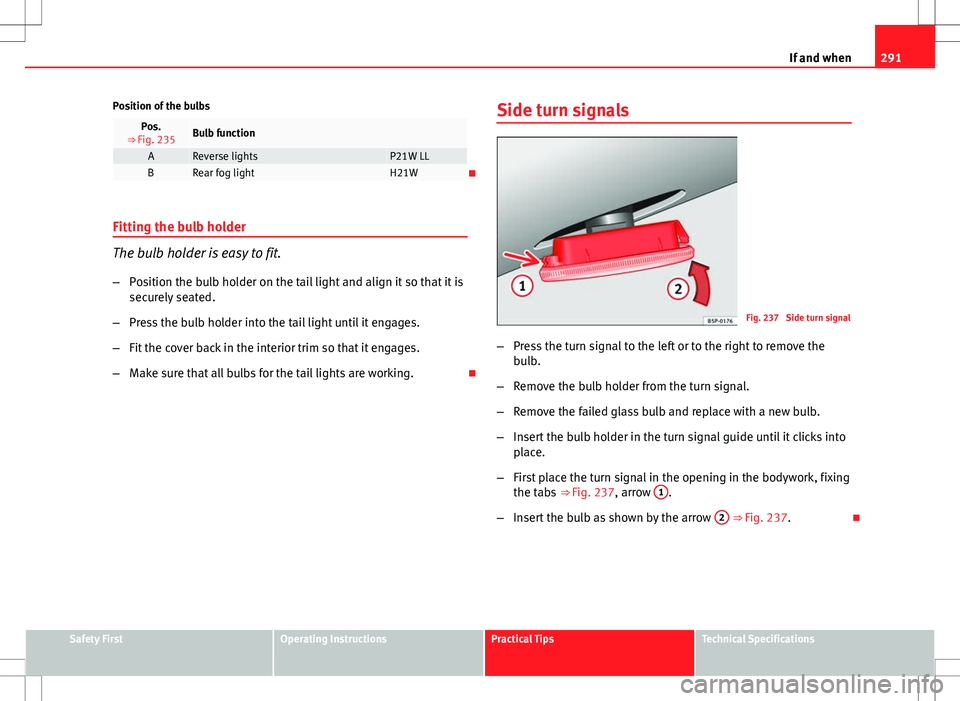
– Make sure that all bulbs for the tail lights are working. Side turn signals
Fig. 237 Side turn signal
– Press the turn signal to the left or to the right to remove the
bulb.
– Remove the bulb holder from the turn signal.
– Remove the failed glass bulb and replace with a new bulb.
– Insert the bulb holder in the turn signal guide until it clicks into
place.
– First place the turn signal in the opening in the bodywork, fixing
the tabs ⇒ Fig. 237, arrow 1
.
– Insert the bulb as shown by the arrow 2
⇒ Fig. 237.
Safety FirstOperating InstructionsPractical TipsTechnical Specifications
Page 294 of 325

292If and when
Luggage compartment lights
Fig. 238 Luggage com-
partment light
Fig. 239 Luggage com-
partment light
– Remove the tulip-shaped fitting by pressing on its inside edge
using the flat side of a screwdriver. –
Remove the protective cover and remove the bulb from the
housing.
Registration light
Fig. 240 Number plate
light
Fig. 241 Number plate
light
Page 297 of 325

295
If and when
– Connect one end of the red jump lead to the positive +
termi-
nal of the vehicle with the flat battery A ⇒ Fig. 245.
– Connect the other end of the red jump lead to the positive ter-
minal +
in the vehicle providing assistance B.
– Connect one end of the black jump lead X
to a suitable ground
terminal, a solid piece of metal in the engine block, or to the en-
gine block ⇒ Fig. 245.
– Connect the other end of the black jump lead X
to a solid met-
al component bolted to the engine block or to the engine block
itself of the vehicle with the flat battery. However, connect it to
a point as far as possible from the battery A
.
4. Position the leads in such a way that they cannot come into contact with any moving parts in the engine compartment.
Starting
5. Start the engine of the vehicle with the boosting battery and let it run at idling speed.
6. Start the engine of the vehicle with the flat battery and wait one or two minutes until the engine is running.
Removing the jump leads
7. Before you remove the jump leads, switch off the headlights (if they are switched on).
8. Turn on the heater blower and heated rear window in the vehi- cle with the flat battery. This helps minimise voltage peaks
which are generated when the leads are disconnected.
9. When the engine is running, disconnect the leads in reverse or- der to the details given above. Connect the battery clamps so they have good metal-to-metal contact with
the battery terminals.
If the engine fails to start, switch off the starter after about 10 seconds and
try again after about half a minute.
WARNING
● Please note the safety warnings referring to working in the engine
compartment ⇒ page 234.
● The battery providing assistance must have the same voltage as the
flat battery (12V) and approximately the same capacity (see imprint on
battery). Failure to comply could result in an explosion.
● Never use jump leads when one of the batteries is frozen. Danger of
explosion! Even after the battery has thawed, battery acid could leak and
cause chemical burns. If a battery freezes, it should be replaced.
● Keep sparks, flames and lighted cigarettes away from batteries, dan-
ger of explosion. Failure to comply could result in an explosion.
● Observe the instructions provided by the manufacturer of the jump
leads.
● Do not connect the negative cable from the other vehicle directly to
the negative terminal of the flat battery. The gas emitted from the battery
could be ignited by sparks. Danger of explosion.
● Do not attach the negative cable from the other vehicle to parts of the
fuel system or to the brake line.
● The non-insulated parts of the battery clamps must not be allowed to
touch. The jump lead attached to the positive battery terminal must not
touch metal parts of the vehicle, this can cause a short circuit.
● Position the leads in such a way that they cannot come into contact
with any moving parts in the engine compartment.
● Do not bend over the batteries. This could result in chemical burns.
Safety FirstOperating InstructionsPractical TipsTechnical Specifications
Page 300 of 325
298If and when
Do not pull too hard with the towing vehicle and take care to avoid jerking
the tow rope. When towing on an unpaved road, there is always a risk of
overloading and damaging the anchorage points.
The ignition of the vehicle being towed must be switched on to prevent the
steering wheel from locking and also to allow the use of the turn signals,
horn, windscreen wipers and washers.
As the brake servo does not work if the engine is not running, you must ap-
ply considerably more pressure to the brake pedal than you normally would.
As the power assisted steering does not work if the engine is not running,
you will need more strength to steer than you normally would.
Towing vehicles with an automatic gearbox
● Put the selector lever into position “N”.
● Do not drive faster than 50 km/h.
● Do not tow further than 50 km.
● If a breakdown vehicle is used, the vehicle must be towed with the front
wheels raised.
Note
● Observe legal requirements when towing or tow-starting.
● Switch on the hazard warning lights of both vehicles. However, observe
any regulations to the contrary.
● For technical reasons, vehicles with an automatic gearbox must not be
tow-started.
● If damage to your vehicle means that there is no lubricant in the gear-
box, you must raise the drive wheels while the vehicle is being towed.
● If the vehicle has to be towed more than 50 km, the front wheels should
be raised during towing, and towing should be carried out by a qualified
person. ●
The steering wheel is locked when the vehicle has no electrical power.
The vehicle must then be towed with the front wheels raised. Towing should
be carried out by a qualified person.
● The towing eye should always be kept in the vehicle. Please refer to the
notes ⇒ page 297, Tow-starting.
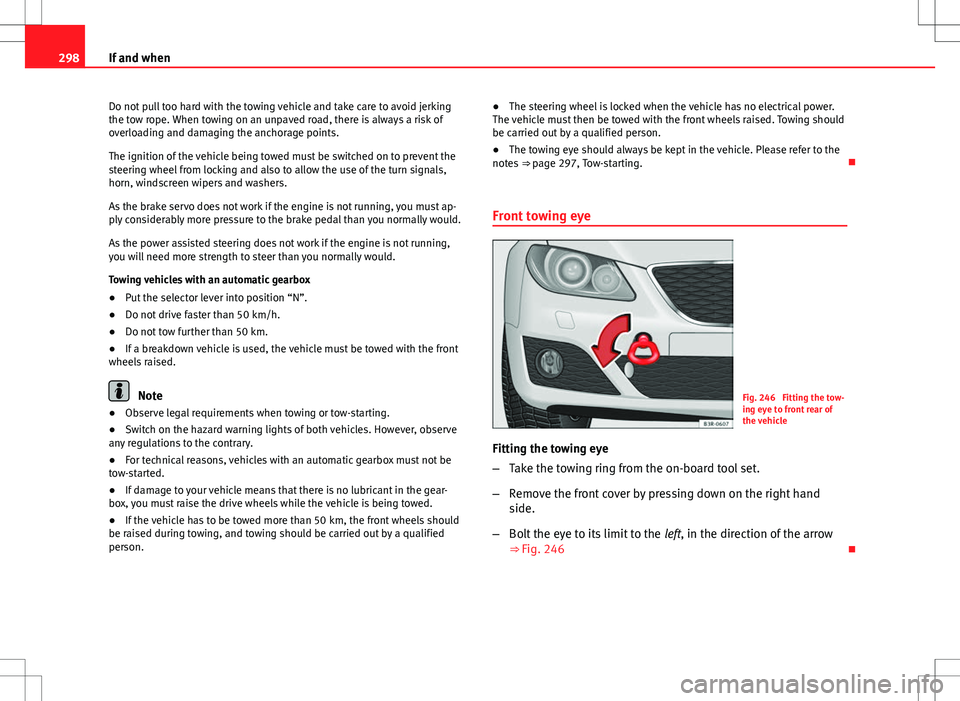
Front towing eyeFig. 246 Fitting the tow-
ing eye to front rear of
the vehicle
Fitting the towing eye
– Take the towing ring from the on-board tool set.
– Remove the front cover by pressing down on the right hand
side.
– Bolt the eye to its limit to the left, in the direction of the arrow
⇒ Fig. 246
Page 315 of 325
Index
Numbers and Symbols
230 V socket . . . . . . . . . . . . . . . . . . . . . . . . . . . 157
A
Accessories . . . . . . . . . . . . . . . . . . . . . . . . . . . . 228 Towing . . . . . . . . . . . . . . . . . . . . . . . . . . . . . 208
Adaptive headlights . . . . . . . . . . . . . . . . . . . . . 123 Faulty . . . . . . . . . . . . . . . . . . . . . . . . . . . . . . . 84
Airbag Warning lamp . . . . . . . . . . . . . . . . . . . . . . . . 68
Airbag covers . . . . . . . . . . . . . . . . . . . . . . . . . . . 35
Airbag system . . . . . . . . . . . . . . . . . . . . . . . . . . . 29 Curtain airbags . . . . . . . . . . . . . . . . . . . . . . . 42
Front airbags . . . . . . . . . . . . . . . . . . . . . . . . 33
Side airbags . . . . . . . . . . . . . . . . . . . . . . . . . 39
Warning lamp . . . . . . . . . . . . . . . . . . . . . . . . 31
Air conditioner 2C-Climatronic . . . . . . . . . . . . . . . . . . . . . . 162
Air distribution . . . . . . . . . . . . . . . . . . . . . . 169
Air outlets . . . . . . . . . . . . . . . . . . . . . . . . . . 169
Air purity sensor . . . . . . . . . . . . . . . . . . . . . 167
Air recirculation . . . . . . . . . . . . . . . . . . . . . 166
Air recirculation (automatic) . . . . . . . . . . . 167
Automatic mode . . . . . . . . . . . . . . . . . . . . . 165
Blower . . . . . . . . . . . . . . . . . . . . . . . . . . . . . 168
Controls . . . . . . . . . . . . . . . . . . . . . . . . . . . . 164
Defrosting . . . . . . . . . . . . . . . . . . . . . . . . . . 166
ECON Mode (economy) . . . . . . . . . . . . . . . 166 Economical use . . . . . . . . . . . . . . . . . . . . . 170
Key settings . . . . . . . . . . . . . . . . . . . . . . . . 170
Solar-powered blower/sunroof . . . . . . . . . 170
Temperature selection . . . . . . . . . . . . . . . . 165
Air duct Fitting . . . . . . . . . . . . . . . . . . . . . . . . . 274, 281
Removing . . . . . . . . . . . . . . . . . . . . . . 274, 280
Air purity sensor . . . . . . . . . . . . . . . . . . . . . . . . 167
Alcantara . . . . . . . . . . . . . . . . . . . . . . . . . . . . . . 224
Alternator Warning lamp . . . . . . . . . . . . . . . . . . . . . . . . 72
Ambient lighting . . . . . . . . . . . . . . . . . . . . . . . 126
Anti-lock brake system How it works . . . . . . . . . . . . . . . . . . . . . . . . 196
Anti-theft alarm system . . . . . . . . . . . . . . . . . . 110 Interior monitoring . . . . . . . . . . . . . . . . . . . 111
Antifreeze . . . . . . . . . . . . . . . . . . . . . . . . . . . . . 238
Aquaplaning . . . . . . . . . . . . . . . . . . . . . . . . . . . 254
Armrest Storage compartment in front armrest . . . 143
Armrests Adjusting the front armrest . . . . . . . . . . . . 143
Ashtray Front . . . . . . . . . . . . . . . . . . . . . . . . . . . . . . 154
Rear . . . . . . . . . . . . . . . . . . . . . . . . . . . . . . . 155
ASR How the system works . . . . . . . . . . . . . . . . 197
Warning lamp . . . . . . . . . . . . . . . . . . . . . . . . 71
Athermic windscreen . . . . . . . . . . . . . . . . . . . . 229 Auto-check system . . . . . . . . . . . . . . . . . . . . . . . 78
Automatic car wash tunnel . . . . . . . . . . . . . . . 217
Automatic gearbox
Dynamic gear control programme . . . . . . . 191
Kick-down feature . . . . . . . . . . . . . . . . . . . . 191
multitronic® . . . . . . . . . . . . . . . . . . . . . . . . 187
Paddle levers (tiptronic mode) . . . . . . . . . 193
Safety interlock for ignition key . . . . . . . . . 173
Selector lever lock . . . . . . . . . . . . . . . . . . . 190
Selector lever positions . . . . . . . . . . . . . . . 189
Steering wheel with paddle levers . . . . . . 193
tiptronic . . . . . . . . . . . . . . . . . . . . . . . . . . . 187
tiptronic mode . . . . . . . . . . . . . . . . . . . . . . 192
Automatic headlight control . . . . . . . . . . . . . . 117
Auxiliary heater . . . . . . . . . . . . . . . . . . . . . . . . 171
B
Battery . . . . . . . . . . . . . . . . . . . . . . . . . . . . . . . . 245 Battery voltage . . . . . . . . . . . . . . . . . . . . . . . 84
Charging . . . . . . . . . . . . . . . . . . . . . . . . . . . 247
Disconnection . . . . . . . . . . . . . . . . . . . . . . . 246
Long periods of non-use . . . . . . . . . . 245, 246
Replacing . . . . . . . . . . . . . . . . . . . . . . 245, 246
Testing . . . . . . . . . . . . . . . . . . . . . . . . . . . . 245
Winter operation . . . . . . . . . . . . . . . . 245, 246
Bicycle rack Towing . . . . . . . . . . . . . . . . . . . . . . . . . . . . . 208
Biodiesel . . . . . . . . . . . . . . . . . . . . . . . . . . . . . . 232
Biodiesel fuel . . . . . . . . . . . . . . . . . . . . . . . . . . 232
313
Index
Page 316 of 325
Bonnet . . . . . . . . . . . . . . . . . . . . . . . . . . . . . . . 233Closing . . . . . . . . . . . . . . . . . . . . . . . . . . . . 235
Opening . . . . . . . . . . . . . . . . . . . . . . . . . . . 234
Releasing . . . . . . . . . . . . . . . . . . . . . . . . . . 233
Brake light Failure control . . . . . . . . . . . . . . . . . . . . . . . . 83
Brake pads . . . . . . . . . . . . . . . . . . . . . . . . . . . . 201
Brakes . . . . . . . . . . . . . . . . . . . . . . . . . . . . . . . . 201 Brake assist system . . . . . . . . . . . . . . . . . . 196
Brake fluid . . . . . . . . . . . . . . . . . . . . . . . . . 244
Worn brake pads . . . . . . . . . . . . . . . . . . . . . 84
Brake servo . . . . . . . . . . . . . . . . . . . . . . . . . . . . 201
Brake system Brakes . . . . . . . . . . . . . . . . . . . . . . . . . . . . . 198
Brake servo . . . . . . . . . . . . . . . . . . . . . . . . . 198
Malfunction . . . . . . . . . . . . . . . . . . . . . . . . . 80
Braking distance . . . . . . . . . . . . . . . . . . . . . . . 201
Bulb change general notes . . . . . . . . . . . . . . . . . . . . . . . 272
C
Car care Exterior . . . . . . . . . . . . . . . . . . . . . . . . . . . . 217
Catalytic converter . . . . . . . . . . . . . . . . . . . . . . 202
CCS . . . . . . . . . . . . . . . . . . . . . . . . . . . . . . . . . . 183
CD-ROM player . . . . . . . . . . . . . . . . . . . . . . . . . 150
Central locking . . . . . . . . . . . . . . . . . . . . . . . . . 101 Manual locking . . . . . . . . . . . . . . . . . . . . . . 105
Sunroof: opening and closing . . . . . . . . . . 116 Central locking system
Anti-theft security system . . . . . . . . . . . . . 103
Locking . . . . . . . . . . . . . . . . . . . . . . . . . . . . 102
Locking and unlocking the vehicle from in-side . . . . . . . . . . . . . . . . . . . . . . . . . . . . . 103
Opening and closing the windows . . . . . . 114
Rear lid . . . . . . . . . . . . . . . . . . . . . . . . . . . . 106
Security central locking . . . . . . . . . . . . . . . 104
Switch on the driver door . . . . . . . . . . . . . . 103
Unlocking . . . . . . . . . . . . . . . . . . . . . . . . . . 102
Cetane number . . . . . . . . . . . . . . . . . . . . . . . . . 232
Changing the main headlight bulb Main headlight . . . . . . . . . . . . . . . . . . . . . . 276
Changing the main headlight bulbs Dipped beam headlight . . . . . . . . . . . . . . . 277
Changing the tail lights Luggage compartment lights . . . . . . . . . . 292
Changing windscreen wiper blades . . . . . . . . 242
Chassis number . . . . . . . . . . . . . . . . . . . . . . . . 301
Checklist Seat upholstery . . . . . . . . . . . . . . . . . . . . . 223
Childproof lock Rear doors . . . . . . . . . . . . . . . . . . . . . . . . . . 107
Child safety . . . . . . . . . . . . . . . . . . . . . . . . . . . . . 47
Child safety seat ISOFIX system . . . . . . . . . . . . . . . . . . . . . . . . 53
Child seat . . . . . . . . . . . . . . . . . . . . . . . . . . . . . . 49 Categorisation in groups . . . . . . . . . . . . . . . 49
Group 1 . . . . . . . . . . . . . . . . . . . . . . . . . . . . . 50
Group 2 . . . . . . . . . . . . . . . . . . . . . . . . . . . . . 50
Group 3 . . . . . . . . . . . . . . . . . . . . . . . . . . . . . 50
Groups 0 and 0+ . . . . . . . . . . . . . . . . . . . . . . 49 Safety notes . . . . . . . . . . . . . . . . . . . . . . . . . 47
Securing . . . . . . . . . . . . . . . . . . . . . . . . . . . . 52
Child seats on the front passenger seat . . . . . . . . . . . . . 30
Cigarette lighter . . . . . . . . . . . . . . . . . . . . . . . . 155
Cleaning alloy wheel rims . . . . . . . . . . . . . . . . 221
Cleaning chrome . . . . . . . . . . . . . . . . . . . . . . . 220
Cleaning engine compartment . . . . . . . . . . . . 222
Cleaning steel wheel rims . . . . . . . . . . . . . . . . 220
Cleaning windows . . . . . . . . . . . . . . . . . . . . . . 219
Clock, setting . . . . . . . . . . . . . . . . . . . . . . . . . . . 63
Coat hooks . . . . . . . . . . . . . . . . . . . . . . . . . . . . 160
Cockpit . . . . . . . . . . . . . . . . . . . . . . . . . . . . . . . . 59 Overview . . . . . . . . . . . . . . . . . . . . . . . . . . . . 59
Compartments . . . . . . . . . . . . . . . . . . . . . . . . . 159 In the door trim . . . . . . . . . . . . . . . . . . . . . . 160
In the front seats . . . . . . . . . . . . . . . . . . . . 161
Coolant Checking the level . . . . . . . . . . . . . . . . . . . 239
Coolant fluid Topping up . . . . . . . . . . . . . . . . . . . . . . . . . 240
Cooling system Coolant temperature gauge . . . . . . . . . . . . . 62
Malfunction . . . . . . . . . . . . . . . . . . . . . . . . . 81
Correct adjustment of front seat head re- straints . . . . . . . . . . . . . . . . . . . . . . . . . . . . . . . 13
Correct adjustment of rear seat head restraints In-use and non-use positions . . . . . . . . . . . 14
Correct sitting position Front passenger . . . . . . . . . . . . . . . . . . . . . . 12
Incorrect sitting position . . . . . . . . . . . . . . . 14
314 Index