warning light Seat Exeo ST 2013 Owners Manual
[x] Cancel search | Manufacturer: SEAT, Model Year: 2013, Model line: Exeo ST, Model: Seat Exeo ST 2013Pages: 327, PDF Size: 5.07 MB
Page 287 of 327
285
If and when
Changing tail light bulbs (on side panel)
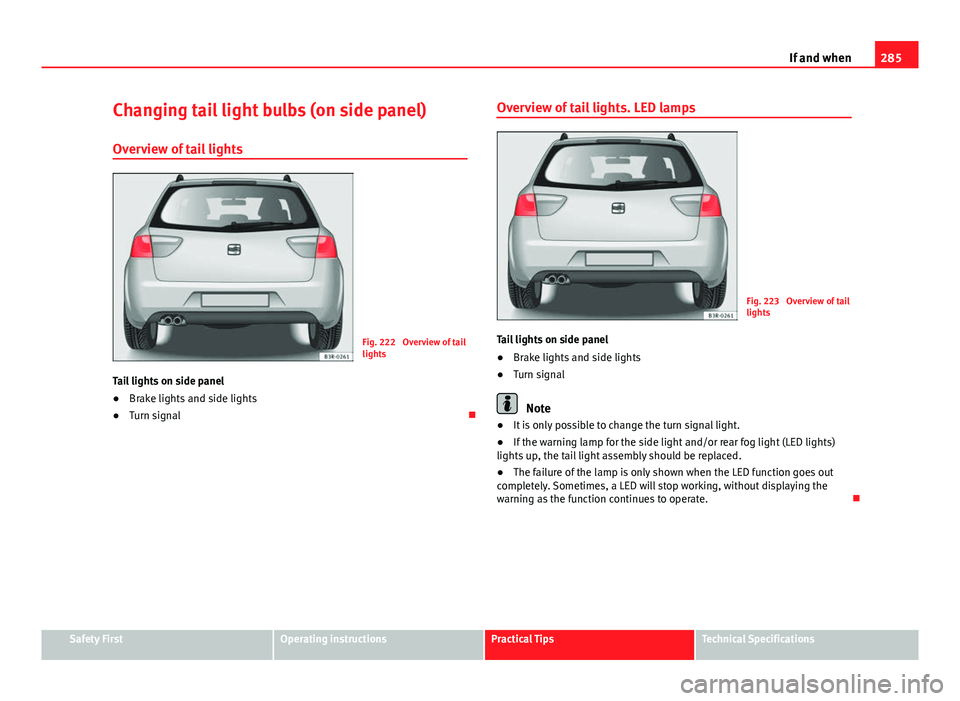
Overview of tail lights
Fig. 222 Overview of tail
lights
Tail lights on side panel
● Brake lights and side lights
● Turn signal Overview of tail lights. LED lamps
Fig. 223 Overview of tail
lights
Tail lights on side panel
● Brake lights and side lights
● Turn signal
Note
● It is only possible to change the turn signal light.
● If the warning lamp for the side light and/or rear fog light (LED lights)
lights up, the tail light assembly should be replaced.
● The failure of the lamp is only shown when the LED function goes out
completely. Sometimes, a LED will stop working, without displaying the
warning as the function continues to operate.
Safety FirstOperating instructionsPractical TipsTechnical Specifications
Page 289 of 327
287
If and when
Remove the bulb holder
When changing a bulb, you must first remove the bulb hold-
er.
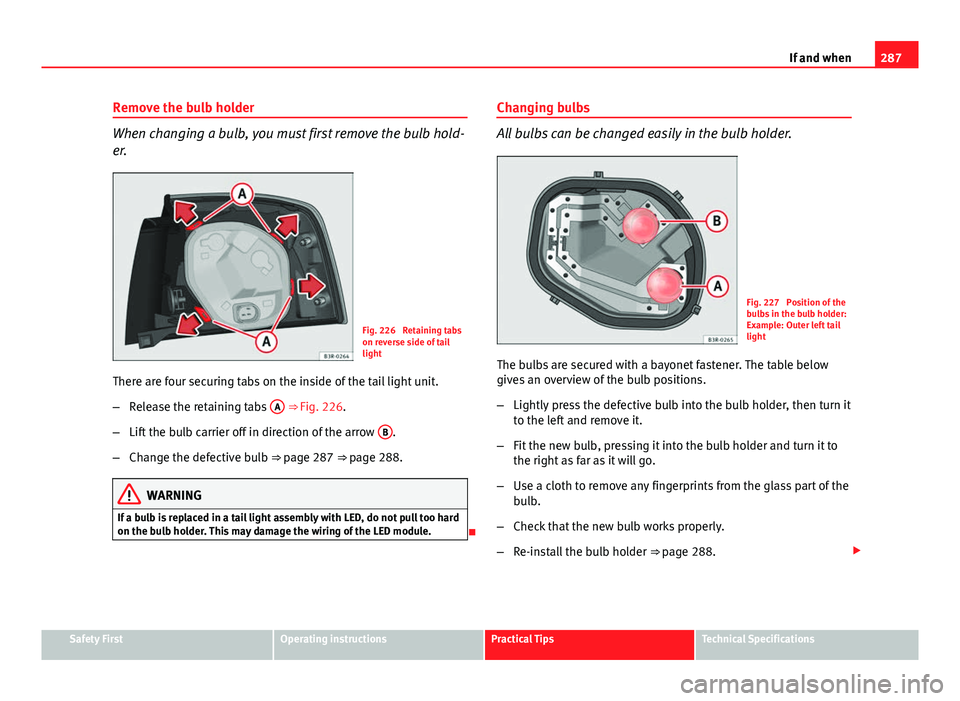
Fig. 226 Retaining tabs
on reverse side of tail
light
There are four securing tabs on the inside of the tail light unit.
– Release the retaining tabs A
⇒ Fig. 226.
– Lift the bulb carrier off in direction of the arrow B
.
– Change the defective bulb ⇒ page 287 ⇒ page 288.
WARNING
If a bulb is replaced in a tail light assembly with LED, do not pull too hard
on the bulb holder. This may damage the wiring of the LED module.
Changing bulbs
All bulbs can be changed easily in the bulb holder.
Fig. 227 Position of the
bulbs in the bulb holder:
Example: Outer left tail
light
The bulbs are secured with a bayonet fastener. The table below
gives an overview of the bulb positions.
– Lightly press the defective bulb into the bulb holder, then turn it
to the left and remove it.
– Fit the new bulb, pressing it into the bulb holder and turn it to
the right as far as it will go.
– Use a cloth to remove any fingerprints from the glass part of the
bulb.
– Check that the new bulb works properly.
– Re-install the bulb holder ⇒ page 288.
Safety FirstOperating instructionsPractical TipsTechnical Specifications
Page 292 of 327
290If and when
CAUTION
Take care when fitting the tail light unit to make sure there is no damage to
the paintwork or any of its components.
Changing tail light bulbs (on rear lid)
Overview of tail lights
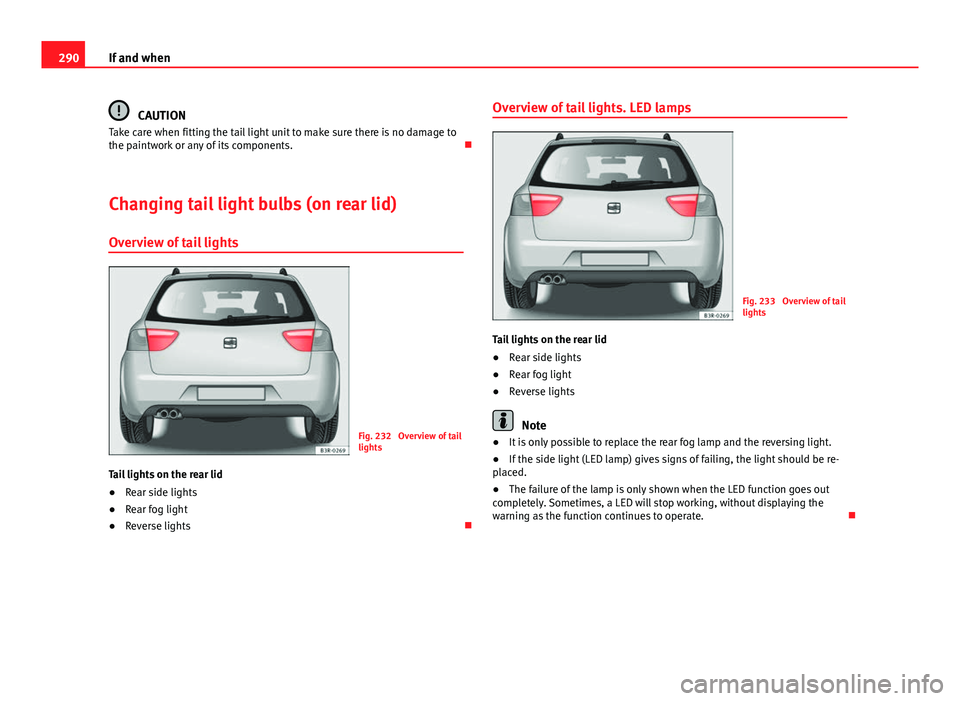
Fig. 232 Overview of tail
lights
Tail lights on the rear lid
● Rear side lights
● Rear fog light
● Reverse lights Overview of tail lights. LED lamps
Fig. 233 Overview of tail
lights
Tail lights on the rear lid
● Rear side lights
● Rear fog light
● Reverse lights
Note
● It is only possible to replace the rear fog lamp and the reversing light.
● If the side light (LED lamp) gives signs of failing, the light should be re-
placed.
● The failure of the lamp is only shown when the LED function goes out
completely. Sometimes, a LED will stop working, without displaying the
warning as the function continues to operate.
Page 293 of 327
291
If and when
Remove the bulb holder
The rear lid must be open to change the bulbs.
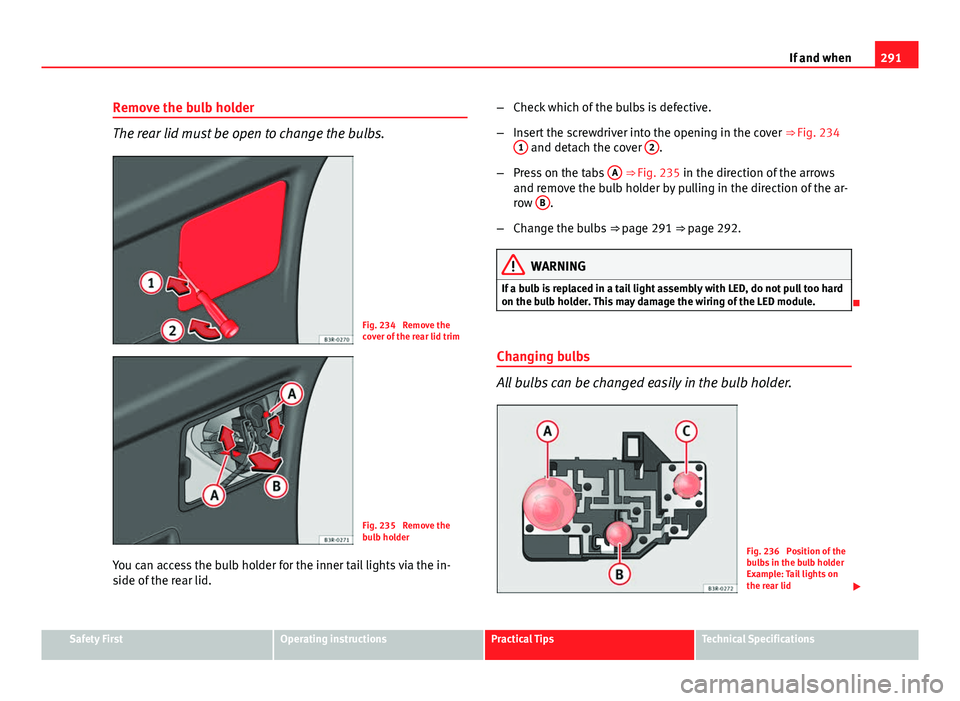
Fig. 234 Remove the
cover of the rear lid trim
Fig. 235 Remove the
bulb holder
You can access the bulb holder for the inner tail lights via the in-
side of the rear lid. –
Check which of the bulbs is defective.
– Insert the screwdriver into the opening in the cover ⇒ Fig. 234
1
and detach the cover 2.
– Press on the tabs A
⇒ Fig. 235 in the direction of the arrows
and remove the bulb holder by pulling in the direction of the ar-
row B
.
– Change the bulbs ⇒ page 291 ⇒ page 292.
WARNING
If a bulb is replaced in a tail light assembly with LED, do not pull too hard
on the bulb holder. This may damage the wiring of the LED module.
Changing bulbs
All bulbs can be changed easily in the bulb holder.
Fig. 236 Position of the
bulbs in the bulb holder
Example: Tail lights on
the rear lid
Safety FirstOperating instructionsPractical TipsTechnical Specifications
Page 299 of 327
297
If and when
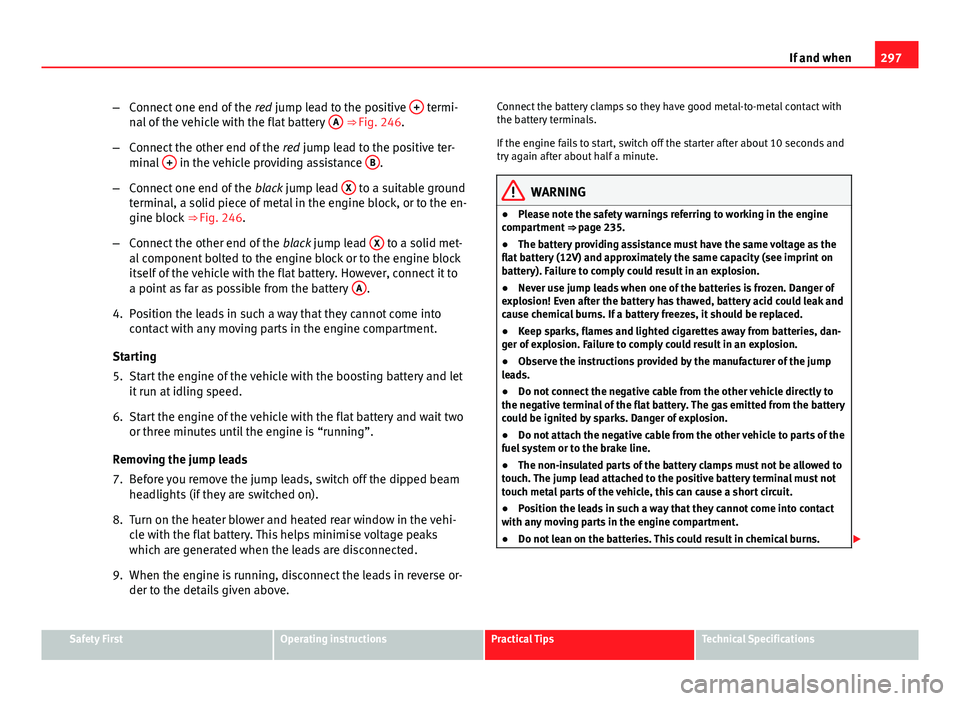
– Connect one end of the red jump lead to the positive +
termi-
nal of the vehicle with the flat battery A ⇒ Fig. 246.
– Connect the other end of the red jump lead to the positive ter-
minal +
in the vehicle providing assistance B.
– Connect one end of the black jump lead X
to a suitable ground
terminal, a solid piece of metal in the engine block, or to the en-
gine block ⇒ Fig. 246.
– Connect the other end of the black jump lead X
to a solid met-
al component bolted to the engine block or to the engine block
itself of the vehicle with the flat battery. However, connect it to
a point as far as possible from the battery A
.
4. Position the leads in such a way that they cannot come into contact with any moving parts in the engine compartment.
Starting
5. Start the engine of the vehicle with the boosting battery and let it run at idling speed.
6. Start the engine of the vehicle with the flat battery and wait two or three minutes until the engine is “running”.
Removing the jump leads
7. Before you remove the jump leads, switch off the dipped beam headlights (if they are switched on).
8. Turn on the heater blower and heated rear window in the vehi- cle with the flat battery. This helps minimise voltage peaks
which are generated when the leads are disconnected.
9. When the engine is running, disconnect the leads in reverse or- der to the details given above. Connect the battery clamps so they have good metal-to-metal contact with
the battery terminals.
If the engine fails to start, switch off the starter after about 10 seconds and
try again after about half a minute.
WARNING
● Please note the safety warnings referring to working in the engine
compartment ⇒ page 235.
● The battery providing assistance must have the same voltage as the
flat battery (12V) and approximately the same capacity (see imprint on
battery). Failure to comply could result in an explosion.
● Never use jump leads when one of the batteries is frozen. Danger of
explosion! Even after the battery has thawed, battery acid could leak and
cause chemical burns. If a battery freezes, it should be replaced.
● Keep sparks, flames and lighted cigarettes away from batteries, dan-
ger of explosion. Failure to comply could result in an explosion.
● Observe the instructions provided by the manufacturer of the jump
leads.
● Do not connect the negative cable from the other vehicle directly to
the negative terminal of the flat battery. The gas emitted from the battery
could be ignited by sparks. Danger of explosion.
● Do not attach the negative cable from the other vehicle to parts of the
fuel system or to the brake line.
● The non-insulated parts of the battery clamps must not be allowed to
touch. The jump lead attached to the positive battery terminal must not
touch metal parts of the vehicle, this can cause a short circuit.
● Position the leads in such a way that they cannot come into contact
with any moving parts in the engine compartment.
● Do not lean on the batteries. This could result in chemical burns.
Safety FirstOperating instructionsPractical TipsTechnical Specifications
Page 301 of 327
299
If and when
Towing and tow-starting
Tow-starting
The use of jump leads is preferable to tow-starting.
We recommend that you do not tow-start your vehicle. Jump-start-
ing is preferable ⇒ page 295.
However, if your vehicle has to be tow-started:
– Engage the 2nd or the 3rd gear.
– Keep the clutch pressed down.
– Switch the ignition on.
– Once both vehicles are moving, release the clutch.
– As soon as the engine starts, press the clutch and move the
gear lever into neutral. This helps to prevent driving into the
towing vehicle.
WARNING
The risk of accidents is high when tow-starting. The vehicle being towed
can easily collide with the towing vehicle.
CAUTION
When tow-starting, fuel could enter the catalytic converter and damage it. General notes
Please observe the following points if you use a tow rope:
Notes for the driver of the towing vehicle
–
Drive slowly at first until the tow rope is taut. Then accelerate
gradually.
– Begin and change gears cautiously. If you are driving an auto-
matic vehicle, accelerate gently.
– Remember that the brake servo and power steering are not
working in the vehicle you are towing. Brake sooner than nor-
mal and pressing the pedal gently.
Notes for the driver of the towed vehicle
– Ensure that the tow rope remains taut at all times when towing.
Tow rope or tow bar
It is easier and safer to tow a vehicle with a tow bar. You should only use a
tow rope if you do not have a tow bar.
A tow rope should be slightly elastic to reduce the loading on both vehicles.
It is advisable to use a tow rope made of synthetic fibre or similarly elastic
material.
Attach the tow rope or the tow bar only to the towline anchorages provided
or a towing bracket.
Driving style
Towing requires some experience, especially when using a tow rope. Both
drivers should be familiar with the technique required for towing. Inexper-
ienced drivers should not attempt to tow.
Safety FirstOperating instructionsPractical TipsTechnical Specifications
Page 302 of 327
300If and when
Do not pull too hard with the towing vehicle and take care to avoid jerking
the tow rope. When towing on an unpaved road, there is always a risk of
overloading and damaging the anchorage points.
The ignition of the vehicle being towed must be switched on to prevent the
steering wheel from locking and also to allow the use of the turn signals,
horn, windscreen wipers and washers.
As the brake servo does not work if the engine is not running, you must ap-
ply considerably more pressure to the brake pedal than you normally would.
As the power assisted steering does not work if the engine is not running,
you will need more strength to steer than you normally would.
Towing vehicles with an automatic gearbox
● Put the selector lever into position “N”.
● Do not drive faster than 50 km/h (30 mph).
● Do not tow further than 50 km.
● If a breakdown vehicle is used, the vehicle must be towed with the front
wheels raised.
Note
● Observe legal requirements when towing or tow-starting.
● Switch on the hazard warning lights of both vehicles. However, observe
any regulations to the contrary.
● For technical reasons, vehicles with an automatic gearbox must not be
tow-started.
● If damage to your vehicle means that there is no lubricant in the gear-
box, you must raise the driven wheels while the vehicle is being towed.
● If the vehicle has to be towed more than 50 km (30 miles), the front
wheels should be raised during towing, and towing should be carried out by
a qualified person. ●
The steering wheel is locked when the vehicle has no electrical power.
The vehicle must then be towed with the front wheels raised. Towing should
be carried out by a qualified person.
● The towline anchorage should always be kept in the vehicle. Please refer
to the notes ⇒ page 299, Tow-starting.
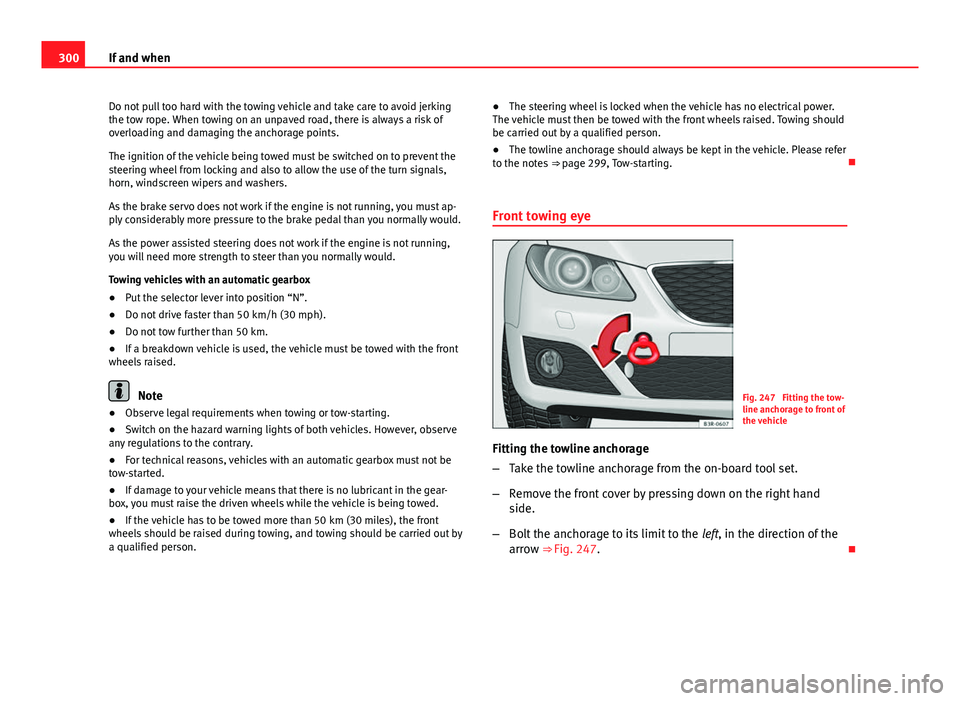
Front towing eyeFig. 247 Fitting the tow-
line anchorage to front of
the vehicle
Fitting the towline anchorage
– Take the towline anchorage from the on-board tool set.
– Remove the front cover by pressing down on the right hand
side.
– Bolt the anchorage to its limit to the left, in the direction of the
arrow ⇒ Fig. 247.
Page 307 of 327
305
Description of specifications
Towing a trailer Trailer weights
Trailer weight
The trailer weights and drawbar loads approved are selected in intensive tri-
als according to precisely defined criteria. The approved trailer weights are
valid for vehicles in the EU for maximum speeds of 80 km/h (50 mph) (in
certain circumstances up to 100 km/h (60 mph). The figures may be differ-
ent in other countries. All data in the official vehicle documentation takes
precedence over these data at all times ⇒
.
Drawbar loads
The maximum permitted drawbar load on the ball joint of the towing bracket
must not exceed 75 kg.
In the interest of road safety, we recommend that you always tow approach-
ing the maximum drawbar load. The response of the trailer on the road will
be poor if the drawbar load is too small.
If the maximum permissible drawbar load cannot be met (e.g. with small,
empty and light-weight single axle trailers or tandem axle trailers with a
wheelbase of less than 1 metre), a minimum of 4% of the actual trailer
weight is legally required for the drawbar load.
WARNING
● For safety reasons, do not exceed the 80 km/h (50 mph) limit. This is
also valid in countries where higher speeds are permitted.
● Never exceed the maximum trailer weights or the drawbar load. If the
permissible axle load or the permissible total weight is exceeded, the
driving characteristics of the vehicle may change, leading to accidents,
injuries and damage to the vehicle.
Wheels
Tyre pressure, snow chains, wheel bolts
Tyre pressures
The sticker with the tyre pressure values can be found on the inside of the
fuel tank flap. The tyre pressure values given there are for cold tyres. The
slightly raised pressures of warm tyres must not be reduced. ⇒
Snow chains
Snow chains may be fitted only to the front wheels.
Consult the section “wheels” of this manual.
Wheel bolts
After the wheels have been changed, the tightening torque of the wheel
bolts should be checked as soon as possible with a torque wrench ⇒
.
The tightening torque for steel and alloy wheels is 120 Nm.
WARNING
● Check the tyre pressure at least once per month. Checking the tyre
pressure is very important. If the tyre pressure is too high or too low,
there is an increased danger of accidents, particularly at high speeds.
● If the tightening torque of the wheel bolts is too low, they could loos-
en while the vehicle is in motion. Risk of accident! If the tightening tor-
que is too high, the wheel bolts and threads can be damaged.
Note
We recommend that you ask your Technical Service for information about
appropriate wheel, tyre and snow chain size.
Safety FirstOperating instructionsPractical TipsTechnical Specifications
Page 317 of 327
Index
Numbers and Symbols
230 V socket . . . . . . . . . . . . . . . . . . . . . . . . . . . 158
A
Accessories . . . . . . . . . . . . . . . . . . . . . . . . . . . . 230 Towing . . . . . . . . . . . . . . . . . . . . . . . . . . . . . 210
Adaptive headlights . . . . . . . . . . . . . . . . . . . . . 123 Faulty . . . . . . . . . . . . . . . . . . . . . . . . . . . . . . . 84
Airbag Warning lamp . . . . . . . . . . . . . . . . . . . . . . . . 68
Airbag covers . . . . . . . . . . . . . . . . . . . . . . . . . . . 35
Airbag system . . . . . . . . . . . . . . . . . . . . . . . . . . . 29 control lamp . . . . . . . . . . . . . . . . . . . . . . . . . 31
Curtain airbags . . . . . . . . . . . . . . . . . . . . . . . 42
Front airbags . . . . . . . . . . . . . . . . . . . . . . . . 33
side airbags . . . . . . . . . . . . . . . . . . . . . . . . . 39
Air conditioner 2C-Climatronic . . . . . . . . . . . . . . . . . . . . . . 163
Air distribution . . . . . . . . . . . . . . . . . . . . . . 170
Air outlets . . . . . . . . . . . . . . . . . . . . . . . . . . 170
Air purity sensor . . . . . . . . . . . . . . . . . . . . . 168
Air recirculation . . . . . . . . . . . . . . . . . . . . . 167
Air recirculation (automatic) . . . . . . . . . . . 168
Automatic mode . . . . . . . . . . . . . . . . . . . . . 166
Blower . . . . . . . . . . . . . . . . . . . . . . . . . . . . . 169
Controls . . . . . . . . . . . . . . . . . . . . . . . . . . . . 165
Defrosting . . . . . . . . . . . . . . . . . . . . . . . . . . 167
ECON Mode (economy) . . . . . . . . . . . . . . . 167 Economical use . . . . . . . . . . . . . . . . . . . . . 171
Key settings . . . . . . . . . . . . . . . . . . . . . . . . 171
Solar-powered blower/sunroof . . . . . . . . . 171
Temperature selection . . . . . . . . . . . . . . . . 166
Air duct Fitting . . . . . . . . . . . . . . . . . . . . . . . . . 276, 283
Removing . . . . . . . . . . . . . . . . . . . . . . 276, 282
Air purity sensor . . . . . . . . . . . . . . . . . . . . . . . . 168
Alcantara . . . . . . . . . . . . . . . . . . . . . . . . . . . . . . 226
Alternator Warning lamp . . . . . . . . . . . . . . . . . . . . . . . . 72
Ambient lighting . . . . . . . . . . . . . . . . . . . . . . . 126
Anti-lock brake system How it works . . . . . . . . . . . . . . . . . . . . . . . . 197
Anti-theft alarm system . . . . . . . . . . . . . . . . . . 110 Interior monitoring . . . . . . . . . . . . . . . . . . . 111
Antifreeze . . . . . . . . . . . . . . . . . . . . . . . . . . . . . 240
Aquaplaning . . . . . . . . . . . . . . . . . . . . . . . . . . . 256
Armrest Storage compartment in front armrest . . . 144
Armrests Adjusting the front armrest . . . . . . . . . . . . 144
Ashtray Front . . . . . . . . . . . . . . . . . . . . . . . . . . . . . . 155
Rear . . . . . . . . . . . . . . . . . . . . . . . . . . . . . . . 156
ASR Control lamp . . . . . . . . . . . . . . . . . . . . . . . . . 71
How the system works . . . . . . . . . . . . . . . . 198
Athermic windscreen . . . . . . . . . . . . . . . . . . . . 231 Auto-check system . . . . . . . . . . . . . . . . . . . . . . . 78
Automatic car wash tunnel . . . . . . . . . . . . . . . 219
Automatic gearbox
Dynamic gear control programme . . . . . . . 192
Kick-down feature . . . . . . . . . . . . . . . . . . . . 192
multitronic® . . . . . . . . . . . . . . . . . . . . . . . . 188
Paddle levers (tiptronic mode) . . . . . . . . . 194
Safety interlock for ignition key . . . . . . . . . 174
Selector lever lock . . . . . . . . . . . . . . . . . . . 191
Selector lever positions . . . . . . . . . . . . . . . 190
Steering wheel with paddle levers . . . . . . 194
tiptronic . . . . . . . . . . . . . . . . . . . . . . . . . . . 188
tiptronic mode . . . . . . . . . . . . . . . . . . . . . . 193
Automatic headlight control . . . . . . . . . . . . . . 117
Auxiliary heater . . . . . . . . . . . . . . . . . . . . . . . . 172
B
Battery . . . . . . . . . . . . . . . . . . . . . . . . . . . . . . . . 247 Battery voltage . . . . . . . . . . . . . . . . . . . . . . . 84
Charging . . . . . . . . . . . . . . . . . . . . . . . . . . . 249
Disconnection . . . . . . . . . . . . . . . . . . . . . . . 248
Long periods of non-use . . . . . . . . . . 247, 248
Replacing . . . . . . . . . . . . . . . . . . . . . . 247, 248
Testing . . . . . . . . . . . . . . . . . . . . . . . . . . . . 247
Winter operation . . . . . . . . . . . . . . . . 247, 248
Bicycle rack Towing . . . . . . . . . . . . . . . . . . . . . . . . . . . . . 210
Biodiesel . . . . . . . . . . . . . . . . . . . . . . . . . . . . . . 234
Biodiesel fuel . . . . . . . . . . . . . . . . . . . . . . . . . . 234
315
Index
Page 319 of 327
Correct sitting positionfront passenger . . . . . . . . . . . . . . . . . . . . . . 11
Incorrect sitting position . . . . . . . . . . . . . . . 15
passenger . . . . . . . . . . . . . . . . . . . . . . . . . . . 12
Cruise control system . . . . . . . . . . . . . . . . . . . . 184 Adjust the stored speed . . . . . . . . . . . . . . . 186
Deactivating . . . . . . . . . . . . . . . . . . . . . . . . 187
Deactivating temporarily . . . . . . . . . . . . . . 186
Setting the speed . . . . . . . . . . . . . . . . . . . . 185
Cruise speed . . . . . . . . . . . . . . . . . . . . . . . . . . . 184
Curtain airbags . . . . . . . . . . . . . . . . . . . . . . . . . . 42 Description . . . . . . . . . . . . . . . . . . . . . . . . . . 42
Operation . . . . . . . . . . . . . . . . . . . . . . . . . . . 43
Safety notes . . . . . . . . . . . . . . . . . . . . . . . . . 43
D Danger of fitting a child seat on the front pas- senger seat . . . . . . . . . . . . . . . . . . . . . . . . . . . 30
Dash panel cleaning . . . . . . . . . . . . . . . . . . . . 228
Data entry control . . . . . . . . . . . . . . . . . . . . . . . . 92
Date display . . . . . . . . . . . . . . . . . . . . . . . . . . . . 63
Daytime driving lights . . . . . . . . . . . . . . . . . . . 122
Deactivating front passenger airbag Safety notes . . . . . . . . . . . . . . . . . . . . . . . . . 46
Deactivating the airbag Front passenger front airbag . . . . . . . . . . . . 45
Diesel . . . . . . . . . . . . . . . . . . . . . . . . . . . . . . . . 234
Diesel engine Winter driving . . . . . . . . . . . . . . . . . . . . . . . 235
Diesel engine particulate filter . . . . . . . . . . . . 204 Diesel particulate filter . . . . . . . . . . . . . . . . . . . 83
Engine oil . . . . . . . . . . . . . . . . . . . . . . . . . . 237
Digital clock . . . . . . . . . . . . . . . . . . . . . . . . . . . . 63
Dipped beam headlights . . . . . . . . . . . . . . . . . 117
DIS Average fuel consumption . . . . . . . . . . . . . . 88
Average speed . . . . . . . . . . . . . . . . . . . . . . . 88
Driving time . . . . . . . . . . . . . . . . . . . . . . . . . 88
Instantaneous fuel consumption . . . . . . . . 88
Disposal Airbags . . . . . . . . . . . . . . . . . . . . . . . . . . . . . 31
Seat belt tensioners . . . . . . . . . . . . . . . . . . . 28
Distance covered . . . . . . . . . . . . . . . . . . . . . . . . 89
Distance to empty . . . . . . . . . . . . . . . . . . . . 76, 88
Door and rear lid warning . . . . . . . . . . . . . . . . . 77
Door lock cylinders . . . . . . . . . . . . . . . . . . . . . . 222
Doors Childproof lock . . . . . . . . . . . . . . . . . . . . . . 107
Locking the doors manually if the centrallocking fails to work . . . . . . . . . . . . . . . . 105
Driver see Correct sitting position . . . . . . . 10, 11, 12
Driver information system . . . . . . . . . . . . . . . . . 74 Auto-check system . . . . . . . . . . . . . . . . . . . . 78
CD and radio display . . . . . . . . . . . . . . . . . . 75
Door and rear lid warning . . . . . . . . . . . . . . 77
Driver messages . . . . . . . . . . . . . . . . . . . . . . 79
Handbrake warning . . . . . . . . . . . . . . . . . . . 79
Menu display . . . . . . . . . . . . . . . . . . . . . . . . 91
Onboard computer . . . . . . . . . . . . . . . . . . . . 88
Outside temperature display . . . . . . . . . . . . 75
Red symbols . . . . . . . . . . . . . . . . . . . . . . . . . 80
Speed warning . . . . . . . . . . . . . . . . . . . . . . . 85 Warning messages . . . . . . . . . . . . . . . . . . . . 79
Yellow symbols . . . . . . . . . . . . . . . . . . . . . . . 82
Driver messages . . . . . . . . . . . . . . . . . . . . . . . . . 79
driver seat Assigning the key to the seat . . . . . . . . . . 142
Driver seat Activating stored settings . . . . . . . . . . . . . 141
With memory . . . . . . . . . . . . . . . . . . . . . . . 140
Driving Driving abroad . . . . . . . . . . . . . . . . . . . . . . 206
Economically / Environmentally friendly . 204
Driving abroad . . . . . . . . . . . . . . . . . . . . . . . . . 206 Headlights . . . . . . . . . . . . . . . . . . . . . . . . . 206
Driving safety . . . . . . . . . . . . . . . . . . . . . . . . . . . . 9
DRP see Dynamic gear control programme . . . 192
Dynamic gear control programme . . . . . . . . . . 192
E
Economical driving . . . . . . . . . . . . . . . . . . . . . . 204
Electric socket . . . . . . . . . . . . . . . . . . . . . . . . . 157
Electric windows . . . . . . . . . . . . . . . . . . . . . . . . 112 Central locking system . . . . . . . . . . . . . . . . 114
Possible malfunctions . . . . . . . . . . . . . . . . 114
Rear doors . . . . . . . . . . . . . . . . . . . . . . . . . . 113
Switches on the driver door . . . . . . . . . . . . 112
Switch on front passenger's door . . . . . . . 113
Electronic differential lock How it works . . . . . . . . . . . . . . . . . . . . . . . . 198
Electronic immobiliser . . . . . . . . . . . . . . . . . . . 101
317
Index