light Seat Exeo ST 2013 User Guide
[x] Cancel search | Manufacturer: SEAT, Model Year: 2013, Model line: Exeo ST, Model: Seat Exeo ST 2013Pages: 327, PDF Size: 5.07 MB
Page 41 of 327
39
Airbag system
Side airbags* Description of side airbags
The airbag system is not a substitute for the seat belts.
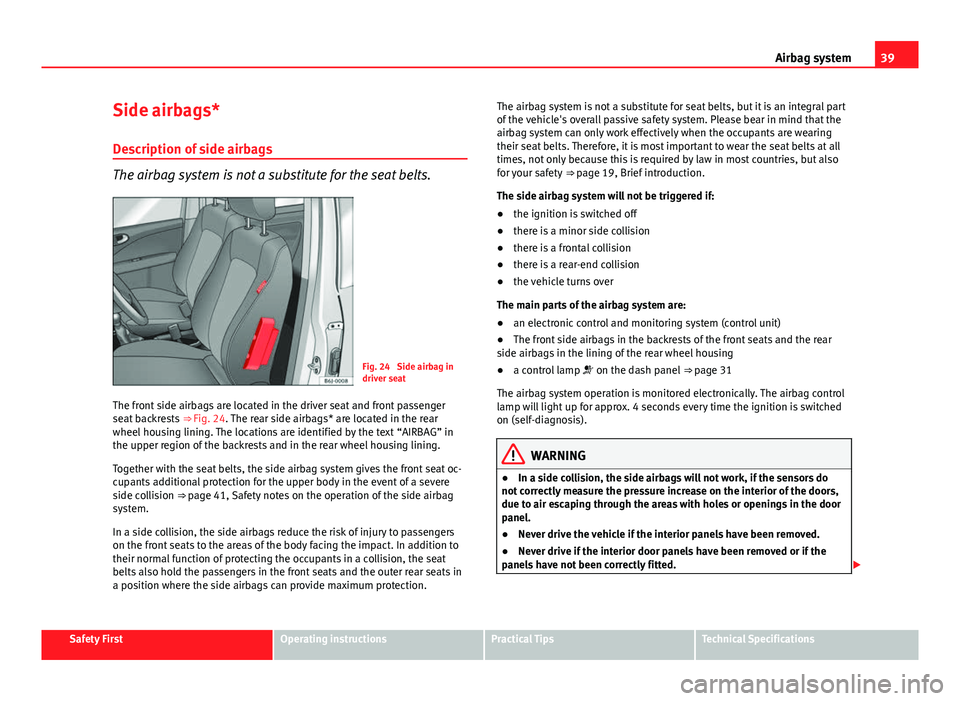
Fig. 24 Side airbag in
driver seat
The front side airbags are located in the driver seat and front passenger
seat backrests ⇒ Fig. 24. The rear side airbags* are located in the rear
wheel housing lining. The locations are identified by the text “AIRBAG” in
the upper region of the backrests and in the rear wheel housing lining.
Together with the seat belts, the side airbag system gives the front seat oc-
cupants additional protection for the upper body in the event of a severe
side collision ⇒ page 41, Safety notes on the operation of the side airbag system.
In a side collision, the side airbags reduce the risk of injury to passengers
on the front seats to the areas of the body facing the impact. In addition to
their normal function of protecting the occupants in a collision, the seat
belts also hold the passengers in the front seats and the outer rear seats in
a position where the side airbags can provide maximum protection. The airbag system is not a substitute for seat belts, but it is an integral part
of the vehicle's overall passive safety system. Please bear in mind that the
airbag system can only work effectively when the occupants are wearing
their seat belts. Therefore, it is most important to wear the seat belts at all
times, not only because this is required by law in most countries, but also
for your safety
⇒ page 19, Brief introduction.
The side airbag system will not be triggered if:
● the ignition is switched off
● there is a minor side collision
● there is a frontal collision
● there is a rear-end collision
● the vehicle turns over
The main parts of the airbag system are:
● an electronic control and monitoring system (control unit)
● The front side airbags in the backrests of the front seats and the rear
side airbags in the lining of the rear wheel housing
● a control lamp on the dash panel ⇒ page 31
The airbag system operation is monitored electronically. The airbag control
lamp will light up for approx. 4 seconds every time the ignition is switched
on (self-diagnosis).
WARNING
● In a side collision, the side airbags will not work, if the sensors do
not correctly measure the pressure increase on the interior of the doors,
due to air escaping through the areas with holes or openings in the door
panel.
● Never drive the vehicle if the interior panels have been removed.
● Never drive if the interior door panels have been removed or if the
panels have not been correctly fitted.
Safety FirstOperating instructionsPractical TipsTechnical Specifications
Page 43 of 327
41
Airbag system
The special design of the airbag allows the controlled escape of the propel-
lant gas when an occupant puts pressure on the bag. Thus, the head and
chest are surrounded and protected by the airbag.
Safety notes on the operation of the side airbag system
If airbags are used correctly, they can considerably reduce
the risk of injury in side impact collisions.
WARNING
● If you do not wear a seat belt, if you lean forward, or are not seated
correctly while the vehicle is in motion, you are at a greater risk of injury
if the side airbag system is triggered in an accident.
● In order for the side airbags to provide their maximum protection, the
prescribed sitting position must always be maintained with seat belts
fastened while travelling.
● Occupants of the outer seats must never carry any objects or pets in
the deployment space between them and the airbags, or allow children
or other passengers to travel in this position. It is also important not to
attach any accessories (such as cup holders) to the doors. This would im-
pair the protection offered by the side airbags.
● The built-in coat hooks should be used only for lightweight clothing.
Do not leave any heavy or sharp-edged objects in the pockets.
● Great forces, such as hard blows or kicks, must not be exerted upon
the backrest bolster because the system may be damaged. In this case,
the side airbags would not be triggered.
● Under no circumstances should protective covers be fitted over seats
with side airbags unless the covers have been approved for use in your
vehicle. Because the airbag is triggered from the side of the backrest, the
WARNING (Continued)
use of non-approved seat covers would obstruct the side airbag, serious-
ly reducing the airbag's effectiveness ⇒ page 230, Accessories, replace-
ment of parts and modifications.
● Any damage to the original seat upholstery or around the seams of
the side airbag units must be repaired immediately by a specialised
workshop.
● The airbags provide protection for just one accident; replace them
once they have deployed.
● When children assume an incorrect sitting position, they expose
themselves to an increased risk of injury in the event of an accident. This
is particularly the case if the child is travelling on the front passenger
seat and the airbag system is triggered in an accident; this could have
critical consequences including serious injury or death ⇒ page 47,
Child safety.
● Any work on the side airbag system or removal and installation of the
airbag components for other repairs (such as removal of the front seat)
should only be performed by a specialised workshop. Otherwise, faults
may occur during the airbag system operation.
● Do not attempt to modify components of the airbag system in any
way.
● The side and head airbags are managed through sensors located in
the interior of the front doors. To ensure the correct operation of the side
and head airbags neither the doors nor the door panels should be modi-
fied in any way (e.g. fitting loudspeakers). If the front door is damaged,
the airbag system may not work correctly. All work carried out on the
front door must be done in a specialised workshop.
Safety FirstOperating instructionsPractical TipsTechnical Specifications
Page 45 of 327

43
Airbag system
Operation of curtain airbags
Fully inflated airbags reduce the risk of head or chest injury
in a side collision.
Fig. 27 Deployed curtain
airbags
During some side collisions the curtain airbag is triggered on the impact
side of the vehicle ⇒ Fig. 27.
In certain types of accident the front, side and curtain airbags may be trig-
gered together.
When the system is triggered, the airbag is filled with propellant gas. In the
process, the curtain airbag covers the side windows and door pillars.
The airbags deploy extremely rapidly, within thousandths of a second, to
provide additional protection in the event of an accident. A fine dust may
develop when the airbag deploys. This is normal and it is not an indication
of fire in the vehicle.
The fully deployed airbags cushion the movement of the front occupants
and help to reduce the risk of injury to the upper body. The special design of the airbag allows the controlled escape of the propel-
lant gas when an occupant puts pressure on the bag. Thus, the head and
chest are surrounded and protected by the airbag.
Safety notes on the operation of the curtain airbag system
If you use airbags correctly, they can considerably reduce
the risk of injury in many kinds of accident.
WARNING
● In order for the side airbags to provide their maximum protection, the
prescribed sitting position must always be maintained with seat belts
fastened while travelling.
● For safety reasons, the curtain airbag must be disabled in those vehi-
cles fitted with a screen dividing the interior of the vehicle. See a Techni-
cal Service to make this adjustment.
● There must be no other persons, animals or objects between the oc-
cupants of the outer seats and the deployment space of the curtain air-
bags so that the curtain airbag can deploy without restriction and pro-
vide the greatest possible protection. Therefore, sun blinds which have
not been expressly approved for use in your vehicle may not be attached
to the side windows ⇒ page 230, Accessories, replacement of parts and
modifications.
● The built-in coat hooks should be used only for lightweight clothing.
Do not leave any heavy or sharp-edged objects in the pockets. Please, do
not hang the clothes on coat hangers.
● The airbags provide protection for just one accident; replace them
once they have deployed.
Safety FirstOperating instructionsPractical TipsTechnical Specifications
Page 48 of 327
46Airbag system
–Check that the control lamp on the instrument panel ⇒ Fig. 29
does not light up when the ignition is switched on ⇒
.
WARNING
● The driver is responsible for the proper position of the key-operated
switch.
● You should only deactivate the front passenger front airbag when, in
exceptional cases, you have to use a rear-facing child seat on the front
passenger seat ⇒ page 47, Child safety.
● Never install a child seat facing backwards on the front passenger
seat unless the front passenger front airbag has been disabled. Other-
wise, there is a risk of death. If under exceptional circumstances it is nec-
essary to transport a child in a rear-facing child seat on the front passen-
ger seat, you must always disable the front passenger front airbag.
● As soon as the child seat is no longer needed on the front passenger
seat, enable the front passenger front airbag again.
● Only deactivate the front passenger front airbag when the ignition is
off, otherwise a fault may occur in the airbag system, which could cause
the airbag to not deploy properly or not deploy at all.
WARNING (Continued)
● When the front passenger front airbag is deactivated, if the control
lamp AIRBAG OFF is not continuously lit up, there may be a fault in the
airbag system:
–Have the airbag system inspected immediately by a specialised
workshop.
– Do not use a child seat on the front passenger seat! The front pas-
senger front airbag could be triggered despite the fact that there is a
fault in the system and, as a result, a child could sustain serious or
fatal injuries.
– It is unpredictable whether the front passenger airbag will deploy
in the event of an accident. Warn all your passengers of this.
● When using the ignition key to activate/deactivate the front passen-
ger front airbag, only the front passenger airbag will be activated/deacti-
vated. The side airbag and head airbag on the passenger side will remain
active.
Page 61 of 327

59
Cockpit
Operating instructions Cockpit
Overview Dash panel overview
Electric windows . . . . . . . . . . . . . . . . . . . . . . . . . . . . . . . . . . . . . . . . . . 112
Door handle
Central locking switch . . . . . . . . . . . . . . . . . . . . . . . . . . . . . . . . . . . . . 103
Electric control for exterior mirrors . . . . . . . . . . . . . . . . . . . . . . . . .134
Air outlets with thumbwheel . . . . . . . . . . . . . . . . . . . . . . . . . . . . . . . 170
Light switch . . . . . . . . . . . . . . . . . . . . . . . . . . . . . . . . . . . . . . . . . . . . . . . 117
Lever for turn signals and main beam headlights . . . . . . . . . . .124
Instrument panel . . . . . . . . . . . . . . . . . . . . . . . . . . . . . . . . . . . . . . . . . . 61
Levers and switches for:
– Windscreen wipers and washer . . . . . . . . . . . . . . . . . . . . . . . . . . 129
– On-board computer . . . . . . . . . . . . . . . . . . . . . . . . . . . . . . . . . . . . . 88
– Menu display . . . . . . . . . . . . . . . . . . . . . . . . . . . . . . . . . . . . . . . . . . . 91
Ignition lock . . . . . . . . . . . . . . . . . . . . . . . . . . . . . . . . . . . . . . . . . . . . . . 174
Depending on equipment fitted:
– Electronic Stability Control (ESC) . . . . . . . . . . . . . . . . . . . . . . . .71
– Start-Stop switch . . . . . . . . . . . . . . . . . . . . . . . . . . . . . . . . . . . . . . . 177
– Warning lamp indicating that front passenger airbag has
been disabled . . . . . . . . . . . . . . . . . . . . . . . . . . . . . . . . . . . . . . . . . . 45
– Switch for acoustic parking aid . . . . . . . . . . . . . . . . . . . . . . . . . . 182
Hazard warning lights . . . . . . . . . . . . . . . . . . . . . . . . . . . . . . . . . . . . . 123
123456789
1011
12
Drink holder
. . . . . . . . . . . . . . . . . . . . . . . . . . . . . . . . . . . . . . . . . . . . . . 154
Storage compartment
Depending on equipment fitted: Sound system or navigation
system
Lockable glove compartment . . . . . . . . . . . . . . . . . . . . . . . . . . . . . . 160
Front passenger airbag . . . . . . . . . . . . . . . . . . . . . . . . . . . . . . . . . . . . 33
Air conditioner . . . . . . . . . . . . . . . . . . . . . . . . . . . . . . . . . . . . . . . . . . . . 165
Switch for heated rear window . . . . . . . . . . . . . . . . . . . . . . . . . . . . . 128
Thumbwheel for seat heating . . . . . . . . . . . . . . . . . . . . . . . . . . . . . . 172
Ashtray . . . . . . . . . . . . . . . . . . . . . . . . . . . . . . . . . . . . . . . . . . . . . . . . . . . 155
Manual gear lever
Cigarette lighter/Power socket . . . . . . . . . . . . . . . . . . . . . . . . . . . . . 155
Auxiliary socket
Tyre pressure monitoring . . . . . . . . . . . . . . . . . . . . . . . . . . . . . . . . . . 69
Storage compartment
Handbrake . . . . . . . . . . . . . . . . . . . . . . . . . . . . . . . . . . . . . . . . . . . . . . . . 180
Seat memory* . . . . . . . . . . . . . . . . . . . . . . . . . . . . . . . . . . . . . . . . . . . . 140
Bonnet lock release . . . . . . . . . . . . . . . . . . . . . . . . . . . . . . . . . . . . . . . 235
Headlight range control . . . . . . . . . . . . . . . . . . . . . . . . . . . . . . . . . . . 121
– coming home and leaving home: delayed lights off and
anticipated lights on function . . . . . . . . . . . . . . . . . . . . . . . . . . . 119
Lever for cruise control . . . . . . . . . . . . . . . . . . . . . . . . . . . . . . . . . . . . 184
131415
161718192021222324252627282930
31
Safety FirstOperating instructionsPractical TipsTechnical Specifications
Page 62 of 327
60Cockpit
Steering wheel with:
–Horn
– Driver airbag . . . . . . . . . . . . . . . . . . . . . . . . . . . . . . . . . . . . . . . . . . . 33
– Controls for radio and telephone*
Adjustable steering column . . . . . . . . . . . . . . . . . . . . . . . . . . . . . . . . 173
On-board documentation compartment / knee airbag* . . . . . .33
32
3334
Note
● Separate Instruction Manual is enclosed if the vehicle is equipped with
a factory-fitted radio or navigation system.
● The arrangement of switches and controls on right-hand drive models*
may be slightly different from the layout shown in ⇒ Fig. 37. However, the
symbols used to identify the controls are the same.
Page 63 of 327

61
Cockpit
Instruments Instrument panel overview
The instrument panel is the driver's information centre.
Fig. 38 Overview of instrument panel Coolant temperature gauge . . . . . . . . . . . . . . . . . . . . . . . . . . . . . . . . 62
Rev counter incorporating digital clock and date . . . . . . . . . . . .63, 63
Warning and indicator lamps . . . . . . . . . . . . . . . . . . . . . . . . . . . . . . 67
Speedometer (incorporating odometer display) . . . . . . . . . . . . .65
Fuel gauge . . . . . . . . . . . . . . . . . . . . . . . . . . . . . . . . . . . . . . . . . . . . . . . . 65
1
2345
Adjuster buttons for
–
Digital clock and date . . . . . . . . . . . . . . . . . . . . . . . . . . . . . . . . . . . 63
– Instrument lighting . . . . . . . . . . . . . . . . . . . . . . . . . . . . . . . . . . . . . 64
Digital display with
– Service interval display . . . . . . . . . . . . . . . . . . . . . . . . . . . . . . . . . 77
– Driver information system . . . . . . . . . . . . . . . . . . . . . . . . . . . . . . . 74
6
7
Safety FirstOperating instructionsPractical TipsTechnical Specifications
Page 64 of 327
62Cockpit
CHECK button . . . . . . . . . . . . . . . . . . . . . . . . . . . . . . . . . . . . . . . . . . . . . 66
Call-up button for service indicator . . . . . . . . . . . . . . . . . . . . . . . . .77
Reset button for trip recorder . . . . . . . . . . . . . . . . . . . . . . . . . . . . . . 65
Coolant temperature gauge
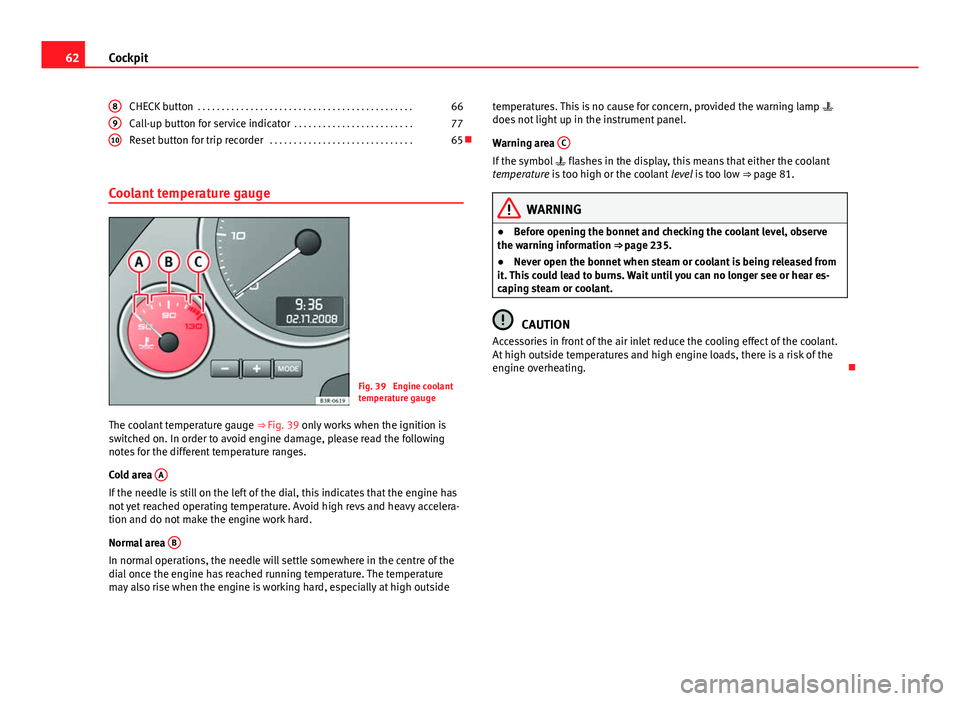
Fig. 39 Engine coolant
temperature gauge
The coolant temperature gauge ⇒ Fig. 39 only works when the ignition is
switched on. In order to avoid engine damage, please read the following
notes for the different temperature ranges.
Cold area A
If the needle is still on the left of the dial, this indicates that the engine has
not yet reached operating temperature. Avoid high revs and heavy accelera-
tion and do not make the engine work hard.
Normal area B
In normal operations, the needle will settle somewhere in the centre of the
dial once the engine has reached running temperature. The temperature
may also rise when the engine is working hard, especially at high outside8
910
temperatures. This is no cause for concern, provided the warning lamp
does not light up in the instrument panel.
Warning area C
If the symbol
flashes in the display, this means that either the coolant
temperature is too high or the coolant level is too low ⇒ page 81.
WARNING
● Before opening the bonnet and checking the coolant level, observe
the warning information ⇒ page 235.
● Never open the bonnet when steam or coolant is being released from
it. This could lead to burns. Wait until you can no longer see or hear es-
caping steam or coolant.
CAUTION
Accessories in front of the air inlet reduce the cooling effect of the coolant.
At high outside temperatures and high engine loads, there is a risk of the
engine overheating.
Page 66 of 327
64Cockpit
–Use the +
and - buttons to set the day.
– Keep pressing the MODE
button until the month display flashes.
– Use the +
and - buttons to set the month.
– Keep pressing the MODE
button until the year display flashes.
– Use the +
and - buttons to set the year.
Deactivating the date display
– Keep pressing the MODE
button until the complete date display
flashes.
– Use the -
button to disable the date display.
Activating the date display
– Keep pressing the MODE
button until the complete date display
flashes.
– Use the +
button to enable the date display.
When the display stops flashing, this means the setting you are performing
is completed and the time and date have been successfully stored.
When the ignition is switched off, the odometer and the digital clock with
date display can be switched on for a few seconds by pressing the CHECK
button ⇒ Fig. 38 8
. Instrument lighting
The brightness of the instrument lighting can be adjusted as
required.
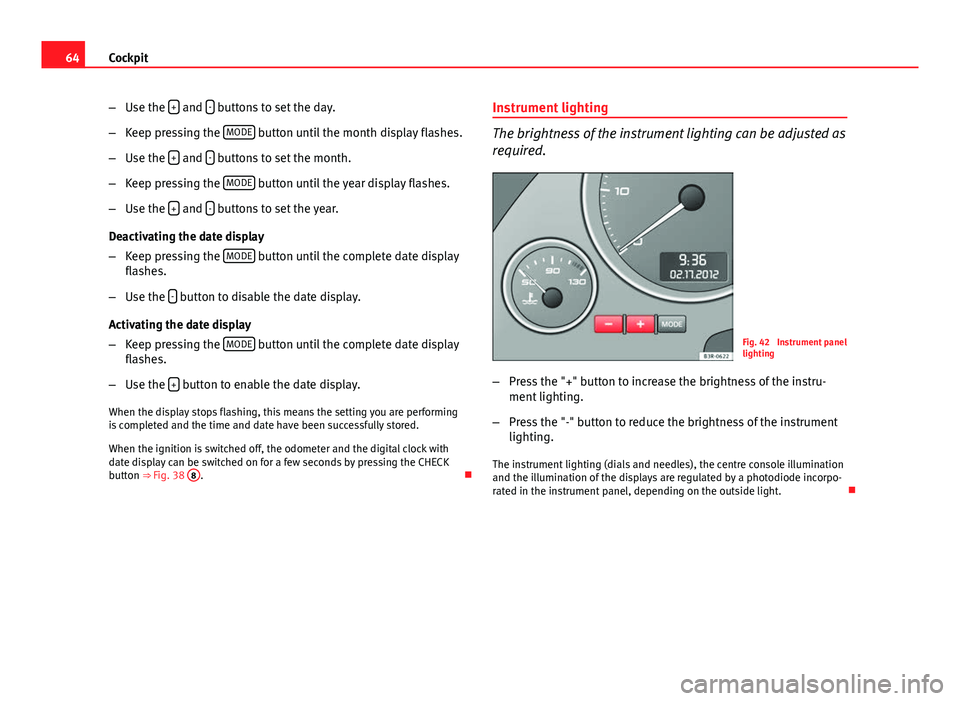
Fig. 42 Instrument panel
lighting
– Press the "+" button to increase the brightness of the instru-
ment lighting.
– Press the "-" button to reduce the brightness of the instrument
lighting.
The instrument lighting (dials and needles), the centre console illumination
and the illumination of the displays are regulated by a photodiode incorpo-
rated in the instrument panel, depending on the outside light.
Page 67 of 327

65
Cockpit
Speedometer with odometer
The speedometer indicates the speed of the vehicle and the
distance travelled.
Fig. 43 Detailed view of
the instrument panel:
Odometer
The distance is normally stated in kilometres (km). On some models, how-
ever, the odometer will show “miles”.
Lower odometer
The lower odometer records the vehicle's total mileage.
Upper odometer (trip recorder)
The upper odometer shows the distance that has been travelled since the
trip recorder was last reset. It is used to measure short trips. The last digit of
the trip recorder indicates distances of 100 metres or one tenths of a mile.
The upper odometer can be reset to zero by pressing the reset button
⇒ Fig. 43. Fault display
If there is a fault in the instrument panel, the letters
DEF will appear perma-
nently in the trip recorder display. Please have the fault repaired as soon as
possible.
Electronic immobiliser
The vehicle key data is consulted when the ignition is switched on.
If an uncoded key is used, the message SAFE* will appear in the trip record-
er display. The vehicle can no longer be started if that happens.
Fuel reserve
The display only works when the ignition is switched on.
When the needle reaches the reserve zone, the symbol lights up in the in-
strument panel display ⇒ page 83. At this point there are still about 8 to
10 litres of fuel left in the tank. This is your reminder to fill up soon.
You can consult the tank capacity of your vehicle in the ⇒ page 314, Di-
mensions and capacities section.
CAUTION
Never run the tank completely dry. If there is an irregular fuel supply, misfir-
ing can occur. This means that fuel could reach the exhaust system without
burning. This may lead to the catalytic converter reheating and being dam-
aged.
Safety FirstOperating instructionsPractical TipsTechnical Specifications