air condition Seat Exeo ST 2013 Owner's Guide
[x] Cancel search | Manufacturer: SEAT, Model Year: 2013, Model line: Exeo ST, Model: Seat Exeo ST 2013Pages: 327, PDF Size: 5.07 MB
Page 173 of 327

171
Air conditioning
Air directed to windows
This setting directs all the air to outlets 1 and 2. Unlike in setting , the
volume of air delivery remains the same.
Air to the driver/front passenger
All the air comes from outlets 3 and 4 in the dash panel and from the rear of
the centre console.
Air to the footwells
Most of the air emerges from outlets 5 and the outlets under the front seats.
Some of the air will also be issued from outlets 3 and 4.
Note
In all of the above air distribution settings, a small amount of air will still
come from the other outlets.
Economical use of the air conditioner
Economical use of the air conditioner will help save fuel.
Engine power is reduced and fuel consumption increases when the
air conditioner is in cooling mode. To ensure that the system is on-
ly switched on when it is really necessary, please note the follow-
ing points:
– Select ECON mode if you wish to save fuel.
– Select ECON mode if you decide to open the windows or sun-
roof* while driving.
– If the vehicle has heated up after standing in the sun, open the
windows and doors for a short time to cool the vehicle.
For the sake of the environment
By saving fuel you also reduce the amount of pollutants emitted from your
vehicle.
Key settings
When the ignition is switched on, the air conditioner set-
tings assigned to the key are selected automatically.
The air conditioner settings selected are automatically stored and assigned
to the key in use. When the vehicle is started, the air conditioner automati-
cally selects the settings assigned to the key. Hence, every driver automati-
cally obtains his/her preferred settings without having to select them man-
ually.
Note
Should another driver use the key and enter other settings, the previous
settings will be deleted.
Solar-powered blower/sunroof*
If the vehicle is parked in sufficiently strong sunlight, the
blower will operate in solar-powered mode when the igni-
tion is switched off.
After the ignition is switched off, the blower is supplied with electrical pow-
er from the sunroof. Please ensure that outlets 3 and 4 are open ⇒ Fig. 142
to ensure the best possible ventilation.
The blower only works when the sunroof is closed or tilted open at the rear.
Safety FirstOperating instructionsPractical TipsTechnical Specifications
Page 174 of 327
172Air conditioning
If the air recirculation mode is on when you switch off the engine, the air
conditioner will automatically switch to fresh air ventilation.
Auxiliary heater*
Diesel vehicles are fitted with an auxiliary heater 1)
to raise the temperature
of the interior as quickly as possible. At outdoor temperatures below +5 °C
and with the engine running, the supplementary heating will switch on and
off automatically depending on the temperature of the coolant.
In order to save fuel, the auxiliary heater can be can be switched off by brief-
ly pressing the
button on the air conditioner. Seat heating*
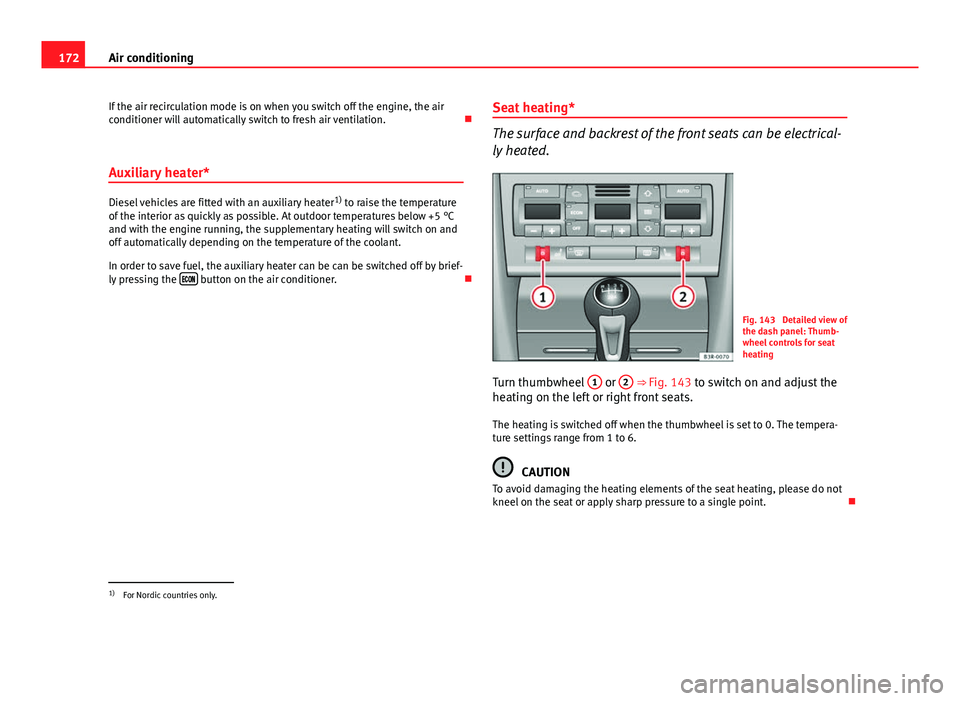
The surface and backrest of the front seats can be electrical-
ly heated.
Fig. 143 Detailed view of
the dash panel: Thumb-
wheel controls for seat
heating
Turn thumbwheel 1
or 2 ⇒ Fig. 143 to switch on and adjust the
heating on the left or right front seats.
The heating is switched off when the thumbwheel is set to 0. The tempera-
ture settings range from 1 to 6.
CAUTION
To avoid damaging the heating elements of the seat heating, please do not
kneel on the seat or apply sharp pressure to a single point.
1)
For Nordic countries only.
Page 179 of 327

177
Driving
WARNING
● Never switch the engine off until the vehicle is stationary.
● The brake servo and the power steering system work only when the
engine is running. You need more strength to steer and brake the vehicle
when the engine is switched off. Given that you will be unable to steer
and brake as usual, this could lead to a risk of accidents and injuries.
CAUTION
If the engine has been running under high load for a long time, there is a
risk of heat building up in the engine compartment after the engine has
been switched off; this could cause engine damage. Therefore, you should
let the engine idle for approximately 2 minutes before you switch it off.
Note
After the engine is switched off the radiator fan may run on for up to 10 mi-
nutes, even if the ignition is switched off. It may also start running again af-
ter some time if the coolant temperature rises due to a build-up of heat un-
der the bonnet, or if the engine is already warm and the engine compart-
ment is heated up further by direct sunlight.
Start-Stop function* Description and operation
The Start-Stop function stops the engine when the vehicle is stop-
ped and starts it automatically when required.
– When the vehicle is stopped, put it in neutral and release the
clutch pedal. The engine will stop. –
When the clutch pedal is pressed, the engine starts again.
– The instrument panel display shows information about the sta-
tus of the Start-Stop function ⇒ Fig. 149.
Start-Stop function conditions
● The driver seat belt must be buckled.
● The bonnet must be closed.
● The engine must be at operating temperature.
● The steering wheel must not be turned more than 270°.
● The vehicle must not be on a steep gradient.
● The vehicle must not be in reverse.
● A trailer must not be connected.
● The temperature of the passenger compartment must be within the con-
venience limits ( ECON
button should not be selected).
● The windscreen de-mist function must be off.
● Otherwise it requires more than 50% of the airflow that the fan can sup-
ply.
● The temperature must not be set to HI or LO.
● The driver door must be closed.
● The diesel particulate filter must not be in regeneration mode, for diesel
engines.
● The battery charge must not be low for the next start.
● The battery temperature must be between -1 °C and 60 °C.
Start-Stop function interruption
In the following situations, the Start-Stop function will be interrupted and
the engine will automatically start:
● The vehicle starts moving.
● The brake pedal is pressed several times in a row.
● The battery has been discharged excessively.
Safety FirstOperating instructionsPractical TipsTechnical Specifications
Page 180 of 327
178Driving
● The Start-Stop System is manually deactivated.
● The windscreen de-mist function is turned on.
● The temperature of the passenger compartment exceeds the comfort
limits (button ECON
should not be selected).
● If more than 50% of the airflow that the fan can supply is ordered.
● Temperature setting HI or LO is selected.
● The engine coolant temperature is insufficient.
● The alternator is faulty, for example the V-belt has ruptured.
● If any of the conditions described in the previous section are not fulfil-
led.
WARNING
Never allow the vehicle to move with the engine off for any reason. You
could lose control of your vehicle. This could cause an accident and seri-
ous injury.
● Power steering does not work when the engine is not running. That is
why it is much more difficult to turn the steering wheel.
● Turn off the Start-Stop system when driving through water (fording
streams, etc.).
Note
● For vehicles with the Start-Stop function and a manual gearbox, when
the engine is started, the clutch must be pressed.
● When the conditions for the Start-Stop function are not fulfilled, the in-
strument panel displays the Start-Stop indicator dimmed.
● If the steering wheel is turned more than 270°, Stop will not function;
however, the angle of steering wheel turn does not affect starting the vehi-
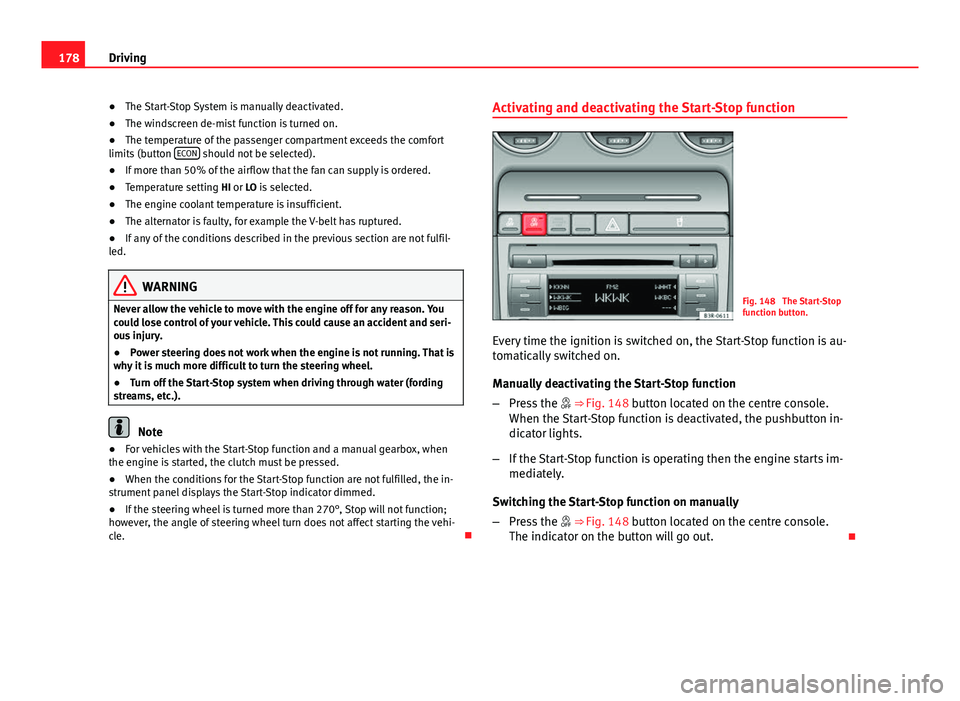
cle. Activating and deactivating the Start-Stop function
Fig. 148 The Start-Stop
function button.
Every time the ignition is switched on, the Start-Stop function is au-
tomatically switched on.
Manually deactivating the Start-Stop function
– Press the ⇒ Fig. 148 button located on the centre console.
When the Start-Stop function is deactivated, the pushbutton in-
dicator lights.
– If the Start-Stop function is operating then the engine starts im-
mediately.
Switching the Start-Stop function on manually
– Press the ⇒ Fig. 148 button located on the centre console.
The indicator on the button will go out.
Page 200 of 327

198Intelligent technology
WARNING
Please remember that the accident risk always increases if you drive too
fast, especially in corners or on a slippery road, or if you follow too close
behind the vehicle in front of you. An increased accident risk cannot be
compensated even by the brake assist system. Risk of accident.
Electronic differential lock (EDL)
The electronic differential lock prevents the loss of traction
caused if one wheel starts spinning. General notes
The electronic differential lock (EDL) helps the vehicle to start moving, ac-
celerate and climb a gradient in slippery conditions where this may other-
wise be difficult or even impossible.
How it works
The EDL works automatically, without the driver's involvement. With the aid
of the ABS sensors, the system monitors the rotational speed of the drive
wheels ⇒ page 197. If a considerable difference in revs is detected (approx.
100 rpm) in the speed of the drive wheels, e.g. when only one part of the
surface supporting the wheels is slippery, the system applies the brake to
slow down the skidding wheel so that more of the power is directed to the
other wheels. The systems works up to a speed of approx. 80 km/h. The
system will make noise while it is working.
Starting the vehicle
If one wheel has less grip and starts spinning (for instance, if one of the
drive wheels is on ice), keep pressing the accelerator gradually until the ve-
hicle starts moving. Overheating of the brakes
To prevent the brake disk of the braked wheel from overheating, the EDL
cuts out automatically if subjected to excessive loads. In this case, the vehi-
cle will continue to run and will have the same running properties as those
of another without EDL.
The EDL will switch on again automatically when the brake has cooled
down.
WARNING
● When accelerating on a uniformly slippery surface (for instance all
four wheels on ice or snow), press the accelerator gradually and careful-
ly. Despite EDL, the drive wheels may otherwise start to spin. This could
impair the vehicle's stability. Risk of accident.
● Even with EDL, you should always adjust your speed to suit the road
and traffic conditions. Do not let the extra safety features tempt you into
taking any risks when driving. Failure to do so could result in an accident.
Note
If the ABS warning lamp lights up, this can also mean there is a fault in the
EDL. Take the vehicle to a specialised workshop as soon as possible.
Traction control system (ASR)
The traction control system prevents the driven wheels from
spinning when the vehicle is accelerating. General notes
The traction control system (ASR) is one of the functions incorporated in the
Electronic Stability Control (ESC)
Page 205 of 327
203
Driving and the environment
WARNING (Continued)
● On steep slopes, if brakes are excessively used, they will overheat.
Before driving down a long steep slope, it is advisable to reduce speed
and change down into a lower gear or range (depending on the type of
transmission). This makes use of engine braking and relieves the brakes.
● Never let the brakes “drag” by applying light pressure. Continuous
braking will cause the brakes to overheat and the braking distance will
increase. Apply and then release the brakes alternately.
● Never let the vehicle run with the engine switched off. The braking
distance is increased considerably when the brake servo is not active.
● If the brake fluid loses its viscosity and is subjected to heavy use, va-
pour bubbles can form in the brake system. This reduces the efficiency of
the brakes.
● Non-standard or damaged front spoilers could restrict the airflow to
the brakes and cause them to overheat. Before purchasing accessories
please observe the relevant instructions ⇒ page 230, Technical modifi-
cations.
● If a brake system circuit fails, the braking distance will be increased
considerably. Contact a specialised workshop immediately and avoid un-
necessary journeys.
Exhaust gas purification system Catalytic converter*
To maintain the useful life of the catalytic converter
– Use only unleaded petrol with petrol engines, as lead damages
the catalytic converter.
– Do not let the fuel get too low in the tank. –
For engine oil changes, do not replenish with too much engine
oil ⇒ page 239.
– Never tow the vehicle to start it, use jump leads if necessary
⇒ page 295.
If you notice misfiring, uneven running or loss of power when the vehicle is
moving, reduce speed immediately and have the vehicle inspected at the
nearest specialised workshop. In general, the exhaust gas warning lamp
will light up when any of the described symptoms occur ⇒ page 68. If this
happens, unburnt fuel can enter the exhaust system and escape into the en-
vironment. The catalytic converter can also be damaged by overheating.
WARNING
The catalytic converter reaches very high temperatures! Risk of fire!
● Never park where the catalytic converter could come into contact with
dry grass or flammable materials under the vehicle.
● Do not apply additional underseal or anti-corrosion coatings to the
exhaust pipes, catalytic converter or the heat shields on the exhaust sys-
tem. These materials could catch fire when the vehicle is being driven.
CAUTION
Never run the fuel tank completely dry because the irregularity of the fuel
supply may cause ignition problems. This allows unburnt fuel to enter the
exhaust system, which could cause overheating and damage the catalytic
converter.
For the sake of the environment
Even when the emission control system is working perfectly, there may be a
smell of sulphur from the exhaust gas under some conditions. This depends
on the sulphur content of the fuel used. Quite often the problem can be
solved by changing to another brand of fuel.
Safety FirstOperating instructionsPractical TipsTechnical Specifications
Page 229 of 327
227
Vehicle maintenance and cleaning
CAUTION
● Brushes should only be used to clean the carpet and floor mats! Other
fabrics may be damaged if cleaned with a brush.
● If cream detergents or detergents for delicate garments are applied with
a damp cloth or sponge, they may, for example, leave rings when dry be-
cause of the surfactant components they contain. Generally, such rings are
very difficult or almost impossible to remove.
CAUTION
● Do not let water soak into Alcantara ®
under any circumstances.
● Do not use leather cleaning products, solvents, wax polish, shoe cream,
stain removers or similar products on Alcantara ®
.
● Never use brushes for cleaning damp material as they could damage the
surface.
Cleaning and maintenance of natural leather upholstery
Consult a professional cleaning workshop if you have any doubts on clean-
ing and maintaining the leather equipment in your vehicle.
Maintenance and treatment
Nappa natural leather is delicate because it has no additional protective
layer.
● After cleaning, regularly apply a conditioner with sun-screen and im-
pregnating action. These products nourish the leather, soften it and make it
more breathable, as well as re-hydrating it. They also provide it with a pro-
tective film.
● Clean the leather every two or three months and remove stains as they
appear.
● Treat the leather regularly (about twice a year) with a suitable mainte-
nance product. ●
Apply as few cleaning and maintenance products as possible, always
using a dry, lint-free cotton or woollen cloth. Do not apply cleaning and
maintenance products directly to the leather.
● Remove recent ball-point pen and ink stains, lipstick, shoe cream and
similar stains as soon as possible.
● Maintain the colour of the leather. To do this, use a special cream espe-
cially coloured for leather to achieve the same overall colour, if necessary.
● Afterwards, go over it with a soft cloth.
Cleaning the vehicle
SEAT recommends using a slightly damp cotton or woollen cloth for general
cleaning purposes.
Generally, the leather should never be soaked at any point, nor should wa-
ter penetrate the seams.
Before cleaning the leather upholstery, bear in mind the following recom-
mendations ⇒ page 226, Cleaning the fabric on heated seats and electrical-
ly adjustable seats or seats with airbag components.CAUTION
● On no account use solvents, wax polish, shoe cream, stain removers or
similar materials on leather.
● If the stain remains on the leather for long, it will soak in and be impos-
sible to remove.
● In the event of spilt liquids, dry immediately with an absorbent cloth to
prevent the liquid penetrating through the leather or seams.
● If the vehicle is left standing in the sun for long periods, the leather
should be protected against direct sunlight to prevent it from fading.
Note
The leather will usually change colour slightly with use.
Safety FirstOperating instructionsPractical TipsTechnical Specifications
Page 231 of 327
229
Vehicle maintenance and cleaning
If large stains form on the belts, it will not retract correctly into the automat-
ic belt retractor.
WARNING
● Do not use chemical cleaning agents on the seat belts, as this can im-
pair the strength of the webbing. Ensure that seat belts do not come into
contact with corrosive fluids.
● Check the condition of the seat belts at regular intervals. If you notice
that the belt webbing, fittings, retractor mechanism or buckle of any of
the belts is damaged, the belt must be replaced by a specialised work-
shop.
● Do not attempt to repair a damaged seat belt yourself. The seat belts
must not be removed or modified in any way.
CAUTION
After cleaning, allow seat belts to dry completely before rolling them up.
Otherwise, the belt retractors could become damaged.
Safety FirstOperating instructionsPractical TipsTechnical Specifications
Page 238 of 327
236Checking and refilling levels
WARNING (Continued)
● Protect face, hands and arms from any hot steam or hot coolant fluid
released by covering the cap with a large, thick rag when opening the ex-
pansion tank.
● If any tests have to be performed with the engine running, there is an
added safety risk from the rotating parts (e.g. drive belts, alternator, ra-
diator fan, etc.) and from the high-voltage ignition system.
● Observe the following additional warnings if work on the fuel system
or the electrical system is necessary:
–Always disconnect the battery from the on-board network.
– Do not smoke.
– Never work near open flames.
– Always keep an approved fire extinguisher immediately available.
CAUTION
When topping up fluids, make sure the correct fluid is put into the correct
filler opening. This can otherwise cause serious malfunctions or engine
damage.
For the sake of the environment
Inspect the ground underneath your vehicle regularly so that any leaks are
detected at an early stage. If you find spots of oil or other fluids, have your
vehicle inspected at the workshop.
● When the external temperature and level of humidity are high or when
the engine stops, it is possible for water to drop from the air conditioning
system evaporator potentially forming a small puddle on the ground. This is
normal and does not indicate a leak.
Note
On right-hand drive vehicles some of the reservoirs mentioned below are lo-
cated on the other side of the engine compartment. Releasing the bonnet
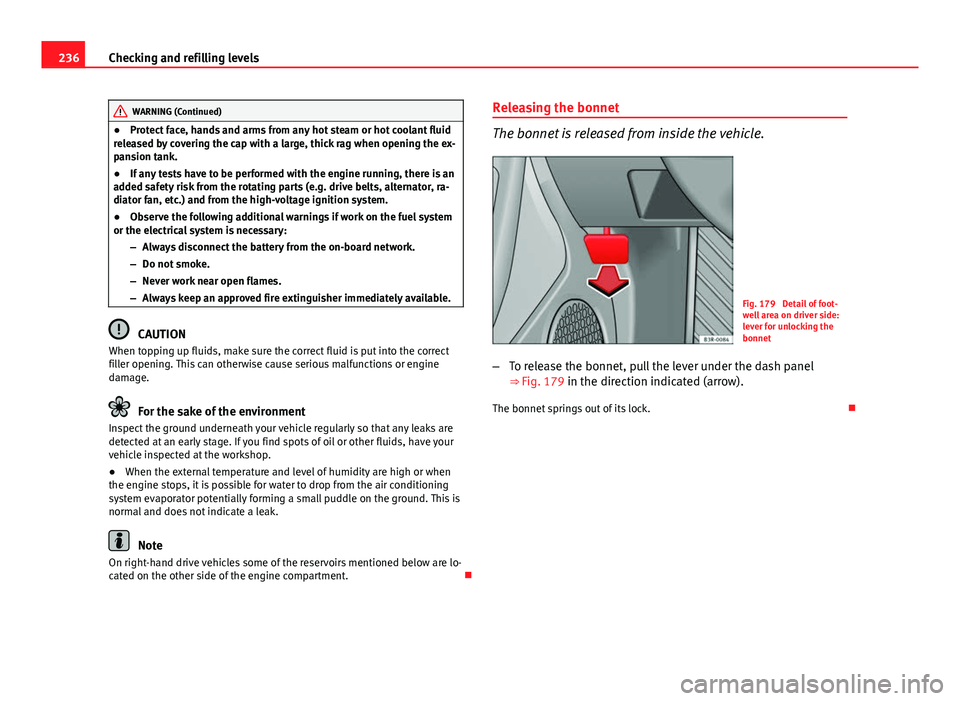
The bonnet is released from inside the vehicle.
Fig. 179 Detail of foot-
well area on driver side:
lever for unlocking the
bonnet
– To release the bonnet, pull the lever under the dash panel
⇒ Fig. 179 in the direction indicated (arrow).
The bonnet springs out of its lock.
Page 259 of 327

257
Wheels and tyres
The damaged tyre should be changed as soon as possible. The rim should
be checked in a specialised workshop to detect possible damage and re-
place it if necessary. We recommend you contact Technical Service. If more
than one tyre is being used under emergency conditions, this reduces the
distance which can be travelled.
Starting driving in emergency conditions
When loss in tyre pressure is displayed on the instrument panel, this means
that at least one tyre is being driven in emergency conditions ⇒
.
End of emergency operation
Do not drive on if:
● smoke is coming from one of the tyres,
● there is a smell of rubber,
● the vehicle vibrates,
● there is a rattling noise.
When is it no longer possible to continue driving even using run-flat tyres?
● If the Electronic Stability Control (ESC) does not function.
● If the tyre pressure monitoring system* does not work.
● If one of the tyres has been severely damaged in an accident, etc. If a
tyre has been badly damaged there is a risk that parts of the tread can be
thrown off and cause damage to the fuel lines, brake pipes or fuel filler.
● It is also advisable to stop driving if severe vibrations occur, or if the
wheel starts overheating and gives off smoke.
WARNING
When driving in emergency conditions, the driving quality of the vehicle
is considerably impaired.
● The maximum permitted speed of 80 km/h (50 mph) is subject to
road and weather conditions. Please observe legal requirements when
doing so.
● Avoid sharp turns and rapid manoeuvres, and brake earlier than usu-
al.
● Avoid driving over obstacles (for example kerbs) or potholes.
● If one or more tyres are being driven in emergency conditions, the
driving quality of the vehicle is impaired and there is a risk of accident.
Note
● The run-flat tyres do not “deflate” on losing pressure because they are
supported on the reinforced sides. Therefore defects in the tyre cannot be
detected with a visual inspection.
● Snow chains must not be used on front tyres used in emergency condi-
tions.
New tyres and wheels
New tyres and wheels have to be run in.
The tyres and wheel rims are an essential part of the vehicle's design. The
tyres and rims approved by SEAT are specially matched to the characteris-
tics of the vehicle and make a major contribution to good road holding and
safe handling ⇒
.
Tyres should be replaced at least in pairs and not individually (i.e. both front
tyres or both rear tyres together). A knowledge of tyre designations makes it
easier to choose the correct tyres. Radial tyres have the tyre designations
marked on the sidewall, for example:
Safety FirstOperating instructionsPractical TipsTechnical Specifications