heating Seat Exeo ST 2013 Owner's Guide
[x] Cancel search | Manufacturer: SEAT, Model Year: 2013, Model line: Exeo ST, Model: Seat Exeo ST 2013Pages: 327, PDF Size: 5.07 MB
Page 211 of 327
209
Trailer towing
Where possible, operate the trailer with the maximum permitted drawbar
load on the ball joint of the towing bracket, but do not exceed the specified
limit.
Tyre pressure
Check the tyre pressures on your vehicle, and adjust for “full load” condi-
tions (refer to the sticker listing the tyre pressures on the door pillar). It may
also be necessary to adjust the tyre pressures on the trailer according to the
recommendations of the trailer manufacturer.
Exterior mirrors
Check whether you can see enough of the road behind the trailer with the
standard mirrors. If this is not the case you should have additional mirrors
fitted. The two exterior mirrors should be fitted on folding arms. Adjust the
mirrors to give sufficient rear vision.
Headlights
Before starting a journey, check the headlight beam settings with the trailer
hitched up. If necessary, alter the height of the headlight beams by means
of the headlight range control. See ⇒ page 121.
Power supply
When you remove the ignition key, the power supply to the trailer is inter-
rupted.
Removable ball joint coupling
Vehicles with a factory-fitted towing bracket are equipped with a removable
ball joint coupling. This is stored in the spare wheel well in the luggage
compartment together with the necessary fitting instructions.
Note
If you frequently tow, we recommend you also have the vehicle serviced be-
tween services. Notes on towing
Towing a trailer involves additional attention by the driver.
Weight distribution
The weight distribution of a loaded trailer with an unladen vehicle is very
unfavourable. However, if this cannot be avoided, drive extra slow to allow
for the unbalanced weight distribution.
Speed
The stability of the vehicle and trailer is reduced with increasing speed.
Therefore, it is advisable not to drive at the maximum permissible speed in
unfavourable road, weather or wind conditions. This especially applies
when driving downhill.
You should always reduce speed immediately if the trailer shows the slight-
est sign of swaying. Never try to stabilise the trailer by accelerating.
Anticipate hazards and brake in good time. If towing a trailer with an inertia
brake, first brake gently and then harder. This will prevent brake tapping by
the trailer wheels when they lock. Select a low gear in due course before go-
ing down a steep downhill. This enables you to use the engine braking to
slow down the vehicle.
Swaying and pitching can be reduced by stabiliser aids. We recommend
having stabiliser aids installed when towing trailers with a high trailer
weight. They can be purchased and installed at a Technical Service.
Reheating
When climbing long hills in hot weather with the engine running fast in low
gear, you should keep an eye on the coolant temperature gauge ⇒ page 62.
Reduce speed immediately if the needle moves to the right end of the scale.
If the temperature warning lamp in the instrument panel should start
flashing, stop the vehicle and let the engine cool down by running it at
idling speed for a few minutes.
Safety FirstOperating instructionsPractical TipsTechnical Specifications
Page 224 of 327
222Vehicle maintenance and cleaning
Wax deposits can be removed with a special cleaner available in your Tech-
nical Services. Wax deposits on the windscreen could cause the wiper
blades to judder. Adding a window cleaner that dissolves wax to the wind-
screen washer fluid prevents wiper blades from juddering, but wax deposits
are not removed.
CAUTION
● Never use warm or hot water to remove snow and ice from windows and
mirrors. This could cause the glass to crack!
● The heating element for the rear window is located on the inner side of
the window. To prevent damage, do not put stickers over the heating ele-
ments on the inside of the window.
Cleaning windscreen wiper blades
Clean wiper blades improve visibility.
1. Use a soft cloth to remove dust and dirt from the windscreen wiper blades.
2. Use window cleaner to clean the windscreen wiper blades. Use a sponge or a cloth to remove stubborn dirt.
Rubber seals maintenance
If rubber seals are well looked after, they will not freeze so
quickly. 1. Use a soft cloth to remove dust and dirt from the rubber seals.
2. Apply a specialist care product to the rubber seals. The rubber strips on the doors, windows, bonnet and rear lid will remain
pliable and last longer if they are treated with a suitable care product (for
example silicone spray).
Caring for rubber seals will also prevent premature ageing and leaks. The
doors will be easier to open. If rubber seals are well looked after, they will
not freeze so quickly in winter.
Door lock cylinders
The door lock cylinders can freeze up in winter.
To de-ice the lock cylinders you should only use spray with lubricating and
anti-corrosive properties.
Cleaning chrome parts
1. Clean chrome parts with a damp cloth.
2. Polish chrome parts with a soft, dry cloth. If this does not provide satisfying results, use a specialist chrome cleaning
product. Chrome cleaning products will remove stains from the surface.
CAUTION
To prevent scratching chrome surfaces:
● Never use an abrasive cleaning product on chrome.
● Do not clean or polish chrome parts in a sandy or dusty environment.
Page 243 of 327

241
Checking and refilling levels
When the coolant is topped up, use a mixture of distilled water and, at
least, 40 % of the G 13 or G 12 plus-plus (TL-VW 774 G) additive (both are
purple) to obtain an optimum anticorrosion protection ⇒
. The mixture of
G 13 with G 12 plus (TL-VW 774 F), G 12 (red) or G 11 (green-blue) engine
coolants will significantly reduce the anticorrosion protection and should,
therefore be avoided ⇒
.
WARNING
If there is not enough anti-freeze in the coolant system, the engine may
fail leading to serious damage. ● Please make sure that the percentage
of additive is correct with respect to the lowest expected ambient tem-
perature in the zone in which the vehicle is to be used. ● When the out-
side temperature is very low, the coolant could freeze and the vehicle
would be immobilised. In this case, the heating would not work either
and inadequately dressed passengers could die of cold.
CAUTION
The original additives should never be mixed with coolants which are not
approved by SEAT. Otherwise, you run the risk of causing severe damage to
the engine and the engine cooling system.
● If the fluid in the expansion tank is not purple but is, for example,
brown, this indicates that the G 13 additive has been mixed with an inade-
quate coolant. The coolant must be changed as soon as possible if this is
the case! This could result in serious faults and engine damage.
For the sake of the environment
Coolants and additives can contaminate the environment. If any fluids are
spilled, they should be collected and correctly disposed of, with respect to
the environment. Checking the coolant level
The coolant level can be checked visually.
Fig. 183 Engine com-
partment: Coolant fluid
deposit
– Switch the ignition off.
– Check the coolant level on coolant fluid expansion tank
⇒ Fig. 183. When the engine is cold, it should be between the
“min” and “max” marks. When the engine is hot, it may be
slightly above the “max” mark.
Its location is shown in the corresponding general overview of the engine
compartment.
The coolant level should be checked with the engine switched off.
The coolant level is monitored by a warning lamp on the instrument panel
display ⇒ page 81. However, we recommend that it should be checked oc-
casionally.
Safety FirstOperating instructionsPractical TipsTechnical Specifications
Page 244 of 327
242Checking and refilling levels
Coolant fluid loss
Any loss of coolant fluid normally indicates a leak in the cooling system. In
this case the cooling system should be inspected by a specialised work-
shop without delay. It is not sufficient merely to top up the coolant fluid.
If there are no leaks in the system, a loss of coolant fluid can only occur if
the coolant boils and is forced out of the system as a result of overheating.
CAUTION
Radiator sealants must not be added to the coolant fluid. Such additives
could seriously impair the function of the cooling system.
Topping up the coolant fluid
Be careful when topping up with coolant fluid. – Switch the ignition off.
– Wait for the engine to cool down.
– Cover the cap on the expansion tank ⇒ Fig. 183 with a cloth,
and carefully unscrew the cap anticlockwise ⇒
.
– Add coolant fluid.
– Screw on the cap tightly.
Make sure that the coolant fluid meets the required specifications
⇒ page 240. Do not use a different type of antifreeze if G12++ antifreeze is
not available. In this case, use only water and bring the antifreeze concen-
tration back up to the correct level as soon as possible.
Always top up with new coolant fluid. Do not fill above the “max” mark. Excess coolant fluid is forced out of the
system through the valve in the filler cap when the engine gets hot.
If a lot of coolant fluid has been lost, wait for the engine to
cool down before
putting in cold coolant. Failure to do so could result in serious engine dam-
age.
WARNING
● The cooling system is under pressure. Do not unscrew the cap on the
expansion tank when the engine is hot. Failure to comply could result in
burns.
● The antifreeze and coolant fluid can be a health hazard. Therefore,
the antifreeze should be stored in the original container in a safe place
out of reach of children. Failure to comply could result in poisoning.
For the sake of the environment
Drained off coolant should not be used again. Drain off the used coolant in-
to a suitable container and dispose of it in the proper manner (observe envi-
ronmental regulations).
Radiator fan
The radiator fan can start running spontaneously. The auxiliary fan can continue to run for as long as 10 minutes after stop-
ping the engine, even after the ignition is switched off. It may also start run-
ning suddenly ⇒
after some while if
● Stored heat raises the coolant temperature, or
● The hot engine compartment is additionally heated up by the sun.
Page 254 of 327
252Wheels and tyres
2. The tyre pressures should only be checked when the tyres are
cold. The slightly raised pressures of warm tyres must not be re-
duced.
3. Adjust the tyre pressure to the load you are carrying.
Tyre pressure
The correct tyre pressure is especially important at high speeds. The pres-
sure should therefore be checked at least once a month and before starting
a journey.
The sticker with the tyre pressure values can be found on the inside of the
fuel tank flap. The tyre pressure values given are for cold tyres. Do not re-
duce the slightly raised pressures of warm tyres ⇒
.
WARNING
● Check the tyre pressure at least once per month. Checking the tyre
pressure is very important. If the tyre pressure is too high or too low,
there is an increased danger of accidents - particularly at high speeds.
● A tyre can easily burst if the pressure is too low, causing an accident!
● At continuously high speeds, a tyre with insufficient pressure flexes
more. In this way it becomes too hot, and this can cause tread separation
and tyre blow-out. Always observe the recommended tyre pressures.
● If the tyre pressure is too low or too high, the tyres will wear prema-
turely and the vehicle will not handle well. Risk of accident!
For the sake of the environment
Under-inflated tyres will increase fuel consumption. Tyre pressure monitoring*
The tyre pressure monitoring system constantly checks the
pressure of the tyres.
The system warns the driver in the event of a loss of pressure by means of
symbols and messages in the instrument panel display.
Note that tyre pressure also depends on tyre temperature. Tyre pressure in-
creases about 0.1 bar for each 10 °C in tyre temperature increase. The tyre
heats up while the vehicle is being driven and the tyre pressure will rise ac-
cordingly. For this reason, you should only adjust the tyre pressures when
they are cold (i.e. approximately at ambient temperature).
To ensure that the tyre pressure monitoring system works reliably, you
should check and, if necessary, adjust the tyre pressures at regular intervals
and store the correct pressures (reference values) in the system.
A tyre pressure information label is attached to the inside of the fuel tank
flap.
WARNING
● Never adjust tyre pressure when the tyres are hot. This may damage
or even burst the tyres. Risk of accident!
● An insufficiently inflated tyre flexes a lot more at high speeds and
causes significant heating of the tyre. Under these conditions, the tyre
bead may be released or the tyre may burst. Risk of accident!
For the sake of the environment
Under-inflated tyres lead to increased fuel consumption and tyre wear.
Page 259 of 327

257
Wheels and tyres
The damaged tyre should be changed as soon as possible. The rim should
be checked in a specialised workshop to detect possible damage and re-
place it if necessary. We recommend you contact Technical Service. If more
than one tyre is being used under emergency conditions, this reduces the
distance which can be travelled.
Starting driving in emergency conditions
When loss in tyre pressure is displayed on the instrument panel, this means
that at least one tyre is being driven in emergency conditions ⇒
.
End of emergency operation
Do not drive on if:
● smoke is coming from one of the tyres,
● there is a smell of rubber,
● the vehicle vibrates,
● there is a rattling noise.
When is it no longer possible to continue driving even using run-flat tyres?
● If the Electronic Stability Control (ESC) does not function.
● If the tyre pressure monitoring system* does not work.
● If one of the tyres has been severely damaged in an accident, etc. If a
tyre has been badly damaged there is a risk that parts of the tread can be
thrown off and cause damage to the fuel lines, brake pipes or fuel filler.
● It is also advisable to stop driving if severe vibrations occur, or if the
wheel starts overheating and gives off smoke.
WARNING
When driving in emergency conditions, the driving quality of the vehicle
is considerably impaired.
● The maximum permitted speed of 80 km/h (50 mph) is subject to
road and weather conditions. Please observe legal requirements when
doing so.
● Avoid sharp turns and rapid manoeuvres, and brake earlier than usu-
al.
● Avoid driving over obstacles (for example kerbs) or potholes.
● If one or more tyres are being driven in emergency conditions, the
driving quality of the vehicle is impaired and there is a risk of accident.
Note
● The run-flat tyres do not “deflate” on losing pressure because they are
supported on the reinforced sides. Therefore defects in the tyre cannot be
detected with a visual inspection.
● Snow chains must not be used on front tyres used in emergency condi-
tions.
New tyres and wheels
New tyres and wheels have to be run in.
The tyres and wheel rims are an essential part of the vehicle's design. The
tyres and rims approved by SEAT are specially matched to the characteris-
tics of the vehicle and make a major contribution to good road holding and
safe handling ⇒
.
Tyres should be replaced at least in pairs and not individually (i.e. both front
tyres or both rear tyres together). A knowledge of tyre designations makes it
easier to choose the correct tyres. Radial tyres have the tyre designations
marked on the sidewall, for example:
Safety FirstOperating instructionsPractical TipsTechnical Specifications
Page 321 of 327
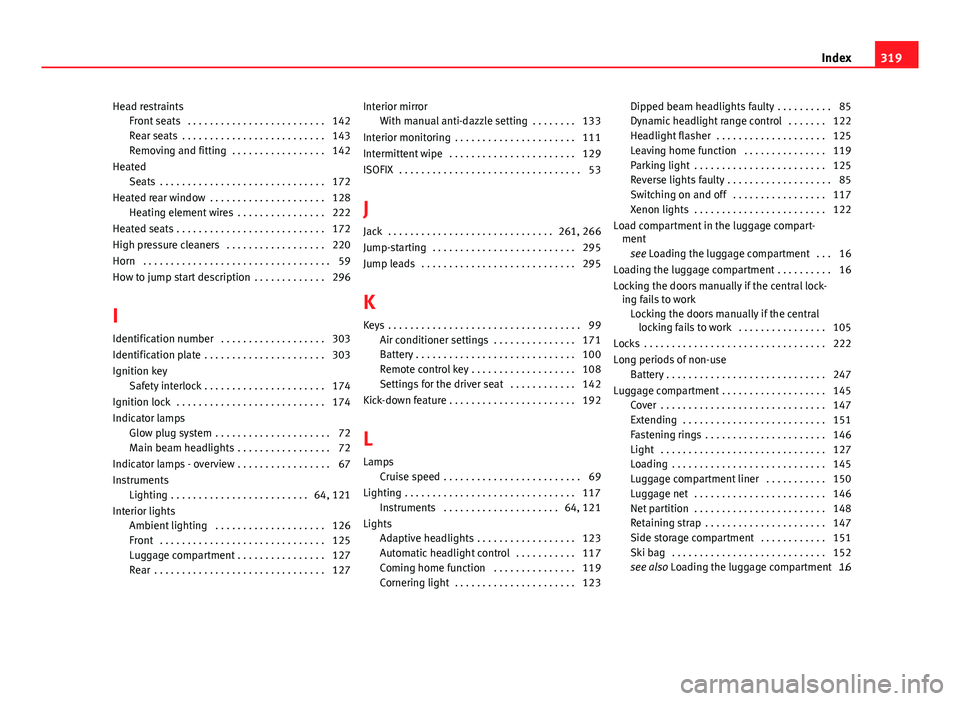
Head restraintsFront seats . . . . . . . . . . . . . . . . . . . . . . . . . 142
Rear seats . . . . . . . . . . . . . . . . . . . . . . . . . . 143
Removing and fitting . . . . . . . . . . . . . . . . . 142
Heated Seats . . . . . . . . . . . . . . . . . . . . . . . . . . . . . . 172
Heated rear window . . . . . . . . . . . . . . . . . . . . . 128 Heating element wires . . . . . . . . . . . . . . . . 222
Heated seats . . . . . . . . . . . . . . . . . . . . . . . . . . . 172
High pressure cleaners . . . . . . . . . . . . . . . . . . 220
Horn . . . . . . . . . . . . . . . . . . . . . . . . . . . . . . . . . . 59
How to jump start description . . . . . . . . . . . . . 296
I
Identification number . . . . . . . . . . . . . . . . . . . 303
Identification plate . . . . . . . . . . . . . . . . . . . . . . 303
Ignition key Safety interlock . . . . . . . . . . . . . . . . . . . . . . 174
Ignition lock . . . . . . . . . . . . . . . . . . . . . . . . . . . 174
Indicator lamps Glow plug system . . . . . . . . . . . . . . . . . . . . . 72
Main beam headlights . . . . . . . . . . . . . . . . . 72
Indicator lamps - overview . . . . . . . . . . . . . . . . . 67
Instruments Lighting . . . . . . . . . . . . . . . . . . . . . . . . . 64, 121
Interior lights Ambient lighting . . . . . . . . . . . . . . . . . . . . 126
Front . . . . . . . . . . . . . . . . . . . . . . . . . . . . . . 125
Luggage compartment . . . . . . . . . . . . . . . . 127
Rear . . . . . . . . . . . . . . . . . . . . . . . . . . . . . . . 127 Interior mirror
With manual anti-dazzle setting . . . . . . . . 133
Interior monitoring . . . . . . . . . . . . . . . . . . . . . . 111
Intermittent wipe . . . . . . . . . . . . . . . . . . . . . . . 129
ISOFIX . . . . . . . . . . . . . . . . . . . . . . . . . . . . . . . . . 53
J
Jack . . . . . . . . . . . . . . . . . . . . . . . . . . . . . . 261, 266
Jump-starting . . . . . . . . . . . . . . . . . . . . . . . . . . 295
Jump leads . . . . . . . . . . . . . . . . . . . . . . . . . . . . 295
K
Keys . . . . . . . . . . . . . . . . . . . . . . . . . . . . . . . . . . . 99 Air conditioner settings . . . . . . . . . . . . . . . 171
Battery . . . . . . . . . . . . . . . . . . . . . . . . . . . . . 100
Remote control key . . . . . . . . . . . . . . . . . . . 108
Settings for the driver seat . . . . . . . . . . . . 142
Kick-down feature . . . . . . . . . . . . . . . . . . . . . . . 192
L
Lamps Cruise speed . . . . . . . . . . . . . . . . . . . . . . . . . 69
Lighting . . . . . . . . . . . . . . . . . . . . . . . . . . . . . . . 117 Instruments . . . . . . . . . . . . . . . . . . . . . 64, 121
Lights Adaptive headlights . . . . . . . . . . . . . . . . . . 123
Automatic headlight control . . . . . . . . . . . 117
Coming home function . . . . . . . . . . . . . . . 119
Cornering light . . . . . . . . . . . . . . . . . . . . . . 123 Dipped beam headlights faulty . . . . . . . . . . 85
Dynamic headlight range control . . . . . . . 122
Headlight flasher . . . . . . . . . . . . . . . . . . . . 125
Leaving home function . . . . . . . . . . . . . . . 119
Parking light . . . . . . . . . . . . . . . . . . . . . . . . 125
Reverse lights faulty . . . . . . . . . . . . . . . . . . . 85
Switching on and off . . . . . . . . . . . . . . . . . 117
Xenon lights . . . . . . . . . . . . . . . . . . . . . . . . 122
Load compartment in the luggage compart- ment
see Loading the luggage compartment . . . 16
Loading the luggage compartment . . . . . . . . . . 16
Locking the doors manually if the central lock- ing fails to work
Locking the doors manually if the centrallocking fails to work . . . . . . . . . . . . . . . . 105
Locks . . . . . . . . . . . . . . . . . . . . . . . . . . . . . . . . . 222
Long periods of non-use Battery . . . . . . . . . . . . . . . . . . . . . . . . . . . . . 247
Luggage compartment . . . . . . . . . . . . . . . . . . . 145 Cover . . . . . . . . . . . . . . . . . . . . . . . . . . . . . . 147
Extending . . . . . . . . . . . . . . . . . . . . . . . . . . 151
Fastening rings . . . . . . . . . . . . . . . . . . . . . . 146
Light . . . . . . . . . . . . . . . . . . . . . . . . . . . . . . 127
Loading . . . . . . . . . . . . . . . . . . . . . . . . . . . . 145
Luggage compartment liner . . . . . . . . . . . 150
Luggage net . . . . . . . . . . . . . . . . . . . . . . . . 146
Net partition . . . . . . . . . . . . . . . . . . . . . . . . 148
Retaining strap . . . . . . . . . . . . . . . . . . . . . . 147
Side storage compartment . . . . . . . . . . . . 151
Ski bag . . . . . . . . . . . . . . . . . . . . . . . . . . . . 152
see also Loading the luggage compartment . .16
319
Index
Page 323 of 327
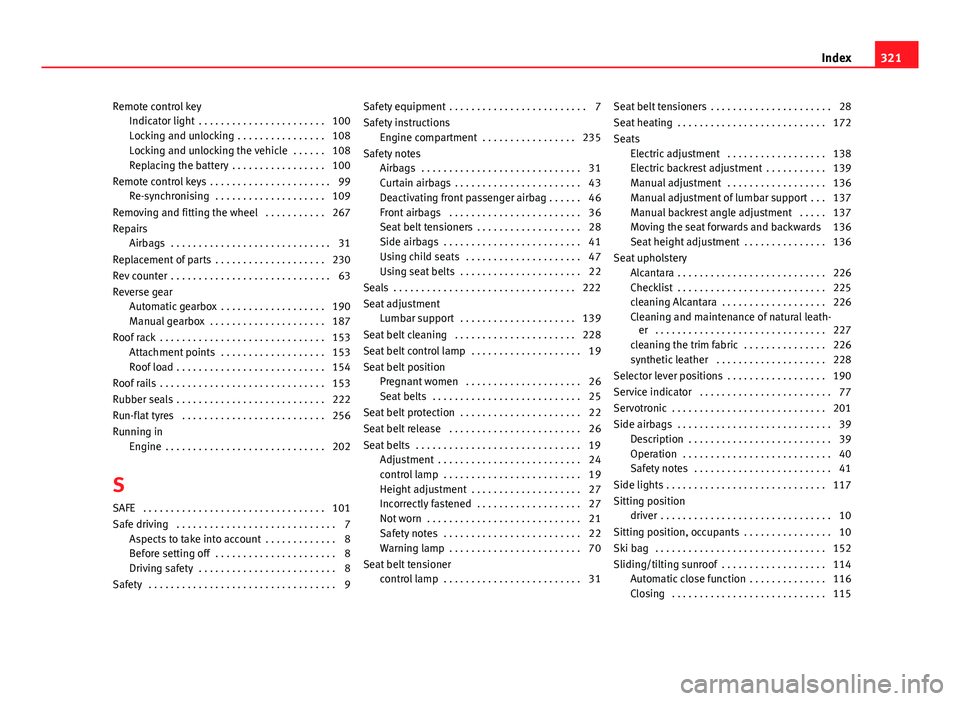
Remote control keyIndicator light . . . . . . . . . . . . . . . . . . . . . . . 100
Locking and unlocking . . . . . . . . . . . . . . . . 108
Locking and unlocking the vehicle . . . . . . 108
Replacing the battery . . . . . . . . . . . . . . . . . 100
Remote control keys . . . . . . . . . . . . . . . . . . . . . . 99 Re-synchronising . . . . . . . . . . . . . . . . . . . . 109
Removing and fitting the wheel . . . . . . . . . . . 267
Repairs Airbags . . . . . . . . . . . . . . . . . . . . . . . . . . . . . 31
Replacement of parts . . . . . . . . . . . . . . . . . . . . 230
Rev counter . . . . . . . . . . . . . . . . . . . . . . . . . . . . . 63
Reverse gear Automatic gearbox . . . . . . . . . . . . . . . . . . . 190
Manual gearbox . . . . . . . . . . . . . . . . . . . . . 187
Roof rack . . . . . . . . . . . . . . . . . . . . . . . . . . . . . . 153 Attachment points . . . . . . . . . . . . . . . . . . . 153
Roof load . . . . . . . . . . . . . . . . . . . . . . . . . . . 154
Roof rails . . . . . . . . . . . . . . . . . . . . . . . . . . . . . . 153
Rubber seals . . . . . . . . . . . . . . . . . . . . . . . . . . . 222
Run-flat tyres . . . . . . . . . . . . . . . . . . . . . . . . . . 256
Running in Engine . . . . . . . . . . . . . . . . . . . . . . . . . . . . . 202
S SAFE . . . . . . . . . . . . . . . . . . . . . . . . . . . . . . . . . 101
Safe driving . . . . . . . . . . . . . . . . . . . . . . . . . . . . . 7 Aspects to take into account . . . . . . . . . . . . . 8
Before setting off . . . . . . . . . . . . . . . . . . . . . . 8
Driving safety . . . . . . . . . . . . . . . . . . . . . . . . . 8
Safety . . . . . . . . . . . . . . . . . . . . . . . . . . . . . . . . . . 9 Safety equipment . . . . . . . . . . . . . . . . . . . . . . . . . 7
Safety instructions
Engine compartment . . . . . . . . . . . . . . . . . 235
Safety notes Airbags . . . . . . . . . . . . . . . . . . . . . . . . . . . . . 31
Curtain airbags . . . . . . . . . . . . . . . . . . . . . . . 43
Deactivating front passenger airbag . . . . . . 46
Front airbags . . . . . . . . . . . . . . . . . . . . . . . . 36
Seat belt tensioners . . . . . . . . . . . . . . . . . . . 28
Side airbags . . . . . . . . . . . . . . . . . . . . . . . . . 41
Using child seats . . . . . . . . . . . . . . . . . . . . . 47
Using seat belts . . . . . . . . . . . . . . . . . . . . . . 22
Seals . . . . . . . . . . . . . . . . . . . . . . . . . . . . . . . . . 222
Seat adjustment Lumbar support . . . . . . . . . . . . . . . . . . . . . 139
Seat belt cleaning . . . . . . . . . . . . . . . . . . . . . . 228
Seat belt control lamp . . . . . . . . . . . . . . . . . . . . 19
Seat belt position Pregnant women . . . . . . . . . . . . . . . . . . . . . 26
Seat belts . . . . . . . . . . . . . . . . . . . . . . . . . . . 25
Seat belt protection . . . . . . . . . . . . . . . . . . . . . . 22
Seat belt release . . . . . . . . . . . . . . . . . . . . . . . . 26
Seat belts . . . . . . . . . . . . . . . . . . . . . . . . . . . . . . 19 Adjustment . . . . . . . . . . . . . . . . . . . . . . . . . . 24
control lamp . . . . . . . . . . . . . . . . . . . . . . . . . 19
Height adjustment . . . . . . . . . . . . . . . . . . . . 27
Incorrectly fastened . . . . . . . . . . . . . . . . . . . 27
Not worn . . . . . . . . . . . . . . . . . . . . . . . . . . . . 21
Safety notes . . . . . . . . . . . . . . . . . . . . . . . . . 22
Warning lamp . . . . . . . . . . . . . . . . . . . . . . . . 70
Seat belt tensioner control lamp . . . . . . . . . . . . . . . . . . . . . . . . . 31 Seat belt tensioners . . . . . . . . . . . . . . . . . . . . . . 28
Seat heating . . . . . . . . . . . . . . . . . . . . . . . . . . . 172
Seats
Electric adjustment . . . . . . . . . . . . . . . . . . 138
Electric backrest adjustment . . . . . . . . . . . 139
Manual adjustment . . . . . . . . . . . . . . . . . . 136
Manual adjustment of lumbar support . . . 137
Manual backrest angle adjustment . . . . . 137
Moving the seat forwards and backwards 136
Seat height adjustment . . . . . . . . . . . . . . . 136
Seat upholstery Alcantara . . . . . . . . . . . . . . . . . . . . . . . . . . . 226
Checklist . . . . . . . . . . . . . . . . . . . . . . . . . . . 225
cleaning Alcantara . . . . . . . . . . . . . . . . . . . 226
Cleaning and maintenance of natural leath-er . . . . . . . . . . . . . . . . . . . . . . . . . . . . . . . 227
cleaning the trim fabric . . . . . . . . . . . . . . . 226
synthetic leather . . . . . . . . . . . . . . . . . . . . 228
Selector lever positions . . . . . . . . . . . . . . . . . . 190
Service indicator . . . . . . . . . . . . . . . . . . . . . . . . 77
Servotronic . . . . . . . . . . . . . . . . . . . . . . . . . . . . 201
Side airbags . . . . . . . . . . . . . . . . . . . . . . . . . . . . 39 Description . . . . . . . . . . . . . . . . . . . . . . . . . . 39
Operation . . . . . . . . . . . . . . . . . . . . . . . . . . . 40
Safety notes . . . . . . . . . . . . . . . . . . . . . . . . . 41
Side lights . . . . . . . . . . . . . . . . . . . . . . . . . . . . . 117
Sitting position driver . . . . . . . . . . . . . . . . . . . . . . . . . . . . . . . 10
Sitting position, occupants . . . . . . . . . . . . . . . . 10
Ski bag . . . . . . . . . . . . . . . . . . . . . . . . . . . . . . . 152
Sliding/tilting sunroof . . . . . . . . . . . . . . . . . . . 114 Automatic close function . . . . . . . . . . . . . . 116
Closing . . . . . . . . . . . . . . . . . . . . . . . . . . . . 115
321
Index