tyre pressure Seat Exeo ST 2013 Owner's Guide
[x] Cancel search | Manufacturer: SEAT, Model Year: 2013, Model line: Exeo ST, Model: Seat Exeo ST 2013Pages: 327, PDF Size: 5.07 MB
Page 261 of 327

259
Wheels and tyres
Wheel bolts
Wheel bolts must be tightened to the correct torque.
The design of wheel bolts is matched to the rims. If different wheel rims are
fitted, the correct wheel bolts with the right length and correctly shaped
bolt heads must be used. This ensures that wheels are fitted securely and
that the brake system functions correctly.
In certain circumstances, you should not use wheel bolts from a different
vehicle, even if it is the same model ⇒ page 230.
After the wheels have been changed, the tightening torque of the wheel
bolts should be checked as soon as possible with a torque wrench. ⇒
The tightening torque for steel and alloy wheels is 120 Nm.
WARNING
If the wheel bolts are not tightened correctly, the wheel could become
loose while driving. Risk of accident.
● The wheel bolts must be clean and turn easily. Never apply grease or
oil to them.
● Use only wheel bolts which belong to the wheel.
● If the tightening torque of the wheel bolts is too low, they could loos-
en whilst the vehicle is in motion. Risk of accident! If the tightening tor-
que is too high, the wheel bolts and threads can be damaged.
CAUTION
The prescribed tightening torque for wheel bolts for steel and alloy wheels
is 120 Nm. Winter tyres
Winter tyres will improve the vehicles handling on snow and
ice.
In winter conditions winter tyres will considerably improve the vehicle's han-
dling. The design of summer tyres (width, rubber compound, tread pattern)
gives less grip on ice and snow.
Winter tyres must be inflated to a pressure 0.2 bar higher than the pres-
sures specified for summer tyres (see sticker on fuel tank flap).
Winter tyres must be fitted on all four wheels.
Information on permitted winter tyre sizes can be found in the vehicle's reg-
istration documentation. Use only radial winter tyres. All tyre sizes listed in
the vehicle documentation also apply to winter tyres.
Winter tyres lose their effectiveness when the tread is worn down to a depth
of 4 mm.
The speed rating code ⇒ page 257, New tyres and wheels determines the
following speed limits for winter tyres: ⇒
max. 160 km/h (100 mph)
max. 180 km/h (110 mph)
max. 190 km/h (118 mph)
max. 210 km/h (130 mph)
In some countries, vehicles which can exceed the speed rating of the fitted
tyre must have an appropriate sticker in the driver's field of view. These
stickers are available from your Technical Service. The legal requirements of
each country must be followed.
Do not have winter tyres fitted for unnecessarily long periods. Vehicles with
summer tyres handle better when the roads are free of snow and ice.
Q
S
T
H
Safety FirstOperating instructionsPractical TipsTechnical Specifications
Page 264 of 327
262If and when
● A hook for removing wheel covers* or hub caps
● Box spanner for wheel bolts
● Towline anchorage
● An adapter for the anti-theft wheel bolts*
Before replacing the jack in the storage bin, wind down the arm of the jack
as far as it will go.
Some of the tools listed are only provided in certain models or are optional
extras.
WARNING
● The factory-supplied jack is only designed for changing wheels on
this model. On no account attempt to use it for lifting heavier vehicles or
other loads. Risk of injury.
● Never start the engine when the vehicle is raised. Failure to do so
could result in an accident.
● If work is to be carried out underneath the vehicle, this must be se-
cured by suitable stands. Otherwise, there is a risk of injury.
Tyre mobility system
The tyre mobility system is stored under the floor panel in
the luggage compartment.
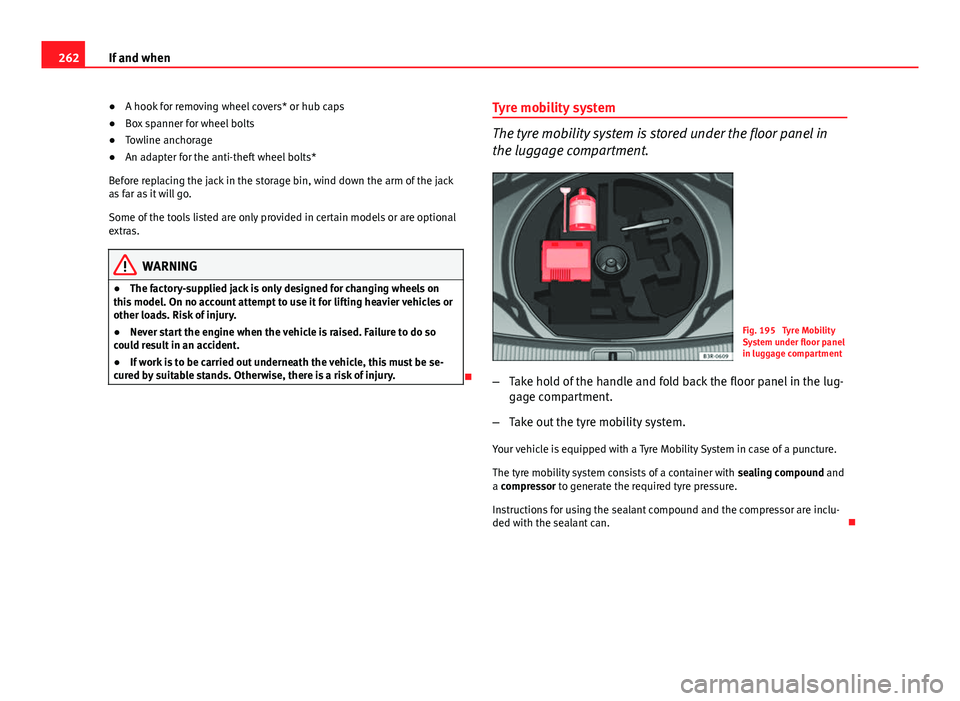
Fig. 195 Tyre Mobility
System under floor panel
in luggage compartment
– Take hold of the handle and fold back the floor panel in the lug-
gage compartment.
– Take out the tyre mobility system.
Your vehicle is equipped with a Tyre Mobility System in case of a puncture.
The tyre mobility system consists of a container with sealing compound and
a compressor to generate the required tyre pressure.
Instructions for using the sealant compound and the compressor are inclu-
ded with the sealant can.
Page 265 of 327

263
If and when
Spare steel rim wheel
The spare steel rim wheel is carried in the wheel well under
the floor panel in the luggage compartment. It is only inten-
ded for temporary use over short distances.
Fig. 196 Spare steel rim
wheel
Taking out the spare wheel
– Turn the plastic knob ⇒ Fig. 196 anticlockwise.
– Take out the spare wheel.
Securing the defective wheel in the spare wheel well
– Place wheel in spare wheel well in the luggage compartment.
– Secure the wheel by turning plastic knob clockwise.
– Replace the floor panel before closing the rear lid.
Your vehicle can be factory-equipped with a spare steel wheel. The spare
wheel does not usually meet the same performance standards as the wheels fitted on the vehicle because of the wheel/tyre dimensions, rubber
composition, tread pattern, etc. Therefore, note the following restrictions:
●
The spare steel wheel is designed only for your vehicle model. Do not
attempt to mount the wheel on any vehicle but your own.
● Your vehicle will have different driving characteristics when the spare
steel rim wheel is mounted ⇒
.
● The spare wheel is only intended for temporary use after having a flat
tyre. Replace the spare wheel with a normal wheel that has the proper tyre
dimensions as soon as possible.
● If the size of the spare steel rim wheel is different to that of the other
wheels, it is unlikely that snow chains suitable for the other wheels will fit it.
WARNING
● After mounting the spare steel rim wheel, the tyre pressure must be
checked and corrected as soon as possible. The tyre pressure must corre-
spond to the vehicle load (consult the table containing the inflation pres-
sures). Otherwise there is danger of causing an accident. Use the highest
tyre pressure as indicated in the table.
● Do not drive faster than 80 km/h, as higher speeds can cause an acci-
dent.
● Avoid heavy acceleration, hard braking and fast cornering, as this
could cause an accident.
Safety FirstOperating instructionsPractical TipsTechnical Specifications
Page 267 of 327
265
If and when
– The inflation pressure of the newly fitted spare tyre must be
checked as soon as possible.
– Have the tightening torque of the wheel bolts checked as soon
as possible with a torque wrench. It must be 120 Nm (always
when cold)
– Have the flat tyre replaced as quickly as possible.
Note
● If you notice that the wheel bolts are rusty and difficult to turn when
changing a wheel, they must be replaced before having the tightening tor-
que checked.
● For safety reasons, drive at moderate speeds until the wheel bolt tight-
ening torque has been checked. Loosening and tightening the wheel bolts
The wheel bolts must be loosened before raising the vehicle.
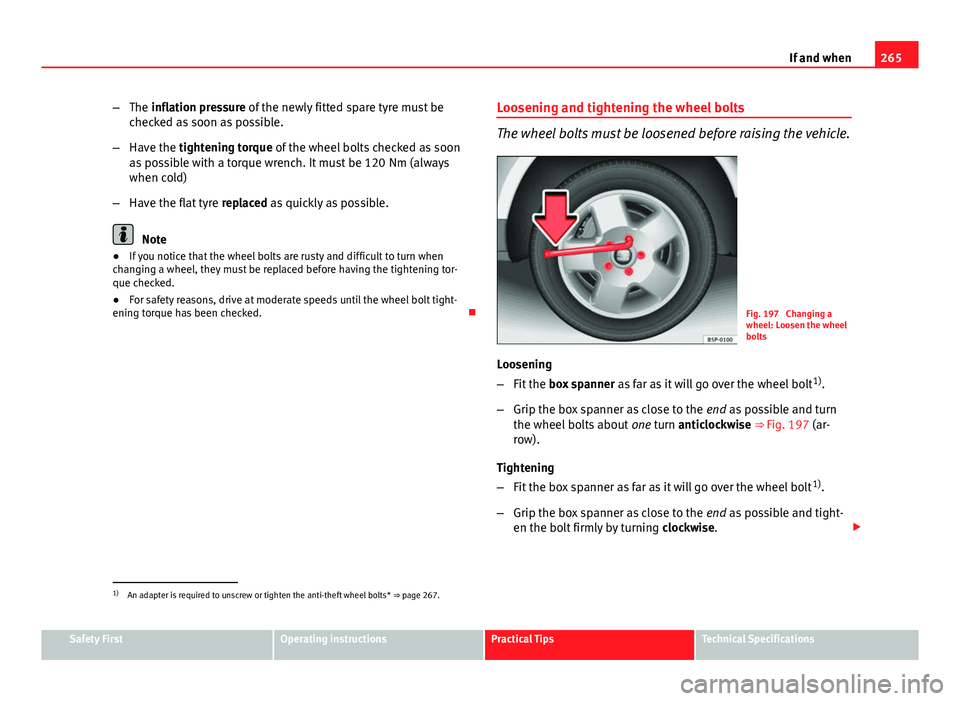
Fig. 197 Changing a
wheel: Loosen the wheel
bolts
Loosening
– Fit the box spanner as far as it will go over the wheel bolt 1)
.
– Grip the box spanner as close to the end as possible and turn
the wheel bolts about one turn anticlockwise ⇒ Fig. 197 (ar-
row).
Tightening
– Fit the box spanner as far as it will go over the wheel bolt 1)
.
– Grip the box spanner as close to the end as possible and tight-
en the bolt firmly by turning clockwise.
1)
An adapter is required to unscrew or tighten the anti-theft wheel bolts* ⇒ page 267.
Safety FirstOperating instructionsPractical TipsTechnical Specifications
Page 271 of 327

269
If and when
The sealing compound must not be used in the following cases:
● If the cuts and punctures on the tyre are longer than 4 mm ⇒ Fig. 201 1
●
If the wheel rim has been damaged 2●
If you have been driving with very low pressure or a completely flat tyre
3
How to use the TMS (tyre mobility system) is described in the section Re-
pairing a tyre ⇒ page 270 and in the instructions supplied with the tyre
sealant can.
The TMS (tire mobility system) can be used at outside temperatures down
to -20 °C.
WARNING
After repairing a tyre please note the following points:
● Do not drive faster than 80 km/h (50 mph).
● Avoid heavy acceleration, hard braking and fast cornering.
● Vehicle handling could be impaired.
● Tyres which have been sealed using the Tyre Mobility System are only
suitable for temporary use over a short period.
● After using the tyre sealant the tyre pressure monitoring system* may
malfunction. Therefore, please drive carefully to the next available speci-
alised workshop.
● The Tyre Mobility System must NOT be used:
– If the cuts and punctures on the tyre are longer or wider than
4 mm.
– if the wheel rim has been damaged.
– If you have been driving with very low pressure or a completely flat
tyre.
● Seek professional assistance if the repair of a tyre puncture is not
possible with the sealing product.
WARNING (Continued)
● Do not allow the sealing product to come into contact with your eyes,
skin or clothing.
● If you do come into contact with the sealing product immediately
rinse the eyes or skin affected with clean water.
● Change clothing immediately if it becomes soiled with the sealing
product.
● Make sure you do not breathe in the fumes!
● If any of the sealing product is accidentally ingested, immediately
rinse the mouth thoroughly and drink lots of water.
–Do not induce vomiting. Seek medical assistance if needed.
● If any allergic reactions should occur get medical help immediately.
● Keep the sealing product away from children.
For the sake of the environment
If you have to dispose of a sealant can, go to a specialised waste service or
to a SEAT Technical Service, where the product can be recycled in an appro-
priate waste container.
Note
● If sealing product should leak out, leave it to dry. This way you can pull it
off like a piece of foil.
● Observe the expiry date stated on the sealing compound can. Have the
sealing compound exchanged by a specialised workshop.
Safety FirstOperating instructionsPractical TipsTechnical Specifications
Page 272 of 327
270If and when
Repairing a tyre
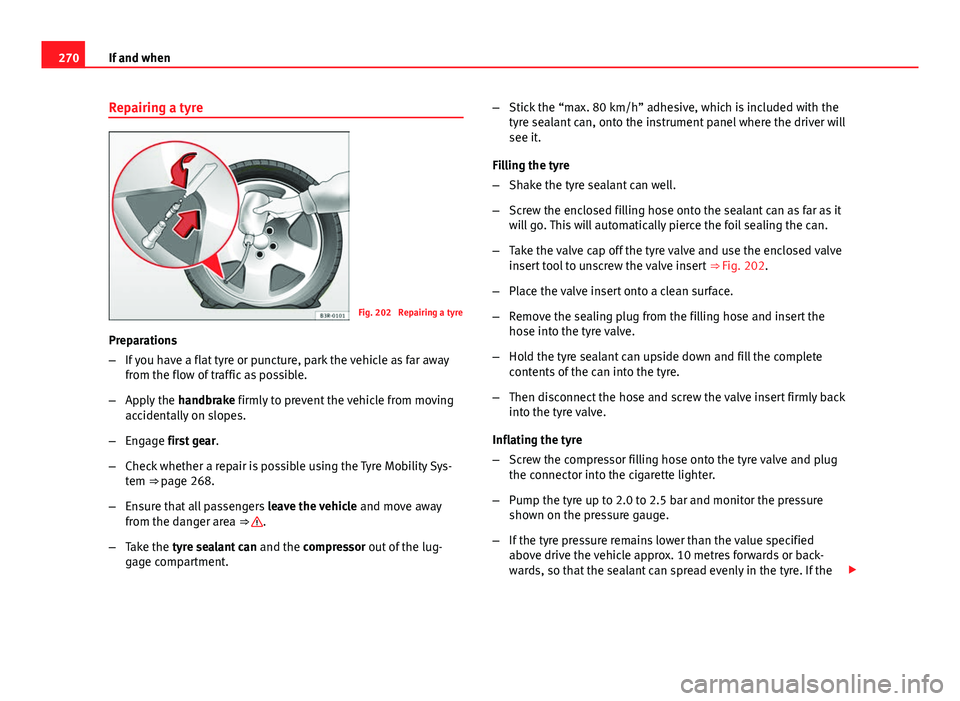
Fig. 202 Repairing a tyre
Preparations
– If you have a flat tyre or puncture, park the vehicle as far away
from the flow of traffic as possible.
– Apply the handbrake firmly to prevent the vehicle from moving
accidentally on slopes.
– Engage first gear .
– Check whether a repair is possible using the Tyre Mobility Sys-
tem ⇒ page 268.
– Ensure that all passengers leave the vehicle and move away
from the danger area ⇒
.
– Take the tyre sealant can and the compressor out of the lug-
gage compartment. –
Stick the “max. 80 km/h” adhesive, which is included with the
tyre sealant can, onto the instrument panel where the driver will
see it.
Filling the tyre
– Shake the tyre sealant can well.
– Screw the enclosed filling hose onto the sealant can as far as it
will go. This will automatically pierce the foil sealing the can.
– Take the valve cap off the tyre valve and use the enclosed valve
insert tool to unscrew the valve insert ⇒ Fig. 202.
– Place the valve insert onto a clean surface.
– Remove the sealing plug from the filling hose and insert the
hose into the tyre valve.
– Hold the tyre sealant can upside down and fill the complete
contents of the can into the tyre.
– Then disconnect the hose and screw the valve insert firmly back
into the tyre valve.
Inflating the tyre
– Screw the compressor filling hose onto the tyre valve and plug
the connector into the cigarette lighter.
– Pump the tyre up to 2.0 to 2.5 bar and monitor the pressure
shown on the pressure gauge.
– If the tyre pressure remains lower than the value specified
above drive the vehicle approx. 10 metres forwards or back-
wards, so that the sealant can spread evenly in the tyre. If the
Page 273 of 327

271
If and when
pressure is still lower than the specification the tyre is too badly
damaged and cannot be repaired using the tyre sealant.
Final check
– After about 10 minutes, stop to check the tyre pressure.
– If tyre pressure is less than 1.3 bar, the tyre is too badly dam-
aged. Do not drive on! You should obtain professional assis-
tance.
WARNING
● If you have a puncture in heavy traffic, switch on the hazard warning
lights and place the warning triangle in a visible location. This is for your
own safety and also warns other road users.
● Make sure your passengers wait in a safe place (for instance behind
the roadside crash barrier).
● Please observe the manufacturer's safety notes on the compressor
and the instructions supplied with the tyre sealant can.
● If it is not possible to build up a tyre pressure of 2.0 bar within 6 mi-
nutes this means that the tyre is too badly damaged. Do not drive on!
● Seek professional assistance if the repair of a tyre puncture is not
possible with the sealing product.
● If tyre pressure is less than 1.3 bar after driving about 10 minutes,
the tyre is too badly damaged. Do not drive on! Obtain technical assis-
tance.
CAUTION
Take special care if you have to repair a tyre on a slope.
Note
● Do not use the compressor for longer than 6 minutes. Otherwise, it
might overheat. When the compressor has cooled down, you can use it
again.
● If tyre sealant should leak out, leave it to dry and then pull it off like foil.
● After carrying out a tyre repair remember to buy a new tyre sealant can at
a specialised workshop. This will ensure that the Tyre Mobility System is op-
erative again.
● Please observe legal requirements when doing so.
Safety FirstOperating instructionsPractical TipsTechnical Specifications
Page 307 of 327
305
Description of specifications
Towing a trailer Trailer weights
Trailer weight
The trailer weights and drawbar loads approved are selected in intensive tri-
als according to precisely defined criteria. The approved trailer weights are
valid for vehicles in the EU for maximum speeds of 80 km/h (50 mph) (in
certain circumstances up to 100 km/h (60 mph). The figures may be differ-
ent in other countries. All data in the official vehicle documentation takes
precedence over these data at all times ⇒
.
Drawbar loads
The maximum permitted drawbar load on the ball joint of the towing bracket
must not exceed 75 kg.
In the interest of road safety, we recommend that you always tow approach-
ing the maximum drawbar load. The response of the trailer on the road will
be poor if the drawbar load is too small.
If the maximum permissible drawbar load cannot be met (e.g. with small,
empty and light-weight single axle trailers or tandem axle trailers with a
wheelbase of less than 1 metre), a minimum of 4% of the actual trailer
weight is legally required for the drawbar load.
WARNING
● For safety reasons, do not exceed the 80 km/h (50 mph) limit. This is
also valid in countries where higher speeds are permitted.
● Never exceed the maximum trailer weights or the drawbar load. If the
permissible axle load or the permissible total weight is exceeded, the
driving characteristics of the vehicle may change, leading to accidents,
injuries and damage to the vehicle.
Wheels
Tyre pressure, snow chains, wheel bolts
Tyre pressures
The sticker with the tyre pressure values can be found on the inside of the
fuel tank flap. The tyre pressure values given there are for cold tyres. The
slightly raised pressures of warm tyres must not be reduced. ⇒
Snow chains
Snow chains may be fitted only to the front wheels.
Consult the section “wheels” of this manual.
Wheel bolts
After the wheels have been changed, the tightening torque of the wheel
bolts should be checked as soon as possible with a torque wrench ⇒
.
The tightening torque for steel and alloy wheels is 120 Nm.
WARNING
● Check the tyre pressure at least once per month. Checking the tyre
pressure is very important. If the tyre pressure is too high or too low,
there is an increased danger of accidents, particularly at high speeds.
● If the tightening torque of the wheel bolts is too low, they could loos-
en while the vehicle is in motion. Risk of accident! If the tightening tor-
que is too high, the wheel bolts and threads can be damaged.
Note
We recommend that you ask your Technical Service for information about
appropriate wheel, tyre and snow chain size.
Safety FirstOperating instructionsPractical TipsTechnical Specifications
Page 316 of 327

314Technical specifications
Dimensions and capacities
Dimensions
Length, width 4661-4741a)
mm/ 1772 mm
Height at kerb weight 1454 mm with roof bars
Front and rear projection 976 mm/ 1048-1123a)
mm
Wheelbase 2642 mm
Turning circle 11.2 m
Track width b) Front
Rear
1522 mm 1523 mm
Capacities
Fuel tank 70 litres. Reserve 10 litres.
Windscreen washer fluid container with headlight washer 4.8 l.
Tyre pressure
Summer-grade tyres:
The correct tyre pressure can be seen on the sticker on the inside of the tank flap.
Winter tyres:
The pressure of these tyres is the same as the summer tyre pressure plus 0.2 bar.
a) With towing eye.
b) This data will change depending on the type of wheel rim.
Page 320 of 327
Electronic Stability Control . . . . . . . . . . . . . . . . 71description . . . . . . . . . . . . . . . . . . . . . . . . . 173
Operation . . . . . . . . . . . . . . . . . . . . . . . . . . 196
warning lamp . . . . . . . . . . . . . . . . . . . . . . . 174
Emergencies Changing a wheel . . . . . . . . . . . . . . . . . . . 264
Disconnecting the battery . . . . . . . . . . . . . 248
Jack . . . . . . . . . . . . . . . . . . . . . . . . . . . 261, 266
Sunroof emergency activation . . . . . . . . . . 116
Tools . . . . . . . . . . . . . . . . . . . . . . . . . . . . . . 261
Tyre mobility system . . . . . . . . . . . . . . . . . . 262
Engine Running in . . . . . . . . . . . . . . . . . . . . . . . . . 202
Starting . . . . . . . . . . . . . . . . . . . . . . . . . . . . 175
Stop . . . . . . . . . . . . . . . . . . . . . . . . . . . . . . . 176
Engine compartment Safety instructions . . . . . . . . . . . . . . . . . . . 235
Engine coolant G 12 plus-plus . . . . . . . . . . . . . . . . . . . . . . 240
G 13 . . . . . . . . . . . . . . . . . . . . . . . . . . . . . . . 240
Specifications . . . . . . . . . . . . . . . . . . . . . . . 240
Engine oil . . . . . . . . . . . . . . . . . . . . . . . . . . . . . 237 Checking oil level . . . . . . . . . . . . . . . . . . . . 239
Checking the level . . . . . . . . . . . . . . . . . . . . 83
Consumption . . . . . . . . . . . . . . . . . . . . . . . 239
Engine oil pressure too low . . . . . . . . . . . . . 81
Oil properties . . . . . . . . . . . . . . . . . . . . . . . 238
Oil sensor defective . . . . . . . . . . . . . . . . . . . 83
Topping up . . . . . . . . . . . . . . . . . . . . . . . . . 240
Engine speed governing . . . . . . . . . . . . . . . . . . 83
Environment . . . . . . . . . . . . . . . . . . . . . . . . . . . 204 Environmental friendliness . . . . . . . . . . . . 206
Roof racks . . . . . . . . . . . . . . . . . . . . . . . . . . 154 Environmentally friendly driving . . . . . . . . . . . 204
Environmental tip
Avoiding pollution . . . . . . . . . . . . . . . . . . . 233
ESC . . . . . . . . . . . . . . . . . . . . . . . . . . . . . . . . . . . 71 see also Electronic Stability Control . . . . . 173
Exhaust gas purification system . . . . . . . . . . . 203
Exterior mirrors . . . . . . . . . . . . . . . . . . . . . . . . . 221
F
Fastening rings . . . . . . . . . . . . . . . . . . . . . . . . . . 17
Floor mats . . . . . . . . . . . . . . . . . . . . . . . . . . . . . . 16
Fog lights . . . . . . . . . . . . . . . . . . . . . . . . . . . . . 119
Front airbags . . . . . . . . . . . . . . . . . . . . . . . . . . . 33 Description . . . . . . . . . . . . . . . . . . . . . . . . . . 33
Operation . . . . . . . . . . . . . . . . . . . . . . . . . . . 34
Safety notes . . . . . . . . . . . . . . . . . . . . . . . . . 36
Front drink holder . . . . . . . . . . . . . . . . . . . . . . . 154
Front passenger airbag deactivation . . . . . . . . 45
Fuel Diesel . . . . . . . . . . . . . . . . . . . . . . . . . . . . . 234
Fuel gauge . . . . . . . . . . . . . . . . . . . . . . . . . . 65
Fuel level low . . . . . . . . . . . . . . . . . . . . . . . . 83
Instantaneous fuel consumption . . . . . . . . 88
Petrol . . . . . . . . . . . . . . . . . . . . . . . . . . . . . . 233
Fuel consumption . . . . . . . . . . . . . . . . . . . 204, 303
Fuel tank opening the fuel tank flap . . . . . . . . . . . . . 232
Fuel: save . . . . . . . . . . . . . . . . . . . . . . . . . . . . . 204
Fuses . . . . . . . . . . . . . . . . . . . . . . . . . . . . . . . . . 272 Fuse box . . . . . . . . . . . . . . . . . . . . . . . . . . . 273
Identifying blown fuses . . . . . . . . . . . . . . . 274 Identifying by colours . . . . . . . . . . . . . . . . 273
Preparation before replacing . . . . . . . . . . . 274
Replacement . . . . . . . . . . . . . . . . . . . . . . . . 273
G
Gear display . . . . . . . . . . . . . . . . . . . . . . . . . . . . 76
Gear shift pattern . . . . . . . . . . . . . . . . . . . . . . . 187
General overview of the engine compartment 306
Glove compartment . . . . . . . . . . . . . . . . . . . . . 160 Light . . . . . . . . . . . . . . . . . . . . . . . . . . . . . . 125
H
Handbrake . . . . . . . . . . . . . . . . . . . . . . . . . . . . 180 Control lamp . . . . . . . . . . . . . . . . . . . . . . . . . 72
Hazard warning lights . . . . . . . . . . . . . . . . . . . 123
Headlight range control . . . . . . . . . . . . . . . . . . 121 Dynamic . . . . . . . . . . . . . . . . . . . . . . . . . . . 122
Faulty . . . . . . . . . . . . . . . . . . . . . . . . . . . . . . . 84
Headlights Adaptive headlights . . . . . . . . . . . . . . . . . . 123
Automatic headlight control . . . . . . . . . . . 118
Automatic headlight control photosensors . .118
Driving abroad . . . . . . . . . . . . . . . . . . . . . . 206
Front fog lights . . . . . . . . . . . . . . . . . . . . . . 119
Headlight range control . . . . . . . . . . . . . . . 121
Headlight washer system . . . . . . . . . . . . . 132
Head restraint Rear seat . . . . . . . . . . . . . . . . . . . . . . . . . . . 143
318 Index