ECU Seat Exeo ST 2013 Service Manual
[x] Cancel search | Manufacturer: SEAT, Model Year: 2013, Model line: Exeo ST, Model: Seat Exeo ST 2013Pages: 327, PDF Size: 5.07 MB
Page 214 of 327
212Trailer towing
Fitting the ball joint (step 1)
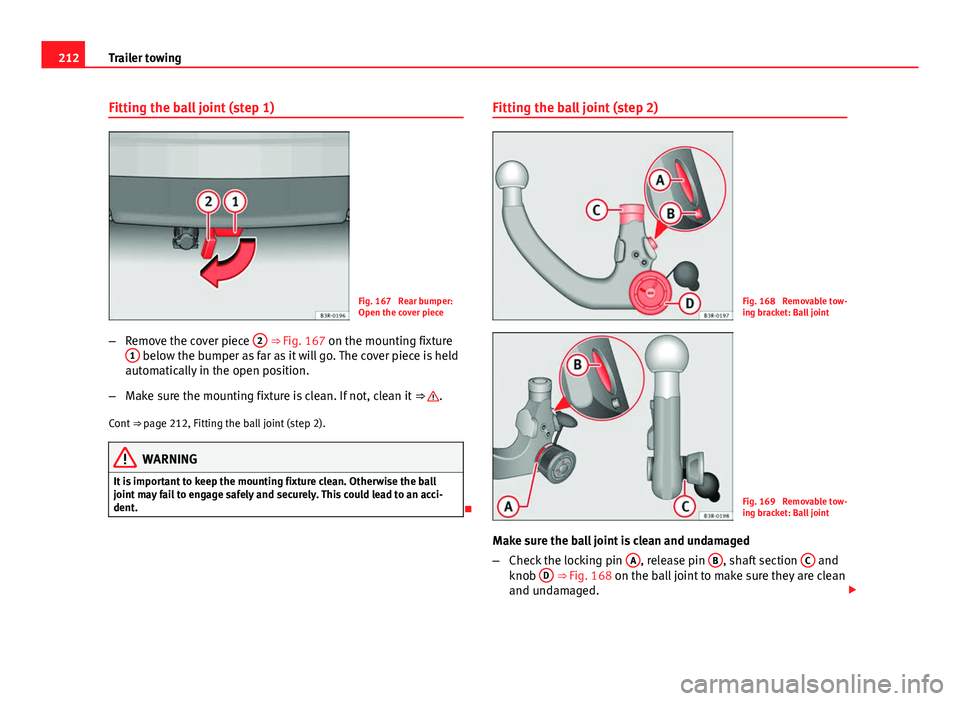
Fig. 167 Rear bumper:
Open the cover piece
– Remove the cover piece 2
⇒ Fig. 167 on the mounting fixture
1 below the bumper as far as it will go. The cover piece is held
automatically in the open position.
– Make sure the mounting fixture is clean. If not, clean it ⇒
.
Cont ⇒ page 212, Fitting the ball joint (step 2).
WARNING
It is important to keep the mounting fixture clean. Otherwise the ball
joint may fail to engage safely and securely. This could lead to an acci-
dent.
Fitting the ball joint (step 2)
Fig. 168 Removable tow-
ing bracket: Ball joint
Fig. 169 Removable tow-
ing bracket: Ball joint
Make sure the ball joint is clean and undamaged
– Check the locking pin A
, release pin B, shaft section C and
knob D ⇒ Fig. 168 on the ball joint to make sure they are clean
and undamaged.
Page 218 of 327
216Trailer towing
WARNING
● To avoid injury, keep your hands away from the locking pin and the
release pin when releasing the locking mechanism.
● Make sure that the cover piece is properly engaged on the mounting
fixture on the vehicle. Otherwise the ball joint may fail to engage secure-
ly if dirt accumulates in the mounting fixture.
Fitting a towing bracket*
It is possible to fit a towing bracket to the rear of the vehicle.
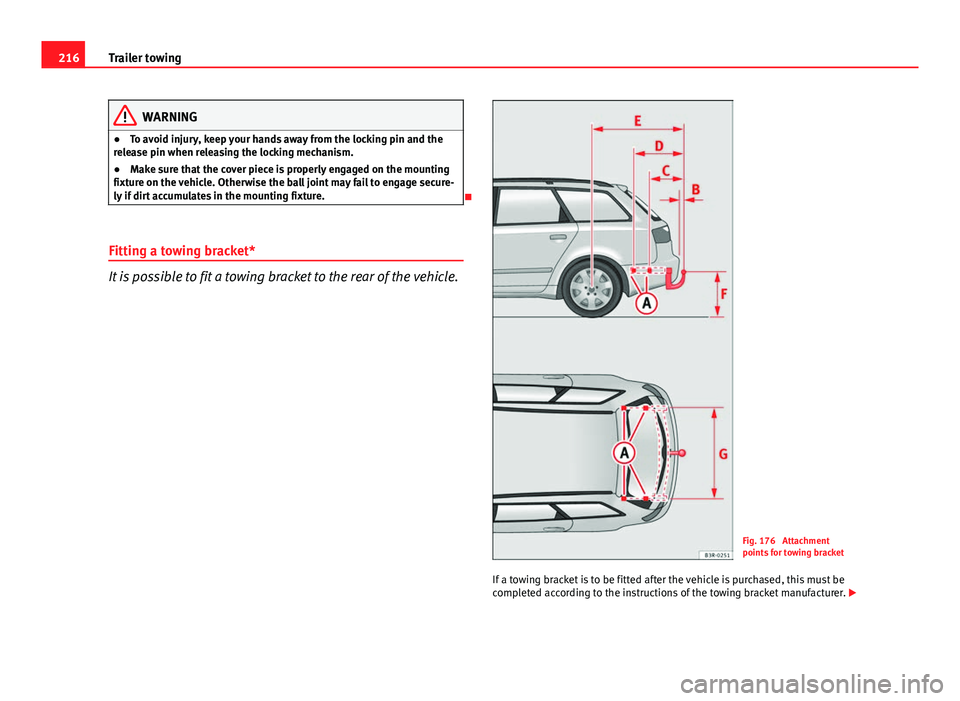
Fig. 176 Attachment
points for towing bracket
If a towing bracket is to be fitted after the vehicle is purchased, this must be
completed according to the instructions of the towing bracket manufacturer.
Page 219 of 327
217
Trailer towing
The attachment points for the towing bracket A
are on the lower part of the
vehicle.
The distance between the centre of the ball coupling and the ground should
never be lower than the indicated value, even with a fully loaded vehicle
and including the maximum drawbar load.
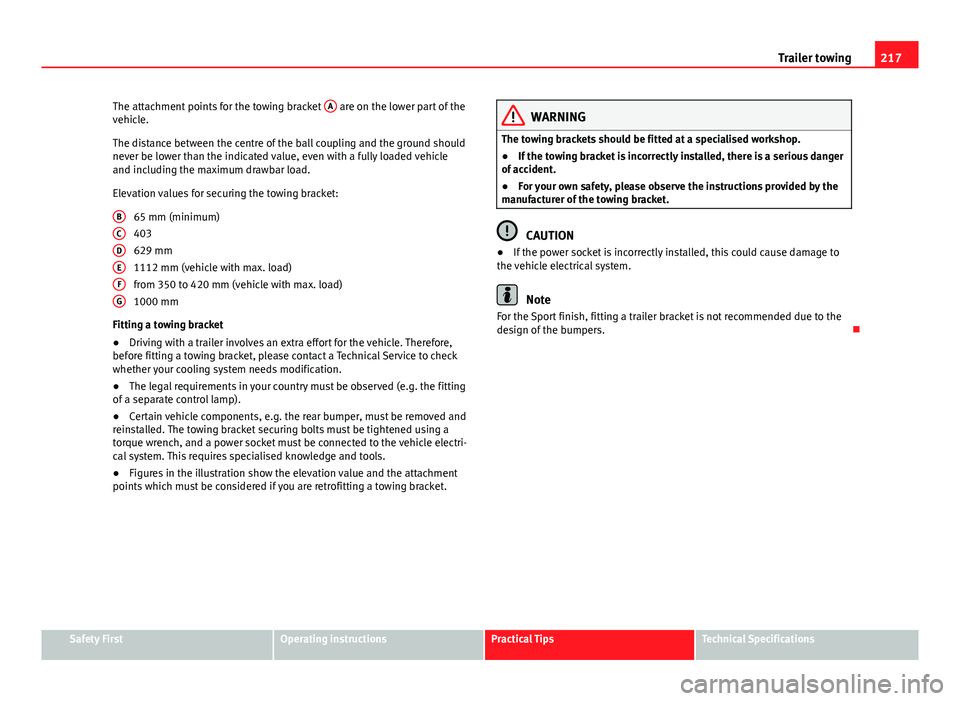
Elevation values for securing the towing bracket:
65 mm (minimum)
403
629 mm
1112 mm (vehicle with max. load)
from 350 to 420 mm (vehicle with max. load)
1000 mm
Fitting a towing bracket
● Driving with a trailer involves an extra effort for the vehicle. Therefore,
before fitting a towing bracket, please contact a Technical Service to check
whether your cooling system needs modification.
● The legal requirements in your country must be observed (e.g. the fitting
of a separate control lamp).
● Certain vehicle components, e.g. the rear bumper, must be removed and
reinstalled. The towing bracket securing bolts must be tightened using a
torque wrench, and a power socket must be connected to the vehicle electri-
cal system. This requires specialised knowledge and tools.
● Figures in the illustration show the elevation value and the attachment
points which must be considered if you are retrofitting a towing bracket. B
CDEFG
WARNING
The towing brackets should be fitted at a specialised workshop.
● If the towing bracket is incorrectly installed, there is a serious danger
of accident.
● For your own safety, please observe the instructions provided by the
manufacturer of the towing bracket.
CAUTION
● If the power socket is incorrectly installed, this could cause damage to
the vehicle electrical system.
Note
For the Sport finish, fitting a trailer bracket is not recommended due to the
design of the bumpers.
Safety FirstOperating instructionsPractical TipsTechnical Specifications
Page 239 of 327
237
Checking and refilling levels
Opening the bonnet
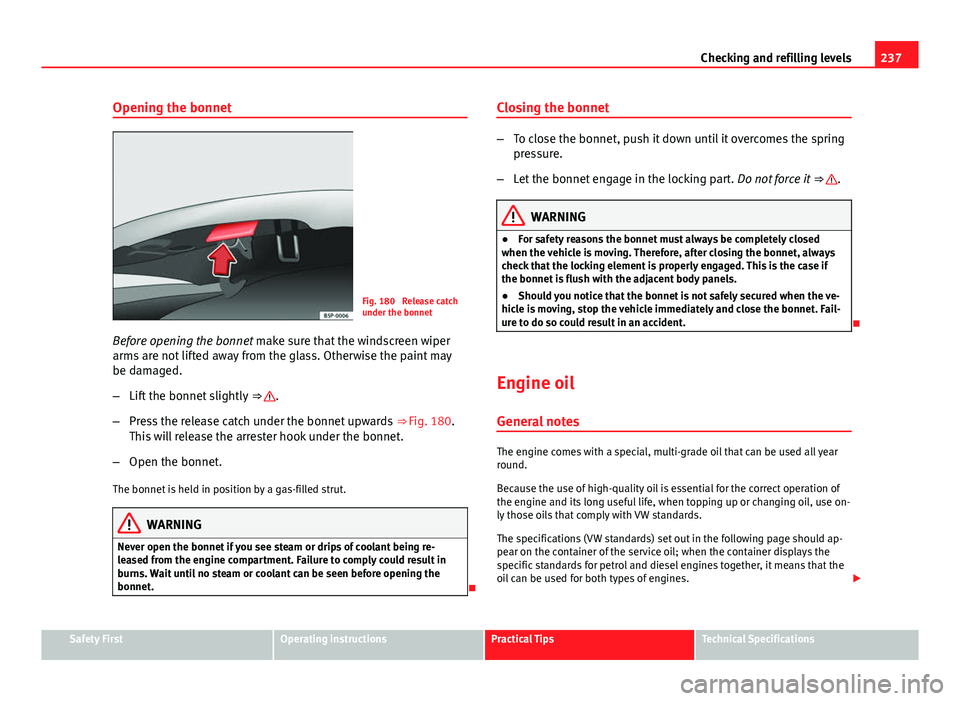
Fig. 180 Release catch
under the bonnet
Before opening the bonnet make sure that the windscreen wiper
arms are not lifted away from the glass. Otherwise the paint may
be damaged.
– Lift the bonnet slightly ⇒
.
– Press the release catch under the bonnet upwards ⇒ Fig. 180.
This will release the arrester hook under the bonnet.
– Open the bonnet.
The bonnet is held in position by a gas-filled strut.
WARNING
Never open the bonnet if you see steam or drips of coolant being re-
leased from the engine compartment. Failure to comply could result in
burns. Wait until no steam or coolant can be seen before opening the
bonnet.
Closing the bonnet
–
To close the bonnet, push it down until it overcomes the spring
pressure.
– Let the bonnet engage in the locking part. Do not force it ⇒
.
WARNING
● For safety reasons the bonnet must always be completely closed
when the vehicle is moving. Therefore, after closing the bonnet, always
check that the locking element is properly engaged. This is the case if
the bonnet is flush with the adjacent body panels.
● Should you notice that the bonnet is not safely secured when the ve-
hicle is moving, stop the vehicle immediately and close the bonnet. Fail-
ure to do so could result in an accident.
Engine oil General notes
The engine comes with a special, multi-grade oil that can be used all year
round.
Because the use of high-quality oil is essential for the correct operation of
the engine and its long useful life, when topping up or changing oil, use on-
ly those oils that comply with VW standards.
The specifications (VW standards) set out in the following page should ap-
pear on the container of the service oil; when the container displays the
specific standards for petrol and diesel engines together, it means that the
oil can be used for both types of engines.
Safety FirstOperating instructionsPractical TipsTechnical Specifications
Page 250 of 327

248Checking and refilling levels
Disconnecting the battery
If the battery is disconnected, some of the vehicle's functions will become
inoperative (e.g. electric windows). These functions will require resetting af-
ter the battery is reconnected. For this reason, the battery should only be
disconnected from the vehicle's electrical system when absolutely necessa-
ry.
Long periods of non-use
The battery will gradually lose its charge because certain electrical equip-
ment continues to draw current even when the ignition is off. If you park the
vehicle for long periods of time in winter you should take the battery out of
the vehicle and store it in a place protected from frost. This way it will not
freeze and become damaged. At warm outside temperatures it is sufficient
to disconnect the negative terminal of the battery. Even when the battery is
not connected you should charge it from time to time.
Winter operation
The battery is drained more in cold weather, which means that the starting
power is reduced. For this reason, have the battery checked and charged if
necessary before the start of winter.
Replacing the battery
A replacement battery must have the same capacity, voltage and current rat-
ing. It must also have the same dimensions as the original, factory-fitted
battery and have sealed caps. The SEAT batteries which have been specially
developed fulfil the maintenance, performance and safety specifications for
your vehicle.
We recommend you use maintenance-free batteries.
WARNING
● All work on batteries requires specialist knowledge. If work is re-
quired on the battery, this should be performed by a Technical Service or
specialised workshop. Danger of caustic burns and explosion!
● The battery must not be opened. Never try to change the battery's liq-
uid level. Explosive gas is released from the battery that could cause an
explosion.
CAUTION
● The battery holder and clamps must always be correctly secured.
● Before starting any work on the battery, always observe the warnings
listed under ⇒
.
For the sake of the environment
Batteries contain toxic substances including sulphuric acid and lead.
Therefore, they must be disposed of in line with environmental regulations
and must not be disposed of with ordinary household waste. Make sure dis-
connected batteries cannot tip over. Sulphuric acid could be spilt!
Important safety warnings for handling a vehicle battery
The battery is located at the back of the engine compartment ⇒ page 306.
Wear eye protection
Battery acid is extremely corrosive. Wear protective gloves and
eye protection!
Fires, sparks, open flames and smoking are prohibited!
Page 261 of 327

259
Wheels and tyres
Wheel bolts
Wheel bolts must be tightened to the correct torque.
The design of wheel bolts is matched to the rims. If different wheel rims are
fitted, the correct wheel bolts with the right length and correctly shaped
bolt heads must be used. This ensures that wheels are fitted securely and
that the brake system functions correctly.
In certain circumstances, you should not use wheel bolts from a different
vehicle, even if it is the same model ⇒ page 230.
After the wheels have been changed, the tightening torque of the wheel
bolts should be checked as soon as possible with a torque wrench. ⇒
The tightening torque for steel and alloy wheels is 120 Nm.
WARNING
If the wheel bolts are not tightened correctly, the wheel could become
loose while driving. Risk of accident.
● The wheel bolts must be clean and turn easily. Never apply grease or
oil to them.
● Use only wheel bolts which belong to the wheel.
● If the tightening torque of the wheel bolts is too low, they could loos-
en whilst the vehicle is in motion. Risk of accident! If the tightening tor-
que is too high, the wheel bolts and threads can be damaged.
CAUTION
The prescribed tightening torque for wheel bolts for steel and alloy wheels
is 120 Nm. Winter tyres
Winter tyres will improve the vehicles handling on snow and
ice.
In winter conditions winter tyres will considerably improve the vehicle's han-
dling. The design of summer tyres (width, rubber compound, tread pattern)
gives less grip on ice and snow.
Winter tyres must be inflated to a pressure 0.2 bar higher than the pres-
sures specified for summer tyres (see sticker on fuel tank flap).
Winter tyres must be fitted on all four wheels.
Information on permitted winter tyre sizes can be found in the vehicle's reg-
istration documentation. Use only radial winter tyres. All tyre sizes listed in
the vehicle documentation also apply to winter tyres.
Winter tyres lose their effectiveness when the tread is worn down to a depth
of 4 mm.
The speed rating code ⇒ page 257, New tyres and wheels determines the
following speed limits for winter tyres: ⇒
max. 160 km/h (100 mph)
max. 180 km/h (110 mph)
max. 190 km/h (118 mph)
max. 210 km/h (130 mph)
In some countries, vehicles which can exceed the speed rating of the fitted
tyre must have an appropriate sticker in the driver's field of view. These
stickers are available from your Technical Service. The legal requirements of
each country must be followed.
Do not have winter tyres fitted for unnecessarily long periods. Vehicles with
summer tyres handle better when the roads are free of snow and ice.
Q
S
T
H
Safety FirstOperating instructionsPractical TipsTechnical Specifications
Page 265 of 327

263
If and when
Spare steel rim wheel
The spare steel rim wheel is carried in the wheel well under
the floor panel in the luggage compartment. It is only inten-
ded for temporary use over short distances.
Fig. 196 Spare steel rim
wheel
Taking out the spare wheel
– Turn the plastic knob ⇒ Fig. 196 anticlockwise.
– Take out the spare wheel.
Securing the defective wheel in the spare wheel well
– Place wheel in spare wheel well in the luggage compartment.
– Secure the wheel by turning plastic knob clockwise.
– Replace the floor panel before closing the rear lid.
Your vehicle can be factory-equipped with a spare steel wheel. The spare
wheel does not usually meet the same performance standards as the wheels fitted on the vehicle because of the wheel/tyre dimensions, rubber
composition, tread pattern, etc. Therefore, note the following restrictions:
●
The spare steel wheel is designed only for your vehicle model. Do not
attempt to mount the wheel on any vehicle but your own.
● Your vehicle will have different driving characteristics when the spare
steel rim wheel is mounted ⇒
.
● The spare wheel is only intended for temporary use after having a flat
tyre. Replace the spare wheel with a normal wheel that has the proper tyre
dimensions as soon as possible.
● If the size of the spare steel rim wheel is different to that of the other
wheels, it is unlikely that snow chains suitable for the other wheels will fit it.
WARNING
● After mounting the spare steel rim wheel, the tyre pressure must be
checked and corrected as soon as possible. The tyre pressure must corre-
spond to the vehicle load (consult the table containing the inflation pres-
sures). Otherwise there is danger of causing an accident. Use the highest
tyre pressure as indicated in the table.
● Do not drive faster than 80 km/h, as higher speeds can cause an acci-
dent.
● Avoid heavy acceleration, hard braking and fast cornering, as this
could cause an accident.
Safety FirstOperating instructionsPractical TipsTechnical Specifications
Page 266 of 327
264If and when
Changing a wheel
Preparation work
What you must do before changing a wheel.
– If you have a flat tyre or puncture, park the vehicle as far away
from the flow of traffic as possible. Choose a location that is as
level as possible.
– All occupants should leave the vehicle. They should wait in a
safe place (e.g. behind the roadside crash barrier).
– Apply the handbrake firmly.
– Engage first gear .
– When towing a trailer: Unhitch the trailer from your vehicle.
– Take the tools and the spare wheel ⇒ page 261 out of the lug-
gage compartment.
WARNING
If you have a puncture in heavy traffic, switch on the hazard warning
lights and place the warning triangle in a visible location. This is for your
own safety and also warns other road users.
CAUTION
If you have to change the tyre on a gradient, block the wheel opposite the
wheel being changed by placing a stone or similar object under it to prevent
the vehicle from rolling away.
Note
Please observe legal requirements when doing so.
Changing a wheel
Change the wheel as described below.
– Remove the wheel cover .
– Loosen the wheel bolts ⇒ page 265.
– Raise the vehicle with the jack ⇒ page 266.
– Take off the wheel with the flat tyre and then put on the spare
wheel ⇒ page 267.
– Lower the vehicle.
– Tighten the wheel bolts firmly in diagonal sequence with the
box spanner ⇒ page 265.
– Replace the cover.
After changing a wheel
After changing the wheel, there are still tasks to complete. – Place the wheel with the defective tyre in the spare wheel well
and secure it.
– Put the tools and jack back in the luggage compartment.
Page 288 of 327
286If and when
Removing tail light
To change the bulbs you must remove the tail light assem-
bly. Removing the light requires a certain degree of practical
skill.
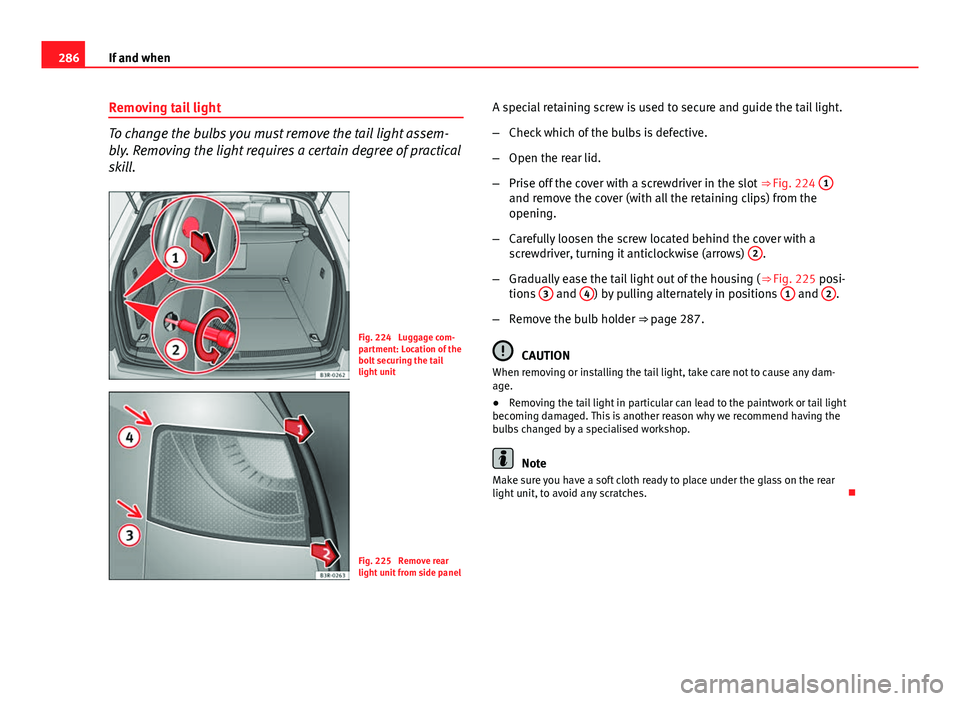
Fig. 224 Luggage com-
partment: Location of the
bolt securing the tail
light unit
Fig. 225 Remove rear
light unit from side panel A special retaining screw is used to secure and guide the tail light.
–
Check which of the bulbs is defective.
– Open the rear lid.
– Prise off the cover with a screwdriver in the slot ⇒ Fig. 224 1
and remove the cover (with all the retaining clips) from the
opening.
– Carefully loosen the screw located behind the cover with a
screwdriver, turning it anticlockwise (arrows) 2
.
– Gradually ease the tail light out of the housing ( ⇒ Fig. 225 posi-
tions 3
and 4) by pulling alternately in positions 1 and 2.
– Remove the bulb holder ⇒ page 287.
CAUTION
When removing or installing the tail light, take care not to cause any dam-
age.
● Removing the tail light in particular can lead to the paintwork or tail light
becoming damaged. This is another reason why we recommend having the
bulbs changed by a specialised workshop.
Note
Make sure you have a soft cloth ready to place under the glass on the rear
light unit, to avoid any scratches.
Page 289 of 327
287
If and when
Remove the bulb holder
When changing a bulb, you must first remove the bulb hold-
er.
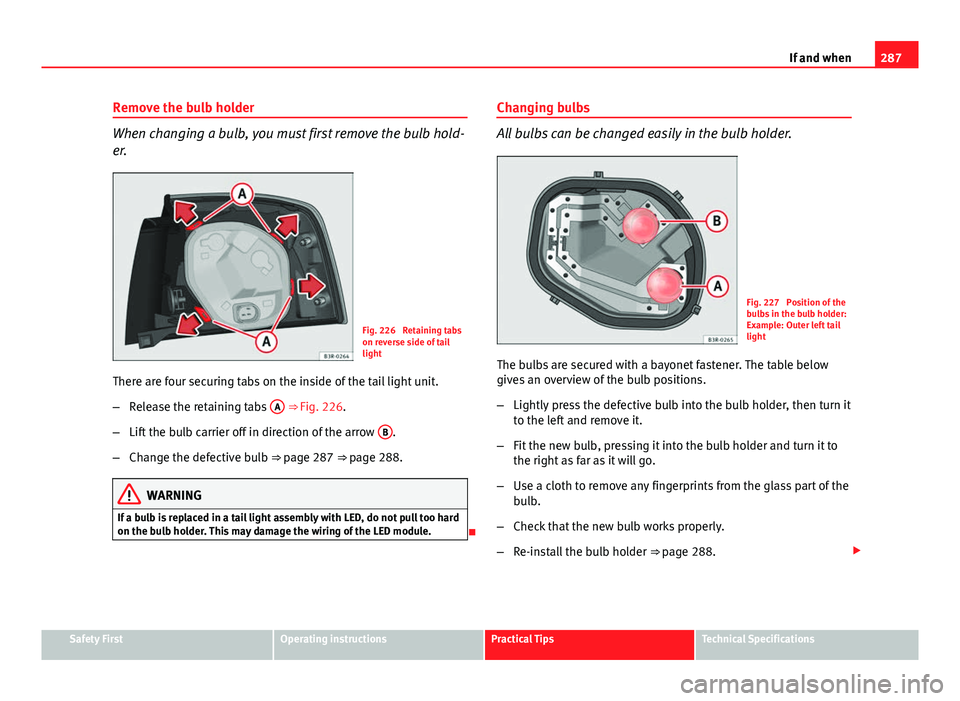
Fig. 226 Retaining tabs
on reverse side of tail
light
There are four securing tabs on the inside of the tail light unit.
– Release the retaining tabs A
⇒ Fig. 226.
– Lift the bulb carrier off in direction of the arrow B
.
– Change the defective bulb ⇒ page 287 ⇒ page 288.
WARNING
If a bulb is replaced in a tail light assembly with LED, do not pull too hard
on the bulb holder. This may damage the wiring of the LED module.
Changing bulbs
All bulbs can be changed easily in the bulb holder.
Fig. 227 Position of the
bulbs in the bulb holder:
Example: Outer left tail
light
The bulbs are secured with a bayonet fastener. The table below
gives an overview of the bulb positions.
– Lightly press the defective bulb into the bulb holder, then turn it
to the left and remove it.
– Fit the new bulb, pressing it into the bulb holder and turn it to
the right as far as it will go.
– Use a cloth to remove any fingerprints from the glass part of the
bulb.
– Check that the new bulb works properly.
– Re-install the bulb holder ⇒ page 288.
Safety FirstOperating instructionsPractical TipsTechnical Specifications