turn signal Seat Exeo ST 2013 Owner's manual
[x] Cancel search | Manufacturer: SEAT, Model Year: 2013, Model line: Exeo ST, Model: Seat Exeo ST 2013Pages: 327, PDF Size: 5.07 MB
Page 6 of 327
Trailer towing . . . . . . . . . . . . . . . . . . . . . . . . . . . . . . 208
Trailer towing . . . . . . . . . . . . . . . . . . . . . . . . . . . . . 208
Removable towing bracket . . . . . . . . . . . . . . . . . . 211
Vehicle maintenance and cleaning . . . . . . . . . 218
General notes . . . . . . . . . . . . . . . . . . . . . . . . . . . . 218
Care of the vehicle exterior . . . . . . . . . . . . . . . . . . 219
Vehicle interior maintenance . . . . . . . . . . . . . . . . 224
Accessories, replacement of parts and
modifications . . . . . . . . . . . . . . . . . . . . . . . . . . . . . 230
Accessories and spare parts . . . . . . . . . . . . . . . . 230
Technical modifications . . . . . . . . . . . . . . . . . . . . 230
Mobile phones and two-way radios . . . . . . . . . . . 231
Athermic windscreen* . . . . . . . . . . . . . . . . . . . . . 231
Checking and refilling levels . . . . . . . . . . . . . . . 232
Refuelling . . . . . . . . . . . . . . . . . . . . . . . . . . . . . . . 232
Petrol . . . . . . . . . . . . . . . . . . . . . . . . . . . . . . . . . . . 233
Diesel . . . . . . . . . . . . . . . . . . . . . . . . . . . . . . . . . . . 234
Bonnet . . . . . . . . . . . . . . . . . . . . . . . . . . . . . . . . . . 235
Engine oil . . . . . . . . . . . . . . . . . . . . . . . . . . . . . . . . 237
Cooling system . . . . . . . . . . . . . . . . . . . . . . . . . . . 240
Washer fluid and windscreen wiper blades . . . . 243
Brake fluid . . . . . . . . . . . . . . . . . . . . . . . . . . . . . . . 246
Vehicle battery . . . . . . . . . . . . . . . . . . . . . . . . . . . 247
Wheels and tyres . . . . . . . . . . . . . . . . . . . . . . . . . . 251
Wheels . . . . . . . . . . . . . . . . . . . . . . . . . . . . . . . . . . 251
If and when . . . . . . . . . . . . . . . . . . . . . . . . . . . . . . . 261
Tools, tyre repair kit and spare wheel . . . . . . . . . 261
Changing a wheel . . . . . . . . . . . . . . . . . . . . . . . . . 264
Tyre repair* (Tyre-Mobility-System) . . . . . . . . . . . 268
Fuses . . . . . . . . . . . . . . . . . . . . . . . . . . . . . . . . . . . 272
Bulbs . . . . . . . . . . . . . . . . . . . . . . . . . . . . . . . . . . . 274
Changing bulbs. Halogen headlights . . . . . . . . . 275
Changing bulbs. Bi-Xenon AFS headlights . . . . . 281
Changing tail light bulbs (on side panel) . . . . . . 285
Changing tail light bulbs (on rear lid) . . . . . . . . . 290
Side turn signals . . . . . . . . . . . . . . . . . . . . . . . . . . 293 Luggage compartment lights . . . . . . . . . . . . . . . . 294
Registration light . . . . . . . . . . . . . . . . . . . . . . . . . . 294
Sun visor light . . . . . . . . . . . . . . . . . . . . . . . . . . . . 295
Jump-starting . . . . . . . . . . . . . . . . . . . . . . . . . . . . . 295
Towing and tow-starting . . . . . . . . . . . . . . . . . . . . 299
Technical Specifications . . . . . . . . . . . 302
Description of specifications . . . . . . . . . . . . . . . 302
Important information . . . . . . . . . . . . . . . . . . . . . 302
Information on fuel consumption . . . . . . . . . . . . 303
Towing a trailer . . . . . . . . . . . . . . . . . . . . . . . . . . . 305
Wheels . . . . . . . . . . . . . . . . . . . . . . . . . . . . . . . . . . 305
Technical specifications . . . . . . . . . . . . . . . . . . . . 306
Engine specifications . . . . . . . . . . . . . . . . . . . . . . 306
Dimensions and capacities . . . . . . . . . . . . . . . . . 314
Index . . . . . . . . . . . . . . . . . . . . . . . . . . . . . . . . . . . 315
4Table of Contents
Page 39 of 327
37
Airbag system
that the airbag system can only help to protect you if you are wearing your
seat belt and wearing it properly.
Remember too that airbags will deploy only once and only in certain kinds
of accidents - your seat belts are always there to offer protection in those
accidents in which airbags are not supposed to deploy or when they have
already deployed, for example when your vehicle strikes or is struck by an-
other after the first collision.
This is just one of the reasons why an airbag is not a substitute for the seat
belt. The airbag system works most effectively when used with the seat
belts. Therefore, always wear your seat belts correctly.
It is important to remember that while the airbag system is designed to re-
duce the possibility of serious injuries, other injuries, for example, swelling,
bruising, and minor abrasions can also be associated with airbags.
The knee airbag system basically consists of:
● The electronic control module
● One inflatable airbag (airbag and gas generator) for the driver
● An airbag indicator light on the instrument panel
The knee airbag system will not be triggered:
● if the ignition is switched off
● in frontal collisions when the deceleration measured by the control unit
is too low
● in side collisions
● in rear-end collisions
● in rollovers
● in the event of a system malfunction (hazard warning lights/turn signals
illuminated) ⇒ page 67.
WARNING
● Seat belts and the airbag system can only provide protection when
occupants are in the proper seating position.
● If the airbag indicator light comes on when the vehicle is being used,
have the system inspected immediately by your Technical Service. The
airbag may not work properly when the vehicle acceleration in a side col-
lision is high enough to deploy the airbag. See also ⇒ page 67.
How knee airbags work
The risk of injury to the leg area is reduced by fully deployed
knee airbags.
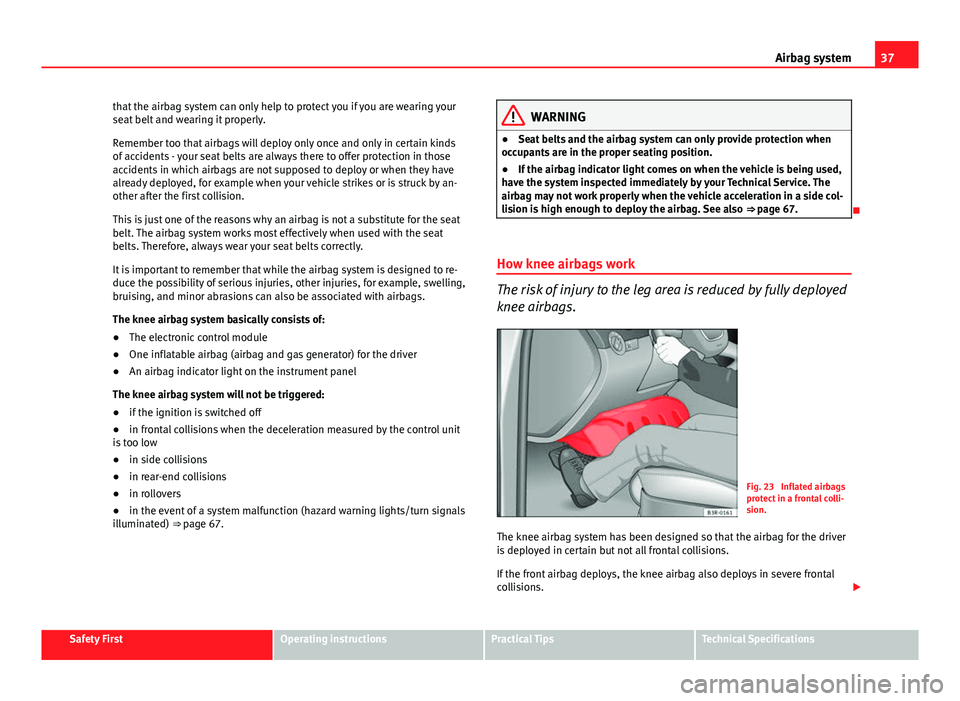
Fig. 23 Inflated airbags
protect in a frontal colli-
sion.
The knee airbag system has been designed so that the airbag for the driver
is deployed in certain but not all frontal collisions.
If the front airbag deploys, the knee airbag also deploys in severe frontal
collisions.
Safety FirstOperating instructionsPractical TipsTechnical Specifications
Page 61 of 327

59
Cockpit
Operating instructions Cockpit
Overview Dash panel overview
Electric windows . . . . . . . . . . . . . . . . . . . . . . . . . . . . . . . . . . . . . . . . . . 112
Door handle
Central locking switch . . . . . . . . . . . . . . . . . . . . . . . . . . . . . . . . . . . . . 103
Electric control for exterior mirrors . . . . . . . . . . . . . . . . . . . . . . . . .134
Air outlets with thumbwheel . . . . . . . . . . . . . . . . . . . . . . . . . . . . . . . 170
Light switch . . . . . . . . . . . . . . . . . . . . . . . . . . . . . . . . . . . . . . . . . . . . . . . 117
Lever for turn signals and main beam headlights . . . . . . . . . . .124
Instrument panel . . . . . . . . . . . . . . . . . . . . . . . . . . . . . . . . . . . . . . . . . . 61
Levers and switches for:
– Windscreen wipers and washer . . . . . . . . . . . . . . . . . . . . . . . . . . 129
– On-board computer . . . . . . . . . . . . . . . . . . . . . . . . . . . . . . . . . . . . . 88
– Menu display . . . . . . . . . . . . . . . . . . . . . . . . . . . . . . . . . . . . . . . . . . . 91
Ignition lock . . . . . . . . . . . . . . . . . . . . . . . . . . . . . . . . . . . . . . . . . . . . . . 174
Depending on equipment fitted:
– Electronic Stability Control (ESC) . . . . . . . . . . . . . . . . . . . . . . . .71
– Start-Stop switch . . . . . . . . . . . . . . . . . . . . . . . . . . . . . . . . . . . . . . . 177
– Warning lamp indicating that front passenger airbag has
been disabled . . . . . . . . . . . . . . . . . . . . . . . . . . . . . . . . . . . . . . . . . . 45
– Switch for acoustic parking aid . . . . . . . . . . . . . . . . . . . . . . . . . . 182
Hazard warning lights . . . . . . . . . . . . . . . . . . . . . . . . . . . . . . . . . . . . . 123
123456789
1011
12
Drink holder
. . . . . . . . . . . . . . . . . . . . . . . . . . . . . . . . . . . . . . . . . . . . . . 154
Storage compartment
Depending on equipment fitted: Sound system or navigation
system
Lockable glove compartment . . . . . . . . . . . . . . . . . . . . . . . . . . . . . . 160
Front passenger airbag . . . . . . . . . . . . . . . . . . . . . . . . . . . . . . . . . . . . 33
Air conditioner . . . . . . . . . . . . . . . . . . . . . . . . . . . . . . . . . . . . . . . . . . . . 165
Switch for heated rear window . . . . . . . . . . . . . . . . . . . . . . . . . . . . . 128
Thumbwheel for seat heating . . . . . . . . . . . . . . . . . . . . . . . . . . . . . . 172
Ashtray . . . . . . . . . . . . . . . . . . . . . . . . . . . . . . . . . . . . . . . . . . . . . . . . . . . 155
Manual gear lever
Cigarette lighter/Power socket . . . . . . . . . . . . . . . . . . . . . . . . . . . . . 155
Auxiliary socket
Tyre pressure monitoring . . . . . . . . . . . . . . . . . . . . . . . . . . . . . . . . . . 69
Storage compartment
Handbrake . . . . . . . . . . . . . . . . . . . . . . . . . . . . . . . . . . . . . . . . . . . . . . . . 180
Seat memory* . . . . . . . . . . . . . . . . . . . . . . . . . . . . . . . . . . . . . . . . . . . . 140
Bonnet lock release . . . . . . . . . . . . . . . . . . . . . . . . . . . . . . . . . . . . . . . 235
Headlight range control . . . . . . . . . . . . . . . . . . . . . . . . . . . . . . . . . . . 121
– coming home and leaving home: delayed lights off and
anticipated lights on function . . . . . . . . . . . . . . . . . . . . . . . . . . . 119
Lever for cruise control . . . . . . . . . . . . . . . . . . . . . . . . . . . . . . . . . . . . 184
131415
161718192021222324252627282930
31
Safety FirstOperating instructionsPractical TipsTechnical Specifications
Page 69 of 327

67
Cockpit
Warning and indicator lamps General description
The warning and indicator lamps indicate a number of dif-
ferent functions and possible faults.
Fig. 45 Instrument panel with warning and indicator lamps
Exhaust emission control system⇒ page 68
Airbag system⇒ page 68
Tyre pressure too low⇒ page 69
Cruise speed (Cruise control)⇒ page 69
Trailer turn signals⇒ page 69
Anti-lock brake system (ABS)⇒ page 70
Seat belt warning⇒ page 70
If it stays lit: ASR switched off⇒ page 71
⇒ page 71
⇒ page 173
Left turn signals⇒ page 71
If flashing: the Electronic Stability Control
(ESC) is working or the ASR is working
If the following remain lit: ESC or ASR
faulty⇒ page 71
⇒ page 71
⇒ page 173
Alternator⇒ page 72
Main beam headlights⇒ page 72
Handbrake on⇒ page 72
⇒ page 79
Engine management (alternative to )⇒ page 72
Glow plug system (alternative to )⇒ page 72
Fault in brake system⇒ page 73
Right turn signals⇒ page 71
Safety FirstOperating instructionsPractical TipsTechnical Specifications
Page 71 of 327
69
Cockpit
Tyre pressure warning lamp*
The tyre pressure should be corrected as soon as possible if
it is too low.
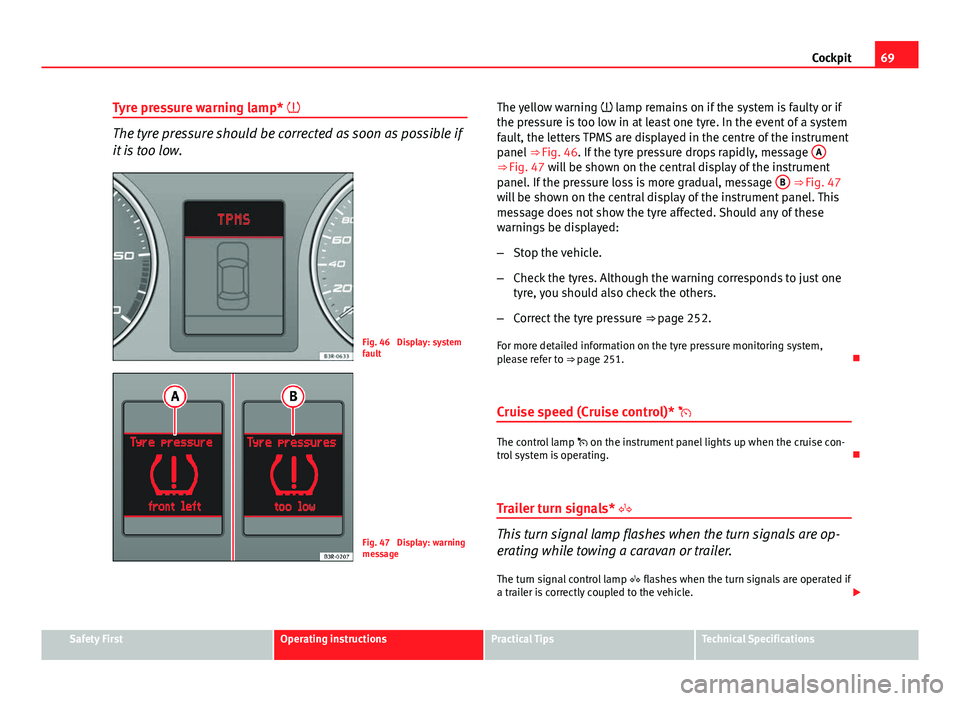
Fig. 46 Display: system
fault
Fig. 47 Display: warning
message The yellow warning
lamp remains on if the system is faulty or if
the pressure is too low in at least one tyre. In the event of a system
fault, the letters TPMS are displayed in the centre of the instrument
panel ⇒ Fig. 46. If the tyre pressure drops rapidly, message A
⇒ Fig. 47 will be shown on the central display of the instrument
panel. If the pressure loss is more gradual, message B ⇒ Fig. 47
will be shown on the central display of the instrument panel. This
message does not show the tyre affected. Should any of these
warnings be displayed:
– Stop the vehicle.
– Check the tyres. Although the warning corresponds to just one
tyre, you should also check the others.
– Correct the tyre pressure ⇒ page 252.
For more detailed information on the tyre pressure monitoring system,
please refer to ⇒ page 251.
Cruise speed (Cruise control)*
The control lamp on the instrument panel lights up when the cruise con-
trol system is operating.
Trailer turn signals*
This turn signal lamp flashes when the turn signals are op-
erating while towing a caravan or trailer. The turn signal control lamp flashes when the turn signals are operated if
a trailer is correctly coupled to the vehicle.
Safety FirstOperating instructionsPractical TipsTechnical Specifications
Page 72 of 327
70Cockpit
Where a turn signal bulb does not work, either on the trailer or on the tow-
ing vehicle, the turn signal bulb will not flash.
Anti-lock brake system (ABS)
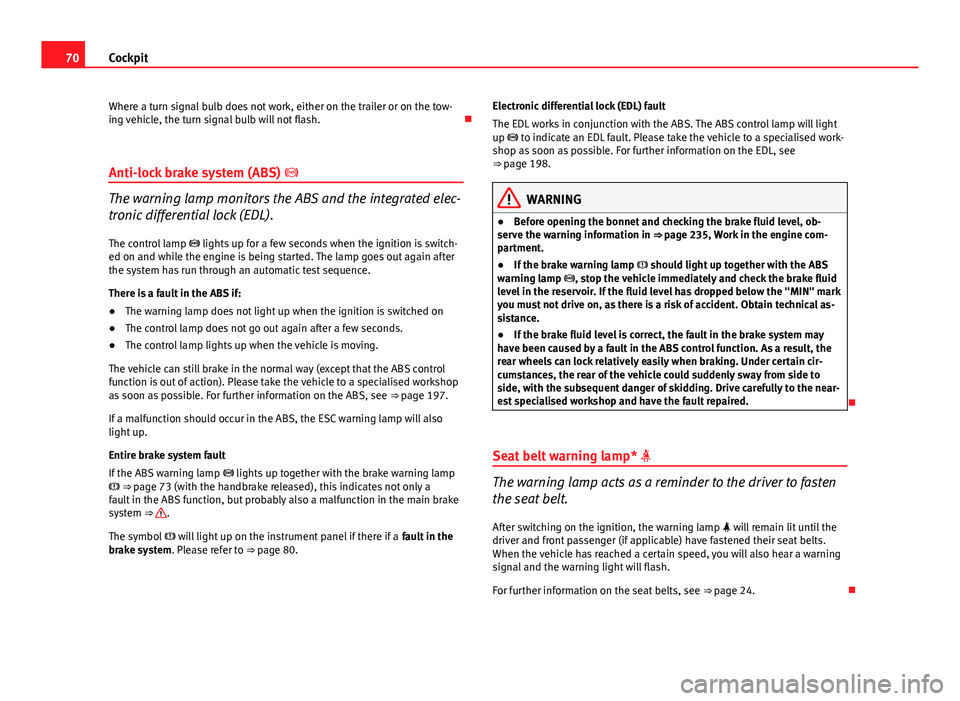
The warning lamp monitors the ABS and the integrated elec-
tronic differential lock (EDL).
The control lamp lights up for a few seconds when the ignition is switch-
ed on and while the engine is being started. The lamp goes out again after
the system has run through an automatic test sequence.
There is a fault in the ABS if:
● The warning lamp does not light up when the ignition is switched on
● The control lamp does not go out again after a few seconds.
● The control lamp lights up when the vehicle is moving.
The vehicle can still brake in the normal way (except that the ABS control
function is out of action). Please take the vehicle to a specialised workshop
as soon as possible. For further information on the ABS, see ⇒ page 197.
If a malfunction should occur in the ABS, the ESC warning lamp will also
light up.
Entire brake system fault
If the ABS warning lamp lights up together with the brake warning lamp
⇒ page 73 (with the handbrake released), this indicates not only a
fault in the ABS function, but probably also a malfunction in the main brake
system ⇒
.
The symbol will light up on the instrument panel if there if a fault in the
brake system. Please refer to ⇒ page 80. Electronic differential lock (EDL) fault
The EDL works in conjunction with the ABS. The ABS control lamp will light
up to indicate an EDL fault. Please take the vehicle to a specialised work-
shop as soon as possible. For further information on the EDL, see
⇒ page 198.
WARNING
● Before opening the bonnet and checking the brake fluid level, ob-
serve the warning information in ⇒ page 235, Work in the engine com-
partment.
● If the brake warning lamp should light up together with the ABS
warning lamp , stop the vehicle immediately and check the brake fluid
level in the reservoir. If the fluid level has dropped below the "MIN" mark
you must not drive on, as there is a risk of accident. Obtain technical as-
sistance.
● If the brake fluid level is correct, the fault in the brake system may
have been caused by a fault in the ABS control function. As a result, the
rear wheels can lock relatively easily when braking. Under certain cir-
cumstances, the rear of the vehicle could suddenly sway from side to
side, with the subsequent danger of skidding. Drive carefully to the near-
est specialised workshop and have the fault repaired.
Seat belt warning lamp*
The warning lamp acts as a reminder to the driver to fasten
the seat belt. After switching on the ignition, the warning lamp will remain lit until the
driver and front passenger (if applicable) have fastened their seat belts.
When the vehicle has reached a certain speed, you will also hear a warning
signal and the warning light will flash.
For further information on the seat belts, see ⇒ page 24.
Page 73 of 327
71
Cockpit
Turn signals and hazard warning lights
Depending on which turn signal is operated, either the left or right turn
signal lamp flashes. Both turn signal lamps will flash when the hazard warn-
ing lights are switched on.
If a turn signal fails, the indicator lamp will start flashing twice as fast as
normal.
This does not apply when towing a trailer. Where a turn signal bulb does not
work, either on the trailer or on the towing vehicle, the turn signal bulb will
not flash. For further information on the turn signals, see ⇒ page 124.
Electronic Stability Control (ESC)* /
There are two control lamps for the electronic stability con-
trol. The lamp provides information concerning the func-
tion and the provides information on the disconnection
status
Both lamps come on together when the ignition is switched on and should
go out after approx. 2 seconds, which is how long the function check lasts.
This programme includes the ABS, EDL and ASR. This also includes the
brake assistance system (BAS), automatic cleaning of the brake discs and
the trailer stability programme (TSP).
The warning lamp has the following functions:
● It flashes whilst driving when the ASR/ESC is activated.
● It will light up continuously if there is a fault in the ESC.
● As the ESC operates in conjunction with the ABS, it will also light up if a
fault should occur in the ABS. If the ESC control lamp
lights up and stays on after the engine is started,
this may mean that the control system has temporarily switched off the ESC.
In this case the ESC can be reactivated by switching the ignition off and
then on again. If the control lamp goes out, this means the system is fully
functional.
The lamp provides information about the disconnection status of the
system:
● It stays lit when the ASR is disconnected when pressing the switch.
Traction control system (ASR)* /
The traction control system prevents the driven wheels from
spinning when the vehicle is accelerating
There are two warning lamps for the traction control system: and . Both
lamps come on together when the ignition is switched on and should go out
after approx. 2 seconds, which is how long the function check lasts.
The lamp has the following function:
● It flashes when the ASR is working if the vehicle is moving.
If the system is deactivated or if it has any fault, the warning lamp will re-
main lit. The warning lamp will also light up if a fault should occur in the
ABS because the ASR operates in conjunction with the ABS. For further in-
formation, see ⇒ page 196.
The lamp provides information about the disconnection status of the
system:
● It stays lit when the ASR is disconnected when pressing the ASR OFF
switch.
By pressing it again, the ASR function is reactivated and the warning lamp
switched off.
Safety FirstOperating instructionsPractical TipsTechnical Specifications
Page 87 of 327
85
Cockpit
Bulb monitor
The bulb monitor checks whether the lights on the vehicle
are working.
If a defective bulb is detected, or if one of the lights has failed for any rea-
son, the bulb monitor symbol will appear in the display together with an
additional message (which goes out after 5 seconds). For instance, if the
rear left turn signal is not working, the display in the instrument panel will
show the following message:
Left rear turn signal
The message disappears after 5 seconds. Press the CHECK button briefly if
you wish to call up the message again.
If the display indicates that one of the lights is not working, this can have a
number of causes:
● Bulb failure ⇒ page 274.
● A blown fuse ⇒ page 273.
● Faulty electrical wiring.
It is not necessary to have lamps replaced in a specialised workshop, how-
ever the use of Xenon lamps is recommended.
LED lamps
If any of the LED (Light Emitting Diode) functions fail, the complete lamp
should be replaced.
The failure of the lamp is only shown when the LED function goes out com-
pletely. Sometimes, a LED will stop working, without displaying the warning
as the function continues to operate.WARNING
● Bulbs are highly sensitive to pressure. The glass can break when you
touch the bulb, causing injury.
● The high voltage element of gas discharge bulbs* (xenon light) must
be handled correctly. Otherwise, there is a risk of death.
Speed warning* Introduction
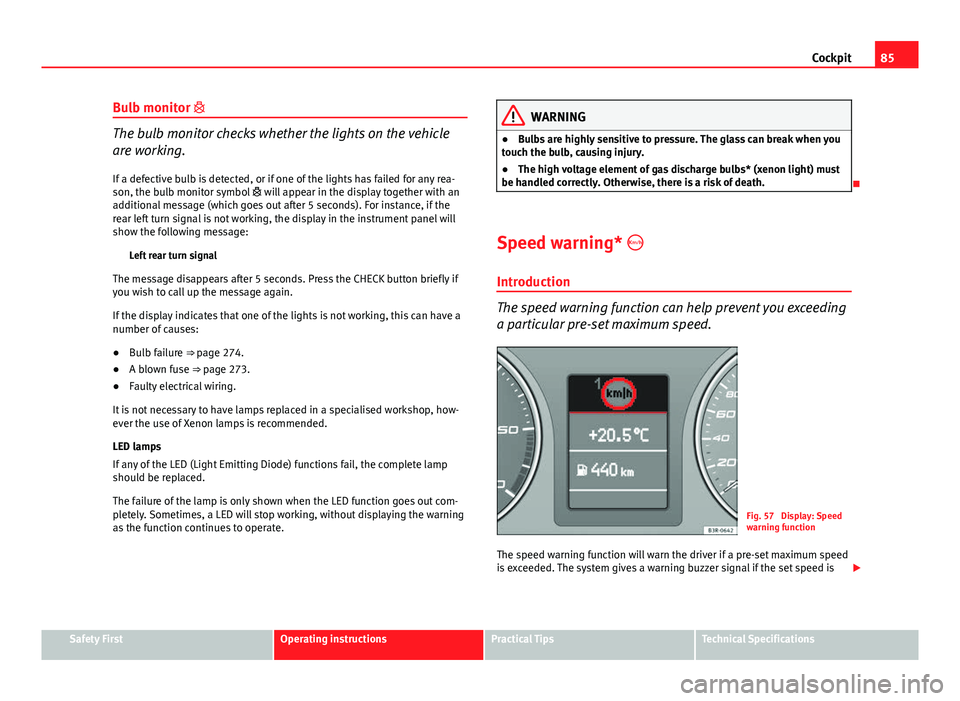
The speed warning function can help prevent you exceeding
a particular pre-set maximum speed.
Fig. 57 Display: Speed
warning function
The speed warning function will warn the driver if a pre-set maximum speed
is exceeded. The system gives a warning buzzer signal if the set speed is
Safety FirstOperating instructionsPractical TipsTechnical Specifications
Page 110 of 327
108Opening and closing
Activating the childproof lock
–Turn the key in the direction of the arrow ⇒ Fig. 78.
Deactivating the childproof lock
– Turn the key in the opposite direction of the arrow.
When the childproof lock is enabled, the inside door handle will not work
and the door can only be opened from the outside.
Remote control key Description
The remote control key will lock and unlock the vehicle with-
out having to insert the key in the lock. The following functions are available:
● Locking and unlocking the vehicle
● Unlocking the rear lid
All the turn signals will flash as confirmation when the vehicle is locked or
unlocked. Furthermore, the interior lights will automatically light up when
the vehicle is unlocked and go out when the vehicle is locked, provided that
the switches are in the courtesy light position.
The remote control transmitter and the battery are integrated into the han-
dle of the key. The receiver is in the interior of the vehicle. The maximum
range depends on different circumstances. The range is reduced when the
battery starts to lose power.
The remote control incorporates a foldaway key that can be used to manual-
ly lock or unlock the vehicle, as well as to start the engine. If the receiver has been repaired or replaced, or if a replacement key is
used, the system will need re-programming by a specialised workshop. Only
then will you be able use the remote control again.
The remote control meets all relevant authorisation requirements and has
been approved by the Federal Approvals Office for Telecommunications of
the Federal Republic of Germany. All components are marked in accordance
with the current legal requirements. This certification forms the basis for of-
ficial approval for use in other countries.
Note
● The remote control is automatically disabled when the ignition is switch-
ed on.
● The function of the remote control may be impaired by interference from
other nearby radio signals (e.g. from a mobile phone or TV transmitter) if
these are in the same frequency range.
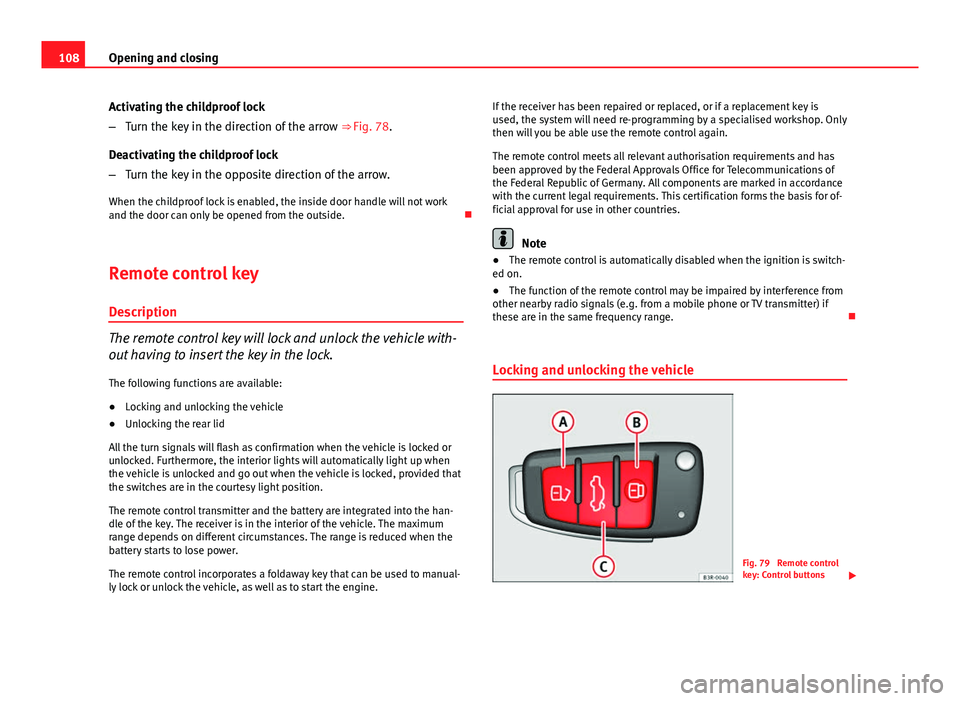
Locking and unlocking the vehicle
Fig. 79 Remote control
key: Control buttons
Page 111 of 327

109
Opening and closing
Unlocking the vehicle
–
Press button A ⇒ Fig. 79 for about 1 second.
Locking the vehicle
–
Press button B for about 1 second.
Opening the rear lid
–
Press button C and hold for at least one second.
The turn signals will flash twice as confirmation when you unlock the vehi-
cle. The vehicle will be locked again automatically if you do not open one of
the doors or the rear lid within 60 seconds after unlocking the vehicle with
button A
. This function prevents the vehicle from remaining unlocked if the
unlocking button is pressed by mistake.
In vehicles with the security central locking* feature, you can unlock just
the driver door and the tank flap by pressing button A
once or the whole
vehicle by pressing the button twice.
The turn signals flash once when the vehicle is locked to confirm that the
doors and rear lid are properly locked.
Moreover, apart from unlocking the vehicle, the seat* and mirror* memory
programmed in the key is activated. The driver seat and exterior mirrors will
be automatically adjusted to the positions stored in the memory.
The interior lights will automatically light up when the vehicle is unlocked
and go out when the vehicle is locked, provided that the switch is in the
courtesy light position.
WARNING
Do not leave anyone (especially children) in the vehicle if it is locked from
the outside and the anti-theft security system is enabled, as the doors
and windows cannot then be opened from the inside. Locked doors could
delay assistance in an emergency, potentially putting lives at risk.
Note
● The remote control should only be used when the doors and the rear lid
are closed.
● The remote control should not be used when the vehicle is out of sight.
● The anti-theft alarm* can be accidentally triggered and the vehicle
locked if you press the locking button
on the remote control inside the
vehicle before inserting the key in the ignition. If this should happen by
mistake, press the unlock button
.
Re-synchronising
Should the remote control fail to lock or unlock the vehicle,
the system must be re-synchronised.
– If the vehicle is locked, use the key to unlock the driver door.
– Press the unlock button
on the remote control.
– Insert the key into the ignition and switch on the ignition.
– Switch off the ignition and remove the key.
– Press the unlock
or the lock button .
Safety FirstOperating instructionsPractical TipsTechnical Specifications