fuse Seat Ibiza 2017 Edition 11.17 User Guide
[x] Cancel search | Manufacturer: SEAT, Model Year: 2017, Model line: Ibiza, Model: Seat Ibiza 2017Pages: 312, PDF Size: 6.51 MB
Page 174 of 312
Operation
● Set the air di
s
tribution regulator
››› Fig. 175 3 to the air flow configuration
de s
ir
ed: (towards the windscreen), (to-
wards the chest), (towards the footwell)
and (towards the windscreen and foot-
well).
Interior cooling
When the air conditioning is switched on, the
temperature and the air humidity go down.
This way, if the outside humidity is extreme,
the air conditioning prevents the misting of
the windows and therefore, comfort is im-
proved.
● Turn on the cooling system using the
butt
on (the button light turns on).
● Turn the temperature control switch until
the desir
ed interior temperature is reached. ●
Turn the blo
wer switch to any of the set-
tings 1-4.
● Set the air distribution control to the air
flow configur
ation desired: (towards the
windscreen), (towards the chest), (to-
wards the footwell) and (towards the wind-
screen and footwell).
Demisting the windscreen
● Turn air distribution to .
● Turn the fan control to one of the two levels
depending on the speed r
equired.
● Rotate the temperature control to the de-
sired l
evel of comfort.
● Close the central outlets.
● Open and turn the side outlets towards the
window
s. If the air conditioning does not work, this
may
be due to the following reasons:
● The engine is stationary.
● The fan blower is switched off.
● The outside temperature is lower than +3°C
(+37°F).
● The air conditioning system compressor
has
been temporarily switched off because of
an increased engine coolant temperature.
● The air conditioner fuse is faulty.
● Another fault in the vehicle. Have the air
conditioning c
hecked by a specialised work-
shop.
172
Page 178 of 312
Operation
If the engine does not start immediately,
sw it
c
h the starter off after 10 seconds and try
again after half a minute. If the engine still
does not start, the fuel pump fuse should be
checked ››› page 104, Fuses. WARNING
● Never s t
art or run the engine in unventila-
ted or closed rooms. The exhaust gases con-
tain carbon monoxide, an odourless and col-
ourless poisonous gas. Risk of fatal acci-
dents. Carbon monoxide can cause loss of
consciousness and result in death.
● Never leave the vehicle unattended if the
engine is
running.
● Never use “cold start sprays”, they could
explode or c
ause the engine to run at high
revs. Risk of injury. CAUTION
● When the engine i s
cold, you should avoid
high engine speeds, driving at full throttle
and over-loading the engine. Risk of engine
damage.
● The vehicle should not be pushed or towed
more than 50 metr
es to start the engine. Un-
burnt fuel could enter the catalytic converter
and damage it.
● Before attempting to push-start or tow a ve-
hicle in or
der to start it, you should first try to
start it using the battery of another vehicle.
Please observe and follow the notes on the
››› page 71, How to jump start. For the sake of the environment
Do not warm-up the engine by running the
engine w ith the
vehicle stationary. Start off
immediately, driving gently. This helps the
engine reach operating temperature faster
and reduces emissions. Starting diesel engines
The engine can only be started using a genu-
ine S
EA
T key with its correct code.
– Move the gearbox lever to the neutral posi-
tion and depre s
s the clutch pedal thor-
oughly and hold it in this position for the
starter to turn the engine on.
– Turn the ignition key to position ›››
Fig. 177
2 . The warning lamp
wi
l l light for en-
gine pre-heating.
– When the lamp turns off, turn the ignition
key t
o position 3 to start the engine. Do
not pr
e
ss the accelerator.
– Release the ignition key as soon as the en-
gine star
ts. The starter motor should not
turn at the same time.
When starting a cold engine, it may be a little
noisy for the first few seconds until oil pres-
sure has built up in the hydraulic valve com-
pensators. This is quite normal, and no cause
for concern. If there are problems starting the engine, see
the
›››
page 71.
Glow plug system for diesel engines
To avoid unnecessary discharging of the bat-
tery, do not use any other major electrical
equipment while the glow plugs are pre-heat-
ing.
Start the engine as soon as the glow plug
warning lamp goes out.
Starting a diesel engine after the fuel tank
has run dry
If the fuel tank has been completely run dry,
it may take longer than normal (up to one mi-
nute) to start a diesel engine after refuelling.
This is because the fuel system must elimi-
nate air first. WARNING
Observe the safety warnings ›››
in Starting
petro l
engines on page 176. CAUTION
● When the engine i s
cold, you should avoid
high engine speeds, driving at full throttle
and over-loading the engine. Risk of engine
damage.
● The vehicle should not be pushed or towed
more than 50 metr
es to start the engine. Un-
burnt fuel could enter the particulate filter
and damage it. 176
Page 226 of 312
Operation
When the ACC halts the vehicle (e.g. traffic
j am), the in
s
trument panel display shows the
ACC ready to start message. If the ve-
hicle ahead drives off again, the ACC will also
do so automatically.
If the vehicle ahead does not drive off again,
the vehicle can be kept indefinitely in the
ACC ready to start status by operating
the third lever repeatedly towards position 2
› ››
Fig. 198
or b
y pressing the brake pedal.
If the Press the brake message is shown
on the instrument panel, press the brake. If
you do not, an acoustic warning will be heard
and the ACC will switch to inactive mode
(Standby). At this point, the vehicle may be-
gin to move towards the stopped vehicle
ahead ››› .
Ov er
t
aking
When the turn signal lights up before the ve-
hicle begins an overtaking manoeuvre, the
ACC accelerates the vehicle automatically
and thus reduces the distance from the vehi-
cle in front.
When the vehicle enters the overtaking lane,
if the ACC does not detect another vehicle in
front, it accelerates until it reaches the pro-
grammed speed and maintains it.
System acceleration can be interrupted at
any time by pressing the brake or moving the
third lever backwards ››› page 219. Driving through a bend
On entering or e
xiting bends, the radar sen-
sor may no longer determine the vehicle in
front or react to a vehicle in the adjacent lane
››› Fig. 201 A. In these situations the vehicle
may brake unnecessarily or fail to react to re-
act to the vehicle in front. In this case, the
driver has to intervene by accelerating or in-
terrupting the braking process by applying
the brake or pushing the third lever back-
wards ››› page 219.
Driving in tunnels
When driving through tunnels the radar sen-
sor may be limited. Switch off the ACC in tun-
nels.
Narrow or misaligned vehicles
The radar sensor can only detect narrow or
misaligned vehicles when they are within
range ››› Fig. 201 B. This applies particularly
to narrow vehicles such as motorbikes. In
these cases, you should brake as necessary.
Vehicles with special loads and accessories
Special loads and accessories of other vehi-
cles that jut out over the sides, backwards or
over the top may be out of the ACC's range.
Switch off the ACC when driving behind vehi-
cles with special loads and accessories or
when overtaking them. In these cases, you
should brake as necessary. Other vehicles changing lanes
Vehicl
es changing lanes a short distance
away from your own can only be detected
when they are within range of the sensors.
Consequently, the ACC will take longer to re-
act ››› Fig. 202 C. In these cases, you should
brake as necessary.
Stationary vehicles
The ACC does not detect stationary objects
while driving, such as traffic tails or damaged
vehicles.
If a vehicle detected by the ACC turns or
moves over and there is a stationary vehicle
in front of it, the ACC will not react to it
››› Fig. 202 D. In these cases, you should
brake as necessary.
Vehicles driving in the opposite direction
and vehicles crossing your path
The ACC does not react to vehicles approach-
ing from the opposite direction or vehicles
crossing your path.
Metal objects
Metal objects, e.g. rails on the road or sheets
used in road works, can confuse the radar
sensor and cause the ACC to react wrongly.
224
Page 246 of 312
Operation
WARNING
The towing bracket ball coupling must be
st or
ed securely in the luggage compartment
to prevent them being flung through the vehi-
cle and causing injury. Note
● By l
aw, the ball coupling must be removed
if a trailer is not being towed if it obscures
the number plate. Driving with a trailer
Fig. 225
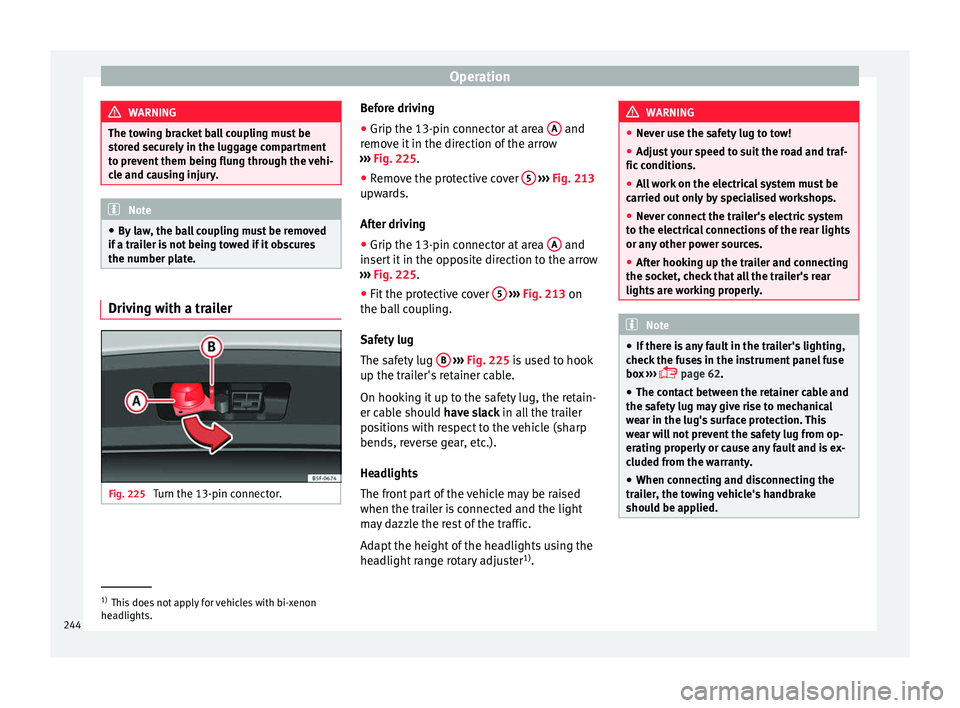
Turn the 13-pin connector. Before driving
●
Grip the 13-pin connector at area A and
r emo
v
e it in the direction of the arrow
››› Fig. 225.
● Remove the protective cover 5
› ››
Fig. 213
up w
ards.
After driving
● Grip the 13-pin connector at area A and
in ser
t
it in the opposite direction to the arrow
››› Fig. 225.
● Fit the protective cover 5
› ›
› Fig. 213
on
the ball coupling.
Safety lug
The safety lug B
› ›
› Fig. 225
is used to hook
up the trailer's retainer cable.
On hooking it up to the safety lug, the retain-
er cable should have slack in all the trailer
positions with respect to the vehicle (sharp
bends, reverse gear, etc.).
Headlights
The front part of the vehicle may be raised
when the trailer is connected and the light
may dazzle the rest of the traffic.
Adapt the height of the headlights using the
headlight range rotary adjuster 1)
. WARNING
● Never u se the s
afety lug to tow!
● Adjust your speed to suit the road and traf-
fic condition
s.
● All work on the electrical system must be
carried out on
ly by specialised workshops.
● Never connect the trailer's electric system
to the electric
al connections of the rear lights
or any other power sources.
● After hooking up the trailer and connecting
the socket, c
heck that all the trailer's rear
lights are working properly. Note
● If ther e i
s any fault in the trailer's lighting,
check the fuses in the instrument panel fuse
box ›››
page 62.
● The contact between the retainer cable and
the safety
lug may give rise to mechanical
wear in the lug's surface protection. This
wear will not prevent the safety lug from op-
erating properly or cause any fault and is ex-
cluded from the warranty.
● When connecting and disconnecting the
trail
er, the towing vehicle's handbrake
should be applied. 1)
This does not apply for vehicles with bi-xenon
hea dlights.
244
Page 264 of 312
Advice
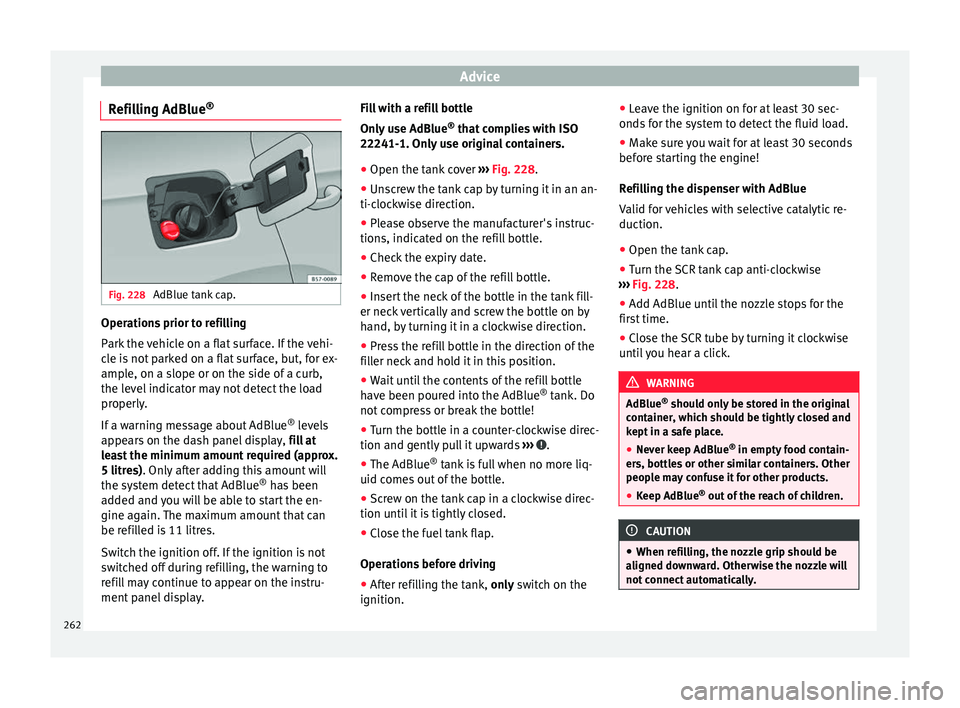
Refilling AdBlue ®Fig. 228
AdBlue tank cap. Operations prior to refilling
P
ark
the
vehicle on a flat surface. If the vehi-
cle is not parked on a flat surface, but, for ex-
ample, on a slope or on the side of a curb,
the level indicator may not detect the load
properly.
If a warning message about AdBlue ®
levels
appears on the dash panel display, fill at
least the minimum amount required (approx.
5 litres). Only after adding this amount will
the system detect that AdBlue ®
has been
added and you will be able to start the en-
gine again. The maximum amount that can
be refilled is 11 litres.
Switch the ignition off. If the ignition is not
switched off during refilling, the warning to
refill may continue to appear on the instru-
ment panel display. Fill with a refill bottle
Only u
se AdBlue ®
that complies with ISO
22241-1. Only use original containers.
● Open the tank cover ›››
Fig. 228.
● Unscrew the tank cap by turning it in an an-
ti-clock
wise direction.
● Please observe the manufacturer's instruc-
tions, indicat
ed on the refill bottle.
● Check the expiry date.
● Remove the cap of the refill bottle.
● Insert the neck of the bottle in the tank fill-
er neck
vertically and screw the bottle on by
hand, by turning it in a clockwise direction.
● Press the refill bottle in the direction of the
fill
er neck and hold it in this position.
● Wait until the contents of the refill bottle
have been pour
ed into the AdBlue ®
tank. Do
not compress or break the bottle!
● Turn the bottle in a counter-clockwise direc-
tion and gently p
ull it upwards ››› .
● The AdBlue ®
tank
i
s full when no more liq-
uid comes out of the bottle.
● Screw on the tank cap in a clockwise direc-
tion until
it is tightly closed.
● Close the fuel tank flap.
Operations
before driving
● After refilling the tank, only sw
itch on the
ignition. ●
Leav
e the ignition on for at least 30 sec-
onds for the system to detect the fluid load.
● Make sure you wait for at least 30 seconds
before s
tarting the engine!
Refilling the dispenser with AdBlue
Valid for vehicles with selective catalytic re-
duction.
● Open the tank cap.
● Turn the SCR tank cap anti-clockwise
›››
Fig. 228.
● Add AdBlue until the nozzle stops for the
first
time.
● Close the SCR tube by turning it clockwise
until
you hear a click. WARNING
AdBlue ®
shoul d on
ly be stored in the original
container, which should be tightly closed and
kept in a safe place.
● Never keep AdBlue ®
in empty food c
ontain-
ers, bottles or other similar containers. Other
people may confuse it for other products.
● Keep AdBlue ®
out of the r
each of children. CAUTION
● When refi l
ling, the nozzle grip should be
aligned downward. Otherwise the nozzle will
not connect automatically. 262
Page 271 of 312
Checking and refilling levels
For the sake of the environment
The oil level must never be above area
›› ›
Fig. 230 A . Otherwise oil can be drawn in
through the c r
ankcase breather and escape
into the atmosphere via the exhaust system. Changing engine oil
Read the additional information carefully
›› ›
page 58
The engine oil must be changed at the inter-
vals given in the service schedule.
We recommend that you have the engine oil
changed by a Technical Service.
The oil change intervals are shown in the
Maintenance Programme. WARNING
Only change the engine oil yourself if you
hav e the s
pecialist knowledge required!
● Before opening the bonnet, read and ob-
serve the w
arnings ››› page 263, Safety notes
for work in the engine compartment .
● Wait for the engine to cool down. Hot oil
may
cause burn injuries.
● Wear eye protection to avoid injuries, such
as ac
id burns, caused by splashes of oil.
● When removing the oil drain plug with your
finger
s, keep your arm horizontal to help pre-
vent oil from running down your arm. ●
Wa sh
your skin thoroughly if it comes into
contact with engine oil.
● Engine oil is poisonous! Used engine oil
must
be stored in a safe place out of the
reach of children. CAUTION
No additives should be used with engine oil.
Thi s c
ould result in engine damage. Any dam-
age caused by the use of such additives
would not be covered by the factory warranty. For the sake of the environment
● Bec au
se of disposal problems and the spe-
cial tools and specialist knowledge required,
we recommend that you have the engine oil
and filter changed by a Technical Service.
● Never pour oil down drains or into the
ground.
● U
se a suitable container when draining the
used oil
. It must be large enough to hold all
the engine oil. Cooling system
C ontr o
l lamp There is a fault if:
● The l amp does not go out again after a
f ew sec
onds. ●
The lamp lights up or fl
ashes while the
vehicle is running, and three acoustic warn-
ing signals are emitted ››› .
Thi s
me
ans that either the coolant level is too
low or the coolant temperature is too high.
Coolant temperature too high
If the lamp lights up, stop the vehicle,
turn off the engine and wait for it to cool
down. Check the coolant level.
If the coolant level is correct, the overheating
may be caused by a malfunction of the radia-
tor fan. Check the radiator fan fuse and have
it replaced if necessary ››› page 104.
If the control lamp lights up again after driv-
ing on for a short distance, stop the vehicle
and switch the engine off. Contact a Techni-
cal Service or a specialised workshop.
Coolant level too low
If the lamp lights up, stop the vehicle,
turn off the engine and wait for it to cool
down. First check the coolant level. If the lev-
el of the coolant is below the “MIN” mark,
top up with coolant liquid ››› .
WARNING
● If y
our vehicle is immobilised for technical
reasons, move it to a safe distance from traf-
fic. Turn the engine off, turn the hazard lights
on and place the warning triangle. » 269
Technical data
Advice
Operation
Emergencies
Safety
Page 302 of 312
Index
Doors chi
l
dproof locks . . . . . . . . . . . . . . . . . . . . . . . . 138
opening and closing . . . . . . . . . . . . . . . . . . . . . 15
Double headlight bulbs . . . . . . . . . . . . . . . . . . . . 107
Downhill speed control . . . . . . . . . . . . . . . . . . . . 195
Downhill speed control function . . . . . . . . . . . . . 195
Driver see Correct sitting position . . . . . . . . . 76, 77, 78
Driver-side general instrument panel left-hand drive . . . . . . . . . . . . . . . . . . . . . . . . . . . 9
right-hand drive . . . . . . . . . . . . . . . . . . . . . . . . . 10
Driver information system additional consumers . . . . . . . . . . . . . . . . . . . . 42
assist systems . . . . . . . . . . . . . . . . . . . . . . . . . . 40
bonnet, rear lid and doors open . . . . . . . . . . . . 40
engine oil temperature . . . . . . . . . . . . . . . . . . . . 42
gear-change indicator . . . . . . . . . . . . . . . . . . . . 41
journey data . . . . . . . . . . . . . . . . . . . . . . . . . . . . 38
menu . . . . . . . . . . . . . . . . . . . . . . . . . . . . . . . . . . 38
operation . . . . . . . . . . . . . . . . . . . . . . . . . . . . . . . 37
outside temperature . . . . . . . . . . . . . . . . . . . . . . 41
saving tips . . . . . . . . . . . . . . . . . . . . . . . . . . . . . . 42
service intervals . . . . . . . . . . . . . . . . . . . . . . . . . 43
speed warning . . . . . . . . . . . . . . . . . . . . . . . . . . 42
warning and information messages . . . . . . . . . 41
Driving driving abroad . . . . . . . . . . . . . . . . . . . . . . . . . 203
driving through water . . . . . . . . . . . . . . . . . . . . 204
economic . . . . . . . . . . . . . . . . . . . . . . . . . . . . . 200
safe . . . . . . . . . . . . . . . . . . . . . . . . . . . . . . . . . . . 75
with a trailer . . . . . . . . . . . . . . . . . . 242, 244, 245
with trailer . . . . . . . . . . . . . . . . . . . . . . . . . . . . . 237
Driving abroad headlights . . . . . . . . . . . . . . . . . . . . . . . . . . . . . 203
petrol . . . . . . . . . . . . . . . . . . . . . . . . . . . . . . . . . 203
Driving data data summary . . . . . . . . . . . . . . . . . . . . . . . . . . . 39 Driving mode . . . . . . . . . . . . . . . . . . . . . . . . . . . . 226
Driving on flooded r
oads . . . . . . . . . . . . . . . . . . . 204
Driving profile . . . . . . . . . . . . . . . . . . . . . . . . . . . . 226
DSG . . . . . . . . . . . . . . . . . . . . . . . . . . . . . . . . . . . . 190
Duplicate keys . . . . . . . . . . . . . . . . . . . . . . . . . . . 130
Dust and pollen filter . . . . . . . . . . . . . . . . . . . . . . 166
Dynamic lights range control . . . . . . . . . . . . . . . . 149
E E10 see Ethanol (fuel) . . . . . . . . . . . . . . . . . . . . . . . 258
Easy Connect . . . . . . . . . . . . . . . . . . . . . . . . 34, 123
Easy Connect System . . . . . . . . . . . . . . . . . . . . . . 123
EDL see Electronic differential lock . . . . . . . . . . . . . 186
EDS . . . . . . . . . . . . . . . . . . . . . . . . . . . . . . . . . . . . 186
Efficiency program additional consumers . . . . . . . . . . . . . . . . . . . . 42
saving tips . . . . . . . . . . . . . . . . . . . . . . . . . . . . . . 42
Electrical power socket . . . . . . . . . . . . . . . . . . . . 160
Electrical socket trailer . . . . . . . . . . . . . . . . . . . . . . . . . . . . . . . . . 243
Electric windows . . . . . . . . . . . . . . . . . . . . . . 18, 141 convenience opening and closing . . . . . . . . . 143
Electrolyte . . . . . . . . . . . . . . . . . . . . . . . . . . . . . . . 273
Electronic differential lock . . . . . . . . . . . . . 183, 186 control lamp . . . . . . . . . . . . . . . . . . . . . . 186, 187
Electronic differential lock control . . . . . . . . . . . 185
Electronic differential lock (XDS) . . . . . . . . . . . . . 188
Electronic immobiliser . . . . . . . . . . . . . . . . . 15, 177
Electronic Stability Control (ESC) . . . . . . . 183, 185
Emergencies . . . . . . . . . . . . . . . . . . . . . . . . . . . . . . 97 automatic gearbox emergency program . . . . . 196
bulbs . . . . . . . . . . . . . . . . . . . . . . . . . . . . . . . . . . 63
changing a wheel . . . . . . . . . . . . . . . . . . . . . . . . 65
changing the battery . . . . . . . . . . . . . . . . . . . . 274
emergency towing of the vehicle . . . . . . . . . . . . 70 emergency warning triangle . . . . . . . . . . . . . . . 97
fire extin
guisher . . . . . . . . . . . . . . . . . . . . . . . . . 97
first-aid kit . . . . . . . . . . . . . . . . . . . . . . . . . . . . . . 97
fuses . . . . . . . . . . . . . . . . . . . . . . . . . . . . . . . . . . 62
hazard warning lights . . . . . . . . . . . . . . . . . . . 150
jump leads . . . . . . . . . . . . . . . . . . . . . . . . . . . . . 71
puncture . . . . . . . . . . . . . . . . . . . . . . . . . . . . . . . 63
replacing a blown fuse . . . . . . . . . . . . . . . . . . . . 62
Spare wheel . . . . . . . . . . . . . . . . . . . . . . . . . . . 279
vehicle tools . . . . . . . . . . . . . . . . . . . . . . . . . . . . 97
Emergency braking assistance system indications on the display . . . . . . . . . . . . . . . . 212
malfunction . . . . . . . . . . . . . . . . . . . . . . . . . . . . 214
operating . . . . . . . . . . . . . . . . . . . . . . . . . . . . . . 215
radar sensor . . . . . . . . . . . . . . . . . . . . . . . . . . . 214
switching off temporarily . . . . . . . . . . . . . . . . . 216
system limitations . . . . . . . . . . . . . . . . . . . . . . 216
Emergency operation front passenger door . . . . . . . . . . . . . . . . . . . . . 16
selector lever . . . . . . . . . . . . . . . . . . . . . . . . . . . 50
Emergency warning triangle . . . . . . . . . . . . . . . . . 97
Emission control system catalytic converter . . . . . . . . . . . . . . . . . . . . . . 202
control lamp . . . . . . . . . . . . . . . . . . . . . . . . . . . 203
diesel particulate filter . . . . . . . . . . . . . . . . . . . 202
Emissions data . . . . . . . . . . . . . . . . . . . . . . . . . . . 282
Engine assisted starting . . . . . . . . . . . . . . . . . . . . . . . . . 71
noises . . . . . . . . . . . . . . . . . . . . . . . . . . . . . . . . 180
running in . . . . . . . . . . . . . . . . . . . . . . . . . . . . . 199
Start-Stop system . . . . . . . . . . . . . . . . . . . . . . . 204
Engine and ignition automatic ignition switch-off . . . . . . . . . . . . . . 178
My Beat . . . . . . . . . . . . . . . . . . . . . . . . . . . . . . . 180
preheating the engine . . . . . . . . . . . . . . . . . . . 179
starting the engine . . . . . . . . . . . . . . . . . . . . . . 179
300
Page 303 of 312
Index
starting the engine with Press & Drive . . . . . . 179
s t
op
ping the engine . . . . . . . . . . . . . . . . . . . . . 180
Engine compartment . . . . . . . . . . . . . . 17, 263, 266 battery . . . . . . . . . . . . . . . . . . . . . . . . . . . . . . . . 272
brake fluid . . . . . . . . . . . . . . . . . . . . . . . . . . . . . 271
closing . . . . . . . . . . . . . . . . . . . . . . . . . . . . . . . . 265
coolant . . . . . . . . . . . . . . . . . . . . . . . . . . 269, 270
engine oil . . . . . . . . . . . . . . . . . . . . . . . . 266, 268
opening . . . . . . . . . . . . . . . . . . . . . . . . . . . . . . . 264
safety notes . . . . . . . . . . . . . . . . . . . . . . . . . . . 263
windscreen washer liquid . . . . . . . . . . . . . . . . 272
Engine coolant . . . . . . . . . . . . . . . . . . . . . . . . . . . . 59 checking level . . . . . . . . . . . . . . . . . . . . . . . . . . 269
G12 plus-plus . . . . . . . . . . . . . . . . . . . . . . . . . . . 59
G13 . . . . . . . . . . . . . . . . . . . . . . . . . . . . . . . . . . . 59
specifications . . . . . . . . . . . . . . . . . . . . . . . . . . . 59
Engine data . . . . . . . . . . . . . . . . . . . . . . . . . . . . . . 284
Engine fault control lamp . . . . . . . . . . . . . . . . . . . . . . . . . . . 203
Engine management . . . . . . . . . . . . . . . . . . . . . . 202 control lamp . . . . . . . . . . . . . . . . . . . . . . . . . . . 203
Engine oil . . . . . . . . . . . . . . . . . . . . . . . . . . . 58, 266 changing . . . . . . . . . . . . . . . . . . . . . . . . . 266, 269
checking engine oil level . . . . . . . . . . . . . . . . . 268
consumption . . . . . . . . . . . . . . . . . . . . . . . . . . . 268
diesel . . . . . . . . . . . . . . . . . . . . . . . . . . . . . . . . . 266
dipstick . . . . . . . . . . . . . . . . . . . . . . . . . . . . . . . 268
inspection service . . . . . . . . . . . . . . . . . . . . . . 266
maintenance intervals . . . . . . . . . . . . . . . . . . . 266
oil properties . . . . . . . . . . . . . . . . . . . . . . . . . . . 58
specifications . . . . . . . . . . . . . . . . . . . . . . 59, 266
temperature display . . . . . . . . . . . . . . . . . . . . . . 42
topping up . . . . . . . . . . . . . . . . . . . . . . . . . . . . 268
Engine oil pressure control lamp . . . . . . . . . . . . . . . . . . . . . . . . . . . 267 Environment
envir onmental compatibility . . . . . . . . . . . . . . 199
environmentally-friendly driving . . . . . . . . . . . 200
Environmental tip refuelling . . . . . . . . . . . . . . . . . . . . . . . . . . . . . . 257
Equipment . . . . . . . . . . . . . . . . . . . . . . . . . . . . . . 247
ESC . . . . . . . . . . . . . . . . . . . . . . . . . . . . . . . . . . . . 183 electronic stability control . . . . . . . . . . . 183, 185
Multi-collision Brake . . . . . . . . . . . . . . . . . . . . 188
Sport Mode . . . . . . . . . . . . . . . . . . . . . . . . . . . . 185
Ethanol (fuel) . . . . . . . . . . . . . . . . . . . . . . . . . . . . 258
Event Data Recorder . . . . . . . . . . . . . . . . . . . . . . . . 96
Exhaust purification system for vehicles with diesel engines . . . . . . . . . . . . . . . . . . . . . . . . . 261
Extending the luggage compartment . . . . . . . . . . . . . . . . 157
Exterior lighting changing the bulbs . . . . . . . . . . . . . . . . . . . . . 106
Exterior mirrors . . . . . . . . . . . . . . . . . . . . . . . . . . . 153 adjusting . . . . . . . . . . . . . . . . . . . . . . . . . . . . . . . 20
control . . . . . . . . . . . . . . . . . . . . . . . . . . . . . . . . 153
folding in electrically . . . . . . . . . . . . . . . . . . . . 153
folding in manually . . . . . . . . . . . . . . . . . . . . . 153
heated . . . . . . . . . . . . . . . . . . . . . . . . . . . . . . . . 153
Exterior view . . . . . . . . . . . . . . . . . . . . . . . . . . . . . 7, 8
External aerial . . . . . . . . . . . . . . . . . . . . . . . . . . . . 247
F Fastening rings . . . . . . . . . . . . . . . . . . . . . . . . . . . 162
Fatigue detection . . . . . . . . . . . . . . . . . . . . . . . . . 227
Fault in electronic differential lock (EDL) control lamp . . . . . . . . . . . . . . . . . . . . . . . . . . . 186
Faulty bulbs changing the bulbs . . . . . . . . . . . . . . . . . . . . . 106
Filling up the tank . . . . . . . . . . . . . . . . . . . . . . . . 257
Fire extinguisher . . . . . . . . . . . . . . . . . . . . . . . . . . . 97
First-aid kit . . . . . . . . . . . . . . . . . . . . . . . . . . . . . . . 97 Floor mats . . . . . . . . . . . . . . . . . . . . . . . . . . . . . . . . 80
Fluid Level
control . . . . . . . . . . . . . . . . . . . . . . . . . 57
Fog light bulb . . . . . . . . . . . . . . . . . . . . . . . . . . . . 109
Front airbags . . . . . . . . . . . . . . . . . . . . . . . . . . 21, 88 safety instructions . . . . . . . . . . . . . . . . . . . . . . . 88
Front Assist indications on the display . . . . . . . . . . . . . . . . 212
Front drink holder . . . . . . . . . . . . . . . . . . . . . . . . . 159
Front passenger front airbag control lamp . . . . . . . . . . . . . . . . . . . . . . . . . . . . 91
deactivation . . . . . . . . . . . . . . . . . . . . . . . . . . . . 22
Front seat manual adjustment . . . . . . . . . . . . . . . . . . . . . . 19
Fuel . . . . . . . . . . . . . . . . . . . . . . . . . . . . . . . . 57, 258 consumption . . . . . . . . . . . . . . . . . . . . . . . . . . . 282
diesel . . . . . . . . . . . . . . . . . . . . . . . . . . . . . . . . . 260
ethanol . . . . . . . . . . . . . . . . . . . . . . . . . . . . . . . 258
fuel gauge . . . . . . . . . . . . . . . . . . . . . . . . . . . . . 121
natural gas . . . . . . . . . . . . . . . . . . . . . . . . . . . . 260
refuelling . . . . . . . . . . . . . . . . . . . . . . . . . . . . . . 258
saving . . . . . . . . . . . . . . . . . . . . . . . . . . . . . . . . 200
Fuel consumption . . . . . . . . . . . . . . . . . . . . . . . . . 200 why does fuel consumption increase? . . . . . . 202
Fuel tank cap opening and closing . . . . . . . . . . . . . . . . . . . . . 57
Fuses . . . . . . . . . . . . . . . . . . . . . . . . . . . . . . . 62, 104 fuse box . . . . . . . . . . . . . . . . . . . . . . . . . . . . . . . 104
identifying blown fuses . . . . . . . . . . . . . . . . . . . 63
identifying by colours . . . . . . . . . . . . . . . . . . . . . 62
preparation before replacing . . . . . . . . . . . . . . . 62
replacing . . . . . . . . . . . . . . . . . . . . . . . . . . . . . . . 62
G
Gear-change indicator . . . . . . . . . . . . . . . . . 41, 197
Gearbox DSG see Automatic gearbox . . . . . . . . . . . . . . . . . . . 190
Gearbox lever . . . . . . . . . . . . . . . . . . . . . . . . . . . . . 50
301