bonnet Seat Ibiza 5D 2006 User Guide
[x] Cancel search | Manufacturer: SEAT, Model Year: 2006, Model line: Ibiza 5D, Model: Seat Ibiza 5D 2006Pages: 268, PDF Size: 8.14 MB
Page 182 of 268
Checking and refilling levels
180Mono-grade oil
Single grade oils are generally not suitable for all year round use, due to
ranges of viscosity
6).
These oils are only useful in a climate that is constantly very cold or very
warm.
Engine oil additives
No type of additive should be mixed with the engine oil. The deterioration
caused by these additives is not covered by the warranty.
Note
Before a long trip, we recommend findin g an engine oil that conforms to the
corresponding VW specifications and keeping it in the vehicle. This way, the
correct engine oil will always be available for a top-up if needed.
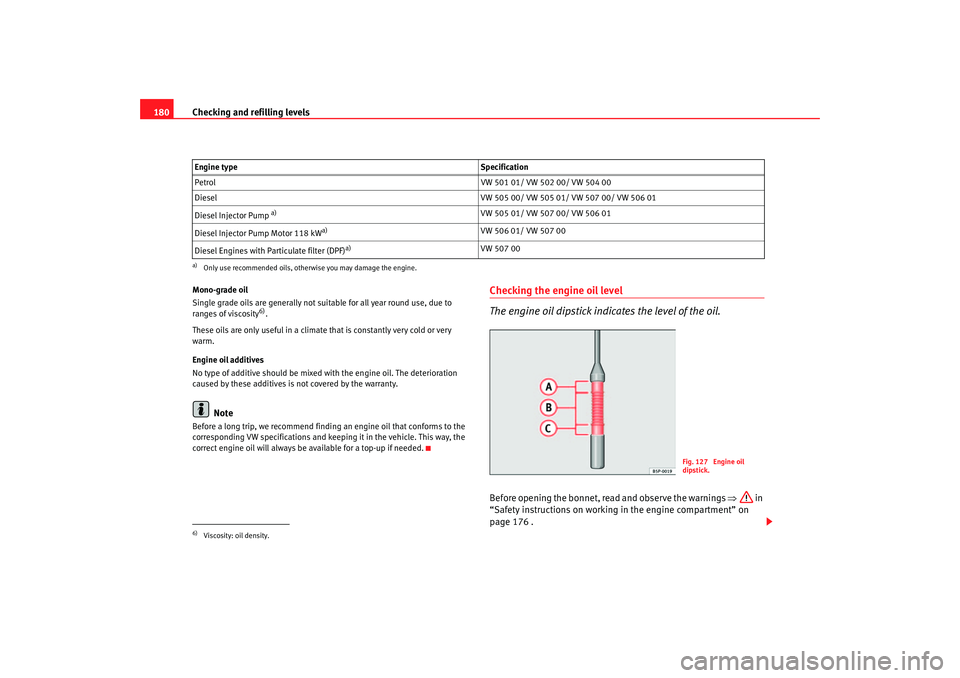
Checking the engine oil level
The engine oil dipstick indicates the level of the oil.Before opening the bonnet, read and observe the warnings ⇒ in
“Safety instructions on working in the engine compartment” on
page 176 .
Engine type Specification
Petrol VW 501 01/ VW 502 00/ VW 504 00
Diesel VW 505 00/ VW 505 01/ VW 507 00/ VW 506 01
Diesel Injector Pump
a)
a)Only use recommended oils, otherwise you may damage the engine.
VW 505 01/ VW 507 00/ VW 506 01
Diesel Injector Pump Motor 118 kW
a)
VW 506 01/ VW 507 00
Diesel Engines with Particulate filter (DPF)
a)
VW 507 00
6)Viscosity: oil density.
Fig. 127 Engine oil
dipstick.
ibiza_angles_0706_DEF Seite 180 Freitag, 1. September 2006 1:18 13
Page 183 of 268
Checking and refilling levels181
Safety First
Operating instructions
Tips and Maintenance
Te c h n i c a l D a t a
– Park the vehicle on an even surface.
– After stopping the engine, wait a few minutes for the oil to drain
back into the sump.
–Raise the bonnet ⇒page 178.
– Pull out the dipstick.
– Wipe the dipstick with a cloth and insert it again, pushing it in as far as it will go.
– Pull the dipstick out again and check the oil level ⇒ page 180,
fig. 127.
– Replace the dipstick, pushing it in as far as it will go.The position of the dipstick is shown in the corresponding engine compart-
ment diagram ⇒page 238.
If the oil level is in area ⇒page 180, fig. 127 , do not top up with oil.
If the oil level is in area , you may top up with oil (approx. 0.5 l).
If the oil level is in area , you mu st top up with oil (approx. 1.0 l).
It is normal for the engine to consume a certain amount of oil. Consumption
can be up to 1.0 litres per 1,000 km. For this reason the engine oil level must
be checked at regular intervals, prefer ably when filling the tank and before a
journey.
When the engine is working hard, for instance during sustained high-speed
motorway cruising in summer, when towi ng a trailer or climbing on mountain
passes, the oil level should preferably be kept within area and not above
this.
WARNING
Any work carried out in the engine compartment or on the engine must be
carried out cautiously.•
When working in the engine compartm ent, always observe the safety
warnings ⇒page 176.Caution
If the oil level is above the area do not start the engine. This could result
in damage to the engine and catalytic converter. Contact an Authorised
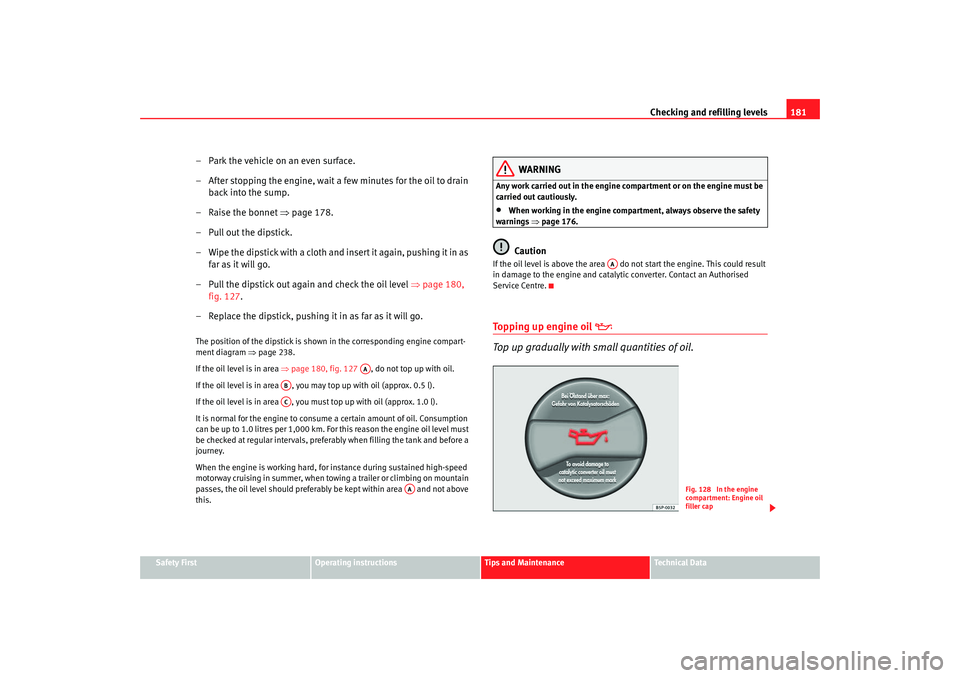
Service Centre.Topping up engine oil
Top up gradually with small quantities of oil.
AA
ABAC
AA
AA
Fig. 128 In the engine
compartment: Engine oil
filler cap
ibiza_angles_0706_DEF Seite 181 Freitag, 1. September 2006 1:18 13
Page 184 of 268
Checking and refilling levels
182
Before opening the bonnet, read and observe the warnings ⇒ in
“Safety instructions on working in the engine compartment” on
page 176 .
– Unscrew cap from oil filler opening ⇒ page 181, fig. 128.
– Top-up oil in small amounts, using the correct oil.
– To avoid over-filling with engine oil, you should top-up using small quantities, wait a while and check the oil level before
adding any more oil.
– As soon as the oil level is in area , carefully close the cap.The position of the oil filler openi ng is shown in the corresponding engine
compartment diagram ⇒ page 238.
Engine oil specification ⇒page 179.
WARNING
Oil is highly inflammable! Ensure tha t no oil comes into contact with hot
engine components when topping up.
Caution
If the oil level is above the area do not start the engine. This could result
in damage to the engine and catalytic converter. Contact a qualified work-
shop.
For the sake of the environment
The oil level must never be above area . Otherwise oil can be drawn in
through the crankcase breather and escape into the atmosphere via the
exhaust system.
Changing engine oil
The engine oil must be changed at the intervals given in the
service schedule.We recommend that you have the engine oil changed by an Authorised
Service Centre.
The two different oil change intervals are shown in the ⇒ Booklet “Service
schedule”.
WARNING
Only change the oil yourself if you have the specialist knowledge required!•
Before opening the bonnet, read and observe the warnings
⇒ page 176, “Safety instructions on wo rking in the engine compartment”.
•
Wait for the engine to cool down. Hot oil may cause burn injuries.
•
Wear eye protection to avoid injuries caused by splashes of oil.
•
When removing the oil drain plug with your fingers, keep your arm hori-
zontal to help prevent oil from running down your arm.
•
Wash your skin thoroughly if it comes into contact with engine oil.
•
Engine oil is poisonous! Used oil must be stored in a safe place out of
the reach of children until it is disposed of.Caution
No additives should be used with engine oil. This could result in engine
damage. Any damage caused by the use of such additives would not be
covered by the factory warranty.
AB
AA
AA
ibiza_angles_0706_DEF Seite 182 Freitag, 1. September 2006 1:18 13
Page 186 of 268
Checking and refilling levels
184Checking the coolant level and topping up
The correct coolant level is important for fault-free func-
tioning of the engine cooling system.Before opening the bonnet, read and observe the warnings ⇒ in
“Safety instructions on working in the engine compartment” on
page 176 .
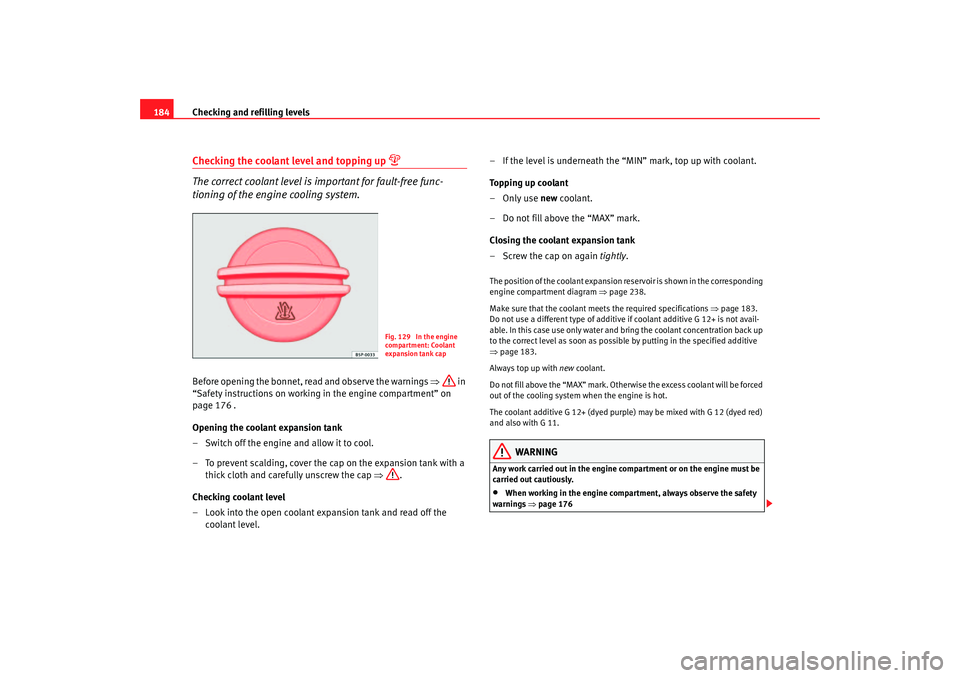
Opening the coolant expansion tank
– Switch off the engine and allow it to cool.
– To prevent scalding, cover the cap on the expansion tank with a thick cloth and carefully unscrew the cap ⇒.
Checking coolant level
– Look into the open coolant ex pansion tank and read off the
coolant level. – If the level is underneath the “MIN” mark, top up with coolant.
Topping up coolant
–Only use
new coolant.
– Do not fill above the “MAX” mark.
Closing the coolant expansion tank
– Screw the cap on again tightly.
The position of the coolant expansion re servoir is shown in the corresponding
engine compartment diagram ⇒page 238.
Make sure that the coolant meets the required specifications ⇒page 183.
Do not use a different type of additive if coolant additive G 12+ is not avail-
able. In this case use only water and bring the coolant concentration back up
to the correct level as soon as possible by putting in the specified additive
⇒ page 183.
Always top up with new coolant.
Do not fill above the “MAX” mark. Otherwise the excess coolant will be forced
out of the cooling system when the engine is hot.
The coolant additive G 12+ (dyed purple ) may be mixed with G 12 (dyed red)
and also with G 11.
WARNING
Any work carried out in the engine compartment or on the engine must be
carried out cautiously.•
When working in the engine compartment, always observe the safety
warnings ⇒page 176
Fig. 129 In the engine
compartment: Coolant
expansion tank cap
ibiza_angles_0706_DEF Seite 184 Freitag, 1. September 2006 1:18 13
Page 189 of 268
Checking and refilling levels187
Safety First
Operating instructions
Tips and Maintenance
Te c h n i c a l D a t a
If the
windscreen wipers smear , they should be replaced if they are damaged,
or cleaned if they are soiled.
If this does not produce the desired results, the setting angle of the wind-
screen wiper arms might be incorrect. They should be checked by a qualified
workshop and corrected if necessary.
WARNING
Do not drive unless you have good visibility through all windows!•
Clean the windscreen wiper blades and all windows regularly.
•
The wiper blades should be changed once or twice a year.Caution
•
Damaged or dirty windscreen wipers could scratch the windscreen.
•
Never use fuel, nail varnish remover, paint thinner or similar products to
clean the windows. This could damage the windscreen wiper blades.
•
Never move the windscreen wiper or windscreen wiper arm manually. This
could cause damage.Note
•
The wiper arms can be moved to the service position only when the
bonnet is properly closed.
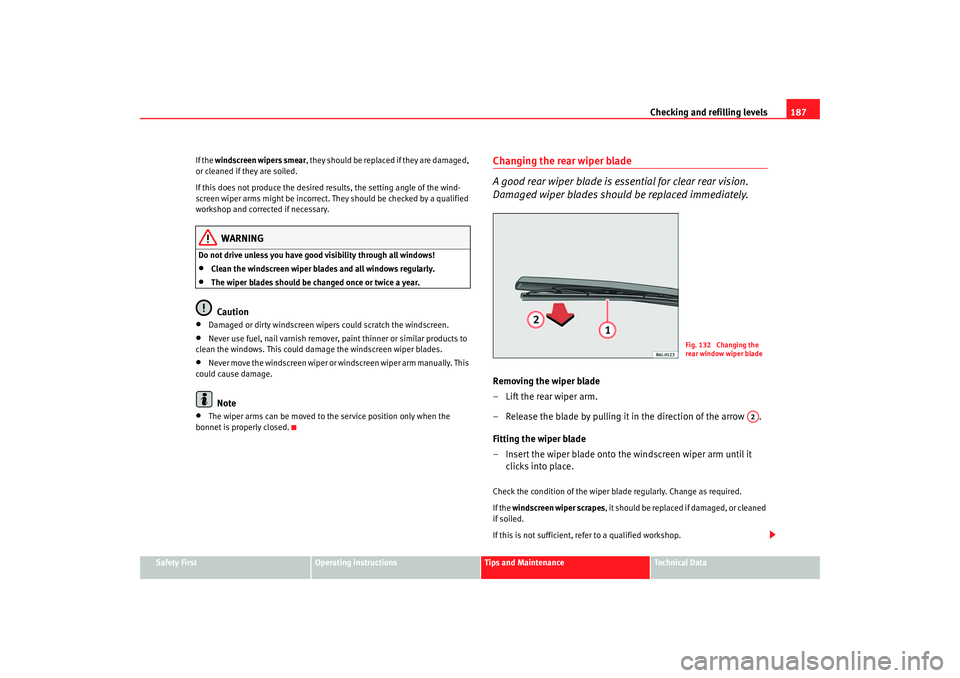
Changing the rear wiper blade
A good rear wiper blade is es sential for clear rear vision.
Damaged wiper blades should be replaced immediately.Removing the wiper blade
– Lift the rear wiper arm.
– Release the blade by pulling it in the direction of the arrow .
Fitting the wiper blade
– Insert the wiper blade onto the windscreen wiper arm until it
clicks into place.Check the condition of the wiper blade regularly. Change as required.
If the windscreen wiper scrapes , it should be replaced if damaged, or cleaned
if soiled.
If this is not sufficient, refer to a qualified workshop.
Fig. 132 Changing the
rear window wiper blade
A2
ibiza_angles_0706_DEF Seite 187 Freitag, 1. September 2006 1:18 13
Page 191 of 268
Checking and refilling levels189
Safety First
Operating instructions
Tips and Maintenance
Te c h n i c a l D a t a
However, if the level goes down noticeably in a short time, or drops below the
“MIN” mark, there may be a leak in the brake system. A display on the instru-
ment panel will warn you if the brake fluid level is too low
⇒page 58.
WARNING
Before opening the bonnet to check the brake fluid level, read and observe
the warnings ⇒page 176.Changing the brake fluid
The brake fluid must be renewed every two years.We recommend that you have the brake fluid changed by an Authorised
Service Centre.
Before opening the bonnet, please read and follow the warnings ⇒ in
“Safety instructions on working in the engine compartment” on page 176 in
“Working in the engine compartment”.
Brake fluid absorbs moisture. In the cour se of time, it will absorb water from
the ambient air. If the water content in the brake fluid is too high, the brake
system could corrode. This also considerably reduces the boiling point of the
brake fluid. Heavy use of the brakes may then cause a vapour lock which
could impair the braking effect.
For this reason the brake fluid must be renewed every two years.
It is important that you use only use brake fluid compliant with the US
standard FMVSS 116 DOT 4. We recommend the use of Genuine SEAT brake
fluid.
WARNING
Brake fluid is poisonous. Old brake fluid impairs the braking effect.
•
Before opening the bonnet to check the brake fluid level, read and
observe the warnings ⇒page 176.
•
Brake fluid should be stored in the closed original container in a safe
place out of reach of children. There is a toxic risk.
•
Have the brake fluid changed every two years at the latest. Heavy use
of the brakes may cause a vapour lock if the brake fluid is left in the system
for too long. This would seriously affect the efficiency of the brakes and the
safety of the vehicle. This may cause an accident.Caution
Brake fluid could damage the paintwork. Wipe off any brake fluid from the
paintwork immediately.
For the sake of the environment
Brake fluid must be drained and disposed of in the proper manner observing
environmental regulations.
WARNING (continued)
ibiza_angles_0706_DEF Seite 189 Freitag, 1. September 2006 1:18 13
Page 193 of 268
Checking and refilling levels191
Safety First
Operating instructions
Tips and Maintenance
Te c h n i c a l D a t a
•
If the vehicle is left standing in cold conditions for a long period, protect
the battery from frost. If it “freezes” it will be damaged.
Checking the electrolyte level
The electrolyte level should be checked regularly in high-
mileage vehicles, in hot countries and in older batteries.– Open the bonnet and open the battery cover at the front ⇒ in
“Safety instructions on working in the engine compartment” on
page 176 ⇒ in “Warnings on handling the battery” on
page 190.
– Check the colour display in the "magic eye" on the top of the battery.
– If there are air bubbles in the window, tap the window gently until they disperse.The position of the battery is shown in the corresponding engine compart-
ment diagram ⇒page 238.
The round window (“magic eye”) on the top of the battery changes colour,
depending on the charge level and electrolyte level of the battery.
If the colour in the window is colourless or bright yellow, the electrolyte level
of the battery is too low. Have the battery checked by a qualified workshop.
The colours green and black are used by the workshops for diagnostic
purposes.
Charging and changing the vehicle battery
The battery is maintenance-free and is checked during the
inspection service. All work on the vehicle battery requires
specialist knowledge.If you often drive short distances or if the vehicle is not driven for long
periods, the battery should be checked by a qualified workshop between the
scheduled services.
If the battery has discharged and you have problems starting the vehicle, the
battery might be damaged. If this happens, we recommend you have the
vehicle battery checked by an Authorised Service Centre where it will be re-
charged or replaced.
Charging the battery
The vehicle battery should be charged by a qualified workshop only, as
batteries using special technology have been installed and they must be
charged in a controlled environment.
Replacing a vehicle battery
The battery has been developed to suit the conditions of its location and has
special safety features.
Genuine SEAT batteries fulfil the maintenance, performance and safety spec-
ifications of your vehicle.
WARNING
•
We recommend you use only maintenance-free or cycle free leak-proof
batteries that comply with the standards T 825 06 and VW 7 50 73. This
standard applies as of 2001.
•
Before starting any work on the batteries, you must read and observe
the warnings ⇒ in “Warnings on handling the battery” on page 190.
ibiza_angles_0706_DEF Seite 191 Freitag, 1. September 2006 1:18 13
Page 218 of 268
If and when
216
Side lights
Indicator lights
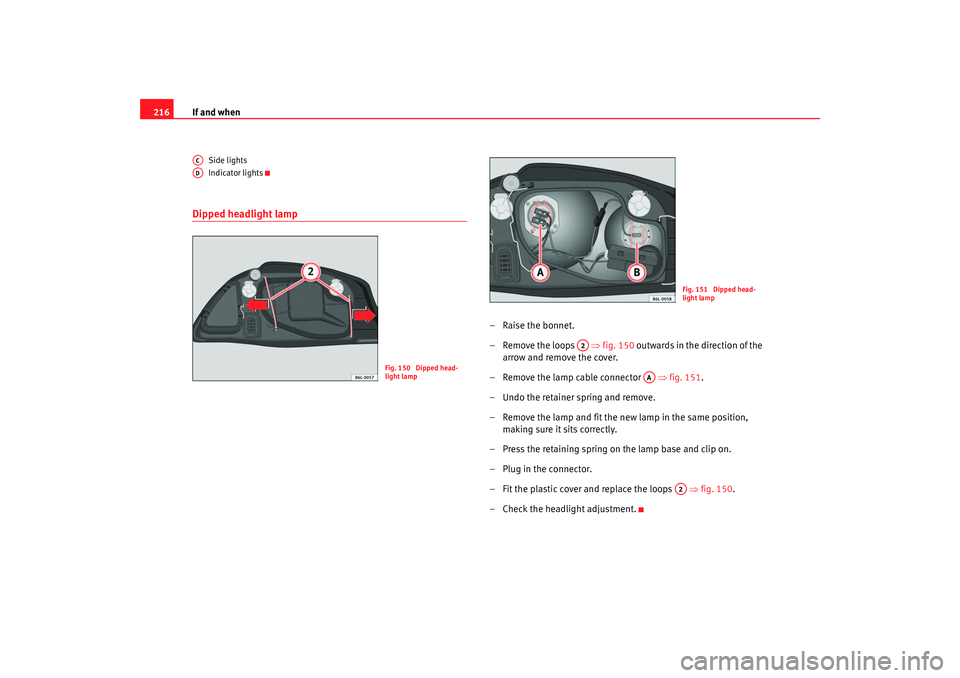
Dipped headlight lamp
–Raise the bonnet.
– Remove the loops ⇒fig. 150 outwards in the direction of the
arrow and remove the cover.
– Remove the lamp cable connector ⇒fig. 151 .
– Undo the retainer spring and remove.
– Remove the lamp and fit the new lamp in the same position, making sure it sits correctly.
– Press the retaining spring on the lamp base and clip on.
– Plug in the connector.
– Fit the plastic cover and replace the loops ⇒fig. 150.
– Check the headlight adjustment.
ACAD
Fig. 150 Dipped head-
light lamp
Fig. 151 Dipped head-
light lamp
A2
AA
A2
ibiza_angles_0706_DEF Seite 216 Freitag, 1. September 2006 1:18 13
Page 219 of 268
If and when217
Safety First
Operating instructions
Tips and Maintenance
Te c h n i c a l D a t a
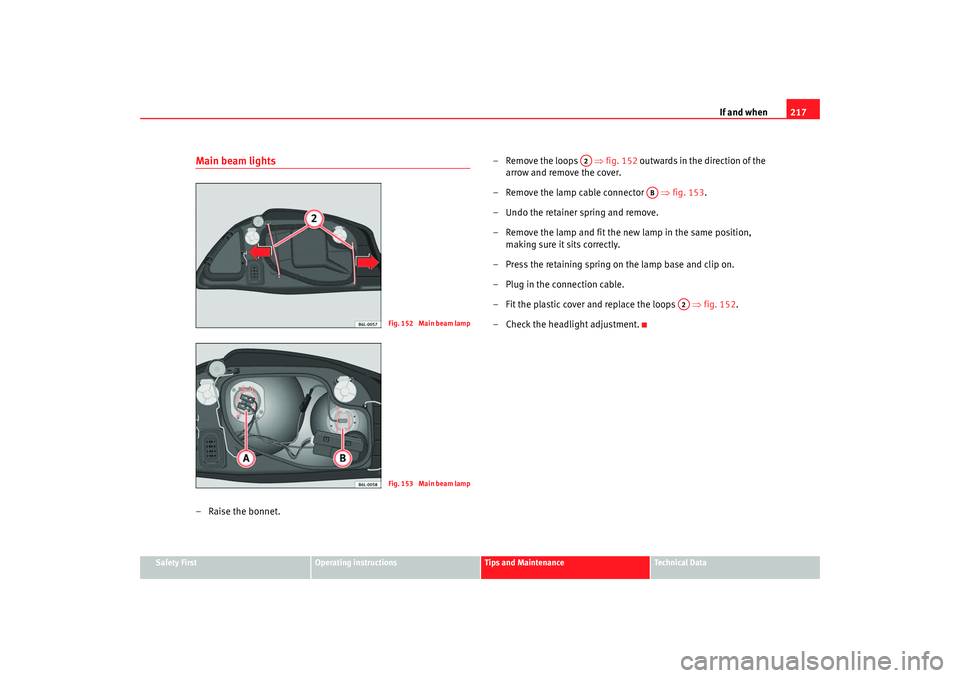
Main beam lights–Raise the bonnet. – Remove the loops
⇒fig. 152 outwards in the direction of the
arrow and remove the cover.
– Remove the lamp cable connector ⇒fig. 153.
– Undo the retainer spring and remove.
– Remove the lamp and fit the new lamp in the same position, making sure it sits correctly.
– Press the retaining spring on the lamp base and clip on.
– Plug in the connection cable.
– Fit the plastic cover and replace the loops ⇒fig. 152 .
– Check the headlight adjustment.
Fig. 152 Main beam lampFig. 153 Main beam lamp
A2
AB
A2
ibiza_angles_0706_DEF Seite 217 Freitag, 1. September 2006 1:18 13
Page 220 of 268
If and when
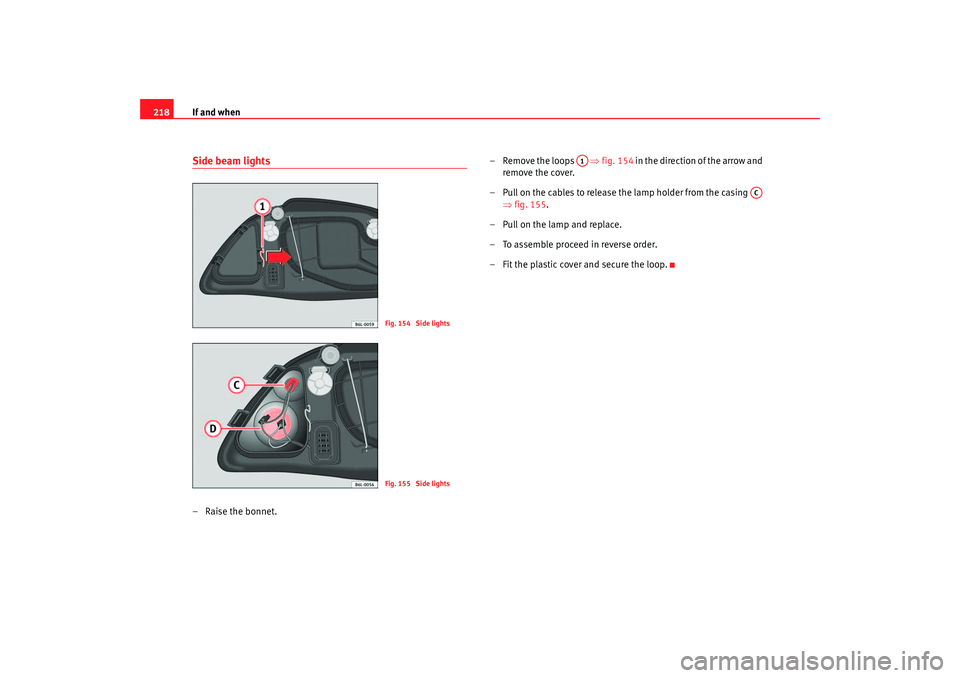
218Side beam lights– Raise the bonnet. – Remove the loops
⇒fig. 154 in the direction of the arrow and
remove the cover.
– Pull on the cables to release the lamp holder from the casing ⇒fig. 155.
–Pull on the lamp and replace.
– To assemble proceed in reverse order.
– Fit the plastic cover and secure the loop.
Fig. 154 Side lightsFig. 155 Side lights
A1
AC
ibiza_angles_0706_DEF Seite 218 Freitag, 1. September 2006 1:18 13