trailer Seat Ibiza 5D 2006 User Guide
[x] Cancel search | Manufacturer: SEAT, Model Year: 2006, Model line: Ibiza 5D, Model: Seat Ibiza 5D 2006Pages: 268, PDF Size: 8.14 MB
Page 159 of 268
Driving and the environment157
Safety First
Operating instructions
Tips and Maintenance
Te c h n i c a l D a t a
Where possible, operate the trailer with the maximum permitted
draw bar
weight on the ball joint of the towing bracket, but do not exceed the specified
limit.
The figures for trailer weights and draw bar weights that are given on the
data plate of the towing bracket are for certification purposes only. The
correct figures for your sp ecific model, which may be lower than these figures
for the towing bracket, are give n in the registration documents ⇒Section
“Technical data”.
Distributing the load
Distribute loads in the trailer so that heavy objects are as near to the axle as
possible. Loads carried in the trailer must be secured to prevent them
moving.
Tyre pressure
Set tyre pressure to the maximum permissible pressure shown on the sticker
on the inside of the fuel tank flap. Set the tyre pressure of the trailer tyres in
accordance with the trailer manufacturer's recommendations.
Exterior mirrors
Check whether you can see enough of the road behind the trailer with the
standard mirrors. If this is not the case you should have additional mirrors
fitted. Both exterior mirrors should be mounted on hinged extension
brackets. Adjust the mirrors to give sufficient vision to the rear.
WARNING
Never transport people in a trailer. This could result in fatal accidents.
Note
•
Towing a trailer places additional demands on the vehicle. We recom-
mend additional services between the normal inspection intervals if the
vehicle is used frequently for towing a trailer.
•
Find out whether special regulations apply to towing a trailer in your
country.
Ball coupling of towing bracket*
The ball coupling of the towing bracket is located in the tool
boxThe ball coupling is provided with in structions on fitting and removing the
ball coupling of the towing bracket.
WARNING
The towing bracket ball coupling must be stored securely in the luggage
compartment to prevent them being flung through the vehicle and causing
injury.
Note
•
By law, the ball coupling must be re moved if a trailer is not being towed
and it obscures the number plate.
Driving tips
Driving with a trailer always requires extra care.Weight distribution
The weight distribution of a loaded trailer with an unladen vehicle is very
unfavourable. However, if this cannot be avoided, drive extra slowly to allow
for the unbalanced we ight distribution.
ibiza_angles_0706_DEF Seite 157 Freitag, 1. September 2006 1:18 13
Page 160 of 268
Driving and the environment
158Speed
The stability of the vehicle and trailer is reduced with increasing speed. For
this reason it is advisable not to drive at the maximum permissible speed in
unfavourable road, weather or wind conditions. This applies especially when
driving downhill.
You should always reduce speed immediately if the trailer shows the slightest
sign of snaking . Never try to stop the “snaking” by increasing speed.
Always brake in good time. If the trailer has an overrun brake, apply the
brakes gently at first and then firmly. This will pr event the jerking that can be
caused by the trailer wheels locking. Select a low gear in good time before
going down a steep descent. This enables you to use the engine braking to
slow down the vehicle.
Heating
At very high temperatures and during prolonged ascents, driving in a low gear
and high engine speed, always monitor the temperature indicator for the
coolant ⇒page 49.
Electronic Stabilisation program*
Do not switch off the ESP* when towing a trailer. The ESP* makes it easier to
stabilise if the trailer starts to snake.
Driving economically and with respect for the
environmentGeneral notes
Fuel consumption depends largely on your personal driving
style.Fuel economy, environmental impact and wear on the engine, brakes and
tyres depend largely on three factors:•
Personal driving style
•
Conditions of use (weather, road surface)
•
Technical requirements
By adopting an economical driving style and anticipating the traffic situation
ahead, you can easily reduce fuel consumption by 10-15%. This section
suggests methods of lessening the impact on the environment and reducing
your operating costs at the same time.
Think ahead when drivingA vehicle uses most fuel when accelerating. If you think ahead when driving,
you will need to brake less and thus accelerate less. Wherever possible, let
the vehicle roll slowly to a stop, for instance when you can see that the next
traffic lights are red.
ibiza_angles_0706_DEF Seite 158 Freitag, 1. September 2006 1:18 13
Page 174 of 268
Accessories, parts replacement and modifications
172If a towing bracket is to be fitted after the vehicle is purchased, this must be
completed according to the instructions of the towing bracket manufacturer.
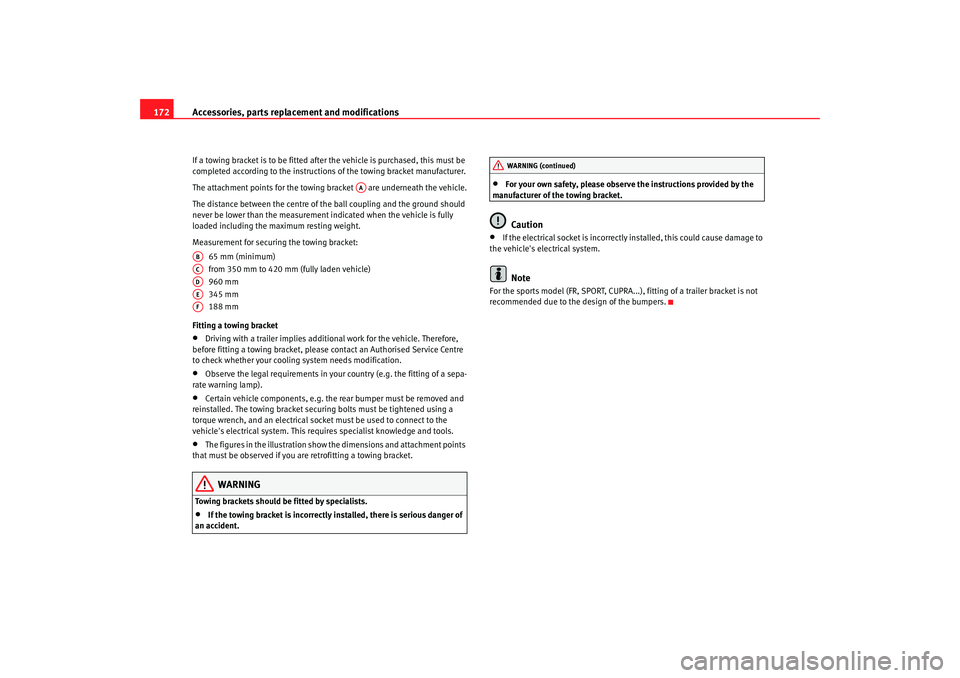
The attachment points for the towing bracket are underneath the vehicle.
The distance between the centre of the ball coupling and the ground should
never be lower than the measurement indicated when the vehicle is fully
loaded including the maximum resting weight.
Measurement for securing the towing bracket:
65 mm (minimum)
from 350 mm to 420 mm (fully laden vehicle)
960 mm
345 mm
188 mm
Fitting a towing bracket•
Driving with a trailer implies additional work for the vehicle. Therefore,
before fitting a towing bracket, please contact an Authorised Service Centre
to check whether your cooling system needs modification.
•
Observe the legal requirements in your country (e.g. the fitting of a sepa-
rate warning lamp).
•
Certain vehicle components, e.g. the rear bumper must be removed and
reinstalled. The towing bracket securin g bolts must be tightened using a
torque wrench, and an electrical sock et must be used to connect to the
vehicle's electrical system. This requ ires specialist knowledge and tools.
•
The figures in the illustration show the dimensions and attachment points
that must be observed if you are retrofitting a towing bracket.
WARNING
Towing brackets should be fitted by specialists.•
If the towing bracket is incorrectly installed, there is serious danger of
an accident.
•
For your own safety, please observe the instructions provided by the
manufacturer of the towing bracket.Caution
•
If the electrical socket is incorrectly installed, this could cause damage to
the vehicle's electrical system.Note
For the sports model (FR, SPORT, CUPRA...), fitting of a trailer bracket is not
recommended due to the design of the bumpers.
AA
ABACADAEAF
WARNING (continued)
ibiza_angles_0706_DEF Seite 172 Freitag, 1. September 2006 1:18 13
Page 183 of 268
Checking and refilling levels181
Safety First
Operating instructions
Tips and Maintenance
Te c h n i c a l D a t a
– Park the vehicle on an even surface.
– After stopping the engine, wait a few minutes for the oil to drain
back into the sump.
–Raise the bonnet ⇒page 178.
– Pull out the dipstick.
– Wipe the dipstick with a cloth and insert it again, pushing it in as far as it will go.
– Pull the dipstick out again and check the oil level ⇒ page 180,
fig. 127.
– Replace the dipstick, pushing it in as far as it will go.The position of the dipstick is shown in the corresponding engine compart-
ment diagram ⇒page 238.
If the oil level is in area ⇒page 180, fig. 127 , do not top up with oil.
If the oil level is in area , you may top up with oil (approx. 0.5 l).
If the oil level is in area , you mu st top up with oil (approx. 1.0 l).
It is normal for the engine to consume a certain amount of oil. Consumption
can be up to 1.0 litres per 1,000 km. For this reason the engine oil level must
be checked at regular intervals, prefer ably when filling the tank and before a
journey.
When the engine is working hard, for instance during sustained high-speed
motorway cruising in summer, when towi ng a trailer or climbing on mountain
passes, the oil level should preferably be kept within area and not above
this.
WARNING
Any work carried out in the engine compartment or on the engine must be
carried out cautiously.•
When working in the engine compartm ent, always observe the safety
warnings ⇒page 176.Caution
If the oil level is above the area do not start the engine. This could result
in damage to the engine and catalytic converter. Contact an Authorised
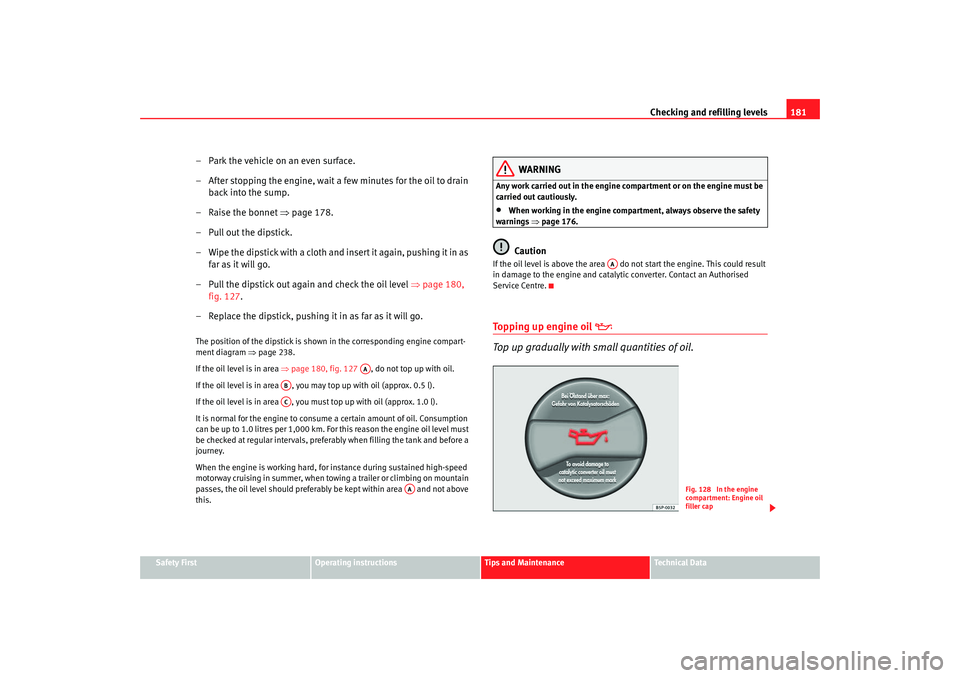
Service Centre.Topping up engine oil
Top up gradually with small quantities of oil.
AA
ABAC
AA
AA
Fig. 128 In the engine
compartment: Engine oil
filler cap
ibiza_angles_0706_DEF Seite 181 Freitag, 1. September 2006 1:18 13
Page 203 of 268
If and when201
Safety First
Operating instructions
Tips and Maintenance
Te c h n i c a l D a t a
Note
•
Seek professional assistance if the repair of a tyre puncture is not
possible with the sealing compound.
Wheel changePreparation work
What you must do before changing a wheel.– If you have a flat tyre or puncture, park the vehicle as far away from the flow of traffic as possible. Choose a location that is as
level as possible.
– All passengers should leave the vehicle. They should wait in a safe area (for instance behind the roadside crash barrier).
– Switch off the engine. Switch on the hazard warning lights.
–Apply the handbrake firmly.
–Engage the first gear, or put the selector lever to position P for
those vehicles with an automatic gearbox.
– If you are towing a trailer, unhitch it from your vehicle.
–Take the vehicle tools and the spare wheel out of the luggage
compartment.
WARNING
Put the hazard warning lights on and place the warning triangle in position.
This is for your own safety and also warns other road users.
Caution
If you have to change the tyre on a gradient, block the wheel opposite the
wheel being changed by placing a stone or similar object under it to prevent
the vehicle from rolling away.
Note
Please observe legal requirements when doing so.Changing a wheelChange the wheel as described below
–Pull off the hub cap see also ⇒page 202.
–Slacken the wheel bolts.
– Raise the car with the jack in the corresponding zone.
– Ta k e o f f the wheel and then put on the spare wheel.
– Lower the vehicle.
– Tighten the wheel bolts firmly i n d i a go na l s e q u e n ce wi t h t h e b ox
spanner.
–Replace the hub cap.
ibiza_angles_0706_DEF Seite 201 Freitag, 1. September 2006 1:18 13
Page 238 of 268
General notes on the technical data
236WeightsKerb weight refers to the basic model with a fuel tank filled to 90% capacity
and without optional extras. The figure quoted includes 75 kg to allow for the
weight of the driver.
For special versions and optional equipment fittings or for the addition of
accessories, the weight of the vehicle will increase ⇒.
WARNING
•
Please note that the centre of gravity may shift when transporting
heavy objects; this may affect the vehi cle's handling and lead to an acci-
dent. Always adjust your speed and dr iving style to suit road conditions
and requirements.
•
Never exceed the gross axle weight rating or the gross vehicle weight
rating. If the allowed axle load or the allowed total weight is exceeded, the
driving characteristics of the vehicle may change, leading to accidents,
injuries and damage to the vehicle.
To w i n g a t r a i l e rTrailer weightsTrailer weights
The trailer weights and drawbar loads approved are selected in intensive
trials according to precisely defined criteria. The approved trailer weights are
valid for vehicles in EU for maximum speeds of 80 km/h (in certain circum-
stances up to 100 km/h). The figures may be different in other countries. All
data in the official vehicle documents take precedence over these data ⇒. Drawbar load
The
maximum permitted weight exerted by the trailer drawbar on the ball joint
of the towing bracket must not exceed 75 kg.
In the interest of road safety, we recommend that you always tow
approaching the maximum drawbar load. The response of the trailer on the
road will be poor if th e drawbar load is too small.
If the maximum permissible drawbar load cannot be met (e.g. with small,
empty and light-weight single axle trailers or tandem axle trailers with an axle
base of less than 1 metre), at least 4% of the actual trailer weight is a legal
stipulation for a drawbar load.
WARNING
•
For safety reasons, you should not drive at speeds above 80 km/h when
towing a trailer. This also applies to countries where higher speeds are
permitted.
•
Never exceed the maximum trailer weights or the draw bar loading. If
the permissible axle load or the perm issible total weight is exceeded, the
driving characteristics of the vehicle may change, leading to accidents,
injuries and damage to the vehicle.
WheelsTyre pressure, snow chains, wheel boltsTyre pressures
The sticker with the tyre pressure values can be found on the inside of the
tank flap. The tyre pressure values given there are for cold tyres. The slightly
raised pressures of warm tyres must not be reduced ⇒.
ibiza_angles_0706_DEF Seite 236 Freitag, 1. September 2006 1:18 13
Page 242 of 268

Technical Data
240Trailer weights
Engine oil capacityPetrol engine 1.4 litre 63 kW (86 bhp)General engine data
Performance figures With no brakes, gradients up to 12%
500
With brakes, gradients up to 12% 800
Approximate engine oil capacity with oil filter change 3,2 litres
Power output in kW (bhp) rpm 63 (86)/ 5000
Maximum torque in Nm at rpm 132/ 3800
No. of cylinders, capacity in cm
3
4/ 1390
Compression 10,5 +/- 0,3
Fuel Super 95 RON
a)/Normal 91 RON
b)
a)Research- Octane- Number = Measure of the predetonation power of the petrol.b)Slight power lossMaximum speed in km/h 180
Acceleration from 0-80 km/h in sec. 8,1
Acceleration from 0-100 km/h in sec. 11,9
ibiza_angles_0706_DEF Seite 240 Freitag, 1. September 2006 1:18 13
Page 243 of 268
Technical Data241
Safety First
Operating instructions
Tips and Maintenance
Te c h n i c a l D a t a
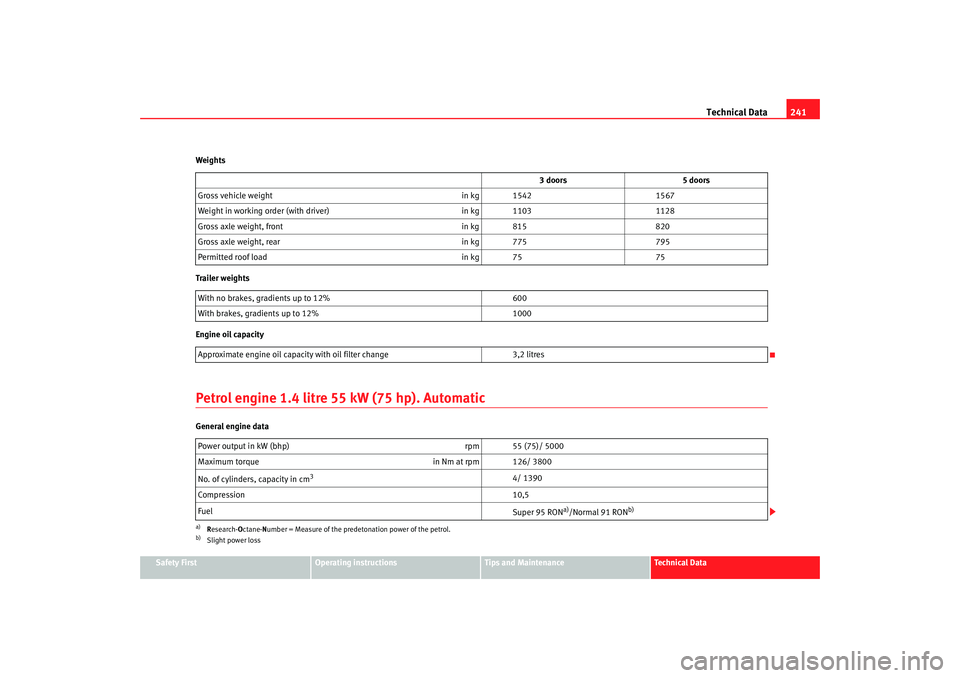
Weights
Trailer weights
Engine oil capacity
Petrol engine 1.4 litre 55 kW (75 hp). AutomaticGeneral engine data
3 doors
5 doors
Gross vehicle weight in kg 15421567
Weight in working order (with driver) in kg 11031128
Gross axle weight, front in kg 815820
Gross axle weight, rear in kg 775795
Permitted roof load in kg 7575
With no brakes, gradients up to 12% 600
With brakes, gradients up to 12% 1000
Approximate engine oil capacity with oil filter change 3,2 litres
Power output in kW (bhp) rpm 55 (75)/ 5000
Maximum torque in Nm at rpm 126/ 3800
No. of cylinders, capacity in cm
3
4/ 1390
Compression 10,5
Fuel Super 95 RON
a)/Normal 91 RON
b)
a)Research- Octane- Number = Measure of the predetonation power of the petrol.
ibiza_angles_0706_DEF Seite 241 Freitag, 1. September 2006 1:18 13
b)Slight power loss
Page 244 of 268
Technical Data
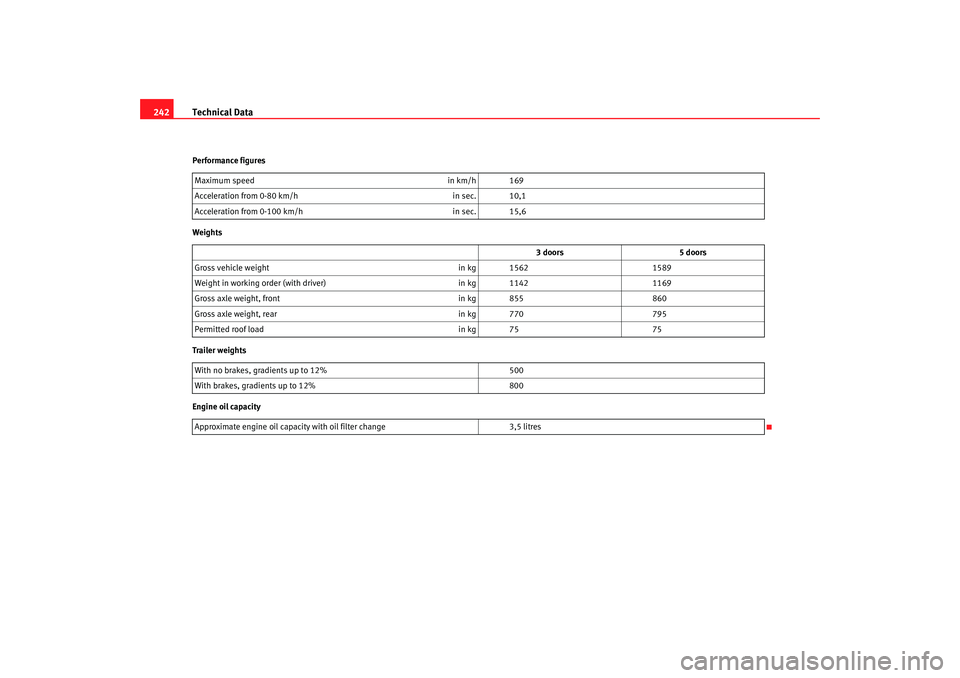
242Performance figures
Weights
Trailer weights
Engine oil capacity Maximum speed
in km/h 169
Acceleration from 0-80 km/h in sec. 10,1
Acceleration from 0-100 km/h in sec. 15,6
3 doors 5 doors
Gross vehicle weight in kg 15621589
Weight in working order (with driver) in kg 11421169
Gross axle weight, front in kg 855860
Gross axle weight, rear in kg 770795
Permitted roof load in kg 7575
With no brakes, gradients up to 12% 500
With brakes, gradients up to 12% 800
Approximate engine oil capacity with oil filter change 3,5 litres
ibiza_angles_0706_DEF Seite 242 Freitag, 1. September 2006 1:18 13
Page 246 of 268

Technical Data
244Trailer weights
Engine oil capacityPetrol engine 1.6 litre 77 kW (105 bhp)General engine data
Performance figures With no brakes, gradients up to 12%
500
With brakes, gradients up to 12% 1000
Approximate engine oil capacity with oil filter change 3,5 litres
Power output in kW (bhp) rpm 77 (105)/5 600
Maximum torque in Nm at rpm 153/ 3800
No. of cylinders, capacity in cm
3
4/ 1598
Compression 10,5+/- 0,2
Fuel 95 super RON
a)
a)Research- Octane- Number = Measure of the predetonation power of the petrol.Maximum speed in km/h 192
Acceleration from 0-80 km/h in sec. 7,2
Acceleration from 0-100 km/h in sec. 11,0
ibiza_angles_0706_DEF Seite 244 Freitag, 1. September 2006 1:18 13