steering Seat Ibiza 5D 2006 Owner's Guide
[x] Cancel search | Manufacturer: SEAT, Model Year: 2006, Model line: Ibiza 5D, Model: Seat Ibiza 5D 2006Pages: 268, PDF Size: 8.14 MB
Page 196 of 268
Checking and refilling levels
194Wear indicators
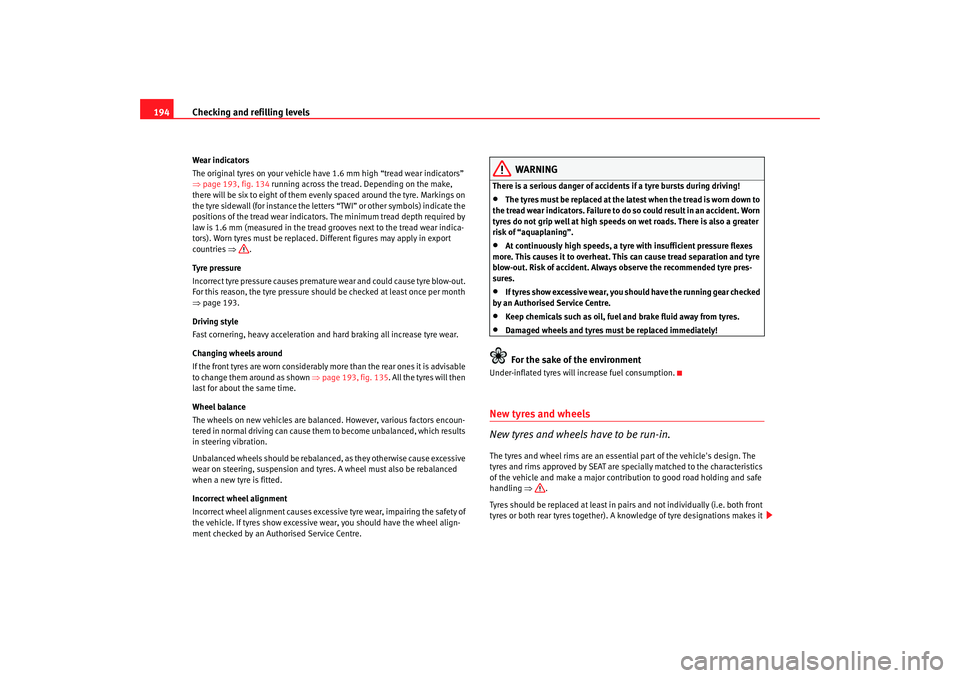
The original tyres on your vehicle have 1.6 mm high “tread wear indicators”
⇒ page 193, fig. 134 running across the tread. Depending on the make,
there will be six to eight of them evenly spaced around the tyre. Markings on
the tyre sidewall (for instance the letters “TWI” or other symbols) indicate the
positions of the tread wear indicators. The minimum tread depth required by
law is 1.6 mm (measured in the tread grooves next to the tread wear indica-
tors). Worn tyres must be replaced. D ifferent figures may apply in export
countries ⇒.
Tyre pressure
Incorrect tyre pressure causes premature wear and could cause tyre blow-out.
For this reason, the tyre pressure should be checked at least once per month
⇒ page 193.
Driving style
Fast cornering, heavy acceleration and hard braking all increase tyre wear.
Changing wheels around
If the front tyres are worn considerably more than the rear ones it is advisable
to change them around as shown ⇒page 193, fig. 135. All the tyres will then
last for about the same time.
Wheel balance
The wheels on new vehicles are balanced. However, various factors encoun-
tered in normal driving can cause them to become unbalanced, which results
in steering vibration.
Unbalanced wheels should be rebalanced, as they otherwise cause excessive
wear on steering, suspension and tyre s. A wheel must also be rebalanced
when a new tyre is fitted.
Incorrect wheel alignment
Incorrect wheel alignment causes excessiv e tyre wear, impairing the safety of
the vehicle. If tyres show excessive wear, you should have the wheel align-
ment checked by an Authorised Service Centre.
WARNING
There is a serious danger of accidents if a tyre bursts during driving!•
The tyres must be replaced at the latest when the tread is worn down to
the tread wear indicators. Failure to do so could result in an accident. Worn
tyres do not grip well at high speeds on wet roads. There is also a greater
risk of “aquaplaning”.
•
At continuously high speeds, a tyre with insufficient pressure flexes
more. This causes it to overheat. This can cause tread separation and tyre
blow-out. Risk of accident. Always observe the recommended tyre pres-
sures.
•
If tyres show excessive wear, you should have the running gear checked
by an Authorised Service Centre.
•
Keep chemicals such as oil, fuel and brake fluid away from tyres.
•
Damaged wheels and tyres must be replaced immediately!For the sake of the environment
Under-inflated tyres will increase fuel consumption.New tyres and wheels
New tyres and wheels have to be run-in.The tyres and wheel rims are an essenti al part of the vehicle's design. The
tyres and rims approved by SEAT are specially matched to the characteristics
of the vehicle and make a major contribution to good road holding and safe
handling ⇒.
Tyres should be replaced at least in pairs and not individually (i.e. both front
tyres or both rear tyres together). A knowledge of tyre designations makes it
ibiza_angles_0706_DEF Seite 194 Freitag, 1. September 2006 1:18 13
Page 211 of 268
If and when209
Safety First
Operating instructions
Tips and Maintenance
Te c h n i c a l D a t a
steering wheel on the right the fuses are
on the right-hand side of the instru-
ment panel, behind a cover.
The electric windows are protected by circuit breakers. These reset automat-
ically after a few seconds when the overload (caused for example by frozen
windows) has been corrected.
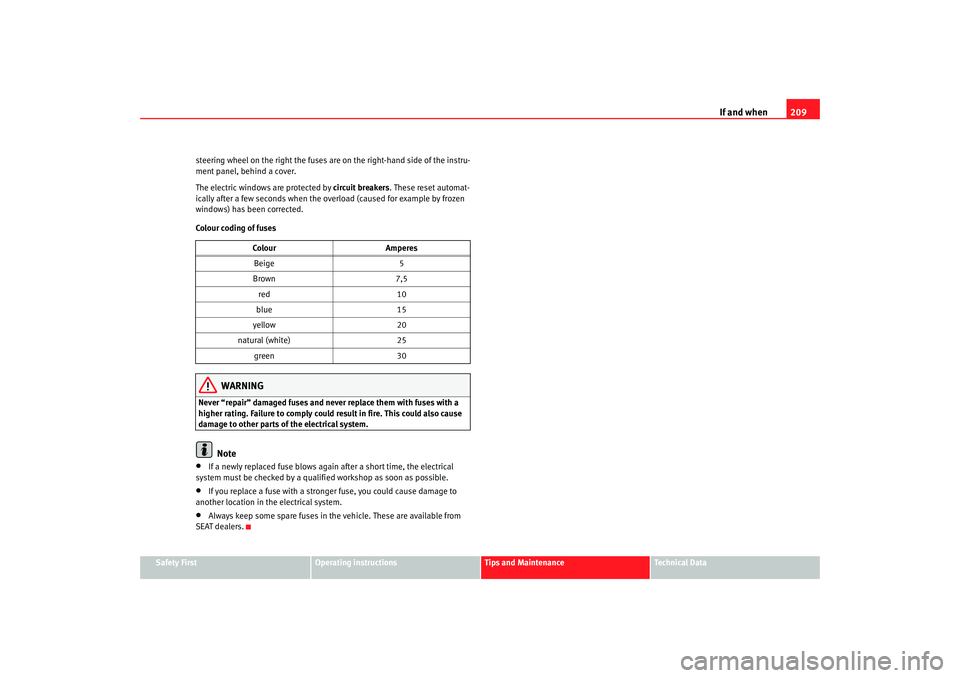
Colour coding of fuses
WARNING
Never “repair” damaged fuses and never replace them with fuses with a
higher rating. Failure to comply could result in fire. This could also cause
damage to other parts of the electrical system.
Note
•
If a newly replaced fuse blows again after a short time, the electrical
system must be checked by a qualified workshop as soon as possible.
•
If you replace a fuse with a stronger fuse, you could cause damage to
another location in the electrical system.
•
Always keep some spare fuses in the vehicle. These are available from
SEAT dealers. Colour
Amperes
Beige 5
Brown 7,5
red 10
blue 15
yellow 20
natural (white) 25
green 30
ibiza_angles_0706_DEF Seite 209 Freitag, 1. September 2006 1:18 13
Page 214 of 268
If and when
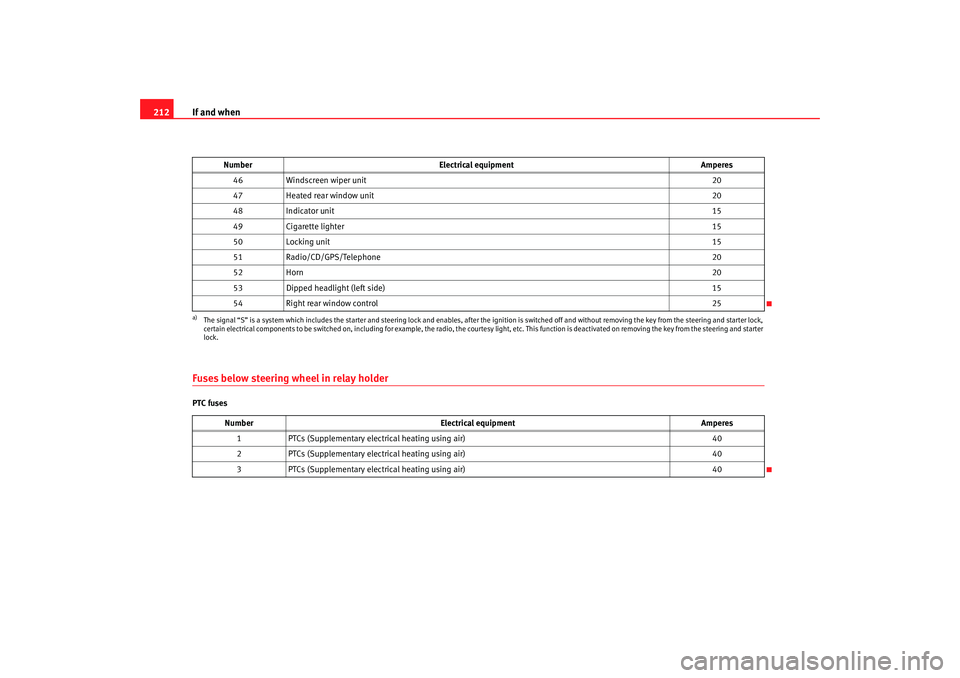
212Fuses below steering wheel in relay holderPTC fuses 46
Windscreen wiper unit 20
47 Heated rear window unit 20
48 Indicator unit 15
49 Cigarette lighter 15
50 Locking unit 15
51 Radio/CD/GPS/Telephone 20
52 Horn 20
53 Dipped headlight (left side) 15
54 Right rear window control 25a)The signal “S” is a system which includes the starter and steering lock and enables, after the ignition is switched off and wit hout removing the key from the steering and starter lock,
certain electrical components to be switched on, including for example, the radio, the courtesy light, etc. This function is de activated on removing the key from the steering and starter
lock.
Number Electrical equipment Amperes
1 PTCs (Supplementary electrical heating using air) 40
2 PTCs (Supplementary electrical heating using air) 40
3 PTCs (Supplementary electrical heating using air) 40
Number
Electrical equipment Amperes
ibiza_angles_0706_DEF Seite 212 Freitag, 1. September 2006 1:18 13
Page 215 of 268
If and when213
Safety First
Operating instructions
Tips and Maintenance
Te c h n i c a l D a t a
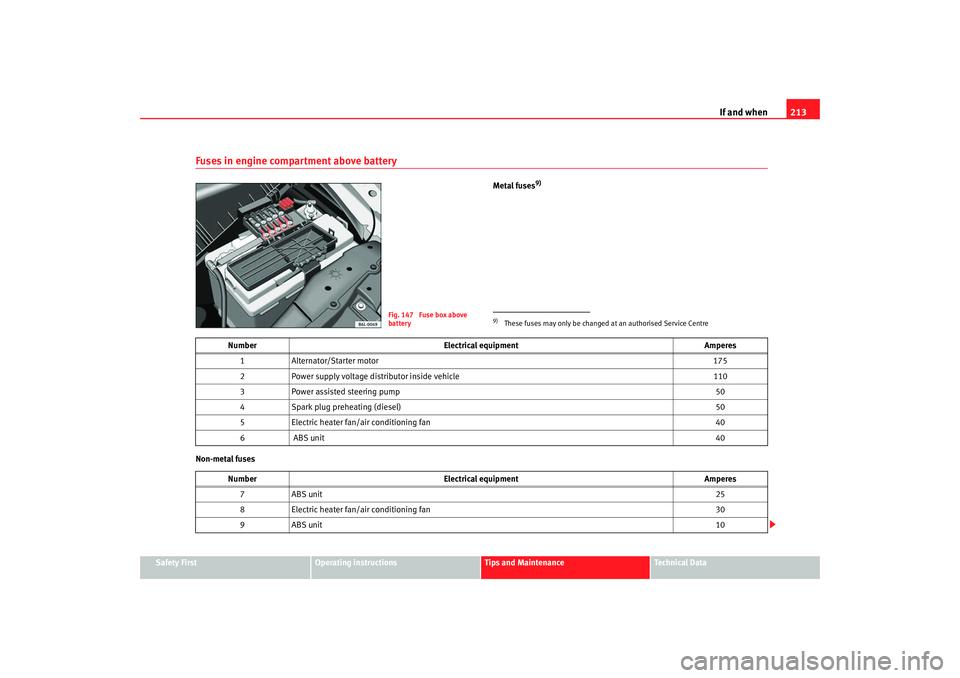
Fuses in engine compartment above battery
Metal fuses
9)
Non-metal fuses
Fig. 147 Fuse box above
battery
9)These fuses may only be changed at an authorised Service Centre
Number Electrical equipment Amperes
1 Alternator/Starter motor 175
2 Power supply voltage distributor inside vehicle 110
3 Power assisted steering pump 50
4 Spark plug preheating (diesel) 50
5 Electric heater fan/ air conditioning fan 40
6 A BS u nit 40
Number Electrical equipment Amperes
7A BS u nit 25
8 Electric heater fan/ air conditioning fan 30
9A BS u nit 10
ibiza_angles_0706_DEF Seite 213 Freitag, 1. September 2006 1:18 13
Page 230 of 268
If and when
228To w i n g a n d t o w - s t a r t i n gTo w - s t a r t i n g *
The use of jump leads is preferable to tow-starting.We recommend that you do not t o w - s t a r t yo u r v e h i c l e . J u m p - s ta r t i n g
is preferable ⇒page 225.
However, if your vehicle has to be tow-started:
– Engage the 2
nd or the 3
rd gear.
– Keep the clutch pressed down.
– Switch on the ignition.
– Once both vehicles are moving, release the clutch.
– As soon as the engine starts, press the clutch and move the gear lever into neutral. This helps to prevent driving into the towing
vehicle.
WARNING
The risk of accidents is high when tow-starting. The vehicle being towed
can easily collide with the towing vehicle.
Caution
When tow-starting, fuel could enter the catalytic converter and damage it.
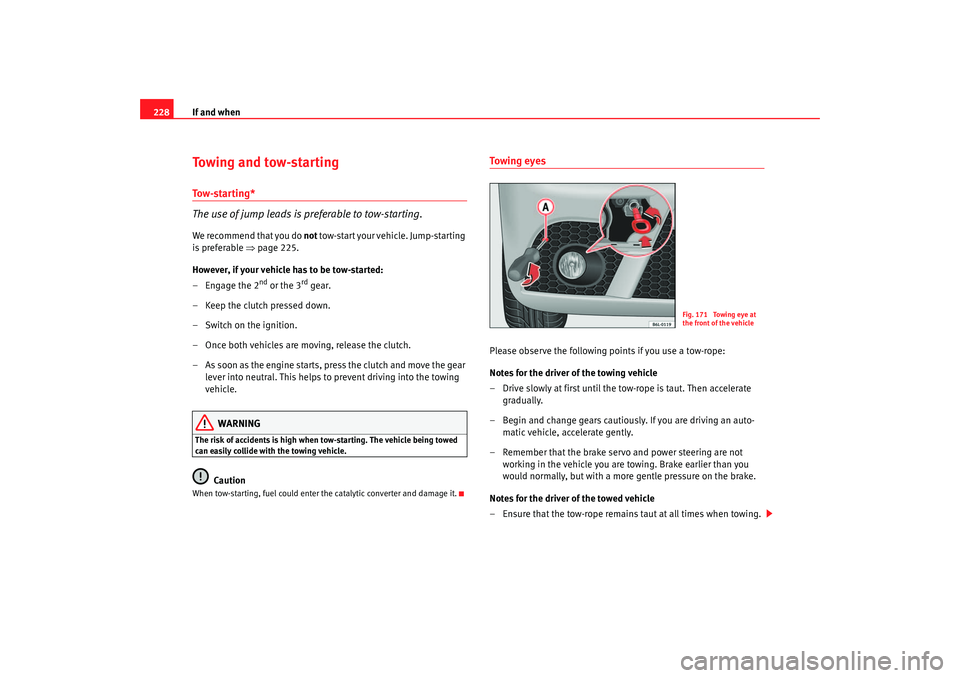
Towing eyesPlease observe the following points if you use a tow-rope:
Notes for the driver of the towing vehicle
– Drive slowly at first until the tow-rope is taut. Then accelerate gradually.
– Begin and change gears cautiously. If you are driving an auto- matic vehicle, accelerate gently.
– Remember that the brake servo and power steering are not working in the vehicle you are towing. Brake earlier than you
would normally, but with a more gentle pressure on the brake.
Notes for the driver of the towed vehicle
– Ensure that the tow-rope remains taut at all times when towing.
Fig. 171 Towing eye at
the front of the vehicle
ibiza_angles_0706_DEF Seite 228 Freitag, 1. September 2006 1:18 13
Page 231 of 268
If and when229
Safety First
Operating instructions
Tips and Maintenance
Te c h n i c a l D a t a
Fitting the front towing eye
– First remove the right hand co ver from the lower part of the
bumper.
– Remove the bolt ⇒page 228, fig. 171 .
– Take the towing ring from the onboard tools.
– Rotate the towing ring to the left until it is completely tightened into position.
– To remove the ring, rotate it to the right.Tow-rope or tow-bar
It is easier and safer to tow a vehicle with a tow-bar. You should only use a
tow-rope if you do not have a tow-bar.
A tow-rope should be slight ly elastic to reduce the loading on both vehicles.
It is advisable to use a tow-rope made of synthetic fibre or similarly elastic
material.
Attach the tow-rope or the tow-bar only to the towing eyes provided or a
towing bracket.
Driving style
Towing requires some experience, espec ially when using a tow-rope. Both
drivers should be famili ar with the technique required for towing. Inexperi-
enced drivers should not attempt to tow-start or tow away another vehicle.
Do not pull too hard with the towing vehi cle and take care to avoid jerking the
tow-rope. When towing on an unpaved road, there is always a risk of over-
loading and damaging the anchorage points.
The ignition of the vehicle being towed must be switched on to prevent the
steering wheel from locking and also to allow the use of the turn signals,
horn, windscreen wipers and washers. As the brake servo does not work if th
e engine is not running, you must apply
considerably more pressure to the brake pedal than you normally would.
As the power assisted steering does not work if the engine is not running, you
will need more strength to steer than you normally would.
Towing vehicles with an automatic gearbox
•
Put the selector lever into position “N”.
•
Do not drive faster than 50 km/h when towing a vehicle.
•
Do not tow further than 50 km.
•
If a breakdown vehicle is used, the vehicle must be towed with the front
wheels raised.Note
•
Observe legal requirements when towing or tow-starting.
•
Switch on the hazard warning lights of both vehicles. However, observe
any regulations to the contrary.
•
For technical reasons, vehicles with an automatic gearbox must not be
tow-started.
•
If damage to your vehicle means that there is no lubricant in the gearbox,
you must raise the drive wheels while the vehicle is being towed.
•
If the vehicle has to be towed more than 50 km, the front wheels must be
raised during towing, and towing should be carried out by a qualified person.
•
The steering wheel is locked when the vehicle has no electrical power. The
vehicle must then be towed with the front wheels raised. Towing should be
carried out by a qualified person.
•
The towing eye should always be kept in the vehicle. Please refer to the
notes on ⇒page 228.
AA
ibiza_angles_0706_DEF Seite 229 Freitag, 1. September 2006 1:18 13
Page 261 of 268
Index259
Convenience opening
Windows . . . . . . . . . . . . . . . . . . . . . . . . . . . . . 84
Coolant . . . . . . . . . . . . . . . . . . . . . . . . . . . 183, 184
Coolant Level . . . . . . . . . . . . . . . . . . . . . . . . . . . 184
Coolant level warning light . . . . . . . . . . . . . . . . . . . . . . . . . 61
Coolant Loss . . . . . . . . . . . . . . . . . . . . . . . . . . . 184
Coolant temperature Display . . . . . . . . . . . . . . . . . . . . . . . . . . . . . . 51
Safety instructions . . . . . . . . . . . . . . . . . . . . . 62
Correct adjustment of front head restraints . . . . 12
Cruise control system . . . . . . . . . . . . . . . . . . . . 140
Curtain airbags . . . . . . . . . . . . . . . . . . . . . . . . . . 35 Description . . . . . . . . . . . . . . . . . . . . . . . . . . . 35
Function . . . . . . . . . . . . . . . . . . . . . . . . . . . . . 36
Safety notes . . . . . . . . . . . . . . . . . . . . . . . . . . 36DDanger of fitting a child seat on the front passenger seat . . . . . . . . . . . . . . . . . . . . . . . . . . . . . . . 26
Deep Water in Cupra version . . . . . . . . . . . . . . 149
Diesel . . . . . . . . . . . . . . . . . . . . . . . . . . . . . . . . . 175
Diesel engine Winter driving . . . . . . . . . . . . . . . . . . . . . . . . 175
Diesel engine particulate filter* . . . . . . . . . . . . 151
Differential lock . . . . . . . . . . . . . . . . . . . . . . . . . 148
Differential lock fault (EDL) warning lamp . . . . . . . . . . . . . . . . . . . . . . . . . 65
Digital clock . . . . . . . . . . . . . . . . . . . . . . . . . . . . . 52
Dipped headlights . . . . . . . . . . . . . . . . . . . . . . . . 88 Disabling front passenger airbag
Safety notes . . . . . . . . . . . . . . . . . . . . . . . . . . 39
Disabling the airbag Disabling front passenger airbag . . . . . . . . . 38
Displays in the Mult i-function display
Memory displays . . . . . . . . . . . . . . . . . . . . . . 54
Door lock cylinders . . . . . . . . . . . . . . . . . . . . . . 164
Door release lever . . . . . . . . . . . . . . . . . . . . . . . . 49
Doors Childproof locks . . . . . . . . . . . . . . . . . . . . . . . 72
Unlocking and locking . . . . . . . . . . . . . . . . . 68
Drive wheels traction control system . . . . . . . . 146
Driving Driving abroad . . . . . . . . . . . . . . . . . . . . . . . 151
With a trailer . . . . . . . . . . . . . . . . . . . . . . . . . 157
with a trailer . . . . . . . . . . . . . . . . . . . . . . . . . 156
Driving abroad . . . . . . . . . . . . . . . . . . . . . . . . . . 151 Headlights . . . . . . . . . . . . . . . . . . . . . . . . . . 152
Driving economically . . . . . . . . . . . . . . . . . . . . . 158
Driving safety . . . . . . . . . . . . . . . . . . . . . . . . . . . . . 8
Driving with respect for the environment . . . . . 158
Duplicate keys . . . . . . . . . . . . . . . . . . . . . . . . . . . 75
Dust filter . . . . . . . . . . . . . . . . . . . . . . . . . . . . . . 126
Dynamic headlight range control . . . . . . . . . . . . 89
EEDL . . . . . . . . . . . . . . . . . . . . . . . . . . . . . . . . . . . 148
EDS Warning lamp . . . . . . . . . . . . . . . . . . . . . . . . . 62
Electrical sockets . . . . . . . . . . . . . . . . . . . . . . . . 112 Electrohydraulic steering
warning lamp . . . . . . . . . . . . . . . . . . . . . . . . . 60
Electronic differential lock . . . . . . . . . . . . . . . . 148 Warning lamp . . . . . . . . . . . . . . . . . . . . . . . . 62
Electronic immobiliser . . . . . . . . . . . . . . . . 65, 131
Electronic stabilisation program . . . . . . . . . . . . 64 Description . . . . . . . . . . . . . . . . . . . . . . . . . . 129
Warning lamp . . . . . . . . . . . . . . . . . . . . . . . 130
Electronic stabilisation program (ESP) warning lamp . . . . . . . . . . . . . . . . . . . . . . . . . 64
Electronic stabilisation programme . . . . . . . . . 147
Emission control system warning lamp . . . . . . . . . . . . . . . . . . . . . . . . . 63
Engine Running-in . . . . . . . . . . . . . . . . . . . . . . . . . . 149
Engine compartment Working in the engine compartment . . . . . 176
Engine coolant . . . . . . . . . . . . . . . . . . . . . . . . . . 183
Engine fault warning lamp . . . . . . . . . . . . . . . . . . . . . . . . . 61
Engine management Warning lamp . . . . . . . . . . . . . . . . . . . . . . . . 61
Engine oil . . . . . . . . . . . . . . . . . . . . . . . . . . . . . . 179 Changing . . . . . . . . . . . . . . . . . . . . . . . . . . . 182
Checking level . . . . . . . . . . . . . . . . . . . . . . . 180
Oil properties . . . . . . . . . . . . . . . . . . . . . . . . 179
Specifications . . . . . . . . . . . . . . . . . . . . . . . 179
Topping up . . . . . . . . . . . . . . . . . . . . . . . . . . 181
Engine oil dipstick . . . . . . . . . . . . . . . . . . . . . . . 180
Engine oil pressure Warning lamp . . . . . . . . . . . . . . . . . . . . . . . . 65
ibiza_angles_0706_DEF Seite 259 Freitag, 1. September 2006 1:18 13
Page 264 of 268
Index
262Rev counter . . . . . . . . . . . . . . . . . . . . . . . . . . . . . 51
Reverse gear
Manual gearbox . . . . . . . . . . . . . . . . . . . . . 134
RME fuel (biodiesel) . . . . . . . . . . . . . . . . . . . . . 175
Roll-back function Sliding/tilting roof . . . . . . . . . . . . . . . . . . . . 87
Windows . . . . . . . . . . . . . . . . . . . . . . . . . . . . 84
Roof aerial* . . . . . . . . . . . . . . . . . . . . . . . . . . . . 170
Roof carrier* . . . . . . . . . . . . . . . . . . . . . . . . . . . . 116
Rubber seals . . . . . . . . . . . . . . . . . . . . . . . . . . . 164
Running-in Brake pads . . . . . . . . . . . . . . . . . . . . . . . . . . 149
Engine . . . . . . . . . . . . . . . . . . . . . . . . . . . . . 149
Tyres . . . . . . . . . . . . . . . . . . . . . . . . . . . . . . . 149
Running-in tyres . . . . . . . . . . . . . . . . . . . . . . . . 149SSafe driving . . . . . . . . . . . . . . . . . . . . . . . . . . . . . . 7
Safety . . . . . . . . . . . . . . . . . . . . . . . . . . . . . . . . . . . 8
Safety equipment . . . . . . . . . . . . . . . . . . . . . . . . . 7
Safety instructions Coolant temperature . . . . . . . . . . . . . . . . . . . 62
Safety notes Belt tension devices . . . . . . . . . . . . . . . . . . . 24
Curtain airbags . . . . . . . . . . . . . . . . . . . . . . . 36
Disabling front passenger airbag . . . . . . . . 39
Front airbags . . . . . . . . . . . . . . . . . . . . . . . . . 31
Side airbags . . . . . . . . . . . . . . . . . . . . . . . . . 34
Using child seats . . . . . . . . . . . . . . . . . . . . . . 41
Using seat belts . . . . . . . . . . . . . . . . . . . . . . 19 Safety system- safe . . . . . . . . . . . . . . . . . . . . . . . 69
Seals . . . . . . . . . . . . . . . . . . . . . . . . . . . . . . . . . 164
Seat adjustment . . . . . . . . . . . . . . . . . . . . 102, 105
Seat belt position
Pregnant women . . . . . . . . . . . . . . . . . . . . . . 22
Seat belts . . . . . . . . . . . . . . . . . . . . . . . . . . . . 21
Seat belt release . . . . . . . . . . . . . . . . . . . . . . . . . 23
Seat belt warning lamp . . . . . . . . . . . . . . . . . . . . 16
Seat belts . . . . . . . . . . . . . . . . . . . . . . . . . . . . . . . 16 adjustment . . . . . . . . . . . . . . . . . . . . . . . . . . 20
Incorrectly fastened . . . . . . . . . . . . . . . . . . . 23
Not worn . . . . . . . . . . . . . . . . . . . . . . . . . . . . 18
Safety notes . . . . . . . . . . . . . . . . . . . . . . . . . . 19
Warning lamp . . . . . . . . . . . . . . . . . . . . . . . . 16
Seat belts protect . . . . . . . . . . . . . . . . . . . . . . . . 19
Seat heating . . . . . . . . . . . . . . . . . . . . . . . . . . . 106
Seats . . . . . . . . . . . . . . . . . . . . . . . . . . . . . . . . . . 16
Selective opening* . . . . . . . . . . . . . . . . . . . . . . . 70
Semiautomatic air conditioning controls . . . . . . . . . . . . . . . . . . . . . . . . . . . . 120
Shoes . . . . . . . . . . . . . . . . . . . . . . . . . . . . . . . . . . 14
Side airbags . . . . . . . . . . . . . . . . . . . . . . . . . . . . 31 Description . . . . . . . . . . . . . . . . . . . . . . . . . . 31
Function . . . . . . . . . . . . . . . . . . . . . . . . . . . . . 33
Safety notes . . . . . . . . . . . . . . . . . . . . . . . . . . 34
Side lights . . . . . . . . . . . . . . . . . . . . . . . . . . . . . . 88
Sitting position Driver . . . . . . . . . . . . . . . . . . . . . . . . . . . . . . . . 9
Front passenger . . . . . . . . . . . . . . . . . . . . . . 10
Incorrect sitting position . . . . . . . . . . . . . . . 13
Passengers . . . . . . . . . . . . . . . . . . . . . . . . . . 11 Sitting position, occupants . . . . . . . . . . . . . . . . . 9
Sliding/tilting roof . . . . . . . . . . . . . . . . . . . . . . . 85
Snow chains . . . . . . . . . . . . . . . . . . . . . . . 197, 237
Soot accumulation in the
diesel engine particulate
filter *
Indicator . . . . . . . . . . . . . . . . . . . . . . . . . . . . 64
Spare wheel* . . . . . . . . . . . . . . . . . . . . . . . . . . . 199
Spares . . . . . . . . . . . . . . . . . . . . . . . . . . . . . . . . 169
Speedometer . . . . . . . . . . . . . . . . . . . . . . . . . . . . 52
Starting Petrol engines . . . . . . . . . . . . . . . . . . . 132
Starting the engine . . . . . . . . . . . . . . . . . . 131, 132 After the fuel tank has been run dry . . . . . 133
Steam cleaners . . . . . . . . . . . . . . . . . . . . . . . . . 162
Steering . . . . . . . . . . . . . . . . . . . . . . . . . . . . . . . 128 Steering lock . . . . . . . . . . . . . . . . . . . . . . . . 130
Steering wheel controls . . . . . . . . . . . . . . . . . . . 66
Steering wheel height adjustment . . . . . . . . . 128
Stowage frnt right seats . . . . . . . . . . . . . . . . . . . . . . . 109
Stowage compartment Front passenger side . . . . . . . . . . . . . . . . . 108
Sun visors . . . . . . . . . . . . . . . . . . . . . . . . . . . . . . 94
Sunroof . . . . . . . . . . . . . . . . . . . . . . . . . . . . . . . . 85
Sunroof blind Sliding/tilting roof . . . . . . . . . . . . . . . . . . . . 86
Switch Hazard warning lights . . . . . . . . . . . . . . . . . . 90
Rear window heating . . . . . . . . . . . . . . . . . . 89
ibiza_angles_0706_DEF Seite 262 Freitag, 1. September 2006 1:18 13