wheel Seat Ibiza 5D 2006 Workshop Manual
[x] Cancel search | Manufacturer: SEAT, Model Year: 2006, Model line: Ibiza 5D, Model: Seat Ibiza 5D 2006Pages: 268, PDF Size: 8.14 MB
Page 206 of 268
If and when
204
WARNING
Loosen the wheel bolts only about one turn before raising the vehicle with
the jack, loosening the wheel bolts more than one turn can result in an acci-
dent.
Note
•
Do not use the hexagonal socket in the screwdriver handle to loosen or
tighten the wheel bolts.
•
If the wheel bolt is very tight, you may be able to loosen it by pushing
down the end of the spanner carefully with your foot. Hold on to the vehicle
for support and take care not to slip.
Raising the vehicle
The vehicle must be raised with a jack to remove the wheel.
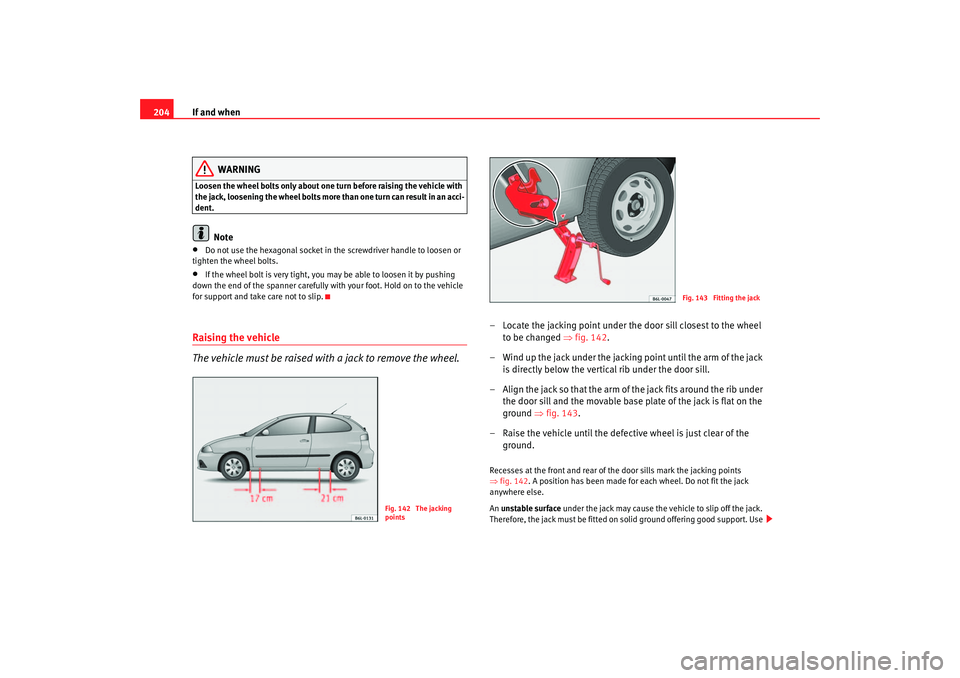
– Locate the jacking point under the door sill closest to the wheel to be changed ⇒fig. 142.
– Wind up the jack under the jacking point until the arm of the jack is directly below the vertical rib under the door sill.
– Align the jack so that the arm of the jack fits around the rib under the door sill and the movable base plate of the jack is flat on the
ground ⇒fig. 143.
– Raise the vehicle until the defective wheel is just clear of the ground.Recesses at the front and rear of the door sills mark the jacking points
⇒fig. 142. A position has been made for each wheel. Do not fit the jack
anywhere else.
An unstable surface under the jack may cause the vehicle to slip off the jack.
Therefore, the jack must be fitted on solid ground offering good support. Use
Fig. 142 The jacking
points
Fig. 143 Fitting the jack
ibiza_angles_0706_DEF Seite 204 Freitag, 1. September 2006 1:18 13
Page 207 of 268
If and when205
Safety First
Operating instructions
Tips and Maintenance
Te c h n i c a l D a t a
a large and stable base, if necessary. On a hard, slippery surface (such as
tiles) use a rubber mat or similar to prevent the jack from slipping.
WARNING
•
Take all precautions so that the base of the jack does not slip. Failure to
do so could result in an accident.
•
The vehicle can be damaged if the jack is not applied at the correct
jacking points. There is also a risk of injury since the jack can slip off
suddenly if it is not properly engaged.
Removing and fitting the wheel
For removing and fitting the wheel, the following tasks must
be completed.Change the wheel as described below, after loosening the wheel
bolts and raising the vehicle with the jack. Removing a wheel
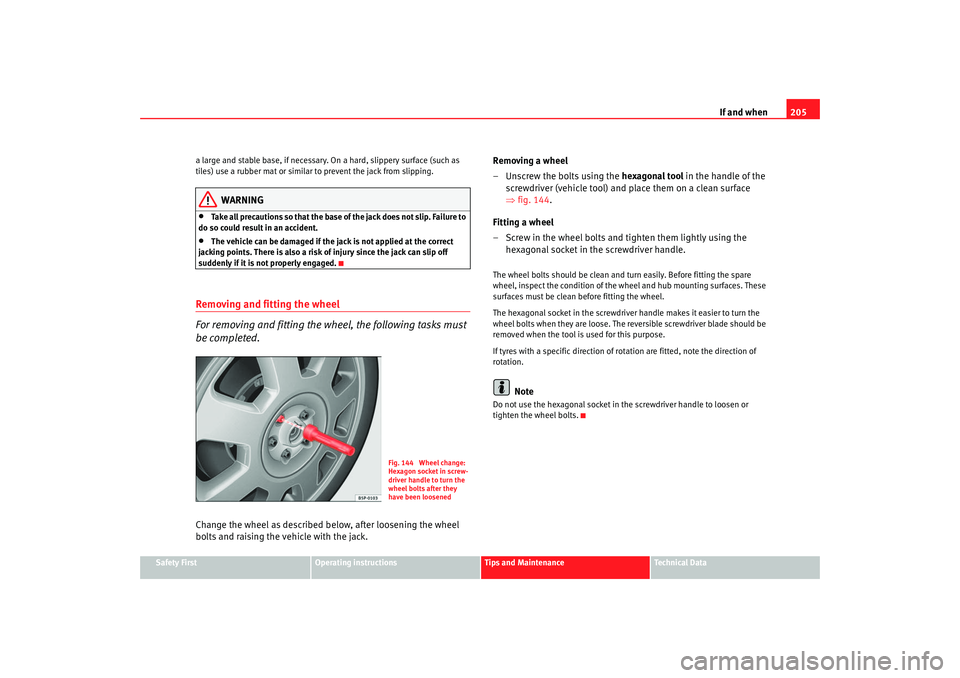
– Unscrew the bolts using the
hexagonal tool in the handle of the
screwdriver (vehicle tool) and place them on a clean surface
⇒ fig. 144.
Fitting a wheel
– Screw in the wheel bolts and tighten them lightly using the hexagonal socket in the screwdriver handle.
The wheel bolts should be clean and turn easily. Before fitting the spare
wheel, inspect the condition of the wheel and hub mounting surfaces. These
surfaces must be clean before fitting the wheel.
The hexagonal socket in the screwdriver handle makes it easier to turn the
wheel bolts when they are loose. The reversible screwdriver blade should be
removed when the tool is used for this purpose.
If tyres with a specific direction of ro tation are fitted, note the direction of
rotation.
Note
Do not use the hexagonal socket in the screwdriver handle to loosen or
tighten the wheel bolts.
Fig. 144 Wheel change:
Hexagon socket in screw-
driver handle to turn the
wheel bolts after they
have been loosened
ibiza_angles_0706_DEF Seite 205 Freitag, 1. September 2006 1:18 13
Page 208 of 268
If and when
206Anti-theft wheel bolts*
A special adapter is required to turn the anti-theft wheel
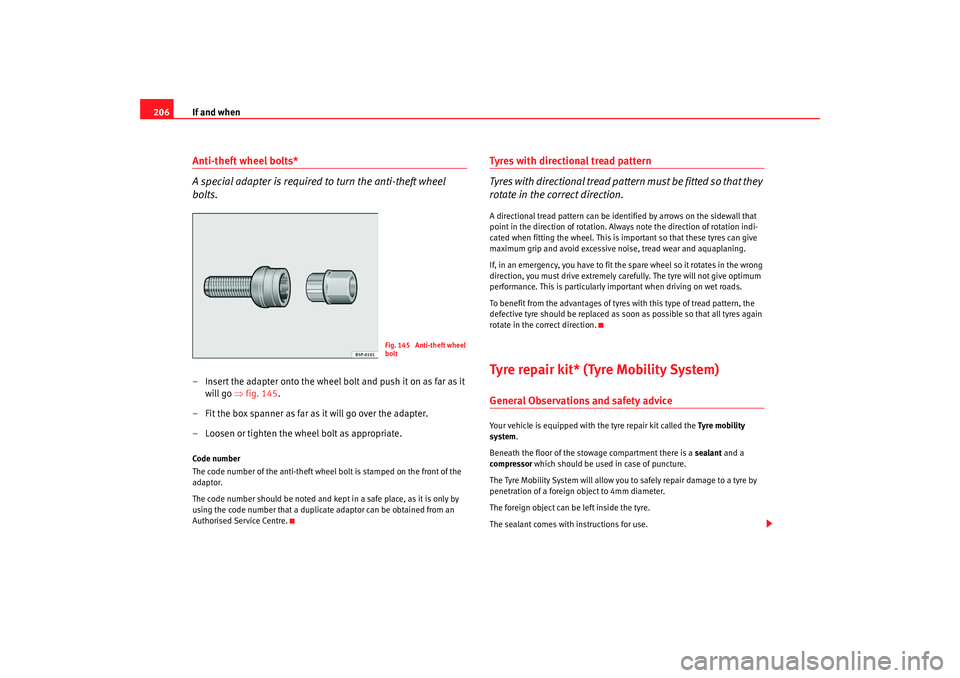
bolts.– Insert the adapter onto the wheel bolt and push it on as far as it
will go ⇒fig. 145 .
– Fit the box spanner as far as it will go over the adapter.
– Loosen or tighten the wheel bolt as appropriate.Code number
The code number of the anti-theft wheel bolt is stamped on the front of the
adaptor.
The code number should be noted and kept in a safe place, as it is only by
using the code number that a duplicate adaptor can be obtained from an
Authorised Service Centre.
Tyres with directional tread pattern
Tyres with directional tread pattern must be fi tted s o tha t they
rotate in the correct direction.A directional tread pattern can be identified by arrows on the sidewall that
point in the direction of rotation. Always note the direction of rotation indi-
cated when fitting the wheel. This is important so that these tyres can give
maximum grip and avoid excessive noise, tread wear and aquaplaning.
If, in an emergency, you have to fit the spare wheel so it rotates in the wrong
direction, you must drive extremely care fully. The tyre will not give optimum
performance. This is particularly im portant when driving on wet roads.
To benefit from the advantages of tyres with this type of tread pattern, the
defective tyre should be replaced as soon as possible so that all tyres again
rotate in the correct direction.Tyre repair kit* (Tyre Mobility System)General Observations and safety adviceYour vehicle is equipped with the tyre repair kit called the Tyre mobility
system.
Beneath the floor of the stowage compartment there is a sealant and a
compressor which should be used in case of puncture.
The Tyre Mobility System will allow you to safely repair damage to a tyre by
penetration of a foreign object to 4mm diameter.
The foreign object can be left inside the tyre.
The sealant comes with instructions for use.
Fig. 145 Anti-theft wheel
bolt
ibiza_angles_0706_DEF Seite 206 Freitag, 1. September 2006 1:18 13
Page 209 of 268
If and when207
Safety First
Operating instructions
Tips and Maintenance
Te c h n i c a l D a t a
There is also a guide to using the compressor.
WARNING
•
The sealant should not be used if th
e tyre has been damaged as a result
of going flat.
•
Follow the instructions for your safety and use on the compressor and
the sealant packaging.
•
Do not drive at more than 80 km/h, avoid accelerating or braking hard
or taking curves at high speed.
•
A tyre that has been repaired with sealant should only be used provi-
sionally, and for a short time. Therefore, your car should be taken carefully
to the nearest specialised workshop.For the sake of the environment
If you want to dispose of the sealant bottle, go to a company that treats waste
products.
Note
Seek professional assistance if the repair of a tyre puncture is not possible
with the sealing compound.Preparation work
What you must do before changing a wheel.– If you have a flat tyre or puncture, park the vehicle as far away from the flow of traffic as possible.
–Apply the handbrake firmly. – Engage the first gear
, or put the selector lever to position P for
those vehicles with an automatic gearbox.
– All passengers must leave the vehicle. They should wait in a safe
area (for instance behind the roadside crash barrier).
– Check whether the puncture can be mended using the Tyre Mobility System “General observations and safety advice.”
– Unscrew cap from the valve of the affected wheel.
– Take the tyre repair kit from the luggage compartment.
WARNING
Put the hazard warning lights on and place the warning triangle in position.
This is for your own safety and also warns other road users.
Caution
Take the utmost caution when repairing a flat tyre on a gradient.
Note
Please observe legal requirements when doing so.
ibiza_angles_0706_DEF Seite 207 Freitag, 1. September 2006 1:18 13
Page 211 of 268
If and when209
Safety First
Operating instructions
Tips and Maintenance
Te c h n i c a l D a t a
steering wheel on the right the fuses are
on the right-hand side of the instru-
ment panel, behind a cover.
The electric windows are protected by circuit breakers. These reset automat-
ically after a few seconds when the overload (caused for example by frozen
windows) has been corrected.
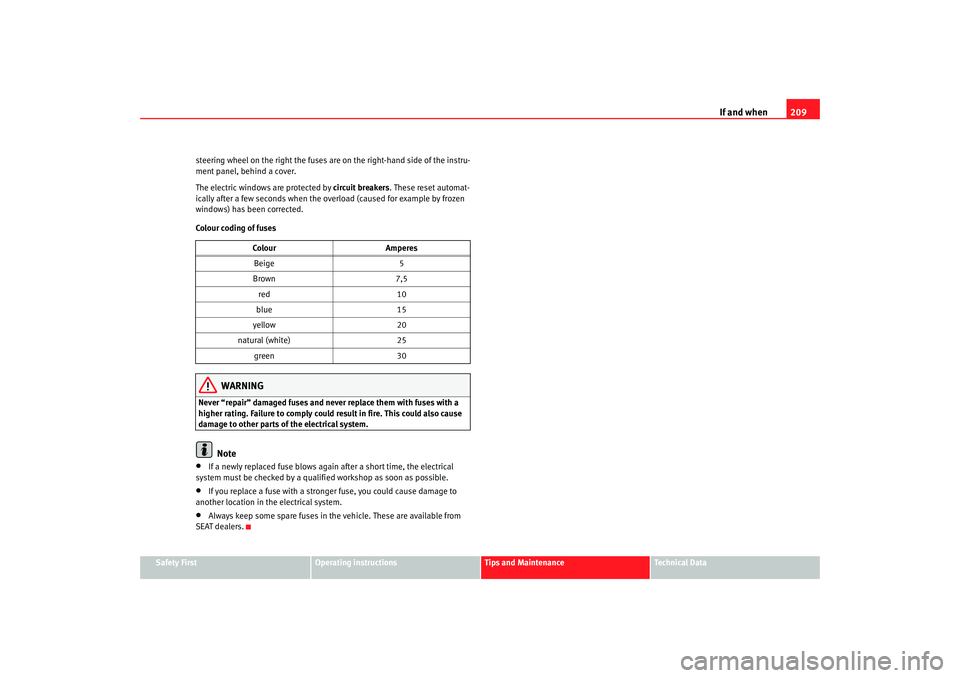
Colour coding of fuses
WARNING
Never “repair” damaged fuses and never replace them with fuses with a
higher rating. Failure to comply could result in fire. This could also cause
damage to other parts of the electrical system.
Note
•
If a newly replaced fuse blows again after a short time, the electrical
system must be checked by a qualified workshop as soon as possible.
•
If you replace a fuse with a stronger fuse, you could cause damage to
another location in the electrical system.
•
Always keep some spare fuses in the vehicle. These are available from
SEAT dealers. Colour
Amperes
Beige 5
Brown 7,5
red 10
blue 15
yellow 20
natural (white) 25
green 30
ibiza_angles_0706_DEF Seite 209 Freitag, 1. September 2006 1:18 13
Page 214 of 268
If and when
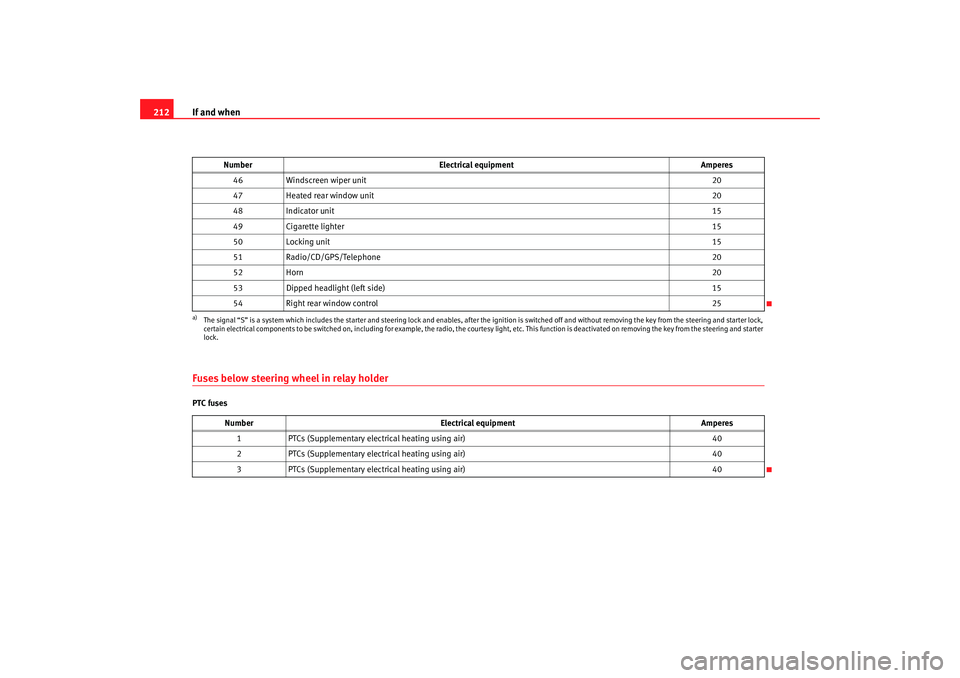
212Fuses below steering wheel in relay holderPTC fuses 46
Windscreen wiper unit 20
47 Heated rear window unit 20
48 Indicator unit 15
49 Cigarette lighter 15
50 Locking unit 15
51 Radio/CD/GPS/Telephone 20
52 Horn 20
53 Dipped headlight (left side) 15
54 Right rear window control 25a)The signal “S” is a system which includes the starter and steering lock and enables, after the ignition is switched off and wit hout removing the key from the steering and starter lock,
certain electrical components to be switched on, including for example, the radio, the courtesy light, etc. This function is de activated on removing the key from the steering and starter
lock.
Number Electrical equipment Amperes
1 PTCs (Supplementary electrical heating using air) 40
2 PTCs (Supplementary electrical heating using air) 40
3 PTCs (Supplementary electrical heating using air) 40
Number
Electrical equipment Amperes
ibiza_angles_0706_DEF Seite 212 Freitag, 1. September 2006 1:18 13
Page 231 of 268
If and when229
Safety First
Operating instructions
Tips and Maintenance
Te c h n i c a l D a t a
Fitting the front towing eye
– First remove the right hand co ver from the lower part of the
bumper.
– Remove the bolt ⇒page 228, fig. 171 .
– Take the towing ring from the onboard tools.
– Rotate the towing ring to the left until it is completely tightened into position.
– To remove the ring, rotate it to the right.Tow-rope or tow-bar
It is easier and safer to tow a vehicle with a tow-bar. You should only use a
tow-rope if you do not have a tow-bar.
A tow-rope should be slight ly elastic to reduce the loading on both vehicles.
It is advisable to use a tow-rope made of synthetic fibre or similarly elastic
material.
Attach the tow-rope or the tow-bar only to the towing eyes provided or a
towing bracket.
Driving style
Towing requires some experience, espec ially when using a tow-rope. Both
drivers should be famili ar with the technique required for towing. Inexperi-
enced drivers should not attempt to tow-start or tow away another vehicle.
Do not pull too hard with the towing vehi cle and take care to avoid jerking the
tow-rope. When towing on an unpaved road, there is always a risk of over-
loading and damaging the anchorage points.
The ignition of the vehicle being towed must be switched on to prevent the
steering wheel from locking and also to allow the use of the turn signals,
horn, windscreen wipers and washers. As the brake servo does not work if th
e engine is not running, you must apply
considerably more pressure to the brake pedal than you normally would.
As the power assisted steering does not work if the engine is not running, you
will need more strength to steer than you normally would.
Towing vehicles with an automatic gearbox
•
Put the selector lever into position “N”.
•
Do not drive faster than 50 km/h when towing a vehicle.
•
Do not tow further than 50 km.
•
If a breakdown vehicle is used, the vehicle must be towed with the front
wheels raised.Note
•
Observe legal requirements when towing or tow-starting.
•
Switch on the hazard warning lights of both vehicles. However, observe
any regulations to the contrary.
•
For technical reasons, vehicles with an automatic gearbox must not be
tow-started.
•
If damage to your vehicle means that there is no lubricant in the gearbox,
you must raise the drive wheels while the vehicle is being towed.
•
If the vehicle has to be towed more than 50 km, the front wheels must be
raised during towing, and towing should be carried out by a qualified person.
•
The steering wheel is locked when the vehicle has no electrical power. The
vehicle must then be towed with the front wheels raised. Towing should be
carried out by a qualified person.
•
The towing eye should always be kept in the vehicle. Please refer to the
notes on ⇒page 228.
AA
ibiza_angles_0706_DEF Seite 229 Freitag, 1. September 2006 1:18 13
Page 236 of 268
General notes on the technical data
234Vehicle identification data
The most important data are given on the type plate and the
vehicle data sticker.Vehicles for certain export countries do not have a model plate.
Type plate
The type plate is located on the left rib inside the engine compartment.
Vehicle identification number
The vehicle identification number (chass is number) can be read from outside
the vehicle through a viewer in the windscreen. This is located on the left-
hand side of the vehicle in the lower area of the windscreen. It is also located
on the right hand side of the engine compartment. Vehicle data
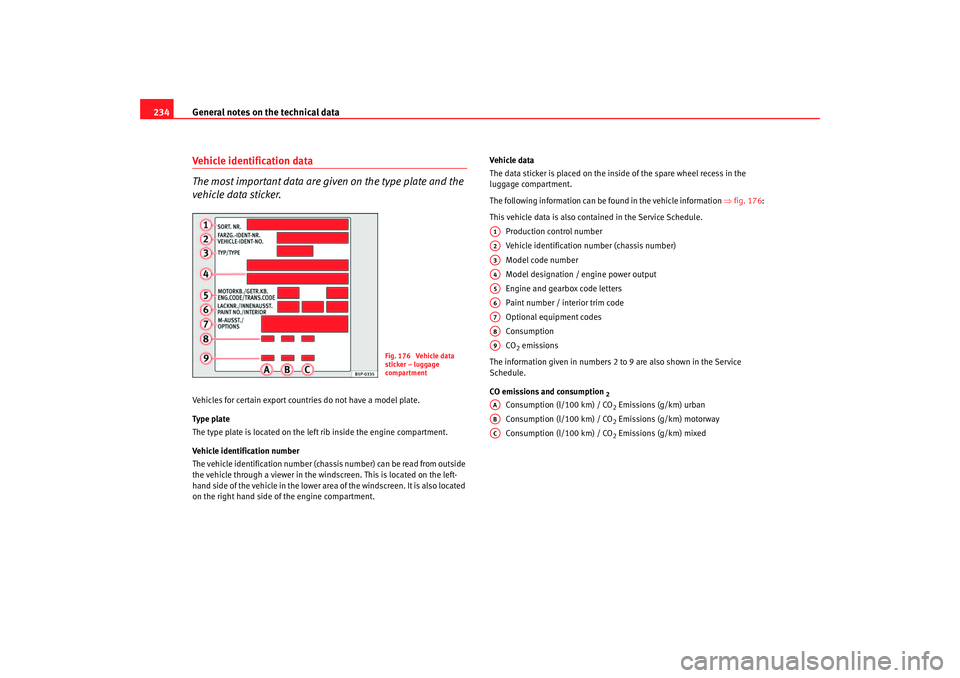
The data sticker is placed on the inside of the spare wheel recess in the
luggage compartment.
The following information can be found in the vehicle information
⇒fig. 176 :
This vehicle data is also contained in the Service Schedule. Production control number
Vehicle identification number (chassis number)
Model code number
Model designation / engine power output
Engine and gearbox code letters
Paint number / interior trim code
Optional equipment codes
Consumption
CO2 emissions
The information given in numbers 2 to 9 are also shown in the Service
Schedule.
CO emissions and consumption
2
Consumption (l/100 km) / CO
2 Emissions (g/km) urban
Con
sumption (l/100 km) / CO
2 Emissions (g/km) motorway
Consumption (l/100 km) / CO2 Emissions (g/km) mixed
Fig. 176 Vehicle data
sticker – luggage
compartment
A1A2A3A4A5A6A7A8A9AAABAC
ibiza_angles_0706_DEF Seite 234 Freitag, 1. September 2006 1:18 13
Page 238 of 268
General notes on the technical data
236WeightsKerb weight refers to the basic model with a fuel tank filled to 90% capacity
and without optional extras. The figure quoted includes 75 kg to allow for the
weight of the driver.
For special versions and optional equipment fittings or for the addition of
accessories, the weight of the vehicle will increase ⇒.
WARNING
•
Please note that the centre of gravity may shift when transporting
heavy objects; this may affect the vehi cle's handling and lead to an acci-
dent. Always adjust your speed and dr iving style to suit road conditions
and requirements.
•
Never exceed the gross axle weight rating or the gross vehicle weight
rating. If the allowed axle load or the allowed total weight is exceeded, the
driving characteristics of the vehicle may change, leading to accidents,
injuries and damage to the vehicle.
To w i n g a t r a i l e rTrailer weightsTrailer weights
The trailer weights and drawbar loads approved are selected in intensive
trials according to precisely defined criteria. The approved trailer weights are
valid for vehicles in EU for maximum speeds of 80 km/h (in certain circum-
stances up to 100 km/h). The figures may be different in other countries. All
data in the official vehicle documents take precedence over these data ⇒. Drawbar load
The
maximum permitted weight exerted by the trailer drawbar on the ball joint
of the towing bracket must not exceed 75 kg.
In the interest of road safety, we recommend that you always tow
approaching the maximum drawbar load. The response of the trailer on the
road will be poor if th e drawbar load is too small.
If the maximum permissible drawbar load cannot be met (e.g. with small,
empty and light-weight single axle trailers or tandem axle trailers with an axle
base of less than 1 metre), at least 4% of the actual trailer weight is a legal
stipulation for a drawbar load.
WARNING
•
For safety reasons, you should not drive at speeds above 80 km/h when
towing a trailer. This also applies to countries where higher speeds are
permitted.
•
Never exceed the maximum trailer weights or the draw bar loading. If
the permissible axle load or the perm issible total weight is exceeded, the
driving characteristics of the vehicle may change, leading to accidents,
injuries and damage to the vehicle.
WheelsTyre pressure, snow chains, wheel boltsTyre pressures
The sticker with the tyre pressure values can be found on the inside of the
tank flap. The tyre pressure values given there are for cold tyres. The slightly
raised pressures of warm tyres must not be reduced ⇒.
ibiza_angles_0706_DEF Seite 236 Freitag, 1. September 2006 1:18 13
Page 239 of 268
General notes on the technical data 237
Safety First
Operating instructions
Tips and Maintenance
Te c h n i c a l D a t a
Snow chains
Snow chains are only permitted on the front wheels and only for tyres 155/80
R13; 165/70 R14 and 185/80 R14. Snow ch
ains must have fine-pitch links
which do not protrude more than 15 mm, including tension device.
Remaining tyres can be fitted with chains no thicker than 9 mm.
Wheel bolts
After the wheels have been changed, the tightening torque of the wheel bolts
should be checked as soon as possible with a torque wrench ⇒. The tight-
ening torque for steel and alloy wheels is 120 Nm.
WARNING
•
Check the tyre pressure at least once per month. Correct tyre pressure
is very important. If the tyre pressure is too high or too low, there is an
increased danger of accidents, particularly at high speeds.
•
If the torque of the wheel bolts is too low, they could loosen whilst the
vehicle is in motion. Risk of accident! If the tightening torque is too high,
the wheel bolts and threads could be damaged.Note
We recommend that you ask your Authorised Service Centre for information
about appropriate wheel, tyre and snow chain size.
ibiza_angles_0706_DEF Seite 237 Freitag, 1. September 2006 1:18 13