light Seat Ibiza 5D 2006 Manual Online
[x] Cancel search | Manufacturer: SEAT, Model Year: 2006, Model line: Ibiza 5D, Model: Seat Ibiza 5D 2006Pages: 268, PDF Size: 8.14 MB
Page 203 of 268
If and when201
Safety First
Operating instructions
Tips and Maintenance
Te c h n i c a l D a t a
Note
•
Seek professional assistance if the repair of a tyre puncture is not
possible with the sealing compound.
Wheel changePreparation work
What you must do before changing a wheel.– If you have a flat tyre or puncture, park the vehicle as far away from the flow of traffic as possible. Choose a location that is as
level as possible.
– All passengers should leave the vehicle. They should wait in a safe area (for instance behind the roadside crash barrier).
– Switch off the engine. Switch on the hazard warning lights.
–Apply the handbrake firmly.
–Engage the first gear, or put the selector lever to position P for
those vehicles with an automatic gearbox.
– If you are towing a trailer, unhitch it from your vehicle.
–Take the vehicle tools and the spare wheel out of the luggage
compartment.
WARNING
Put the hazard warning lights on and place the warning triangle in position.
This is for your own safety and also warns other road users.
Caution
If you have to change the tyre on a gradient, block the wheel opposite the
wheel being changed by placing a stone or similar object under it to prevent
the vehicle from rolling away.
Note
Please observe legal requirements when doing so.Changing a wheelChange the wheel as described below
–Pull off the hub cap see also ⇒page 202.
–Slacken the wheel bolts.
– Raise the car with the jack in the corresponding zone.
– Ta k e o f f the wheel and then put on the spare wheel.
– Lower the vehicle.
– Tighten the wheel bolts firmly i n d i a go na l s e q u e n ce wi t h t h e b ox
spanner.
–Replace the hub cap.
ibiza_angles_0706_DEF Seite 201 Freitag, 1. September 2006 1:18 13
Page 207 of 268
If and when205
Safety First
Operating instructions
Tips and Maintenance
Te c h n i c a l D a t a
a large and stable base, if necessary. On a hard, slippery surface (such as
tiles) use a rubber mat or similar to prevent the jack from slipping.
WARNING
•
Take all precautions so that the base of the jack does not slip. Failure to
do so could result in an accident.
•
The vehicle can be damaged if the jack is not applied at the correct
jacking points. There is also a risk of injury since the jack can slip off
suddenly if it is not properly engaged.
Removing and fitting the wheel
For removing and fitting the wheel, the following tasks must
be completed.Change the wheel as described below, after loosening the wheel
bolts and raising the vehicle with the jack. Removing a wheel
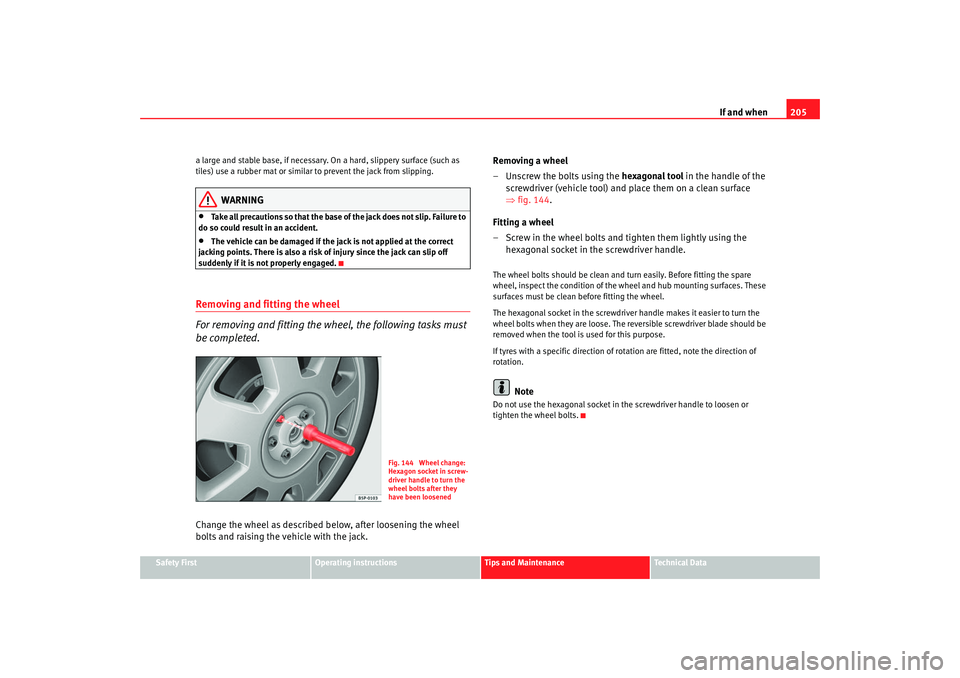
– Unscrew the bolts using the
hexagonal tool in the handle of the
screwdriver (vehicle tool) and place them on a clean surface
⇒ fig. 144.
Fitting a wheel
– Screw in the wheel bolts and tighten them lightly using the hexagonal socket in the screwdriver handle.
The wheel bolts should be clean and turn easily. Before fitting the spare
wheel, inspect the condition of the wheel and hub mounting surfaces. These
surfaces must be clean before fitting the wheel.
The hexagonal socket in the screwdriver handle makes it easier to turn the
wheel bolts when they are loose. The reversible screwdriver blade should be
removed when the tool is used for this purpose.
If tyres with a specific direction of ro tation are fitted, note the direction of
rotation.
Note
Do not use the hexagonal socket in the screwdriver handle to loosen or
tighten the wheel bolts.
Fig. 144 Wheel change:
Hexagon socket in screw-
driver handle to turn the
wheel bolts after they
have been loosened
ibiza_angles_0706_DEF Seite 205 Freitag, 1. September 2006 1:18 13
Page 209 of 268
If and when207
Safety First
Operating instructions
Tips and Maintenance
Te c h n i c a l D a t a
There is also a guide to using the compressor.
WARNING
•
The sealant should not be used if th
e tyre has been damaged as a result
of going flat.
•
Follow the instructions for your safety and use on the compressor and
the sealant packaging.
•
Do not drive at more than 80 km/h, avoid accelerating or braking hard
or taking curves at high speed.
•
A tyre that has been repaired with sealant should only be used provi-
sionally, and for a short time. Therefore, your car should be taken carefully
to the nearest specialised workshop.For the sake of the environment
If you want to dispose of the sealant bottle, go to a company that treats waste
products.
Note
Seek professional assistance if the repair of a tyre puncture is not possible
with the sealing compound.Preparation work
What you must do before changing a wheel.– If you have a flat tyre or puncture, park the vehicle as far away from the flow of traffic as possible.
–Apply the handbrake firmly. – Engage the first gear
, or put the selector lever to position P for
those vehicles with an automatic gearbox.
– All passengers must leave the vehicle. They should wait in a safe
area (for instance behind the roadside crash barrier).
– Check whether the puncture can be mended using the Tyre Mobility System “General observations and safety advice.”
– Unscrew cap from the valve of the affected wheel.
– Take the tyre repair kit from the luggage compartment.
WARNING
Put the hazard warning lights on and place the warning triangle in position.
This is for your own safety and also warns other road users.
Caution
Take the utmost caution when repairing a flat tyre on a gradient.
Note
Please observe legal requirements when doing so.
ibiza_angles_0706_DEF Seite 207 Freitag, 1. September 2006 1:18 13
Page 212 of 268
If and when
210Fuses on left side of dash panelFuses
Number Electrical equipment Amperes
1 Secondary water pump 1.8 20 VT (T16) 15
2A BS/E S P 10
3 Vacant
4 Brake light, clutch switch, relay coils 5
5 Engine control unit (petrol) 5
6R ig h t s id e lig h t 5
7L eft s id e lig ht 5
8 Mirror heating unit 5
9 Lambda probe 10
10 Signal “S”
a). Radio unit 5
11 Electric mirror power supply 5
12 Headlamp height adjustment 5
13 Oil pressure/level sensor 5
14 Additional heati ng engine/fuel pump 10
15 Automatic gearbox unit 10
16 Heated seats 15
17 Engine control unit 5
18 Instrument panel /Heating and vent ilation, Navigation, Headlamp height adjustment, Electric mirror 10
19 Reverse light 10
20 Windscreen washer pump 10
21 Main beam headlight, right 10
ibiza_angles_0706_DEF Seite 210 Freitag, 1. September 2006 1:18 13
Page 213 of 268
If and when211
Safety First
Operating instructions
Tips and Maintenance
Te c h n i c a l D a t a
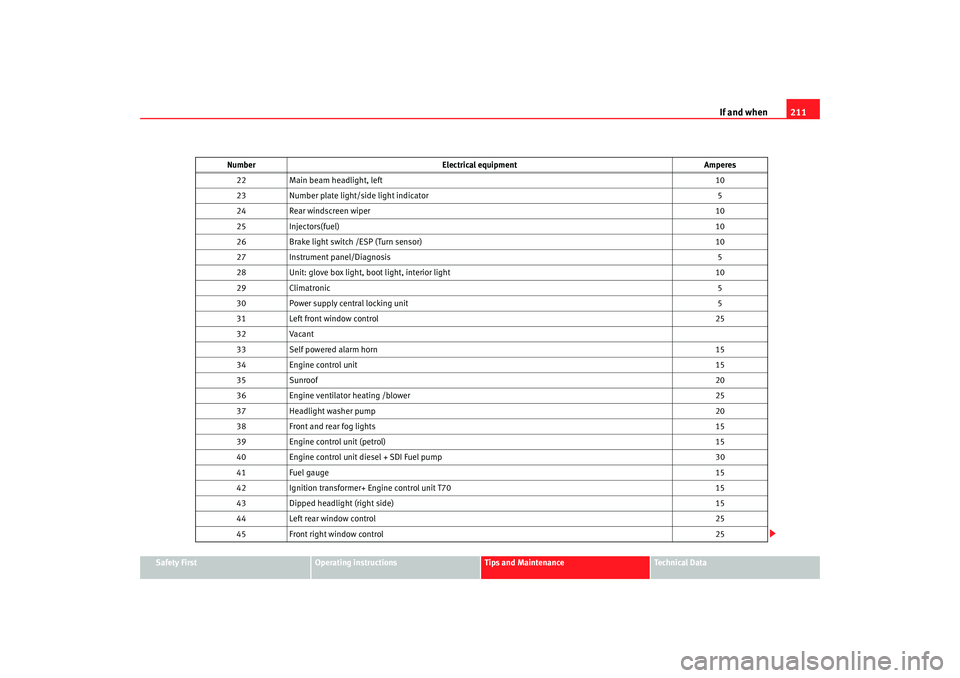
22
Main beam headlight, left 10
23 Number plate light/si de light indicator 5
24 Rear windscreen wiper 10
25 Injectors(fuel) 10
26 Brake light switch /ESP (Turn sensor) 10
27 Instrument panel/Diagnosis 5
28 Unit: glove box light, boot light, interior light 10
29 Climatronic 5
30 Power supply central locking unit 5
31 Left front window control 25
32 Vacant
33 Self powered alarm horn 15
34 Engine control unit 15
35 Sunroof 20
36 Engine ventilator heating /blower 25
37 Headlight washer pump 20
38 Front and rear fog lights 15
39 Engine control unit (petrol) 15
40 Engine control unit diesel + SDI Fuel pump 30
41 Fuel gauge 15
42 Ignition transformer+ E ngine control unit T70 15
43 Dipped headlight (right side) 15
44 Left rear window control 25
45 Front right window control 25
Number
Electrical equipment Amperes
ibiza_angles_0706_DEF Seite 211 Freitag, 1. September 2006 1:18 13
Page 214 of 268
If and when
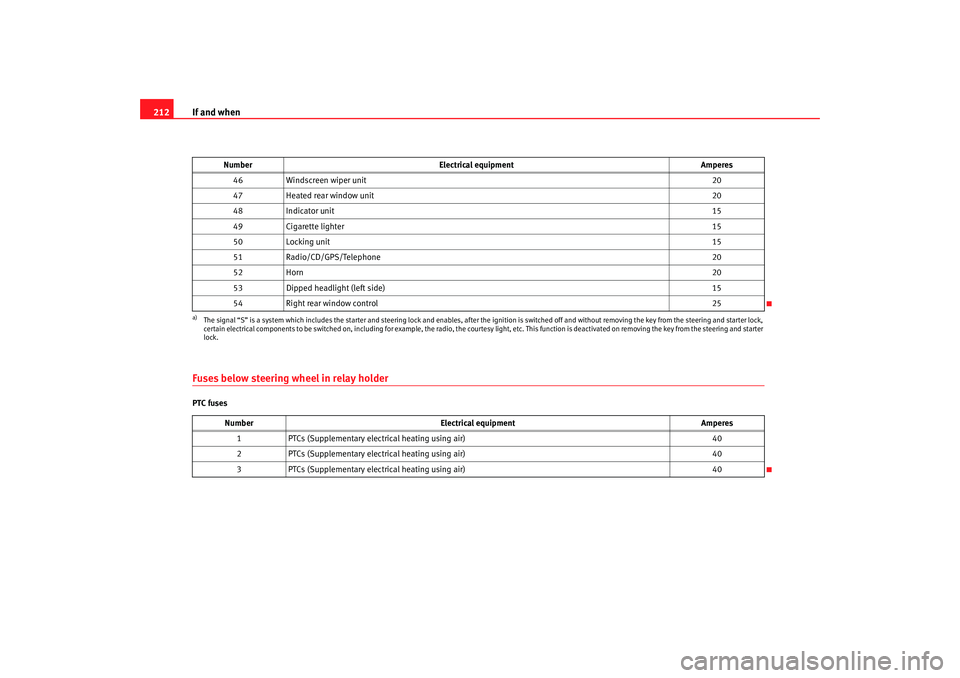
212Fuses below steering wheel in relay holderPTC fuses 46
Windscreen wiper unit 20
47 Heated rear window unit 20
48 Indicator unit 15
49 Cigarette lighter 15
50 Locking unit 15
51 Radio/CD/GPS/Telephone 20
52 Horn 20
53 Dipped headlight (left side) 15
54 Right rear window control 25a)The signal “S” is a system which includes the starter and steering lock and enables, after the ignition is switched off and wit hout removing the key from the steering and starter lock,
certain electrical components to be switched on, including for example, the radio, the courtesy light, etc. This function is de activated on removing the key from the steering and starter
lock.
Number Electrical equipment Amperes
1 PTCs (Supplementary electrical heating using air) 40
2 PTCs (Supplementary electrical heating using air) 40
3 PTCs (Supplementary electrical heating using air) 40
Number
Electrical equipment Amperes
ibiza_angles_0706_DEF Seite 212 Freitag, 1. September 2006 1:18 13
Page 216 of 268
If and when
214Some of the electrical items listed in the table are only fitted on certain
models or are optional extras.
Please note that the above list, while corr ect at the time of printing, is subject
to alterations.Bulb changeGeneral notesBefore changing any bulb first turn off the equipment concerned.
Do not touch the bulb glass. Fingerprints vaporise in the heat, causing a
reduction in the bulb life and conden sation on the mirror surface, thus
reducing efficiency.
A bulb should only be replaced by one of the same type. The type is inscribed
on the bulb, either on the glass part or on the base.
It is highly recommended to keep a box of spare bulbs in the vehicle. At the
very least, the bulbs that most affect road safety should have spares in the
vehicle. Rear lights on frame
Brake/position 12V/P21/5W
Turn signals 12V/P21W
Rear lights on tailgate
Small position light 12V/W5W
Antifog lamp 12V/P21W
Reverse lamp 12V/P21W
Single reflector headlamps*
Full beam/dipped beam 12V 60/55W (H4)
Turn indicator 12V/PY 21W
Position lamp 12/W5W
Double reflector headlamps
Dipped beam 12V/55W (H7)
Full beam 12V/55W (H3)
Turn signals 12V/PY21W
Position lights 12V/W5W
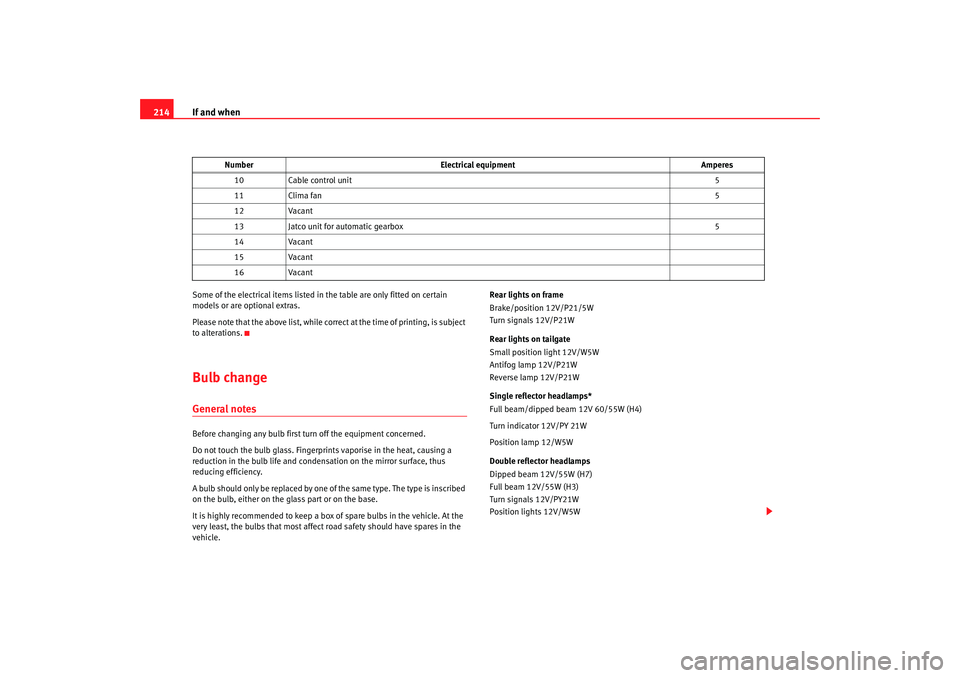
10
Cable control unit 5
11 Clima fan 5
12 Vacant
13 Jatco unit for automatic gearbox 5
14 Vacant
15 Vacant
16 Vacant
Number
Electrical equipment Amperes
ibiza_angles_0706_DEF Seite 214 Freitag, 1. September 2006 1:18 13
Page 217 of 268
If and when215
Safety First
Operating instructions
Tips and Maintenance
Te c h n i c a l D a t a
Xenon headlights
10)
Dipped beam 12V/35W (D1S)
11)
Full beam 12V/55W (H7)
Turn signals 12V/PY21W
Position lights 12V/W5W
Fog lights*
Fog lights 12V/55W (H3)
Registration plate light
Registration plate light - C5W
Caution
•
The halogen lamps (H3, H7...) are pressurised and might explode on
changing them.
•
Therefore protective gloves and glasses should be worn when changing a
halogen lamp.Note
•
Due to the difficulty in accessing the lamps, any replacement work should
be done by a SEAT dealer. However, we shall explain how to change these
lamps, except for the xenon lights*.
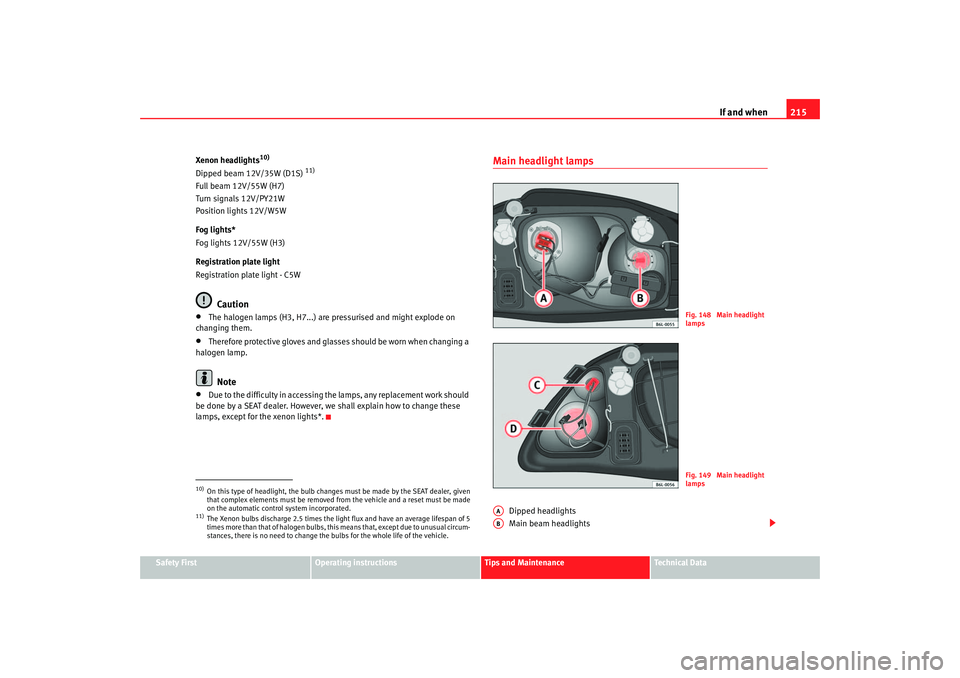
Main headlight lamps
Dipped headlights
Main beam headlights
10)On this type of headlight, the bulb changes must be made by the SEAT dealer, given
that complex elements must be removed from the vehicle and a reset must be made
on the automatic control system incorporated.11)The Xenon bulbs discharge 2.5 times the light flux and have an average lifespan of 5
times more than that of halogen bulbs, this means that, except due to unusual circum-
stances, there is no need to change the bulbs for the whole life of the vehicle.
Fig. 148 Main headlight
lampsFig. 149 Main headlight
lamps
AAAB
ibiza_angles_0706_DEF Seite 215 Freitag, 1. September 2006 1:18 13
Page 218 of 268
If and when
216
Side lights
Indicator lights
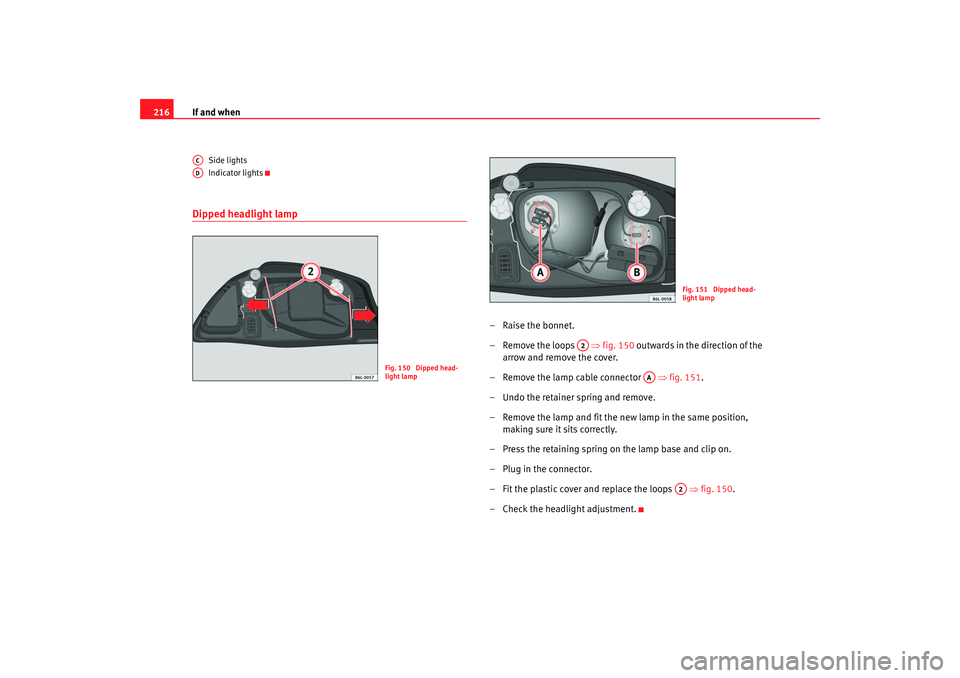
Dipped headlight lamp
–Raise the bonnet.
– Remove the loops ⇒fig. 150 outwards in the direction of the
arrow and remove the cover.
– Remove the lamp cable connector ⇒fig. 151 .
– Undo the retainer spring and remove.
– Remove the lamp and fit the new lamp in the same position, making sure it sits correctly.
– Press the retaining spring on the lamp base and clip on.
– Plug in the connector.
– Fit the plastic cover and replace the loops ⇒fig. 150.
– Check the headlight adjustment.
ACAD
Fig. 150 Dipped head-
light lamp
Fig. 151 Dipped head-
light lamp
A2
AA
A2
ibiza_angles_0706_DEF Seite 216 Freitag, 1. September 2006 1:18 13
Page 219 of 268
If and when217
Safety First
Operating instructions
Tips and Maintenance
Te c h n i c a l D a t a
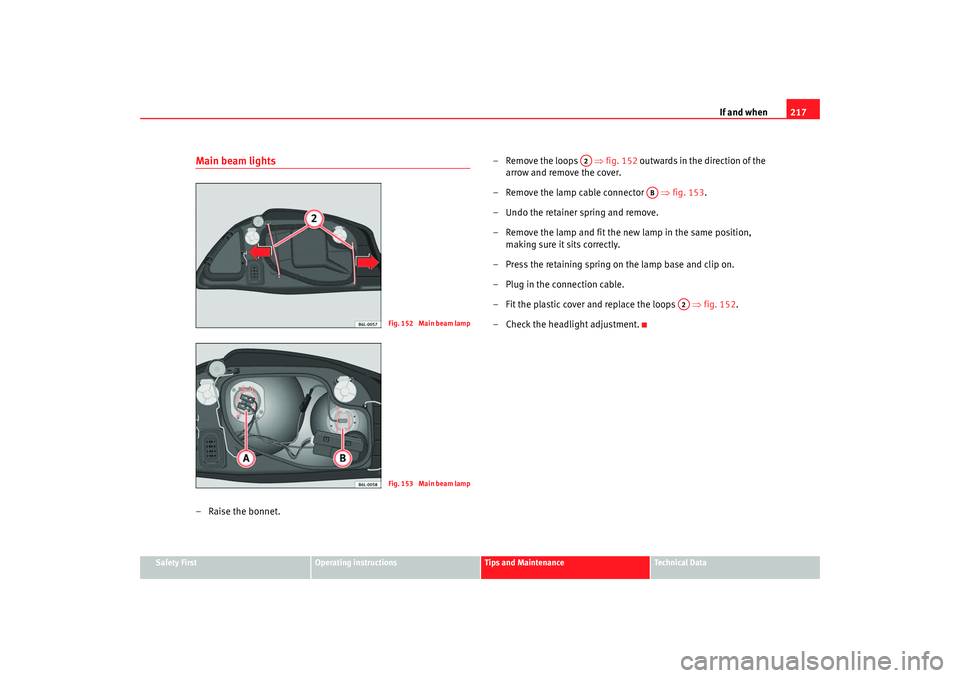
Main beam lights–Raise the bonnet. – Remove the loops
⇒fig. 152 outwards in the direction of the
arrow and remove the cover.
– Remove the lamp cable connector ⇒fig. 153.
– Undo the retainer spring and remove.
– Remove the lamp and fit the new lamp in the same position, making sure it sits correctly.
– Press the retaining spring on the lamp base and clip on.
– Plug in the connection cable.
– Fit the plastic cover and replace the loops ⇒fig. 152 .
– Check the headlight adjustment.
Fig. 152 Main beam lampFig. 153 Main beam lamp
A2
AB
A2
ibiza_angles_0706_DEF Seite 217 Freitag, 1. September 2006 1:18 13