warning Seat Ibiza 5D 2007 Owner's manual
[x] Cancel search | Manufacturer: SEAT, Model Year: 2007, Model line: Ibiza 5D, Model: Seat Ibiza 5D 2007Pages: 272, PDF Size: 8.32 MB
Page 213 of 272
If and when211
Safety First
Operating instructions
Tips and Maintenance
Te c h n i c a l D a t a
– Insert the adapter onto the wheel bolt and push it on as far as it
will go ⇒page 210, fig. 145 .
– Fit the box spanner as far as it will go over the adapter.
– Loosen or tighten the wheel bolt as appropriate.Error code
The code number of the anti-theft wheel bolt is stamped on the front of the
adaptor.
The code number should be noted and kept in a safe place, as it is only by
using the code number that a duplicat e adaptor can be obtained from an
Authorised Service Centre.Tyres with directional tread pattern
Tyres with directional tread pattern must be fitted so that they
rotate in the correct direction.A directional tread pattern can be identified by arrows on the sidewall that
point in the direction of rotation. Always note the direction of rotation indi-
cated when fitting the wheel. This is important so that these tyres can give
maximum grip and avoid excessive noise, tread wear and aquaplaning.
If, in an emergency, you have to fit th e spare wheel so it rotates in the wrong
direction, you must drive extremely care fully. The tyre will not give optimum
performance. This is particularly important when driving on wet roads.
To benefit from the advantages of tyres with this type of tread pattern, the
defective tyre should be replaced as soon as possible so that all tyres again
rotate in the correct direction.
Tyre repair kit* (Tyre Mobility System)General information and safety notesYour vehicle is equipped with a tyre repair kit: the Tyre Mobility System.
In the event of a tyre puncture, sealing compound and an air compressor are
located in the luggage compartment under the floor panel.
The Tyre Mobility System will reliably seal punctures caused by the penetra-
tion of a foreign body of up to about 4 mm in diameter.
It is not necessary to remove the foreign body from the tyre.
Instructions for the sealing compound are located on the sealing compound
container.
Notes for the proper use of the air compressor are included in an additional
instruction leaflet.
WARNING
•
Do not attempt to repair a puncture with the sealing compound if the
tyre has been damaged by driving the car after the tyre has lost its air.
•
Always observe warnings and follow instructions concerning
compressor and sealing compound carefully.
•
Do not drive faster than 80 km/h, avoid heavy acceleration, hard
braking and fast cornering.
•
Tyres which have been repaired with sealing compound are only suit-
able for temporary use over a short period. Therefore, please drive carefully
to the next available qualified workshop.For the sake of the environment
Used sealing compound containers should be disposed of at a proper facility.
IBI_ANG_0707 Seite 211 Montag, 6. August 2007 3:59 15
Page 214 of 272
If and when
212
NoteSeek professional assistance if the repair of a tyre puncture is not possible
with the sealing compound.Preparation work
Certain steps must be taken before repairing a tyre.– If you have a flat tyre or puncture, park the vehicle as far away from the flow of traffic as possible.
–Apply the handbrake firmly.
– Engage the first gear, of put the selector lever to position P.
– All passengers should leave the vehicle. They should wait in a
safe area (for instance behind the roadside crash barrier).
– Check whether a repair is possible using the Tyre Mobility System “General information and safety notes.”
– Unscrew inflation cap from the affected wheel.
– Take the tyre repair kit out of the luggage compartment.
WARNING
Put the hazard warning lights on and pl ace the warning triangle in position.
This is for your own safety and also warns other road users.
Caution
Take special care if you have to repair a tyre on a gradient.
Note
Please observe legal requirements when doing so.Tyre repair
The following sections describe the procedures for repairing
a tyre.Using the sealing compound
– The instructions on the container give detailed information on how to use the sealing compound.
Inflating the tyre.
– Remove the air compressor and hose from the container.
– Screw the retaining nut onto the valve.
– Plug the compressor cable into a 12 volt socket.
– Turn on compressor and monitor the pressure shown on the pres- sure gauge.
Completing the repair
– Remove the compressor hose from the valve.
– Fit the valve cap.
– Unplug the compressor from the socket.
– Return all tools to their proper storing location.
IBI_ANG_0707 Seite 212 Montag, 6. August 2007 3:59 15
Page 215 of 272
If and when213
Safety First
Operating instructions
Tips and Maintenance
Te c h n i c a l D a t a
Note
The compressor should never be allowed to run for longer than 6 minutes.FusesChanging a fuse
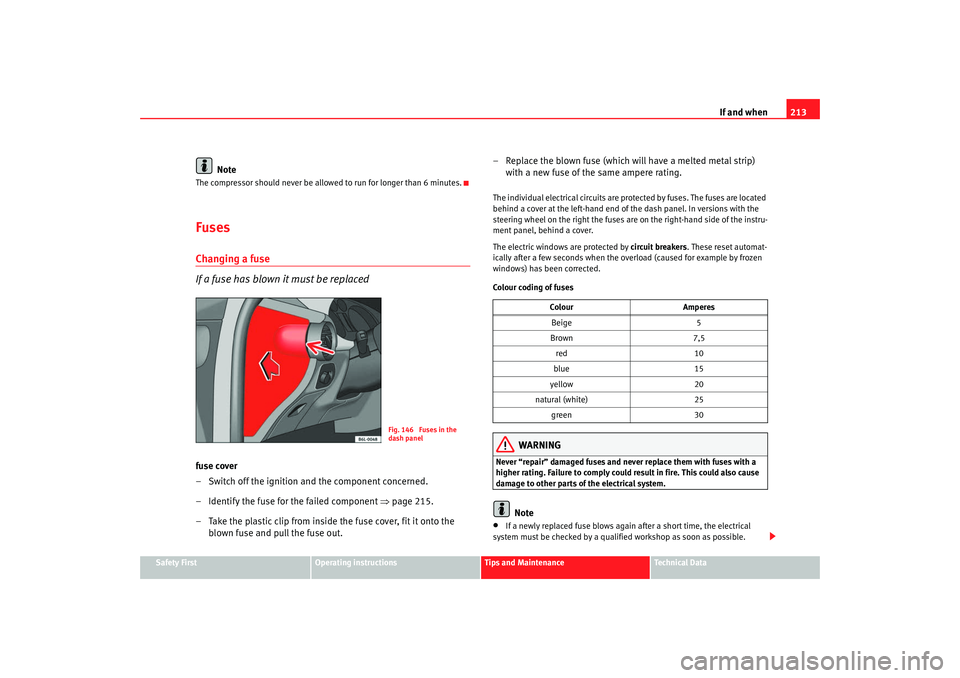
If a fuse has blown it must be replacedfuse cover
– Switch off the ignition and the component concerned.
– Identify the fuse for the failed component ⇒page 215.
– Take the plastic clip from inside the fuse cover, fit it onto the blown fuse and pull the fuse out. – Replace the blown fuse (which will have a melted metal strip)
with a new fuse of the same ampere rating.
The individual electrical circuits are pr otected by fuses. The fuses are located
behind a cover at the left-hand end of the dash panel. In versions with the
steering wheel on the right the fuses are on the right-hand side of the instru-
ment panel, behind a cover.
The electric windows are protected by circuit breakers. These reset automat-
ically after a few seconds when the overload (caused for example by frozen
windows) has been corrected.
Colour coding of fuses
WARNING
Never “repair” damaged fuses and never replace them with fuses with a
higher rating. Failure to comply could re sult in fire. This could also cause
damage to other parts of the electrical system.
Note
•
If a newly replaced fuse blows again after a short time, the electrical
system must be checked by a qualified workshop as soon as possible.
Fig. 146 Fuses in the
dash panel
Colour Amperes
Beige 5
Brown 7,5 red 10
blue 15
yellow 20
natural (white) 25
green 30
IBI_ANG_0707 Seite 213 Montag, 6. August 2007 3:59 15
Page 234 of 272
If and when
232
WARNING
•
Please note the safety warnings referring to working in the engine
compartment ⇒page 180, “Working in the engine compartment”.
•
The battery providing assistance must have the same voltage as the flat
battery (12V) and approximately the same capacity (see imprint on
battery). Failure to comply could result in an explosion.
•
Never use jump leads when one of the batteries is frozen. Danger of
explosion! Even after the battery has thawed, battery acid could leak and
cause chemical burns. If a battery freezes, it should be replaced.
•
Keep sparks, flames and lighted cigarettes away from batteries, danger
of explosion. Failure to comply could result in an explosion.
•
Observe the instructions provided by the manufacturer of the jump
leads.
•
Do not connect the negative cable from the other vehicle directly to the
negative terminal of the flat battery. The gas emitted from the battery could
be ignited by sparks. Danger of explosion.
•
Do not attach the negative cable from the other vehicle to parts of the
fuel system or to the brake line.
•
The non-insulated parts of the battery clamps must not be allowed to
touch. The jump lead atta ched to the positive battery terminal must not
touch metal parts of the vehicle, this can cause a short circuit.
•
Position the leads in such a way that they cannot come into contact
with any moving parts in the engine compartment.
•
Do not bend over the batteries. This could result in chemical burns.Note
The vehicles must not touch each other, otherwise electricity could flow as
soon as the positive terminals are connected.
IBI_ANG_0707 Seite 232 Montag, 6. August 2007 3:59 15
Page 235 of 272
If and when233
Safety First
Operating instructions
Tips and Maintenance
Te c h n i c a l D a t a
Towing and tow-startingTo w - s t a r t i n g *
The use of jump leads is preferable to tow-starting.We recommend that you do not tow-start your vehicle. Jump-starting
is preferable ⇒page 230.
However, if your vehicle has to be tow-started:
–Engage the 2
nd or the 3
rd gear.
– Keep the clutch pressed down.
– Switch on the ignition.
– Once both vehicles are mo ving, release the clutch.
– As soon as the engine starts, press the clutch and move the gear lever into neutral. This helps to prevent driving into the towing
vehicle.
WARNING
The risk of accidents is high when tow-starting. The vehicle being towed
can easily collide with the towing vehicle.
Caution
When tow-starting, fuel could enter the catalytic converter and damage it.
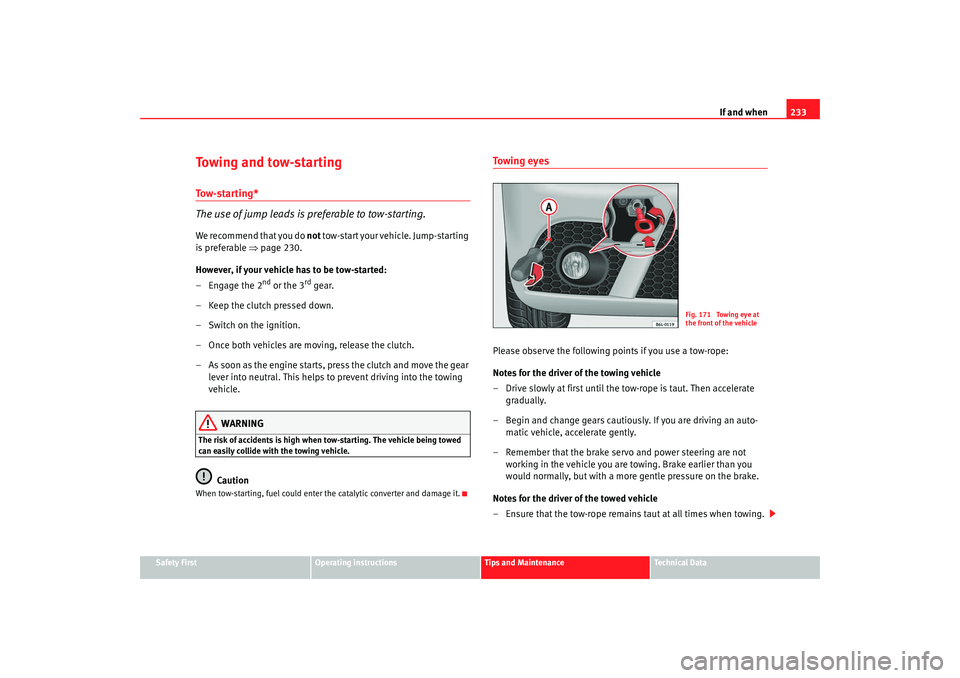
Towing eyesPlease observe the following points if you use a tow-rope:
Notes for the driver of the towing vehicle
– Drive slowly at first until the tow-rope is taut. Then accelerate gradually.
– Begin and change gears cautiously. If you are driving an auto- matic vehicle, accelerate gently.
– Remember that the brake servo and power steering are not working in the vehicle you are towing. Brake earlier than you
would normally, but with a more gentle pressure on the brake.
Notes for the driver of the towed vehicle
– Ensure that the tow-rope remains taut at all times when towing.
Fig. 171 Towing eye at
the front of the vehicle
IBI_ANG_0707 Seite 233 Montag, 6. August 2007 3:59 15
Page 236 of 272
If and when
234
Fitting the front towing eye
– First remove the right hand cover from the lower part of the bumper.
– Remove the bolt ⇒page 233, fig. 171 .
– Take the towing ring from the onboard tools.
– Rotate the towing ring to the left until it is completely tightened into position.
– To remove the ring, rotate it to the right.Tow-rope or tow-bar
It is easier and safer to tow a vehicle with a tow-bar. You should only use a
tow-rope if you do not have a tow-bar.
A tow-rope should be slightly elastic to reduce the loading on both vehicles.
It is advisable to use a tow-rope made of synthetic fibre or similarly elastic
material.
Attach the tow-rope or the tow-bar only to the towing eyes provided or a
towing bracket.
Driving style
Towing requires some experience, especially when using a tow-rope. Both
drivers should be familiar with the te chnique required for towing. Inexperi-
enced drivers should not attempt to tow-start or tow away another vehicle.
Do not pull too hard with the towing vehicle and take care to avoid jerking the
tow-rope. When towing on an unpaved ro ad, there is always a risk of over-
loading and damaging the anchorage points.
The ignition of the vehicle being towed must be switched on to prevent the
steering wheel from locking and also to allow the use of the turn signals,
horn, windscreen wipers and washers. As the brake servo does not work if the
engine is not running, you must apply
considerably more pressure to the brake pedal than you normally would.
As the power assisted steering does not work if the engine is not running, you
will need more strength to steer than you normally would.
Towing vehicles with an automatic gearbox
•
Put the selector lever into position “N”.
•
Do not drive faster than 50 km/h when towing a vehicle.
•
Do not tow further than 50 km.
•
If a breakdown vehicle is used, the vehicle must be towed with the front
wheels raised.Note
•
Observe legal requirements when towing or tow-starting.
•
Switch on the hazard warning lights of both vehicles. However, observe
any regulations to the contrary.
•
For technical reasons, vehicles with an automatic gearbox must not be
tow-started.
•
If damage to your vehicle means that there is no lubricant in the gearbox,
you must raise the drive wheels while the vehicle is being towed.
•
If the vehicle has to be towed more than 50 km, the front wheels must be
raised during towing, and towing should be carried out by a qualified person.
•
The steering wheel is locked when the vehicle has no electrical power. The
vehicle must then be towed with the front wheels raised. Towing should be
carried out by a qualified person.
•
The towing eye should always be kept in the vehicle. Please refer to the
notes on ⇒page 233.
AA
IBI_ANG_0707 Seite 234 Montag, 6. August 2007 3:59 15
Page 242 of 272
General notes on the technical data
240WeightsKerb weight refers to the basic model with a fuel tank filled to 90% capacity
and without optional extras. The figure quoted includes 75 kg to allow for the
weight of the driver.
For special versions and optional equipment fittings or for the addition of
accessories, the weight of the vehicle will increase ⇒.
WARNING
•
Please note that the centre of gravity may shift when transporting
heavy objects; this may affect the vehi cle's handling and lead to an acci-
dent. Always adjust your speed and dr iving style to suit road conditions
and requirements.
•
Never exceed the gross axle weight rating or the gross vehicle weight
rating. If the allowed axle load or the allowed total weight is exceeded, the
driving characteristics of the vehicle may change, leading to accidents,
injuries and damage to the vehicle.
To w i n g a t r a i l e rTrailer weightsTrailer weights
The trailer weights and drawbar loads approved are selected in intensive
trials according to precisely defined criteria. The approved trailer weights are
valid for vehicles in the EU for maximum speeds of 80 km/h (in certain
circumstances up to 100 km/h). The figu res may be different in other coun-
tries. All data in the official vehicl e documents take precedence over these
data ⇒ . Drawbar load
The
maximum permitted weight exerted by the trailer drawbar on the ball joint
of the towing bracket must not exceed 75 kg.
In the interest of road safety, we recommend that you always tow
approaching the maximum drawbar load. The response of the trailer on the
road will be poor if th e drawbar load is too small.
If the maximum permissible drawbar load cannot be met (e.g. with small,
empty and light-weight single axle trailers or tandem axle trailers with an axle
base of less than 1 metre), at least 4% of the actual trailer weight is a legal
stipulation for a drawbar load.
WARNING
•
For safety reasons, you should not drive at speeds above 80 km/h when
towing a trailer. This also applies to countries where higher speeds are
permitted.
•
Never exceed the maximum trailer weights or the draw bar loading. If
the permissible axle load or the perm issible total weight is exceeded, the
driving characteristics of the vehicle may change, leading to accidents,
injuries and damage to the vehicle.
WheelsTyre pressure, snow chains, wheel boltsTyre pressures
The sticker with the tyre pressure values can be found on the inside of the
tank flap. The tyre pressure values given there are for cold tyres. The slightly
raised pressures of warm tyres must not be reduced ⇒.
IBI_ANG_0707 Seite 240 Montag, 6. August 2007 3:59 15
Page 243 of 272
General notes on the technical data 241
Safety First
Operating instructions
Tips and Maintenance
Te c h n i c a l D a t a
Snow chains
Snow chains are only permitted on the front wheels and only for tyres 155/80
R13; 165/70 R14 and 185/80 R14. Snow ch
ains must have fine-pitch links
which do not protrude more than 15 mm, including tension device.
Remaining tyres can be fitted with chains no thicker than 9 mm.
Wheel bolts
After the wheels have been changed, the tightening torque of the wheel bolts
should be checked as soon as possible with a torque wrench ⇒. The tight-
ening torque for steel and alloy wheels is 120 Nm.
WARNING
•
Check the tyre pressure at least once per month. Correct tyre pressure
is very important. If the tyre pressure is too high or too low, there is an
increased danger of accidents, particularly at high speeds.
•
If the torque of the wheel bolts is too low, they could loosen whilst the
vehicle is in motion. Risk of accident! If the tightening torque is too high,
the wheel bolts and threads could be damaged.Note
We recommend that you ask your Authorised Service Centre for information
about appropriate wheel, tyre and snow chain size.
IBI_ANG_0707 Seite 241 Montag, 6. August 2007 3:59 15
Page 263 of 272
Index261
Index
AABS . . . . . . . . . . . . . . . . . . . . . . . . . . . . . . . . . . . 148
Warning lamp . . . . . . . . . . . . . . . . . . . . . . . . . 64
Accessories . . . . . . . . . . . . . . . . . . . . . . . . . . . . 172
Acoustic signal . . . . . . . . . . . . . . . . . . . . . . . . . . 16
Acoustic warning . . . . . . . . . . . . . . . . . . . . . . . . 132
Adjustable service interval display . . . . . . . . . . 58
Adjusting simp le headlights
driving on the left . . . . . . . . . . . . . . . . . . . . 154
driving on the right . . . . . . . . . . . . . . . . . . . 154
Adjusting the seat belt height . . . . . . . . . . . . . . 23
Air conditioning system Climatronic . . . . . . . . . . . . . . . . . . . . . . . . . . 125
General notes . . . . . . . . . . . . . . . . . . . . . . . . 128
Air conditioning* . . . . . . . . . . . . . . . . . . . . . . . . 122
Air outlets . . . . . . . . . . . . . . . . . . . . . . . . . . . . . . 121
Air recirculation Semi-automatic air conditi oning . . . . . . . . 124
Air recirculation mode Climatronic . . . . . . . . . . . . . . . . . . . . . . . . . . 127
Airbag covers . . . . . . . . . . . . . . . . . . . . . . . . . . . . 31
Airbag system . . . . . . . . . . . . . . . . . . . . . . . . . . . 26 Curtain airbags . . . . . . . . . . . . . . . . . . . . . . . 37
Front airbags . . . . . . . . . . . . . . . . . . . . . . . . . 29
Side airbags . . . . . . . . . . . . . . . . . . . . . . . . . . 33
Warning lamp . . . . . . . . . . . . . . . . . . . . . . . . . 27 Airbags
Care . . . . . . . . . . . . . . . . . . . . . . . . . . . . . . . . 28
Disposal . . . . . . . . . . . . . . . . . . . . . . . . . . . . . 28
Safety notes . . . . . . . . . . . . . . . . . . . . . . . . . . 28
Alarm system Switching off . . . . . . . . . . . . . . . . . . . . . . . . . 81
Alterations to the vehicle . . . . . . . . . . . . . . . . . 172
Alternator Warning lamp . . . . . . . . . . . . . . . . . . . . . . . . . 62
Ambient temperature display . . . . . . . . . . . . 55, 57
Anti-freeze . . . . . . . . . . . . . . . . . . . . . . . . . . . . . 187
Anti-lock brake system . . . . . . . . . . . . . . . . . . . 148 Warning lamp . . . . . . . . . . . . . . . . . . . . . . . . . 64
Anti-theft alarm system . . . . . . . . . . . . . . . . . . . . 80 Switching off . . . . . . . . . . . . . . . . . . . . . . . . . 81
Anti-theft wheel bolts . . . . . . . . . . . . . . . . . . . . 208
Aquaplaning . . . . . . . . . . . . . . . . . . . . . . . . . . . 198
Athermic windscreen* . . . . . . . . . . . . . . . . . . . . 100
Automatic anti-dazzle interior mirror* Activating the anti-dazzle function . . . . . . 101
Deactivating anti-dazzle function . . . . . . . . 101
Automatic car washes . . . . . . . . . . . . . . . . . . . . 164
Automatic gearbox . . . . . . . . . . . . . . . . . . . . . . 137 Instructions for driving . . . . . . . . . . . . . . . . 139
Kick-down feature . . . . . . . . . . . . . . . . . . . . 139
Selector lever positions . . . . . . . . . . . . . . . . 138
Automatic wiper/wash function for the rear window 99 Auxiliary audio connection: AUX-IN . . . . . . . . . 115
BBall coupling . . . . . . . . . . . . . . . . . . . . . . . . . . . 159
BAS . . . . . . . . . . . . . . . . . . . . . . . . . . . . . . . . . . . 147
Battery
Changing . . . . . . . . . . . . . . . . . . . . . . . . . . . 195
Charging . . . . . . . . . . . . . . . . . . . . . . . . . . . . 195
Winter conditions . . . . . . . . . . . . . . . . . . . . 194
Belt tension device Disposal . . . . . . . . . . . . . . . . . . . . . . . . . . . . . 24
Warning lamp . . . . . . . . . . . . . . . . . . . . . . . . 27
Belt tension devices . . . . . . . . . . . . . . . . . . . . . . 24
Biodiesel . . . . . . . . . . . . . . . . . . . . . . . . . . . . . . 179
Bonnet . . . . . . . . . . . . . . . . . . . . . . . . . . . . . . . . 182
Boot* . . . . . . . . . . . . . . . . . . . . . . . . . . . . . . 96, 230
Brake assist system . . . . . . . . . . . . . . . . . . . . . 147
Brake fluid . . . . . . . . . . . . . . . . . . . . . . . . . . . . . 192 Changing . . . . . . . . . . . . . . . . . . . . . . . . . . . 193
Brake pads . . . . . . . . . . . . . . . . . . . . . . . . 151, 152
Brake servo . . . . . . . . . . . . . . . . . . . . . . . 147, 152
Brake system . . . . . . . . . . . . . . . . . . . . . . . . . . . 192 Warning lamp . . . . . . . . . . . . . . . . . . . . . . . . 65
Brakes . . . . . . . . . . . . . . . . . . . . . . . . . . . . . . . . 152
Braking distance . . . . . . . . . . . . . . . . . . . . . . . . 152
Bulb changes general notes . . . . . . . . . . . . . . . . . . . . . . . . 219
IBI_ANG_0707 Seite 261 Montag, 6. August 2007 3:59 15
Page 265 of 272
Index263
Coolant . . . . . . . . . . . . . . . . . . . . . . . . . . . 187, 188
Coolant Level . . . . . . . . . . . . . . . . . . . . . . . . . . . 188
Coolant level
warning light . . . . . . . . . . . . . . . . . . . . . . . . . 63
Coolant Loss . . . . . . . . . . . . . . . . . . . . . . . . . . . 188
Coolant temperature Display . . . . . . . . . . . . . . . . . . . . . . . . . . . . . . 53
Safety instructions . . . . . . . . . . . . . . . . . . . . . 64
Correct adjustment of front head restraints . . . . 12
Cruise control system . . . . . . . . . . . . . . . . . . . . 142
Curtain airbags . . . . . . . . . . . . . . . . . . . . . . . . . . 37 Description . . . . . . . . . . . . . . . . . . . . . . . . . . . 37
Function . . . . . . . . . . . . . . . . . . . . . . . . . . . . . 38
Safety notes . . . . . . . . . . . . . . . . . . . . . . . . . . 38DDanger of fitting a child seat on the front passenger seat . . . . . . . . . . . . . . . . . . . . . . . . . . . . . . . 27
Deep Water in Cupra version . . . . . . . . . . . . . . 151
Diesel . . . . . . . . . . . . . . . . . . . . . . . . . . . . . . . . . 179
Diesel engine Winter driving . . . . . . . . . . . . . . . . . . . . . . . . 180
Diesel engine particulate filter* . . . . . . . . . . . . 153
Differential lock . . . . . . . . . . . . . . . . . . . . . . . . . 150
Differential lock fault (EDL) warning lamp . . . . . . . . . . . . . . . . . . . . . . . . . 67
Digital clock . . . . . . . . . . . . . . . . . . . . . . . . . . . . . 54
Dipped headlights . . . . . . . . . . . . . . . . . . . . . . . . 90
Disabling front passenger airbag Safety notes . . . . . . . . . . . . . . . . . . . . . . . . . . 41 Disabling the airbag
Disabling front passenger airbag . . . . . . . . . 40
Displays in the Mult i-function display
Memory displays . . . . . . . . . . . . . . . . . . . . . . 56
Door lock cylinders . . . . . . . . . . . . . . . . . . . . . . 167
Door release lever . . . . . . . . . . . . . . . . . . . . . . . . 51
Doors Childproof locks . . . . . . . . . . . . . . . . . . . . . . . 74
Unlocking and locking . . . . . . . . . . . . . . . . . 70
Drive wheels traction control system . . . . . . . . 148
Driving Driving abroad . . . . . . . . . . . . . . . . . . . . . . . 153
Economically / With Respect for the Environment . . . . . . . . . . . . . . . . . . . . . . . 160
With a trailer . . . . . . . . . . . . . . . . . . . . . . . . . 159
with a trailer . . . . . . . . . . . . . . . . . . . . . . . . . 158
Driving abroad . . . . . . . . . . . . . . . . . . . . . . . . . . 153 Headlights . . . . . . . . . . . . . . . . . . . . . . . . . . 154
Driving economically . . . . . . . . . . . . . . . . . . . . . 160
Driving safety . . . . . . . . . . . . . . . . . . . . . . . . . . . . . 8
Driving with respect for the environment . . . . . 160
Duplicate keys . . . . . . . . . . . . . . . . . . . . . . . . . . . 77
Dust filter . . . . . . . . . . . . . . . . . . . . . . . . . . . . . . 128
Dynamic headlight range control . . . . . . . . . . . . 91
EEDL . . . . . . . . . . . . . . . . . . . . . . . . . . . . . . . . . . . 150
EDS Warning lamp . . . . . . . . . . . . . . . . . . . . . . . . . 64
Electrical sockets . . . . . . . . . . . . . . . . . . . . . . . . 114 Electrohydraulic steering
warning lamp . . . . . . . . . . . . . . . . . . . . . . . . . 62
Electronic differential lock . . . . . . . . . . . . . . . . 150 Warning lamp . . . . . . . . . . . . . . . . . . . . . . . . 64
Electronic immobiliser . . . . . . . . . . . . . . . . 67, 133
Electronic stabilisation program . . . . . . . . . . . 149
Electronic stabilisation programme . . . . . . . . . . 66 Description . . . . . . . . . . . . . . . . . . . . . . . . . . 131
Warning lamp . . . . . . . . . . . . . . . . . . . . . . . 132
Electronic stabilisation programme (ESP) warning lamp . . . . . . . . . . . . . . . . . . . . . . . . . 66
Emission control system warning lamp . . . . . . . . . . . . . . . . . . . . . . . . . 65
Engine Running in . . . . . . . . . . . . . . . . . . . . . . . . . . 151
Engine compartment Working in the engine compartment . . . . . 180
Engine coolant . . . . . . . . . . . . . . . . . . . . . . . . . . 187
Engine fault warning lamp . . . . . . . . . . . . . . . . . . . . . . . . . 63
Engine management Warning lamp . . . . . . . . . . . . . . . . . . . . . . . . 63
Engine oil . . . . . . . . . . . . . . . . . . . . . . . . . . . . . . 183 Changing . . . . . . . . . . . . . . . . . . . . . . . . . . . 186
Checking level . . . . . . . . . . . . . . . . . . . . . . . 185
Oil properties . . . . . . . . . . . . . . . . . . . . . . . . 184
Specifications . . . . . . . . . . . . . . . . . . . . . . . 183
Topping up . . . . . . . . . . . . . . . . . . . . . . . . . . 186
Engine oil dipstick . . . . . . . . . . . . . . . . . . . . . . . 185
Engine oil pressure Warning lamp . . . . . . . . . . . . . . . . . . . . . . . . 67
IBI_ANG_0707 Seite 263 Montag, 6. August 2007 3:59 15