warning Seat Ibiza 5D 2007 User Guide
[x] Cancel search | Manufacturer: SEAT, Model Year: 2007, Model line: Ibiza 5D, Model: Seat Ibiza 5D 2007Pages: 272, PDF Size: 8.32 MB
Page 17 of 272
Safe driving15
Safety First
Operating instructions
Tips and Maintenance
Te c h n i c a l D a t a
WARNING
•
If the pedals are obstructed, you could cause an accident. Risk of
serious injuries.
•
Ensure that the floor mats are always securely attached.
•
Never lay or fit floor mats or other floor coverings over the original floor
mats. This would reduce the pedal area and could obstruct the pedals. Risk
of accident.
Stowing luggageLoading the luggage compartment
All luggage and other loose object s must be safely secured in
the luggage compartment.Unsecured objects which shift back and forth could affect safety or
driving characteristics of the vehicle by shifting the centre of gravity.
– Distribute the load evenly in the luggage compartment.
– Lay and stow heavy luggage as far forward as possible in the luggage compartment.
– Stow heavy luggage as low as possible in the luggage compart- ment.
WARNING
•
Loose luggage and other objects in the luggage compartment can
cause serious injuries.
•
Always put objects in the luggage compartment.
•
During sudden manoeuvres or accidents, loose objects can be thrown
forward, injuring vehicle occupants or even to third parties. This increased
risk of injury will be further increased if a loose object is struck by an
inflating airbag. If this happens, objects can be transformed into
“missiles”. Risk of fatal injury.
•
Please note that the centre of gravity may shift when transporting
heavy objects; this may affect the vehicle's handling and lead to an acci-
dent. Therefore, it is essential to adjust your speed and driving style
accordingly, to avoid accidents.
•
Never exceed the allowed axle loads or allowed maximum weight. If the
allowed axle load or the allowed total weight is exceeded, the driving char-
acteristics of the vehicle may change, leading to accidents, injuries and
damage to the vehicle.
•
Never leave your vehicle unattended, especially when the tailgate is
open. Children could climb into the luggage compartment closing the door
behind them; they will remain trapped without help and there is a mortal
risk.
•
Never allow children to play in or around the vehicle. Close and lock
both the tailgate and all the doors when you leave the vehicle. Before you
lock the vehicle, make sure that ther e are no adults or children in the
vehicle.
•
Never transport passengers in the luggage compartment. Every
passenger must be properly belted in ⇒ page 16.Note
•
Air circulation in the vehicle helps reduce fogging of the windows. Used
air escapes through ventilation slits in the side trim of the luggage compart-
ment. Ensure that the ventil ation slits are never covered.WARNING (continued)
IBI_ANG_0707 Seite 15 Montag, 6. August 2007 3:59 15
Page 18 of 272
Seat belts
16Seat belts IntroductionBefore driving: remember your seat belt!
Properly worn seat belts can save lives!In this chapter you will learn why seat belts are so important, how
they work and how to properly fasten, adjust and wear them.
– Read and observe all the information as well as the warnings in
this chapter.
WARNING
•
If the seat belts are worn incorrectly or not at all, the risk of severe inju-
ries increases.
•
Properly worn seat belts can reduce severe injuries in the event of
sudden braking manoeuvres or accidents. Therefore, you and your passen-
gers should always wear the seat belts properly as long as the vehicle is in
motion.
•
Pregnant women or persons with physical disabilities must also use
seat belts. Like all other occupants, these persons can also sustain severe
injuries if they are not wearing their seat belts properly.
Number of seatsYour vehicle has five passenger places, two individual front seats and three
places on the rear seat. Each seat is equipped with a three-point seat belt.
WARNING
•
Never transport more people than there are seats available in the
vehicle.
•
Every occupant in the vehicle must properly fasten and wear the seat
belt belonging to his or her seat. Children must be protected with an appro-
priate child restraint system.
Seat belt warning lamp*
The warning lamp acts as a reminder to the driver to fasten
the seat belt.Before starting the vehicle:
– Fasten your safety belt securely.
– Instruct your passengers to fasten their seat belts properly before driving off.
– Protect children by using child seats of the correct height for the age of the child.The warning lamp
in the combi-instrument lights up if the driver seat belt
is not fastened when the ignition is switched on. In addition, an acoustic
signal can also be heard for a couple of seconds.
The warning lamp* does not go out until the driver seat belt is fastened
while the ignition is switched on.
IBI_ANG_0707 Seite 16 Montag, 6. August 2007 3:59 15
Page 21 of 272
Seat belts19
Safety First
Operating instructions
Tips and Maintenance
Te c h n i c a l D a t a
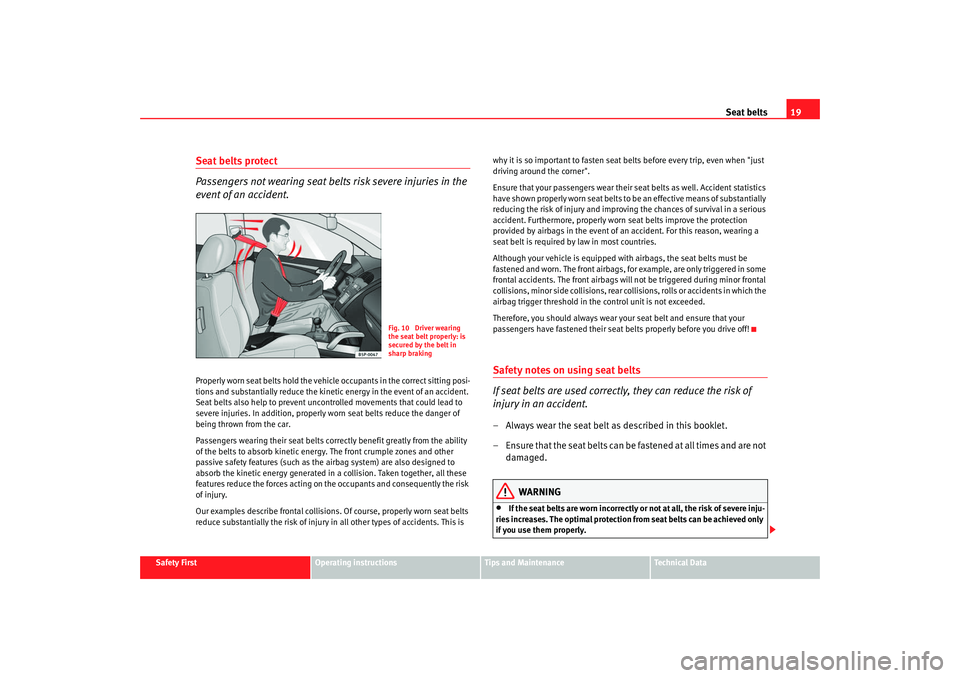
Seat belts protect
Passengers not wearing seat belts risk severe injuries in the
event of an accident.Properly worn seat belts hold the vehicle occupants in the correct sitting posi-
tions and substantially reduce the kinetic energy in the event of an accident.
Seat belts also help to prevent uncontrolled movements that could lead to
severe injuries. In addition, properly worn seat belts reduce the danger of
being thrown from the car.
Passengers wearing their s eat belts correctly benefit greatly from the ability
of the belts to absorb kinetic energy. The front crumple zones and other
passive safety features (such as the airbag system) are also designed to
absorb the kinetic energy generated in a collision. Taken together, all these
features reduce the forces acting on the occupants and consequently the risk
of injury.
Our examples describe frontal collisions . Of course, properly worn seat belts
reduce substantially the risk of injury in all other types of accidents. This is why it is so important to fasten seat
belts before every trip, even when "just
driving around the corner".
Ensure that your passengers wear their seat belts as well. Accident statistics
have shown properly worn seat belts to be an effective means of substantially
reducing the risk of injury and improvi ng the chances of survival in a serious
accident. Furthermore, properly worn seat belts improve the protection
provided by airbags in the event of an accident. For this reason, wearing a
seat belt is required by law in most countries.
Although your vehicle is equipped with airbags, the seat belts must be
fastened and worn. The front airbags, for example, are only triggered in some
frontal accidents. The front airbags will not be triggered during minor frontal
collisions, minor side collisions, rear collisions, rolls or accidents in which the
airbag trigger threshold in the control unit is not exceeded.
Therefore, you should always wear your seat belt and ensure that your
passengers have fastened their seat belts properly before you drive off!
Safety notes on using seat belts
If seat belts are used correctly, they can reduce the risk of
injury in an accident.– Always wear the seat belt as described in this booklet.
– Ensure that the seat belts can be fastened at all times and are not damaged.
WARNING
•
If the seat belts are worn incorrectly or not at all, the risk of severe inju-
ries increases. The optimal protection from seat belts can be achieved only
if you use them properly.
Fig. 10 Driver wearing
the seat belt properly: is
secured by the belt in
sharp braking
IBI_ANG_0707 Seite 19 Montag, 6. August 2007 3:59 15
Page 22 of 272
Seat belts
20•
Fasten your seat belt before every trip - even when driving in town. That
applies also to your front and rear passengers – danger of injury!
•
The seat belt cannot offer its full prot ection if the belt web is not posi-
tioned correctly.
•
Never allow two passengers (even children) to share the same seat belt.
•
Keep both feet in the foot-well in front of your seat as long as the
vehicle is in motion.
•
Never unbuckle a seat belt while the vehicle is in motion. Risk of fatal
injury.
•
The belt webbing must never be twisted while it is being worn.
•
The belt webbing should never lie on hard or fragile objects (such as
glasses or pens, etc.) because this can cause injuries.
•
Do not allow the seat belt to be da maged or jammed, or to rub on any
sharp edges.
•
Never wear the seat belt under the arm or in any other incorrect posi-
tion.
•
Loose, bulky clothing (such as an overcoat over a jacket) impairs the
proper fit and function of the belts, reducing their capacity to protect.
•
The slot in the seat belt buckle must not be blocked with paper or other
objects, as this can prevent the latch plate from engaging securely.
•
Never use seat belt clips, retaining rings or similar instruments to alter
the position of the belt webbing.
•
Frayed or torn seat belts or damage to the connections, belt retractors
or parts of the buckle could cause severe injuries in the event of an acci-
dent. Therefore, you must check the co ndition of all seat belts at regular
intervals.
•
Seat belts which have been worn in an accident and stretched must be
replaced by a qualified workshop. Renewal may be necessary even if there
is no apparent damage. The belt anchorage should also be checked.
•
Do not attempt to repair a damaged seat belt yourself. The seat belts
must not be removed or modified in any way.
•
The belts must be kept clean, ot herwise the retractors may not work
properly.
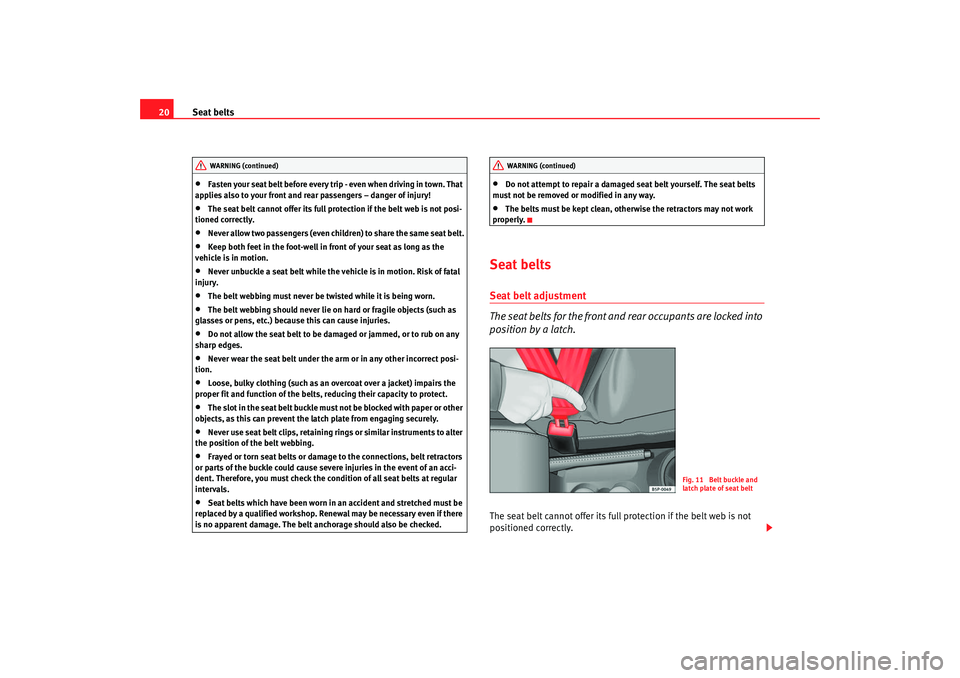
Seat beltsSeat belt adjustment
The seat belts for the front and rear occupants are locked into
position by a latch.The seat belt cannot offer its full protection if the belt web is not
positioned correctly.
WARNING (continued)
WARNING (continued)
Fig. 11 Belt buckle and
latch plate of seat belt
IBI_ANG_0707 Seite 20 Montag, 6. August 2007 3:59 15
Page 23 of 272
Seat belts21
Safety First
Operating instructions
Tips and Maintenance
Te c h n i c a l D a t a
– Adjust the seat and head restraint correctly.
– To fasten the belt, take hold of the latch plate and pull it slowly
across your chest and lap.
– Insert the latch plate into the buckle for the appropriate seat and push it down until it is securely locked with an audible click
⇒page 20, fig. 11.
– Pull the belt to ensure that the latch plate is securely engaged in the buckle.The seat belts are equipped with an automatic retractor on the shoulder
strap. Full freedom of movement is permitted when the shoulder belt is pulled
slowly. However, during sudden braking, during travel in mountains or bends
and during acceleration, the automati c retractor on the shoulder belt is
locked.
The automatic belt retractors on the front seats are fitted with belt tension
devices ⇒page 24.
WARNING
•
An incorrectly worn seat belt web can cause severe injuries in the event
of an accident.
•
The seat belts offer best protection only when the backrests are in an
upright position and the seat belt s have been fastened properly.
•
Never put the latch plate in the buckle of another seat. If you do this, the
seat belt will not protect you properly and the risk of injury is increased.
•
If an occupant is incorrectly belted in, the belt cannot protect him or her
properly. An incorrectly positioned belt web can cause extremely severe
injuries.
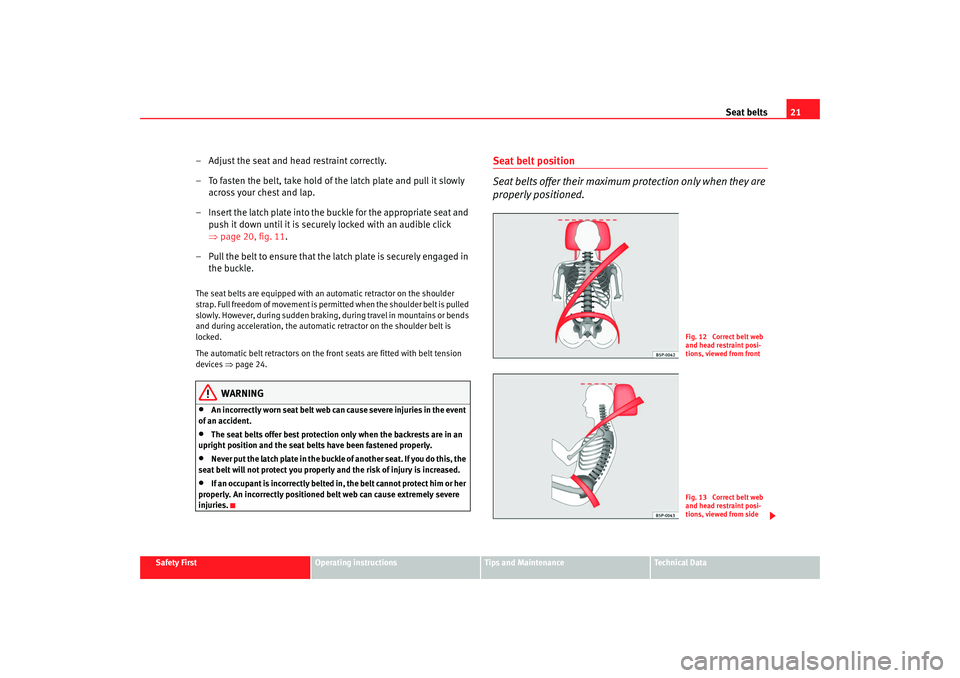
Seat belt position
Seat belts offer their maximum pr otection only when they are
properly positioned.
Fig. 12 Correct belt web
and head restraint posi-
tions, viewed from frontFig. 13 Correct belt web
and head restraint posi-
tions, viewed from side
IBI_ANG_0707 Seite 21 Montag, 6. August 2007 3:59 15
Page 24 of 272
Seat belts
22
WARNING
•
An incorrectly worn seat belt web c an cause severe injuries in the event
of an accident.
•
The shoulder belt must be positioned around the middle of the
shoulder. The seat belt must lie flat and snugly on the torso ⇒page 21,
fig. 12.
•
The lap part of the seat belt must lie across the pelvis, never across the
stomach. The seat belt must lie flat and snugly on the pelvis ⇒page 21,
fig. 13. Pull the belt tight if necessary to take up any slack.
•
Read and observe the warnings ⇒ page 19.
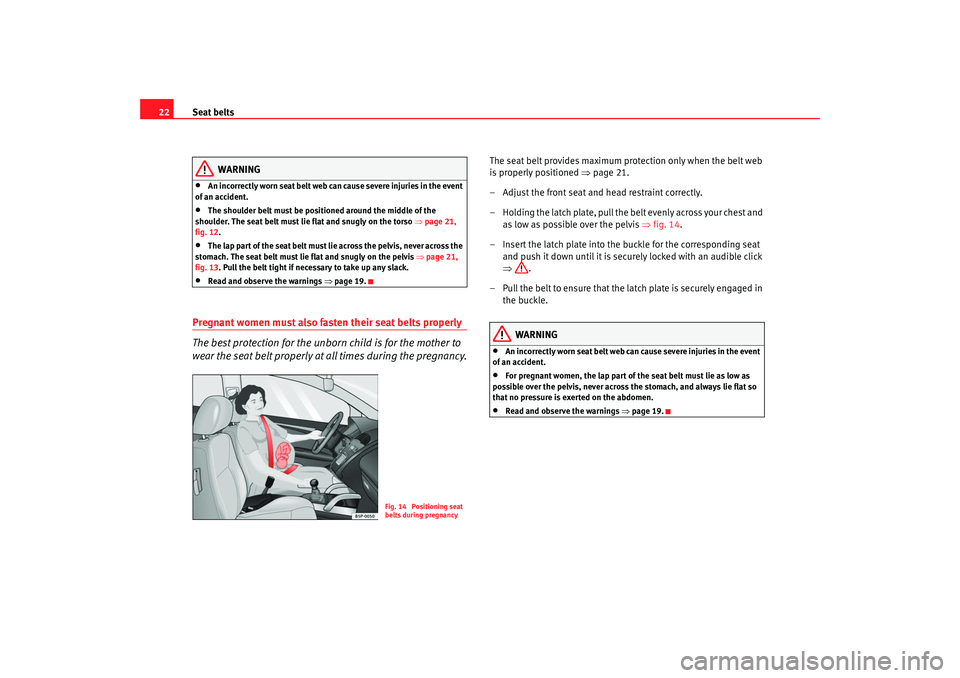
Pregnant women must also fasten their seat belts properly
The best protection for the unborn child is for the mother to
wear the seat belt properly at all times during the pregnancy.
The seat belt provides maximum protection only when the belt web
is properly positioned ⇒page 21.
– Adjust the front seat and head restraint correctly.
– Holding the latch plate, pull the belt evenly across your chest and as low as possible over the pelvis ⇒fig. 14 .
– Insert the latch plate into the buckle for the corresponding seat and push it down until it is secu rely locked with an audible click
⇒ .
– Pull the belt to ensure that the latch plate is securely engaged in the buckle.
WARNING
•
An incorrectly worn seat belt web can cause severe injuries in the event
of an accident.
•
For pregnant women, the lap part of the seat belt must lie as low as
possible over the pelvis, never across the stomach, and always lie flat so
that no pressure is exerted on the abdomen.
•
Read and observe the warnings ⇒page 19.
Fig. 14 Positioning seat
belts during pregnancy
IBI_ANG_0707 Seite 22 Montag, 6. August 2007 3:59 15
Page 25 of 272
Seat belts23
Safety First
Operating instructions
Tips and Maintenance
Te c h n i c a l D a t a
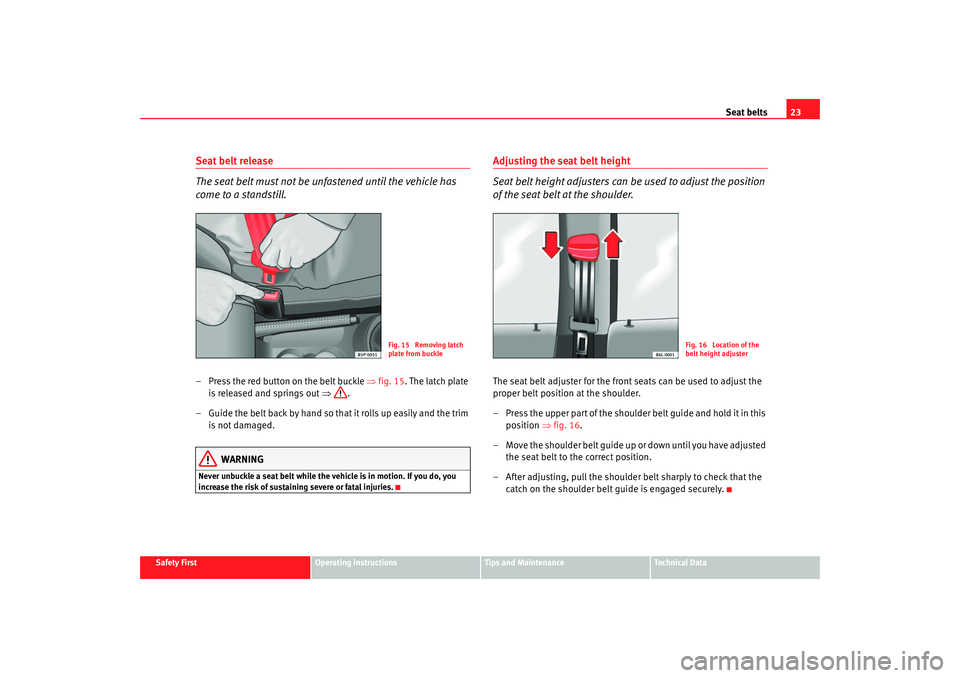
Seat belt release
The seat belt must not be unfastened until the vehicle has
come to a standstill.– Press the red button on the belt buckle ⇒fig. 15. The latch plate
is released and springs out ⇒ .
– Guide the belt back by hand so that it rolls up easily and the trim is not damaged.
WARNING
Never unbuckle a seat belt while the vehicle is in motion. If you do, you
increase the risk of sustaining severe or fatal injuries.
Adjusting the seat belt height
Seat belt height adjusters can be used to adjust the position
of the seat belt at the shoulder.The seat belt adjuster for the front seats can be used to adjust the
proper belt position at the shoulder.
– Press the upper part of the shoulder belt guide and hold it in this position ⇒fig. 16 .
– Move the shoulder belt guide up or down until you have adjusted the seat belt to the correct position.
– After adjusting, pull the shoulder belt sharply to check that the catch on the shoulder belt guide is engaged securely.
Fig. 15 Removing latch
plate from buckle
Fig. 16 Location of the
belt height adjuster
IBI_ANG_0707 Seite 23 Montag, 6. August 2007 3:59 15
Page 26 of 272
Seat belts
24Incorrectly fastened seat belts
Incorrectly worn seat belts can cause severe injuries.Seat belts can provide optimal protection only if the belt web is
properly worn. The seat belts must be fastened exactly in the order
described in this chapter. An incorrect sitting position impairs
substantially the protection a seat belt offers and can lead to severe
or fatal injuries. The risk of severe or fatal injuries is especially
increased when a deploying airbag strikes an occupant who has
assumed an incorrect sitting position . As driver, you are responsible
for all vehicle occupants, especially children. Therefore:
– Never permit anyone to assume an incorrect sitting position in the vehicle while travelling ⇒.
WARNING
•
An incorrectly worn seat belt incr eases the risk of severe injuries.
•
Before every trip, instruct your passengers to adjust their seat belts
properly and to wear them during the trip.
•
Read and always observe information and warnings concerning the use
of seat belts ⇒ page 19.
Belt tension devices*Function of the belt tension device
During a frontal collision, the se at belts on the front seats are
retracted automatically.The seat belts for the front occupants are equipped with belt tension devices.
Sensors will trigger the belt tension devices during severe head-on, lateral
and rear collisions only if the seat belt is being worn. This retracts and
tightens the seat belts, reducing the forward motion of the occupants.
The belt tension device ca n be triggered only once.
The belt tension devices will not be triggered in the event of a light frontal,
side or rear collision, if the vehicle overturns, or in situations where no large
forces act on the front, side or rear of the vehicle.
Note
•
If the belt tension devices are triggered, a fine dust is produced. This is
normal and is no indication that there was a fire in the vehicle.
•
The relevant safety requirements must be observed when the vehicle or
components of the system are scrapped. A qualified workshop is familiar with
these regulations and will be pleased to pass on the information to you.
Service and disposal of belt tension devicesThe belt tension devices are components of the seat belts that are installed
in the seats of your vehicle. If you work on the belt tension devices or remove
and install parts of the system when performing other repair work, the seat
belt may be damaged. The consequence may be that, in the event of an acci-
dent, the belt tension devices function incorrectly or not at all.
IBI_ANG_0707 Seite 24 Montag, 6. August 2007 3:59 15
Page 27 of 272
Seat belts25
Safety First
Operating instructions
Tips and Maintenance
Te c h n i c a l D a t a
So that the effectiveness of the belt tension device is not reduced and that
removed parts do not cause
any injuries or environmental pollution, regula-
tions, which are known to the qualifi ed workshops, must be observed.
WARNING
•
If repairs are not carried out by a professional, or if the belt tension
devices are used incorrectly, the risk of severe or fatal injuries increases.
The belt tension devices may fail to trigger or may trigger in the wrong
circumstances.
•
Never attempt to repair, adjust, remove or install parts of the belt
tension devices or seat belts.
•
The belt tension device and seat be lt including its automatic retractor
cannot be repaired.
•
Any work on the belt tension devi ces and seat belts, including the
removal and refitting of system parts in conjunction with other repair work,
must be performed by a qualified workshop only.
•
The belt tension devices will only provide protection for one accident
and must be changed it they have been activated.
IBI_ANG_0707 Seite 25 Montag, 6. August 2007 3:59 15
Page 28 of 272
Airbag system
26Airbag systemBrief introductionWhy wear a seat belt and assume the correct sitting position?
For the inflating airbags to achieve the best protection, the
sea t b el t m u st al w ay s b e w o rn p ro p e rly a nd t h e co rrec t s i tt i n g
position must be assumed.For your own safety and the safety of the passengers, please ensure
the following before you drive:
– Always wear the seat belt properly.
– Adjust the driver seat and the steering wheel correctly.
– Adjust the front passenger seat correctly.
– Adjust the head restraint seat correctly ⇒page 12.
– Use the correct child restraint system to protect children in your vehicle.The airbag deploys in fractions of a second and with a high velocity. If you
have assumed an incorrect seating po sition at that moment, you could
sustain critical injuries. Therefore, it is essential that all occupants maintain
a correct sitting position while travelling.
Braking heavily the moment before an accident may cause an occupant not
wearing a seat belt to be thrown forwar d into the area of the deploying airbag. In this case, the inflating airbag may infl
ict critical or fatal injuries upon the
occupant. This applies particularly to children.
Always maintain the greatest possible distance between yourself and the
front airbag. This way, the front airbags can completely deploy when trig-
gered, providing their maximum protection.
The most important factors that will trigger an airbag are: the type of acci-
dent, the angle of collision and the speed of the vehicle.
Whether the airbags are triggered depends primarily on the vehicle deceler-
ation rate resulting from the collision an d detected by the control unit. If the
vehicle deceleration occurring duri ng the collision and measured by the
control unit remains below the specifie d reference values, the front, side
and/or curtain airbag will not be triggered. Take into account that the visible
damage in a vehicle following an accident, for whatever reason, are not an
indication as to why the airbags were triggered.
WARNING
•
Wearing the seat belt incorrectly or assuming an incorrect sitting posi-
tion can lead to critical or fatal injuries.
•
All occupants, including children, who are not properly belted can
sustain critical or fatal injuries if the airbag is triggered. You should always
transport all children up to 12 years of age on the rear seat. Never transport
children in the vehicle if they are not restrained or the restraint system is
not appropriate for their age, size or weight.
•
If you are not wearing a seat belt or if you lean forward or to the side or
assume an incorrect sitting position, the risk of injury is increased
substantially. This increased risk of injury will be further increased if you
are struck by an inflating airbag.
•
To reduce the risk of injury from an inflating airbag, always wear the
seat belt properly.
IBI_ANG_0707 Seite 26 Montag, 6. August 2007 3:59 15