towing Seat Ibiza 5D 2007 Owner's Guide
[x] Cancel search | Manufacturer: SEAT, Model Year: 2007, Model line: Ibiza 5D, Model: Seat Ibiza 5D 2007Pages: 272, PDF Size: 8.32 MB
Page 236 of 272
If and when
234
Fitting the front towing eye
– First remove the right hand cover from the lower part of the bumper.
– Remove the bolt ⇒page 233, fig. 171 .
– Take the towing ring from the onboard tools.
– Rotate the towing ring to the left until it is completely tightened into position.
– To remove the ring, rotate it to the right.Tow-rope or tow-bar
It is easier and safer to tow a vehicle with a tow-bar. You should only use a
tow-rope if you do not have a tow-bar.
A tow-rope should be slightly elastic to reduce the loading on both vehicles.
It is advisable to use a tow-rope made of synthetic fibre or similarly elastic
material.
Attach the tow-rope or the tow-bar only to the towing eyes provided or a
towing bracket.
Driving style
Towing requires some experience, especially when using a tow-rope. Both
drivers should be familiar with the te chnique required for towing. Inexperi-
enced drivers should not attempt to tow-start or tow away another vehicle.
Do not pull too hard with the towing vehicle and take care to avoid jerking the
tow-rope. When towing on an unpaved ro ad, there is always a risk of over-
loading and damaging the anchorage points.
The ignition of the vehicle being towed must be switched on to prevent the
steering wheel from locking and also to allow the use of the turn signals,
horn, windscreen wipers and washers. As the brake servo does not work if the
engine is not running, you must apply
considerably more pressure to the brake pedal than you normally would.
As the power assisted steering does not work if the engine is not running, you
will need more strength to steer than you normally would.
Towing vehicles with an automatic gearbox
•
Put the selector lever into position “N”.
•
Do not drive faster than 50 km/h when towing a vehicle.
•
Do not tow further than 50 km.
•
If a breakdown vehicle is used, the vehicle must be towed with the front
wheels raised.Note
•
Observe legal requirements when towing or tow-starting.
•
Switch on the hazard warning lights of both vehicles. However, observe
any regulations to the contrary.
•
For technical reasons, vehicles with an automatic gearbox must not be
tow-started.
•
If damage to your vehicle means that there is no lubricant in the gearbox,
you must raise the drive wheels while the vehicle is being towed.
•
If the vehicle has to be towed more than 50 km, the front wheels must be
raised during towing, and towing should be carried out by a qualified person.
•
The steering wheel is locked when the vehicle has no electrical power. The
vehicle must then be towed with the front wheels raised. Towing should be
carried out by a qualified person.
•
The towing eye should always be kept in the vehicle. Please refer to the
notes on ⇒page 233.
AA
IBI_ANG_0707 Seite 234 Montag, 6. August 2007 3:59 15
Page 237 of 272
If and when235
Safety First
Operating instructions
Tips and Maintenance
Te c h n i c a l D a t a
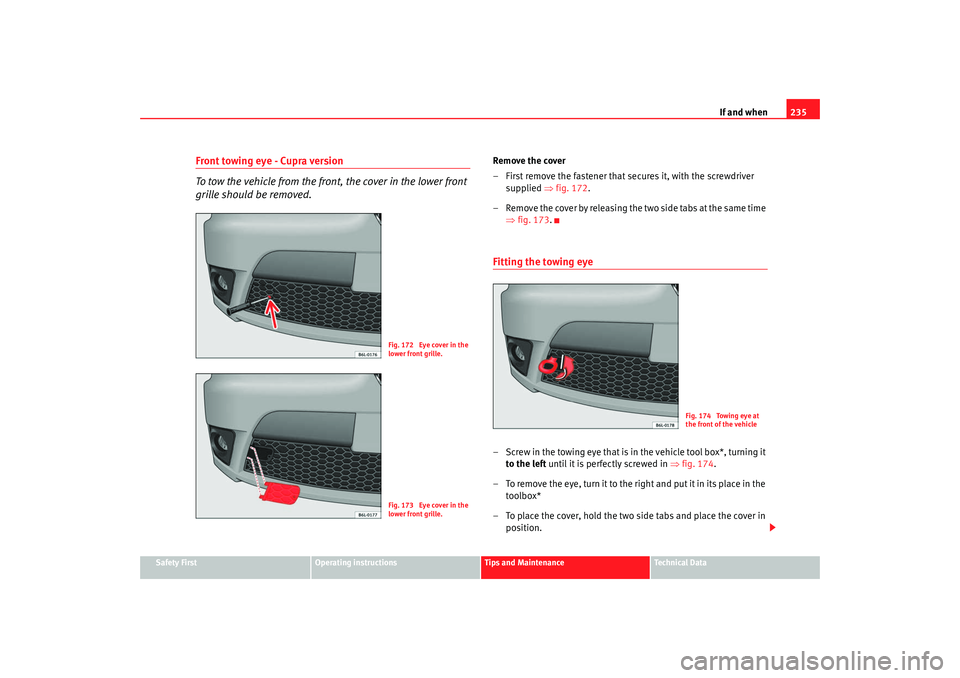
Front towing eye - Cupra version
To tow the vehicle from the front, the cover in the lower front
grille should be removed.
Remove the cover
– First remove the fastener that secures it, with the screwdriver
supplied ⇒fig. 172 .
– Remove the cover by releasing the two side tabs at the same time ⇒fig. 173.Fitting the towing eye– Screw in the towing eye that is in the vehicle tool box*, turning it
to the left until it is perfectly screwed in ⇒fig. 174.
– To remove the eye, turn it to the right and put it in its place in the toolbox*
– To place the cover, hold the two side tabs and place the cover in position.
Fig. 172 Eye cover in the
lower front grille.Fig. 173 Eye cover in the
lower front grille.
Fig. 174 Towing eye at
the front of the vehicle
IBI_ANG_0707 Seite 235 Montag, 6. August 2007 3:59 15
Page 238 of 272
If and when
236
NoteThe eye should always be carried in the vehicle, as it is specifically for this
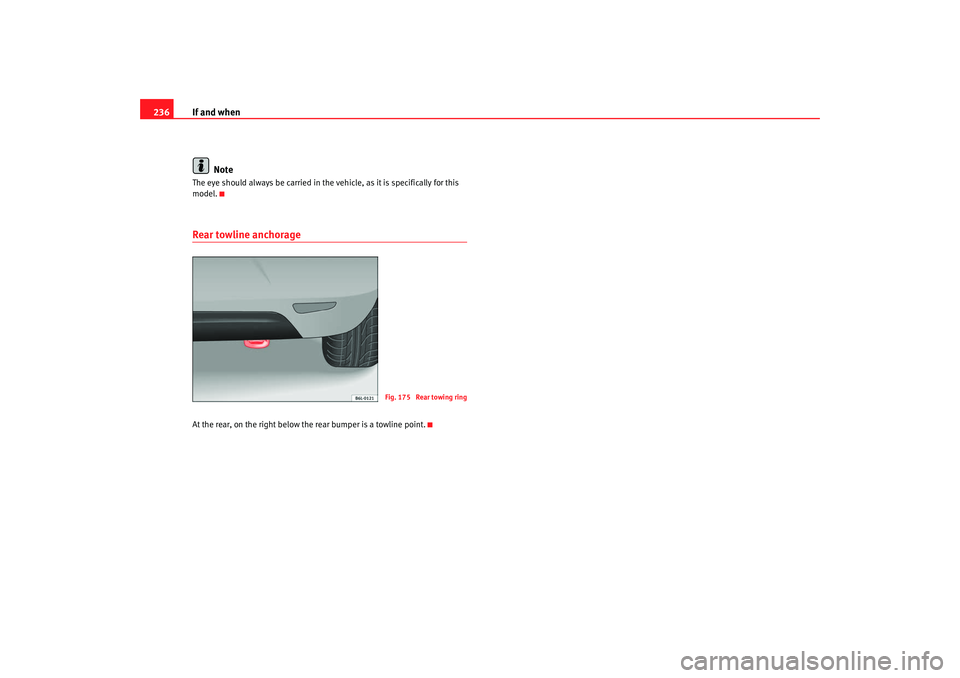
model.Rear towline anchorageAt the rear, on the right below the rear bumper is a towline point.
Fig. 175 Rear towing ring
IBI_ANG_0707 Seite 236 Montag, 6. August 2007 3:59 15
Page 242 of 272
General notes on the technical data
240WeightsKerb weight refers to the basic model with a fuel tank filled to 90% capacity
and without optional extras. The figure quoted includes 75 kg to allow for the
weight of the driver.
For special versions and optional equipment fittings or for the addition of
accessories, the weight of the vehicle will increase ⇒.
WARNING
•
Please note that the centre of gravity may shift when transporting
heavy objects; this may affect the vehi cle's handling and lead to an acci-
dent. Always adjust your speed and dr iving style to suit road conditions
and requirements.
•
Never exceed the gross axle weight rating or the gross vehicle weight
rating. If the allowed axle load or the allowed total weight is exceeded, the
driving characteristics of the vehicle may change, leading to accidents,
injuries and damage to the vehicle.
To w i n g a t r a i l e rTrailer weightsTrailer weights
The trailer weights and drawbar loads approved are selected in intensive
trials according to precisely defined criteria. The approved trailer weights are
valid for vehicles in the EU for maximum speeds of 80 km/h (in certain
circumstances up to 100 km/h). The figu res may be different in other coun-
tries. All data in the official vehicl e documents take precedence over these
data ⇒ . Drawbar load
The
maximum permitted weight exerted by the trailer drawbar on the ball joint
of the towing bracket must not exceed 75 kg.
In the interest of road safety, we recommend that you always tow
approaching the maximum drawbar load. The response of the trailer on the
road will be poor if th e drawbar load is too small.
If the maximum permissible drawbar load cannot be met (e.g. with small,
empty and light-weight single axle trailers or tandem axle trailers with an axle
base of less than 1 metre), at least 4% of the actual trailer weight is a legal
stipulation for a drawbar load.
WARNING
•
For safety reasons, you should not drive at speeds above 80 km/h when
towing a trailer. This also applies to countries where higher speeds are
permitted.
•
Never exceed the maximum trailer weights or the draw bar loading. If
the permissible axle load or the perm issible total weight is exceeded, the
driving characteristics of the vehicle may change, leading to accidents,
injuries and damage to the vehicle.
WheelsTyre pressure, snow chains, wheel boltsTyre pressures
The sticker with the tyre pressure values can be found on the inside of the
tank flap. The tyre pressure values given there are for cold tyres. The slightly
raised pressures of warm tyres must not be reduced ⇒.
IBI_ANG_0707 Seite 240 Montag, 6. August 2007 3:59 15
Page 269 of 272
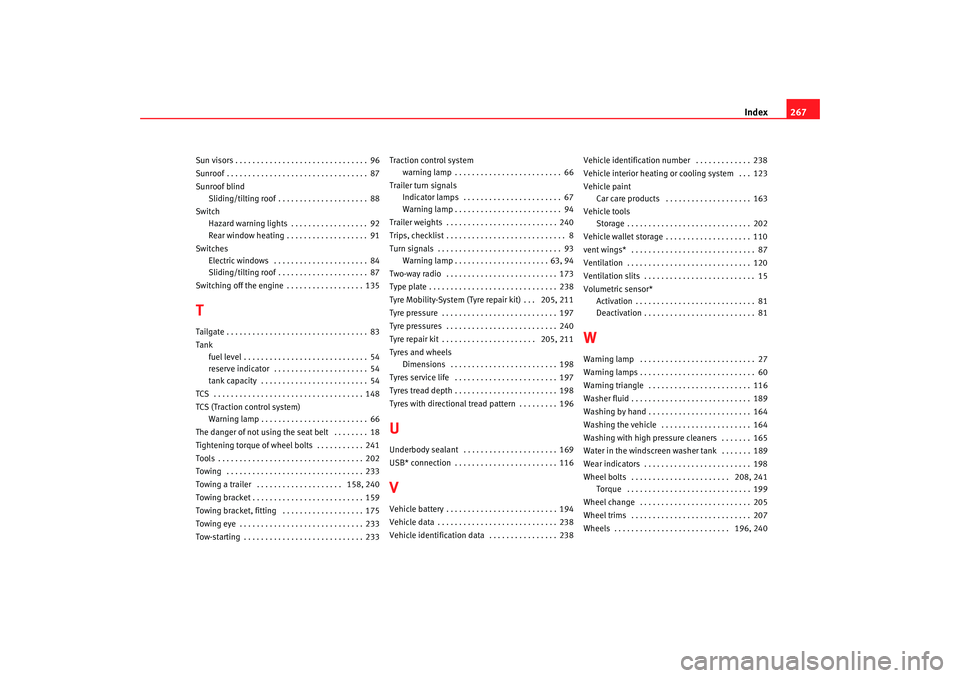
Index267
Sun visors . . . . . . . . . . . . . . . . . . . . . . . . . . . . . . . 96
Sunroof . . . . . . . . . . . . . . . . . . . . . . . . . . . . . . . . . 87
Sunroof blind
Sliding/tilting roof . . . . . . . . . . . . . . . . . . . . . 88
Switch Hazard warning lights . . . . . . . . . . . . . . . . . . 92
Rear window heating . . . . . . . . . . . . . . . . . . . 91
Switches Electric windows . . . . . . . . . . . . . . . . . . . . . . 84
Sliding/tilting roof . . . . . . . . . . . . . . . . . . . . . 87
Switching off the engine . . . . . . . . . . . . . . . . . . 135TTailgate . . . . . . . . . . . . . . . . . . . . . . . . . . . . . . . . . 83
Tank fuel level . . . . . . . . . . . . . . . . . . . . . . . . . . . . . 54
reserve indicator . . . . . . . . . . . . . . . . . . . . . . 54
tank capacity . . . . . . . . . . . . . . . . . . . . . . . . . 54
TCS . . . . . . . . . . . . . . . . . . . . . . . . . . . . . . . . . . . 148
TCS (Traction control system) Warning lamp . . . . . . . . . . . . . . . . . . . . . . . . . 66
The danger of not using the seat belt . . . . . . . . 18
Tightening torque of wheel bolts . . . . . . . . . . . 241
Tools . . . . . . . . . . . . . . . . . . . . . . . . . . . . . . . . . . 202
Towing . . . . . . . . . . . . . . . . . . . . . . . . . . . . . . . . 233
Towing a trailer . . . . . . . . . . . . . . . . . . . . 158, 240
Towing bracket . . . . . . . . . . . . . . . . . . . . . . . . . . 159
Towing bracket, fitting . . . . . . . . . . . . . . . . . . . 175
Towing eye . . . . . . . . . . . . . . . . . . . . . . . . . . . . . 233
Tow-starting . . . . . . . . . . . . . . . . . . . . . . . . . . . . 233 Traction control system
warning lamp . . . . . . . . . . . . . . . . . . . . . . . . . 66
Trailer turn signals Indicator lamps . . . . . . . . . . . . . . . . . . . . . . . 67
Warning lamp . . . . . . . . . . . . . . . . . . . . . . . . . 94
Trailer weights . . . . . . . . . . . . . . . . . . . . . . . . . . 240
Trips, checklist . . . . . . . . . . . . . . . . . . . . . . . . . . . . 8
Turn signals . . . . . . . . . . . . . . . . . . . . . . . . . . . . . 93 Warning lamp . . . . . . . . . . . . . . . . . . . . . . 63, 94
Two-way radio . . . . . . . . . . . . . . . . . . . . . . . . . . 173
Type plate . . . . . . . . . . . . . . . . . . . . . . . . . . . . . . 238
Tyre Mobility-System (Tyre repair kit) . . . 205, 211
Tyre pressure . . . . . . . . . . . . . . . . . . . . . . . . . . . 197
Tyre pressures . . . . . . . . . . . . . . . . . . . . . . . . . . 240
Tyre repair kit . . . . . . . . . . . . . . . . . . . . . . 205, 211
Tyres and wheels Dimensions . . . . . . . . . . . . . . . . . . . . . . . . . 198
Tyres service life . . . . . . . . . . . . . . . . . . . . . . . . 197
Tyres tread depth . . . . . . . . . . . . . . . . . . . . . . . . 198
Tyres with directional tread pattern . . . . . . . . . 196
UUnderbody sealant . . . . . . . . . . . . . . . . . . . . . . 169
USB* connection . . . . . . . . . . . . . . . . . . . . . . . . 116VVehicle battery . . . . . . . . . . . . . . . . . . . . . . . . . . 194
Vehicle data . . . . . . . . . . . . . . . . . . . . . . . . . . . . 238
Vehicle identification data . . . . . . . . . . . . . . . . 238 Vehicle identification number . . . . . . . . . . . . . 238
Vehicle interior heating or cooling system . . . 123
Vehicle paint
Car care products . . . . . . . . . . . . . . . . . . . . 163
Vehicle tools Storage . . . . . . . . . . . . . . . . . . . . . . . . . . . . . 202
Vehicle wallet storage . . . . . . . . . . . . . . . . . . . . 110
vent wings* . . . . . . . . . . . . . . . . . . . . . . . . . . . . . 87
Ventilation . . . . . . . . . . . . . . . . . . . . . . . . . . . . . 120
Ventilation slits . . . . . . . . . . . . . . . . . . . . . . . . . . 15
Volumetric sensor* Activation . . . . . . . . . . . . . . . . . . . . . . . . . . . . 81
Deactivation . . . . . . . . . . . . . . . . . . . . . . . . . . 81
WWarning lamp . . . . . . . . . . . . . . . . . . . . . . . . . . . 27
Warning lamps . . . . . . . . . . . . . . . . . . . . . . . . . . . 60
Warning triangle . . . . . . . . . . . . . . . . . . . . . . . . 116
Washer fluid . . . . . . . . . . . . . . . . . . . . . . . . . . . . 189
Washing by hand . . . . . . . . . . . . . . . . . . . . . . . . 164
Washing the vehicle . . . . . . . . . . . . . . . . . . . . . 164
Washing with high pressure cleaners . . . . . . . 165
Water in the windscreen washer tank . . . . . . . 189
Wear indicators . . . . . . . . . . . . . . . . . . . . . . . . . 198
Wheel bolts . . . . . . . . . . . . . . . . . . . . . . . 208, 241Torque . . . . . . . . . . . . . . . . . . . . . . . . . . . . . 199
Wheel change . . . . . . . . . . . . . . . . . . . . . . . . . . 205
Wheel trims . . . . . . . . . . . . . . . . . . . . . . . . . . . . 207
Wheels . . . . . . . . . . . . . . . . . . . . . . . . . . . 196, 240
IBI_ANG_0707 Seite 267 Montag, 6. August 2007 3:59 15