lights Seat Ibiza 5D 2007 Owner's Guide
[x] Cancel search | Manufacturer: SEAT, Model Year: 2007, Model line: Ibiza 5D, Model: Seat Ibiza 5D 2007Pages: 272, PDF Size: 8.32 MB
Page 152 of 272
Intelligent technology
150Anti-lock brake system (ABS)The anti-lock brake system prevents the wheels locking during braking
⇒ page 148.Electronic differential lock (EDL)*
The electronic differential lock helps prevent the loss of trac-
tion caused if one of the driven wheels starts spinning.EDL helps the vehicle to start moving, accelerate and climb a gradient in slip-
pery conditions where this may otherwise be difficult or even impossible.
The system will control the revolutions of the drive wheels using the ABS
sensors (in case of an EDL fault the warning lamp for ABS lights up)
⇒page 64.
At speeds of up to approximately 80 km/h, it is able to balance out differ-
ences in the speed of the driven wheel s of approximately 100 rpm caused by
a slippery road surface on one side of the vehicle. It does this by braking the
wheel which has lost traction and distributing more driving force to the other
driven wheel via the differential.
To prevent the disc brake of the braked wheel from overheating, the EDL cuts
out automatically if subjected to excessive loads. The vehicle will continue to
function normally without EDL. For this reason, the driver is not informed that
the EDL has been switched off.
The EDL will switch on again automatically when the brake has cooled down.
WARNING
•
When accelerating on a slippery surface, for example on ice and snow,
press the accelerator carefully. Despite EDL, the driven wheels may start to
spin. This could impair the vehicle’s stability.
•
Always adapt your driving style to suit road conditions and the traffic
situation. Do not let the extra safety afforded by EDL tempt you into taking
any risks when driving, this can cause accidents.Caution
Modifications to the vehi cle (e.g. to the engine, the brake system, running
gear or any components affecting the wheels and tyres) could affect the effi-
ciency of the EDL ⇒page 172.The traction control system (TCS)The traction control system prevents the drive wheels from spinning when the
car is accelerating ⇒page 148.
WARNING (continued)
IBI_ANG_0707 Seite 150 Montag, 6. August 2007 3:59 15
Page 155 of 272
Driving and the environment153
Safety First
Operating instructions
Tips and Maintenance
Te c h n i c a l D a t a
If you notice misfiring, uneven running
or loss of power when the vehicle is
moving, reduce speed immediately and have the vehicle inspected at the
nearest qualified workshop. In general, the exhaust warning lamp will light
up when any of the described symptoms occur ⇒page 60. If this happens,
unburnt fuel can enter the exhaust system and escape into the environment.
The catalytic converter can also be damaged by overheating.
WARNING
The catalytic converter reaches very high temperatures! Fire hazard!•
Never park where the catalytic converter could come into contact with
dry grass or inflammable materials under the vehicle.
•
Do not apply additional underseal or anti-corrosion coatings to the
exhaust pipes, catalytic converter or the heat shields on the exhaust
system. These materials could catch fire when the vehicle is driven.Caution
Never fully drain the fuel tank, in this case, the irregularity of the fuel supply
may cause ignition problems. This allow s unburnt fuel to enter the exhaust
system, which could cause overheating and damage the catalytic converter.
For the sake of the environment
Even when the emission control system is working perfectly, there may be a
smell of sulphur from the exhaust unde r some conditions. This depends on
the sulphur content of the fuel used. Quite often the problem can be reme-
died by changing to another brand of fuel.
Diesel engine particulate filter*
The diesel engine particulate filter eliminates soot produced
by burning diesel.The diesel engine dust filter eliminates most of the soot from the exhaust gas
system. Under normal driving conditions, the filter cleans itself. If the driving
conditions do not allow the filter to clean itself (for example, multiple short
trips) the filter will be obstructed by dust and pollen and the indicator
for
the diesel engine particulate filter indicator will light. See under Warning
Lights.
WARNING
•
The diesel engine particulate filter may reach extremely high tempera-
tures; it should not enter into contact with flammable materials under-
neath the vehicle. Failure to comply could result in fire.Caution
Vehicles equipped with a diesel engine particulate filter must not be refueled
using biodiesel (RME), given that the fuel system may be damaged.Driving abroadNotesFor driving abroad, the following must be taken into consideration:•
For vehicles fitted with a catalytic converter ensure that unleaded petrol is
available for the journey. See the chap ter “Refuelling”. Automobile organisa-
IBI_ANG_0707 Seite 153 Montag, 6. August 2007 3:59 15
Page 156 of 272
Driving and the environment
154tions will have information about service station networks selling unleaded
fuel.•
In some countries it is possible that a vehicle model is sold under condi-
tions where some spare parts are not available or that the Authorised Service
Centre may only carr y out limited repairs.
SEAT importers and distributors will gladly provide information about the
technical preparation of your vehicle in addition to necessary maintenance
and repair possibilities.
Adhesive strips for headlightsIf you have to drive a right-hand drive vehicle in a left-hand drive country, or
vice versa, the asymmetric dipped beam headlights will dazzle oncoming
traffic.
To prevent dazzling, you must apply stickers to certain parts of the headlight
lenses. Further information is available from your Authorised Service
Centre.
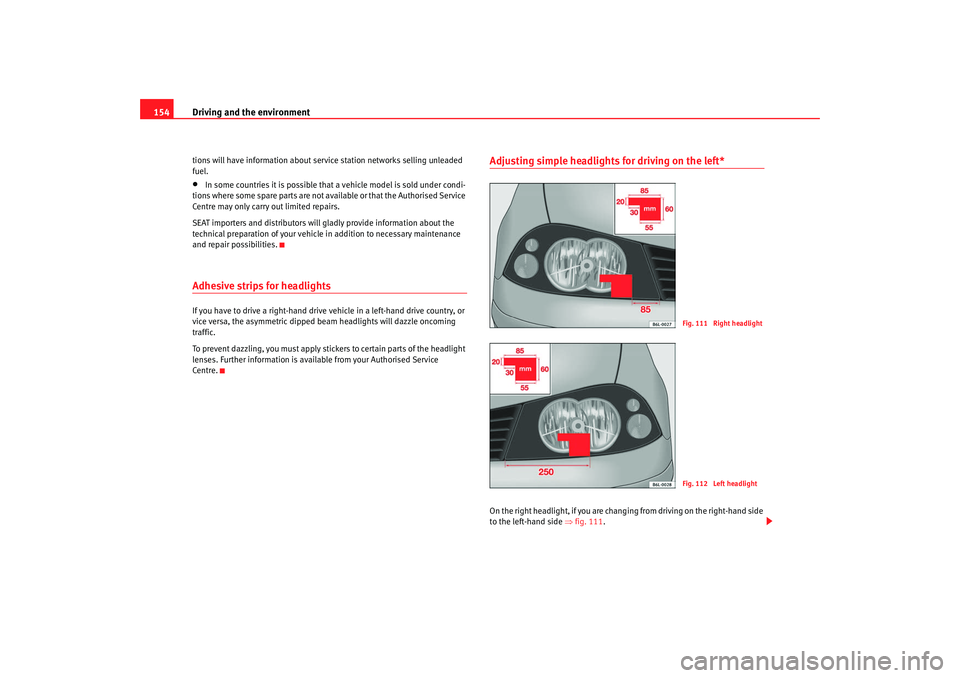
Adjusting simple headlights for driving on the left*On the right headlight, if you are changi ng from driving on the right-hand side
to the left-hand side ⇒fig. 111 .
Fig. 111 Right headlightFig. 112 Left headlight
IBI_ANG_0707 Seite 154 Montag, 6. August 2007 3:59 15
Page 157 of 272
Driving and the environment155
Safety First
Operating instructions
Tips and Maintenance
Te c h n i c a l D a t a
On the left headlight, if you are changi
ng from driving on the right-hand side
to the left-hand side ⇒page 154, fig. 112.
Covering simple headlights for driving on the right*
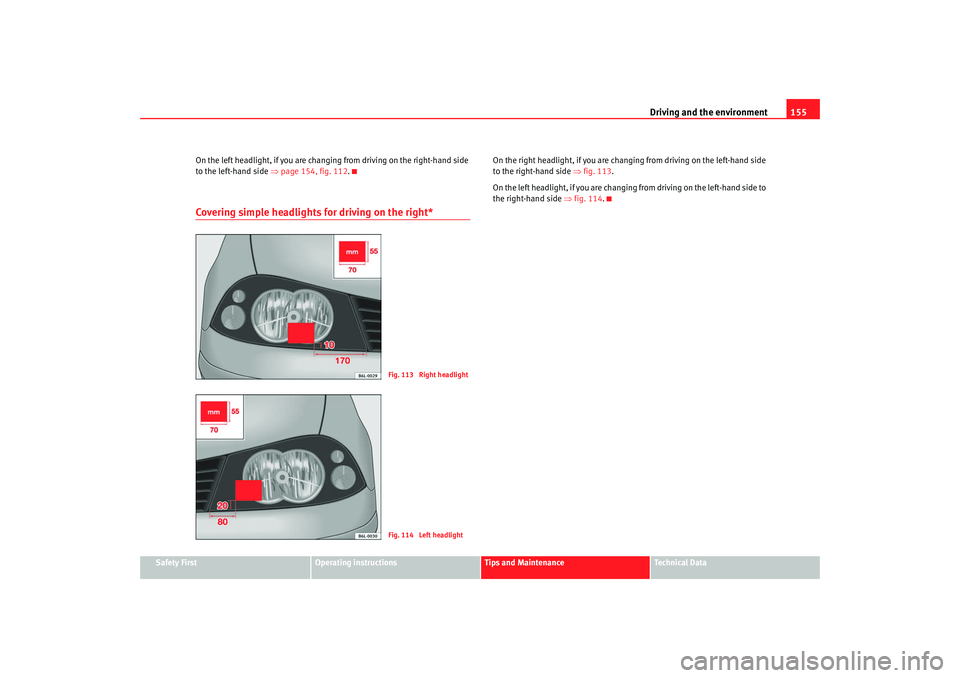
On the right headlight, if you are chan ging from driving on the left-hand side
to the right-hand side ⇒fig. 113 .
On the left headlight, if you are changing from driving on the left-hand side to
the right-hand side ⇒fig. 114 .
Fig. 113 Right headlightFig. 114 Left headlight
IBI_ANG_0707 Seite 155 Montag, 6. August 2007 3:59 15
Page 162 of 272
Driving and the environment
160Speed
The stability of the vehicle and trailer is reduced with increasing speed. For
this reason it is advisable not to drive at the maximum permissible speed in
unfavourable road, weather or wind conditions. This applies especially when
driving downhill.
You should always reduce speed immediately if the trailer shows the slightest
sign of snaking . Never try to stop the “snaking” by increasing speed.
Always brake in good time. If the trailer has an overrun brake, apply the
brakes gently at first and then firmly. This will pr event the jerking that can be
caused by the trailer wheels locking. Select a low gear in good time before
going down a steep descent. This enables you to use the engine braking to
slow down the vehicle.
Heating
At very high temperatures and during prolonged ascents, driving in a low gear
and high engine speed, always monitor the temperature indicator for the
coolant ⇒page 51.
Electronic Stabilisation Program*
Do not switch off the ESP* when towing a trailer. The ESP* makes it easier to
stabilise if the trailer starts to snake.Driving economically and with respect for the
environmentGeneral ObservationsFuel consumption, environmental pollution and wear to the engine, brakes
and tyres depends in large part on your driving style. Fuel consumption may
be reduced from 10 to 15 % by driving defensively and economically. Below we will give you some suggestions to "alleviate" some of the strain in the
environment and, at the same time, your wallet.
Anticipate the traffic situation well in advance
A vehicle uses most fuel when accele
rating. When you anticipate the situa-
tion, you will have to brake less often and, thus, accelerate less. If it is
possible, let the vehicle roll with a gear engaged, for example, if you see a red
light ahead.
Change gear early to save energy
An effective way of saving fuel is to change up through the gears quickly.
Running the engine at high rpm in the lower gears uses an unnecessary
amount of fuel.
Manual gearbox: Change from first to second gear as quickly as possible. We
recommend that, whenever possible, you change to a higher gear upon
reaching 2,000 rpms.
Automatic gearbox: Accelerate slowly and avoid the “kick-down” position.
Avoid driving at high speed
We advise you not to drive at the top speed permitted by the vehicle. Fuel
consumption, exhaust emissions and noise levels all increase very rapidly at
higher speeds. Driving at moderate speeds will help to save fuel.
Avoid idling
It is worthwhile switching off the engine when waiting in a traffic jam, at level
crossings or at traffic lights with a long red phase. The fuel saved after only
30 - 40 seconds is greater than the amount of fuel needed to restart the
engine.
The engine takes a very long time to warm up when it is running at idling
speed. Mechanical wear and pollutant emissions are also especially high
during this initial warm-up phase. It is therefore best to drive off immediately
after starting the engine . Avoid running the engine at high speed.
IBI_ANG_0707 Seite 160 Montag, 6. August 2007 3:59 15
Page 191 of 272
Checking and refilling levels189
Safety First
Operating instructions
Tips and Maintenance
Te c h n i c a l D a t a
The coolant additive G 12+ (dyed purple) may be mixed with G 12 (dyed red)
and also with G 11.
WARNING
Any work carried out in the engine compartment or on the engine must be
carried out cautiously.•
When working in the engine compartment, always observe the safety
warnings ⇒ page 180.
•
When the engine is warm or hot, the cooling system is pressurised! Do
not unscrew the cap on the expansion t ank when the engine is hot. This is
a burn injury risk.Caution
•
When mixed with other additives the colour of G 12 will change to brown.
If this occurs you should have the coolant changed immediately. Failure to do
so will result in engine damage!
•
If a lot of coolant has been lost, wait for the engine to cool down before
putting in cold coolant. This avoids damaging the engine. Large coolant
losses are an indication of leaks in the cooling system. See a specialised
workshop immediately and have the c ooling system checked. Otherwise,
there is a risk of engine damage.
Washer fluid and windscreen wiper bladesTopping up washer fluid
The water for cleaning the windscreen should always be
mixed with washer fluid.The windscreen washer and the headlight washing system are supplied with
fluid from the windscreen washer fluid container in the engine compartment.
The container holds approx. 2 litres; in vehicles with headlamp washers* it
holds approx. 4.5 litres.
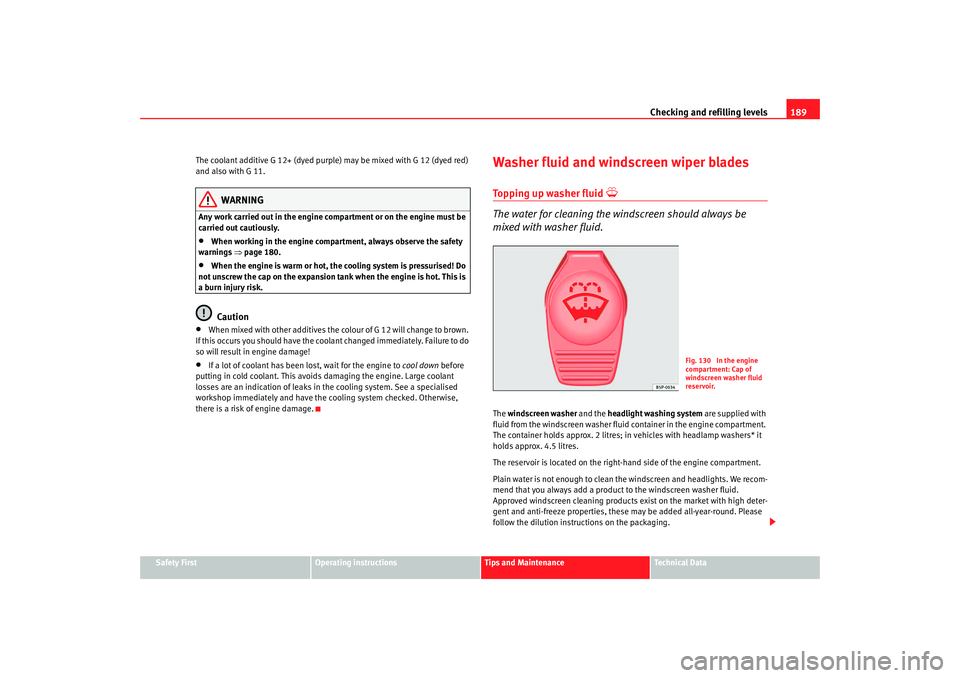
The reservoir is located on the right-hand side of the engine compartment.
Plain water is not enough to clean th e windscreen and headlights. We recom-
mend that you always add a product to the windscreen washer fluid.
Approved windscreen cleaning products exist on the market with high deter-
gent and anti-freeze properties, these may be added all-year-round. Please
follow the dilution instructions on the packaging.
Fig. 130 In the engine
compartment: Cap of
windscreen washer fluid
reservoir.
IBI_ANG_0707 Seite 189 Montag, 6. August 2007 3:59 15
Page 196 of 272
Checking and refilling levels
194BatteryWarnings on handling the battery
WARNING
Always be aware of the danger of injury and chemical burns as well as the
risk of accident or fire when working on the battery and the electrical
system:•
Wear eye protection. Protect your ey es, skin and clothing from acid and
particles containing lead.
•
Battery acid is very corrosive and caustic. Wear protective gloves and
eye protection. Do not tilt the batteries. This could spill acid through the
vents. Rinse battery acid from eyes immediately for several minutes with
clear water. Then seek medical care immediately. Neutralize any acid
splashes on the skin or clothing with a soapy solution, and rinse off with
plenty of water. If acid is swallowed by mistake, consult a doctor immedi-
ately.
•
Fires, sparks, naked lights and smoki ng are prohibited. When handling
cables and electrical equipment, avoid causing sparks and electrostatic charge. Never short the battery terminals. High-energy sparks can cause
injury.
•
A highly explosive mixture of gases is released when the battery is
under charge. The batteries should be charged in a well-ventilated room
only.
•
Keep children away from acid and batteries.
•
Before working on the electrical system, you must switch off the
engine, the ignition and all consumers. The negative cable on the battery
must be disconnected. When a light bu lb is changed, you need only switch
off the light.
•
Deactivate the anti-theft alarm by unlocking the vehicle before you
disconnect the battery! The alar m will otherwise be triggered.
•
When disconnecting the battery from the vehicle electrical system,
disconnect first the negative ca ble and then the positive cable.
•
Switch off all electrical consumers before reconnecting the battery.
Reconnect first the positive cable and then the negative cable. Never
reverse the polarity of the connections. This could cause an electrical fire.
•
Never charge a frozen battery, or one which has thawed. This could
result in explosions and chemical burns. Always replace a battery which
has frozen. A flat battery can freeze at temperatures around 0
°C.
•
Ensure that the vent hose is always connected to the battery.
•
Never use a defective battery. This may be fatally explosive. Replace a
damaged battery immediately.Caution
•
Never disconnect the battery if the ignition is switched on or if the engine
is running. This could damage the elec trical system or electronic compo-
nents.
•
Do not expose the battery to direct sunlight over a long period of time, as
the intense ultraviolet radiation can damage the battery housing.
Wear eye protection
Battery acid is very corrosive and caustic. Wear protec-
tive gloves and eye protection!
Fires, sparks, naked lights and smoking are prohibited!
A highly explosive mixture of gases is released when the
battery is under charge.
Keep children away from acid and batteries!
WARNING (continued)
IBI_ANG_0707 Seite 194 Montag, 6. August 2007 3:59 15
Page 207 of 272
If and when205
Safety First
Operating instructions
Tips and Maintenance
Te c h n i c a l D a t a
Taking out the spare wheel
7)
– Lift the carpet, then remove the plastic nut anticlockwise.
– Take out the tool box* and remove the spare wheel*.
Securing the defective wheel in the spare wheel well
– Put the defective wheel into its housing, and then put the tool
box* into the hollow in the wheel.
– Turn the plastic nut clockwise until the defective wheel is well secured.
– Unhook the carpet and place it on the floor.
WARNING
Check the spare wheel and the tools ar e firmly held to avoid injury to
passengers in the event of sudden braking or collision.Tyre repair kit*
The tyre repair kit (for vehicles not including a spare wheel) is
stored under the floor panel in the luggage compartment.Your vehicle is equipped with the Tyre Mobility System “Tyre repair kit”.
The tyre repair kit consists of a contai ner with sealing compound to repair the
puncture and a compressor to generate the required tyre pressure. The kit will
reliably seal punctures up to a size of about 4 mm caused by the penetration
of a foreign body into the tyre.
Note
•
Seek professional assistance if the repair of a tyre puncture is not
possible with the sealing compound.
Wheel changePreparation work
What you must do before changing a wheel.– If you have a flat tyre or puncture, park the vehicle as far away from the flow of traffic as possible. Choose a location that is as
level as possible.
– All passengers should leave the vehicle. They should wait in a
safe area (for instance behind the roadside crash barrier).
– Switch off the engine. Switch on the hazard warning lights.
–Apply the handbrake firmly.
– Engage the first gear , or put the selector lever to position P for
those vehicles with an automatic gearbox.
– If you are towing a trailer, unhitch it from your vehicle.
– Take the vehicle tools and the spare wheel out of the luggage
compartment.
7)The 17 inch spare wheel is only carried if the "SEAT racing brakes" option is chosen.
IBI_ANG_0707 Seite 205 Montag, 6. August 2007 3:59 15
Page 208 of 272
If and when
206
WARNING
Put the hazard warning lights on and pl ace the warning triangle in position.
This is for your own safety and also warns other road users.
Caution
If you have to change the tyre on a gradient, block the wheel opposite the
wheel being changed by placing a stone or similar object under it to prevent
the vehicle from rolling away.
Note
Please observe legal requirements when doing so.Changing a wheelChange the wheel as described below
– Pull off the hub cap see also ⇒page 207.
–Slacken the wheel bolts.
– Raise the car with the jack in the corresponding zone.
– Ta k e o f f the wheel and then put on the spare wheel.
– Lower the vehicle.
– Tighten the wheel bolts firmly i n d ia go na l s e q u e n ce wi t h t h e b ox
spanner.
–Replace the hub cap.
After changing a wheel
After changing the wheel there are still tasks to complete.– Put the tools and jack back in the luggage compartment.
– Place the wheel with the defective tyre in the luggage compart- ment and secure it.
– Check the tyre pressure of the newly fitted tyre as soon as possible.
– Have the tightening torque of the wheel bolts checked as soon as possible with a torque wrench. The prescribed torque is 120 Nm.
Note•
If you notice that the wheel bolts are corroded and difficult to turn when
changing a wheel, they must be replaced before having the wheel bolt torque
checked.
•
In the interest of safety, drive at moderate speeds until the wheel bolt
torque has been checked.
IBI_ANG_0707 Seite 206 Montag, 6. August 2007 3:59 15
Page 214 of 272
If and when
212
NoteSeek professional assistance if the repair of a tyre puncture is not possible
with the sealing compound.Preparation work
Certain steps must be taken before repairing a tyre.– If you have a flat tyre or puncture, park the vehicle as far away from the flow of traffic as possible.
–Apply the handbrake firmly.
– Engage the first gear, of put the selector lever to position P.
– All passengers should leave the vehicle. They should wait in a
safe area (for instance behind the roadside crash barrier).
– Check whether a repair is possible using the Tyre Mobility System “General information and safety notes.”
– Unscrew inflation cap from the affected wheel.
– Take the tyre repair kit out of the luggage compartment.
WARNING
Put the hazard warning lights on and pl ace the warning triangle in position.
This is for your own safety and also warns other road users.
Caution
Take special care if you have to repair a tyre on a gradient.
Note
Please observe legal requirements when doing so.Tyre repair
The following sections describe the procedures for repairing
a tyre.Using the sealing compound
– The instructions on the container give detailed information on how to use the sealing compound.
Inflating the tyre.
– Remove the air compressor and hose from the container.
– Screw the retaining nut onto the valve.
– Plug the compressor cable into a 12 volt socket.
– Turn on compressor and monitor the pressure shown on the pres- sure gauge.
Completing the repair
– Remove the compressor hose from the valve.
– Fit the valve cap.
– Unplug the compressor from the socket.
– Return all tools to their proper storing location.
IBI_ANG_0707 Seite 212 Montag, 6. August 2007 3:59 15