ignition Seat Ibiza 5D 2007 Repair Manual
[x] Cancel search | Manufacturer: SEAT, Model Year: 2007, Model line: Ibiza 5D, Model: Seat Ibiza 5D 2007Pages: 272, PDF Size: 8.32 MB
Page 219 of 272

If and when217
Safety First
Operating instructions
Tips and Maintenance
Te c h n i c a l D a t a
Fuses below steering wheel in relay holderPTC fuses46
Windscreen wiper unit 20
47 Heated rear window unit 20
48 Indicator unit 15
49 Cigarette lighter 15
50 Locking unit 15
51 Radio/CD/GPS/Telephone 20
52 Horn 20
53 Dipped headlight (left side) 15
54 Right rear window control 25a)The signal “S”is a system which includes the starter and steering lock and enables, after the ignition is switched off and with out removing the key from the steering and starter lock,
certain electrical components to be switched on, including for example, the radio, the courtesy light, etc. This function is de activated on removing the key from the steering and starter
lock.
Number Consumer Amperes
1 PTCs (Supplementary electrical heating using air) 40
2 PTCs (Supplementary electrical heating using air) 40
3 PTCs (Supplementary electrical heating using air) 40
Number
Consumer Amperes
IBI_ANG_0707 Seite 217 Montag, 6. August 2007 3:59 15
Page 233 of 272
If and when231
Safety First
Operating instructions
Tips and Maintenance
Te c h n i c a l D a t a
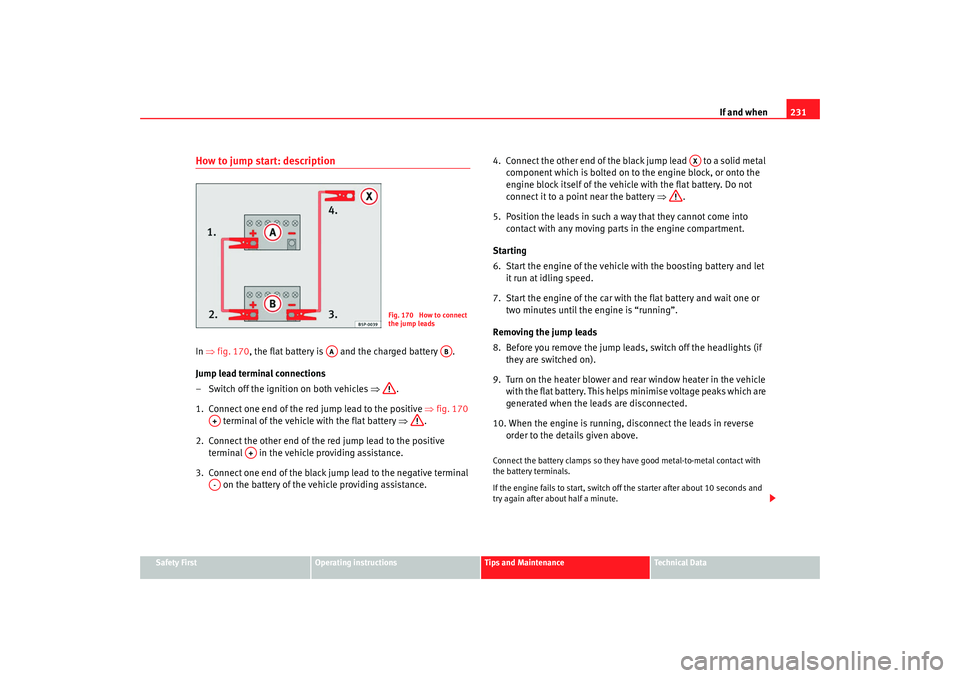
How to jump start: descriptionIn ⇒ fig. 170, the flat battery is and the charged battery .
Jump lead terminal connections
– Switch off the ignition on both vehicles ⇒.
1. Connect one end of the red jump lead to the positive ⇒fig. 170
terminal of the vehicle with the flat battery ⇒.
2. Connect the other end of the red jump lead to the positive terminal in the vehicle providing assistance.
3. Connect one end of the black jump lead to the negative terminal on the battery of the vehicle providing assistance. 4. Connect the other end of the black jump lead to a solid metal
component which is bolted on to the engine block, or onto the
engine block itself of the vehicle with the flat battery. Do not
connect it to a point near the battery ⇒.
5. Position the leads in such a way that they cannot come into contact with any moving parts in the engine compartment.
Starting
6. Start the engine of the vehicle with the boosting battery and let
it run at idling speed.
7. Start the engine of the car with the flat battery and wait one or two minutes until the engine is “running”.
Removing the jump leads
8. Before you remove the jump leads, switch off the headlights (if they are switched on).
9. Turn on the heater blower and rear window heater in the vehicle with the flat battery. This helps minimise voltage peaks which are
generated when the leads are disconnected.
10. When the engine is running, disconnect the leads in reverse order to the details given above.
Connect the battery clamps so they ha ve good metal-to-metal contact with
the battery terminals.
If the engine fails to start, switch off the starter after about 10 seconds and
try again after about half a minute.
Fig. 170 How to connect
the jump leads
AA
AB
A+
A+
A-
AX
IBI_ANG_0707 Seite 231 Montag, 6. August 2007 3:59 15
Page 235 of 272
If and when233
Safety First
Operating instructions
Tips and Maintenance
Te c h n i c a l D a t a
Towing and tow-startingTo w - s t a r t i n g *
The use of jump leads is preferable to tow-starting.We recommend that you do not tow-start your vehicle. Jump-starting
is preferable ⇒page 230.
However, if your vehicle has to be tow-started:
–Engage the 2
nd or the 3
rd gear.
– Keep the clutch pressed down.
– Switch on the ignition.
– Once both vehicles are mo ving, release the clutch.
– As soon as the engine starts, press the clutch and move the gear lever into neutral. This helps to prevent driving into the towing
vehicle.
WARNING
The risk of accidents is high when tow-starting. The vehicle being towed
can easily collide with the towing vehicle.
Caution
When tow-starting, fuel could enter the catalytic converter and damage it.
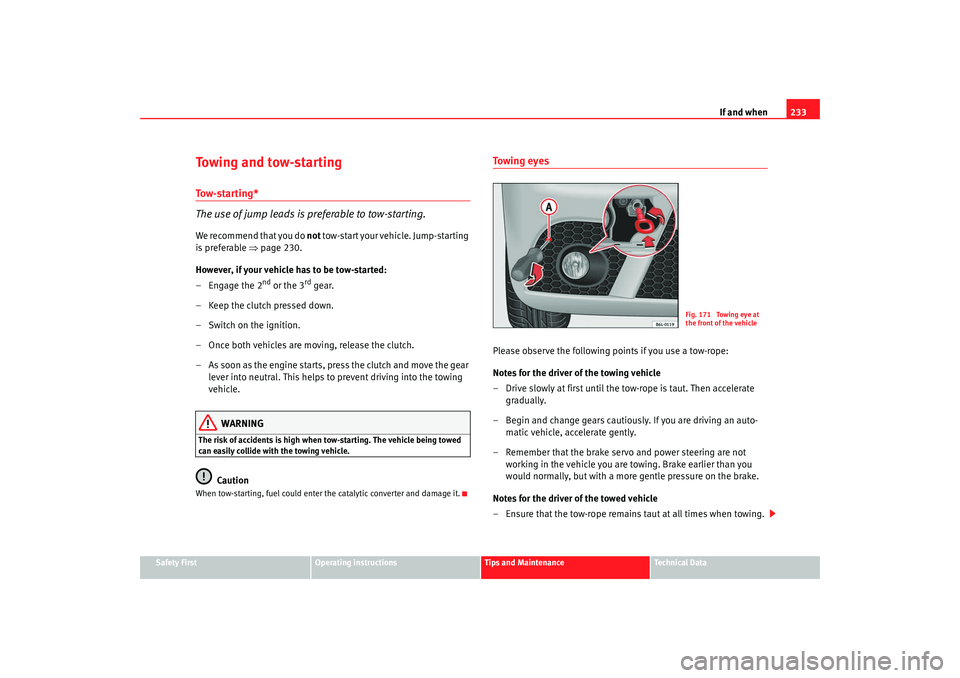
Towing eyesPlease observe the following points if you use a tow-rope:
Notes for the driver of the towing vehicle
– Drive slowly at first until the tow-rope is taut. Then accelerate gradually.
– Begin and change gears cautiously. If you are driving an auto- matic vehicle, accelerate gently.
– Remember that the brake servo and power steering are not working in the vehicle you are towing. Brake earlier than you
would normally, but with a more gentle pressure on the brake.
Notes for the driver of the towed vehicle
– Ensure that the tow-rope remains taut at all times when towing.
Fig. 171 Towing eye at
the front of the vehicle
IBI_ANG_0707 Seite 233 Montag, 6. August 2007 3:59 15
Page 236 of 272
If and when
234
Fitting the front towing eye
– First remove the right hand cover from the lower part of the bumper.
– Remove the bolt ⇒page 233, fig. 171 .
– Take the towing ring from the onboard tools.
– Rotate the towing ring to the left until it is completely tightened into position.
– To remove the ring, rotate it to the right.Tow-rope or tow-bar
It is easier and safer to tow a vehicle with a tow-bar. You should only use a
tow-rope if you do not have a tow-bar.
A tow-rope should be slightly elastic to reduce the loading on both vehicles.
It is advisable to use a tow-rope made of synthetic fibre or similarly elastic
material.
Attach the tow-rope or the tow-bar only to the towing eyes provided or a
towing bracket.
Driving style
Towing requires some experience, especially when using a tow-rope. Both
drivers should be familiar with the te chnique required for towing. Inexperi-
enced drivers should not attempt to tow-start or tow away another vehicle.
Do not pull too hard with the towing vehicle and take care to avoid jerking the
tow-rope. When towing on an unpaved ro ad, there is always a risk of over-
loading and damaging the anchorage points.
The ignition of the vehicle being towed must be switched on to prevent the
steering wheel from locking and also to allow the use of the turn signals,
horn, windscreen wipers and washers. As the brake servo does not work if the
engine is not running, you must apply
considerably more pressure to the brake pedal than you normally would.
As the power assisted steering does not work if the engine is not running, you
will need more strength to steer than you normally would.
Towing vehicles with an automatic gearbox
•
Put the selector lever into position “N”.
•
Do not drive faster than 50 km/h when towing a vehicle.
•
Do not tow further than 50 km.
•
If a breakdown vehicle is used, the vehicle must be towed with the front
wheels raised.Note
•
Observe legal requirements when towing or tow-starting.
•
Switch on the hazard warning lights of both vehicles. However, observe
any regulations to the contrary.
•
For technical reasons, vehicles with an automatic gearbox must not be
tow-started.
•
If damage to your vehicle means that there is no lubricant in the gearbox,
you must raise the drive wheels while the vehicle is being towed.
•
If the vehicle has to be towed more than 50 km, the front wheels must be
raised during towing, and towing should be carried out by a qualified person.
•
The steering wheel is locked when the vehicle has no electrical power. The
vehicle must then be towed with the front wheels raised. Towing should be
carried out by a qualified person.
•
The towing eye should always be kept in the vehicle. Please refer to the
notes on ⇒page 233.
AA
IBI_ANG_0707 Seite 234 Montag, 6. August 2007 3:59 15
Page 239 of 272
General notes on the technical data 237
Safety First
Operating instructions
Tips and Maintenance
Te c h n i c a l D a t a
Te c h n i c a l D a t aGeneral notes on the technical dataWhat you should be aware ofGeneral notes
All data in the official vehicle documents take precedence over this data.All data in these documents are valid for the basic model as offered in Spain.
The vehicle data card included in the Maintenance Programme or the vehicle
registration documents sh ows which engine is installed in the vehicle. The figures may be different if addition
al equipment is fitted, for different
models, for special vehicles and for other countries.
Abbreviations used in this paragraph of the Technical Data Abbreviation MeaningkW Kilowatt, engine power measurement.
bhp Brake horse power, formerly used to denote engine power
at rpm Revolutions per minute - engine speed. Nm Newton metres, unit of engine torque.
l/100 km Fuel consumption in litres per 100 kilometres g/km Carbon dioxide emission s in grams per kilometre.
CO
2
Carbon dioxide
CN Cetane number, indication of the ignition quality of the diesel.
RON Research octane number, indication of the knock resistance of petrol.
IBI_ANG_0707 Seite 237 Montag, 6. August 2007 3:59 15
Page 266 of 272
Index
264Environment . . . . . . . . . . . . . . . . . . . . . . . . . . . 160
Environmental friendliness . . . . . . . . . . . . 161
Environmental tip Avoiding pollution . . . . . . . . . . . . . . . . . . . . 178
ESP . . . . . . . . . . . . . . . . . . . . . . . . . . . . . . . . 66, 149
Exhaust gasses purification system . . . . . . . . 152
Exterior mirrors . . . . . . . . . . . . . . . . . . . . . . . . . 166
External aerial . . . . . . . . . . . . . . . . . . . . . . . . . . 173FFloor mats . . . . . . . . . . . . . . . . . . . . . . . . . . . . . . 14
Fog lights . . . . . . . . . . . . . . . . . . . . . . . . . . . . . . . 90
Front airbags . . . . . . . . . . . . . . . . . . . . . . . . . . . . 29 Description . . . . . . . . . . . . . . . . . . . . . . . . . . 29
Function . . . . . . . . . . . . . . . . . . . . . . . . . . . . . 30
Safety notes . . . . . . . . . . . . . . . . . . . . . . . . . . 32
Front ashtray . . . . . . . . . . . . . . . . . . . . . . . . . . . 113
Front cup holder* . . . . . . . . . . . . . . . . . . . . . . . 112
Front interior light . . . . . . . . . . . . . . . . . . . . . . . . 95
Front passenger airbag deactivation . . . . . . . . . 40
Front reading light . . . . . . . . . . . . . . . . . . . . . . . . 95
Front seat adjustment Lumbar support . . . . . . . . . . . . . . . . . . . . . . 107
Fuel Diesel . . . . . . . . . . . . . . . . . . . . . . . . . . . . . . 179
Petrol . . . . . . . . . . . . . . . . . . . . . . . . . . . . . . 178
Fuel level Indicator . . . . . . . . . . . . . . . . . . . . . . . . . . . . . 54
Fuel reserve . . . . . . . . . . . . . . . . . . . . . . . . . . . . . 64 Fuel Tank
Opening the fuel tank flap . . . . . . . . . . . . . 177
Fuel tank See Fuel reserve . . . . . . . . . . . . . . . . . . . . . . 64
Fuel: save . . . . . . . . . . . . . . . . . . . . . . . . . . . . . . 160
Fuses . . . . . . . . . . . . . . . . . . . . . . . . . . . . . . . . . 213
GG 12 . . . . . . . . . . . . . . . . . . . . . . . . . . . . . . . . . . 187
Gear shift pattern . . . . . . . . . . . . . . . . . . . . . . . 136
General overview of the engine compartment 242
Glove compartment . . . . . . . . . . . . . . . . . . . . . . 110
Glow plug system . . . . . . . . . . . . . . . . . . . . . . . 135 warning lamp . . . . . . . . . . . . . . . . . . . . . . . . . 63HHandbrake . . . . . . . . . . . . . . . . . . . . . . . . . . . . . 141Warning lamp . . . . . . . . . . . . . . . . . . . . 65, 141
Hazard warning lights . . . . . . . . . . . . . . . . . . . . . 92
head restraints Adjusting . . . . . . . . . . . . . . . . . . . . . . . 105, 106
adjustment of the head restraint angle . . . 106
Removing . . . . . . . . . . . . . . . . . . . . . . . . . . . 106
Headlight flasher . . . . . . . . . . . . . . . . . . . . . . . . 94
Headlight range control . . . . . . . . . . . . . . . . . . . 91
Headlights . . . . . . . . . . . . . . . . . . . . . . . . . . . . . . 90 Driving abroad . . . . . . . . . . . . . . . . . . . . . . . 154
Fog lights . . . . . . . . . . . . . . . . . . . . . . . . . . . . 90
Washer system . . . . . . . . . . . . . . . . . . . . . . 100 Heated front seats . . . . . . . . . . . . . . . . . . . . . . 108
Heating and ventilation . . . . . . . . . . . . . . . . . . 119
Heating system . . . . . . . . . . . . . . . . . . . . . . . . . 120
High pressure cleaners . . . . . . . . . . . . . . . . . . . 165
Horn . . . . . . . . . . . . . . . . . . . . . . . . . . . . . . . . . . . 51
How to jump start description . . . . . . . . . . . . . 231
IIdentification number . . . . . . . . . . . . . . . . . . . . 238
Ignition key . . . . . . . . . . . . . . . . . . . . . . . . . . . . 132
Ignition lock . . . . . . . . . . . . . . . . . . . . . . . . . . . . 132
Indicator lights
indication lamp . . . . . . . . . . . . . . . . . . . . . . . 63
Instrument and switch lighting . . . . . . . . . . . . . 91
Instrument lighting . . . . . . . . . . . . . . . . . . . . . . . 51
Instrument panel . . . . . . . . . . . . . . . . . . . . . . . . . 51
Instruments . . . . . . . . . . . . . . . . . . . . . . . . . . . . . 52
Intermittent wipe, windscreen . . . . . . . . . . . . . . 97
ISOFIX and Toptether system . . . . . . . . . . . . . . . 48JJump leads . . . . . . . . . . . . . . . . . . . . . . . . . . . . . 230
Jump-starting . . . . . . . . . . . . . . . . . . . . . . . . . . . 230KKey tab . . . . . . . . . . . . . . . . . . . . . . . . . . . . . . . . . 76
Keys . . . . . . . . . . . . . . . . . . . . . . . . . . . . . . . . . . . 76
IBI_ANG_0707 Seite 264 Montag, 6. August 2007 3:59 15