ECO mode Seat Ibiza 5D 2007 Owner's manual
[x] Cancel search | Manufacturer: SEAT, Model Year: 2007, Model line: Ibiza 5D, Model: Seat Ibiza 5D 2007Pages: 272, PDF Size: 8.32 MB
Page 2 of 272
SEAT S.A. se preocupa constantemente por mantener todos sus tipos y modelos en un desarrollo continuo. Por ello le rogamos que com-
prenda que, en cualquier momento, puedan producirse modificaciones del vehículo entregado en cuanto a la forma, el equipamiento y la
técnica. Por esta razón, no se puede derivar derecho alguno basándose en los datos, las ilustrac iones y descripciones del presente
Manual.
Los textos, las ilustraciones y las normas de este manual se basan en el estado de la información en el momento de la realización de la
impresión. Salvo error u omisión, la información recogida en el presente manual es válida en la fecha de cierre de su edición.
No está permitida la reimpresión, la reproducción o la traducción, total o parcial, sin la autorización escrita de SEAT.
SEAT se reserva expresamente todos los der echos según la ley sobre el "Copyright". Reservados todos los derechos sobre modificación.
❀Este papel está fabricado con celulosa blanqueada sin cloro.
© SEAT S.A. - Reimpresión: 15.09.07
Interior Manual IBIZA 7/8/07 11:23 Página 1
Page 60 of 272
Cockpit
58
NoteWhen the vehicle is stationary or travelling at very low speeds, the tempera-
ture displayed may be slightly higher than the actual ambient temperature as
a result of the heat radiated from the engine.Display field for selector lever position*The position of the automatic gearbox selector lever is shown on the display
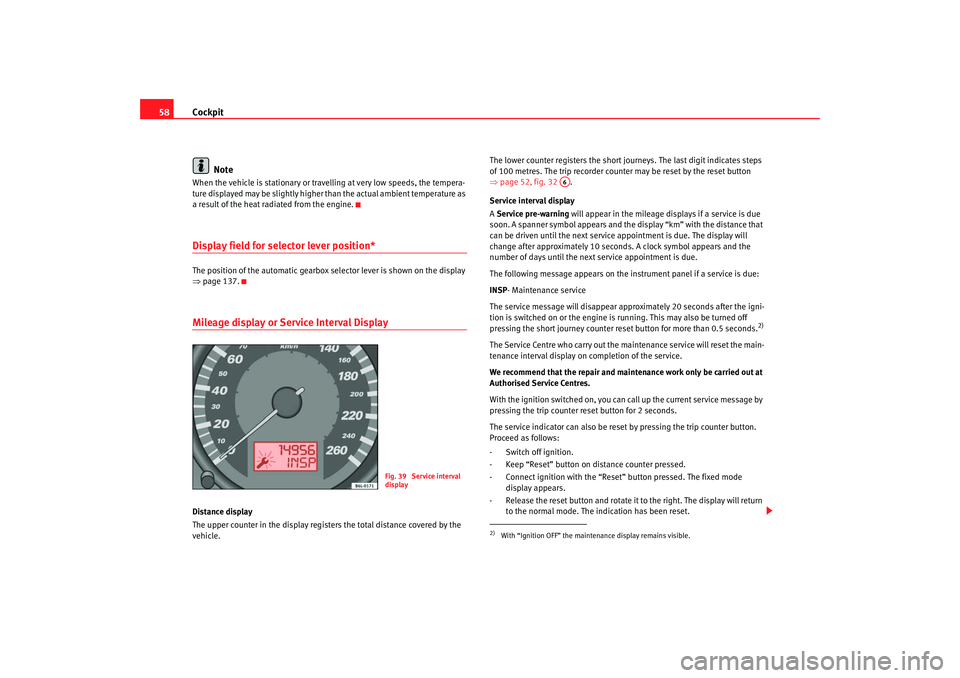
⇒page 137.Mileage display or Service Interval DisplayDistance display
The upper counter in the display registers the total distance covered by the
vehicle. The lower counter registers the short journeys. The last digit indicates steps
of 100 metres. The trip recorder counter may be reset by the reset button
⇒
page 52, fig. 32 .
Service interval display
A Service pre-warning will appear in the mileage displays if a service is due
soon. A spanner symbol appears and the display “km” with the distance that
can be driven until the next service appointment is due. The display will
change after approximately 10 seconds. A clock symbol appears and the
number of days until the next service appointment is due.
The following message appears on the instrument panel if a service is due:
INSP- Maintenance service
The service message will disappear approximately 20 seconds after the igni-
tion is switched on or the engine is running. This may also be turned off
pressing the short journey counter reset button for more than 0.5 seconds.
2)
The Service Centre who carry out the maintenance service will reset the main-
tenance interval display on completion of the service.
We recommend that the repair and main tenance work only be carried out at
Authorised Service Centres.
With the ignition switched on, you can call up the current service message by
pressing the trip counter reset button for 2 seconds.
The service indicator can also be reset by pressing the trip counter button.
Proceed as follows:
- Switch off ignition.
- Keep “Reset” button on distance counter pressed.
- Connect ignition with the “Reset ” button pressed. The fixed mode
display appears.
- Release the reset button and rotate it to the right. The display will return to the normal mode. The indication has been reset.
Fig. 39 Service interval
display
2)With “Ignition OFF” the mainte nance display remains visible.
A6
IBI_ANG_0707 Seite 58 Montag, 6. August 2007 3:59 15
Page 101 of 272
Lights and visibility99
Safety First
Operating instructions
Tips and Maintenance
Te c h n i c a l D a t a
Note
•
Do not put stickers on the windscreen in front of the sensor. This may
cause sensor disruption or faults.
Rear window wiper
The windscreen wiper lever operates the windscreen wiper
and the wash and wipe system for the rear window.
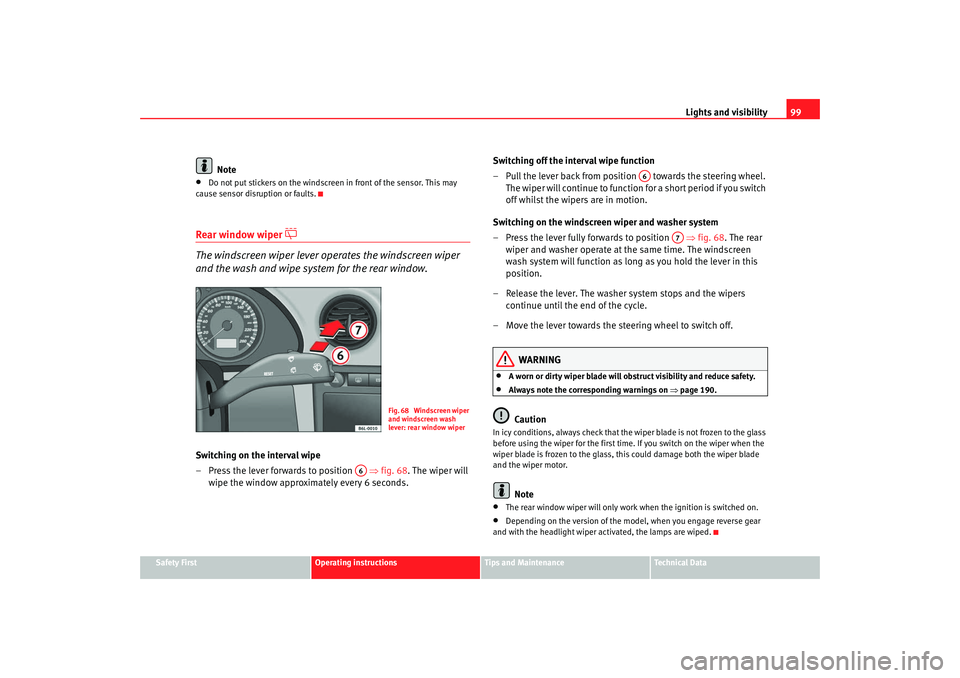
Switching on the interval wipe
– Press the lever forwards to position ⇒fig. 68 . The wiper will
wipe the window approximately every 6 seconds. Switching off the interval wipe function
– Pull the lever back from position towards the steering wheel.
T h e wi p e r will co n t i n u e to fun c t i o n fo r a s h o r t p e r i o d i f yo u s wi tch
off whilst the wipers are in motion.
Switching on the windscreen wiper and washer system
– Press the lever fully forwards to position ⇒fig. 68 . The rear
wiper and washer operate at the same time. The windscreen
wash system will function as long as you hold the lever in this
position.
– Release the lever. The washer system stops and the wipers continue until the end of the cycle.
– Move the lever towards the steering wheel to switch off.
WARNING
•
A worn or dirty wiper blade will obstruct visibility and reduce safety.
•
Always note the corresponding warnings on ⇒page 190.Caution
In icy conditions, always check that the wiper blade is not frozen to the glass
before using the wiper for the first time. If you switch on the wiper when the
wiper blade is frozen to the glass, this could damage both the wiper blade
and the wiper motor.
Note
•
The rear window wiper will only work when the ignition is switched on.
•
Depending on the version of the model, when you engage reverse gear
and with the headlight wiper activated, the lamps are wiped.
Fig. 68 Windscreen wiper
and windscreen wash
lever: rear window wiper
A6
A6
A7
IBI_ANG_0707 Seite 99 Montag, 6. August 2007 3:59 15
Page 128 of 272
Heating, Ventilation and Air conditioning
126
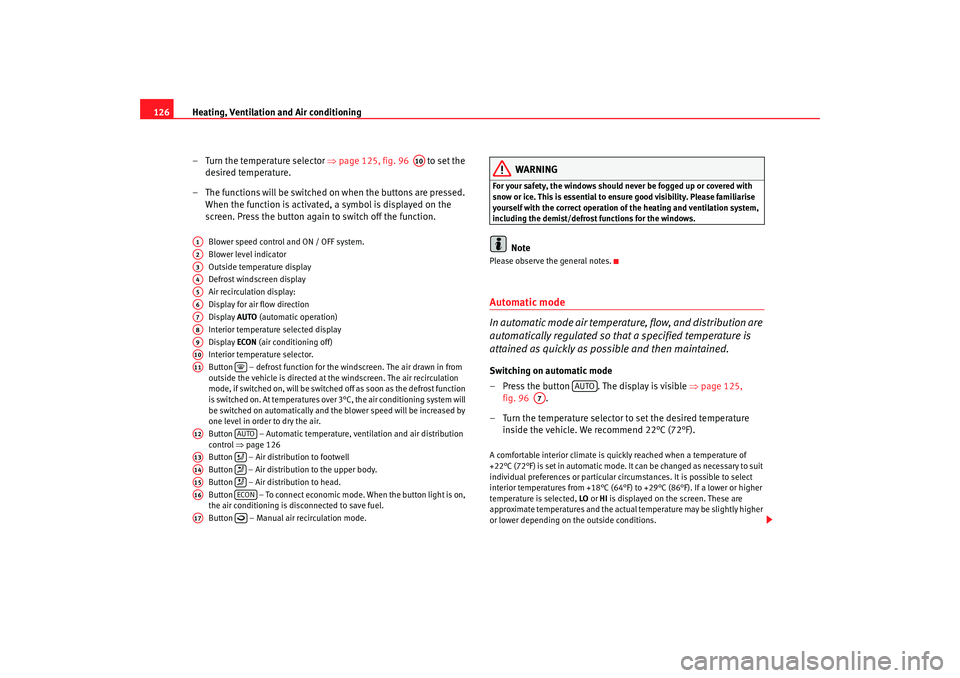
– Turn the temperature selector ⇒page 125, fig. 96 to set the
desired temperature.
– The functions will be switched on when the buttons are pressed. When the function is activated, a symbol is displayed on the
screen. Press the button again to switch off the function.
Blower speed control and ON / OFF system.
Blower level indicator
Outside temperature display
Defrost windscreen display
Air recirculation display:
Display for air flow direction
D isplay AUTO (aut omatic operation)
Interior temperature selected display
D isplay ECON (air conditioning off)
Interior temperature selector.
Button – defrost function for the windscreen. The air drawn in from
outside the vehicle is directed at the windscreen. The air recirculation
mode, if switched on, will be switched off as soon as the defrost function
is switched on. At temperatures over 3°C, the air conditioning system will
be switched on automatically and the blower speed will be increased by
one level in order to dry the air.
Button – Automatic temperature, ventilation and air distribution
control ⇒page 126
Button – Air distribution to footwell
Button – Air distribution to the upper body.
Button – Air distribution to head.
Button – To connect economic mode. When the button light is on,
the air conditioning is disconnected to save fuel.
Button – Manual air recirculation mode.
WARNING
For your safety, the windows should never be fogged up or covered with
snow or ice. This is essential to ensure good visibility. Please familiarise
yourself with the correct operation of the heating and ventilation system,
including the demist/defrost functions for the windows.
Note
Please observe the general notes.Automatic mode
In automatic mode air temperature, flow, and distribution are
automatically regulated so that a specified temperature is
attained as quickly as possible and then maintained.Switching on automatic mode
– Press the button . The display is visible ⇒page 125,
fig. 96 .
– Turn the temperature selector to set the desired temperature inside the vehicle. We recommend 22°C (72°F).A comfortable interior climate is quickly reached when a temperature of
+22°C (72°F) is set in automatic mode. It can be changed as necessary to suit
individual preferences or particular cir cumstances. It is possible to select
interior temperatures from +18°C (64°F) to +29°C (86°F). If a lower or higher
temperature is selected, LO or HI is displayed on the screen. These are
approximate temperatures and the actual temperature may be slightly higher
or lower depending on the outside conditions.
A10
A1A2A3A4A5A6A7A8A9A10A11
A12
AUTO
A13
A14
A15
A16
ECON
A17
AUTO
A7
IBI_ANG_0707 Seite 126 Montag, 6. August 2007 3:59 15
Page 129 of 272
Heating, Ventilation and Air conditioning 127
Safety First
Operating instructions
Tips and Maintenance
Te c h n i c a l D a t a
Climatronic maintains a constant tem
perature level fully automatically. The
temperature of the air supplied to the interior, the blower speed and the air
distribution are regulated automatically. The system also allows for the effect
of strong sunlight, so there is no ne ed for manual adjustment. Therefore,
automatic mode provides the best comfort for the vehicle occupants in virtu-
ally all conditions throughout the year.
Automatic mode is switched off whenever an adjustment is made using the
buttons for the air distribution, blower or . The temperature continues
to be regulated.
Manual mode
In manual mode you can adjust the air temperature, flow, and
distribution yourself.Switching on manual mode
– Press one of the buttons ⇒page 125, fig. 96 to , or turn
the blower control . The display is switched off .Temperature
It is possible to select interior te mperatures from +18°C (64°F) to +29°C
(86°F). These are approximate temperat ures and the actual temperature may
be slightly higher or lower depending on the outside conditions.
If a temperature below 18°C (64°F) is selected, the display switches to LO. In
this setting the system runs at maximum cooling output and the temperature
is not regulated.
If a temperature above 29°C (86°F) is selected the display indicates HI. In this
setting the system runs at maximum heating output and the temperature is
not controlled. Blower
The blower can be infinitely adjusted with the blower control . Always have
the blower running at a low setting to ensure a constant flow of fresh air into
the vehicle. If the blower is switched off (no level displayed ) and the
control is turned further to the left, the Climatronic is switched off. Then
OFF
is displayed on the screen.
Air distribution
The air distribution is adjusted using the buttons , and . It is also
possible to open and close some of the air outlets separately.
Switching the air conditioning system on and off
Pressing the button switches off the air cooling system to save fuel.
The temperature continues to be regulated. The set temperature can then
only be reached if it is higher than the outside temperature.
Air recirculation mode
Air recirculation mode prevents fumes or unpleasant smells
from entering the vehicle.– Press the button to switch air recirculation mode on or off.
This is ON if the symbol
⇒ page 125, fig. 96 is displayed
on the screen.
Air recirculation mode prevents strong odours in the ambient air from
entering the vehicle interior, for example when passing through a tunnel or in
queuing traffic.
When the outside temperature is low, using air recirculation mode provides
more effective heating by heating air from the vehicle interior instead of cold
air from outside.
ECON
A13
A15
A1
A7
A1A2
ECON
A5
IBI_ANG_0707 Seite 127 Montag, 6. August 2007 3:59 15
Page 130 of 272
Heating, Ventilation and Air conditioning
128When the outside temperature is high, using air recirculation mode provides
more effective cooling by cooling air from the vehicle interior instead of warm
air from outside.
For reasons of safety, air recirculation is not possible when the control for air
distribution is set to the windscreen setting
.
WARNING
In air recirculation mode, no ambient ai r enters the vehicle interior. If the
air conditioning system is switched off, the windows can quickly mist over.
Therefore, you should never leave the air recirculation mode switched on
for longer periods, as this increases the risk of an accident.
Note
When reverse gear is engaged the air recirculation connects automatically to
prevent the entrance of exhaust fumes in the vehicle on travelling backwards.
In this case the symbol for air recirculation is not displayed.General notesThe pollen filter
The pollution filter (a combined part iculate filter and active carbon filter)
serves as a barrier against impurities in the ambient air, including dust and
pollen.
For the air conditioning system to work with maximum efficiency, the pollen
filter must be replaced at the intervals specified in the Maintenance Program.
If the filter loses efficiency prematurely due to use in areas with very high
levels of air pollution, the pollen filte r must be changed more frequently than
stated in the Service Schedule.
Caution
•
If you suspect that the air conditioning is damaged, switch off the air
conditioning with button to prev ent further damage and have it
checked by a qualified workshop.
•
Repairs to the air conditioning system require specialist knowledge and
special tools. Therefore, we recommend that you take the vehicle to a quali-
fied workshop should problems occur.Note
•
If the humidity and temperature outside the vehicle are high, condensa-
tion can drip off the evaporator in the cooling system and form a pool under-
neath the vehicle, this is completely no rmal and there is no need to suspect
a leak.
•
Keep the air intake slots in front of the windscreen free of snow, ice and
leaves to ensure heating and cooling is not impaired, and to prevent the
windows misting over.
•
The air from the vents flows through the passenger compartment and is
extracted by slots designed for this purpose. Do not cover these slots with
articles of clothing or other objects.
•
The air conditioning system operates most effectively with the windows
and the sliding/tilting roof* closed. Howe ver, if the sun has heated up the
vehicle, the air inside can be cooled more quickly by opening the windows for
a short period.
•
Do not smoke while air recirculation mode is on, as smoke drawn into the
air conditioning system leaves a r esidue on the evaporator, producing a
permanent unpleasant odour.
•
At low outside temperatures the compressor switches off automatically.
The button cannot be switched on either.
•
It is advisable to connect the air conditioning at least once a month, to
lubricate the system gaskets and prevent leaks. If a decrease in the cooling
capacity is detected, an Authorised Service Centre should be consulted to
check the system.
ECON
AUTO
IBI_ANG_0707 Seite 128 Montag, 6. August 2007 3:59 15
Page 138 of 272
Driving
136
CautionIf the engine has been driven hard for a long period, the engine could over-
heat when it is switched off. Risk of engine damage. For this reason, you
should idle the engine for approx. 2 m inutes before you switch it off.Manual gearboxDriving a car with a manual gearboxSelecting the reverse gear
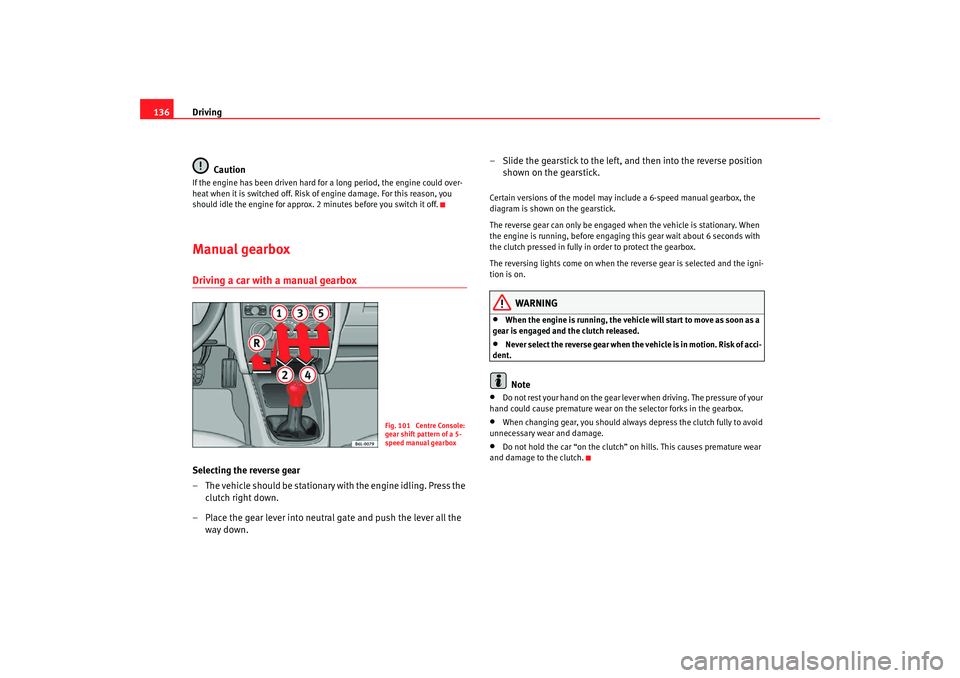
– The vehicle should be stationary with the engine idling. Press the
clutch right down.
– Place the gear lever into neutral gate and push the lever all the way down. – Slide the gearstick to the left, and then into the reverse position
shown on the gearstick.
Certain versions of the model may include a 6-speed manual gearbox, the
diagram is shown on the gearstick.
The reverse gear can only be engaged when the vehicle is stationary. When
the engine is running, before engaging this gear wait about 6 seconds with
the clutch pressed in fully in order to protect the gearbox.
The reversing lights come on when the reverse gear is selected and the igni-
tion is on.
WARNING
•
When the engine is running, the vehicle will start to move as soon as a
gear is engaged and the clutch released.
•
Never select the reverse gear when the vehicle is in motion. Risk of acci-
dent.Note
•
Do not rest your hand on the gear lever when driving. The pressure of your
hand could cause premature wear on the selector forks in the gearbox.
•
When changing gear, you should always depress the clutch fully to avoid
unnecessary wear and damage.
•
Do not hold the car “on the clutch” on hills. This causes premature wear
and damage to the clutch.
Fig. 101 Centre Console:
gear shift pattern of a 5-
speed manual gearbox
IBI_ANG_0707 Seite 136 Montag, 6. August 2007 3:59 15
Page 161 of 272
Driving and the environment159
Safety First
Operating instructions
Tips and Maintenance
Te c h n i c a l D a t a
Where possible, operate the trailer with the maximum permitted
draw bar
weight on the ball joint of the towing bracket, but do not exceed the specified
limit.
The figures for trailer weights and draw bar weights that are given on the
data plate of the towing bracket are for certification purposes only. The
correct figures for your sp ecific model, which may be lower than these figures
for the towing bracket, are give n in the registration documents ⇒Section
“Technical data”.
Distributing the load
Distribute loads in the trailer so that heavy objects are as near to the axle as
possible. Loads carried in the trailer must be secured to prevent them
moving.
Tyre pressure
Set tyre pressure to the maximum permissible pressure shown on the sticker
on the inside of the fuel tank flap. Set the tyre pressure of the trailer tyres in
accordance with the trailer manufacturer's recommendations.
Exterior mirrors
Check whether you can see enough of the road behind the trailer with the
standard mirrors. If this is not the case you should have additional mirrors
fitted. Both exterior mirrors should be mounted on hinged extension
brackets. Adjust the mirrors to give sufficient vision to the rear.
WARNING
Never transport people in a trailer. This could result in fatal accidents.
Note
•
Towing a trailer places additional demands on the vehicle. We recom-
mend additional services between the normal inspection intervals if the
vehicle is used frequently for towing a trailer.
•
Find out whether special regulations apply to towing a trailer in your
country.
Ball coupling of towing bracket*
The ball coupling of the towing bracket is located in the tool
boxThe ball coupling is provided with in structions on fitting and removing the
ball coupling of the towing bracket.
WARNING
The towing bracket ball coupling must be stored securely in the luggage
compartment to prevent them being flung through the vehicle and causing
injury.
Note
•
By law, the ball coupling must be re moved if a trailer is not being towed
and it obscures the number plate.
Driving tips
Driving with a trailer always requires extra care.Weight distribution
The weight distribution of a loaded trailer with an unladen vehicle is very
unfavourable. However, if this cannot be avoided, drive extra slowly to allow
for the unbalanced we ight distribution.
IBI_ANG_0707 Seite 159 Montag, 6. August 2007 3:59 15
Page 162 of 272
Driving and the environment
160Speed
The stability of the vehicle and trailer is reduced with increasing speed. For
this reason it is advisable not to drive at the maximum permissible speed in
unfavourable road, weather or wind conditions. This applies especially when
driving downhill.
You should always reduce speed immediately if the trailer shows the slightest
sign of snaking . Never try to stop the “snaking” by increasing speed.
Always brake in good time. If the trailer has an overrun brake, apply the
brakes gently at first and then firmly. This will pr event the jerking that can be
caused by the trailer wheels locking. Select a low gear in good time before
going down a steep descent. This enables you to use the engine braking to
slow down the vehicle.
Heating
At very high temperatures and during prolonged ascents, driving in a low gear
and high engine speed, always monitor the temperature indicator for the
coolant ⇒page 51.
Electronic Stabilisation Program*
Do not switch off the ESP* when towing a trailer. The ESP* makes it easier to
stabilise if the trailer starts to snake.Driving economically and with respect for the
environmentGeneral ObservationsFuel consumption, environmental pollution and wear to the engine, brakes
and tyres depends in large part on your driving style. Fuel consumption may
be reduced from 10 to 15 % by driving defensively and economically. Below we will give you some suggestions to "alleviate" some of the strain in the
environment and, at the same time, your wallet.
Anticipate the traffic situation well in advance
A vehicle uses most fuel when accele
rating. When you anticipate the situa-
tion, you will have to brake less often and, thus, accelerate less. If it is
possible, let the vehicle roll with a gear engaged, for example, if you see a red
light ahead.
Change gear early to save energy
An effective way of saving fuel is to change up through the gears quickly.
Running the engine at high rpm in the lower gears uses an unnecessary
amount of fuel.
Manual gearbox: Change from first to second gear as quickly as possible. We
recommend that, whenever possible, you change to a higher gear upon
reaching 2,000 rpms.
Automatic gearbox: Accelerate slowly and avoid the “kick-down” position.
Avoid driving at high speed
We advise you not to drive at the top speed permitted by the vehicle. Fuel
consumption, exhaust emissions and noise levels all increase very rapidly at
higher speeds. Driving at moderate speeds will help to save fuel.
Avoid idling
It is worthwhile switching off the engine when waiting in a traffic jam, at level
crossings or at traffic lights with a long red phase. The fuel saved after only
30 - 40 seconds is greater than the amount of fuel needed to restart the
engine.
The engine takes a very long time to warm up when it is running at idling
speed. Mechanical wear and pollutant emissions are also especially high
during this initial warm-up phase. It is therefore best to drive off immediately
after starting the engine . Avoid running the engine at high speed.
IBI_ANG_0707 Seite 160 Montag, 6. August 2007 3:59 15
Page 178 of 272
Accessories, parts replacement and modifications
176If a towing bracket is to be fitted after the vehicle is purchased, this must be
completed according to the instructions of the towing bracket manufacturer.
The attachment points for the towing bracket are underneath the vehicle.
The distance between the centre of the ball coupling and the ground should
never be lower than the measurement indicated when the vehicle is fully
loaded including the maximum resting weight.
Measurement for securing the towing bracket:
65 mm (minimum)
from 350 mm to 420 mm (fully laden vehicle)
960 mm
345 mm
188 mm
Fitting a towing bracket•
Driving with a trailer implies additional work for the vehicle. Therefore,
before fitting a towing bracket, please contact an Authorised Service Centre
to check whether your cooling system needs modification.
•
Observe the legal requirements in your country (e.g. the fitting of a sepa-
rate warning lamp).
•
Certain vehicle components, e.g. the rear bumper must be removed and
reinstalled. The towing bracket securin g bolts must be tightened using a
torque wrench, and an electrical sock et must be used to connect to the
vehicle's electrical system. This requ ires specialist knowledge and tools.
•
The figures in the illustration show the dimensions and attachment points
which must be observed if you are retrofitting a towing bracket.
WARNING
Towing brackets should be fitted by specialists.•
If the towing bracket is incorrectly installed, there is serious danger of
an accident.
•
For your own safety, please observe the instructions provided by the
manufacturer of the towing bracket.Caution
•
If the electrical socket is incorrectly installed, this could cause damage to
the vehicle's electrical system.Note
For the sports model (FR, SPORT, CUPRA...), fitting of a trailer bracket is not
recommended due to the design of the bumpers.
AA
ABACADAEAF
WARNING (continued)
IBI_ANG_0707 Seite 176 Montag, 6. August 2007 3:59 15