oil type Seat Ibiza 5D 2007 Owner's manual
[x] Cancel search | Manufacturer: SEAT, Model Year: 2007, Model line: Ibiza 5D, Model: Seat Ibiza 5D 2007Pages: 272, PDF Size: 8.32 MB
Page 142 of 272
Driving
140If, while driving, the selector lever accidentally moves to position N, first
release the accelerator pedal and wait until the engine slows to idling before
selecting a forward gear ⇒.
Starting
Select a range ( R, D, 3, 2, 1). Wait until the change has taken place and the
power transmission of the drive wheels has stabilised (slight pressure is
noticeable). Then depress the accelerator.
Stopping
In the case of a temporary stop, for example at a traffic light, it is not neces-
sary to move to position N, it is sufficient to brake using the brake pedal. The
engine should only run at idle speed.
Parking
On slopes, first pull handbrake on firmly and then connect block. This
prevents overloading of the locking mechanism, making the subsequent
deactivation easier ⇒ .
Emergency start
For vehicles fitted with an automatic gearbox the engine can not be started by
towing or pushing the vehicle ⇒ page 233.
If the vehicle battery is flat, a battery from another car can be used to jump-
start the car using a set of jump leads ⇒page 133.
To w i n g
If the vehicle requires towing at any time, observe the instructions of
⇒ page 233, “Towing and tow-starting”.
Back-up programme
In the event of a malfunction of the gearbox electronics, emergency
programmes are activated, according to the type of fault.•
The gearbox continues to connect gears automatically, but the operations
are jerky. Consult the Authorised Service Centre.
•
The gearbox does not automatically engage gears.
In this case they can be changed manually. 3rd gear is only available in posi-
tions D, 3 and 2 of the selector lever.
In positions 1 and R of the selector lever 1st gear and reverse gear are avail-
able respectively as normal.
As the torque converter is required to work more, especially due to the lack of
2nd gear, it is possible that the gearbox oil may overheat. In this case, consult
the Authorised Service Centre as soon as possible.
WARNING
•
In all the ranges the vehicle must always be held with the foot brake
when the engine is running. This is because an automatic gearbox still
transmits power even at idling speed , and the vehicle tends to “creep”.
•
If, when the car is at a standstill and the engine is idling, a range is
connected, take care not to accelerate accidentally (for example, when
working in the engine compartment), as the car will start to move immedi-
ately.
•
Before working on a running engine, place the selector lever in position
P and apply the handbrake.
•
To prevent the vehicle from moving out of control, the handbrake
should always be applied when the vehicle is at a standstill. In addition
move the selector lever to position P.
IBI_ANG_0707 Seite 140 Montag, 6. August 2007 3:59 15
Page 163 of 272
Driving and the environment161
Safety First
Operating instructions
Tips and Maintenance
Te c h n i c a l D a t a
Periodic maintenance
Periodic maintenance work guarantees
that, before beginning a journey, you
will not waste fuel. A well-serviced engine gives you the benefit of improved
fuel efficiency as well as maximum reliability and an enhanced resale value.
A maladjusted engine may mean an increase of 10 % over normal fuel
consumption.
Check the oil level every time you fill the tank. Oil consumption depends to a
great extent on the engine load and engine speed. It is quite normal that the
oil consumption of a new engine only reaches its lowest level after a certain
mileage. This means that the oil consumption can only be properly assessed
after about 5,000 km. Depending on your personal driving style, oil consump-
tion can be up to 0.5 litres per 1,000 km.
Avoid short journeys
To reduce the consumption and emission of polluting gases, the engine and
the exhaust filtration systems should reach the optimum service tempera-
ture .
With the engine cold, fuel consumption is proportionally higher. The engine
does not warm up and fuel consumption does not regularise until having
driven some four kilometres. This is the reason why we recommend avoiding
short trips wherever possible.
Maintain the correct tyre pressures
Bear in mind that keeping the tyres at an adequate pressure saves fuel. If the
tyre pressures are just 1 bar too low, this can put the fuel consumption up by
as much as 5 %. Due to the greater rolling resistance, under-inflation also
increases tyre wear and impairs handling.
The tyre pressures should always be checked when the tyres are cold.
Do not use winter tyres all through the year: they will increase fuel consump-
tion by up to 10 %. Avoid unnecessary weight
Every kilo of
extra weight will put up the fuel consumption, so it is worth
checking the luggage compartment occasionally to make sure that no unnec-
essary loads are being transported.
Save electrical energy
The engine activates the alternator, whic h produces electricity. With the need
for electricity, fuel consumption is also increased. Because of this, always
turn off electrical equipme nt when you do not need them. Examples of equip-
ment that use a lot of electricity are: the fan at high speeds, the rear window
heating or the seat heaters*.
Logbook
A good way of keeping a check on fuel consumption is to take regular notes.
You will be able to note the variations (both positive and negative) and react
accordingly.
Environmental friendlinessEnvironmental protection is a top priori ty in the design, choice of materials
and production of your new Seat.
Design measures for economical recycling•
Joints and connections designed for ease of dismantling
•
Modular construction to facilitate dismantling
•
Increased use of single-grade materials
•
Plastic parts and elastomers are labelled in accordance with ISO 1043,
ISO 11469 and ISO 1629
Choice of materials
•
Nearly all materials used can be recycled
•
Similar types of plastics grouped together for easy recycling
IBI_ANG_0707 Seite 161 Montag, 6. August 2007 3:59 15
Page 166 of 272
Cleaning and caring for your vehicle
164Care of the vehicle exteriorAutomatic car washesThe paint is so durable that the car can normally be washed without problems
in an automatic car wash. However, the effect on the paint depends to a large
extent on the design of the car wash, the brushes used, the filtering of the
wash water and the type of detergents and wax solutions used, etc.
Before going through a car wash, be sure to take the usual precautions such
as closing the windows and sunroof. There is nothing to note apart from that.
If the vehicle has special accessories such as spoilers or a roof carrier or two-
way radio aerial, etc., it is advisable to consult the car wash operator.
After the car has been washed, the brakes could hesitate to respond as the
brake discs and pads will be wet, or even frozen in winter. “Dry ” the brakes
by braking several times.
WARNING
Moisture, ice and salt on the brakes may affect braking efficiency. Risk of
accident.
Caution
Before putting the vehicle in a carwash tunne l, do not tighten the aerial if it is
folded as this may cause damage.Washing by handWashing the vehicle
– First soften the dirt with plenty of water and rinse off. – Clean the vehicle with a soft spon
ge, a glove or a brush. Start on
the roof and work your way down. Use only light pressure.
– Rinse the sponge or glove as much as possible.
– Special car shampoo should only be used for very stubborn dirt.
– Clean the wheels, sill panels etc. last using a different sponge or glove.
– Rinse the vehicle thoroughly with water.
– Dry the surface of the vehicle gently using a chamois leather.
–If it is cold , dry the rubber seals and the surfaces they touch with
a cloth to prevent them freezing. Apply silicone spray to the
rubber seals.
After cleaning the vehicle
– If possible, avoid sudden braking directly after washing the vehicle. You must “dry” the brakes by applying the brakes care-
fully several times ⇒page 152, “Braking effect and braking
distance”.
WARNING
•
The ignition must always be switched off before the vehicle is washed.
•
Protect your hands and arms from cuts on sharp metal edges when
cleaning the underbody, the inside of the wheel housings etc. Risk of
injury.
•
Moisture, ice and salt on the brakes may affect braking efficiency. Risk
of accident.
IBI_ANG_0707 Seite 164 Montag, 6. August 2007 3:59 15
Page 182 of 272
Checking and refilling levels
180•
The fuel filter may become clogged when fuel is changed to biodiesel. For
this reason, we recommend that, about every 300 or 400 km, following a fuel
change, also change the fuel filter. Also note the instructions in the Inspec-
tion and Maintenance plan.
•
If the vehicle is to remain parked for more than about two weeks, we
recommend filling the fuel tank with biodiesel and driving about 50 km in
order to avoid damage to the injection system.
Winter driving
Diesel can thicken in winter.Winter-grade diesel
When using “summer-grade diesel fuel”, difficulties may be experienced at
sub-zero temperatures because the fuel thickens due to wax separation. For
this reason, “winter-grade diesel fuel” is available in some countries during
the cold months. It can be used at temperatures as low as -22
°C.
In countries with different climatic conditions the diesel fuel sold generally
has different temperature characteristics. Check with an Authorised Service
Centre or filling stations in the country concerned regarding the type of diesel
fuels available.
Filter pre-heater
Your vehicle is fitted with a fuel filter pre-heater, making it well equipped for
operation in winter. This ensures that the fuel system remains operational to
approx. -24
°C, provided you use winter-grade diesel which is safe to -15
°C.
However, if the fuel has waxed to such an extent that the engine will not start
at temperatures of under -24
°C, simply place the vehicle in a warm place for
a while.
Caution
Do not mix fuel additives (“thinners”, or similar additives) with diesel fuel.Working in the engine compartmentSafety instructions on working in the engine compartment
Any work carried out in the engine compartment or on the
engine must be carried out cautiously.Before starting any work on the engine or in the engine compart-
ment:
1. Switch off the engine and remove the key from the ignition.
2. Apply the handbrake.
3. Move the gear stick to neutral or the selector lever to position P.
4. Wait for the engine to cool down.
5. Keep children away from the vehicle.
6. Raise the bonnet ⇒page 182.You should not do any work in the engine compartment unless you know
exactly how to carry out the jobs and have the correct tools! Have the work
carried out by a qualified workshop if you are uncertain.
All service fluids and consumables, e.g. coolant, engine oil, spark plugs and
batteries, are being constantly developed . SEAT provides a constant flow of
information to the Authorised Service Centres concerning modifications. For
IBI_ANG_0707 Seite 180 Montag, 6. August 2007 3:59 15
Page 185 of 272
Checking and refilling levels183
Safety First
Operating instructions
Tips and Maintenance
Te c h n i c a l D a t a
If the bonnet does not close, do not pr
ess downwards. Open it once more and
let it fall as before.
WARNING
If the bonnet is not closed properly, it could open while you are driving and
completely obscure your view of the road. Risk of accident.•
After closing the bonnet, always check that it is properly secured. The
bonnet must be flush with the surrounding body panels.
•
If you notice that the bonnet latch is not secured when the vehicle is
moving, stop the vehicle immediately and close the bonnet properly. Risk
of accident.
Engine oilEngine oil specifications
The engine oil used must conform with exact specifications.Specifications
The engine comes with a special, high quality, multi grade oil that can be
used in all seasons of the year except for those regions affected by extreme
cold.
As the use of good quality oil is necessary for the correct operation and long
service life of the engine, when it becomes necessary to replenish or change
the oil, always use an oil that complies to the VW standards.
If it is not possible to find oil conforming to the VW standards then oil
conforming to the ACEA or API standard s with an appropriate viscosity at
atmospheric temperature should be used instead. The use of this type of oil may have some repercussions on the performance of the engine for example,
long starting time, increased consumption and a higher emission level.
If a top up is required then different oils may be mixed as long as they all
conform to the VW standards.
The specifications (VW standards) set out in the following page should
appear on the container of the service oil; the container will display together
the different standards for petrol and diesel engines, the oil can be used for
both types of engines.
IBI_ANG_0707 Seite 183 Montag, 6. August 2007 3:59 15
Page 186 of 272
Checking and refilling levels
184Oil properties
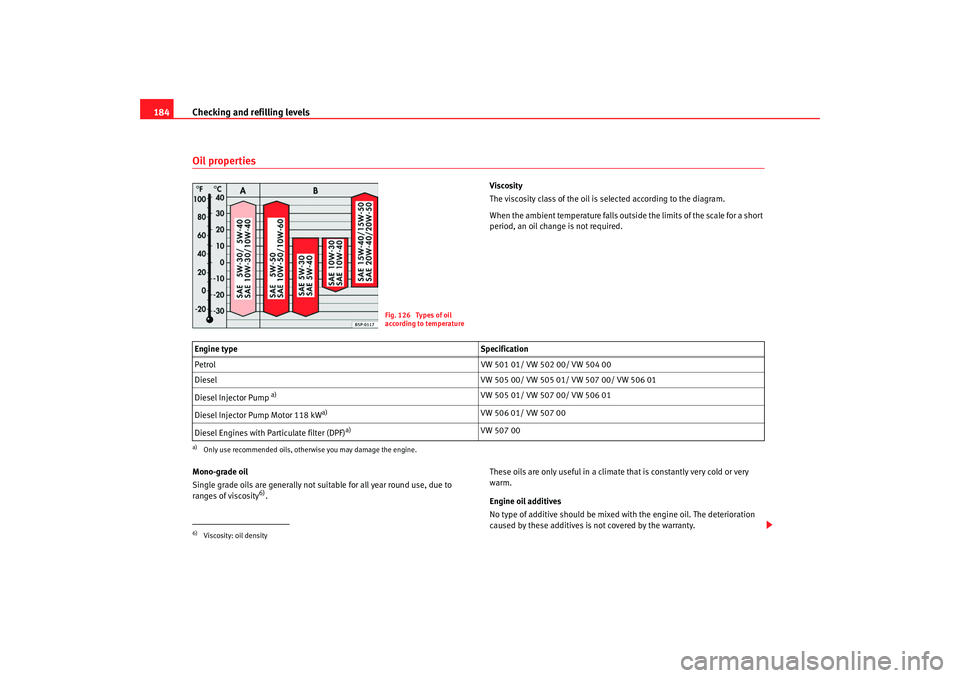
Viscosity
The viscosity class of the oil is selected according to the diagram.
When the ambient temperature falls outside the limits of the scale for a short
period, an oil change is not required.
Mono-grade oil
Single grade oils are generally not suitable for all year round use, due to
ranges of viscosity
6). These oils are only useful in a climate
that is constantly very cold or very
warm.
Engine oil additives
No type of additive should be mixed with the engine oil. The deterioration
caused by these additives is not covered by the warranty.
Fig. 126 Types of oil
according to temperature
Engine type Specification
Petrol VW 501 01/ VW 502 00/ VW 504 00
Diesel VW 505 00/ VW 505 01/ VW 507 00/ VW 506 01
Diesel Injector Pump
a)
a)Only use recommended oils, otherwise you may damage the engine.
VW 505 01/ VW 507 00/ VW 506 01
Diesel Injector Pump Motor 118 kW
a)
VW 506 01/ VW 507 00
Diesel Engines with Particulate filter (DPF)
a)
VW 507 00
6)Viscosity: oil density
IBI_ANG_0707 Seite 184 Montag, 6. August 2007 3:59 15
Page 198 of 272
Checking and refilling levels
196
For the sake of the environmentBatteries contain toxic substances such as sulphuric acid and lead. They
must be disposed of appropriately and must not be disposed of with ordinary
household waste.WheelsGeneral notesAvoiding damage
– If you have to drive over a kerb or similar obstacle, drive very slowly and as near as possible at a right angle to the kerb.
– Keep grease, oil and fuel off the tyres.
– Inspect the tyres regularly for damage (cuts, cracks or blisters, etc.). Remove any foreign objects embedded in the treads.
Storing tyres
– Mark tyres when you remove them to indicate the direction of
rotation. This ensures you will be able to install them correctly
when you replace them.
– When removed, the wheels and/or tyres should be stored in a cool, dry and preferably dark location.
– Store tyres in a vertical position if they are not fitted on wheel rims.
New tyres
New tyres have to be run in ⇒page 151.
The tread depth of new tyres may vary, according to the type and make of tyre
and the tread pattern.
Concealed damage
Damage to tyres and rims is often not re adily visible. If you notice unusual
vibrations or the car pulling to one side, this may indicate that one of the tyres
is damaged. The tyres should be checked immediately by an Authorised
Service Centre.
Tyres with directional tread pattern
An arrow on the tyre sidewall indicates the direction of rotation on tyres with
directional tread. Always observe the di rection of rotation indicated when
fitting the wheel. This guarantees optimum grip and helps to avoid aqua-
planing, excessive noise and wear.
WARNING
•
New tyres do not have maximum grip in the first 500 km. Drive particu-
larly carefully to avoid risk of accident.
•
Never drive with damaged tyres. This may cause an accident.
•
If you notice unusual vibration or if the vehicle pulls to one side when
driving, stop the vehicle immediately and check the tyres for damage.
IBI_ANG_0707 Seite 196 Montag, 6. August 2007 3:59 15
Page 246 of 272
Technical Data
244Trailer weights
Engine oil capacityPetrol engine 1.2 51 kW (69 bhp)General engine data
Performance figures With no brakes, gradients up to 12%
500
With brakes, gradients up to 12% 800
Approximate engine oil capacity with oil filter change 2.8 litres
Power output in kW (bhp) rpm 51 (69)/ 5400
Maximum torque in Nm at rpm 112/ 3000
No. of cylinders, capacity in cm
3
3/ 1198
Compression 10,5 +/- 0,3
Fuel Super 95 RON
a)/Normal 91 RON
b)
a)Research- Octane- Number = Measure of the predetonation power of the petrol.b)With a slight power lossMaximum speed in km/h 170
Acceleration from 0-80 km/h in sec. 9,3
Acceleration from 0-100 km/h in sec. 14,2
IBI_ANG_0707 Seite 244 Montag, 6. August 2007 3:59 15
Page 250 of 272
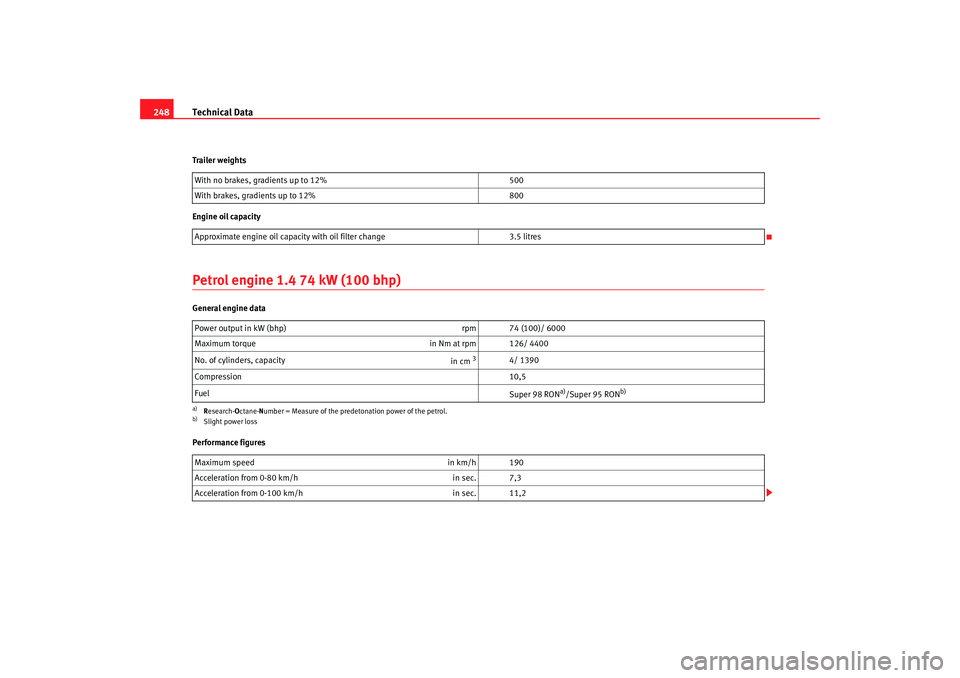
Technical Data
248Trailer weights
Engine oil capacityPetrol engine 1.4 74 kW (100 bhp)General engine data
Performance figures With no brakes, gradients up to 12%
500
With brakes, gradients up to 12% 800
Approximate engine oil capacity with oil filter change 3.5 litres
Power output in kW (bhp) rpm 74 (100)/ 6000
Maximum torque in Nm at rpm 126/ 4400
No. of cylinders, capacity in cm
3
4/ 1390
Compression 10,5
Fuel Super 98 RON
a)/Super 95 RON
b)
a)Research- Octane- Number = Measure of the predetonation power of the petrol.b)Slight power lossMaximum speed in km/h 190
Acceleration from 0-80 km/h in sec. 7,3
Acceleration from 0-100 km/h in sec. 11,2
IBI_ANG_0707 Seite 248 Montag, 6. August 2007 3:59 15
Page 254 of 272
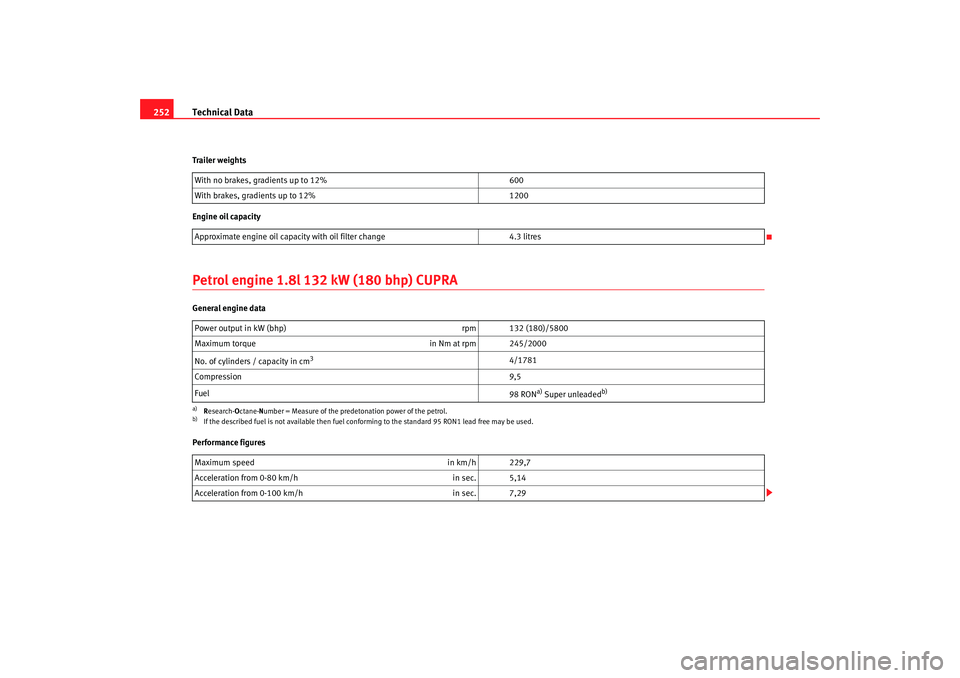
Technical Data
252Trailer weights
Engine oil capacityPetrol engine 1.8l 132 kW (180 bhp) CUPRAGeneral engine data
Performance figures With no brakes, gradients up to 12%
600
With brakes, gradients up to 12% 1200
Approximate engine oil capacity with oil filter change 4.3 litres
Power output in kW (bhp) rpm 132 (180)/5800
Maximum torque in Nm at rpm 245/2000
No. of cylinders / capacity in cm
3
4/1781
Compression 9,5
Fuel 98 RON
a) Super unleaded
b)
a)Research- Octane- Number = Measure of the predetonation power of the petrol.b)If the described fuel is not available then fuel conforming to the standard 95 RON1 lead free may be used.Maximum speed in km/h 229,7
Acceleration from 0-80 km/h in sec. 5,14
Acceleration from 0-100 km/h in sec. 7,29
IBI_ANG_0707 Seite 252 Montag, 6. August 2007 3:59 15