remove seats Seat Ibiza 5D 2007 Owner's manual
[x] Cancel search | Manufacturer: SEAT, Model Year: 2007, Model line: Ibiza 5D, Model: Seat Ibiza 5D 2007Pages: 272, PDF Size: 8.32 MB
Page 26 of 272
Seat belts
24Incorrectly fastened seat belts
Incorrectly worn seat belts can cause severe injuries.Seat belts can provide optimal protection only if the belt web is
properly worn. The seat belts must be fastened exactly in the order
described in this chapter. An incorrect sitting position impairs
substantially the protection a seat belt offers and can lead to severe
or fatal injuries. The risk of severe or fatal injuries is especially
increased when a deploying airbag strikes an occupant who has
assumed an incorrect sitting position . As driver, you are responsible
for all vehicle occupants, especially children. Therefore:
– Never permit anyone to assume an incorrect sitting position in the vehicle while travelling ⇒.
WARNING
•
An incorrectly worn seat belt incr eases the risk of severe injuries.
•
Before every trip, instruct your passengers to adjust their seat belts
properly and to wear them during the trip.
•
Read and always observe information and warnings concerning the use
of seat belts ⇒ page 19.
Belt tension devices*Function of the belt tension device
During a frontal collision, the se at belts on the front seats are
retracted automatically.The seat belts for the front occupants are equipped with belt tension devices.
Sensors will trigger the belt tension devices during severe head-on, lateral
and rear collisions only if the seat belt is being worn. This retracts and
tightens the seat belts, reducing the forward motion of the occupants.
The belt tension device ca n be triggered only once.
The belt tension devices will not be triggered in the event of a light frontal,
side or rear collision, if the vehicle overturns, or in situations where no large
forces act on the front, side or rear of the vehicle.
Note
•
If the belt tension devices are triggered, a fine dust is produced. This is
normal and is no indication that there was a fire in the vehicle.
•
The relevant safety requirements must be observed when the vehicle or
components of the system are scrapped. A qualified workshop is familiar with
these regulations and will be pleased to pass on the information to you.
Service and disposal of belt tension devicesThe belt tension devices are components of the seat belts that are installed
in the seats of your vehicle. If you work on the belt tension devices or remove
and install parts of the system when performing other repair work, the seat
belt may be damaged. The consequence may be that, in the event of an acci-
dent, the belt tension devices function incorrectly or not at all.
IBI_ANG_0707 Seite 24 Montag, 6. August 2007 3:59 15
Page 35 of 272
Airbag system33
Safety First
Operating instructions
Tips and Maintenance
Te c h n i c a l D a t a
Side airbagsDescription of side airbags
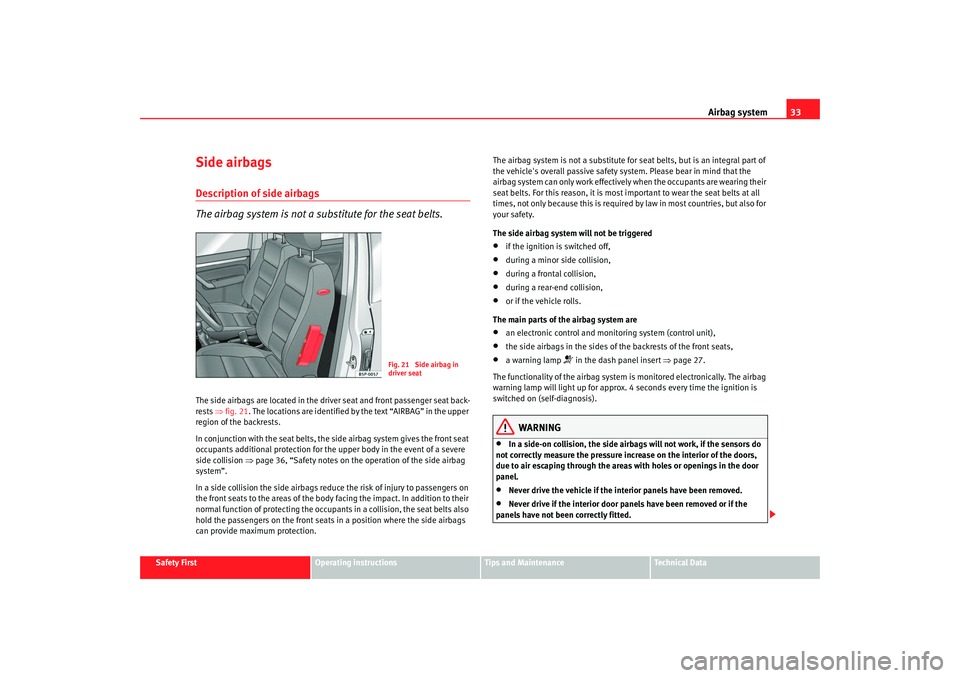
The airbag system is not a substitute for the seat belts.The side airbags are located in the driver seat and front passenger seat back-
rests ⇒fig. 21. The locations are identified by the text “AIRBAG” in the upper
region of the backrests.
In conjunction with the seat belts, the side airbag system gives the front seat
occupants additional protection for the upper body in the event of a severe
side collision ⇒ page 36, “Safety notes on the operation of the side airbag
system”.
In a side collision the side airbags reduce the risk of injury to passengers on
the front seats to the areas of the body facing the impact. In addition to their
normal function of protecting the occupants in a collision, the seat belts also
hold the passengers on the front seats in a position where the side airbags
can provide maximum protection. The airbag system is not a substitute for seat belts, but is an integral part of
the vehicle's overall passive safety system. Please bear in mind that the
airbag system can only work effectively when the occupants are wearing their
seat belts. For this reason, it is most important to wear the seat belts at all
times, not only because this is required
by law in most countries, but also for
your safety.
The side airbag system will not be triggered
•
if the ignition is switched off,
•
during a minor side collision,
•
during a frontal collision,
•
during a rear-end collision,
•
or if the vehicle rolls.
The main parts of the airbag system are
•
an electronic control and monitoring system (control unit),
•
the side airbags in the sides of the backrests of the front seats,
•
a warning lamp
in the dash panel insert ⇒page 27.
The functionality of the airbag system is monitored electronically. The airbag
warning lamp will light up for approx. 4 seconds every time the ignition is
switched on (self-diagnosis).
WARNING
•
In a side-on collision, the side airbags will not work, if the sensors do
not correctly measure the pressure incr ease on the interior of the doors,
due to air escaping through the areas with holes or openings in the door
panel.
•
Never drive the vehicle if the interior panels have been removed.
•
Never drive if the interior door pane ls have been removed or if the
panels have not been correctly fitted.
Fig. 21 Side airbag in
driver seat
IBI_ANG_0707 Seite 33 Montag, 6. August 2007 3:59 15
Page 36 of 272
Airbag system
34•
Never drive the vehicle if the loudspeakers in the door panels have
been removed, unless the holes left by the loudspeakers have been
correctly closed.
•
Always check that the openings are closed or covered if loudspeakers
or other equipment are fitted in the interior door panels.
•
Any work carried out to the doors should be made in a qualified author-
ised workshop.
•
The seat belts and airbags can only provide maximum protection if the
occupants are seated correctly ⇒ page 9, “Proper sitting position for occu-
pants”.
•
If a fault should occur in the airbag system, have the system checked
immediately by a qualified workshop. Otherwise there is a danger that
during a side collision, the system may fail to trigger, or not trigger
correctly.
Function of side airbags
Inflated airbags can reduce the risk of head or chest injury in
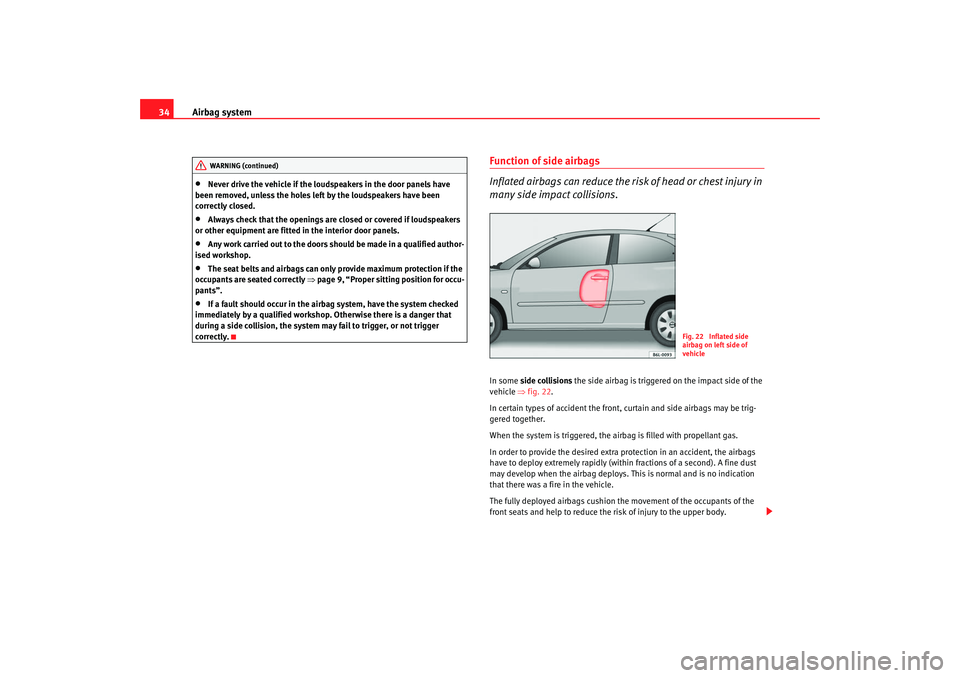
many side impact collisions.In some side collisions the side airbag is triggered on the impact side of the
vehicle ⇒fig. 22 .
In certain types of accident the front, curtain and side airbags may be trig-
gered together.
When the system is triggered, the airbag is filled with propellant gas.
In order to provide the desired extra protection in an accident, the airbags
have to deploy extremely rapidly (within fractions of a second). A fine dust
may develop when the airbag deploys. This is normal and is no indication
that there was a fire in the vehicle.
The fully deployed airbags cushion the movement of the occupants of the
front seats and help to reduce the risk of injury to the upper body.
WARNING (continued)
Fig. 22 Inflated side
airbag on left side of
vehicle
IBI_ANG_0707 Seite 34 Montag, 6. August 2007 3:59 15
Page 107 of 272
Seats and stowage105
Safety First
Operating instructions
Tips and Maintenance
Te c h n i c a l D a t a
Head restraintsCorrect adjustment of head restraints
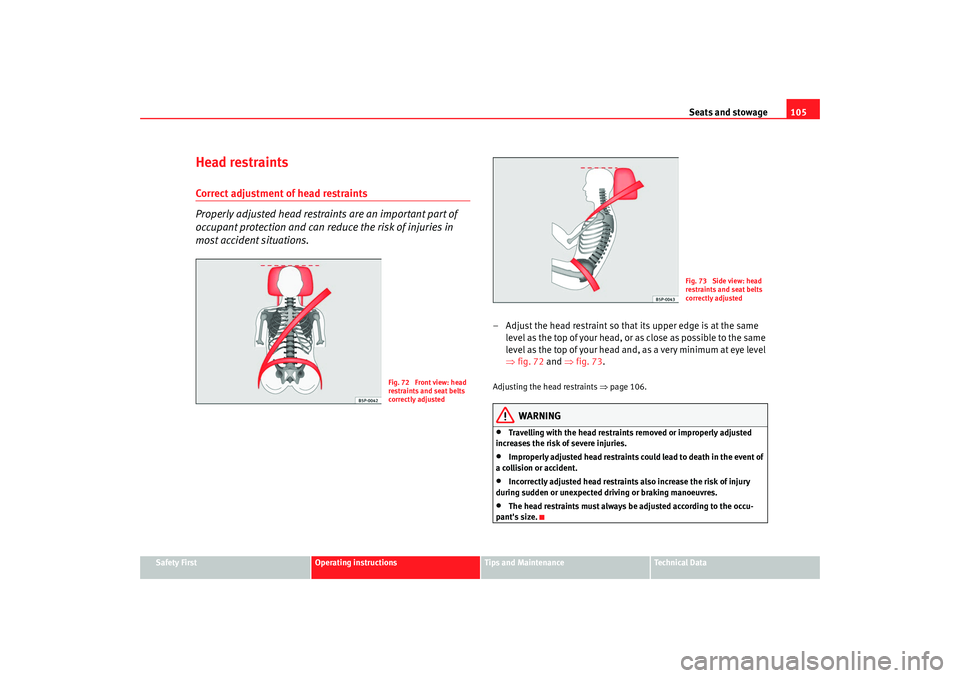
Properly adjusted head restraints are an important part of
occupant protection and can redu ce the risk of injuries in
most accident situations.
– Adjust the head restraint so that its upper edge is at the same
level as the top of your head, or as close as possible to the same
level as the top of your head and, as a very minimum at eye level
⇒fig. 72 and ⇒ fig. 73.Adjusting the head restraints ⇒page 106.
WARNING
•
Travelling with the head restrain ts removed or improperly adjusted
increases the risk of severe injuries.
•
Improperly adjusted head restraints could lead to death in the event of
a collision or accident.
•
Incorrectly adjusted head restraints also increase the risk of injury
during sudden or unexpected driving or braking manoeuvres.
•
The head restraints must always be adjusted according to the occu-
pant's size.
Fig. 72 Front view: head
restraints and seat belts
correctly adjusted
Fig. 73 Side view: head
restraints and seat belts
correctly adjusted
IBI_ANG_0707 Seite 105 Montag, 6. August 2007 3:59 15
Page 108 of 272
Seats and stowage
106Removing or adjust ing head restraints
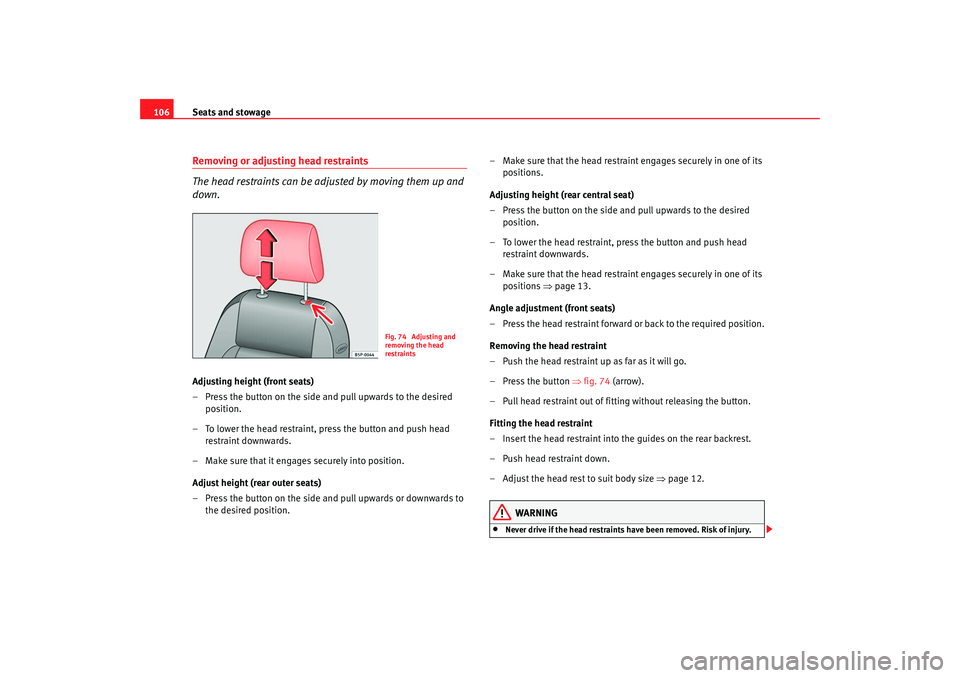
The head restraints can be adjusted by moving them up and
down.Adjusting height (front seats)
– Press the button on the side and pull upwards to the desired position.
– To lower the head restraint, press the button and push head restraint downwards.
– Make sure that it engages securely into position.
Adjust height (rear outer seats)
– Press the button on the side and pull upwards or downwards to the desired position. – Make sure that the head restrain
t engages securely in one of its
positions.
Adjusting height (rear central seat)
– Press the button on the side and pull upwards to the desired position.
– To lower the head restraint, press the button and push head restraint downwards.
– Make sure that the head restrain t engages securely in one of its
positions ⇒page 13.
Angle adjustment (front seats)
– Press the head restraint forward or back to the required position.
Removing the head restraint
– Push the head restraint up as far as it will go.
– Press the button ⇒fig. 74 (arrow).
– Pull head restraint out of fitting without releasing the button.
Fitting the head restraint
– Insert the head restraint into the guides on the rear backrest.
– Push head restraint down.
– Adjust the head rest to suit body size ⇒page 12.
WARNING
•
Never drive if the head restraints have been removed. Risk of injury.
Fig. 74 Adjusting and
removing the head
restraints
IBI_ANG_0707 Seite 106 Montag, 6. August 2007 3:59 15
Page 109 of 272
Seats and stowage107
Safety First
Operating instructions
Tips and Maintenance
Te c h n i c a l D a t a
•
Never drive if the head restraints are in an unsuitable position, there is
a risk of serious injury.
•
After refitting the head restraint, you must always adjust it properly for
height to achieve optimal protection.
•
Please observe the safety warnings ⇒page 105, “Correct adjustment
of head restraints”.Note
•
To fit and remove the rear head restraints, gently tilt the seat back
forwards.
•
When fitting the head restraints again, insert the tubes as far as possible
into the guides without pressing the button.
Front seatsAdjustment of the front seats
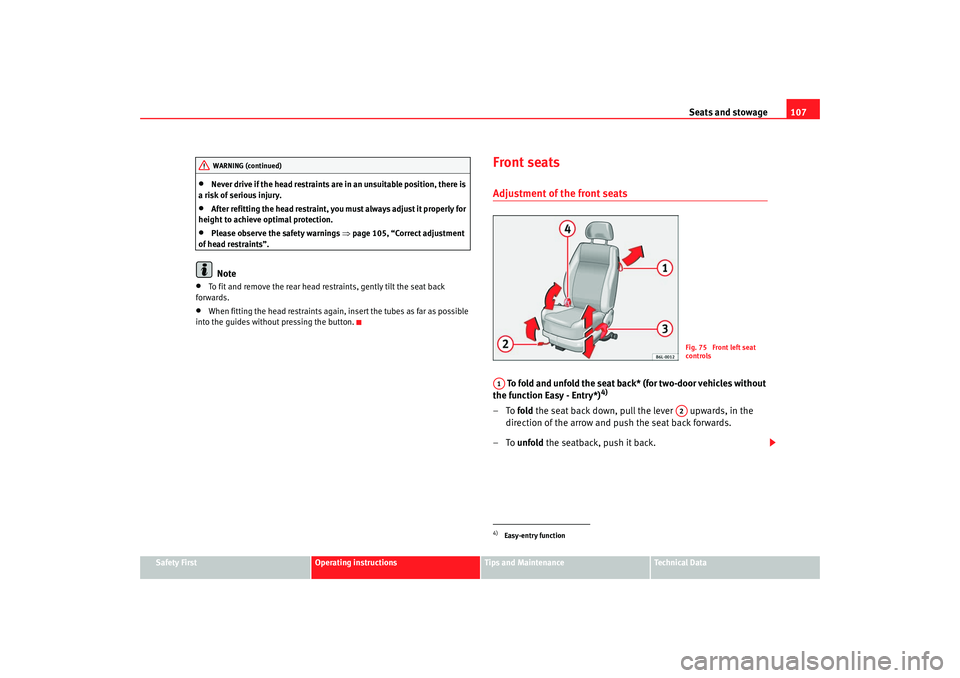
To fold and unfold the seat back* (for two-door vehicles without
the function Easy - Entry*)
4)
–To fold the seat back down, pull the lever upwards, in the
direction of the arrow and push the seat back forwards.
–To unfold the seatback, push it back.
WARNING (continued)
4)Easy-entry function
Fig. 75 Front left seat
controls
A1
A2
IBI_ANG_0707 Seite 107 Montag, 6. August 2007 3:59 15
Page 111 of 272
Seats and stowage109
Safety First
Operating instructions
Tips and Maintenance
Te c h n i c a l D a t a
– Turn the appropriate thumb wheel ⇒page 108, fig. 76 to switch
on the seat heating. The seat heating is switched off in the 0
position.The seat heating only works when the ignition is switched on. The left thumb
wheel controls the left seat and the right thumb wheel the right seat.
Caution
To avoid damaging the heating elements, please do not kneel on the seat or
apply sharp pressure at a single poin t to the seat cushion and backrest.Rear seat benchFolding down rear seats
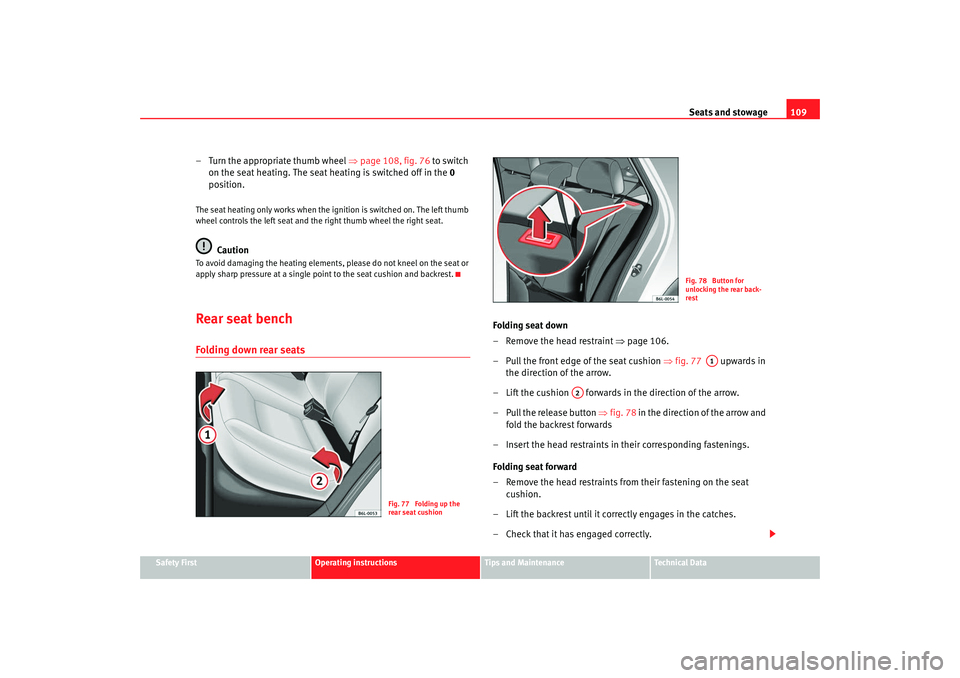
Folding seat down
– Remove the head restraint ⇒page 106.
– Pull the front edge of the seat cushion ⇒fig. 77 upwards in
the direction of the arrow.
– Lift the cushion forwards in the direction of the arrow.
– Pull the release button ⇒ fig. 78 in the direction of the arrow and
fold the backrest forwards
– Insert the head restraints in their corresponding fastenings.
Folding seat forward
– Remove the head restraints from their fastening on the seat cushion.
– Lift the backrest until it correctly engages in the catches.
– Check that it has engaged correctly.
Fig. 77 Folding up the
rear seat cushion
Fig. 78 Button for
unlocking the rear back-
rest
A1
A2
IBI_ANG_0707 Seite 109 Montag, 6. August 2007 3:59 15
Page 120 of 272
Seats and stowage
118•
An overloaded boot could mean that the rear stowage tray is not correctly
seated and it may be bent or damaged.
•
If the boot is overloaded, remove the tray.Note
•
Ensure that, when placing items of clothing on the luggage compartment
cover, rear visibility is not reduced.
Roof carrier*Please observe the following points if you intend to carry loads on the roof:•
For safety reasons, only luggage racks and accessories approved by SEAT
should be used.
•
It is imperative to precisely follow the fitting instructions included for the
rack, taking special care when fitting the front bar in the holes designed for
this and the rear bar between the marks on the upper part of the rear door
frame while respecting the correct direction of travel indicated in the installa-
tion manual. Not following these instructions may lead to paintwork damage
or marks on the bodywork.
•
Pay special attention to the tightening torque of the attachment bolts and
check them following a short journey. If necessary, retighten the bolts and
check them at regular intervals.
•
Distribute the load evenly. A maximum load of 40 kg only is permitted for
each roof carrier system support bar, the load must be distributed evenly over
the entire length. However, the maximu m load permitted for the entire roof
(including the support system) of 75 kg must not be exceeded nor should the
total weight of the vehicle be exceeded. See the chapter on “Technical Data”.
•
When transporting heavy or large objects on the roof, any change in the
normal vehicle behaviour due to a change in the centre of gravity or an increased wind resistance must be taken into account. For this reason, a suit-
able speed and driving style must be used.
•
For those vehicles fitted with a sunroof*, ensure that it does not interfere
with the load on the roof carrier system when opened.
IBI_ANG_0707 Seite 118 Montag, 6. August 2007 3:59 15