towing Seat Ibiza 5D 2009 User Guide
[x] Cancel search | Manufacturer: SEAT, Model Year: 2009, Model line: Ibiza 5D, Model: Seat Ibiza 5D 2009Pages: 257, PDF Size: 6.5 MB
Page 145 of 257
Driving143
Safety First
Controls and equipment
Practical tips
Technical Data
Provided that it is not in continuous mode, the tone on the parking aid system
stops when it detects a wall parallel to the vehicle.
Trailer towing
For vehicles factory-fitted with a towing bar, the parking aid system will not
be activated by the engagement of the reverse gear when pulling a trailer, as
the trailer's electric connector will be plugged into the vehicle.
Possible faults
If a continuous bleep is heard for some seconds when the reverse gear is
engaged, this indicates that there is a fault in the parking aid system.
If the fault continues until the ignition is turned off, the acoustic signal
warning of the fault will not be emitted every time the system is reactivated
(by engaging reverse gear).
Thus, the system ready indication will not sound
either. Have the fault repaired by an Authorised Service Centre as soon as
possible.
If there is no ready signal or no acoustic warning signal, then the parking aid
loudspeaker is faulty and may not warn of obstacles.
To ensure that the system works properly, the sensors must be kept clean and
free of ice and snow.
WARNING
•The sensors have blind spots in which obstacles may not be detected.•Always look out for small children and animals because the system will
not always detect them. Always pay attention when reversing to avoid acci-
dents.•The parking aid is not a replacement for driver awareness. The driver
must take full responsibility for parking and other manoeuvres.
Caution
•Please note that low obstacles detected by the system may no longer be
registered by the sensors as the car moves closer, so the system will not give
any further warning. Certain kinds of obstacles (such as wire fences, chains,
thin posts or trailer draw bars, high kerbs or painted railings etc) may not
always be detected by the system, so there is a risk of damaging the vehicle
in such cases.•In some cases, obstacles with uniform edges and bumps may not be
detected immediately by the system due to their geometry. Take special care
with these types of obstacle, e.g. corners, rectangular objects, etc.., these
can cause damage to the vehicle.•Be especially careful when manoeuvring into a corner between two
perpendicular walls. Survey the approach of the wall to the side of the vehicle
(using the mirrors)•The parking aid system does not replace use of the mirrors for manoeu-
vres.•Distant ultra-sonic sources (hammers, tyres, construction machinery,
other vehicles with PDC) may interfere with the operation of the system.•During the periodic cleaning of the sensors, take care not to damage or
scratch them. When cleaning with high pressure washers or steam cleaners,
the sensors should be sprayed for only a very short period and from a
distance of more than 10 cm.
Ibiza_EN.book Seite 143 Montag, 14. September 2009 6:19 18
Page 153 of 257
Intelligent technology151
Safety First
Controls and equipment
Practical tips
Technical Data
T h e T C S is s w i tch e d o n a u t o m a t i ca ll y w h e n t h e e n g i n e is s ta r t e d . I f n e ce s sa r y,
it may be turned on or off by briefly pushing the ESP button on the centre
console.
When the TCS is switched off, the warning lamp flashes slowly. The TCS
should normally be left switched on at all times. Only in exceptional circum-
stances, when the slipping of the wheels is required, can they be discon-
nected with the ESP button, for example.
•With compact temporary spare wheel.•When using the snow chains.•When driving in deep snow or on loose surfaces•When the vehicle is bogged-down, to free it by “rocking.”
The TCS should be switched on again afterwards as soon as possible.WARNING
•It must be remembered that TCS cannot defy the laws of physics. This
should be kept in mind, particularly on slippery and wet roads and when
towing a trailer.•Always adapt your driving style to suit the condition of the roads and
the traffic situation. Do not let the extra safety afforded by TCS tempt you
into taking any risks when driving, this can cause accidents.Caution
•In order to ensure that TCS function correctly, all four wheels must be
fitted with the same tyres. Any differences in the rolling radius of the tyres can
cause the system to reduce engine power when this is not desired.•Modifications to the vehicle (e.g. to the engine, the brake system, running
gear or any components affecting the wheels and tyres) could affect the effi-
ciency of the ABS and TCS.
XDS*
Driveshaft differentialWhen taking a bend, the driveshaft differential mechanism allows the outer
wheel to turn at a higher speed than the inner wheel. In this way, the wheel
that is turning faster (outer wheel) receives less drive torque than the inner
wheel. This may mean that in certain situations the torque delivered to the
inner wheel is too high, causing the wheels to spin. On the other hand, the
outer wheel is receiving a lower drive torque than it could transmit. This
causes an overall loss of lateral grip on the front axle, resulting in understeer
or “lengthening” of the trajectory.
By using the ESP sensors and signals, the XDS system is able to detect and
correct this effect.
The XDS, via the ESP, brakes the inner wheel thus counteracting the excess
drive torque in this wheel. This means that the driver's desired trajectory is
much more precise,
The XDS system operates in combination with the ESP and is always active,
even when the traction control, TCS, is disconnected.Electronic stabilisation programme (ESP)*General notes
The electronic stabilisation programme increases the
vehicle's stability on the road.The electronic stabilisation programme helps reduce the danger of skidding.
The electronic stabilisation programme (ESP) consists of ABS, EDL and TCS.
Ibiza_EN.book Seite 151 Montag, 14. September 2009 6:19 18
Page 154 of 257
Intelligent technology
152Electronic Stabilising Program (ESP)*
ESP reduces the danger of skidding by braking the wheels individually.
The system uses the steering wheel angle and road speed to calculate the
changes of direction desired by the driver, and constantly compares them
with the actual behaviour of the vehicle. If the desired course is not being
maintained (for instance, if the car is starting to skid), then the ESP compen-
sates automatically by braking the appropriate wheel.
The forces acting on the braked wheel bring the vehicle back to a stable
condition. If the vehicle tends to oversteer, the system will act on the front
wheel on the outside of the turn.
WARNING
•It must be remembered that ESP cannot defy the laws of physics. This
should be kept in mind, particularly on slippery and wet roads and when
towing a trailer.•Always adapt your driving style to suit the condition of the roads and
the traffic situation. Do not let the extra safety afforded by ESP tempt you
into taking any risks when driving, this can cause accidents.Caution
•In order to ensure that ESP functions correctly, all four wheels must be
fitted with the same tyres. Any differences in the rolling radius of the tyres can
cause the system to reduce engine power when this is not desired.•Modifications to the vehicle (e.g. to the engine, the brake system, running
gear or any components affecting the wheels and tyres) could affect the effi-
ciency of the ABS, EDL, ESP and TCS.
Anti-lock brake system (ABS)The anti-lock brake system prevents the wheels locking during braking
⇒ page 150.Electronic differential lock (EDL)*
The electronic differential lock helps prevent the loss of trac-
tion caused if one of the driven wheels starts spinning.EDL helps the vehicle to start moving, accelerate and climb a gradient in slip-
pery conditions where this may otherwise be difficult or even impossible.
The system will control the revolutions of the drive wheels using the ABS
sensors (in case of an EDL fault the warning lamp for ABS lights up)
⇒ page 59.
At speeds of up to approximately 80 km/h, it is able to balance out differ-
ences in the speed of the driven wheels of approximately 100 rpm caused by
a slippery road surface on one side of the vehicle. It does this by braking the
wheel which has lost traction and distributing more driving force to the other
driven wheel via the differential.
To prevent the disc brake of the braking wheel from overheating, the EDL cuts
out automatically if subjected to excessive loads. The vehicle will continue to
function normally without EDL. For this reason, the driver is not informed that
the EDL has been switched off.
The EDL will switch on again automatically when the brake has cooled down.
WARNING
•When accelerating on a slippery surface, for example on ice and snow,
press the accelerator carefully. Despite EDL, the driven wheels may start to
spin. This could impair the vehicle's stability.
Ibiza_EN.book Seite 152 Montag, 14. September 2009 6:19 18
Page 160 of 257
Driving and the environment
158Driving abroadObservationsTo drive abroad, the following must be taken into consideration:•For vehicles fitted with a catalytic converter ensure that unleaded petrol is
available for the journey. See the chapter “Refuelling”. Automobile organisa-
tions will have information about service station networks selling unleaded
fuel.•In some countries, it is possible that a vehicle model is sold under condi-
tions where some spare parts are not available or that the Authorised Service
Centre may only carry out limited repairs.
SEAT importers and distributors will gladly provide information about the
technical preparation of your vehicle and also about necessary maintenance
and repair possibilities.Adhesive strips for headlightsIf you have to drive a right-hand drive vehicle in a left-hand drive country, or
vice versa, the asymmetric dipped beam headlights will dazzle oncoming
traffic.
To prevent dazzling, you must apply stickers to certain parts of the headlight
lenses. Further information is available in your Authorised Service Centre.
In vehicles with self-directing headlights, the rotation system must be
disconnected first. To do this, please go to a specialist workshop.
Trailer towingWhat do you need to bear in mind when towing a trailer?Your vehicle may be used to tow a trailer when fitted with the correct equip-
ment.
If the car is supplied with a factory-fitted towing bracket it will already have
the necessary technical modifications and meet the statutory requirements
for towing a trailer. For the after-market fitting of a trailer towing bracket see
⇒ page 173.
Connectors
Your vehicle is fitted with a 12-pin connector for the electrical connection
between the trailer and the vehicle.
If the trailer has a 7-pin plug you will need to use an adapter cable. This is
available in any SEAT dealer.
Trailer weight / draw bar loading
Never exceed the authorised towing limit. If you do not load the trailer up to
the maximum permitted trailer weight, you can then climb correspondingly
steeper slopes.
The maximum trailer weights listed are only applicable for altitudes up to
1,000 m above sea level. With increa sing altitude the engine power and
therefore the vehicle's climbing ability are impaired because of the reduced
air density. The maximum trailer weight has to be reduced accordingly. The
weight of the vehicle and trailer combination must be reduced by 10% for
every further 1,000 m (or part thereof). The gross combination weight is the
actual weight of the laden vehicle plus the actual weight of the laden trailer.
When possible, operate the trailer with the maximum permitted draw bar
weight on the ball joint of the towing bracket, but do not exceed the specified
limit.
Ibiza_EN.book Seite 158 Montag, 14. September 2009 6:19 18
Page 161 of 257
Driving and the environment159
Safety First
Controls and equipment
Practical tips
Technical Data
The figures for
trailer weights and draw bar weights that are given on the
data plate of the towing bracket are for certification purposes only. The
correct figures for your specific model, which may be lower than these figures
for the towing bracket, are given in the registration documents ⇒Section
“Technical data”.
Distributing the load
Distribute loads in the trailer so that heavy objects are as near to the axle as
possible. Loads carried in the trailer must be secured to prevent them
moving.
Tyre pressure
Set tyre pressure to the maximum permissible pressure shown on the sticker
on the inside of the fuel tank flap. Set the tyre pressure of the trailer tyres in
accordance with the trailer manufacturer's recommendations.
Exterior mirrors
Check whether you can see enough of the road behind the trailer with the
standard mirrors. If this is not the case, you should have additional mirrors
fitted. Both exterior mirrors should be mounted on hinged extension
brackets. Adjust the mirrors to give sufficient vision to the rear.
WARNING
Never transport people in a trailer. This could result in fatal accidents.
Note
•Towing a trailer places additional demands on the vehicle. We recom-
mend additional services between the normal inspection intervals if the
vehicle is used frequently for towing a trailer.•Find out whether special regulations apply to towing a trailer in your
country.
Ball coupling of towing bracket*The ball coupling is provided with instructions on fitting and removing the
ball coupling of the towing bracket.
WARNING
The towing bracket ball coupling must be stored securely in the luggage
compartment to prevent them being flung through the vehicle and causing
injury.
Note
•By law, the ball coupling must be removed if a trailer is not being towed
and it obscures the number plate.Driving tips
Driving with a trailer always requires extra care.Weight distribution
The weight distribution of a loaded trailer with an unladen vehicle is very
unfavourable. However, if this cannot be avoided, drive extra slowly to allow
for the unbalanced weight distribution.
Speed
The stability of the vehicle and trailer is reduced with increasing speed. For
this reason, it is advisable not to drive at the maximum permissible speed in
an unfavourable road, weather or wind conditions. This applies especially
when driving downhill.
You should always reduce speed immediately if the trailer shows the slightest
sign of snaking . Never try to stop the “snaking” by increasing speed.
Ibiza_EN.book Seite 159 Montag, 14. September 2009 6:19 18
Page 175 of 257
Accessories, replacement of parts and modifications173
Safety First
Controls and equipment
Practical tips
Technical Data
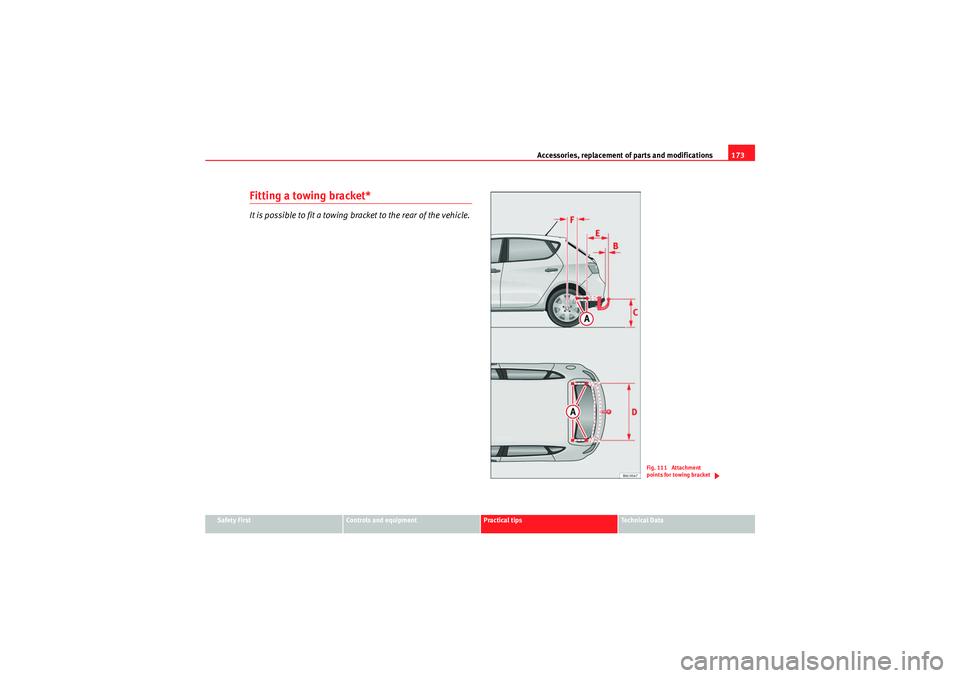
Fitting a towing bracket*It is possible to fit a towing bracket to the rear of the vehicle.
Fig. 111 Attachment
points for towing bracket
Ibiza_EN.book Seite 173 Montag, 14. September 2009 6:19 18
Page 176 of 257
Accessories, replacement of parts and modifications
174If a towing bracket is to be fitted after the vehicle is purchased, this must be
completed according to the instructions of the towing bracket manufacturer.
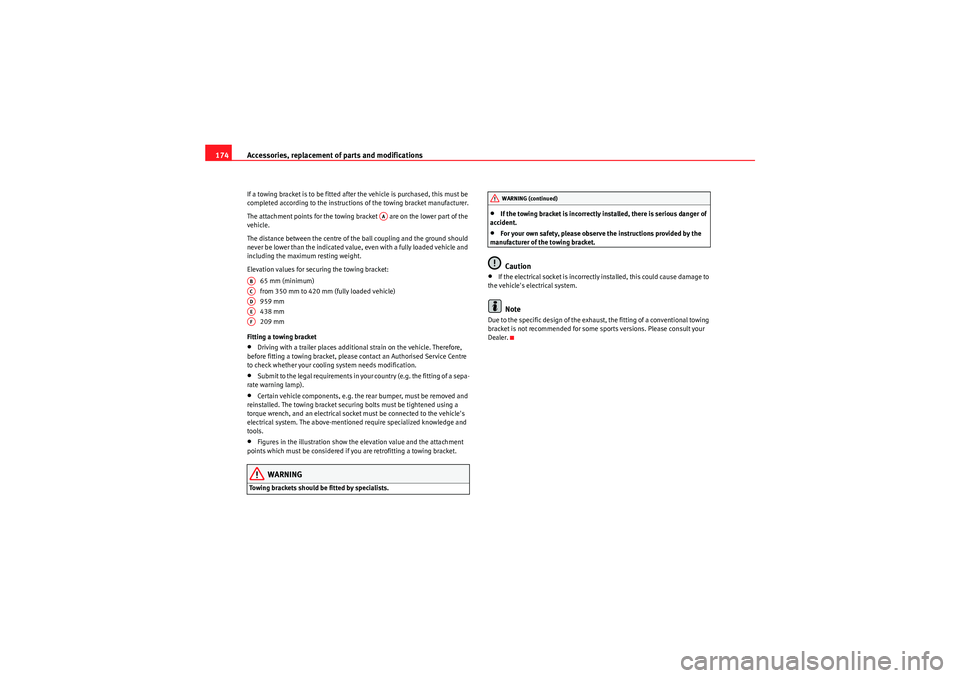
The attachment points for the towing bracket are on the lower part of the
vehicle.
The distance between the centre of the ball coupling and the ground should
never be lower than the indicated value, even with a fully loaded vehicle and
including the maximum resting weight.
Elevation values for securing the towing bracket:
65 mm (minimum)
from 350 mm to 420 mm (fully loaded vehicle)
959 mm
438 mm
209 mm
Fitting a towing bracket•Driving with a trailer places additional strain on the vehicle. Therefore,
before fitting a towing bracket, please contact an Authorised Service Centre
to check whether your cooling system needs modification.•Submit to the legal requirements in your country (e.g. the fitting of a sepa-
rate warning lamp).•Certain vehicle components, e.g. the rear bumper, must be removed and
reinstalled. The towing bracket securing bolts must be tightened using a
torque wrench, and an electrical socket must be connected to the vehicle's
electrical system. The above-mentioned require specialized knowledge and
tools.•Figures in the illustration show the elevation value and the attachment
points which must be considered if you are retrofitting a towing bracket.WARNING
Towing brackets should be fitted by specialists.
•If the towing bracket is incorrectly installed, there is serious danger of
accident.•For your own safety, please observe the instructions provided by the
manufacturer of the towing bracket.Caution
•If the electrical socket is incorrectly installed, this could cause damage to
the vehicle's electrical system.Note
Due to the specific design of the exhaust, the fitting of a conventional towing
bracket is not recommended for some sports versions. Please consult your
Dealer.
AA
ABACADAEAF
WARNING (continued)
Ibiza_EN.book Seite 174 Montag, 14. September 2009 6:19 18
Page 201 of 257
If and when199
Safety First
Controls and equipment
Practical tips
Technical Data
If and whenVehicle tools, spare wheelVehicle Tools
The vehicle onboard tools are lo cated under the floor panel in
the luggage compartment.– Lift floor panel
– Take the onboard tools out of the vehicle.The tool kit includes:•Jack*•Hook to remove integral* trim and screw caps.•Box spanner for wheel bolts*•Reversible screwdriver with handle (including hexagonal interior) for the
wheel bolts. The screwdriver is a combination tool.•Towing ring*•Adapter for the anti-theft wheel bolts*
Some of the items listed are only provided in certain models / model years,
or are optional extras.WARNING
•Do not use the hexagonal socket in the screwdriver handle to tighten
the wheel bolts as with this it is not possible to tighten the bolts to the
required torque. Risk of accident.
•The jack supplied by the factory is only designed for changing wheels
on this model. On no account attempt to use it for lifting heavier vehicles
or other loads. Risk of injury.•Use the jack only on a firm, level ground.•Never start the engine when the vehicle is on the jack. Risk of accident.•I f w o r k is t o b e ca r r ie d o u t un d e r n ea t h t h e v e h ic l e , t h is m u s t be s e cu re d
by suitable means. Otherwise, there is a risk of injury.
Spare wheel (emergency wheel)*
The compact temporary spare wheel (emergency wheel)
should only be used for the absolute minimum time required.The temporary spare wheel is stored under the floor panel in the luggage
compartment and is attached by a thumbnut.
How to use the compact temporary spare wheel
If you have a puncture or loss of pressure, the emergency wheel is only
intended for temporary use until you reach a workshop. Change it for a duty
wheel as soon as possible.
Please note the following restrictions when using the compact temporary
spare wheel. This spare wheel has been specially designed for your vehicle,
thus, it cannot be changed with the spare wheel from another vehicle.
No other type of tyre (normal summer or winter tyre) may be fitted on the
compact temporary spare wheel rim.
WARNING (continued)
Ibiza_EN.book Seite 199 Montag, 14. September 2009 6:19 18
Page 202 of 257
If and when
200Snow chains
For technical reasons, snow chains must not be used on the compact tempo-
rary spare wheel.
If you should have a puncture on one of the front wheels when using snow
chains, fit the compact temporary spare in place of one of the rear wheels.
You can then attach the snow chains to the wheel taken from the rear and use
this wheel to replace the punctured front wheel.
WARNING
•The tyre pressures must be checked and corrected as soon as possible.•Do not drive faster than 80 km/h. Higher speeds can cause an accident.•Avoid heavy acceleration, hard braking and fast cornering. Risk of acci-
dent.•Never use two or more compact spare tyres at the same time, risk of
accident.•No other type of tyre (normal summer or winter tyre) may be fitted on
the compact temporary spare wheel rim.
Tyre repair kit*
The tyre repair kit (for vehicles not including a spare wheel) is
stored under the floor panel in the luggage compartment.Your vehicle is equipped with the Tyre Mobility System “Tyre repair kit”.
The tyre repair kit consists of a container with sealing compound to repair the
puncture and a compressor to generate the required tyre pressure. The kit will
reliably seal punctures up to a size of about 4 mm caused by the penetration
of a foreign body into the tyre.
Note
•Seek professional assistance if the repair of a tyre puncture is not
possible with the sealing compound.Wheel changePreparation work
What you must do before changing a wheel.– If you have a flat tyre or puncture, park the vehicle as far away from the flow of traffic as possible. Choose a location that is as
level as possible.
– All passengers should leave the vehicle. They should wait in a safe area (for instance behind the roadside crash barrier).
– Switch the engine off. Switch the hazard warning lights on and place the warning triangles in position.
–Apply the handbrake firmly.
– Engage the first gear, or put the selector lever to position P for
those vehicles with an automatic gearbox.
– If you are towing a trailer, unhitch it from your vehicle.
–Take the vehicle tools and the spare wheel out of the luggage
compartment.
Ibiza_EN.book Seite 200 Montag, 14. September 2009 6:19 18
Page 211 of 257
If and when209
Safety First
Controls and equipment
Practical tips
Technical Data
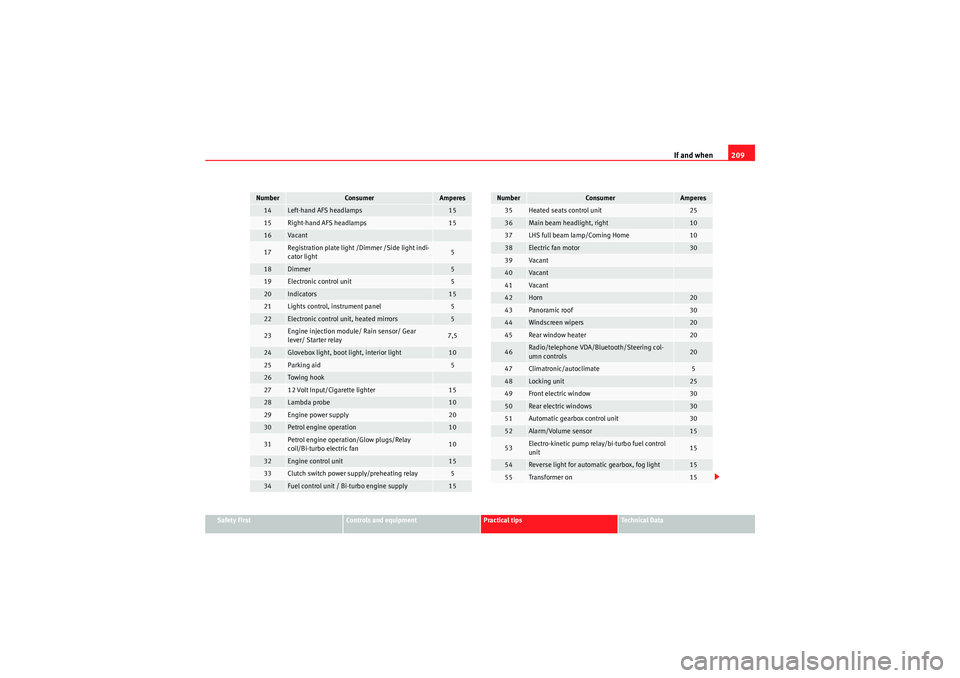
14
Left-hand AFS headlamps
15
15
Right-hand AFS headlamps
15
16
Va can t
17
Registration plate light /Dimmer /Side light indi-
cator light
5
18
Dimmer
5
19
Electronic control unit
5
20
Indicators
15
21
Lights control, instrument panel
5
22
Electronic control unit, heated mirrors
5
23
Engine injection module/ Rain sensor/ Gear
lever/ Starter relay
7,5
24
Glovebox light, boot light, interior light
10
25
Parking aid
5
26
Towing hook
27
12 Volt Input/Cigarette lighter
15
28
Lambda probe
10
29
Engine power supply
20
30
Petrol engine operation
10
31
Petrol engine operation/Glow plugs/Relay
coil/Bi-turbo electric fan
10
32
Engine control unit
15
33
Clutch switch power supply/preheating relay
5
34
Fuel control unit / Bi-turbo engine supply
15
Number
Consumer
Amperes
35
Heated seats control unit
25
36
Main beam headlight, right
10
37
LHS full beam lamp/Coming Home
10
38
Electric fan motor
30
39
Va can t
40
Va can t
41
Va can t
42
Horn
20
43
Panoramic roof
30
44
Windscreen wipers
20
45
Rear window heater
20
46
Radio/telephone VDA/Bluetooth/Steering col-
umn controls
20
47
Climatronic/autoclimate
5
48
Locking unit
25
49
Front electric window
30
50
Rear electric windows
30
51
Automatic gearbox control unit
30
52
Alarm/Volume sensor
15
53
Electro-kinetic pump relay/bi-turbo fuel control
unit
15
54
Reverse light for automatic gearbox, fog light
15
55
Transformer on
15
Number
Consumer
Amperes
Ibiza_EN.book Seite 209 Montag, 14. September 2009 6:19 18