ignition Seat Ibiza 5D 2009 Workshop Manual
[x] Cancel search | Manufacturer: SEAT, Model Year: 2009, Model line: Ibiza 5D, Model: Seat Ibiza 5D 2009Pages: 257, PDF Size: 6.5 MB
Page 138 of 257
Driving
136
– With a selected gear, accelerate slowly and at the same time, release the handbrake.The steeper the slope, the lower the gear required. This increases the braking
effect of the engine. For example, when driving down a very steep slope in 3rd
gear. If the engine brake effect is not enough, the vehicle will speed up. The
automatic gearbox automatically changes up to prevent the engine over-
revving. Use the foot brake to reduce speed and change into 3rd gear again
using Tiptronic* ⇒.
Your vehicle has an automatic interlock which prevents the selector lever
from being put into a position for driving forwards or in reverse from positions
P or N if the brake pedal is not depressed.
The ignition key cannot be removed unless the selector lever is in position P.
Warning lamp “Pressing brake pedal”
When the warning lamp next to the selector lever lights up, press the brake
pedal. This is necessary when the automatic gearbox selector lever is moved
out of positions P or N. At the same time, a text message or instructions to
perform necessary operations may appear on the instrument panel.
WARNING
•As a driver, you should never leave your vehicle if the engine is running
and a gear is engaged. If you have to leave your vehicle while the engine is
running, you must apply the parking brake and engage parking lock P.•If the engine is running and D or R are engaged, you will need to hold
the vehicle stopped by depressing the brake pedal. The car would keep on
creeping forward as the power transmission is not fully interrupted even
when the engine is idling.•Never accelerate when changing gear or you may cause an accident.•Never move the selector lever to R or P when driving. Risk of accident!•Before driving down a long, steep slope, it is advisable to reduce speed
and change into a lower gear.
•If you stop the vehicle up hill, always hold the foot brake strongly
depressed down to stop it from rolling back.•Never allow the brake to rub and do not use the brake pedal too often
or for long periods. Constant braking will cause the brakes to overheat and
will considerably reduce the braking effect. This increases the braking
distance and could cause the brake system to fail.•Never allow the car to roll down a mountain or a slope with the lever in
the N or D position, regardless of whether the engine is running or not.Caution
•If you stop the vehicle on a hill, do not attempt to stop it from rolling back
by depressing the accelerator when a gear has been selected. Otherwise, the
automatic gearbox may overheat causing damage. Pull the handbrake up or
fully depress the brake pedal to prevent the vehicle from rolling away.•If you allow the car to roll when the engine is not running, or with the
selector lever in position N, lack of lubrication in the automatic gearbox will
damage it.WARNING (continued)
Ibiza_EN.book Seite 136 Montag, 14. September 2009 6:19 18
Page 140 of 257
Driving
138Changing gears in the normal or sport programme using the steering wheel
paddle levers
If the paddle levers ⇒ page 137, fig. 102 are used in the normal or sport
programme, the system switches temporarily to “Tiptronic” mode. To exit
“Tiptronic” mode again, press the right paddle lever towards the steering
wheel for approximately one second. You will also leave “Tiptronic” mode if
the paddle levers are not moved for a certain time.
Note
•The gear paddle levers on the steering wheel can be operated with the
gear stick in any position and with the vehicle in motion.Selector lever positions
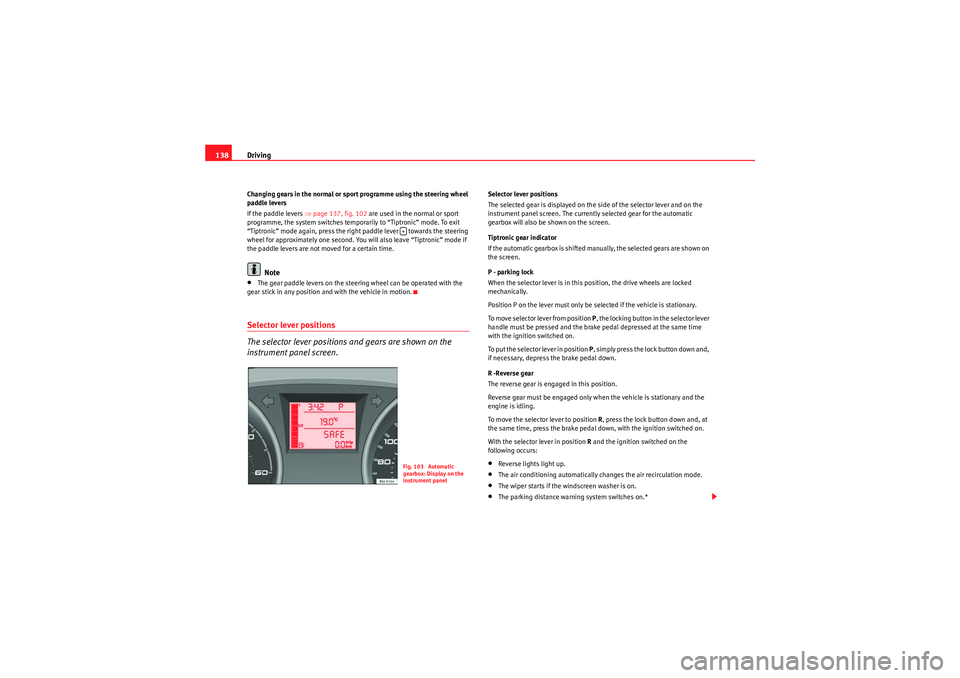
The selector lever positions and gears are shown on the
instrument panel screen.
Selector lever positions
The selected gear is displayed on the side of the selector lever and on the
instrument panel screen. The currently selected gear for the automatic
gearbox will also be shown on the screen.
Tiptronic gear indicator
If the automatic gearbox is shifted manually, the selected gears are shown on
the screen.
P - parking lock
When the selector lever is in this position, the drive wheels are locked
mechanically.
Position P on the lever must only be selected if the vehicle is stationary.
To move selector lever from position P, the locking button in the selector lever
handle must be pressed and the brake pedal depressed at the same time
with the ignition switched on.
To put the selector lever in position P, simply press the lock button down and,
if necessary, depress the brake pedal down.
R -Reverse gear
The reverse gear is engaged in this position.
Reverse gear must be engaged only when the vehicle is stationary and the
engine is idling.
To move the selector lever to position R, press the lock button down and, at
the same time, press the brake pedal down, with the ignition switched on.
With the selector lever in position R and the ignition switched on the
following occurs:•Reverse lights light up.•The air conditioning automatically changes the air recirculation mode.•The wiper starts if the windscreen washer is on.•The parking distance warning system switches on.*
+Fig. 103 Automatic
gearbox: Display on the
instrument panel
Ibiza_EN.book Seite 138 Montag, 14. September 2009 6:19 18
Page 141 of 257
Driving139
Safety First
Controls and equipment
Practical tips
Technical Data
N - Neutral (idling)
If this position is selected, the gearbox is in neutral. Power is not transmitted
to the wheels and the engine does not have a braking function.
Never use the
N position to drive down a hill. The engine does not function as
a brake and the brakes are subjected to excessive stain.
You could damage the automatic gearbox if you drive down hills with the
selector lever in position N and the engine switched off.
D - Drive (forwards)
In this position the gearbox automatically changes to a lower or higher gear,
according to the engine requirements, driving style and speed. The braking
effect of the engine when driving downhill is very limited when the selector is
in this position. The instrument panel screen displays the selected gear as
well as the selector lever in position D.
If position N has been selected and you wish to select D, you must press the
foot brake if the vehicle is stationary, or travelling at under 5 km/h.
S - Standard driving position (Sport programme)
When the selector lever is in position S, it will automatically change up into a
h igh er gea r late r, an d change d own i nto a low g ea r, if com pare d wi th p osi ti on
D . This way, it is possible to take full advantage of the engine reserve power,
depending on the engine demand, driving style and speed. The braking
effect of the engine when driving downhill is very limited. On the instrument
panel screen the selected gear is shown as well as the selector lever to posi-
tion S.
To select gear range S, press the lock button on the selector lever.
WARNING
If the vehicle moves with no control, an accident and serious injury may
occur.•As a driver, you should never leave your vehicle if the engine is running
and a gear is engaged. If you have to leave your vehicle while the engine is running, you must always apply the parking brake and engage parking lock
P.
•If the engine is running and if D or R are engaged, you will need to hold
the vehicle stopped by depressing footbrake down. The car would creep
forward as the power transmission is not fully interrupted even when the
engine is idling.•Never accelerate when changing gear or you may cause an accident.•Never move the selector lever to “R” or “P” when driving. Risk of acci-
dent.•Before driving down a very steep slope, reduce your speed and shift to
position 1st.•Always hold the vehicle on the foot brake if you stop uphill. Otherwise,
the vehicle could roll back.•Never allow the brake to rub and do not use the brake pedal too often
or for long periods. Constant braking will cause the brakes to overheat and
will considerably reduce the braking effect. This increases the braking
distance and could cause the brake system to fail.WARNING
Never switch the engine off until the vehicle is stationary. You could lose
control of your vehicle. This could cause an accident and serious injury.•The airbags and belt tensioners do not work when the ignition is
switched off.•The brake servo does not work when the engine is not running. You
need more force to stop the vehicle.•Power assisted steering does not work when the engine is not running.
That is why it is much more difficult to turn the steering wheel.•Never remove the key from the ignition if the vehicle is in motion. The
steering lock could suddenly engage, and you would not be able to steer
the vehicle.WARNING (continued)
Ibiza_EN.book Seite 139 Montag, 14. September 2009 6:19 18
Page 143 of 257
Driving141
Safety First
Controls and equipment
Practical tips
Technical Data
Always apply the handbrake
firmly. This prevents you driving with the hand-
brake applied ⇒ .
The handbrake warning lamp
lights up when the handbrake is applied
and the ignition is switched on. The warning turns off when the handbrake is
released.
WARNING
•Never use the handbrake to stop the vehicle when it is in motion. The
braking distance is considerably longer, because braking is only applied to
the rear wheels. Risk of accident!•If it is only partially released, this will cause rear brakes overheating,
which can impair the function of the brake system and could lead to an acci-
dent. This also causes premature wear on the rear brake pads.Caution
Always apply the handbrake before you leave the vehicle. The first gear
should also be selected.Parking
The handbrake should always be firmly applied when the
vehicle is parked.Always note the following points when parking the vehicle:
– Use the foot brake to stop the vehicle.
– Apply the handbrake.
– The first gear should also be selected. – Switch the engine off and remove the key from the ignition lock.
Turn the steering wheel slightly to engage the steering lock.
– Always take you car keys with you when you leave the vehicle ⇒ .
Additional notes on parking the vehicle on gradients:
Turn the steering wheel so that the vehicle rolls against the kerb if it started
to roll.•If the vehicle is parked facing downhill, turn the front wheels so that they
point towards the kerb .•If the vehicle is parked facing uphill, turn the front wheels so that they
point away from the kerb .•Secure the vehicle as normal by applying the handbrake firmly and
engaging first gear.WARNING
•Take measures to reduce the risk of injury when you leave your vehicle
unattended.•Never park where the hot exhaust system could ignite inflammable
materials, such as dry grass, low bushes, spilt fuel etc.•Never allow vehicle occupants to remain in the vehicle when it is
locked. They would be unable to open the vehicle from the inside, and
could become trapped in the vehicle in an emergency. In the event of an
emergency, locked doors will delay assistance to occupants.•Never leave children alone in the vehicle. They could set the vehicle in
motion, for example, by releasing the handbrake or the gear lever /
selector lever.•Depending on weather conditions, it may become extremely hot or cold
inside the vehicle. This can be fatal.
Ibiza_EN.book Seite 141 Montag, 14. September 2009 6:19 18
Page 145 of 257
Driving143
Safety First
Controls and equipment
Practical tips
Technical Data
Provided that it is not in continuous mode, the tone on the parking aid system
stops when it detects a wall parallel to the vehicle.
Trailer towing
For vehicles factory-fitted with a towing bar, the parking aid system will not
be activated by the engagement of the reverse gear when pulling a trailer, as
the trailer's electric connector will be plugged into the vehicle.
Possible faults
If a continuous bleep is heard for some seconds when the reverse gear is
engaged, this indicates that there is a fault in the parking aid system.
If the fault continues until the ignition is turned off, the acoustic signal
warning of the fault will not be emitted every time the system is reactivated
(by engaging reverse gear).
Thus, the system ready indication will not sound
either. Have the fault repaired by an Authorised Service Centre as soon as
possible.
If there is no ready signal or no acoustic warning signal, then the parking aid
loudspeaker is faulty and may not warn of obstacles.
To ensure that the system works properly, the sensors must be kept clean and
free of ice and snow.
WARNING
•The sensors have blind spots in which obstacles may not be detected.•Always look out for small children and animals because the system will
not always detect them. Always pay attention when reversing to avoid acci-
dents.•The parking aid is not a replacement for driver awareness. The driver
must take full responsibility for parking and other manoeuvres.
Caution
•Please note that low obstacles detected by the system may no longer be
registered by the sensors as the car moves closer, so the system will not give
any further warning. Certain kinds of obstacles (such as wire fences, chains,
thin posts or trailer draw bars, high kerbs or painted railings etc) may not
always be detected by the system, so there is a risk of damaging the vehicle
in such cases.•In some cases, obstacles with uniform edges and bumps may not be
detected immediately by the system due to their geometry. Take special care
with these types of obstacle, e.g. corners, rectangular objects, etc.., these
can cause damage to the vehicle.•Be especially careful when manoeuvring into a corner between two
perpendicular walls. Survey the approach of the wall to the side of the vehicle
(using the mirrors)•The parking aid system does not replace use of the mirrors for manoeu-
vres.•Distant ultra-sonic sources (hammers, tyres, construction machinery,
other vehicles with PDC) may interfere with the operation of the system.•During the periodic cleaning of the sensors, take care not to damage or
scratch them. When cleaning with high pressure washers or steam cleaners,
the sensors should be sprayed for only a very short period and from a
distance of more than 10 cm.
Ibiza_EN.book Seite 143 Montag, 14. September 2009 6:19 18
Page 146 of 257
Driving
144Cruise control* (GRA)Description
The cruise control system is able to maintain the set speed in
the range from approx. 30 km/h to 180 km/h.Once the speed setting has been saved, you may take your foot off the accel-
erator.
WARNING
It could be dangerous to use the cruise control system if it is not possible
to drive at constant speed.•For safety reasons the cruise control system should not be used in
dense traffic, in sections with bends or where roads are in bad conditions
(e.g. aquaplaning, loose chippings, slippery surfaces, snow). Risk of acci-
dent.•Always switch the CCS off when finish to use it in order to avoid an
involuntary use.•It is dangerous to use a set speed which is too high for the current road,
traffic or weather conditions. Risk of accident.Note
The cruise control cannot maintain a constant speed when descending down
hills. The vehicle will accelerate due to its own weight. Use the foot brake to
slow the vehicle.
Switching the cruise control system on and offSwitching on the system
–Move the control ⇒fig. 105 to the left to ON .
Switching off system
– Move the control to the right to OFF or turn the ignition off
when the vehicle is stationary.W h en the cr uis e cont rol is o n an d a sp ee d is pr ogra m m e d, the in di cato r on
the instrument panel is lit.
10)
If the cruise control system is switched off , the
symbol is switched off. The
system will also be fully switched off when the 1st gear is selected.*
10)Depending on the model version
Fig. 105 Indicator and
main beam headlight
lever: switch and rocker
switch for the cruise
control
AA
AA
Ibiza_EN.book Seite 144 Montag, 14. September 2009 6:19 18
Page 149 of 257
Driving147
Safety First
Controls and equipment
Practical tips
Technical Data
Vehicles with a manual gearbox
The system
is completely turned off by moving the control all the way to
the right hand side (OFF engaged), or when the vehicle is stationary, ignition
off.
Vehicles with an automatic gearbox
To completely disengage the system, the selector lever must be placed in one
of the following positions: P , N , R or 1 or with the vehicle stopped and the
ignition turned off.
AA
Ibiza_EN.book Seite 147 Montag, 14. September 2009 6:19 18
Page 158 of 257
Driving and the environment
156•Never park where the catalytic converter could come into contact with
dry grass or inflammable materials under the vehicle.•Do not apply additional undersea or anti-corrosion coatings to the
exhaust pipes, catalytic converter or the heat shields on the exhaust
system. These materials could catch fire when the vehicle is being driven.Caution
Never fully drain the fuel tank because the irregularity of the fuel supply may
cause ignition problems. This allows unburnt fuel to enter the exhaust
system, which could cause overheating and damage the catalytic converter.
For the sake of the environment
Even when the emission control system is working perfectly, there may be a
smell of sulphur from the exhaust under some conditions. This depends on
the sulphur content of the fuel used. Quite often the problem can be solved
by changing to another fuel brand.Diesel engine particulate filter*
The diesel engine particulate filter eliminates soot produced
by burning diesel.The diesel engine dust filter eliminates most of the soot from the exhaust gas
system. Under normal driving conditions, the filter cleans itself. If the driving
conditions do not allow the filter to clean itself (for example, multiple short
trips) the filter will be obstructed by dust and pollen and the indicator
for
the diesel engine particulate filter indicator will light up. See section on
Warning Lights.
WARNING
•The diesel engine particulate filter may reach extremely high tempera-
tures; it should not enter into contact with flammable materials under-
neath the vehicle. Failure to comply could result in fire.Caution
•The vehicle is not designed for refuelling with mixtures of FAME fuel
(biodiesel) over 7%, in accordance with DIN 51628. The diesel particle filter
will be damaged if this mixture percentage is exceeded.Economical and environmentally-friendly
drivingGeneral notes
Fuel consumption depends to a large extent on your personal
driving style.Fuel consumption, environmental impact and engine, brake and tyre wear
depend largely on three factors:•Personal driving style•Conditions of use (weather, road surface)•Te chni cal r eq ui re men ts
By adopting an economical driving style and anticipating the traffic situation
ahead, you can easily reduce fuel consumption by 10-15%. This section
suggests methods of lessening the impact on the environment and reducing
your operating costs at the same time.
WARNING (continued)
Ibiza_EN.book Seite 156 Montag, 14. September 2009 6:19 18
Page 163 of 257
Vehicle maintenance and cleaning161
Safety First
Controls and equipment
Practical tips
Technical Data
Vehicle maintenance and cleaningGeneral notesRegular washing and care help maintain the value of your
vehicle.Yo u r v e h i c l e m a i n te n a n ce
Regular care and washing help to maintain the value of the vehicle. This may
also be one of the requirements for acknowledging warranty claims in the
event of bodywork corrosion or paint defects.
The best way to protect your vehicle against the harmful effects of the envi-
ronment is through correct maintenance and frequent washing. The longer
substances such as insects remains, bird droppings, resinous tree sap, road
dirt, industrial deposits, tar, soot or road salt and other aggressive materials
remain on the vehicle, the more damage they do to the paintwork. High
temperatures (for instance in strong sunlight) further intensify the corrosive
effect.
After winter, a period when salt is put on the roads, it is impor tant to have the
underside of the vehicle washed thoroughly.
Products for vehicle maintenance
Car care products are available in your Authorised Service Centre. Keep the
product instructions until you have used them up.
WARNING
•Car care products can be toxic. For this, they must always be kept
closed in their original container. Keep them out of the reach of children.
Failure to comply could result in poisoning.•Always read and observe the instructions and warnings on the package
before using car care products. Improper use could damage your health or your vehicle. The use of certain products may produce noxious vapours;
they should be used in well ventilated areas.
•Never use fuel, turpentine, engine oil, nail varnish remover or other
volatile fluids. These are toxic and highly flammable. Risk of fire and explo-
sion.•Before washing your vehicle, or carrying out any maintenance, switch
the engine off, apply your handbrake firmly and remove the key from the
ignition.Caution
Never attempt to remove dirt, mud or dust if the surface of the vehicle is dry.
Never use a dry cloth or sponge for cleaning purposes. This could damage the
paintwork or the windows of your vehicle. Soak dirt, mud or dust with plenty
of water.
For the sake of the environment
•When purchasing products for your vehicle maintenance, select the ones
which are not harmful to the environment.•The leftovers of the car care products should not be disposed of with ordi-
nary household waste. Observe the disposal information on the package.WARNING (continued)
Ibiza_EN.book Seite 161 Montag, 14. September 2009 6:19 18
Page 164 of 257
Vehicle maintenance and cleaning
162Care of the vehicle exteriorAutomatic car washing tunnelThe vehicle paintwork is so durable that the car can normally be washed
without problems in an automatic car washing tunnel. However, the paint-
work wear depends to a large extent, on the kind of the car washing tunnel,
the brushes used, its water filtering and the type of cleaning and preservative
products.
Before going through a car wash, be sure to take the usual precautions such
as closing the windows and sunroof. There is nothing to note apart from that.
If the vehicle has special accessories such as spoilers or a roof carrier or two-
way radio aerial, etc., it is advisable to consult the car washing tunnel oper-
ator.
After washing, the brakes could hesitate to respond as the brake discs and
pads could be wet, or even frozen in winter. “Dry” the brakes by braking
several times.
WARNING
Water, ice and salt on the brakes can reduce braking efficiency. Risk of acci-
dent.
Caution
Before putting the vehicle through the car washing tunnel, do not tighten the
aerial if it is folded because it can be damaged.
Washing by handVehicle washing
– First soften the dirt with plenty of water and rinse it off.
– Clean your vehicle from top to bottom with a soft sponge, a glove or a brush. Use very light pressure.
– Rinse the sponge or glove often with clean water.
– Special car shampoo should only be used for very stubborn dirt.
– Clean the wheels, sill panels etc. until last with a different sponge or glove.
– Rinse the vehicle thoroughly with water.
– Dry your vehicle surface gently with a chamois leather.
–When temperature is cold , dry the rubber seals and its surfaces
to prevent them from freezing. Apply silicone spray to the rubber
seals.
After washing
– Directly after washing, avoid sudden and sharp braking. “Dry” the brakes by braking several times.
WARNING
•Wash your car with the ignition switched off.•Protect your hands and arms from cuts on sharp metal edges when
cleaning the underbody, the inside of the wheel housings etc. Risk of
injury.
Ibiza_EN.book Seite 162 Montag, 14. September 2009 6:19 18