key Seat Ibiza 5D 2011 Service Manual
[x] Cancel search | Manufacturer: SEAT, Model Year: 2011, Model line: Ibiza 5D, Model: Seat Ibiza 5D 2011Pages: 278, PDF Size: 3.83 MB
Page 155 of 278
153
Driving
WARNING (Continued)
● The brake servo does not work with the engine off. You need more
force to stop the vehicle.
● Power steering does not work when the engine is not running. That is
why it is much more difficult to turn the steering wheel.
● Never remove the key from the ignition if the vehicle is in motion. The
steering lock could suddenly engage, and you would not be able to steer
the vehicle.
● Never allow the car to roll downhill with the selector lever in “N”, re-
gardless of the engine is running or not.
CAUTION
If you allow the vehicle to move when the engine is switched off or with the
selector lever in position “N”, take your foot off the accelerator and wait un-
til the engine starts idling before returning to position “D”.
Kickdown feature
This feature allows maximum acceleration. If you press the accelerator down thoroughly, the gearbox automatically
changes down, depending on speed and engine speed, into a lower gear to
take full advantage of give the vehicle maximum acceleration.
The gearbox does not change gear until the engine reaches the maximum
determined engine speed for the gear.
WARNING
You could lose control of the vehicle if you accelerate on slippery road
surfaces. Risk of serious injury.
● Be particularly careful when using the kickdown features on slippery
road surfaces. With a fast acceleration, the vehicle could lose traction
and skid.
● You should use the kickdown feature only when traffic and weather
conditions allow it to be used safely.
Handbrake Using the handbrake
The handbrake should be applied firmly to prevent the vehi-
cle from accidentally rolling away.
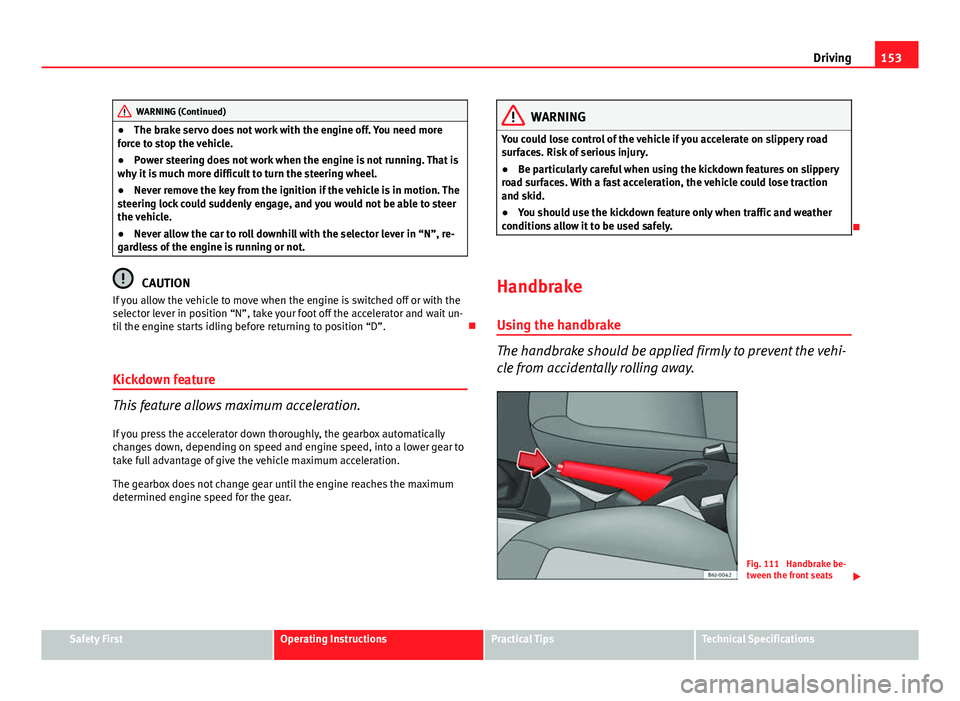
Fig. 111 Handbrake be-
tween the front seats
Safety FirstOperating InstructionsPractical TipsTechnical Specifications
Page 156 of 278
154Driving
Always apply the handbrake when you leave your vehicle and when
you park.
Applying the handbrake
–Pull the handbrake lever up firmly ⇒ fig. 111.
Releasing the handbrake
– Pull the lever up slightly and press the release knob in the di-
rection of the arrow ⇒ fig. 111 and guide the handbrake lever
down fully ⇒
.
Always apply the handbrake as far as it will go in order to prevent you from
driving with the handbrake applied by mistake ⇒
.
The handbrake warning lamp lights up when the handbrake is applied
and the ignition switched on. The warning turns off when the handbrake is
released.
WARNING
● Never use the handbrake to stop the vehicle when it is in motion. The
braking distance is considerably longer, because braking is only applied
to the rear wheels. Risk of accident!
● If it is only partially released, this will cause rear brakes overheating,
which can impair the function of the brake system and could lead to an
accident. This also causes premature wear on the rear brake pads.
CAUTION
Always apply the handbrake before you leave the vehicle. The first gear
should also be selected. Parking
The handbrake should always be firmly applied when the
vehicle is parked.
Always note the following points when parking the vehicle:
–
Use the brake pedal to stop the vehicle.
– Apply the handbrake.
– Select first gear.
– Switch the engine off and remove the key from the ignition. Turn
the steering wheel slightly to engage the steering lock.
– Always take you car keys with you when you leave the vehicle
⇒
.
Additional notes on parking the vehicle on gradients:
Turn the steering wheel so that the vehicle rolls against the kerb if it started
to roll.
● If the vehicle is parked facing downhill, turn the front wheels so that
they point towards the kerb .
● If the vehicle is parked facing uphill, turn the front wheels so that they
point away from the kerb .
● Secure the vehicle as normal by applying the handbrake firmly and se-
lecting first gear.
Page 177 of 278
175
Vehicle maintenance and cleaning
Vehicle maintenance and cleaning General notes
Regular washing and care help maintain the value of your
vehicle.Vehicle maintenance
Regular care and washing help to maintain the value of the vehicle. This
may also be one of the requirements for acknowledging warranty claims in
the event of bodywork corrosion or paint defects.
The best way to protect your vehicle against the harmful effects of the envi-
ronment is through correct maintenance and frequent washing. The longer
substances such as insect remains, bird droppings, resinous tree sap, road
dirt, industrial deposits, tar, soot or road salt and other aggressive materi-
als remain on the vehicle, the more damage they do to the paintwork. High
temperatures (for instance in strong sunlight) further intensify the corrosive
effect.
After winter, a period when salt is put on the roads, it is important to have
the underside of the vehicle washed thoroughly.
Products for vehicle maintenance
Car care products are available in your Authorised Service Centre. Keep the
product instructions until you have used them up.
WARNING
● Car care products can be toxic. Because of this, they must always be
kept closed in their original container. Keep them out of the reach of chil-
dren. Failure to comply could result in poisoning.
● Always read and observe the instructions and warnings on the pack-
age before using vehicle care products. Improper use could cause health
problems or damage the vehicle. The use of certain products may pro-
duce noxious vapours; they should be used in well ventilated areas.
● Never use fuel, turpentine, engine oil, nail varnish remover or other
volatile fluids. These are toxic and highly flammable. Risk of fire and ex-
plosion.
● Before washing your vehicle, or carrying out any maintenance, switch
the engine off, apply the handbrake firmly and remove the key from the
ignition.
CAUTION
Never attempt to remove dirt, mud or dust if the surface of the vehicle is dry.
Never use a dry cloth or sponge for cleaning purposes. This could damage
the paintwork or the windows of your vehicle. Soak dirt, mud or dust with
plenty of water.
For the sake of the environment
● When purchasing products for your vehicle maintenance, select the
ones which are not harmful to the environment.
● The waste from car care products should not be disposed of with ordina-
ry household waste. Observe the disposal information on the package.
Safety FirstOperating InstructionsPractical TipsTechnical Specifications
Page 183 of 278
181
Vehicle maintenance and cleaning
WARNING
Do not apply underseal or anti-corrosion coatings to the exhaust pipes,
catalytic converter or the heat shields on the exhaust system. The heat of
the exhaust system or the engine could cause them to ignite. Risk of fire.
Cleaning the engine compartment
Take special care when cleaning the engine compartment.
Anti-corrosion treatment
The engine compartment and the surface of the power unit are given anti-
corrosion treatment at the factory.
Good corrosion protection is particularly important in winter when the vehi-
cle is frequently driven on salted roads. To prevent the salt corroding the ve-
hicle, the entire engine compartment should be thoroughly cleaned before
and after winter.
Your Authorised Service Centre has got the necessary equipment to provide
the correct cleaning and preserving products. For this reason, we recom-
mend having this work performed by them.
The anti-corrosion protection is usually removed if the engine compartment
is cleaned with grease removing solutions, or if you have the engine
cleaned. On commissioning this work, ensure that all surfaces, seams,
joints and components in the engine compartment are given anti-corrosion
treatment.
WARNING
● When working in the engine compartment, always observe the safety
warnings ⇒ page 194.
● Before opening the bonnet, switch the engine off, apply the hand-
brake firmly and always remove the key from the ignition.
● Allow the engine to cool before you clean the engine compartment.
● Do not clean the vehicle underbody, wheel arches or wheel trims
without protecting your hands and arms. You may cut yourself on sharp-
edged metal parts. Failure to comply could result in injury.
● Moisture, ice and salt on the brakes may affect braking efficiency.
Risk of accident. Directly after washing, avoid sudden and sharp braking.
● Never touch the radiator fan. It is temperature-controlled and could
start automatically, even when the key is removed from the ignition!
For the sake of the environment
Fuel, grease and oil deposits could be removed when the engine is washed.
The polluted water must be cleaned in an oil separator. For this reason, en-
gine washing should be carried out only by a specialised workshop or a pet-
rol station.
Vehicle interior maintenance Plastic parts and dash panel cleaning
– Use a clean, damp cloth to clean plastic parts and the dash
panel.
– If this does not provide satisfactory results, use a special sol-
vent-free plastic cleaning product.
Safety FirstOperating InstructionsPractical TipsTechnical Specifications
Page 190 of 278
188Checking and refilling levels
Checking and refilling levels
Refuelling
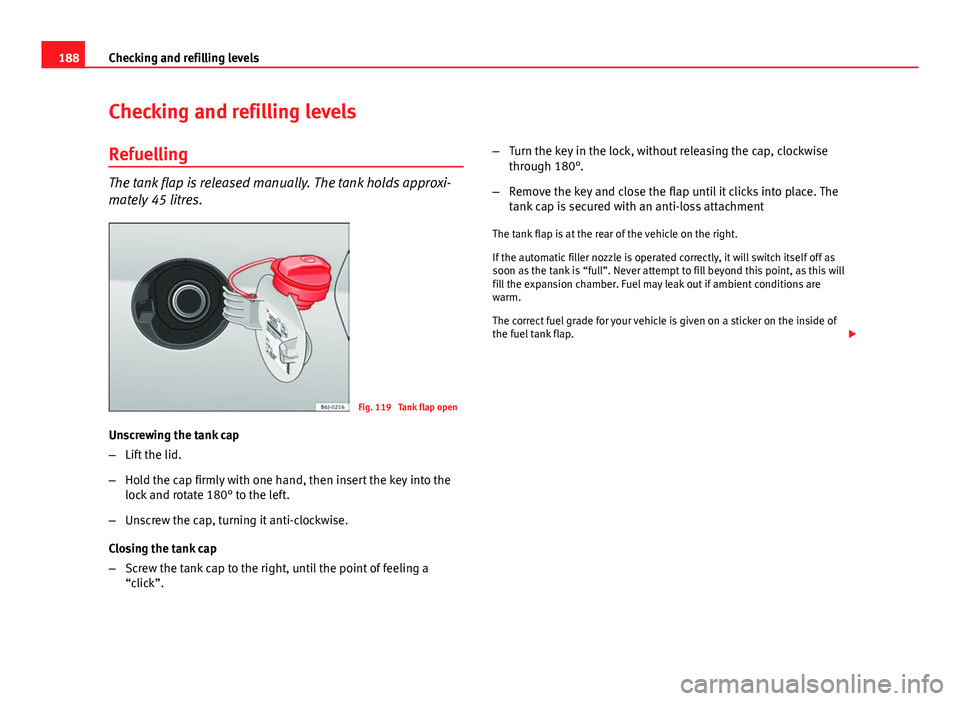
The tank flap is released manually. The tank holds approxi-
mately 45 litres.
Fig. 119 Tank flap open
Unscrewing the tank cap
– Lift the lid.
– Hold the cap firmly with one hand, then insert the key into the
lock and rotate 180° to the left.
– Unscrew the cap, turning it anti-clockwise.
Closing the tank cap
– Screw the tank cap to the right, until the point of feeling a
“click”. –
Turn the key in the lock, without releasing the cap, clockwise
through 180°.
– Remove the key and close the flap until it clicks into place. The
tank cap is secured with an anti-loss attachment
The tank flap is at the rear of the vehicle on the right.
If the automatic filler nozzle is operated correctly, it will switch itself off as
soon as the tank is “full”. Never attempt to fill beyond this point, as this will
fill the expansion chamber. Fuel may leak out if ambient conditions are
warm.
The correct fuel grade for your vehicle is given on a sticker on the inside of
the fuel tank flap.
Page 196 of 278
194Checking and refilling levels
Winter driving
Diesel can thicken in winter.
Winter-grade diesel
When using “summer-grade diesel fuel”, difficulties may be experienced at
sub-zero temperatures because the fuel thickens due to wax separation. For
this reason, “winter-grade diesel fuel” is available in some countries during
the cold months. It can be used at temperatures as low as -22 °C.
In countries with different climatic conditions the diesel fuel generally sold
has different temperature characteristics. Check with an Authorised Service
Centre or filling stations in the country concerned regarding the type of die-
sel fuels available.
Filter pre-heater
Your vehicle is fitted with a fuel filter glow plug system, making it well
equipped for operation in winter. This ensures that the fuel system remains
operational to approx. -24 °C, provided you use winter-grade diesel that is
safe to -15 °C.
However, if the fuel has waxed to such an extent that the engine will not
start at temperatures of under -24 °C, simply place the vehicle in a warm
place for a while.
CAUTION
Do not mix fuel additives (thinners or similar products) with diesel fuel. Working in the engine compartment
Safety instructions on working in the engine compartment
Any work carried out in the engine compartment or on the
engine must be carried out cautiously.
Before starting any work on the engine or in the engine compart-
ment:
1. Switch off the engine and remove the key from the ignition.
2. Apply the handbrake.
3. Move the gear lever to neutral or the selector lever to position P.
4. Wait for the engine to cool down.
5. Keep children away from the vehicle.
6. Raise the bonnet ⇒ page 196.
You should not do any work in the engine compartment unless you know ex-
actly how to carry out the jobs and have the correct tools! Have the work car-
ried out by a specialised workshop if you are uncertain.
All service fluids and consumables, e.g. coolant, engine oil, spark plugs
and batteries, are under constant development. SEAT provides a constant
flow of information to the Authorised Service Centres concerning modifica-
tions. For this reason, we recommend you to have service fluids and con-
sumables replaced by an Authorised Service Centre. Please observe the rel-
evant instructions ⇒ page 184. The engine compartment of the vehicle is a
hazardous area ⇒
.
Page 197 of 278
195
Checking and refilling levels
WARNING
All work on the engine or in the engine compartment, e.g. checking and
refilling fluids, involves the danger of injury and scalding as well as the
risk of accident or fire.
● Never open the bonnet if you see steam, smoke or coolant escaping
from the engine compartment. Otherwise, there is a risk of sustaining
burns. Wait until no more steam or coolant is emitted, then allow the en-
gine to cool before carefully opening the bonnet.
● Switch off the engine and remove the key from the ignition.
● Apply the handbrake and move the gear lever to neutral or selector
lever to position P.
● Keep children away from the vehicle.
● Never touch hot engine parts. There is a risk of burns.
● Never spill liquids on a hot engine or on a hot exhaust gas system.
This is a fire hazard.
● Avoid causing short-circuits in the electrical system, particularly at
the points where the jump leads are attached ⇒ page 240. The battery
could explode.
● Never touch the radiator fan. It is temperature controlled and could
start automatically, even when the engine has been switched off and the
key removed from the ignition!
● Do not unscrew the cap on the expansion tank when the engine is
hot. If the coolant is hot, the cooling system will be pressurised!
● Protect face, hands and arms by covering the cap with a large, thick
cloth to protect against escaping coolant and steam.
● Always make sure you have not left any objects, such as cleaning
cloths and tools, in the engine compartment.
● If you have to work underneath the vehicle, you must use suitable
stands additionally to support the vehicle, there is a risk of accident!. A
hydraulic jack is insufficient for securing the vehicle and there is a risk of
injury.WARNING (Continued)
● If any work has to be performed when the engine is started or with
the engine running, there is an additional, potentially fatal, safety risk
from the rotating parts, such as the drive belts, alternator, radiator fan,
etc., and from the high-voltage ignition system. You should also observe
the following points:
–Never touch the electrical wiring of the ignition system.
– Ensure that jewellery, loose clothing and long hair do not get trap-
ped in rotating engine parts. Danger of death. Before starting any
work remove jewellery, tie back and cover hair, and wear tight-fitting
clothes.
– Never accelerate with a gear engaged without taking the necessary
precautions. The vehicle could move, even if the handbrake is ap-
plied. Danger of death.
● If work has to be carried out on the fuel system or on electrical com-
ponents, you must observe the following safety notes in addition to the
above warnings:
–Always disconnect the battery. The vehicle must be unlocked when
this is done, otherwise the alarm will be triggered.
– Do not smoke.
– Never work near naked flames.
– Always have a fire extinguisher on hand.
CAUTION
When topping up service fluids, make sure not to mistake them. Using the
wrong fluids could cause serious malfunctions and engine damage!
For the sake of the environment
Service fluids leaks are harmful to the environment. For this reason you
should make regular checks on the ground underneath your vehicle. If you
find spots of oil or other fluids, have your vehicle inspected in a specialised
workshop.
Safety FirstOperating InstructionsPractical TipsTechnical Specifications
Page 230 of 278
228If and when
Xenon 1)
/ adaptive headlights*
- D1S2)
- LED 3)
- LED 3)
- PY 21W
Fog lights - H11
WARNING
● Take particular care when working on components in the engine com-
partment if the engine is warm - risk of burns!
● Bulbs are highly sensitive to pressure. The glass can break when you
touch the bulb, causing injury.
● The high voltage element of gas discharge bulbs* (xenon light) must
be handled correctly. Otherwise, there is a risk of death.
● When changing bulbs, please take care not to injure yourself on sharp
parts in the headlight housing.
CAUTION
● Remove the ignition key before working on the electric system. If not, a
short circuit could occur.
● Switch off the lights or parking lights before you change a bulb.
Dipped and full beam
Position
DRL (day light)
Turn signals
Fog light/cornering
For the sake of the environment
Please ask your specialist retailer how to dispose of used bulbs in the prop-
er manner.
Note
● Depending on weather conditions (cold or wet), the front lights, the fog
lights, the tail lights and the turn signals may be temporarily misted. This
has no influence on the useful life of the lighting system. By switching on
the lights, the area through which the beam of light is projected will quickly
be demisted. However, the edges may continue to be misted.
● Please check at regular intervals that all lighting (especially the exterior
lighting) on your vehicle is functioning properly. This is not only in the inter-
est of your own safety, but also that of all other road users.
● Before changing a bulb, make sure you have the correct new bulb.
● Do not touch the glass part of the bulb with your bare hands, use a cloth
or paper towel instead. Otherwise, the fingerprints left on the glass will va-
porise as a result of the heat generated by the bulb, they will be deposited
on the reflector and will impair its surface.
1)
With this type of headlight, the user can replace the indicator bulb. Replacement of the dip-
ped/main beam bulb must be done by a Technical Service, given that complex elements
must be removed from the vehicle and the automatic control system that incorporates it
must be reset.
2) The Xenon bulbs discharge 2.5 times the light flux and have an average lifespan of 5 times
more than that of halogen bulbs, this means that, except due to unusual circumstances,
there is no need to change the bulbs for the whole life of the vehicle.
3) In the event that there is a fault in the LEDs, the complete headlight must be replaced.
Page 271 of 278
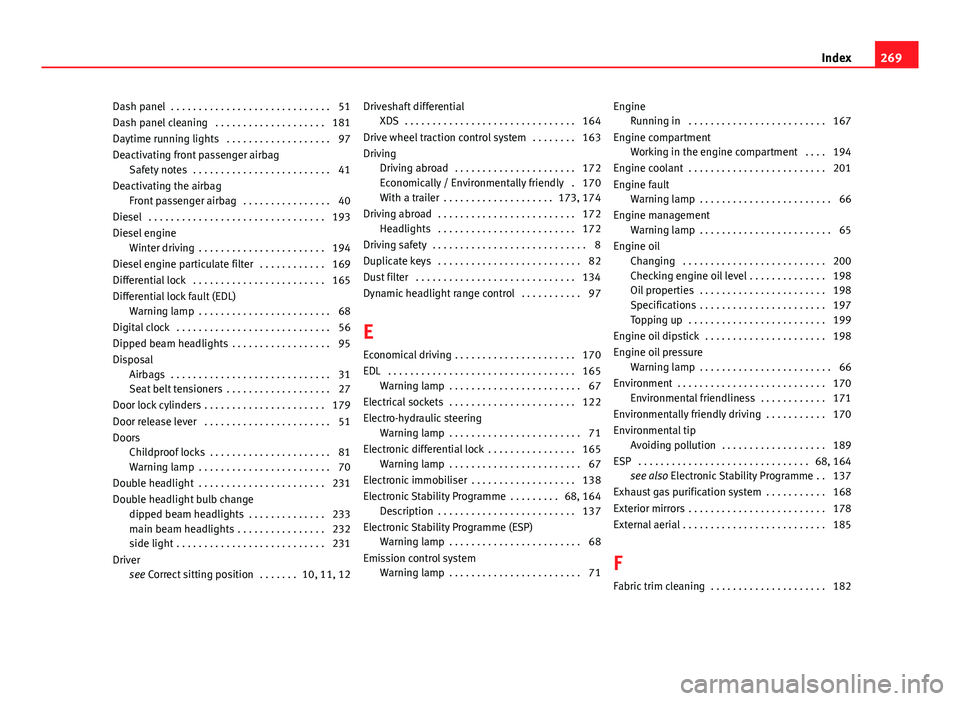
Dash panel . . . . . . . . . . . . . . . . . . . . . . . . . . . . . 51
Dash panel cleaning . . . . . . . . . . . . . . . . . . . . 181
Daytime running lights . . . . . . . . . . . . . . . . . . . 97
Deactivating front passenger airbagSafety notes . . . . . . . . . . . . . . . . . . . . . . . . . 41
Deactivating the airbag Front passenger airbag . . . . . . . . . . . . . . . . 40
Diesel . . . . . . . . . . . . . . . . . . . . . . . . . . . . . . . . 193
Diesel engine Winter driving . . . . . . . . . . . . . . . . . . . . . . . 194
Diesel engine particulate filter . . . . . . . . . . . . 169
Differential lock . . . . . . . . . . . . . . . . . . . . . . . . 165
Differential lock fault (EDL) Warning lamp . . . . . . . . . . . . . . . . . . . . . . . . 68
Digital clock . . . . . . . . . . . . . . . . . . . . . . . . . . . . 56
Dipped beam headlights . . . . . . . . . . . . . . . . . . 95
Disposal Airbags . . . . . . . . . . . . . . . . . . . . . . . . . . . . . 31
Seat belt tensioners . . . . . . . . . . . . . . . . . . . 27
Door lock cylinders . . . . . . . . . . . . . . . . . . . . . . 179
Door release lever . . . . . . . . . . . . . . . . . . . . . . . 51
Doors Childproof locks . . . . . . . . . . . . . . . . . . . . . . 81
Warning lamp . . . . . . . . . . . . . . . . . . . . . . . . 70
Double headlight . . . . . . . . . . . . . . . . . . . . . . . 231
Double headlight bulb change dipped beam headlights . . . . . . . . . . . . . . 233
main beam headlights . . . . . . . . . . . . . . . . 232
side light . . . . . . . . . . . . . . . . . . . . . . . . . . . 231
Driver see Correct sitting position . . . . . . . 10, 11, 12 Driveshaft differential
XDS . . . . . . . . . . . . . . . . . . . . . . . . . . . . . . . 164
Drive wheel traction control system . . . . . . . . 163
Driving Driving abroad . . . . . . . . . . . . . . . . . . . . . . 172
Economically / Environmentally friendly . 170
With a trailer . . . . . . . . . . . . . . . . . . . . 173, 174
Driving abroad . . . . . . . . . . . . . . . . . . . . . . . . . 172 Headlights . . . . . . . . . . . . . . . . . . . . . . . . . 172
Driving safety . . . . . . . . . . . . . . . . . . . . . . . . . . . . 8
Duplicate keys . . . . . . . . . . . . . . . . . . . . . . . . . . 82
Dust filter . . . . . . . . . . . . . . . . . . . . . . . . . . . . . 134
Dynamic headlight range control . . . . . . . . . . . 97
E
Economical driving . . . . . . . . . . . . . . . . . . . . . . 170
EDL . . . . . . . . . . . . . . . . . . . . . . . . . . . . . . . . . . 165 Warning lamp . . . . . . . . . . . . . . . . . . . . . . . . 67
Electrical sockets . . . . . . . . . . . . . . . . . . . . . . . 122
Electro-hydraulic steering Warning lamp . . . . . . . . . . . . . . . . . . . . . . . . 71
Electronic differential lock . . . . . . . . . . . . . . . . 165 Warning lamp . . . . . . . . . . . . . . . . . . . . . . . . 67
Electronic immobiliser . . . . . . . . . . . . . . . . . . . 138
Electronic Stability Programme . . . . . . . . . 68, 164 Description . . . . . . . . . . . . . . . . . . . . . . . . . 137
Electronic Stability Programme (ESP) Warning lamp . . . . . . . . . . . . . . . . . . . . . . . . 68
Emission control system Warning lamp . . . . . . . . . . . . . . . . . . . . . . . . 71 Engine
Running in . . . . . . . . . . . . . . . . . . . . . . . . . 167
Engine compartment Working in the engine compartment . . . . 194
Engine coolant . . . . . . . . . . . . . . . . . . . . . . . . . 201
Engine fault Warning lamp . . . . . . . . . . . . . . . . . . . . . . . . 66
Engine management Warning lamp . . . . . . . . . . . . . . . . . . . . . . . . 65
Engine oil Changing . . . . . . . . . . . . . . . . . . . . . . . . . . 200
Checking engine oil level . . . . . . . . . . . . . . 198
Oil properties . . . . . . . . . . . . . . . . . . . . . . . 198
Specifications . . . . . . . . . . . . . . . . . . . . . . . 197
Topping up . . . . . . . . . . . . . . . . . . . . . . . . . 199
Engine oil dipstick . . . . . . . . . . . . . . . . . . . . . . 198
Engine oil pressure Warning lamp . . . . . . . . . . . . . . . . . . . . . . . . 66
Environment . . . . . . . . . . . . . . . . . . . . . . . . . . . 170 Environmental friendliness . . . . . . . . . . . . 171
Environmentally friendly driving . . . . . . . . . . . 170
Environmental tip Avoiding pollution . . . . . . . . . . . . . . . . . . . 189
ESP . . . . . . . . . . . . . . . . . . . . . . . . . . . . . . . 68, 164 see also Electronic Stability Programme . . 137
Exhaust gas purification system . . . . . . . . . . . 168
Exterior mirrors . . . . . . . . . . . . . . . . . . . . . . . . . 178
External aerial . . . . . . . . . . . . . . . . . . . . . . . . . . 185
F
Fabric trim cleaning . . . . . . . . . . . . . . . . . . . . . 182
269
Index
Page 272 of 278
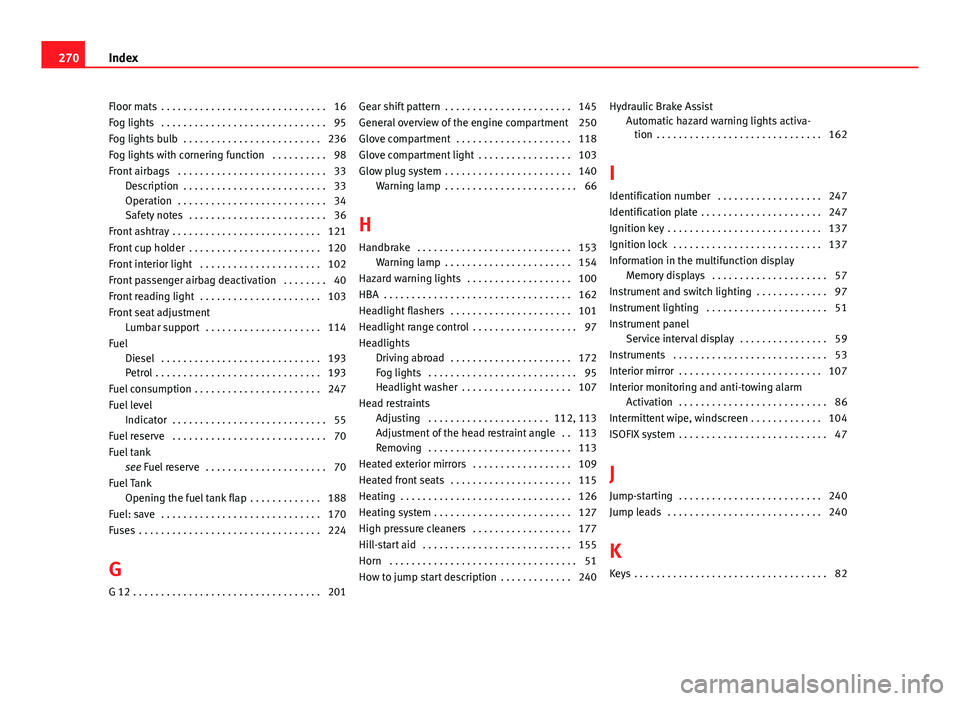
Floor mats . . . . . . . . . . . . . . . . . . . . . . . . . . . . . . 16
Fog lights . . . . . . . . . . . . . . . . . . . . . . . . . . . . . . 95
Fog lights bulb . . . . . . . . . . . . . . . . . . . . . . . . . 236
Fog lights with cornering function . . . . . . . . . . 98
Front airbags . . . . . . . . . . . . . . . . . . . . . . . . . . . 33Description . . . . . . . . . . . . . . . . . . . . . . . . . . 33
Operation . . . . . . . . . . . . . . . . . . . . . . . . . . . 34
Safety notes . . . . . . . . . . . . . . . . . . . . . . . . . 36
Front ashtray . . . . . . . . . . . . . . . . . . . . . . . . . . . 121
Front cup holder . . . . . . . . . . . . . . . . . . . . . . . . 120
Front interior light . . . . . . . . . . . . . . . . . . . . . . 102
Front passenger airbag deactivation . . . . . . . . 40
Front reading light . . . . . . . . . . . . . . . . . . . . . . 103
Front seat adjustment Lumbar support . . . . . . . . . . . . . . . . . . . . . 114
Fuel Diesel . . . . . . . . . . . . . . . . . . . . . . . . . . . . . 193
Petrol . . . . . . . . . . . . . . . . . . . . . . . . . . . . . . 193
Fuel consumption . . . . . . . . . . . . . . . . . . . . . . . 247
Fuel level Indicator . . . . . . . . . . . . . . . . . . . . . . . . . . . . 55
Fuel reserve . . . . . . . . . . . . . . . . . . . . . . . . . . . . 70
Fuel tank see Fuel reserve . . . . . . . . . . . . . . . . . . . . . . 70
Fuel Tank Opening the fuel tank flap . . . . . . . . . . . . . 188
Fuel: save . . . . . . . . . . . . . . . . . . . . . . . . . . . . . 170
Fuses . . . . . . . . . . . . . . . . . . . . . . . . . . . . . . . . . 224
G G 12 . . . . . . . . . . . . . . . . . . . . . . . . . . . . . . . . . . 201 Gear shift pattern . . . . . . . . . . . . . . . . . . . . . . . 145
General overview of the engine compartment 250
Glove compartment . . . . . . . . . . . . . . . . . . . . . 118
Glove compartment light . . . . . . . . . . . . . . . . . 103
Glow plug system . . . . . . . . . . . . . . . . . . . . . . . 140
Warning lamp . . . . . . . . . . . . . . . . . . . . . . . . 66
H Handbrake . . . . . . . . . . . . . . . . . . . . . . . . . . . . 153 Warning lamp . . . . . . . . . . . . . . . . . . . . . . . 154
Hazard warning lights . . . . . . . . . . . . . . . . . . . 100
HBA . . . . . . . . . . . . . . . . . . . . . . . . . . . . . . . . . . 162
Headlight flashers . . . . . . . . . . . . . . . . . . . . . . 101
Headlight range control . . . . . . . . . . . . . . . . . . . 97
Headlights Driving abroad . . . . . . . . . . . . . . . . . . . . . . 172
Fog lights . . . . . . . . . . . . . . . . . . . . . . . . . . . 95
Headlight washer . . . . . . . . . . . . . . . . . . . . 107
Head restraints Adjusting . . . . . . . . . . . . . . . . . . . . . . 112, 113
Adjustment of the head restraint angle . . 113
Removing . . . . . . . . . . . . . . . . . . . . . . . . . . 113
Heated exterior mirrors . . . . . . . . . . . . . . . . . . 109
Heated front seats . . . . . . . . . . . . . . . . . . . . . . 115
Heating . . . . . . . . . . . . . . . . . . . . . . . . . . . . . . . 126
Heating system . . . . . . . . . . . . . . . . . . . . . . . . . 127
High pressure cleaners . . . . . . . . . . . . . . . . . . 177
Hill-start aid . . . . . . . . . . . . . . . . . . . . . . . . . . . 155
Horn . . . . . . . . . . . . . . . . . . . . . . . . . . . . . . . . . . 51
How to jump start description . . . . . . . . . . . . . 240 Hydraulic Brake Assist
Automatic hazard warning lights activa-tion . . . . . . . . . . . . . . . . . . . . . . . . . . . . . . 162
I
Identification number . . . . . . . . . . . . . . . . . . . 247
Identification plate . . . . . . . . . . . . . . . . . . . . . . 247
Ignition key . . . . . . . . . . . . . . . . . . . . . . . . . . . . 137
Ignition lock . . . . . . . . . . . . . . . . . . . . . . . . . . . 137
Information in the multifunction display Memory displays . . . . . . . . . . . . . . . . . . . . . 57
Instrument and switch lighting . . . . . . . . . . . . . 97
Instrument lighting . . . . . . . . . . . . . . . . . . . . . . 51
Instrument panel Service interval display . . . . . . . . . . . . . . . . 59
Instruments . . . . . . . . . . . . . . . . . . . . . . . . . . . . 53
Interior mirror . . . . . . . . . . . . . . . . . . . . . . . . . . 107
Interior monitoring and anti-towing alarm Activation . . . . . . . . . . . . . . . . . . . . . . . . . . . 86
Intermittent wipe, windscreen . . . . . . . . . . . . . 104
ISOFIX system . . . . . . . . . . . . . . . . . . . . . . . . . . . 47
J Jump-starting . . . . . . . . . . . . . . . . . . . . . . . . . . 240
Jump leads . . . . . . . . . . . . . . . . . . . . . . . . . . . . 240
K
Keys . . . . . . . . . . . . . . . . . . . . . . . . . . . . . . . . . . . 82
270 Index