warning Seat Ibiza 5D 2011 Manual Online
[x] Cancel search | Manufacturer: SEAT, Model Year: 2011, Model line: Ibiza 5D, Model: Seat Ibiza 5D 2011Pages: 278, PDF Size: 3.83 MB
Page 114 of 278
112Seats and storage compartments
Head restraints
Correct adjustment of head restraints
Properly adjusted head restraints are an important part of
passenger protection and can reduce the risk of injuries in
most accident situations.
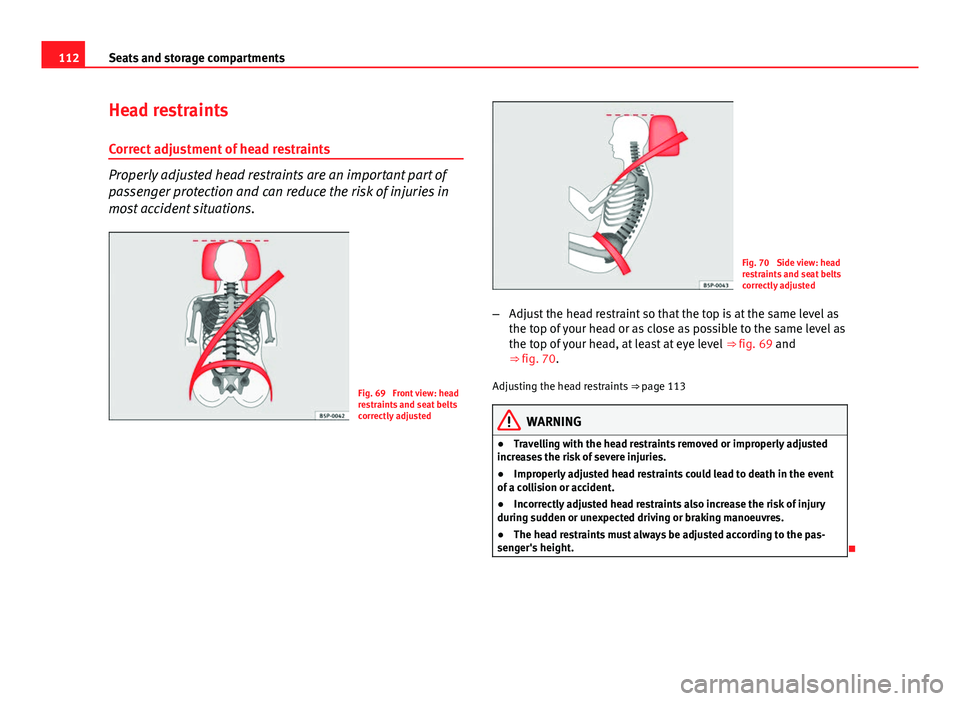
Fig. 69 Front view: head
restraints and seat belts
correctly adjusted
Fig. 70 Side view: head
restraints and seat belts
correctly adjusted
– Adjust the head restraint so that the top is at the same level as
the top of your head or as close as possible to the same level as
the top of your head, at least at eye level ⇒ fig. 69 and
⇒ fig. 70.
Adjusting the head restraints ⇒ page 113
WARNING
● Travelling with the head restraints removed or improperly adjusted
increases the risk of severe injuries.
● Improperly adjusted head restraints could lead to death in the event
of a collision or accident.
● Incorrectly adjusted head restraints also increase the risk of injury
during sudden or unexpected driving or braking manoeuvres.
● The head restraints must always be adjusted according to the pas-
senger's height.
Page 115 of 278
113
Seats and storage compartments
Removing or adjusting head restraints
The head restraints can be adjusted by moving them up and
down.
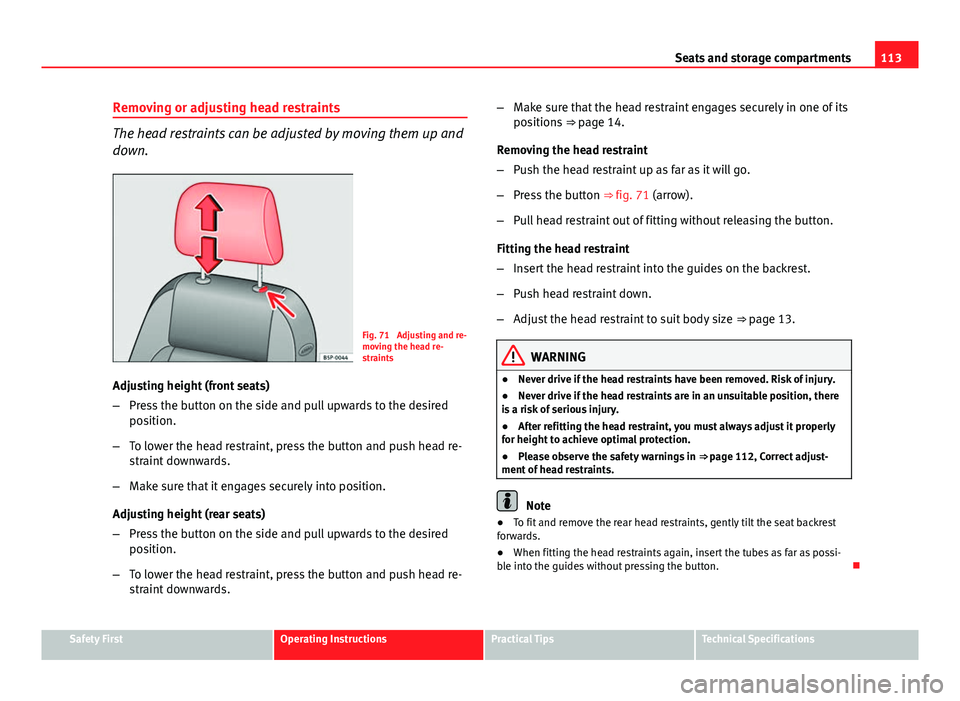
Fig. 71 Adjusting and re-
moving the head re-
straints
Adjusting height (front seats)
– Press the button on the side and pull upwards to the desired
position.
– To lower the head restraint, press the button and push head re-
straint downwards.
– Make sure that it engages securely into position.
Adjusting height (rear seats)
– Press the button on the side and pull upwards to the desired
position.
– To lower the head restraint, press the button and push head re-
straint downwards. –
Make sure that the head restraint engages securely in one of its
positions ⇒ page 14.
Removing the head restraint
– Push the head restraint up as far as it will go.
– Press the button ⇒ fig. 71 (arrow).
– Pull head restraint out of fitting without releasing the button.
Fitting the head restraint
– Insert the head restraint into the guides on the backrest.
– Push head restraint down.
– Adjust the head restraint to suit body size ⇒ page 13.
WARNING
● Never drive if the head restraints have been removed. Risk of injury.
● Never drive if the head restraints are in an unsuitable position, there
is a risk of serious injury.
● After refitting the head restraint, you must always adjust it properly
for height to achieve optimal protection.
● Please observe the safety warnings in ⇒ page 112, Correct adjust-
ment of head restraints.
Note
● To fit and remove the rear head restraints, gently tilt the seat backrest
forwards.
● When fitting the head restraints again, insert the tubes as far as possi-
ble into the guides without pressing the button.
Safety FirstOperating InstructionsPractical TipsTechnical Specifications
Page 116 of 278
114Seats and storage compartments
Front seats
Adjustment of the front seats
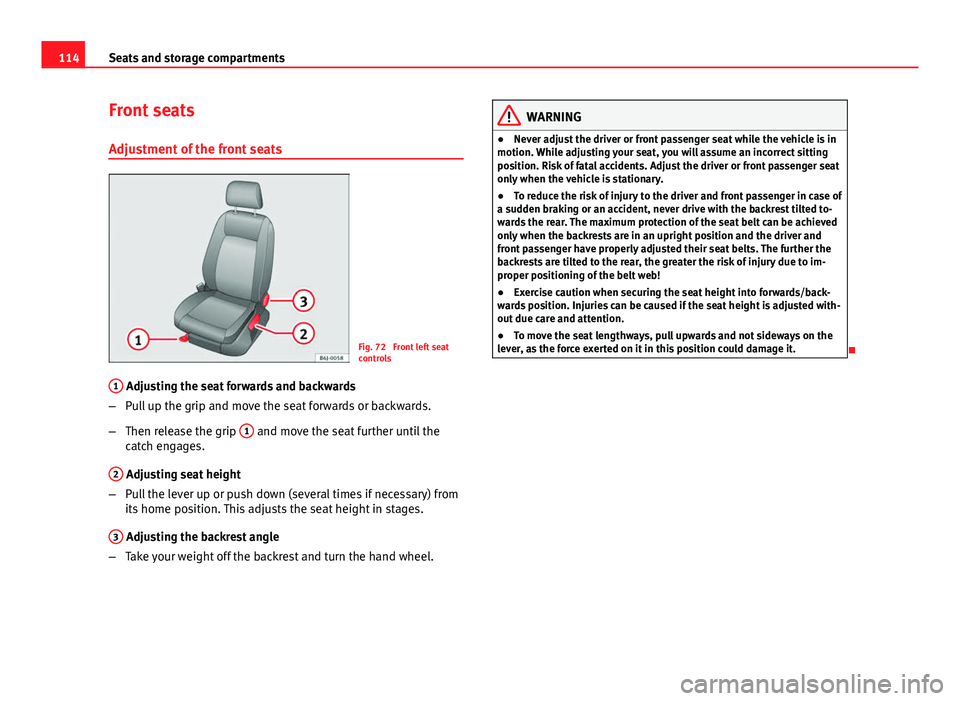
Fig. 72 Front left seat
controls
1
Adjusting the seat forwards and backwards
– Pull up the grip and move the seat forwards or backwards.
– Then release the grip 1
and move the seat further until the
catch engages.
2
Adjusting seat height
– Pull the lever up or push down (several times if necessary) from
its home position. This adjusts the seat height in stages.
3
Adjusting the backrest angle
– Take your weight off the backrest and turn the hand wheel.
WARNING
● Never adjust the driver or front passenger seat while the vehicle is in
motion. While adjusting your seat, you will assume an incorrect sitting
position. Risk of fatal accidents. Adjust the driver or front passenger seat
only when the vehicle is stationary.
● To reduce the risk of injury to the driver and front passenger in case of
a sudden braking or an accident, never drive with the backrest tilted to-
wards the rear. The maximum protection of the seat belt can be achieved
only when the backrests are in an upright position and the driver and
front passenger have properly adjusted their seat belts. The further the
backrests are tilted to the rear, the greater the risk of injury due to im-
proper positioning of the belt web!
● Exercise caution when securing the seat height into forwards/back-
wards position. Injuries can be caused if the seat height is adjusted with-
out due care and attention.
● To move the seat lengthways, pull upwards and not sideways on the
lever, as the force exerted on it in this position could damage it.
Page 119 of 278
117
Seats and storage compartments
On split rear seats 1)
the backrest and cushion can be lowered and raised re-
spectively in two sections.
WARNING
● Please be careful when folding back the backrest! Injuries can be
caused if the seat height is adjusted without due care and attention.
● Do no trap or damage seat belts when raising the backrest.
● After raising the backrest, check it has engaged properly in position.
Do this by pulling on the central seat belt or directly on the backrest and
check that the position lever is in the neutral position.
● The three point automatic seat belt only works correctly when the
backrest of the central seat is correctly engaged.
1) Optional equipment
Safety FirstOperating InstructionsPractical TipsTechnical Specifications
Page 120 of 278
118Seats and storage compartments
Storage compartment
Storage compartment on the front passenger side
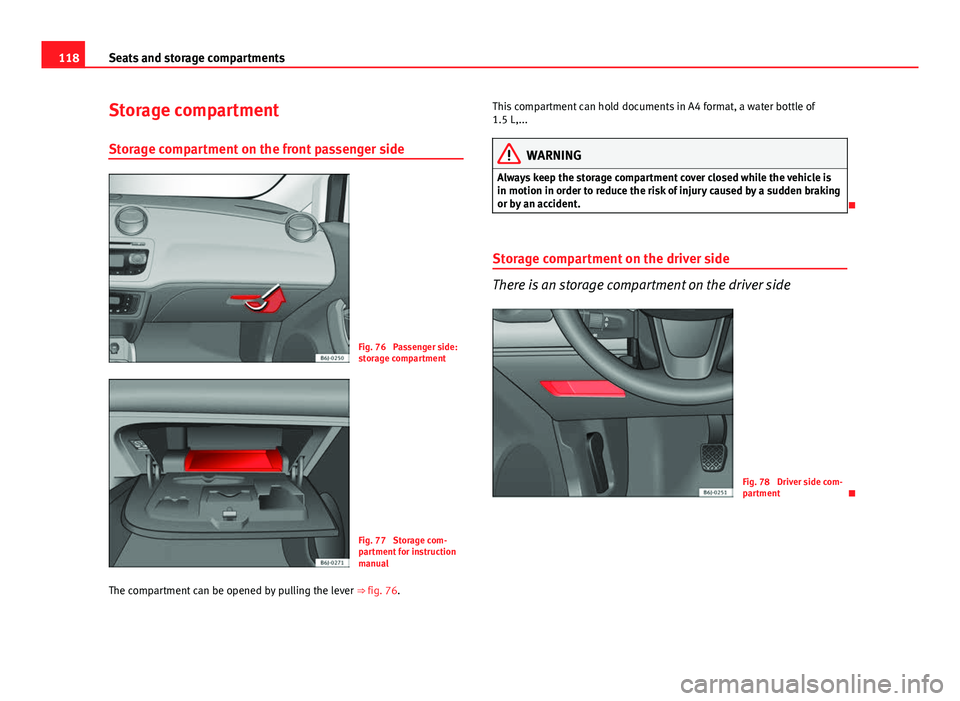
Fig. 76 Passenger side:
storage compartment
Fig. 77 Storage com-
partment for instruction
manual
The compartment can be opened by pulling the lever ⇒ fig. 76.This compartment can hold documents in A4 format, a water bottle of
WARNING
Always keep the storage compartment cover closed while the vehicle is
in motion in order to reduce the risk of injury caused by a sudden braking
or by an accident.
Storage compartment on the driver side
There is an storage compartment on the driver side
Fig. 78 Driver side com-
partment
1.5 L,...
Page 122 of 278
120Seats and storage compartments
Seat storage pocket*
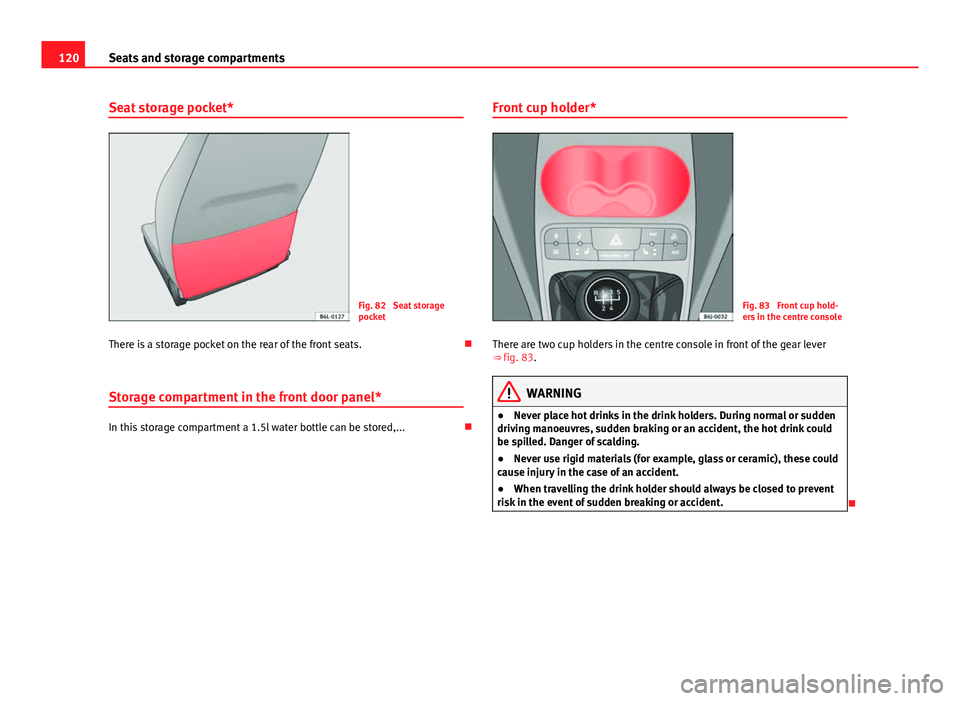
Fig. 82 Seat storage
pocket
There is a storage pocket on the rear of the front seats.
Storage compartment in the front door panel*
In this storage compartment a 1.5l water bottle can be stored,... Front cup holder*
Fig. 83 Front cup hold-
ers in the centre console
There are two cup holders in the centre console in front of the gear lever
⇒ fig. 83.
WARNING
● Never place hot drinks in the drink holders. During normal or sudden
driving manoeuvres, sudden braking or an accident, the hot drink could
be spilled. Danger of scalding.
● Never use rigid materials (for example, glass or ceramic), these could
cause injury in the case of an accident.
● When travelling the drink holder should always be closed to prevent
risk in the event of sudden breaking or accident.
Page 123 of 278
121
Seats and storage compartments
Rear drink holder*
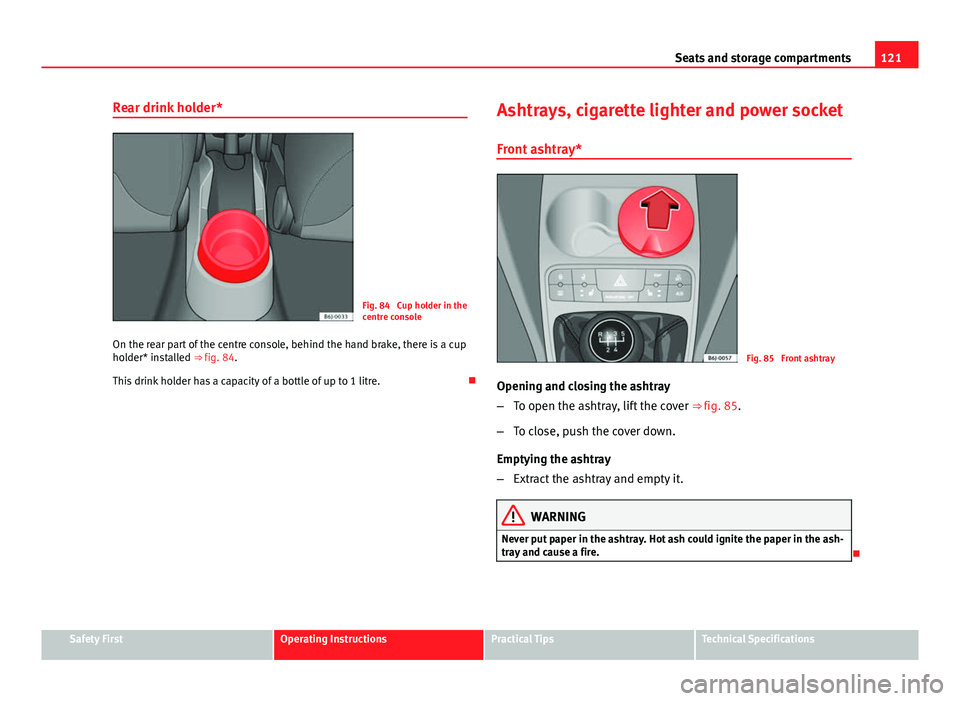
Fig. 84 Cup holder in the
centre console
On the rear part of the centre console, behind the hand brake, there is a cup
holder* installed ⇒ fig. 84.
This drink holder has a capacity of a bottle of up to 1 litre. Ashtrays, cigarette lighter and power socket
Front ashtray*
Fig. 85 Front ashtray
Opening and closing the ashtray
– To open the ashtray, lift the cover ⇒ fig. 85.
– To close, push the cover down.
Emptying the ashtray
– Extract the ashtray and empty it.
WARNING
Never put paper in the ashtray. Hot ash could ignite the paper in the ash-
tray and cause a fire.
Safety FirstOperating InstructionsPractical TipsTechnical Specifications
Page 124 of 278
122Seats and storage compartments
Cigarette lighter*
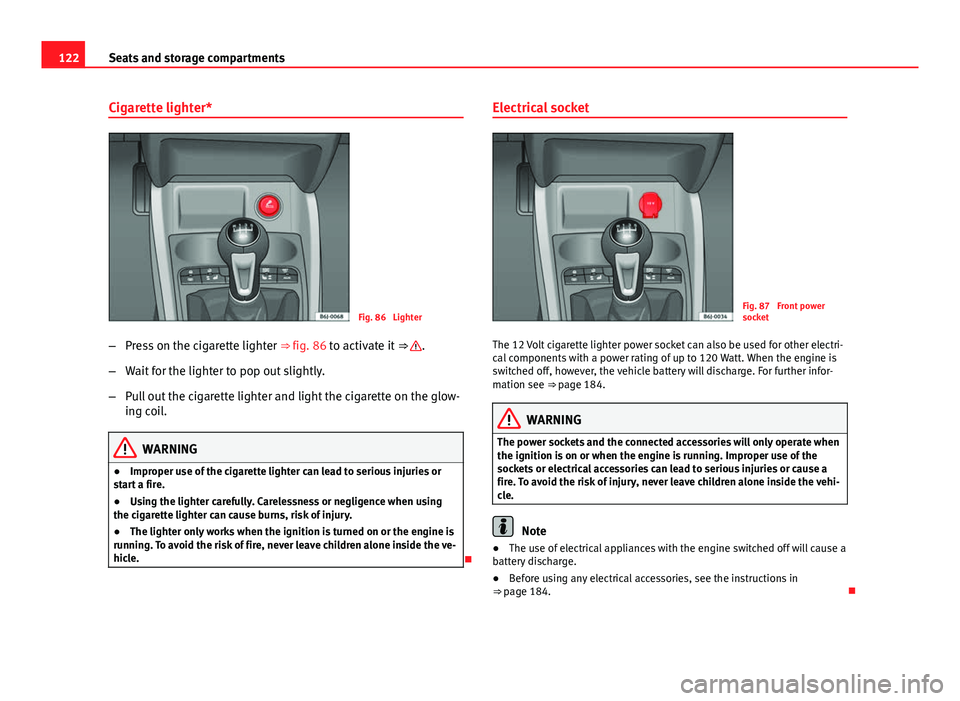
Fig. 86 Lighter
– Press on the cigarette lighter ⇒ fig. 86 to activate it ⇒
.
– Wait for the lighter to pop out slightly.
– Pull out the cigarette lighter and light the cigarette on the glow-
ing coil.
WARNING
● Improper use of the cigarette lighter can lead to serious injuries or
start a fire.
● Using the lighter carefully. Carelessness or negligence when using
the cigarette lighter can cause burns, risk of injury.
● The lighter only works when the ignition is turned on or the engine is
running. To avoid the risk of fire, never leave children alone inside the ve-
hicle.
Electrical socket
Fig. 87 Front power
socket
The 12 Volt cigarette lighter power socket can also be used for other electri-
cal components with a power rating of up to 120 Watt. When the engine is
switched off, however, the vehicle battery will discharge. For further infor-
mation see ⇒ page 184.
WARNING
The power sockets and the connected accessories will only operate when
the ignition is on or when the engine is running. Improper use of the
sockets or electrical accessories can lead to serious injuries or cause a
fire. To avoid the risk of injury, never leave children alone inside the vehi-
cle.
Note
● The use of electrical appliances with the engine switched off will cause a
battery discharge.
● Before using any electrical accessories, see the instructions in
⇒ page 184.
Page 125 of 278
123
Seats and storage compartments
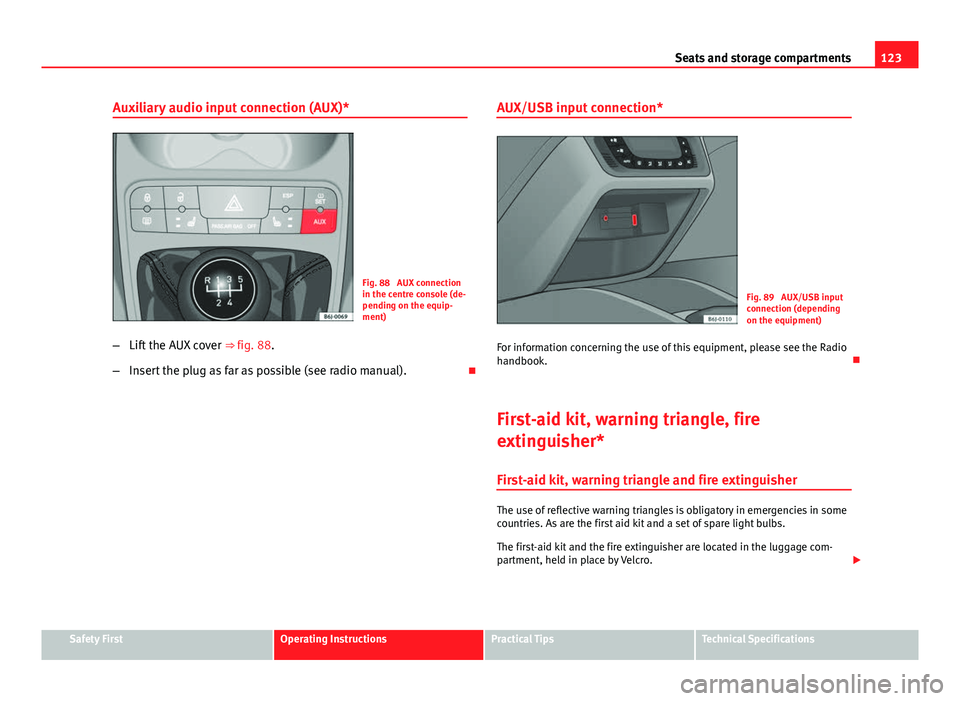
Auxiliary audio input connection (AUX)*
Fig. 88 AUX connection
in the centre console (de-
pending on the equip-
ment)
– Lift the AUX cover ⇒ fig. 88.
– Insert the plug as far as possible (see radio manual). AUX/USB input connection*Fig. 89 AUX/USB input
connection (depending
on the equipment)
For information concerning the use of this equipment, please see the Radio
handbook.
First-aid kit, warning triangle, fire
extinguisher* First-aid kit, warning triangle and fire extinguisher
The use of reflective warning triangles is obligatory in emergencies in some
countries. As are the first aid kit and a set of spare light bulbs.
The first-aid kit and the fire extinguisher are located in the luggage com-
partment, held in place by Velcro.
Safety FirstOperating InstructionsPractical TipsTechnical Specifications
Page 126 of 278
124Seats and storage compartments
The warning triangle may be located in the rear of the luggage compartment
secured by rubber bands.
Note
● The first aid kit, the warning triangles and the fire extinguisher are not
supplied with the vehicle as standard.
● The first aid kit, the warning triangles and the fire extinguisher should
meet legal requirements.
● The expiry date of the content of the first aid kit should be checked.
● Ensure that the fire extinguisher is fully functional. The fire extinguisher
should, therefore, be checked regularly. The sticker on the fire extinguisher
will inform you of the next date for checking.
● Before purchasing accessories and spare parts, see the instructions in
⇒ page 184, Accessories, replacement of parts and modifications.
Luggage compartment
Storing objects
All luggage must be securely stowed. Please observe the following points to ensure the vehicle handles
well at all times:
– Distribute the load as evenly as possible.
– Place heavy objects as far forward in the luggage compartment
as possible.
WARNING
● Loose luggage and other loose items in the vehicle may cause serious
injuries.
● Loose objects in the luggage compartment can suddenly move and
change the way the vehicle handles.
● In case of sudden manoeuvres or accidents, loose objects in the pas-
senger compartment can be flung forward, injuring passengers.
● Always put objects in the luggage compartment.
● When you transport heavy objects, always take in account that a
change in the centre of gravity can also cause changes in vehicle han-
dling.
● Please observe information on safe driving ⇒ page 7, Safe driving.
CAUTION
Hard objects on the shelf could chafe against the wires of the heating ele-
ment in the rear window and cause damage.
Note
The ventilation slots in front of the rear side windows must not be covered
as this would prevent stale air being extracted from the vehicle.