brake light Seat Ibiza 5D 2011 Owner's manual
[x] Cancel search | Manufacturer: SEAT, Model Year: 2011, Model line: Ibiza 5D, Model: Seat Ibiza 5D 2011Pages: 278, PDF Size: 3.83 MB
Page 5 of 278
Table of Contents
Manual structure . . . . . . . . . . . . . . . . . . . . 5
Content . . . . . . . . . . . . . . . . . . . . . . . . . . . . . . . . 6
Safety First . . . . . . . . . . . . . . . . . . . . . . . . . . . . 7
Safe driving . . . . . . . . . . . . . . . . . . . . . . . . . . . . . . . 7
Brief introduction . . . . . . . . . . . . . . . . . . . . . . . . . 7
Proper sitting position for occupants . . . . . . . . . 10
Pedal area . . . . . . . . . . . . . . . . . . . . . . . . . . . . . . . 16
Storing objects . . . . . . . . . . . . . . . . . . . . . . . . . . . 16
Seat belts . . . . . . . . . . . . . . . . . . . . . . . . . . . . . . . . . 18
Brief introduction . . . . . . . . . . . . . . . . . . . . . . . . . 18
Why wear seat belts? . . . . . . . . . . . . . . . . . . . . . . 20
Seat belts . . . . . . . . . . . . . . . . . . . . . . . . . . . . . . . 24
Seat belt tensioners* . . . . . . . . . . . . . . . . . . . . . . 27
Airbag system . . . . . . . . . . . . . . . . . . . . . . . . . . . . . 29
Brief introduction . . . . . . . . . . . . . . . . . . . . . . . . . 29
Front airbags . . . . . . . . . . . . . . . . . . . . . . . . . . . . . 33
Side airbags . . . . . . . . . . . . . . . . . . . . . . . . . . . . . 37
Deactivating airbags* . . . . . . . . . . . . . . . . . . . . . . 40
Child safety . . . . . . . . . . . . . . . . . . . . . . . . . . . . . . . 42
Brief introduction . . . . . . . . . . . . . . . . . . . . . . . . . 42
Child seats . . . . . . . . . . . . . . . . . . . . . . . . . . . . . . . 44
Securing child seats . . . . . . . . . . . . . . . . . . . . . . . 47
Operating Instructions . . . . . . . . . . . . . 51
Cockpit . . . . . . . . . . . . . . . . . . . . . . . . . . . . . . . . . . . 51
Overview . . . . . . . . . . . . . . . . . . . . . . . . . . . . . . . . 51
Instruments . . . . . . . . . . . . . . . . . . . . . . . . . . . . . . 53 LPG system* . . . . . . . . . . . . . . . . . . . . . . . . . . . . . 54
Digital instrument panel display . . . . . . . . . . . . . 55
Warning lamps . . . . . . . . . . . . . . . . . . . . . . . . . . . 61
Steering column controls* . . . . . . . . . . . . . . . . . 74
General information . . . . . . . . . . . . . . . . . . . . . . . 74
Audio Control . . . . . . . . . . . . . . . . . . . . . . . . . . . . . 75
Audio + Telephone Control . . . . . . . . . . . . . . . . . . 76
Unlocking and locking . . . . . . . . . . . . . . . . . . . . . 77
Central locking . . . . . . . . . . . . . . . . . . . . . . . . . . . 77
Keys . . . . . . . . . . . . . . . . . . . . . . . . . . . . . . . . . . . . 82
Radio frequency remote control* . . . . . . . . . . . . . 83
Anti-theft alarm system* . . . . . . . . . . . . . . . . . . . 85
Tailgate . . . . . . . . . . . . . . . . . . . . . . . . . . . . . . . . . 88
Windows . . . . . . . . . . . . . . . . . . . . . . . . . . . . . . . . 90
Panorama tilting sunroof* . . . . . . . . . . . . . . . . . . 93
Lights and visibility . . . . . . . . . . . . . . . . . . . . . . . . 95
Lights . . . . . . . . . . . . . . . . . . . . . . . . . . . . . . . . . . . 95
Interior lights . . . . . . . . . . . . . . . . . . . . . . . . . . . . . 102
Visibility . . . . . . . . . . . . . . . . . . . . . . . . . . . . . . . . . 103
Windscreen wipers . . . . . . . . . . . . . . . . . . . . . . . . 104
Rear view mirrors . . . . . . . . . . . . . . . . . . . . . . . . . . 107
Seats and storage compartments . . . . . . . . . . 111
The importance of correct seat adjustment . . . . . 111
Head restraints . . . . . . . . . . . . . . . . . . . . . . . . . . . 112
Front seats . . . . . . . . . . . . . . . . . . . . . . . . . . . . . . . 114
Rear seats . . . . . . . . . . . . . . . . . . . . . . . . . . . . . . . 116
Storage compartment . . . . . . . . . . . . . . . . . . . . . . 118
Ashtrays, cigarette lighter and power socket . . . 121
First-aid kit, warning triangle, fire extinguisher* 123
Luggage compartment . . . . . . . . . . . . . . . . . . . . . 124
Air conditioning . . . . . . . . . . . . . . . . . . . . . . . . . . . 126
Heating . . . . . . . . . . . . . . . . . . . . . . . . . . . . . . . . . 126
Air conditioning* . . . . . . . . . . . . . . . . . . . . . . . . . . 129 Climatronic . . . . . . . . . . . . . . . . . . . . . . . . . . . . . . 132
General notes . . . . . . . . . . . . . . . . . . . . . . . . . . . . 134
Driving . . . . . . . . . . . . . . . . . . . . . . . . . . . . . . . . . . . . 136
Steering . . . . . . . . . . . . . . . . . . . . . . . . . . . . . . . . . 136
Safety . . . . . . . . . . . . . . . . . . . . . . . . . . . . . . . . . . . 137
Ignition lock . . . . . . . . . . . . . . . . . . . . . . . . . . . . . . 137
Starting and stopping the engine . . . . . . . . . . . . 139
Start-Stop function* . . . . . . . . . . . . . . . . . . . . . . . 142
Manual gearbox . . . . . . . . . . . . . . . . . . . . . . . . . . 145
Automatic gearbox* . . . . . . . . . . . . . . . . . . . . . . . 146
Handbrake . . . . . . . . . . . . . . . . . . . . . . . . . . . . . . . 153
Acoustic parking aid system* . . . . . . . . . . . . . . . 155
Cruise speed* (Cruise control system) . . . . . . . . 158
Practical Tips . . . . . . . . . . . . . . . . . . . . . . . . . 162
Intelligent technology . . . . . . . . . . . . . . . . . . . . . 162
Brakes . . . . . . . . . . . . . . . . . . . . . . . . . . . . . . . . . . 162
Anti-lock brake system and traction control ABS 163
Electronic Stability Programme (ESP)* . . . . . . . . 164
Driving and the environment . . . . . . . . . . . . . . . 167
Running-in . . . . . . . . . . . . . . . . . . . . . . . . . . . . . . . 167
Exhaust gas purification system . . . . . . . . . . . . . 168
Economical and environmentally friendly driving 170
Driving abroad . . . . . . . . . . . . . . . . . . . . . . . . . . . . 172
Trailer towing . . . . . . . . . . . . . . . . . . . . . . . . . . . . . 173
Vehicle maintenance and cleaning . . . . . . . . . 175
General notes . . . . . . . . . . . . . . . . . . . . . . . . . . . . 175
Care of the vehicle exterior . . . . . . . . . . . . . . . . . . 176
Vehicle interior maintenance . . . . . . . . . . . . . . . . 181
3
Table of Contents
Page 6 of 278
Accessories, replacement of parts and
modifications . . . . . . . . . . . . . . . . . . . . . . . . . . . . . 184
Accessories and spare parts . . . . . . . . . . . . . . . . 184
Technical modifications . . . . . . . . . . . . . . . . . . . . 184
Roof aerial* . . . . . . . . . . . . . . . . . . . . . . . . . . . . . . 185
Mobile telephones and two-way radios . . . . . . . . 185
Fitting a towing bracket* . . . . . . . . . . . . . . . . . . . 186
Checking and refilling levels . . . . . . . . . . . . . . . 188
Refuelling . . . . . . . . . . . . . . . . . . . . . . . . . . . . . . . 188
LPG system* . . . . . . . . . . . . . . . . . . . . . . . . . . . . . 190
Petrol . . . . . . . . . . . . . . . . . . . . . . . . . . . . . . . . . . . 193
Diesel . . . . . . . . . . . . . . . . . . . . . . . . . . . . . . . . . . . 193
Working in the engine compartment . . . . . . . . . . 194
Engine oil . . . . . . . . . . . . . . . . . . . . . . . . . . . . . . . . 197
Coolant . . . . . . . . . . . . . . . . . . . . . . . . . . . . . . . . . 201
Washer fluid and windscreen wiper blades . . . . 203
Brake fluid . . . . . . . . . . . . . . . . . . . . . . . . . . . . . . . 206
Vehicle battery . . . . . . . . . . . . . . . . . . . . . . . . . . . 208
Wheels . . . . . . . . . . . . . . . . . . . . . . . . . . . . . . . . . . 210
If and when . . . . . . . . . . . . . . . . . . . . . . . . . . . . . . . 216
Vehicle tools, spare wheel . . . . . . . . . . . . . . . . . . 216
Wheel change . . . . . . . . . . . . . . . . . . . . . . . . . . . . 217
Tyre repair kit* (Tyre Mobility-System) . . . . . . . . . 222
Fuses . . . . . . . . . . . . . . . . . . . . . . . . . . . . . . . . . . . 224
Bulb change . . . . . . . . . . . . . . . . . . . . . . . . . . . . . 227
Single headlight bulb change . . . . . . . . . . . . . . . 229
Double headlight bulb change . . . . . . . . . . . . . . . 231
Changing the bulbs of AFS headlights . . . . . . . . 235
Changing the fog light bulbs . . . . . . . . . . . . . . . . 236
Changing the rear, side and interior light bulbs . 237
Jump-starting . . . . . . . . . . . . . . . . . . . . . . . . . . . . . 240
Towing and tow-starting . . . . . . . . . . . . . . . . . . . . 243 Technical Specifications
. . . . . . . . . . . 246
Description of specifications . . . . . . . . . . . . . . . 246
Important information . . . . . . . . . . . . . . . . . . . . . 246
Information on fuel consumption . . . . . . . . . . . . 248
Towing a trailer . . . . . . . . . . . . . . . . . . . . . . . . . . . 248
Wheels . . . . . . . . . . . . . . . . . . . . . . . . . . . . . . . . . . 249
Technical specifications . . . . . . . . . . . . . . . . . . . . 250
Checking fluid levels . . . . . . . . . . . . . . . . . . . . . . . 250
Petrol engine 1.2 44 kW (60 PS) . . . . . . . . . . . . . 251
Petrol engine 1.2 51 kW (70 PS) . . . . . . . . . . . . . 252
Petrol engine/LPG 1.6 60 kW (81 PS) . . . . . . . . . 253
Petrol engine 1.4 63 kW (85 PS) . . . . . . . . . . . . . 254
Petrol engine 1.2 TSI 77 kW (105 PS) . . . . . . . . . 255
Petrol engine 1.2 TSI 77 kW (105 PS) Start-Stop 256
Petrol engine 1.6 77 kW (105 PS) . . . . . . . . . . . . 257
Petrol engine 1.4 110 kW (150 PS) . . . . . . . . . . . 258
Diesel engine 1.2 TDI CR 55 kW (75 PS) DPF
Start-Stop Ecomotive . . . . . . . . . . . . . . . . . . . . . . 259
Diesel engine 1.2 TDI CR 55 kW (75 PS) DPF . . . . 260
Diesel engine 1.6 TDI CR 66 kW (90 PS) DPF . . . . 261
Diesel engine 1.6 TDI CR 77 kW (105 PS) with/
without DPF . . . . . . . . . . . . . . . . . . . . . . . . . . . . . . 262
Diesel engine 2.0 TDI CR 105 kW (143 PS) DPF . 263
Dimensions and capacities . . . . . . . . . . . . . . . . . 265
Index . . . . . . . . . . . . . . . . . . . . . . . . . . . . . . . . . . . 267
4Table of Contents
Page 12 of 278
10Safe driving
Proper sitting position for occupants
Proper sitting position for driver
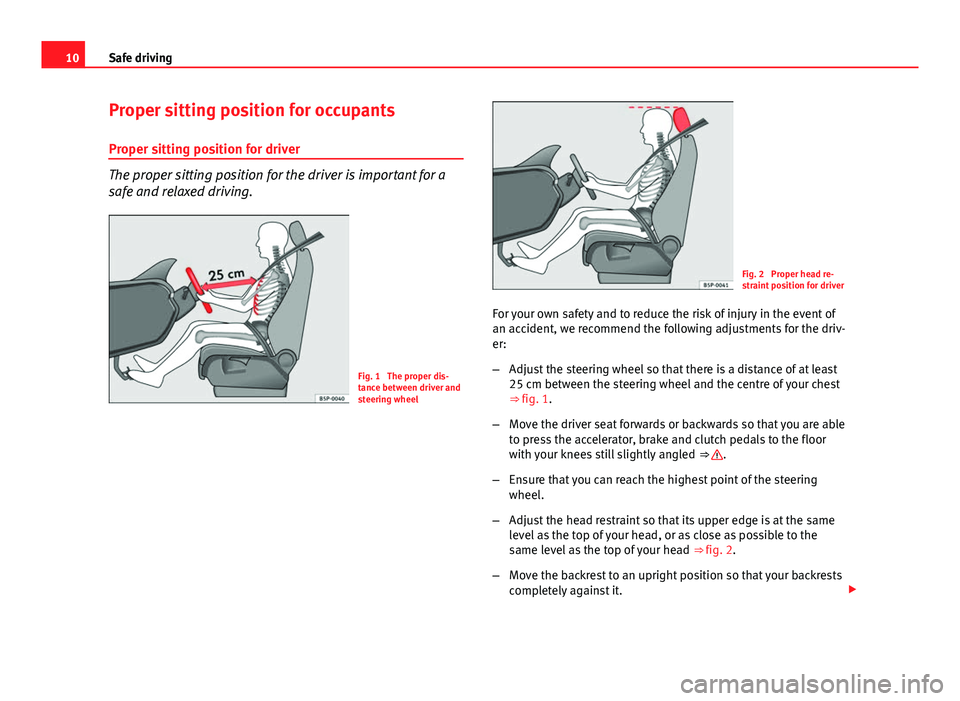
The proper sitting position for the driver is important for a
safe and relaxed driving.
Fig. 1 The proper dis-
tance between driver and
steering wheel
Fig. 2 Proper head re-
straint position for driver
For your own safety and to reduce the risk of injury in the event of
an accident, we recommend the following adjustments for the driv-
er:
– Adjust the steering wheel so that there is a distance of at least
25 cm between the steering wheel and the centre of your chest
⇒ fig. 1.
– Move the driver seat forwards or backwards so that you are able
to press the accelerator, brake and clutch pedals to the floor
with your knees still slightly angled ⇒
.
– Ensure that you can reach the highest point of the steering
wheel.
– Adjust the head restraint so that its upper edge is at the same
level as the top of your head, or as close as possible to the
same level as the top of your head ⇒ fig. 2.
– Move the backrest to an upright position so that your backrests
completely against it.
Page 53 of 278
51
Cockpit
Operating Instructions Cockpit
Overview Overview of the dash panel
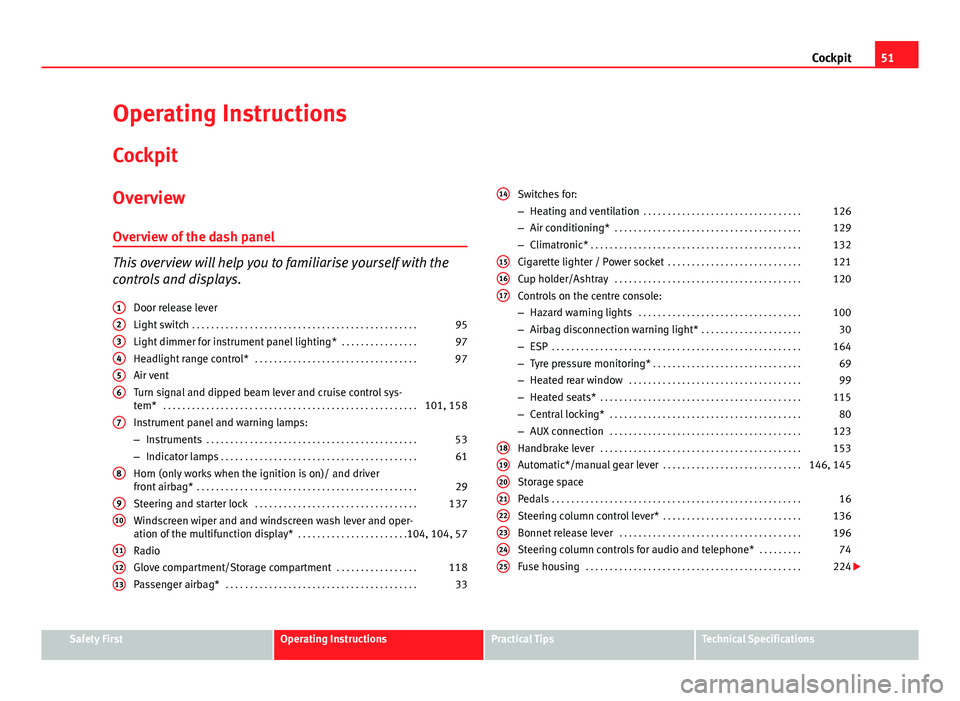
This overview will help you to familiarise yourself with the
controls and displays. Door release lever
Light switch . . . . . . . . . . . . . . . . . . . . . . . . . . . . . . . . . . . . . . . . . . . . . . . 95
Light dimmer for instrument panel lighting* . . . . . . . . . . . . . . . .97
Headlight range control* . . . . . . . . . . . . . . . . . . . . . . . . . . . . . . . . . . 97
Air vent
Turn signal and dipped beam lever and cruise control sys-
tem* . . . . . . . . . . . . . . . . . . . . . . . . . . . . . . . . . . . . . . . . . . . . . . . . . . . . . 101, 158
Instrument panel and warning lamps:
– Instruments . . . . . . . . . . . . . . . . . . . . . . . . . . . . . . . . . . . . . . . . . . . . 53
– Indicator lamps . . . . . . . . . . . . . . . . . . . . . . . . . . . . . . . . . . . . . . . . . 61
Horn (only works when the ignition is on)/ and driver
front airbag* . . . . . . . . . . . . . . . . . . . . . . . . . . . . . . . . . . . . . . . . . . . . . . 29
Steering and starter lock . . . . . . . . . . . . . . . . . . . . . . . . . . . . . . . . . . 137
Windscreen wiper and and windscreen wash lever and oper-
ation of the multifunction display* . . . . . . . . . . . . . . . . . . . . . . . . .104, 104, 57
Radio
Glove compartment/Storage compartment . . . . . . . . . . . . . . . . .118
Passenger airbag* . . . . . . . . . . . . . . . . . . . . . . . . . . . . . . . . . . . . . . . . 33
1
23456
7
8
910
111213
Switches for:
–
Heating and ventilation . . . . . . . . . . . . . . . . . . . . . . . . . . . . . . . . . 126
– Air conditioning* . . . . . . . . . . . . . . . . . . . . . . . . . . . . . . . . . . . . . . . 129
– Climatronic* . . . . . . . . . . . . . . . . . . . . . . . . . . . . . . . . . . . . . . . . . . . . 132
Cigarette lighter / Power socket . . . . . . . . . . . . . . . . . . . . . . . . . . . . 121
Cup holder/Ashtray . . . . . . . . . . . . . . . . . . . . . . . . . . . . . . . . . . . . . . . 120
Controls on the centre console:
– Hazard warning lights . . . . . . . . . . . . . . . . . . . . . . . . . . . . . . . . . . 100
– Airbag disconnection warning light* . . . . . . . . . . . . . . . . . . . . .30
– ESP . . . . . . . . . . . . . . . . . . . . . . . . . . . . . . . . . . . . . . . . . . . . . . . . . . . . 164
– Tyre pressure monitoring* . . . . . . . . . . . . . . . . . . . . . . . . . . . . . . . 69
– Heated rear window . . . . . . . . . . . . . . . . . . . . . . . . . . . . . . . . . . . . 99
– Heated seats* . . . . . . . . . . . . . . . . . . . . . . . . . . . . . . . . . . . . . . . . . . 115
– Central locking* . . . . . . . . . . . . . . . . . . . . . . . . . . . . . . . . . . . . . . . . 80
– AUX connection . . . . . . . . . . . . . . . . . . . . . . . . . . . . . . . . . . . . . . . . 123
Handbrake lever . . . . . . . . . . . . . . . . . . . . . . . . . . . . . . . . . . . . . . . . . . 153
Automatic*/manual gear lever . . . . . . . . . . . . . . . . . . . . . . . . . . . . . 146, 145
Storage space
Pedals . . . . . . . . . . . . . . . . . . . . . . . . . . . . . . . . . . . . . . . . . . . . . . . . . . . . 16
Steering column control lever* . . . . . . . . . . . . . . . . . . . . . . . . . . . . . 136
Bonnet release lever . . . . . . . . . . . . . . . . . . . . . . . . . . . . . . . . . . . . . . 196
Steering column controls for audio and telephone* . . . . . . . . .74
Fuse housing . . . . . . . . . . . . . . . . . . . . . . . . . . . . . . . . . . . . . . . . . . . . . 224
14
151617
1819202122232425
Safety FirstOperating InstructionsPractical TipsTechnical Specifications
Page 64 of 278
62Cockpit
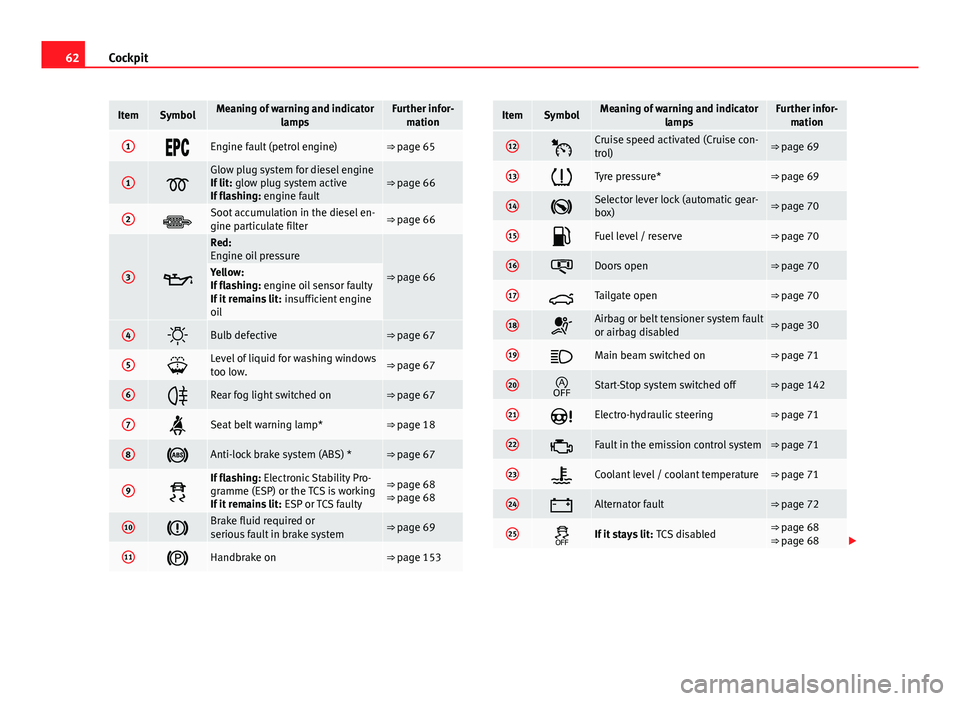
ItemSymbolMeaning of warning and indicator
lampsFurther infor-mation
1Engine fault (petrol engine)⇒ page 65
1Glow plug system for diesel engine
If lit: glow plug system active
If flashing: engine fault⇒ page 66
2Soot accumulation in the diesel en-
gine particulate filter⇒ page 66
3
Red:
Engine oil pressure
⇒ page 66Yellow:
If flashing: engine oil sensor faulty
If it remains lit: insufficient engine
oil
4Bulb defective⇒ page 67
5Level of liquid for washing windows
too low.⇒ page 67
6Rear fog light switched on⇒ page 67
7Seat belt warning lamp*⇒ page 18
8Anti-lock brake system (ABS) *⇒ page 67
9
If flashing: Electronic Stability Pro-
gramme (ESP) or the TCS is working
If it remains lit: ESP or TCS faulty⇒ page 68
⇒ page 68
10Brake fluid required or
serious fault in brake system⇒ page 69
11Handbrake on⇒ page 153
ItemSymbolMeaning of warning and indicator
lampsFurther infor-mation
12Cruise speed activated (Cruise con-
trol)⇒ page 69
13Tyre pressure*⇒ page 69
14Selector lever lock (automatic gear-
box)⇒ page 70
15Fuel level / reserve⇒ page 70
16Doors open⇒ page 70
17Tailgate open⇒ page 70
18Airbag or belt tensioner system fault
or airbag disabled⇒ page 30
19Main beam switched on⇒ page 71
20Start-Stop system switched off⇒ page 142
21Electro-hydraulic steering⇒ page 71
22Fault in the emission control system⇒ page 71
23Coolant level / coolant temperature⇒ page 71
24Alternator fault⇒ page 72
25If it stays lit: TCS disabled⇒ page 68
⇒ page 68
Page 66 of 278
64Cockpit
WARNING
● Failure to observe warning lamps and warning messages can result in
serious personal injury or damage to your vehicle.
● The risk of an accident increases if your vehicle breaks down. Use a
warning triangle to draw the attention of other road users in order to pre-
vent danger to third parties.
● The engine compartment is a dangerous area! Before you open the
bonnet to work on the engine or in the engine compartment, you must
switch the engine off and allow it to cool to reduce the risk of scalding or
other injuries. Read and observe the relevant warnings ⇒ page 194.
Note
● The appropriate warning lamp for a fault will light up in vehicles without
warning or information messages in the display.
● In vehicles with warning or information texts on the screen, the appro-
priate warning lamp for a fault will light up and a warning or information
message will also appear on the screen.
Warning symbols
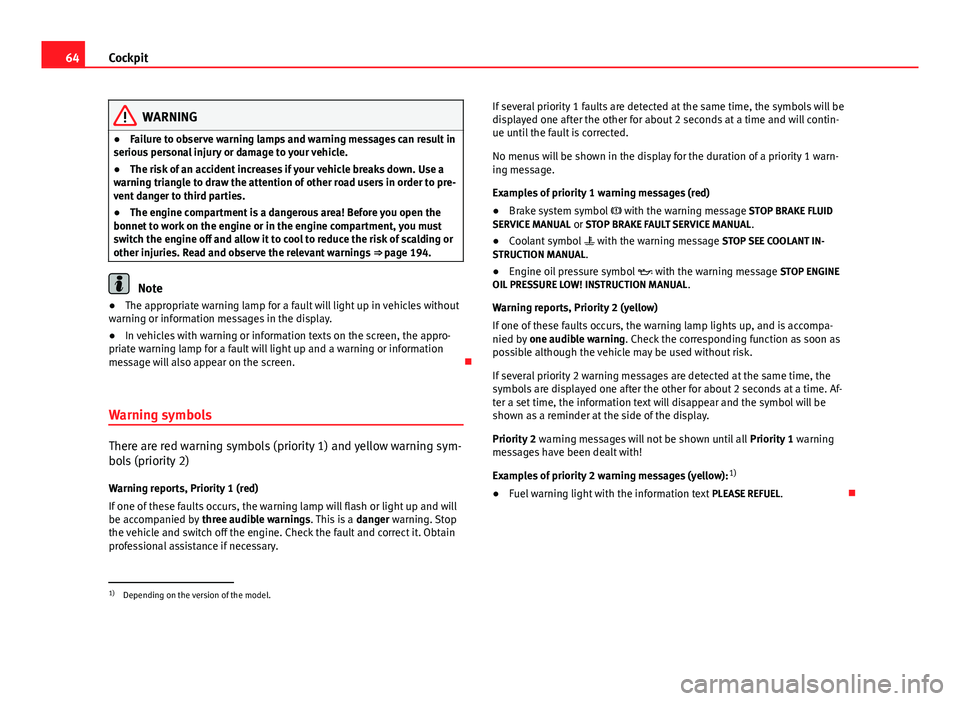
There are red warning symbols (priority 1) and yellow warning sym-
bols (priority 2) Warning reports, Priority 1 (red)
If one of these faults occurs, the warning lamp will flash or light up and will
be accompanied by three audible warnings. This is a danger warning. Stop
the vehicle and switch off the engine. Check the fault and correct it. Obtain
professional assistance if necessary. If several priority 1 faults are detected at the same time, the symbols will be
displayed one after the other for about 2 seconds at a time and will contin-
ue until the fault is corrected.
No menus will be shown in the display for the duration of a priority 1 warn-
ing message.
Examples of priority 1 warning messages (red)
●
Brake system symbol with the warning message STOP BRAKE FLUID
SERVICE MANUAL or STOP BRAKE FAULT SERVICE MANUAL .
● Coolant symbol with the warning message STOP SEE COOLANT IN-
STRUCTION MANUAL.
● Engine oil pressure symbol with the warning message STOP ENGINE
OIL PRESSURE LOW! INSTRUCTION MANUAL .
Warning reports, Priority 2 (yellow)
If one of these faults occurs, the warning lamp lights up, and is accompa-
nied by one audible warning. Check the corresponding function as soon as
possible although the vehicle may be used without risk.
If several priority 2 warning messages are detected at the same time, the
symbols are displayed one after the other for about 2 seconds at a time. Af-
ter a set time, the information text will disappear and the symbol will be
shown as a reminder at the side of the display.
Priority 2 warning messages will not be shown until all Priority 1 warning
messages have been dealt with!
Examples of priority 2 warning messages (yellow): 1)
● Fuel warning light with the information text PLEASE REFUEL.
1)
Depending on the version of the model.
Page 67 of 278
65
Cockpit
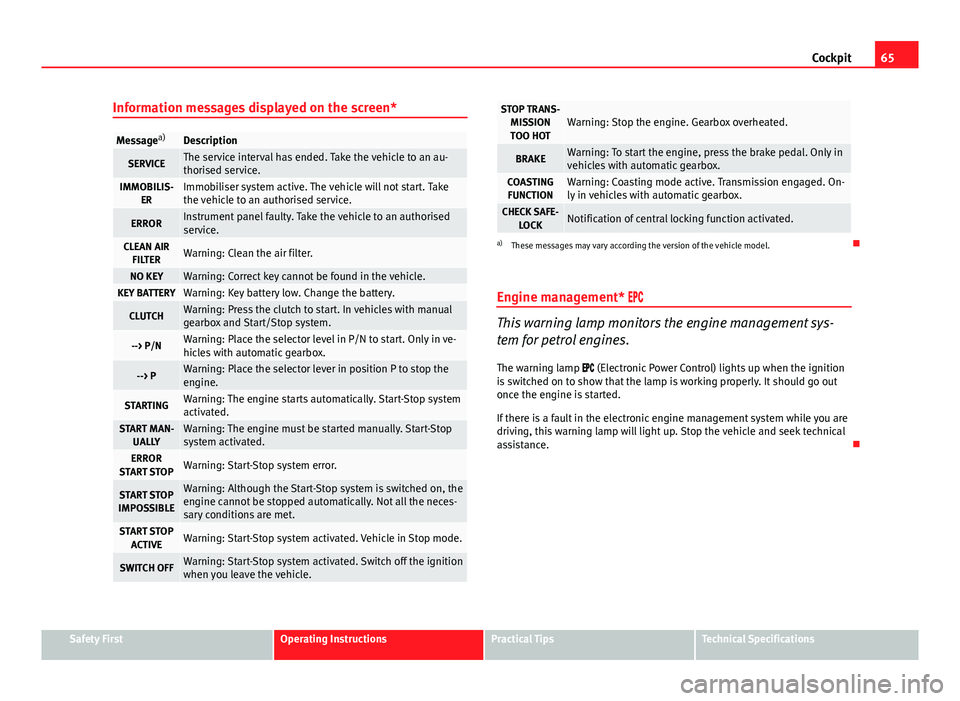
Information messages displayed on the screen*
Message a)Description
SERVICEThe service interval has ended. Take the vehicle to an au-
thorised service.
IMMOBILIS-
ERImmobiliser system active. The vehicle will not start. Take
the vehicle to an authorised service.
ERRORInstrument panel faulty. Take the vehicle to an authorised
service.
CLEAN AIRFILTERWarning: Clean the air filter.
NO KEYWarning: Correct key cannot be found in the vehicle.KEY BATTERYWarning: Key battery low. Change the battery.
CLUTCHWarning: Press the clutch to start. In vehicles with manual
gearbox and Start/Stop system.
--> P/NWarning: Place the selector level in P/N to start. Only in ve-
hicles with automatic gearbox.
--> PWarning: Place the selector lever in position P to stop the
engine.
STARTINGWarning: The engine starts automatically. Start-Stop system
activated.
START MAN- UALLYWarning: The engine must be started manually. Start-Stop
system activated.
ERROR
START STOPWarning: Start-Stop system error.
START STOP
IMPOSSIBLEWarning: Although the Start-Stop system is switched on, the
engine cannot be stopped automatically. Not all the neces-
sary conditions are met.
START STOP ACTIVEWarning: Start-Stop system activated. Vehicle in Stop mode.
SWITCH OFFWarning: Start-Stop system activated. Switch off the ignition
when you leave the vehicle.
STOP TRANS-MISSIONTOO HOTWarning: Stop the engine. Gearbox overheated.
BRAKEWarning: To start the engine, press the brake pedal. Only in
vehicles with automatic gearbox.
COASTING FUNCTIONWarning: Coasting mode active. Transmission engaged. On-
ly in vehicles with automatic gearbox.
CHECK SAFE- LOCKNotification of central locking function activated.
a)These messages may vary according the version of the vehicle model.
Engine management*
This warning lamp monitors the engine management sys-
tem for petrol engines.
The warning lamp (Electronic Power Control) lights up when the ignition
is switched on to show that the lamp is working properly. It should go out
once the engine is started.
If there is a fault in the electronic engine management system while you are
driving, this warning lamp will light up. Stop the vehicle and seek technical
assistance.
Safety FirstOperating InstructionsPractical TipsTechnical Specifications
Page 69 of 278
67
Cockpit
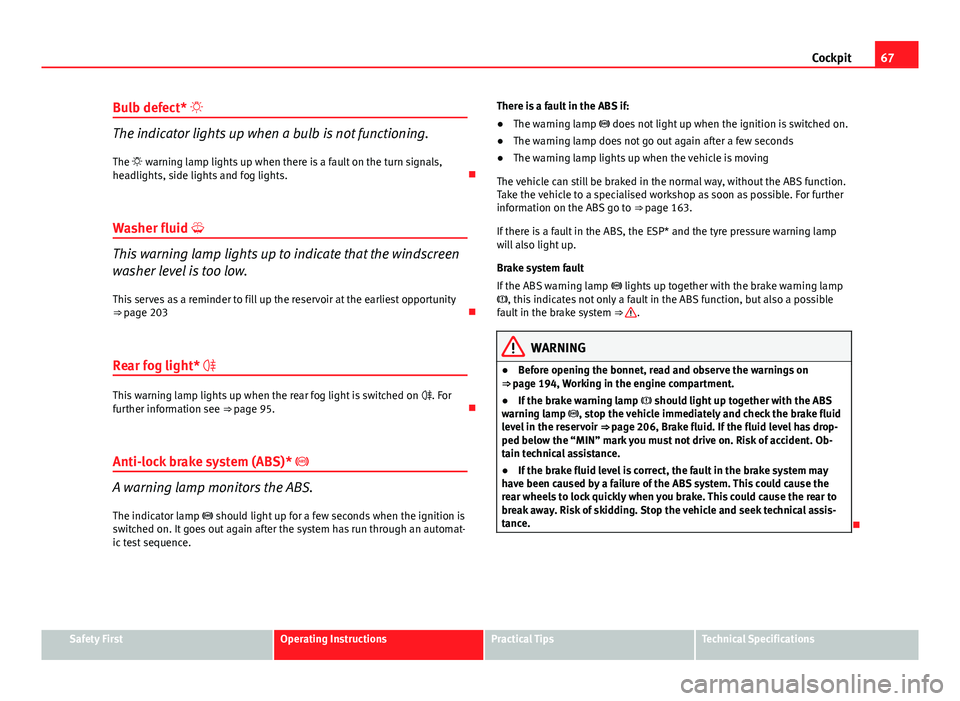
Bulb defect*
The indicator lights up when a bulb is not functioning. The warning lamp lights up when there is a fault on the turn signals,
headlights, side lights and fog lights.
Washer fluid
This warning lamp lights up to indicate that the windscreen
washer level is too low. This serves as a reminder to fill up the reservoir at the earliest opportunity
⇒ page 203
Rear fog light*
This warning lamp lights up when the rear fog light is switched on . For
further information see ⇒ page 95.
Anti-lock brake system (ABS)*
A warning lamp monitors the ABS. The indicator lamp should light up for a few seconds when the ignition is
switched on. It goes out again after the system has run through an automat-
ic test sequence. There is a fault in the ABS if:
●
The warning lamp does not light up when the ignition is switched on.
● The warning lamp does not go out again after a few seconds
● The warning lamp lights up when the vehicle is moving
The vehicle can still be braked in the normal way, without the ABS function.
Take the vehicle to a specialised workshop as soon as possible. For further
information on the ABS go to ⇒ page 163.
If there is a fault in the ABS, the ESP* and the tyre pressure warning lamp
will also light up.
Brake system fault
If the ABS warning lamp lights up together with the brake warning lamp
, this indicates not only a fault in the ABS function, but also a possible
fault in the brake system ⇒
.
WARNING
● Before opening the bonnet, read and observe the warnings on
⇒ page 194, Working in the engine compartment.
● If the brake warning lamp should light up together with the ABS
warning lamp , stop the vehicle immediately and check the brake fluid
level in the reservoir ⇒ page 206, Brake fluid. If the fluid level has drop-
ped below the “MIN” mark you must not drive on. Risk of accident. Ob-
tain technical assistance.
● If the brake fluid level is correct, the fault in the brake system may
have been caused by a failure of the ABS system. This could cause the
rear wheels to lock quickly when you brake. This could cause the rear to
break away. Risk of skidding. Stop the vehicle and seek technical assis-
tance.
Safety FirstOperating InstructionsPractical TipsTechnical Specifications
Page 70 of 278
68Cockpit
Differential lock fault (EDL)*
EDL operates along with the ABS in vehicles equipped with
an Electronic Stability Programme (ESP)*
A malfunction in the EDL is indicated by the ABS warning lamp . Take the
vehicle to a specialised workshop as soon as possible. For further informa-
tion on the EDL see ⇒ page 165, Electronic differential lock (EDL)*.
Traction control system (TCS)* /
The traction control system prevents the driven wheels from
spinning when the vehicle is accelerating
There are two warning lamps for the traction control system: and . Both
warning lamps light up together when the ignition is switched on and
should turn off after approximately 2 seconds. This is the time taken for the
function check.
The lamp has the following function:
● It flashes when the TCS is on, and the vehicle is moving.
If the system is deactivated or if it has any fault, the warning lamp will re-
main lit. It will also come on if a fault should occur in the ABS because the
TCS operates in conjunction with the ABS. For further information, see
⇒ page 162, Brakes
The lamp provides information about the disconnection status of the
system:
● It stays lit when the TCS is disconnected after pressing the TCS OFF
switch.
By pressing again, TCS function is reactivated and the warning lamp switch-
ed off. Electronic Stability Programme (ESP)* /
There are two warning lamps for the electronic stability pro-
gramme. The lamp provides information concerning the
function and the
provides information on the disconnec-
tion status
Both warning lamps light up together when the ignition is switched on and
should turn off after approximately 2 seconds. This is the time taken for the
function check.
This programme includes the ABS, EDL and TCS. It also includes emergency
braking assistance (BAS).
The warning lamp has the following functions:
● It flashes when the TCS/ESP is activated when driving.
● It will light up continuously if there is a malfunction in the ESP.
● It will also come on if a fault should occur in the ABS because the ESP
operates in conjunction with the ABS.
If the ESP warning lamp lights up and stays on after the engine is started,
this may mean that the control system has temporarily switched off the ESP.
In this case the ESP can be reactivated by switching the ignition off and
then on again. If the warning lamp goes out, this means the system is fully
functional.
The lamp provides information about the disconnection status of the
system:
● It stays lit when the TCS is disconnected after pressing the switch.
Page 71 of 278
69
Cockpit
Brake system*
This warning lamp lights up if the brake fluid level is too low
or if there is a fault in the system.
This warning lamp lights up if
● the brake fluid level is too low ⇒ page 206.
● there is a fault in the brake system.
This warning lamp can light up together with the ABS system warning lamp.
WARNING
● If the brake warning lamp does not go out, or if it lights up when driv-
ing, the brake fluid level ⇒ page 206, Brake fluid in the reservoir is too
low. Risk of accident. Stop the vehicle and do not drive on. Obtain techni-
cal assistance.
● If the brake warning lamp lights up together with the ABS warning
lamp , the control function of the ABS could be out of action. This could
cause the rear wheels to lock quickly when you brake. This could cause
the rear to break away. Risk of skidding. Stop the vehicle and seek tech-
nical assistance.
Cruise speed (Cruise control)*
The warning lamp comes on when the cruise control system
is switched on.
The warning lamp lights up when the cruise control system is switched
on. For further information on the cruise control system, see ⇒ page 158.Tyre pressure*
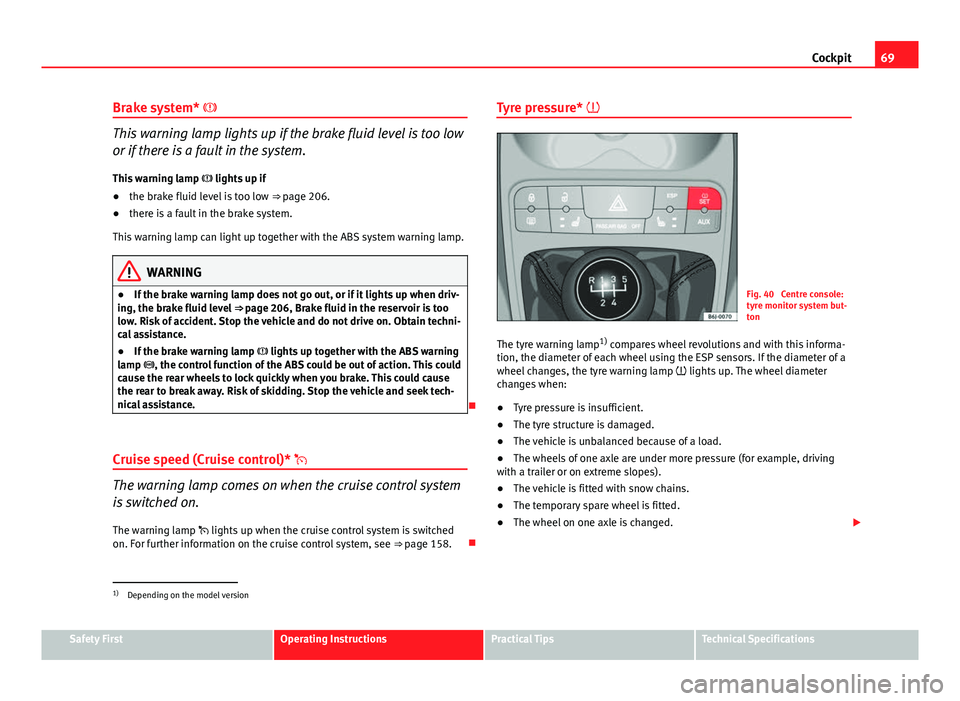
Fig. 40 Centre console:
tyre monitor system but-
ton
The tyre warning lamp 1)
compares wheel revolutions and with this informa-
tion, the diameter of each wheel using the ESP sensors. If the diameter of a
wheel changes, the tyre warning lamp lights up. The wheel diameter
changes when:
● Tyre pressure is insufficient.
● The tyre structure is damaged.
● The vehicle is unbalanced because of a load.
● The wheels of one axle are under more pressure (for example, driving
with a trailer or on extreme slopes).
● The vehicle is fitted with snow chains.
● The temporary spare wheel is fitted.
● The wheel on one axle is changed.
1)
Depending on the model version
Safety FirstOperating InstructionsPractical TipsTechnical Specifications