height adjustment Seat Ibiza 5D 2011 Owner's manual
[x] Cancel search | Manufacturer: SEAT, Model Year: 2011, Model line: Ibiza 5D, Model: Seat Ibiza 5D 2011Pages: 278, PDF Size: 3.83 MB
Page 15 of 278
13
Safe driving
Correct adjustment of head restraints
Properly adjusted head restraints are an important part of
passenger protection and can reduce the risk of injuries in
most accident situations.
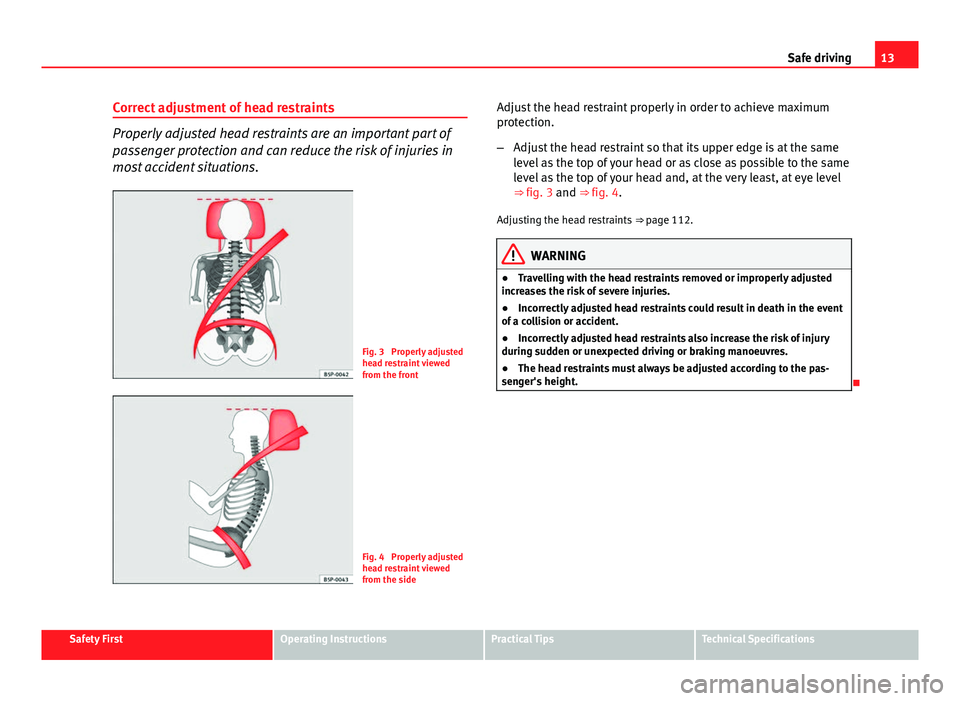
Fig. 3 Properly adjusted
head restraint viewed
from the front
Fig. 4 Properly adjusted
head restraint viewed
from the side Adjust the head restraint properly in order to achieve maximum
protection.
–
Adjust the head restraint so that its upper edge is at the same
level as the top of your head or as close as possible to the same
level as the top of your head and, at the very least, at eye level
⇒ fig. 3 and ⇒ fig. 4.
Adjusting the head restraints ⇒ page 112.
WARNING
● Travelling with the head restraints removed or improperly adjusted
increases the risk of severe injuries.
● Incorrectly adjusted head restraints could result in death in the event
of a collision or accident.
● Incorrectly adjusted head restraints also increase the risk of injury
during sudden or unexpected driving or braking manoeuvres.
● The head restraints must always be adjusted according to the pas-
senger's height.
Safety FirstOperating InstructionsPractical TipsTechnical Specifications
Page 45 of 278
43
Child safety
WARNING
● Never install a child seat facing backwards on the front passenger
seat unless the front passenger airbag has been disabled. This could
lead to a risk of potentially fatal injuries to the child! However, if it is nec-
essary, in exceptional cases, to transport a child in the front passenger
seat, the front passenger airbag must always be disabled ⇒ page 40, De-
activating airbags*. If the passenger seat has a height adjustment op-
tion, move it to the highest position.
● For those vehicles that do not include a key lock switch to disconnect
the airbag, the vehicle must be taken to a Technical Service.
● All passengers, especially children, must assume the proper sitting
position and be properly belted in while travelling.
● Never hold children or babies on your lap, this can result in potential-
ly fatal injuries to the child!
● Never allow a child to be transported in a vehicle without being prop-
erly secured, or to stand up or kneel on a seat while travelling. In an acci-
dent, the child could be flung through the vehicle, causing possibly fatal
injuries to themselves and to the other passengers.
● If children assume an improper sitting position when the vehicle is
moving, they expose themselves to greater risk of injury in the event of a
sudden braking manoeuvre or in an accident. This is particularly impor-
tant if the child is travelling on the front passenger seat and the airbag
system is triggered in an accident; as this could cause serious injury or
even death.
● A suitable child seat can protect your child!
● Never leave an unsupervised child alone on a child seat or in the vehi-
cle.
● Depending on weather conditions, it may become extremely hot or
cold inside the vehicle. This can be fatal.WARNING (Continued)
● Children who are less than 1.5 metres tall must not wear a normal
seat belt without a child seat, as this could cause injuries to the abdomi-
nal and neck areas during a sudden braking manoeuvre or in an accident.
● Do not allow the seat belt to become twisted or jammed, or to rub on
any sharp edges.
● Incorrectly worn seat belts can cause injuries even in a minor colli-
sion or in sudden braking manoeuvres.
● The seat belt provides maximum protection only when the seat belt is
properly positioned ⇒ page 24, Seat belts.
● Only one child may occupy a child seat ⇒ page 44, Child seats.
Safety FirstOperating InstructionsPractical TipsTechnical Specifications
Page 114 of 278
112Seats and storage compartments
Head restraints
Correct adjustment of head restraints
Properly adjusted head restraints are an important part of
passenger protection and can reduce the risk of injuries in
most accident situations.
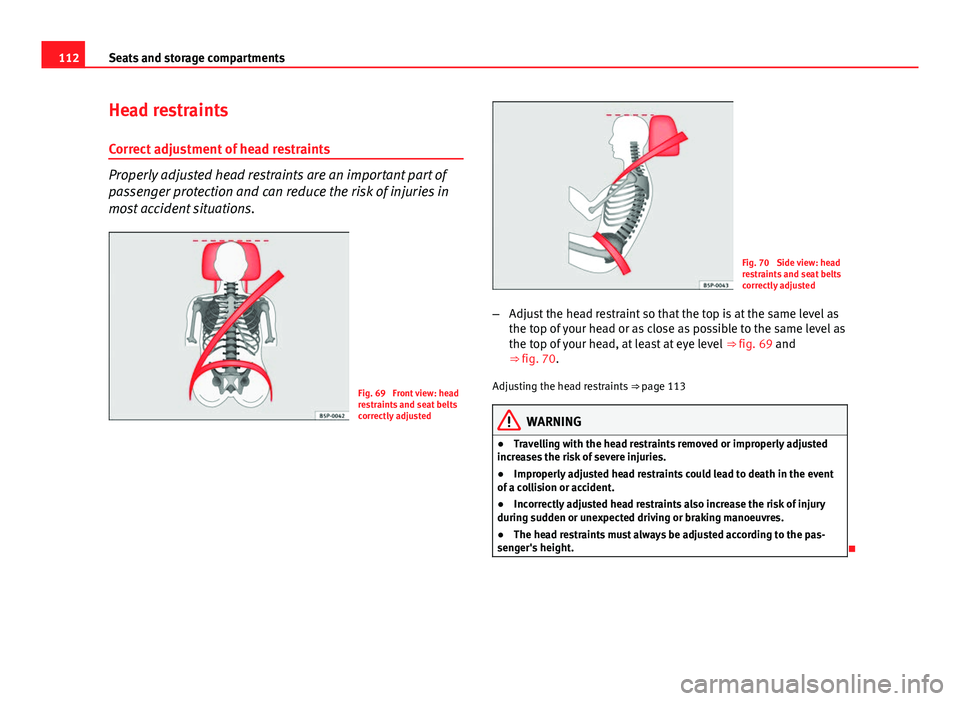
Fig. 69 Front view: head
restraints and seat belts
correctly adjusted
Fig. 70 Side view: head
restraints and seat belts
correctly adjusted
– Adjust the head restraint so that the top is at the same level as
the top of your head or as close as possible to the same level as
the top of your head, at least at eye level ⇒ fig. 69 and
⇒ fig. 70.
Adjusting the head restraints ⇒ page 113
WARNING
● Travelling with the head restraints removed or improperly adjusted
increases the risk of severe injuries.
● Improperly adjusted head restraints could lead to death in the event
of a collision or accident.
● Incorrectly adjusted head restraints also increase the risk of injury
during sudden or unexpected driving or braking manoeuvres.
● The head restraints must always be adjusted according to the pas-
senger's height.
Page 116 of 278
114Seats and storage compartments
Front seats
Adjustment of the front seats
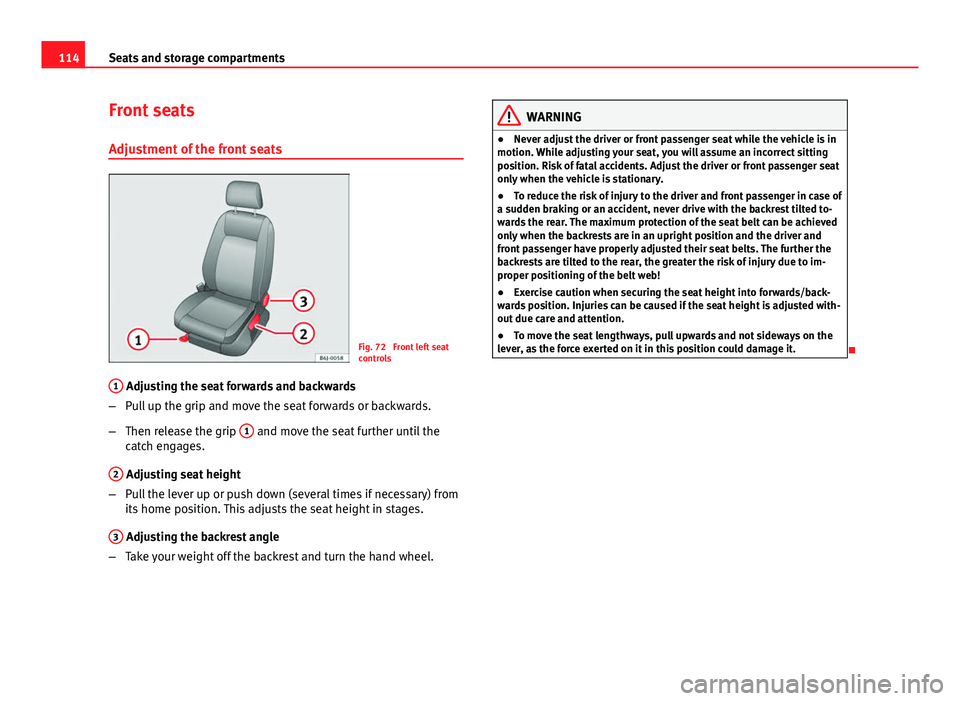
Fig. 72 Front left seat
controls
1
Adjusting the seat forwards and backwards
– Pull up the grip and move the seat forwards or backwards.
– Then release the grip 1
and move the seat further until the
catch engages.
2
Adjusting seat height
– Pull the lever up or push down (several times if necessary) from
its home position. This adjusts the seat height in stages.
3
Adjusting the backrest angle
– Take your weight off the backrest and turn the hand wheel.
WARNING
● Never adjust the driver or front passenger seat while the vehicle is in
motion. While adjusting your seat, you will assume an incorrect sitting
position. Risk of fatal accidents. Adjust the driver or front passenger seat
only when the vehicle is stationary.
● To reduce the risk of injury to the driver and front passenger in case of
a sudden braking or an accident, never drive with the backrest tilted to-
wards the rear. The maximum protection of the seat belt can be achieved
only when the backrests are in an upright position and the driver and
front passenger have properly adjusted their seat belts. The further the
backrests are tilted to the rear, the greater the risk of injury due to im-
proper positioning of the belt web!
● Exercise caution when securing the seat height into forwards/back-
wards position. Injuries can be caused if the seat height is adjusted with-
out due care and attention.
● To move the seat lengthways, pull upwards and not sideways on the
lever, as the force exerted on it in this position could damage it.
Page 138 of 278
136Driving
Driving
SteeringAdjusting the steering wheel position
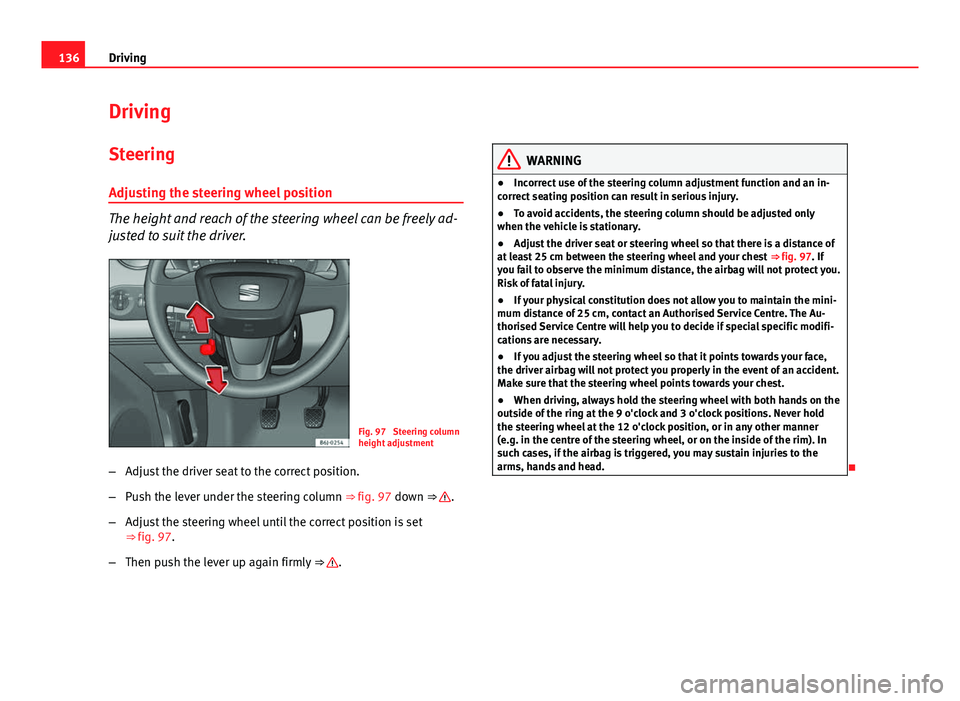
The height and reach of the steering wheel can be freely ad-
justed to suit the driver.
Fig. 97 Steering column
height adjustment
– Adjust the driver seat to the correct position.
– Push the lever under the steering column ⇒ fig. 97 down ⇒
.
– Adjust the steering wheel until the correct position is set
⇒ fig. 97.
– Then push the lever up again firmly ⇒
.
WARNING
● Incorrect use of the steering column adjustment function and an in-
correct seating position can result in serious injury.
● To avoid accidents, the steering column should be adjusted only
when the vehicle is stationary.
● Adjust the driver seat or steering wheel so that there is a distance of
at least 25 cm between the steering wheel and your chest ⇒ fig. 97. If
you fail to observe the minimum distance, the airbag will not protect you.
Risk of fatal injury.
● If your physical constitution does not allow you to maintain the mini-
mum distance of 25 cm, contact an Authorised Service Centre. The Au-
thorised Service Centre will help you to decide if special specific modifi-
cations are necessary.
● If you adjust the steering wheel so that it points towards your face,
the driver airbag will not protect you properly in the event of an accident.
Make sure that the steering wheel points towards your chest.
● When driving, always hold the steering wheel with both hands on the
outside of the ring at the 9 o'clock and 3 o'clock positions. Never hold
the steering wheel at the 12 o'clock position, or in any other manner
(e.g. in the centre of the steering wheel, or on the inside of the rim). In
such cases, if the airbag is triggered, you may sustain injuries to the
arms, hands and head.
Page 275 of 278
Speedometer . . . . . . . . . . . . . . . . . . . . . . . . . . . 54
Speed selector lever lockWarning lamp . . . . . . . . . . . . . . . . . . . . . . . . 70
Start-Stop Activating and deactivating . . . . . . . . . . . . 144
Function . . . . . . . . . . . . . . . . . . . . . . . . . . . 142
Starting petrol engines . . . . . . . . . . . . . . . . . . 139
Starting Petrol engines . . . . . . . . . . . . . . . . . . 140
Starting the engine . . . . . . . . . . . . . . . . . 139, 140 After the fuel tank has been run dry . . . . . 140
Steam jets . . . . . . . . . . . . . . . . . . . . . . . . . . . . . 177
Steering . . . . . . . . . . . . . . . . . . . . . . . . . . . . . . 136 Steering lock . . . . . . . . . . . . . . . . . . . . . . . . 137
Steering column controls Audio Control . . . . . . . . . . . . . . . . . . . . . . . . 74
Steering wheel height adjustment . . . . . . . . . 136
Storage compartment Front passenger side . . . . . . . . . . . . . . . . . 118
Front right seat . . . . . . . . . . . . . . . . . . . . . . 119
Sun visor Sliding/tilting sunroof . . . . . . . . . . . . . . . . . 93
Sun visors . . . . . . . . . . . . . . . . . . . . . . . . . . . . . 103
Switch Hazard warning lights . . . . . . . . . . . . . . . . 100
Light switch . . . . . . . . . . . . . . . . . . . . . . . . . 95
Rear window heating . . . . . . . . . . . . . . . . . . 99
Switches Electric windows . . . . . . . . . . . . . . . . . . . . . . 90
Sliding/tilting sunroof . . . . . . . . . . . . . . . . . 93
Switching off the engine . . . . . . . . . . . . . . . . . 140 T
Tailgate . . . . . . . . . . . . . . . . . . . . . . . . . . . . . . . . 88 Emergency opening . . . . . . . . . . . . . . . . . . . 89
Warning lamp . . . . . . . . . . . . . . . . . . . . . . . . 70
Tank Fuel level . . . . . . . . . . . . . . . . . . . . . . . . . . . . 55
Reserve indicator . . . . . . . . . . . . . . . . . . . . . 55
Tank capacity . . . . . . . . . . . . . . . . . . . . . . . . 55
TCS . . . . . . . . . . . . . . . . . . . . . . . . . . . . . . . . . . 163
TCS (Traction control system) Warning lamp . . . . . . . . . . . . . . . . . . . . . . . . 68
Technical modifications . . . . . . . . . . . . . . . . . . 184
The danger of not using the seat belt . . . . . . . . 21
Tightening torque of wheel bolts . . . . . . . . . . 249
Tilting sunroof . . . . . . . . . . . . . . . . . . . . . . . . . . 93
Tire Mobility System (tyre repair kit) . . . . . . . . 222
Tools . . . . . . . . . . . . . . . . . . . . . . . . . . . . . . . . . 216
Top Tether system . . . . . . . . . . . . . . . . . . . . . . . 48
Tow-starting . . . . . . . . . . . . . . . . . . . . . . . . . . . 243
Towing . . . . . . . . . . . . . . . . . . . . . . . . . . . . . . . . 243
Towing a trailer . . . . . . . . . . . . . . . . . . . . . 173, 248
Towing bracket . . . . . . . . . . . . . . . . . . . . . . . . . 174
Towing bracket, fitting . . . . . . . . . . . . . . . . . . . 186
Towing eye . . . . . . . . . . . . . . . . . . . . . . . . . . . . 243
Towing eyes . . . . . . . . . . . . . . . . . . . . . . . . . . . 244
Tow starting Comments . . . . . . . . . . . . . . . . . . . . . . . . . . 243
Traction control system Warning lamp . . . . . . . . . . . . . . . . . . . . . . . . 68
Trailer turn signals Warning lamp . . . . . . . . . . . . . . . . . . . . . . . 102 Trailer weights . . . . . . . . . . . . . . . . . . . . . . . . . 248
Turn signals . . . . . . . . . . . . . . . . . . . . . . . . . . . 101
Indicator lamp . . . . . . . . . . . . . . . . . . . . . . . 72
Warning lamp . . . . . . . . . . . . . . . . . . . . . . . 102
Two-way radio . . . . . . . . . . . . . . . . . . . . . . . . . . 185
Tyre Mobility System (tyre repair kit) . . . . . . . . 217
Tyre pressure . . . . . . . . . . . . . . . . . . . . . . . . . . 211
Tyre pressures . . . . . . . . . . . . . . . . . . . . . . . . . . 249
Tyre pressure warning lamp . . . . . . . . . . . . . . . . 69
Tyre repair kit . . . . . . . . . . . . . . . . . . . . . . 217, 222
Tyres and wheels Dimensions . . . . . . . . . . . . . . . . . . . . . . . . . 212
Tyres service life . . . . . . . . . . . . . . . . . . . . . . . . 211
Tyres tread depth . . . . . . . . . . . . . . . . . . . . . . . 212
Tyres with directional tread pattern . . . . . . . . 210
U
Underbody protection . . . . . . . . . . . . . . . . . . . 180
V
Vehicle battery . . . . . . . . . . . . . . . . . . . . . . . . . 208
Vehicle data . . . . . . . . . . . . . . . . . . . . . . . . . . . 247
Vehicle identification data . . . . . . . . . . . . . . . . 247
Vehicle identification number . . . . . . . . . . . . . 247
Vehicle interior heating or cooling system . . . 130
Vehicle modifications . . . . . . . . . . . . . . . . . . . 184
Vehicle paintwork Maintenance . . . . . . . . . . . . . . . . . . . . . . . . 178
Products for vehicle maintenance . . . . . . . 175
273
Index