steering Seat Ibiza 5D 2012 User Guide
[x] Cancel search | Manufacturer: SEAT, Model Year: 2012, Model line: Ibiza 5D, Model: Seat Ibiza 5D 2012Pages: 280, PDF Size: 3.66 MB
Page 55 of 280
53
Cockpit
Operating Instructions Cockpit
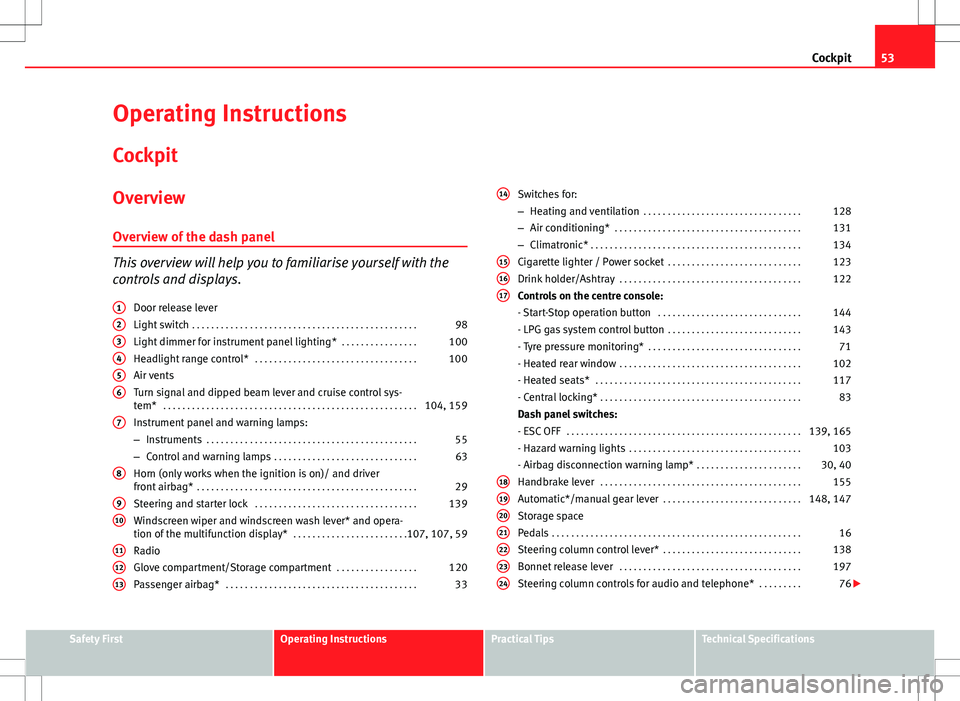
Overview Overview of the dash panel
This overview will help you to familiarise yourself with the
controls and displays. Door release lever
Light switch . . . . . . . . . . . . . . . . . . . . . . . . . . . . . . . . . . . . . . . . . . . . . . . 98
Light dimmer for instrument panel lighting* . . . . . . . . . . . . . . . .100
Headlight range control* . . . . . . . . . . . . . . . . . . . . . . . . . . . . . . . . . . 100
Air vents
Turn signal and dipped beam lever and cruise control sys-
tem* . . . . . . . . . . . . . . . . . . . . . . . . . . . . . . . . . . . . . . . . . . . . . . . . . . . . . 104, 159
Instrument panel and warning lamps:
– Instruments . . . . . . . . . . . . . . . . . . . . . . . . . . . . . . . . . . . . . . . . . . . . 55
– Control and warning lamps . . . . . . . . . . . . . . . . . . . . . . . . . . . . . . 63
Horn (only works when the ignition is on)/ and driver
front airbag* . . . . . . . . . . . . . . . . . . . . . . . . . . . . . . . . . . . . . . . . . . . . . . 29
Steering and starter lock . . . . . . . . . . . . . . . . . . . . . . . . . . . . . . . . . . 139
Windscreen wiper and windscreen wash lever* and opera-
tion of the multifunction display* . . . . . . . . . . . . . . . . . . . . . . . . . .107, 107, 59
Radio
Glove compartment/Storage compartment . . . . . . . . . . . . . . . . .120
Passenger airbag* . . . . . . . . . . . . . . . . . . . . . . . . . . . . . . . . . . . . . . . . 33
1
23456
7
8
910
111213
Switches for:
–
Heating and ventilation . . . . . . . . . . . . . . . . . . . . . . . . . . . . . . . . . 128
– Air conditioning* . . . . . . . . . . . . . . . . . . . . . . . . . . . . . . . . . . . . . . . 131
– Climatronic* . . . . . . . . . . . . . . . . . . . . . . . . . . . . . . . . . . . . . . . . . . . . 134
Cigarette lighter / Power socket . . . . . . . . . . . . . . . . . . . . . . . . . . . . 123
Drink holder/Ashtray . . . . . . . . . . . . . . . . . . . . . . . . . . . . . . . . . . . . . . 122
Controls on the centre console:
- Start-Stop operation button . . . . . . . . . . . . . . . . . . . . . . . . . . . . . . 144
- LPG gas system control button . . . . . . . . . . . . . . . . . . . . . . . . . . . . 143
- Tyre pressure monitoring* . . . . . . . . . . . . . . . . . . . . . . . . . . . . . . . . 71
- Heated rear window . . . . . . . . . . . . . . . . . . . . . . . . . . . . . . . . . . . . . . 102
- Heated seats* . . . . . . . . . . . . . . . . . . . . . . . . . . . . . . . . . . . . . . . . . . . 117
- Central locking* . . . . . . . . . . . . . . . . . . . . . . . . . . . . . . . . . . . . . . . . . . 83
Dash panel switches:
- ESC OFF . . . . . . . . . . . . . . . . . . . . . . . . . . . . . . . . . . . . . . . . . . . . . . . . . 139, 165
- Hazard warning lights . . . . . . . . . . . . . . . . . . . . . . . . . . . . . . . . . . . . 103
- Airbag disconnection warning lamp* . . . . . . . . . . . . . . . . . . . . . .30, 40
Handbrake lever . . . . . . . . . . . . . . . . . . . . . . . . . . . . . . . . . . . . . . . . . . 155
Automatic*/manual gear lever . . . . . . . . . . . . . . . . . . . . . . . . . . . . . 148, 147
Storage space
Pedals . . . . . . . . . . . . . . . . . . . . . . . . . . . . . . . . . . . . . . . . . . . . . . . . . . . . 16
Steering column control lever* . . . . . . . . . . . . . . . . . . . . . . . . . . . . . 138
Bonnet release lever . . . . . . . . . . . . . . . . . . . . . . . . . . . . . . . . . . . . . . 197
Steering column controls for audio and telephone* . . . . . . . . .76
14
151617
18192021222324
Safety FirstOperating InstructionsPractical TipsTechnical Specifications
Page 66 of 280
64Cockpit
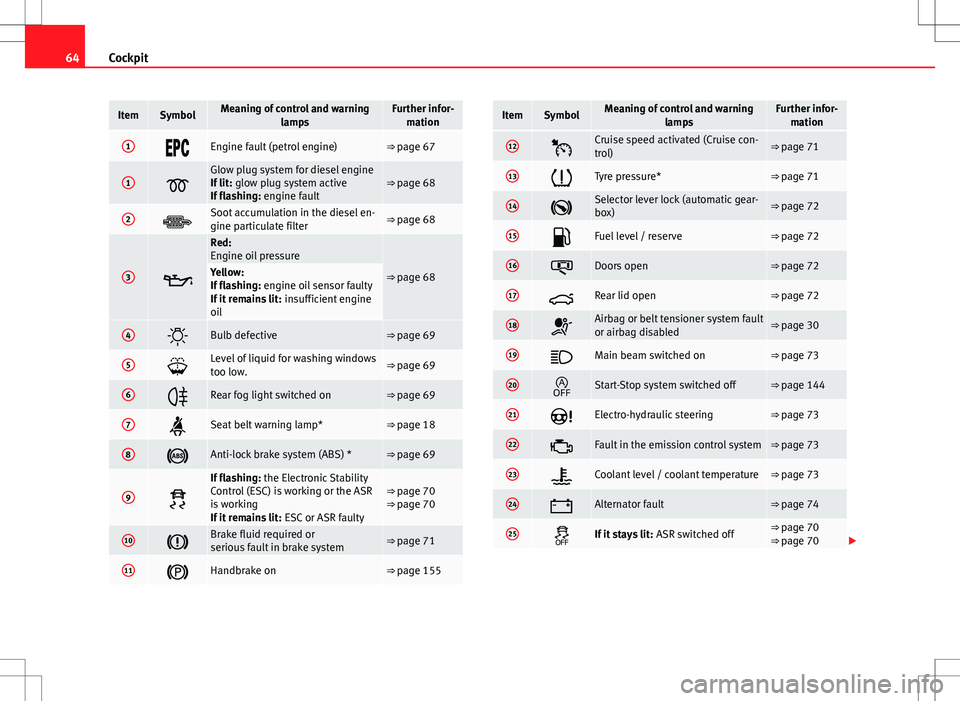
ItemSymbolMeaning of control and warning
lampsFurther infor-mation
1Engine fault (petrol engine)⇒ page 67
1
Glow plug system for diesel engine
If lit: glow plug system active
If flashing: engine fault⇒ page 68
2Soot accumulation in the diesel en-
gine particulate filter⇒ page 68
3
Red:
Engine oil pressure
⇒ page 68Yellow:
If flashing: engine oil sensor faulty
If it remains lit: insufficient engine
oil
4Bulb defective⇒ page 69
5Level of liquid for washing windows
too low.⇒ page 69
6Rear fog light switched on⇒ page 69
7Seat belt warning lamp*⇒ page 18
8Anti-lock brake system (ABS) *⇒ page 69
9
If flashing: the Electronic Stability
Control (ESC) is working or the ASR
is working
If it remains lit: ESC or ASR faulty⇒ page 70
⇒ page 70
10Brake fluid required or
serious fault in brake system⇒ page 71
11Handbrake on⇒ page 155
ItemSymbolMeaning of control and warning
lampsFurther infor-mation
12Cruise speed activated (Cruise con-
trol)⇒ page 71
13Tyre pressure*⇒ page 71
14Selector lever lock (automatic gear-
box)⇒ page 72
15Fuel level / reserve⇒ page 72
16Doors open⇒ page 72
17Rear lid open⇒ page 72
18Airbag or belt tensioner system fault
or airbag disabled⇒ page 30
19Main beam switched on⇒ page 73
20Start-Stop system switched off⇒ page 144
21Electro-hydraulic steering⇒ page 73
22Fault in the emission control system⇒ page 73
23Coolant level / coolant temperature⇒ page 73
24Alternator fault⇒ page 74
25If it stays lit: ASR switched off⇒ page 70
⇒ page 70
Page 75 of 280
73
Cockpit
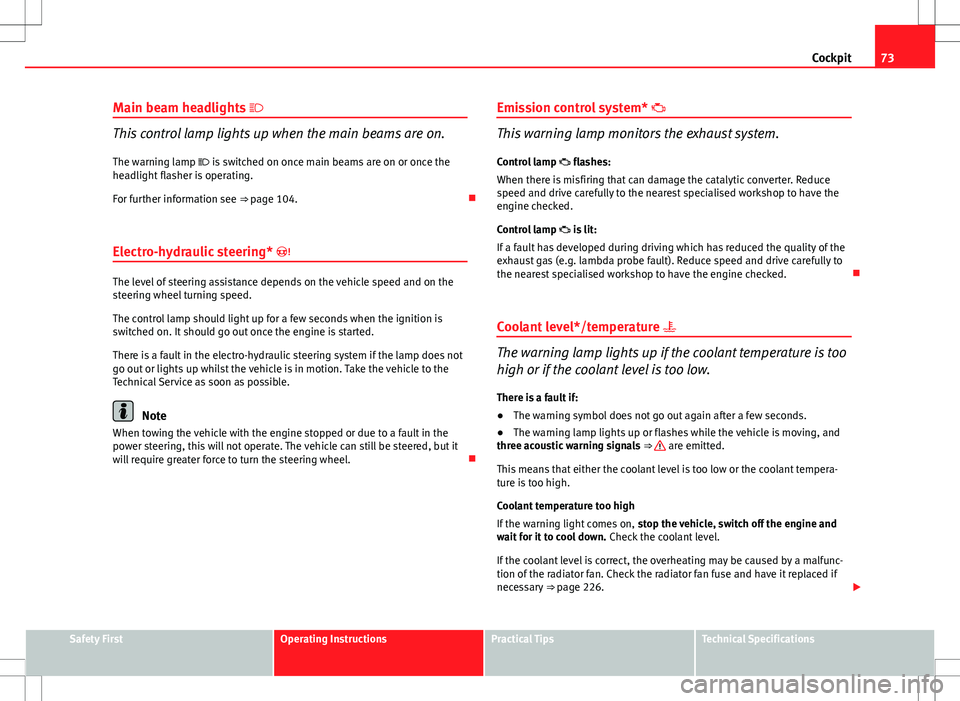
Main beam headlights
This control lamp lights up when the main beams are on.
The warning lamp is switched on once main beams are on or once the
headlight flasher is operating.
For further information see ⇒ page 104.
Electro-hydraulic steering*
The level of steering assistance depends on the vehicle speed and on the
steering wheel turning speed.
The control lamp should light up for a few seconds when the ignition is
switched on. It should go out once the engine is started.
There is a fault in the electro-hydraulic steering system if the lamp does not
go out or lights up whilst the vehicle is in motion. Take the vehicle to the
Technical Service as soon as possible.
Note
When towing the vehicle with the engine stopped or due to a fault in the
power steering, this will not operate. The vehicle can still be steered, but it
will require greater force to turn the steering wheel. Emission control system*
This warning lamp monitors the exhaust system.
Control lamp flashes:
When there is misfiring that can damage the catalytic converter. Reduce
speed and drive carefully to the nearest specialised workshop to have the
engine checked.
Control lamp is lit:
If a fault has developed during driving which has reduced the quality of the
exhaust gas (e.g. lambda probe fault). Reduce speed and drive carefully to
the nearest specialised workshop to have the engine checked.
Coolant level*/temperature
The warning lamp lights up if the coolant temperature is too
high or if the coolant level is too low.
There is a fault if:
● The warning symbol does not go out again after a few seconds.
● The warning lamp lights up or flashes while the vehicle is moving, and
three acoustic warning signals ⇒
are emitted.
This means that either the coolant level is too low or the coolant tempera-
ture is too high.
Coolant temperature too high
If the warning light comes on, stop the vehicle, switch off the engine and
wait for it to cool down. Check the coolant level.
If the coolant level is correct, the overheating may be caused by a malfunc-
tion of the radiator fan. Check the radiator fan fuse and have it replaced if
necessary ⇒ page 226.
Safety FirstOperating InstructionsPractical TipsTechnical Specifications
Page 78 of 280
76Steering column controls*
Steering column controls*
General information
The column incorporates multifunctional modules from which to control au-
dio and telephone functions on the vehicle.
There are two versions of the multifunction module:
● Audio version, to control the available audio functions from the steering
wheel.
● Audio version+ Telephone version, to control the available audio func-
tions and the telephone system from the steering wheel.
Both versions can be used to control the Audio system (Radio, Audio CD,
MP3 CD, iPod 1)
/USB 1)
).
1)
If fitted in the vehicle.
Page 79 of 280
77
Steering column controls*
Audio Control
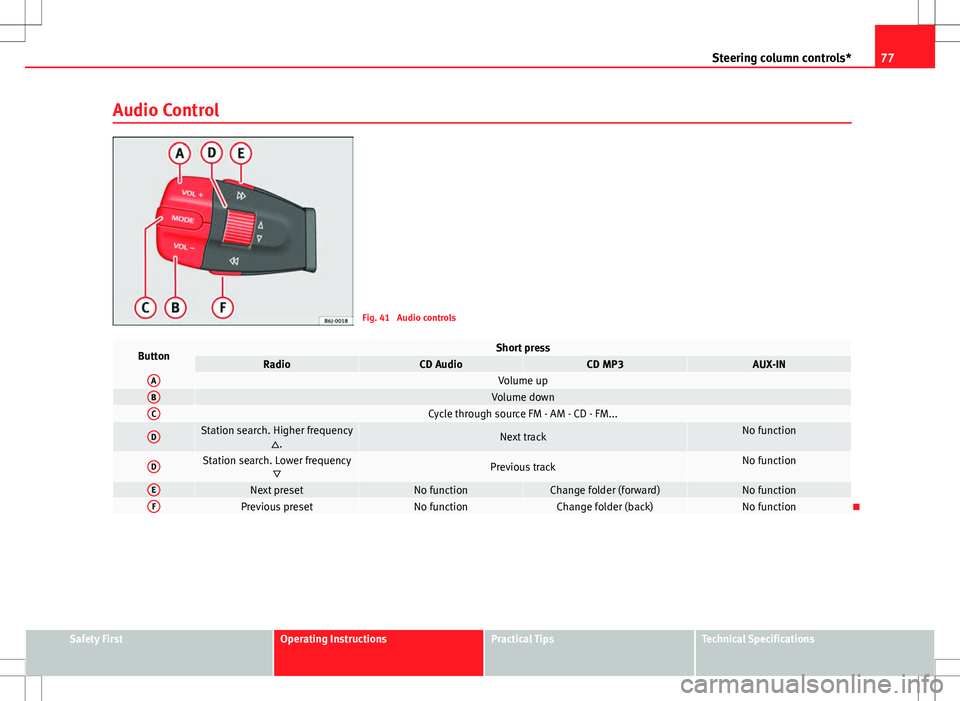
Fig. 41 Audio controls
ButtonShort pressRadioCD AudioCD MP3AUX-INAVolume upBVolume downCCycle through source FM - AM - CD - FM...
DStation search. Higher frequency .Next trackNo function
DStation search. Lower frequencyPrevious trackNo function
ENext presetNo functionChange folder (forward)No functionFPrevious presetNo functionChange folder (back)No function
Safety FirstOperating InstructionsPractical TipsTechnical Specifications
Page 80 of 280
78Steering column controls*
Audio + Telephone Control
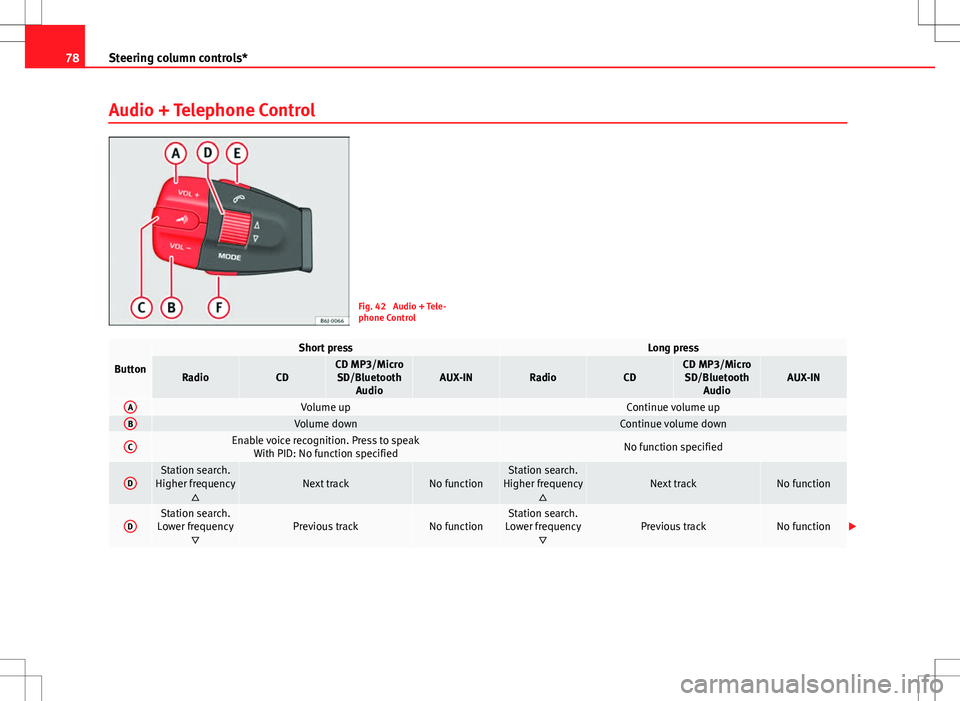
Fig. 42 Audio + Tele-
phone Control
Button
Short pressLong press
RadioCDCD MP3/Micro
SD/Bluetooth AudioAUX-INRadioCDCD MP3/MicroSD/Bluetooth AudioAUX-IN
AVolume upContinue volume upBVolume downContinue volume down
CEnable voice recognition. Press to speak With PID: No function specifiedNo function specified
DStation search.
Higher frequency Next trackNo functionStation search.
Higher frequency Next trackNo function
DStation search.
Lower frequency Previous trackNo functionStation search.
Lower frequency Previous trackNo function
Page 81 of 280
79
Steering column controls*
EAccept call/hang up a)Reject call
With PID: No function specified
FCycle through source FM - AM - CD - Micro SD - Bluetooth Audio - FM ...Cycle through source FM - AM - CD - Micro SD - Bluetooth Audio - FM ...a) With PID the button, E, performs more functions. Consult the specific PID Navigator manual.
Safety FirstOperating InstructionsPractical TipsTechnical Specifications
Page 87 of 280
85
Opening and closing
Keys
Set of keys
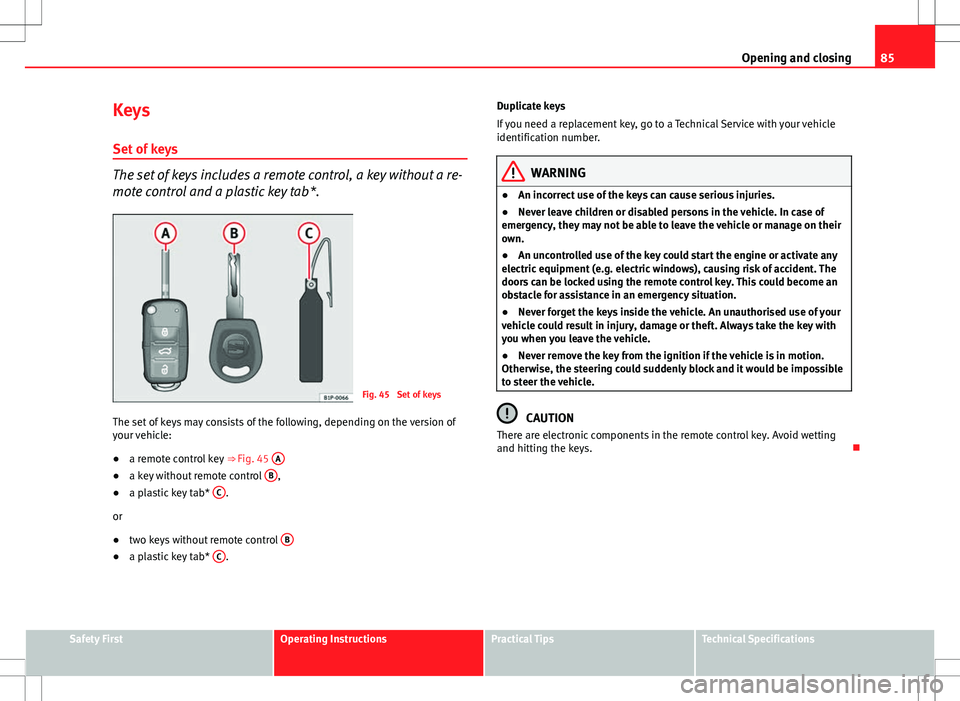
The set of keys includes a remote control, a key without a re-
mote control and a plastic key tab*.
Fig. 45 Set of keys
The set of keys may consists of the following, depending on the version of
your vehicle:
● a remote control key
⇒ Fig. 45 A
●
a key without remote control B,
● a plastic key tab* C.
or
● two keys without remote control B
●
a plastic key tab* C. Duplicate keys
If you need a replacement key, go to a Technical Service with your vehicle
identification number.
WARNING
● An incorrect use of the keys can cause serious injuries.
● Never leave children or disabled persons in the vehicle. In case of
emergency, they may not be able to leave the vehicle or manage on their
own.
● An uncontrolled use of the key could start the engine or activate any
electric equipment (e.g. electric windows), causing risk of accident. The
doors can be locked using the remote control key. This could become an
obstacle for assistance in an emergency situation.
● Never forget the keys inside the vehicle. An unauthorised use of your
vehicle could result in injury, damage or theft. Always take the key with
you when you leave the vehicle.
● Never remove the key from the ignition if the vehicle is in motion.
Otherwise, the steering could suddenly block and it would be impossible
to steer the vehicle.
CAUTION
There are electronic components in the remote control key. Avoid wetting
and hitting the keys.
Safety FirstOperating InstructionsPractical TipsTechnical Specifications
Page 103 of 280
101
Lights and visibility
Insert the key and switch the ignition on, holding it in this position for 3
seconds. Then, switch off the ignition. The daytime lights are deactivated
and cannot be switched on.
Note
See legal requirements for each country.
Adaptive headlights* (for driving round bends)
When driving around bends, the headlights will light the
most important areas of the road.
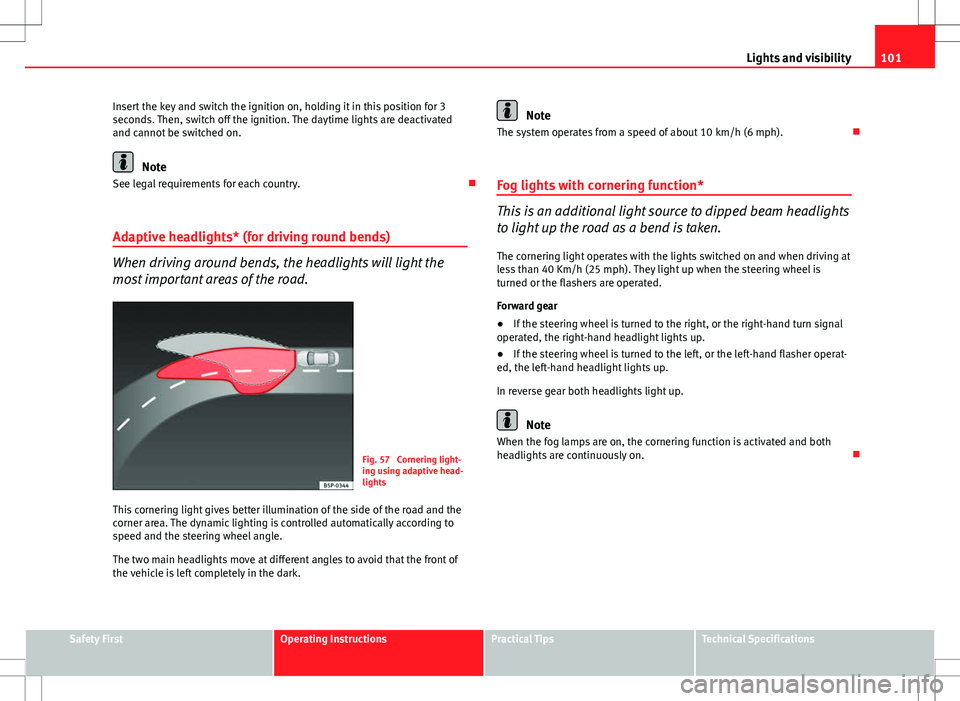
Fig. 57 Cornering light-
ing using adaptive head-
lights
This cornering light gives better illumination of the side of the road and the
corner area. The dynamic lighting is controlled automatically according to
speed and the steering wheel angle.
The two main headlights move at different angles to avoid that the front of
the vehicle is left completely in the dark.
Note
The system operates from a speed of about 10 km/h (6 mph).
Fog lights with cornering function*
This is an additional light source to dipped beam headlights
to light up the road as a bend is taken.
The cornering light operates with the lights switched on and when driving at
less than 40 Km/h (25 mph). They light up when the steering wheel is
turned or the flashers are operated.
Forward gear
● If the steering wheel is turned to the right, or the right-hand turn signal
operated, the right-hand headlight lights up.
● If the steering wheel is turned to the left, or the left-hand flasher operat-
ed, the left-hand headlight lights up.
In reverse gear both headlights light up.
Note
When the fog lamps are on, the cornering function is activated and both
headlights are continuously on.
Safety FirstOperating InstructionsPractical TipsTechnical Specifications
Page 106 of 280
104Lights and visibility
Note
● The battery will run down if the hazard warning lights are left on for a
long time, even if the ignition is switched off.
● The use of the hazard warning lights described here is subject to the rel-
evant statutory requirements.
Turn signal and main beam headlight lever
The turn signal and main beam lever also operates the park-
ing lights and the headlight flasher.
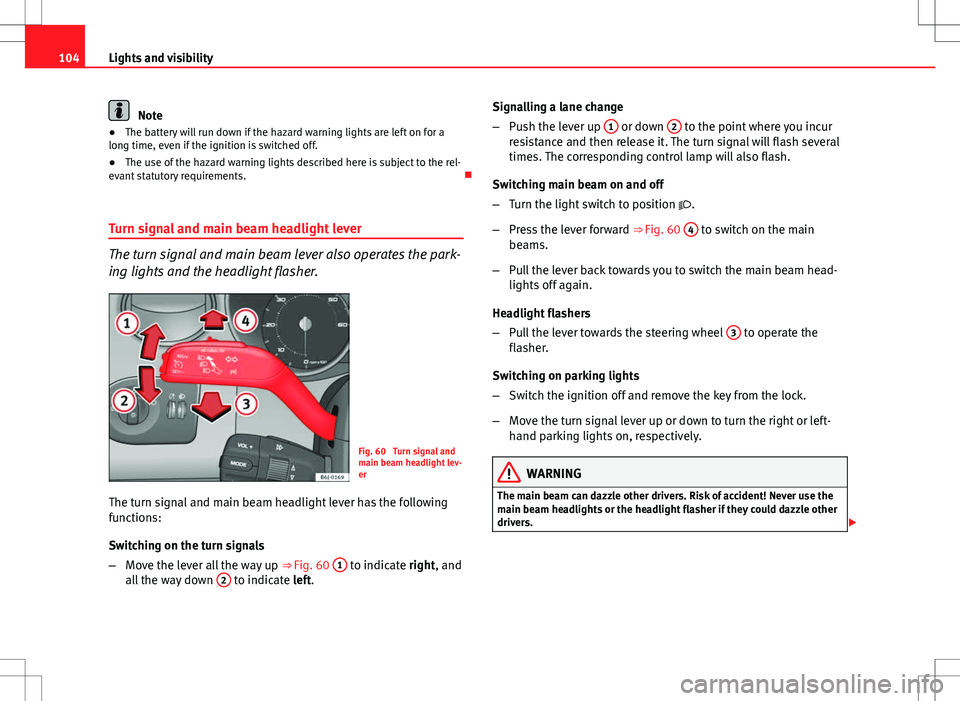
Fig. 60 Turn signal and
main beam headlight lev-
er
The turn signal and main beam headlight lever has the following
functions:
Switching on the turn signals
– Move the lever all the way up ⇒
Fig. 60 1
to indicate right, and
all the way down 2 to indicate left. Signalling a lane change
–
Push the lever up 1
or down 2 to the point where you incur
resistance and then release it. The turn signal will flash several
times. The corresponding control lamp will also flash.
Switching main beam on and off
– Turn the light switch to position .
– Press the lever forward ⇒ Fig. 60 4
to switch on the main
beams.
– Pull the lever back towards you to switch the main beam head-
lights off again.
Headlight flashers
– Pull the lever towards the steering wheel 3
to operate the
flasher.
Switching on parking lights
– Switch the ignition off and remove the key from the lock.
– Move the turn signal lever up or down to turn the right or left-
hand parking lights on, respectively.
WARNING
The main beam can dazzle other drivers. Risk of accident! Never use the
main beam headlights or the headlight flasher if they could dazzle other
drivers.