ignition Seat Ibiza 5D 2012 Manual PDF
[x] Cancel search | Manufacturer: SEAT, Model Year: 2012, Model line: Ibiza 5D, Model: Seat Ibiza 5D 2012Pages: 280, PDF Size: 3.66 MB
Page 232 of 280
230If and when
Xenon 1)
//adaptive headlights*
- D1S2)
- LED 3)
- LED3)
- PY 21W
Fog light - H11
WARNING
● Take particular care when working on components in the engine com-
partment if the engine is warm. Risk of burns.
● Bulbs are highly sensitive to pressure. The glass can break when you
touch the bulb, causing injury.
● The high voltage element of gas discharge bulbs* (xenon light) must
be handled correctly. Otherwise, there is a risk of death.
● When changing bulbs, please take care not to injure yourself on sharp
parts in the headlight housing.
CAUTION
● Remove the ignition key before working on the electric system. Other-
wise, a short circuit could occur.
● Switch off the lights or parking lights before you change a bulb.
Dipped and full beam
Side
DRL (day light)
Turn signals
Fog light/cornering
For the sake of the environment
Please ask your specialist retailer how to dispose of used bulbs in the prop-
er manner.
Note
● Depending on weather conditions (cold or wet), the front lights, the fog
lights, the tail lights and the turn signals may be temporarily misted. This
has no influence on the useful life of the lighting system. By switching on
the lights, the area through which the beam of light is projected will quickly
be demisted. However, the edges may continue to be misted.
● Please check at regular intervals that all lighting (especially the exterior
lighting) on your vehicle is functioning properly. This is not only in the inter-
est of your own safety, but also that of all other road users.
● Before changing a bulb, make sure you have the correct new bulb.
● Do not touch the glass part of the bulb with your bare hands, use a cloth
or paper towel instead. Otherwise, the fingerprints left on the glass will va-
porise as a result of the heat generated by the bulb, they will be deposited
on the reflector and will impair its surface.
1)
With this type of headlight, the user can replace the turn signal bulb. Replacement of the
dipped/main beam bulb must be done by a Technical Service, given that complex elements
must be removed from the vehicle and the automatic control system that incorporates it
must be reset.
2) The Xenon bulbs discharge 2.5 times the light flux and have an average lifespan of 5 times
more than that of halogen bulbs, this means that, except due to unusual circumstances,
there is no need to change the bulbs for the whole life of the vehicle.
3) In the event that there is a fault in the LEDs, the complete headlight must be replaced.
Page 245 of 280
243
If and when
Jump leads
Jump leads must comply with standard DIN 72553 (see cable manufactur-
er's instructions). The wire cross section must be at least 25 mm 2
for petrol
engines and at least 35 mm 2
for diesel engines.
Note
● The vehicles must not touch each other, otherwise electricity could flow
as soon as the positive terminals are connected.
● The discharged battery must be properly connected to the on-board net-
work.
How to jump start: description
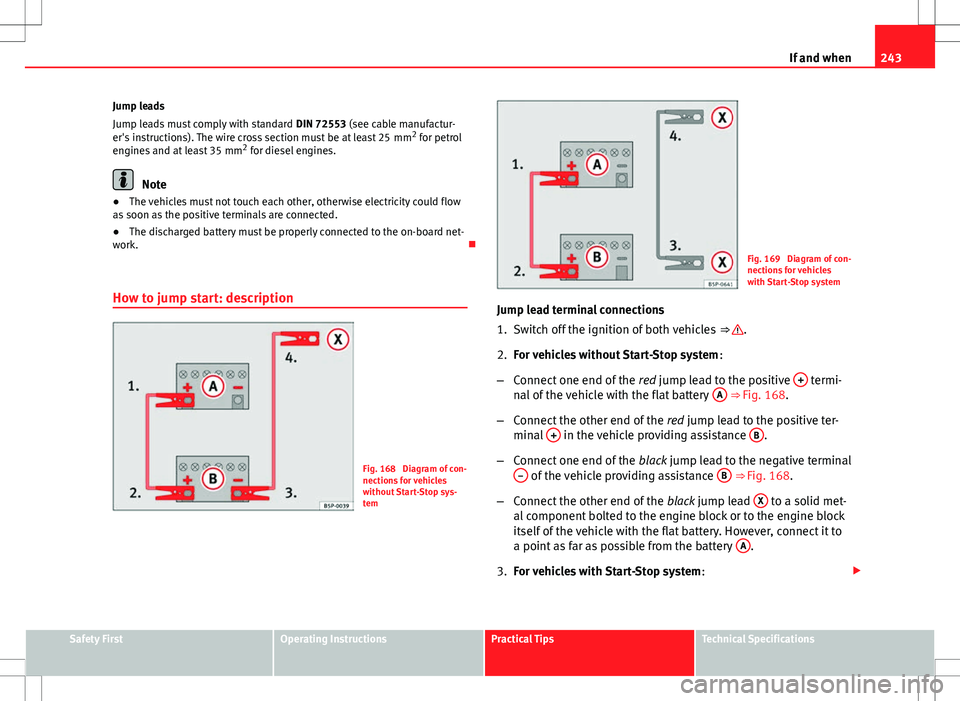
Fig. 168 Diagram of con-
nections for vehicles
without Start-Stop sys-
tem
Fig. 169 Diagram of con-
nections for vehicles
with Start-Stop system
Jump lead terminal connections
1. Switch off the ignition of both vehicles ⇒
.
2. For vehicles without Start-Stop system :
– Connect one end of the red jump lead to the positive +
termi-
nal of the vehicle with the flat battery A ⇒ Fig. 168.
– Connect the other end of the red jump lead to the positive ter-
minal +
in the vehicle providing assistance B.
– Connect one end of the black jump lead to the negative terminal
–
of the vehicle providing assistance B ⇒ Fig. 168.
– Connect the other end of the black jump lead X
to a solid met-
al component bolted to the engine block or to the engine block
itself of the vehicle with the flat battery. However, connect it to
a point as far as possible from the battery A
.
3. For vehicles with Start-Stop system :
Safety FirstOperating InstructionsPractical TipsTechnical Specifications
Page 248 of 280
246If and when
Towing and tow-starting
Tow-starting*
The use of jump leads is preferable to tow-starting.
We recommend that you do not tow-start your vehicle. Jump-start-
ing is preferable ⇒ page 242.
However, if your vehicle has to be tow-started:
– Engage the 2nd or the 3rd gear.
– Keep the clutch pressed down.
– Switch the ignition on.
– Once both vehicles are moving, release the clutch.
– As soon as the engine starts, press the clutch and move the
gear lever into neutral. This helps to prevent driving into the
towing vehicle.
WARNING
The risk of accidents is high when tow-starting. The vehicle being towed
can easily collide with the towing vehicle.
CAUTION
When tow-starting, fuel could enter the catalytic converter and damage it. Comments
Please observe the following points if you use a tow rope:
Notes for the driver of the towing vehicle
–
Drive slowly at first until the tow rope is taut. Then accelerate
gradually.
– Begin and change gears cautiously. If you are driving an auto-
matic vehicle, accelerate gently.
– Remember that the brake servo and power steering are not
working in the vehicle you are towing. Brake sooner than nor-
mal and pressing the pedal gently.
Notes for the driver of the towed vehicle
– Ensure that the tow rope remains taut at all times when towing.
Tow rope or tow bar
It is easier and safer to tow a vehicle with a tow bar. You should only use a
tow rope if you do not have a tow bar.
A tow rope should be slightly elastic to reduce the loading on both vehicles.
It is advisable to use a tow rope made of synthetic fibre or similarly elastic
material.
Attach the tow rope or the tow bar only to the towline anchorages provided
or a towing bracket.
Driving style
Towing requires some experience, especially when using a tow rope. Both
drivers should be familiar with the technique required for towing. Inexper-
ienced drivers should not attempt to tow.
Page 249 of 280
247
If and when
Do not pull too hard with the towing vehicle and take care to avoid jerking
the tow rope. When towing on an unpaved road, there is always a risk of
overloading and damaging the anchorage points.
The ignition of the vehicle being towed must be switched on to prevent the
steering wheel from locking and also to allow the use of the turn signals,
horn, windscreen wipers and washers.
As the brake servo does not work if the engine is not running, you must ap-
ply considerably more pressure to the brake pedal than you normally would.
As the power assisted steering does not work if the engine is not running,
you will need more strength to steer than you normally would.
Towing vehicles with an automatic gearbox
● Put the selector lever into position “N”.
● Do not drive faster than 50 km/h (30 mph).
● Do not tow further than 50 km (30 miles).
● If a breakdown vehicle is used, the vehicle must be towed with the front
wheels raised.
Note
● Observe legal requirements when towing or tow-starting.
● Switch on the hazard warning lights of both vehicles. However, observe
any regulations to the contrary.
● For technical reasons, vehicles with an automatic gearbox must not be
tow-started.
● If damage to your vehicle means that there is no lubricant in the gear-
box, you must raise the driven wheels while the vehicle is being towed.
● If the vehicle has to be towed more than 50 km (30 miles), the front
wheels should be raised during towing, and towing should be carried out by
a qualified person. ●
The steering wheel is locked when the vehicle has no electrical power.
The vehicle must then be towed with the front wheels raised. Towing should
be carried out by a qualified person.
● The towline anchorage should always be kept in the vehicle.
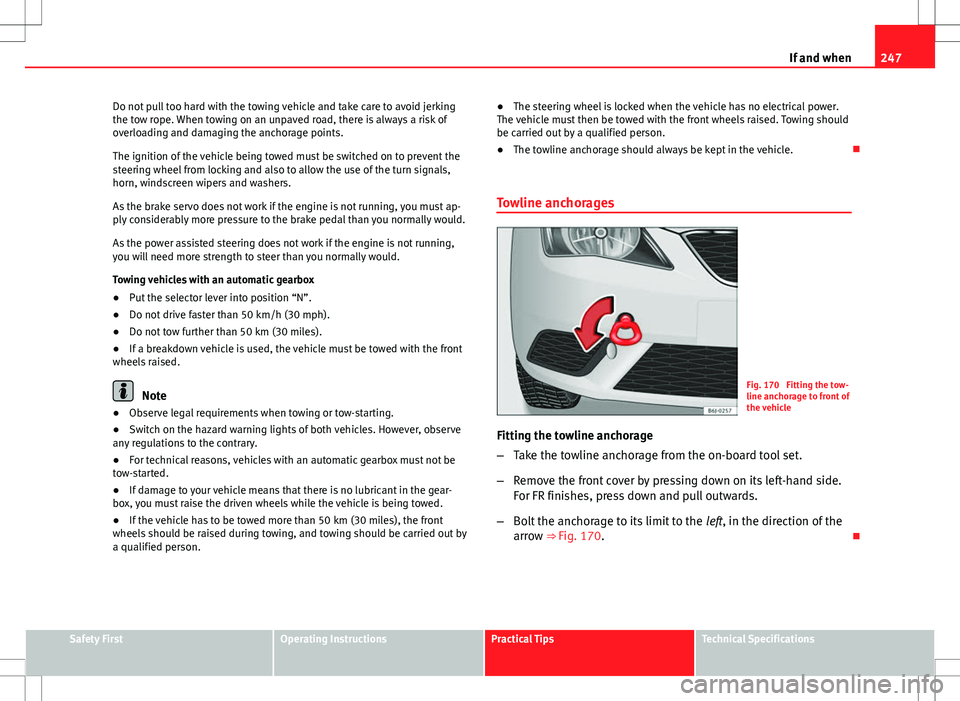
Towline anchoragesFig. 170 Fitting the tow-
line anchorage to front of
the vehicle
Fitting the towline anchorage
– Take the towline anchorage from the on-board tool set.
– Remove the front cover by pressing down on its left-hand side.
For FR finishes, press down and pull outwards.
– Bolt the anchorage to its limit to the left, in the direction of the
arrow ⇒ Fig. 170.
Safety FirstOperating InstructionsPractical TipsTechnical Specifications
Page 274 of 280
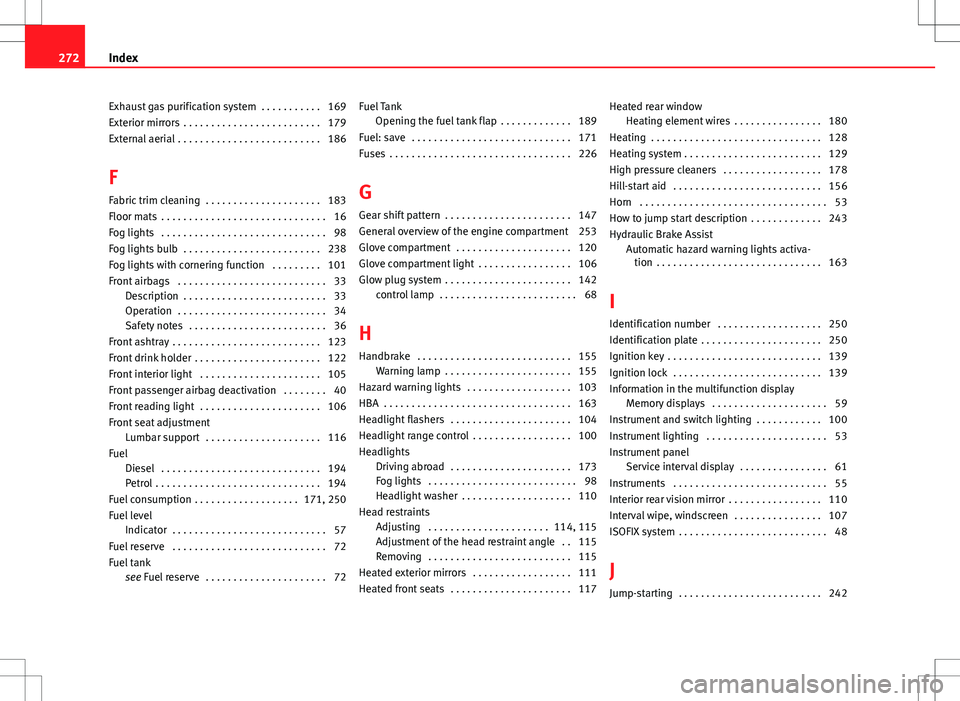
Exhaust gas purification system . . . . . . . . . . . 169
Exterior mirrors . . . . . . . . . . . . . . . . . . . . . . . . . 179
External aerial . . . . . . . . . . . . . . . . . . . . . . . . . . 186
F
Fabric trim cleaning . . . . . . . . . . . . . . . . . . . . . 183
Floor mats . . . . . . . . . . . . . . . . . . . . . . . . . . . . . . 16
Fog lights . . . . . . . . . . . . . . . . . . . . . . . . . . . . . . 98
Fog lights bulb . . . . . . . . . . . . . . . . . . . . . . . . . 238
Fog lights with cornering function . . . . . . . . . 101
Front airbags . . . . . . . . . . . . . . . . . . . . . . . . . . . 33 Description . . . . . . . . . . . . . . . . . . . . . . . . . . 33
Operation . . . . . . . . . . . . . . . . . . . . . . . . . . . 34
Safety notes . . . . . . . . . . . . . . . . . . . . . . . . . 36
Front ashtray . . . . . . . . . . . . . . . . . . . . . . . . . . . 123
Front drink holder . . . . . . . . . . . . . . . . . . . . . . . 122
Front interior light . . . . . . . . . . . . . . . . . . . . . . 105
Front passenger airbag deactivation . . . . . . . . 40
Front reading light . . . . . . . . . . . . . . . . . . . . . . 106
Front seat adjustment Lumbar support . . . . . . . . . . . . . . . . . . . . . 116
Fuel Diesel . . . . . . . . . . . . . . . . . . . . . . . . . . . . . 194
Petrol . . . . . . . . . . . . . . . . . . . . . . . . . . . . . . 194
Fuel consumption . . . . . . . . . . . . . . . . . . . 171, 250
Fuel level Indicator . . . . . . . . . . . . . . . . . . . . . . . . . . . . 57
Fuel reserve . . . . . . . . . . . . . . . . . . . . . . . . . . . . 72
Fuel tank see Fuel reserve . . . . . . . . . . . . . . . . . . . . . . 72 Fuel Tank
Opening the fuel tank flap . . . . . . . . . . . . . 189
Fuel: save . . . . . . . . . . . . . . . . . . . . . . . . . . . . . 171
Fuses . . . . . . . . . . . . . . . . . . . . . . . . . . . . . . . . . 226
G
Gear shift pattern . . . . . . . . . . . . . . . . . . . . . . . 147
General overview of the engine compartment 253
Glove compartment . . . . . . . . . . . . . . . . . . . . . 120
Glove compartment light . . . . . . . . . . . . . . . . . 106
Glow plug system . . . . . . . . . . . . . . . . . . . . . . . 142 control lamp . . . . . . . . . . . . . . . . . . . . . . . . . 68
H
Handbrake . . . . . . . . . . . . . . . . . . . . . . . . . . . . 155 Warning lamp . . . . . . . . . . . . . . . . . . . . . . . 155
Hazard warning lights . . . . . . . . . . . . . . . . . . . 103
HBA . . . . . . . . . . . . . . . . . . . . . . . . . . . . . . . . . . 163
Headlight flashers . . . . . . . . . . . . . . . . . . . . . . 104
Headlight range control . . . . . . . . . . . . . . . . . . 100
Headlights Driving abroad . . . . . . . . . . . . . . . . . . . . . . 173
Fog lights . . . . . . . . . . . . . . . . . . . . . . . . . . . 98
Headlight washer . . . . . . . . . . . . . . . . . . . . 110
Head restraints Adjusting . . . . . . . . . . . . . . . . . . . . . . 114, 115
Adjustment of the head restraint angle . . 115
Removing . . . . . . . . . . . . . . . . . . . . . . . . . . 115
Heated exterior mirrors . . . . . . . . . . . . . . . . . . 111
Heated front seats . . . . . . . . . . . . . . . . . . . . . . 117 Heated rear window
Heating element wires . . . . . . . . . . . . . . . . 180
Heating . . . . . . . . . . . . . . . . . . . . . . . . . . . . . . . 128
Heating system . . . . . . . . . . . . . . . . . . . . . . . . . 129
High pressure cleaners . . . . . . . . . . . . . . . . . . 178
Hill-start aid . . . . . . . . . . . . . . . . . . . . . . . . . . . 156
Horn . . . . . . . . . . . . . . . . . . . . . . . . . . . . . . . . . . 53
How to jump start description . . . . . . . . . . . . . 243
Hydraulic Brake Assist Automatic hazard warning lights activa-tion . . . . . . . . . . . . . . . . . . . . . . . . . . . . . . 163
I
Identification number . . . . . . . . . . . . . . . . . . . 250
Identification plate . . . . . . . . . . . . . . . . . . . . . . 250
Ignition key . . . . . . . . . . . . . . . . . . . . . . . . . . . . 139
Ignition lock . . . . . . . . . . . . . . . . . . . . . . . . . . . 139
Information in the multifunction display Memory displays . . . . . . . . . . . . . . . . . . . . . 59
Instrument and switch lighting . . . . . . . . . . . . 100
Instrument lighting . . . . . . . . . . . . . . . . . . . . . . 53
Instrument panel Service interval display . . . . . . . . . . . . . . . . 61
Instruments . . . . . . . . . . . . . . . . . . . . . . . . . . . . 55
Interior rear vision mirror . . . . . . . . . . . . . . . . . 110
Interval wipe, windscreen . . . . . . . . . . . . . . . . 107
ISOFIX system . . . . . . . . . . . . . . . . . . . . . . . . . . . 48
J
Jump-starting . . . . . . . . . . . . . . . . . . . . . . . . . . 242
272 Index