steering wheel adjustment Seat Ibiza 5D 2012 Owner's manual
[x] Cancel search | Manufacturer: SEAT, Model Year: 2012, Model line: Ibiza 5D, Model: Seat Ibiza 5D 2012Pages: 280, PDF Size: 3.66 MB
Page 12 of 280
10Safe driving
Proper sitting position for occupants
Correct sitting position for driver
The correct sitting position for the driver is important for
safe and relaxed driving.
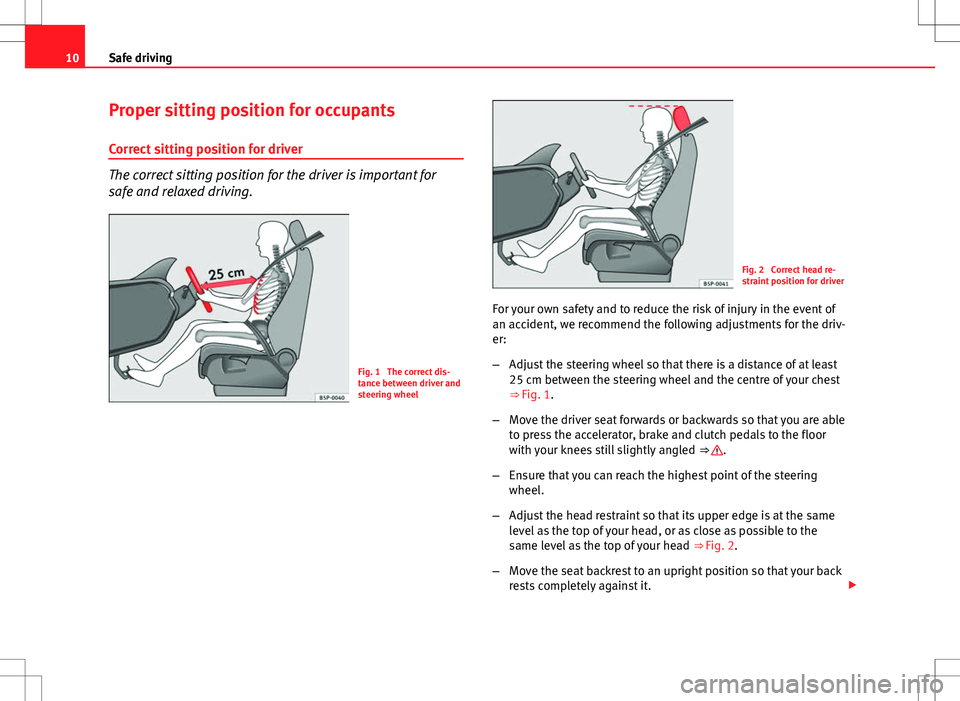
Fig. 1 The correct dis-
tance between driver and
steering wheel
Fig. 2 Correct head re-
straint position for driver
For your own safety and to reduce the risk of injury in the event of
an accident, we recommend the following adjustments for the driv-
er:
– Adjust the steering wheel so that there is a distance of at least
25 cm between the steering wheel and the centre of your chest
⇒ Fig. 1.
– Move the driver seat forwards or backwards so that you are able
to press the accelerator, brake and clutch pedals to the floor
with your knees still slightly angled ⇒
.
– Ensure that you can reach the highest point of the steering
wheel.
– Adjust the head restraint so that its upper edge is at the same
level as the top of your head, or as close as possible to the
same level as the top of your head ⇒ Fig. 2.
– Move the seat backrest to an upright position so that your back
rests completely against it.
Page 13 of 280
11
Safe driving
– Fasten your seat belt securely ⇒ page 18.
– Keep both feet in the footwell so that you have the vehicle un-
der control at all times.
Adjustment of the driver seat ⇒ page 113.
WARNING
● An incorrect sitting position of the driver can lead to severe injuries.
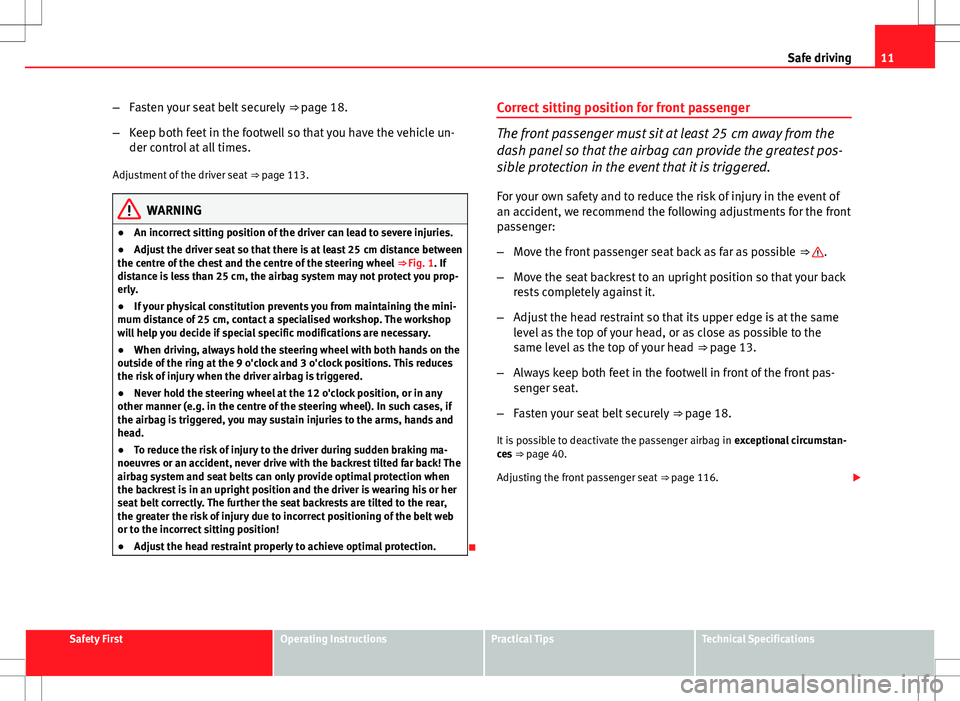
● Adjust the driver seat so that there is at least 25 cm distance between
the centre of the chest and the centre of the steering wheel ⇒ Fig. 1. If
distance is less than 25 cm, the airbag system may not protect you prop-
erly.
● If your physical constitution prevents you from maintaining the mini-
mum distance of 25 cm, contact a specialised workshop. The workshop
will help you decide if special specific modifications are necessary.
● When driving, always hold the steering wheel with both hands on the
outside of the ring at the 9 o'clock and 3 o'clock positions. This reduces
the risk of injury when the driver airbag is triggered.
● Never hold the steering wheel at the 12 o'clock position, or in any
other manner (e.g. in the centre of the steering wheel). In such cases, if
the airbag is triggered, you may sustain injuries to the arms, hands and
head.
● To reduce the risk of injury to the driver during sudden braking ma-
noeuvres or an accident, never drive with the backrest tilted far back! The
airbag system and seat belts can only provide optimal protection when
the backrest is in an upright position and the driver is wearing his or her
seat belt correctly. The further the seat backrests are tilted to the rear,
the greater the risk of injury due to incorrect positioning of the belt web
or to the incorrect sitting position!
● Adjust the head restraint properly to achieve optimal protection.
Correct sitting position for front passenger
The front passenger must sit at least 25 cm away from the
dash panel so that the airbag can provide the greatest pos-
sible protection in the event that it is triggered.
For your own safety and to reduce the risk of injury in the event of
an accident, we recommend the following adjustments for the front
passenger:
– Move the front passenger seat back as far as possible ⇒
.
– Move the seat backrest to an upright position so that your back
rests completely against it.
– Adjust the head restraint so that its upper edge is at the same
level as the top of your head, or as close as possible to the
same level as the top of your head ⇒ page 13.
– Always keep both feet in the footwell in front of the front pas-
senger seat.
– Fasten your seat belt securely ⇒ page 18.
It is possible to deactivate the passenger airbag in exceptional circumstan-
ces ⇒ page 40.
Adjusting the front passenger seat ⇒ page 116.
Safety FirstOperating InstructionsPractical TipsTechnical Specifications
Page 115 of 280
113
Seats and storage compartments
Seats and storage compartments The importance of correct seat adjustment
Proper seat adjustment optimises the level of protection of-
fered by seat belts and airbags.
Your vehicle has five seats, two in the front and three in the rear. Each seat
is equipped with a three-point seat belt.
The driver seat and the front passenger seat can be adjusted in many ways
to suit the physical requirements of the vehicle occupants. The correct seat
position is very important for:
● a fast and easy operation of all controls on the instrument panel,
● a relaxed posture which does not cause drowsiness,
● a safe driving ⇒ page 7,
● ensuring that the seat belts and airbag system provide maximum pro-
tection ⇒ page 18.
WARNING
● If the driver and passengers assume improper sitting positions, they
may sustain critical injuries.
● Never transport more than the permitted amount of people in your ve-
hicle.
● Every vehicle occupant must properly fasten and wear the seat belt
belonging to his or her seat. Children must be protected with an appro-
priate child restraint system ⇒ page 42, Child safety.
● The front seats and all head restraints must always be adjusted to
body size and the seat belt must always be properly adjusted to provide
you and your passengers with optimum protection.
WARNING (Continued)
● Always keep your feet on the footwell when the vehicle is moving;
never rest them on the dash panel, out of the window or on the seat. This
is also applied to passengers. An incorrect sitting position exposes you
to an increased risk of injury in case of a sudden braking or an accident.
If the airbag is triggered, you could sustain severe injuries due to an in-
correct sitting position.
● It is important for the driver and front passenger to keep a distance of
at least 25 cm from the steering wheel and dash panel. Failure to respect
the minimum distance means that the airbag will not protect you. Risk of
fatal injury. The distance between the driver and the steering wheel or
between the front passenger and the dash panel should always be as
great as possible.
● Adjust the driver or front passenger seat only when the vehicle is sta-
tionary. Otherwise, your seat could move unexpectedly while the vehicle
is moving. This could increase the risk of an accident and therefore, in-
jury. In addition, while adjusting your seat, you will assume an incorrect
sitting position. Risk of fatal accidents.
● Special guidelines apply to installing a child seat on the front passen-
ger seat. When installing a child seat, please observe the warnings de-
scribed in ⇒ page 42, Child safety.
Safety FirstOperating InstructionsPractical TipsTechnical Specifications
Page 140 of 280
138Driving
Driving
SteeringAdjusting the steering wheel position
The height and reach of the steering wheel can be freely ad-
justed to suit the driver.
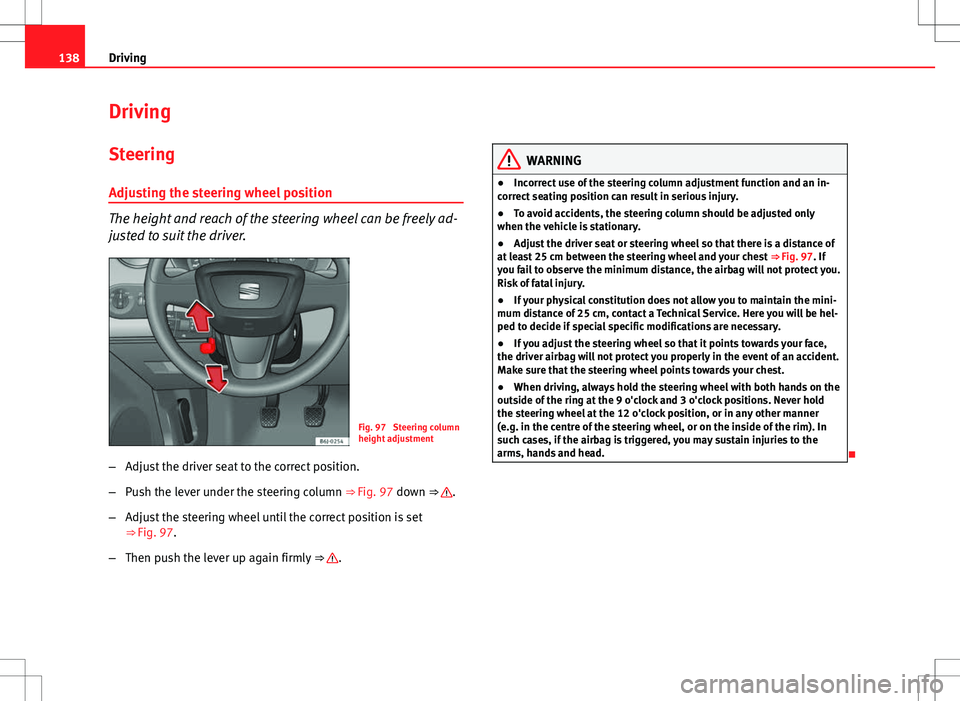
Fig. 97 Steering column
height adjustment
– Adjust the driver seat to the correct position.
– Push the lever under the steering column ⇒ Fig. 97 down ⇒
.
– Adjust the steering wheel until the correct position is set
⇒ Fig. 97.
– Then push the lever up again firmly ⇒
.
WARNING
● Incorrect use of the steering column adjustment function and an in-
correct seating position can result in serious injury.
● To avoid accidents, the steering column should be adjusted only
when the vehicle is stationary.
● Adjust the driver seat or steering wheel so that there is a distance of
at least 25 cm between the steering wheel and your chest ⇒ Fig. 97. If
you fail to observe the minimum distance, the airbag will not protect you.
Risk of fatal injury.
● If your physical constitution does not allow you to maintain the mini-
mum distance of 25 cm, contact a Technical Service. Here you will be hel-
ped to decide if special specific modifications are necessary.
● If you adjust the steering wheel so that it points towards your face,
the driver airbag will not protect you properly in the event of an accident.
Make sure that the steering wheel points towards your chest.
● When driving, always hold the steering wheel with both hands on the
outside of the ring at the 9 o'clock and 3 o'clock positions. Never hold
the steering wheel at the 12 o'clock position, or in any other manner
(e.g. in the centre of the steering wheel, or on the inside of the rim). In
such cases, if the airbag is triggered, you may sustain injuries to the
arms, hands and head.
Page 277 of 280
Soot accumulation in the diesel engine particu-late filter
control lamp . . . . . . . . . . . . . . . . . . . . . . . . . 68
Spanner symbol . . . . . . . . . . . . . . . . . . . . . . . . . 62
Spare parts . . . . . . . . . . . . . . . . . . . . . . . . . . . . 185
Spare wheel . . . . . . . . . . . . . . . . . . . . . . . . . . . 218
Speedometer . . . . . . . . . . . . . . . . . . . . . . . . . . . 56
Speed selector lever lock control lamp . . . . . . . . . . . . . . . . . . . . . . . . . 72
Start-Stop Activating and deactivating . . . . . . . . . . . . 146
Function . . . . . . . . . . . . . . . . . . . . . . . . . . . 144
Starting petrol engines . . . . . . . . . . . . . . 141, 142
Starting the engine . . . . . . . . . . . . . . . . . 141, 142 After the fuel tank has been run dry . . . . . 142
Steam jets . . . . . . . . . . . . . . . . . . . . . . . . . . . . . 178
Steering . . . . . . . . . . . . . . . . . . . . . . . . . . . . . . 138 Steering lock . . . . . . . . . . . . . . . . . . . . . . . . 139
Steering column controls Audio Control . . . . . . . . . . . . . . . . . . . . . . . . 76
Steering wheel height adjustment . . . . . . . . . 138
Storage compartment Front passenger side . . . . . . . . . . . . . . . . . 120
Front right seat . . . . . . . . . . . . . . . . . . . . . . 121
Sun visor Sliding/tilting sunroof . . . . . . . . . . . . . . . . . 96
Sun visors . . . . . . . . . . . . . . . . . . . . . . . . . . . . . 106
Switch Hazard warning lights . . . . . . . . . . . . . . . . 103
Heated rear window . . . . . . . . . . . . . . . . . . 102
Light switch . . . . . . . . . . . . . . . . . . . . . . . . . 98 Switches
Electric windows . . . . . . . . . . . . . . . . . . . . . . 93
panoramic/tilting sunroof . . . . . . . . . . . . . . 96
Switching off the engine . . . . . . . . . . . . . . . . . 142
T Tank Fuel level . . . . . . . . . . . . . . . . . . . . . . . . . . . . 57
Reserve indicator . . . . . . . . . . . . . . . . . . . . . 57
Tank capacity . . . . . . . . . . . . . . . . . . . . . . . . 57
Technical modifications . . . . . . . . . . . . . . . . . . 185
The danger of not using the seat belt . . . . . . . . 21
Tightening torque of wheel bolts . . . . . . . . . . 252
Tilting sunroof . . . . . . . . . . . . . . . . . . . . . . . . . . 96
Tire Mobility System (tyre repair kit) . . . . . . . . 224
Tools . . . . . . . . . . . . . . . . . . . . . . . . . . . . . . . . . 218
Top Tether system . . . . . . . . . . . . . . . . . . . . . . . 49
Tow-starting . . . . . . . . . . . . . . . . . . . . . . . . . . . 246
Towing . . . . . . . . . . . . . . . . . . . . . . . . . . . . . . . . 246
Towing a trailer . . . . . . . . . . . . . . . . . . . . . 173, 251
Towing bracket . . . . . . . . . . . . . . . . . . . . . . . . . 174
Towing bracket, fitting . . . . . . . . . . . . . . . . . . . 187
Towline anchorage . . . . . . . . . . . . . . . . . . . . . . 246
Towline anchorages . . . . . . . . . . . . . . . . . . . . . 247
Tow starting Comments . . . . . . . . . . . . . . . . . . . . . . . . . . 246
Traction control system control lamp . . . . . . . . . . . . . . . . . . . . . . . . . 70
Traction control system (ASR) . . . . . . . . . . . . . 164
Trailer turn signals control lamp . . . . . . . . . . . . . . . . . . . . . . . . 105 Trailer weights . . . . . . . . . . . . . . . . . . . . . . . . . 251
Turn signals . . . . . . . . . . . . . . . . . . . . . . . . . . . 104
control lamp . . . . . . . . . . . . . . . . . . . . . 74, 105
Two-way radio . . . . . . . . . . . . . . . . . . . . . . . . . . 186
Tyre Mobility System (tyre repair kit) . . . . . . . . 219
Tyre pressure . . . . . . . . . . . . . . . . . . . . . . . . . . 212
Tyre pressure control lamp . . . . . . . . . . . . . . . . 71
Tyre pressures . . . . . . . . . . . . . . . . . . . . . . . . . . 252
Tyre repair kit . . . . . . . . . . . . . . . . . . . . . . 219, 224
Tyres and wheels Dimensions . . . . . . . . . . . . . . . . . . . . . . . . . 214
Tyres tread depth . . . . . . . . . . . . . . . . . . . . . . . 213
Tyres useful life . . . . . . . . . . . . . . . . . . . . . . . . . 213
Tyres with directional tread pattern . . . . . . . . 212
U Underbody protection . . . . . . . . . . . . . . . . . . . 181
V
Vehicle battery . . . . . . . . . . . . . . . . . . . . . . . . . 209
Vehicle data . . . . . . . . . . . . . . . . . . . . . . . . . . . 250
Vehicle identification data . . . . . . . . . . . . . . . . 250
Vehicle identification number . . . . . . . . . . . . . 250
Vehicle interior heating or cooling system . . . 132
Vehicle interior monitoring and tow-away pro- tection system
Activation . . . . . . . . . . . . . . . . . . . . . . . . . . . 89
Vehicle modifications . . . . . . . . . . . . . . . . . . . 185
275
Index