wheel torque Seat Ibiza 5D 2012 Owner's manual
[x] Cancel search | Manufacturer: SEAT, Model Year: 2012, Model line: Ibiza 5D, Model: Seat Ibiza 5D 2012Pages: 280, PDF Size: 3.66 MB
Page 167 of 280
165
Intelligent technology
The ASR helps the car to start moving, accelerate and climb a gradient in
slippery conditions, where this may otherwise be difficult or even impossi-
ble.
The ASR automatically switches on when the engine is started. If necessary,
it may be turned on or off by briefly pushing the ESC button on the centre
console.
When the ASR is off, the warning lamp is lit. The ASR should normally be
left on. Only in exceptional circumstances, when the slipping of the wheels
is required, can they be disconnected using the ESC button, for example.
● With compact temporary spare wheel.
● When using the snow chains.
● When driving in deep snow or on loose surfaces
● When the vehicle is bogged-down, to free it by rocking.
The ASR should be switched on again as soon as possible.
WARNING
● Remember that not even the ASR can defy the laws of physics. This
should be kept in mind, particularly on slippery and wet roads and when
towing a trailer.
● Always adapt your driving style to suit the condition of the roads and
the traffic situation. The greater safety provided by the ASR should not
encourage you to run any risks.
CAUTION
● To ensure that the ASR works correctly, identical tyres should be fitted
on all four wheels. Any differences in the rolling radius of the tyres can
cause the system to reduce engine power when this is not desired.
● Any modifications made to the vehicle (for example, to the engine,
brake system, running gear or to the combination of wheels and tyres) may
affect the operation of the ABS and ASR. XDS*
Driveshaft differential
When taking a bend, the driveshaft differential mechanism allows the outer
wheel to turn at a higher speed than the inner wheel. In this way, the wheel
that is turning faster (outer wheel) receives less drive torque than the inner
wheel. This may mean that in certain situations the torque delivered to the
inner wheel is too high, causing the wheels to spin. On the other hand, the
outer wheel is receiving a lower drive torque than it could transmit. This
causes an overall loss of lateral grip on the front axle, resulting in under-
steer or “lengthening” of the trajectory.
The XDS system can detect and correct this effect via the sensors and sig-
nals of the ESC.
Via the ESC, the XDS will brake the inside wheel and counter the excess
driving torque of that wheel. This means that the driver's desired trajectory
is much more precise,
The XDS system works in combination with the ESC and is always active,
even when the ASR traction control is disconnected.
Electronic Stability Control (ESC)*
General notes
The Electronic Stability Control increases the vehicle's stabil-
ity on the road. The Electronic Stability Control helps reduce the danger of skidding.
The Electronic Stability Control (ESC) includes the systems ABS, EDL and
ASR
Safety FirstOperating InstructionsPractical TipsTechnical Specifications
Page 217 of 280
215
Checking and refilling levels
WARNING
● We recommend that you use only wheels and tyres which have been
approved by SEAT for your model. Failure to do so could impair vehicle
handling. Risk of accident.
● Avoid running the vehicle on tyres that are more than 6 years old. If
you have no alternative, you should drive slowly and with extra care at all
times.
● Never use old tyres or those with an unknown history of use.
● If wheel trims are retrofitted, you must ensure that the flow of air to
the brakes is not restricted. This could cause the brake system to over-
heat.
● All four wheels must be fitted with radial tyres of the same type, size
(rolling circumference) and the same tread pattern.
For the sake of the environment
Old tyres must be disposed of according to the laws in the country con-
cerned.
Note
● For technical reasons, it is not generally possible to use the wheels from
other vehicles. This can also apply to wheels of the same model. The use of
wheels or tyres which have not been approved by SEAT for use with your
model may invalidate the vehicle's type approval for use on public roads.
● If the spare wheel is not the same as the tyres that are mounted on the
vehicle (e.g. winter tyres) you should only use the spare tyre for a short peri-
od of time and drive with extra care. Refit the normal road wheel as soon as
possible. Wheel bolts
Wheel bolts must be tightened to the correct torque.
The design of wheel bolts is matched to the rims. If different wheel rims are
fitted, the correct wheel bolts with the right length and correctly shaped
bolt heads must be used. This ensures that wheels are fitted securely and
that the brake system functions correctly.
In certain circumstances, you should not use wheel bolts from a different
vehicle, even if it is the same model ⇒ page 185.
WARNING
If the wheel bolts are not tightened correctly, the wheel could become
loose while driving. Risk of accident.
● The wheel bolts must be clean and turn easily. Never apply grease or
oil to them.
● Use only wheel bolts which belong to the wheel.
● If the prescribed torque of the wheel bolts is too low, they could loos-
en whilst the vehicle is in motion. Risk of accident! If the tightening tor-
que is too high, the wheel bolts and threads can be damaged.
CAUTION
The prescribed tightening torque for wheel bolts for steel and alloy wheels
is 120 Nm.
Safety FirstOperating InstructionsPractical TipsTechnical Specifications
Page 222 of 280
220If and when
WARNING
Switch on the hazard warning lights and place the warning triangles in
position. This is for your own safety and also warns other road users.
CAUTION
If you have to change the wheel on a slope, it is essential to lock the parallel
wheel on the same axle as that to be changed, with a wedge or similar in
order to immobilise the vehicle.
Note
Please observe legal requirements when doing so.
Changing a wheel
Change the wheel as described below
– Remove the hub caps or the integral trim .
– Slacken the wheel bolts .
– Raise the vehicle with the jack at the corresponding point.
– Remove the wheel and then fit the spare wheel.
– Lower the vehicle.
– Tighten the wheel bolts firmly with the box spanner.
– Replace the hub cap. After changing a wheel
After changing the wheel there are still tasks to complete.
– Put the tools and jack back in the luggage compartment.
– Place the wheel with the defective tyre in the luggage compart-
ment and secure it.
– Check the tyre pressure of the newly fitted tyre as soon as pos-
sible.
– Have the tightening torque of the wheel bolts checked as soon
as possible with a torque wrench. The prescribed torque must
be 120 Nm.
Note
● If you notice that the wheel bolts are corroded and difficult to turn when
changing a wheel, they must be replaced before having the wheel bolt tight-
ening torque checked.
● For safety reasons, drive at moderate speeds until the wheel bolt tight-
ening torque has been checked.
Page 254 of 280
252Description of specifications
Drawbar loads
The maximum permitted drawbar load on the ball joint of the towing bracket
must not exceed 75 kg.
In the interest of road safety, we recommend that you always tow approach-
ing the maximum drawbar load. The response of the trailer on the road will
be poor if the drawbar load is too small.
If the maximum permissible drawbar load cannot be met (e.g. with small,
empty and light-weight single axle trailers or tandem axle trailers with a
wheelbase of less than 1 metre), a minimum of 4% of the actual trailer
weight is legally required for the drawbar load.
WARNING
● For safety reasons, do not exceed the 80 km/h (50 mph) limit. This is
also valid in countries where higher speeds are permitted.
● Never exceed the maximum trailer weights or the drawbar load. If the
permissible axle load or the permissible total weight is exceeded, the
driving characteristics of the vehicle may change, leading to accidents,
injuries and damage to the vehicle.
Wheels
Tyre pressure, snow chains, wheel bolts
Tyre pressures
The sticker with the tyre pressure values can be found on the inside of the
fuel tank flap. The tyre pressure values given there are for cold tyres. The
slightly raised pressures of warm tyres must not be reduced. ⇒
Snow chains
Snow chains may be fitted only to the front wheels, and only for the follow-
ing tyres:
175/70R14
185/60R15Chains with links not exceeding 15 mm (including the chain
closure)
215/45R16Chains with links not exceeding 9 mm (including the chain
closure)
215/40R17Chains with links not exceeding 7 mm (including the chain
closure)
Wheel bolts
After the wheels have been changed, the tightening torque of the wheel
bolts should be checked as soon as possible with a torque wrench ⇒
.
The tightening torque for steel and alloy wheels is 120 Nm.
WARNING
● Check the tyre pressure at least once per month. Checking the tyre
pressure is very important. If the tyre pressure is too high or too low,
there is an increased danger of accidents, particularly at high speeds.
● If the tightening torque of the wheel bolts is too low, they could loos-
en while the vehicle is in motion. Risk of accident! If the tightening tor-
que is too high, the wheel bolts and threads can be damaged.
Note
We recommend that you ask your Technical Service for information about
appropriate wheel, tyre and snow chain size.
Page 277 of 280
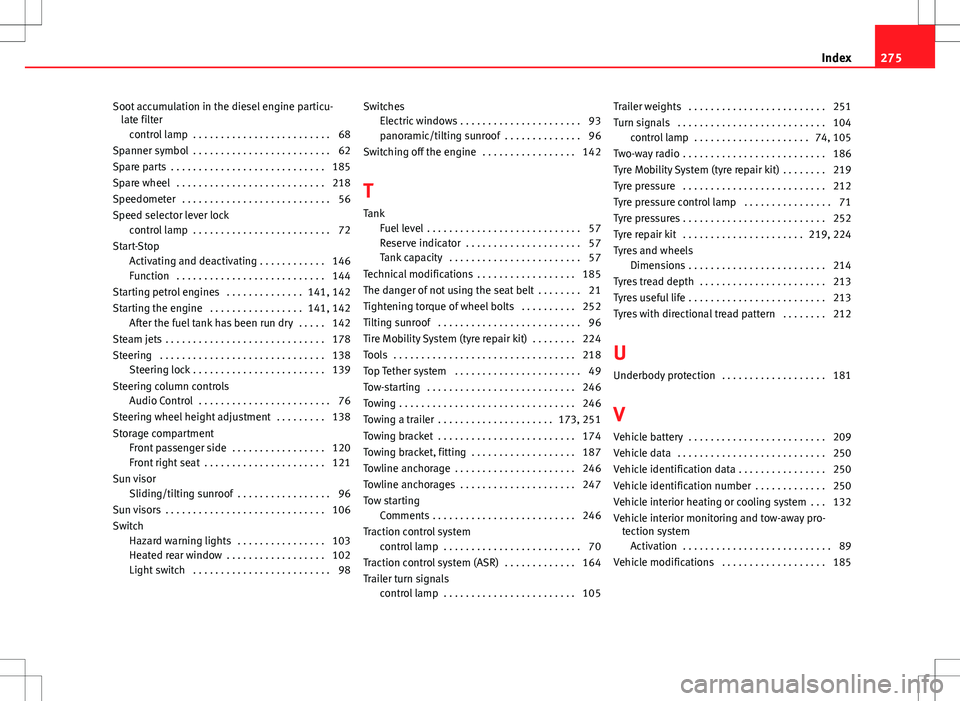
Soot accumulation in the diesel engine particu-late filter
control lamp . . . . . . . . . . . . . . . . . . . . . . . . . 68
Spanner symbol . . . . . . . . . . . . . . . . . . . . . . . . . 62
Spare parts . . . . . . . . . . . . . . . . . . . . . . . . . . . . 185
Spare wheel . . . . . . . . . . . . . . . . . . . . . . . . . . . 218
Speedometer . . . . . . . . . . . . . . . . . . . . . . . . . . . 56
Speed selector lever lock control lamp . . . . . . . . . . . . . . . . . . . . . . . . . 72
Start-Stop Activating and deactivating . . . . . . . . . . . . 146
Function . . . . . . . . . . . . . . . . . . . . . . . . . . . 144
Starting petrol engines . . . . . . . . . . . . . . 141, 142
Starting the engine . . . . . . . . . . . . . . . . . 141, 142 After the fuel tank has been run dry . . . . . 142
Steam jets . . . . . . . . . . . . . . . . . . . . . . . . . . . . . 178
Steering . . . . . . . . . . . . . . . . . . . . . . . . . . . . . . 138 Steering lock . . . . . . . . . . . . . . . . . . . . . . . . 139
Steering column controls Audio Control . . . . . . . . . . . . . . . . . . . . . . . . 76
Steering wheel height adjustment . . . . . . . . . 138
Storage compartment Front passenger side . . . . . . . . . . . . . . . . . 120
Front right seat . . . . . . . . . . . . . . . . . . . . . . 121
Sun visor Sliding/tilting sunroof . . . . . . . . . . . . . . . . . 96
Sun visors . . . . . . . . . . . . . . . . . . . . . . . . . . . . . 106
Switch Hazard warning lights . . . . . . . . . . . . . . . . 103
Heated rear window . . . . . . . . . . . . . . . . . . 102
Light switch . . . . . . . . . . . . . . . . . . . . . . . . . 98 Switches
Electric windows . . . . . . . . . . . . . . . . . . . . . . 93
panoramic/tilting sunroof . . . . . . . . . . . . . . 96
Switching off the engine . . . . . . . . . . . . . . . . . 142
T Tank Fuel level . . . . . . . . . . . . . . . . . . . . . . . . . . . . 57
Reserve indicator . . . . . . . . . . . . . . . . . . . . . 57
Tank capacity . . . . . . . . . . . . . . . . . . . . . . . . 57
Technical modifications . . . . . . . . . . . . . . . . . . 185
The danger of not using the seat belt . . . . . . . . 21
Tightening torque of wheel bolts . . . . . . . . . . 252
Tilting sunroof . . . . . . . . . . . . . . . . . . . . . . . . . . 96
Tire Mobility System (tyre repair kit) . . . . . . . . 224
Tools . . . . . . . . . . . . . . . . . . . . . . . . . . . . . . . . . 218
Top Tether system . . . . . . . . . . . . . . . . . . . . . . . 49
Tow-starting . . . . . . . . . . . . . . . . . . . . . . . . . . . 246
Towing . . . . . . . . . . . . . . . . . . . . . . . . . . . . . . . . 246
Towing a trailer . . . . . . . . . . . . . . . . . . . . . 173, 251
Towing bracket . . . . . . . . . . . . . . . . . . . . . . . . . 174
Towing bracket, fitting . . . . . . . . . . . . . . . . . . . 187
Towline anchorage . . . . . . . . . . . . . . . . . . . . . . 246
Towline anchorages . . . . . . . . . . . . . . . . . . . . . 247
Tow starting Comments . . . . . . . . . . . . . . . . . . . . . . . . . . 246
Traction control system control lamp . . . . . . . . . . . . . . . . . . . . . . . . . 70
Traction control system (ASR) . . . . . . . . . . . . . 164
Trailer turn signals control lamp . . . . . . . . . . . . . . . . . . . . . . . . 105 Trailer weights . . . . . . . . . . . . . . . . . . . . . . . . . 251
Turn signals . . . . . . . . . . . . . . . . . . . . . . . . . . . 104
control lamp . . . . . . . . . . . . . . . . . . . . . 74, 105
Two-way radio . . . . . . . . . . . . . . . . . . . . . . . . . . 186
Tyre Mobility System (tyre repair kit) . . . . . . . . 219
Tyre pressure . . . . . . . . . . . . . . . . . . . . . . . . . . 212
Tyre pressure control lamp . . . . . . . . . . . . . . . . 71
Tyre pressures . . . . . . . . . . . . . . . . . . . . . . . . . . 252
Tyre repair kit . . . . . . . . . . . . . . . . . . . . . . 219, 224
Tyres and wheels Dimensions . . . . . . . . . . . . . . . . . . . . . . . . . 214
Tyres tread depth . . . . . . . . . . . . . . . . . . . . . . . 213
Tyres useful life . . . . . . . . . . . . . . . . . . . . . . . . . 213
Tyres with directional tread pattern . . . . . . . . 212
U Underbody protection . . . . . . . . . . . . . . . . . . . 181
V
Vehicle battery . . . . . . . . . . . . . . . . . . . . . . . . . 209
Vehicle data . . . . . . . . . . . . . . . . . . . . . . . . . . . 250
Vehicle identification data . . . . . . . . . . . . . . . . 250
Vehicle identification number . . . . . . . . . . . . . 250
Vehicle interior heating or cooling system . . . 132
Vehicle interior monitoring and tow-away pro- tection system
Activation . . . . . . . . . . . . . . . . . . . . . . . . . . . 89
Vehicle modifications . . . . . . . . . . . . . . . . . . . 185
275
Index
Page 278 of 280
Vehicle paintworkMaintenance . . . . . . . . . . . . . . . . . . . . . . . . 179
Products for vehicle maintenance . . . . . . . 176
Vehicle tools Storage . . . . . . . . . . . . . . . . . . . . . . . . . . . . 218
Vehicle washing . . . . . . . . . . . . . . . . . . . . . . . . 177
Ventilation . . . . . . . . . . . . . . . . . . . . . . . . . . . . 129
Ventilation slits . . . . . . . . . . . . . . . . . . . . . . . . . 17
W Warning lamps . . . . . . . . . . . . . . . . . . . . . . . . . . 63
Warning messages Red . . . . . . . . . . . . . . . . . . . . . . . . . . . . . . . . 66
Yellow . . . . . . . . . . . . . . . . . . . . . . . . . . . . . . 66
Warning symbols . . . . . . . . . . . . . . . . . . . . . . . . 66
Warning triangle . . . . . . . . . . . . . . . . . . . . . . . . 125
Washer fluid . . . . . . . . . . . . . . . . . . . . . . . . . . . 204
Washing by hand . . . . . . . . . . . . . . . . . . . . . . . 177
Washing the vehicle . . . . . . . . . . . . . . . . . . . . . 177
Washing tunnel . . . . . . . . . . . . . . . . . . . . . . . . 177
Washing with high pressure cleaners . . . . . . . 178
Water in the windscreen washer tank . . . . . . . 204
Wear indicators . . . . . . . . . . . . . . . . . . . . . . . . 213
Wearing suitable shoes . . . . . . . . . . . . . . . . . . . 16
Wheel bolts . . . . . . . . . . . . . . . . . . . . . . . . 221, 252 Tightening torque . . . . . . . . . . . . . . . . . . . . 215
Wheel change . . . . . . . . . . . . . . . . . . . . . . . . . . 219
Wheels . . . . . . . . . . . . . . . . . . . . . . . . . . . 211, 252
Why assume the correct sitting position? . . . . . 29
Why should head restraints be correctly adjus- ted? . . . . . . . . . . . . . . . . . . . . . . . . . . . . . . . . . 13 Why wear seat belts? . . . . . . . . . . . . . . . 18, 20, 29
Windows . . . . . . . . . . . . . . . . . . . . . . . . . . . . . . . 93
Windscreen defrosting . . . . . . . . . . . . . . . . . . . 129
Windscreen washer fluid
control lamp . . . . . . . . . . . . . . . . . . . . . . . . . 69
Windscreen wiper blades Cleaning . . . . . . . . . . . . . . . . . . . . . . . . . . . 180
Windscreen wipers . . . . . . . . . . . . . . . . . . . . . . 107 Changing blades . . . . . . . . . . . . . . . . . . . . 205
Changing the rear wiper blade . . . . . . . . . 207
Winter driving Diesel engine . . . . . . . . . . . . . . . . . . . . . . . 195
Winter tyres . . . . . . . . . . . . . . . . . . . . . . . . . . . . 216
Wooden trim cleaning . . . . . . . . . . . . . . . . . . . 183
Working in the engine compartment . . . . . . . 195
276 Index