checking oil Seat Ibiza 5D 2013 User Guide
[x] Cancel search | Manufacturer: SEAT, Model Year: 2013, Model line: Ibiza 5D, Model: Seat Ibiza 5D 2013Pages: 294, PDF Size: 4.05 MB
Page 219 of 294
217
Checking and refilling levels
To change the blades it is necessary to change the rest position of
the wipers to the service position.
Do not change the windscreen wipers when out of the service posi-
tion, as it could cause paint to flake off the bonnet due to friction
with the windscreen wiper arm.
Service position (For changing wiper blades)
– Ensure that the wiper blades are not frozen.
– Turn ignition on and off and then (before approx. 9 sec.) move
the windscreen wiper lever to the intermittent wipe position.
The windscreen wipers will move to the service position
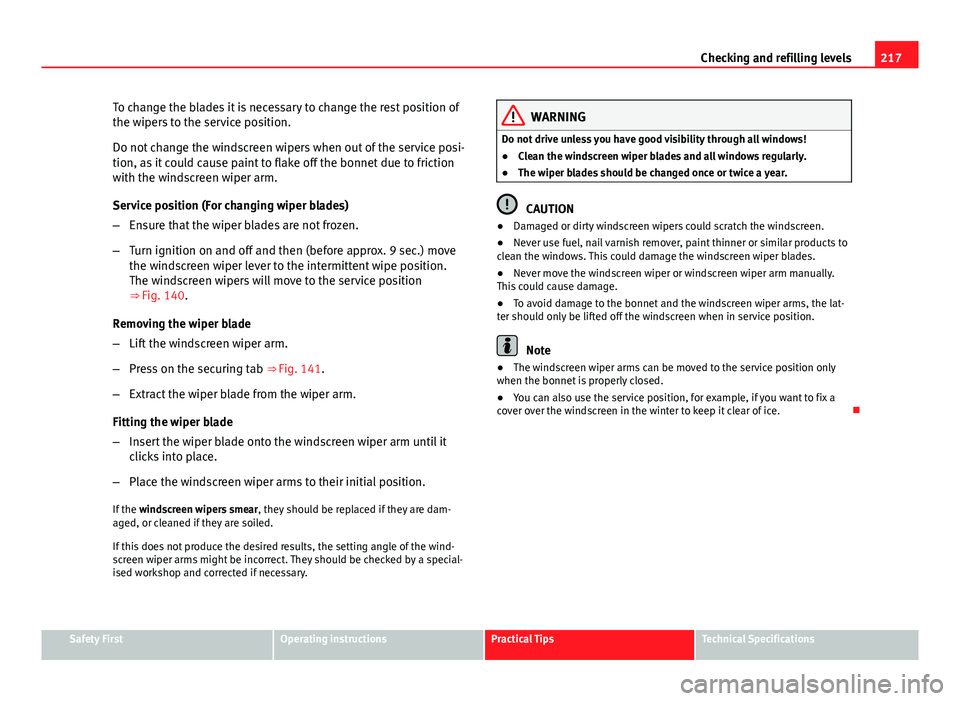
⇒ Fig. 140.
Removing the wiper blade
– Lift the windscreen wiper arm.
– Press on the securing tab ⇒ Fig. 141.
– Extract the wiper blade from the wiper arm.
Fitting the wiper blade
– Insert the wiper blade onto the windscreen wiper arm until it
clicks into place.
– Place the windscreen wiper arms to their initial position.
If the windscreen wipers smear , they should be replaced if they are dam-
aged, or cleaned if they are soiled.
If this does not produce the desired results, the setting angle of the wind-
screen wiper arms might be incorrect. They should be checked by a special-
ised workshop and corrected if necessary.
WARNING
Do not drive unless you have good visibility through all windows!
● Clean the windscreen wiper blades and all windows regularly.
● The wiper blades should be changed once or twice a year.
CAUTION
● Damaged or dirty windscreen wipers could scratch the windscreen.
● Never use fuel, nail varnish remover, paint thinner or similar products to
clean the windows. This could damage the windscreen wiper blades.
● Never move the windscreen wiper or windscreen wiper arm manually.
This could cause damage.
● To avoid damage to the bonnet and the windscreen wiper arms, the lat-
ter should only be lifted off the windscreen when in service position.
Note
● The windscreen wiper arms can be moved to the service position only
when the bonnet is properly closed.
● You can also use the service position, for example, if you want to fix a
cover over the windscreen in the winter to keep it clear of ice.
Safety FirstOperating instructionsPractical TipsTechnical Specifications
Page 220 of 294

218Checking and refilling levels
Changing the rear wiper blade
A good rear wiper blade is essential for clear rear vision.
Damaged wiper blades should be replaced immediately.
Fig. 142 Removing the
rear window wiper blade
Fig. 143 Fitting the rear
window wiper blade Removing the wiper blade
–
Lift the wiper arm away from the glass ⇒ Fig. 142.
– Slide the blade adapter in the direction of the arrow and remove
the blade ⇒ Fig. 142.
Fitting the wiper blade
– With one hand, hold the top end of the wiper arm.
– Place the blade as shown in the ⇒ Fig. 143 and slide the adapt-
er along until it engages.
Check the condition of the wiper blade regularly. Change as required.
If the windscreen wiper scrapes, it should be replaced if damaged, or
cleaned if soiled.
If this is not sufficient, refer to a specialised workshop.
WARNING
Do not drive unless you have good visibility through all windows!
● Clean the windscreen wiper blades and all windows regularly.
● The wiper blades should be changed once or twice a year.
CAUTION
● A damaged or dirty window wiper could scratch the rear window.
● Never use fuel, nail varnish remover, paint thinner or similar products to
clean the window.
● Never move the windscreen wiper by hand. This could cause damage.
Page 221 of 294
219
Checking and refilling levels
Brake fluid Checking the brake fluid level
The brake fluid is checked at the intervals given in the serv-
ice schedule.
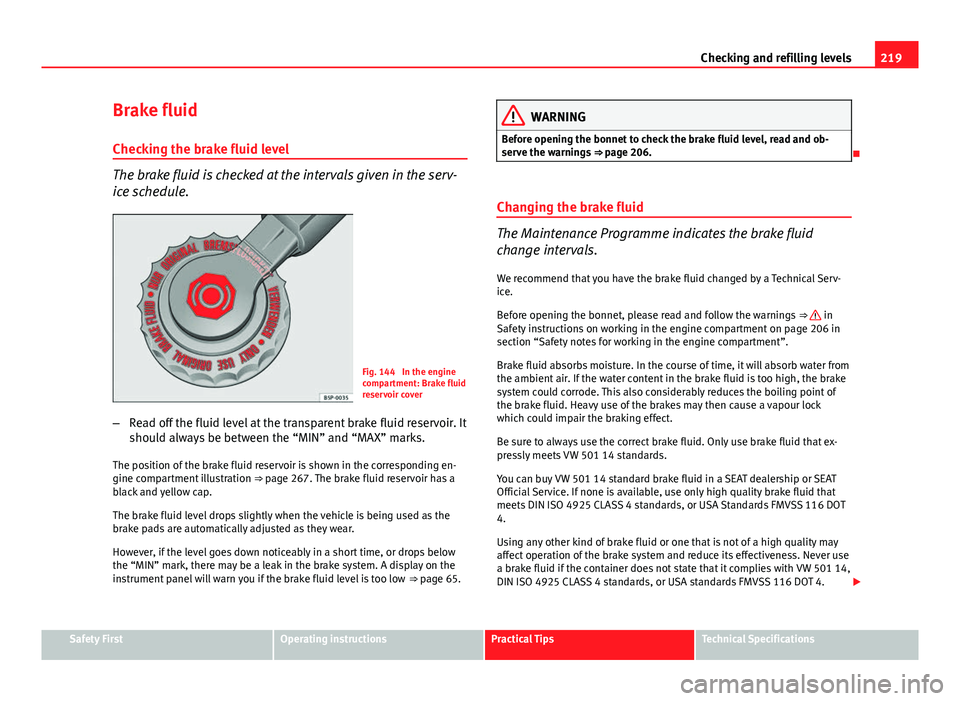
Fig. 144 In the engine
compartment: Brake fluid
reservoir cover
– Read off the fluid level at the transparent brake fluid reservoir. It
should always be between the “MIN” and “MAX” marks.
The position of the brake fluid reservoir is shown in the corresponding en-
gine compartment illustration ⇒ page 267. The brake fluid reservoir has a
black and yellow cap.
The brake fluid level drops slightly when the vehicle is being used as the
brake pads are automatically adjusted as they wear.
However, if the level goes down noticeably in a short time, or drops below
the “MIN” mark, there may be a leak in the brake system. A display on the
instrument panel will warn you if the brake fluid level is too low ⇒ page 65.
WARNING
Before opening the bonnet to check the brake fluid level, read and ob-
serve the warnings ⇒ page 206.
Changing the brake fluid
The Maintenance Programme indicates the brake fluid
change intervals. We recommend that you have the brake fluid changed by a Technical Serv-
ice.
Before opening the bonnet, please read and follow the warnings ⇒
in
Safety instructions on working in the engine compartment on page 206 in
section “Safety notes for working in the engine compartment”.
Brake fluid absorbs moisture. In the course of time, it will absorb water from
the ambient air. If the water content in the brake fluid is too high, the brake
system could corrode. This also considerably reduces the boiling point of
the brake fluid. Heavy use of the brakes may then cause a vapour lock
which could impair the braking effect.
Be sure to always use the correct brake fluid. Only use brake fluid that ex-
pressly meets VW 501 14 standards.
You can buy VW 501 14 standard brake fluid in a SEAT dealership or SEAT
Official Service. If none is available, use only high quality brake fluid that
meets DIN ISO 4925 CLASS 4 standards, or USA Standards FMVSS 116 DOT
4.
Using any other kind of brake fluid or one that is not of a high quality may
affect operation of the brake system and reduce its effectiveness. Never use
a brake fluid if the container does not state that it complies with VW 501 14,
DIN ISO 4925 CLASS 4 standards, or USA standards FMVSS 116 DOT 4.
Safety FirstOperating instructionsPractical TipsTechnical Specifications
Page 224 of 294
222Checking and refilling levels
There are two different colours:
● Black: correct charge status.
● Transparent/clear yellow: the battery must be replaced. Contact a speci-
alised workshop.
Charging and changing the vehicle battery
The battery is maintenance-free and is checked during the
inspection service. All work on the vehicle battery requires
specialist knowledge.
If you often drive short distances or if the vehicle is not driven for long peri-
ods, the battery should be checked by a specialised workshop between the
scheduled services.
If the battery has discharged and you have problems starting the vehicle,
the battery might be damaged. If this happens, we recommend you have
the vehicle battery checked by a Technical Service where it will be re-charg-
ed or replaced.
Charging the battery
The vehicle battery should be charged by a specialised workshop only, as
batteries using special technology have been installed and they must be
charged in a controlled environment.
Replacing a vehicle battery
The battery has been developed to suit the conditions of its location and
has special safety features.
Genuine SEAT batteries fulfil the maintenance, performance and safety
specifications of your vehicle.
WARNING
● We recommend you use only maintenance-free or cycle free leak-proof
batteries which comply with standards T 825 06 and VW 7 50 73. This
standard applies as of 2001.
● Before starting any work on the batteries, you must read and observe
the warnings ⇒
in Warnings on handling the battery on page 220.
For the sake of the environment
Batteries contain toxic substances such as sulphuric acid and lead. They
must be disposed of appropriately and must not be disposed of with ordi-
nary household waste.
Wheels
General notes
Avoiding damage
– If you have to drive over a kerb or similar obstacle, drive very
slowly and at a right angle.
– Keep grease, oil and fuel off the tyres.
– Inspect the tyres regularly for damage (cuts, cracks or blisters,
etc.). Remove any foreign objects embedded in the treads.
Storing tyres
– When you remove the tyres, mark them in order to maintain the
same direction of rotation when they are installed again.
Page 227 of 294
225
Checking and refilling levels
WARNING
There is a serious danger of accidents if a tyre bursts during driving!
● The tyres must be replaced at the latest when the tread wear indica-
tors are worn ⇒ page 224. Failure to do so could result in an accident.
Worn tyres do not grip well at high speeds on wet roads. There is also a
greater risk of aquaplaning.
● At continuously high speeds, a tyre with insufficient pressure flexes
more. This causes it to overheat. This can cause tread separation and tyre
blow-out. Risk of accident. Always observe the recommended tyre pres-
sures.
● If tyres show excessive wear, you should have the running gear
checked by a Technical Service.
● Keep chemicals such as oil, fuel and brake fluid away from tyres.
● Damaged wheels and tyres must be replaced immediately!
For the sake of the environment
Under-inflated tyres will increase fuel consumption.
New tyres and wheels
New tyres and wheels have to be run in.
The tyres and wheel rims are an essential part of the vehicle's design. The
tyres and rims approved by SEAT are specially matched to the characteris-
tics of the vehicle and make a major contribution to good road holding and
safe handling ⇒
.
Tyres should be replaced at least in pairs and not individually (i.e. both front
tyres or both rear tyres together). A knowledge of tyre designations makes it
easier to choose the correct tyres. Radial tyres have the tyre designations
marked on the sidewall, for example: 195/65 R15 91T
This contains the following information: Tyre width in mm
Height/width ratio in %
Tyre construction: Radial
Rim diameter in inches
Load rating code
Speed rating
The tyres could also have the following information:
● A direction of rotation symbol
● “Reinforced” denotes heavy-duty tyres.
The manufacturing date is also indicated on the tyre sidewall (possibly only
on the inner side of the wheel).
“DOT... 1103...” means, for example, that the tyre was produced in the 11th
week of 2003.
We recommend that work on tyres and wheels be carried out by a Technical
Service. They are familiar with the procedure and have the necessary spe-
cial tools and spare parts as well as the proper facilities for disposing of the
old tyres.
Any Technical Service has full information on the technical requirements
when installing or changing tyres, wheels or wheel trims.
195
65
R
15
91
T
Safety FirstOperating instructionsPractical TipsTechnical Specifications
Page 228 of 294
226Checking and refilling levels
WARNING
● We recommend that you use only wheels and tyres which have been
approved by SEAT for your model. Failure to do so could impair vehicle
handling. Risk of accident.
● Avoid running the vehicle on tyres that are more than 6 years old. If
you have no alternative, you should drive slowly and with extra care at all
times.
● Never use old tyres or those with an unknown history of use.
● If wheel trims are retrofitted, you must ensure that the flow of air to
the brakes is not restricted. This could cause the brake system to over-
heat.
● All four wheels must be fitted with radial tyres of the same type, size
(rolling circumference) and the same tread pattern.
For the sake of the environment
Old tyres must be disposed of according to the laws in the country con-
cerned.
Note
● For technical reasons, it is not generally possible to use the wheels from
other vehicles. This can also apply to wheels of the same model. The use of
wheels or tyres which have not been approved by SEAT for use with your
model may invalidate the vehicle's type approval for use on public roads.
● If the spare tyre is not the same as the tyres that are mounted on the
vehicle (e.g. winter tyres) you should only use the spare tyre for a short peri-
od of time and drive with extra care. Refit the normal road wheel as soon as
possible. Wheel bolts
Wheel bolts must be tightened to the correct torque.
The design of wheel bolts is matched to the rims. If different wheel rims are
fitted, the correct wheel bolts with the right length and correctly shaped
bolt heads must be used. This ensures that wheels are fitted securely and
that the brake system functions correctly.
In certain circumstances, you should not use wheel bolts from a different
vehicle, even if it is the same model ⇒ page 196.
WARNING
If the wheel bolts are not tightened correctly, the wheel could become
loose while driving. Risk of accident.
● The wheel bolts must be clean and turn easily. Never apply grease or
oil to them.
● Use only wheel bolts which belong to the wheel.
● If the prescribed torque of the wheel bolts is too low, they could loos-
en whilst the vehicle is in motion. Risk of accident! If the tightening tor-
que is too high, the wheel bolts and threads can be damaged.
CAUTION
The prescribed tightening torque for wheel bolts for steel and alloy wheels
is 120 Nm.
Page 269 of 294
267
Technical specifications
Technical specifications
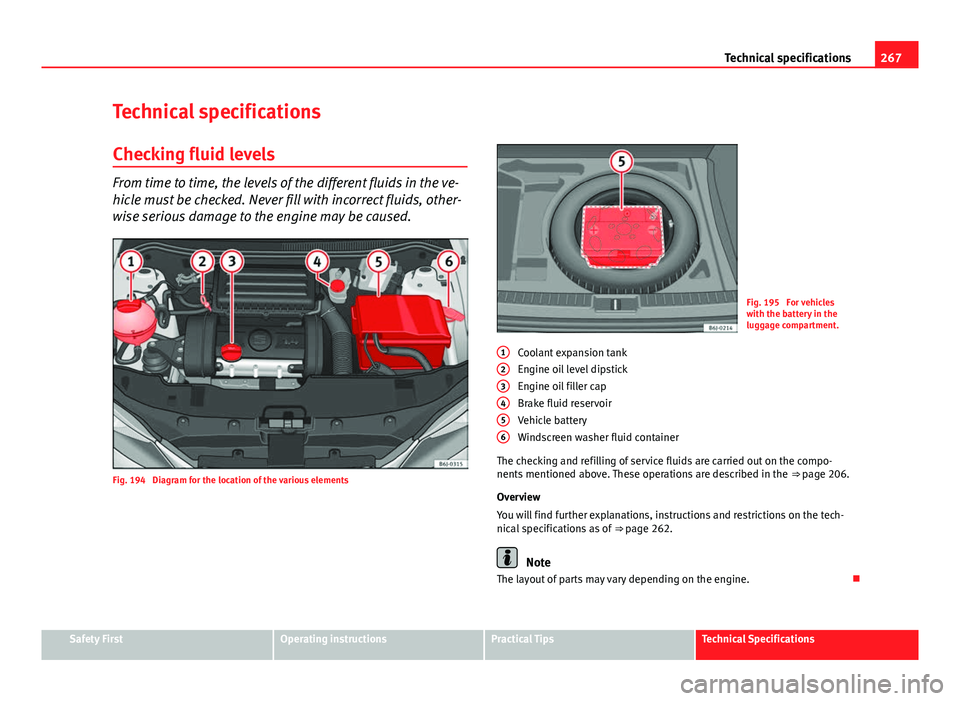
Checking fluid levels
From time to time, the levels of the different fluids in the ve-
hicle must be checked. Never fill with incorrect fluids, other-
wise serious damage to the engine may be caused.
Fig. 194 Diagram for the location of the various elements
Fig. 195 For vehicles
with the battery in the
luggage compartment.
Coolant expansion tank
Engine oil level dipstick
Engine oil filler cap
Brake fluid reservoir
Vehicle battery
Windscreen washer fluid container
The checking and refilling of service fluids are carried out on the compo-
nents mentioned above. These operations are described in the ⇒ page 206.
Overview
You will find further explanations, instructions and restrictions on the tech-
nical specifications as of ⇒ page 262.
Note
The layout of parts may vary depending on the engine.
123456
Safety FirstOperating instructionsPractical TipsTechnical Specifications
Page 286 of 294
Central lock buttonLocking . . . . . . . . . . . . . . . . . . . . . . . . . . . . . 85
Unlocking . . . . . . . . . . . . . . . . . . . . . . . . . . . 85
Central locking . . . . . . . . . . . . . . . . . . . . . . . . . . 82 Automatic speed-dependent locking . . . . . 84
Locking system for involuntary unlocking . 84
Selective unlocking system . . . . . . . . . . . . . 83
Unlocking system . . . . . . . . . . . . . . . . . . . . . 84
Cetane number . . . . . . . . . . . . . . . . . . . . . . . . . 205
Changing bulbs interior light and reading light . . . . . . . . . 255
Changing bulbs on tail lights . . . . . . . . . 250, 251
Changing gear see Manual gearbox . . . . . . . . . . . . . . . . . . 156
Changing gear in tiptronic mode . . . . . . . . . . 160
Changing rear lights on the rear lid . . . . . . . . . . . . . . . . . . . . . . . 253
on the wing . . . . . . . . . . . . . . . . . . . . . . . . . 251
Changing single headlight bulbs Turn signal bulb . . . . . . . . . . . . . . . . . . . . . 241
Changing the AFS headlight bulbs Xenon lights . . . . . . . . . . . . . . . . . . . . . . . . 247
Changing the bulbs AFS headlight bulbs . . . . . . . . . . . . . . . . . . 247
fog light bulbs . . . . . . . . . . . . . . . . . . . . . . 248
luggage compartment light . . . . . . . . . . . . 256
number plate light . . . . . . . . . . . . . . . . . . . 255
Side turn signal lights . . . . . . . . . . . . . . . . 254
Changing the main headlight bulb turn signal lights . . . . . . . . . . . . . . . . . . . . 245
Changing the main headlight bulbs turn signal lights . . . . . . . . . . . . . . . . . . . . 247 Changing the single headlight bulbs
Dipped/main beam . . . . . . . . . . . . . . . . . . 242
Side light . . . . . . . . . . . . . . . . . . . . . . . . . . 242
Changing windscreen wiper blades . . . . . . . . 216
Chassis number . . . . . . . . . . . . . . . . . . . . . . . . 264
Checking . . . . . . . . . . . . . . . . . . . . . . . . . . . . . . 221
Checking battery electrolyte level . . . . . . . . . . 221
Checking engine oil level . . . . . . . . . . . . . . . . . 211
Child safety . . . . . . . . . . . . . . . . . . . . . . . . . . . . . 43
Child seat Categorisation in groups . . . . . . . . . . . . . . . 45
Group 1 . . . . . . . . . . . . . . . . . . . . . . . . . . . . . 46
Group 2 . . . . . . . . . . . . . . . . . . . . . . . . . . . . . 46
Group 3 . . . . . . . . . . . . . . . . . . . . . . . . . . . . . 46
Groups 0 and 0+ . . . . . . . . . . . . . . . . . . . . . . 45
Safety notes . . . . . . . . . . . . . . . . . . . . . . . . . 43
Securing . . . . . . . . . . . . . . . . . . . . . . . . . . . . 48
Child seats . . . . . . . . . . . . . . . . . . . . . . . . . . . . . 45 ISOFIX system . . . . . . . . . . . . . . . . . . . . . . . . 49
on the front passenger seat . . . . . . . . . . . . . 31
Top Tether system . . . . . . . . . . . . . . . . . . . . 50
Cigarette lighter . . . . . . . . . . . . . . . . . . . . . . . . 129
Cleaning alloy wheel rims . . . . . . . . . . . . . . . . 192
Cleaning chrome . . . . . . . . . . . . . . . . . . . . . . . 191
Cleaning engine compartment . . . . . . . . . . . . 193
Cleaning steel wheel rims . . . . . . . . . . . . . . . . 192
Cleaning windows . . . . . . . . . . . . . . . . . . . . . . 190
Climatronic automatic mode . . . . . . . . . . . . . . . . . . . . . 144
controls . . . . . . . . . . . . . . . . . . . . . . . . . . . . 143
General notes . . . . . . . . . . . . . . . . . . . . . . . 145
manual mode . . . . . . . . . . . . . . . . . . . . . . . 144 Clock . . . . . . . . . . . . . . . . . . . . . . . . . . . . . . . . . . 60
Cloth seat covers cleaning . . . . . . . . . . . . . . . . 194
Cockpit . . . . . . . . . . . . . . . . . . . . . . . . . . . . . . . . 55
Coming Home function . . . . . . . . . . . . . . . . . . 105
Compartment for on-board documentation . . 125
Control
Exterior mirrors . . . . . . . . . . . . . . . . . . . . . . 115
control lamp . . . . . . . . . . . . . . . . . . . . . . . . . . . . 31
Control lamps . . . . . . . . . . . . . . . . . . . . . . . . . . . 65
Control lighting . . . . . . . . . . . . . . . . . . . . . . . . . . 55
Controls Electric windows . . . . . . . . . . . . . . . . . . . . . . 96
Convenience closing Sliding/tilting sunroof . . . . . . . . . . . . . . . . 100
Windows . . . . . . . . . . . . . . . . . . . . . . . . . . . . 98
Convenience opening Windows . . . . . . . . . . . . . . . . . . . . . . . . . . . . 98
Coolant . . . . . . . . . . . . . . . . . . . . . . . . . . . 213, 214
Coolant level . . . . . . . . . . . . . . . . . . . . . . . . . . . 214 control lamp . . . . . . . . . . . . . . . . . . . . . . . . . 75
Coolant loss . . . . . . . . . . . . . . . . . . . . . . . . . . . 214
Coolant temperature control lamp . . . . . . . . . . . . . . . . . . . . . . . . . 75
Safety instructions . . . . . . . . . . . . . . . . . . . . 76
Correct adjustment of front head restraints . . . 13
Correct sitting position front passenger . . . . . . . . . . . . . . . . . . . . . . 11
Incorrect sitting position . . . . . . . . . . . . . . . 14
passenger . . . . . . . . . . . . . . . . . . . . . . . . . . . 12
Cruise control Control lamp . . . . . . . . . . . . . . . . . . . . . . . . . 73
Cruise control system . . . . . . . . . . . . . . . . . . . . 171
284 Index
Page 287 of 294
Cruise speed . . . . . . . . . . . . . . . . . . . . . . . . . . . 171Control lamp . . . . . . . . . . . . . . . . . . . . . . . . . 73
D Danger of fitting a child seat on the front pas- senger seat . . . . . . . . . . . . . . . . . . . . . . . . . . . 31
Dash panel . . . . . . . . . . . . . . . . . . . . . . . . . . . . . 55
Dash panel cleaning . . . . . . . . . . . . . . . . . . . . 193
Daytime driving lights . . . . . . . . . . . . . . . . . . . 103
daytime running lights Nordic countries . . . . . . . . . . . . . . . . . . . . . 104
Deactivating front passenger airbag Safety notes . . . . . . . . . . . . . . . . . . . . . . . . . 42
Deactivating the airbag Front passenger front airbag . . . . . . . . . . . . 41
Diesel . . . . . . . . . . . . . . . . . . . . . . . . . . . . . . . . 205
Diesel engine Winter driving . . . . . . . . . . . . . . . . . . . . . . . 206
Diesel engine particulate filter . . . . . . . . . . . . 181
Differential lock . . . . . . . . . . . . . . . . . . . . . . . . 177
Differential lock fault (EDL) control lamp . . . . . . . . . . . . . . . . . . . . . . . . . 72
Digital clock . . . . . . . . . . . . . . . . . . . . . . . . . . . . 60
Dimensions . . . . . . . . . . . . . . . . . . . . . . . . . . . . 282
Dipped beam headlights . . . . . . . . . . . . . . . . . 101
Disposal Airbags . . . . . . . . . . . . . . . . . . . . . . . . . . . . . 32
Seat belt tensioners . . . . . . . . . . . . . . . . . . . 28
Door lock cylinders . . . . . . . . . . . . . . . . . . . . . . 191
Door release lever . . . . . . . . . . . . . . . . . . . . . . . 55 Doors
Childproof locks . . . . . . . . . . . . . . . . . . . . . . 86
control lamp . . . . . . . . . . . . . . . . . . . . . . . . . 74
Double headlight . . . . . . . . . . . . . . . . . . . . . . . 243
Double headlight bulb change dipped beam headlights . . . . . . . . . . . . . . 245
main beam headlights . . . . . . . . . . . . . . . . 244
side light . . . . . . . . . . . . . . . . . . . . . . . . . . . 243
Driver see Correct sitting position . . . . . . . 10, 11, 12
Driveshaft differential XDS . . . . . . . . . . . . . . . . . . . . . . . . . . . . . . . 176
Driving Driving abroad . . . . . . . . . . . . . . . . . . . . . . 184
Economically / Environmentally friendly . 182
With a trailer . . . . . . . . . . . . . . . . . . . . 184, 186
Driving abroad . . . . . . . . . . . . . . . . . . . . . . . . . 184 Headlights . . . . . . . . . . . . . . . . . . . . . . . . . 184
Driving safety . . . . . . . . . . . . . . . . . . . . . . . . . . . . 8
Duplicate keys . . . . . . . . . . . . . . . . . . . . . . . . . . 87
Dust filter . . . . . . . . . . . . . . . . . . . . . . . . . . . . . 145
Dynamic headlight range control . . . . . . . . . . 103
E
Economical driving . . . . . . . . . . . . . . . . . . . . . . 182
EDL . . . . . . . . . . . . . . . . . . . . . . . . . . . . . . . . . . 177 control lamp . . . . . . . . . . . . . . . . . . . . . . . . . 71
Electro-hydraulic steering control lamp . . . . . . . . . . . . . . . . . . . . . . . . . 75
Electronic differential lock . . . . . . . . . . . . . . . . 177 control lamp . . . . . . . . . . . . . . . . . . . . . . . . . 71 Electronic immobiliser . . . . . . . . . . . . . . . . . . . 149
Electronic stability control
description . . . . . . . . . . . . . . . . . . . . . . . . . 148
Electronic Stability Control . . . . . . . . . . . . 72, 176
Electronic Stability Control (ESC) control lamp . . . . . . . . . . . . . . . . . . . . . . . . . 72
Emission control system control lamp . . . . . . . . . . . . . . . . . . . . . . . . . 75
Engine Running in . . . . . . . . . . . . . . . . . . . . . . . . . 179
Engine compartment Working in the engine compartment . . . . 206
Engine coolant . . . . . . . . . . . . . . . . . . . . . . . . . 213 G 12 plus-plus . . . . . . . . . . . . . . . . . . . . . . 213
G 13 . . . . . . . . . . . . . . . . . . . . . . . . . . . . . . . 213
Specifications . . . . . . . . . . . . . . . . . . . . . . . 213
Engine fault control lamp . . . . . . . . . . . . . . . . . . . . . . . . . 70
Engine management control lamp . . . . . . . . . . . . . . . . . . . . . . . . . 69
Engine oil Changing . . . . . . . . . . . . . . . . . . . . . . . . . . 212
Checking engine oil level . . . . . . . . . . . . . . 211
Oil properties . . . . . . . . . . . . . . . . . . . . . . . 210
Specifications . . . . . . . . . . . . . . . . . . . . . . . 209
Topping up . . . . . . . . . . . . . . . . . . . . . . . . . 212
Engine oil dipstick . . . . . . . . . . . . . . . . . . . . . . 211
Engine oil pressure control lamp . . . . . . . . . . . . . . . . . . . . . . . . . 70
Environment . . . . . . . . . . . . . . . . . . . . . . . . . . . 182 Environmental friendliness . . . . . . . . . . . . 183
Environmentally friendly driving . . . . . . . . . . . 182
285
Index