maintenance Seat Ibiza 5D 2013 Owner's Guide
[x] Cancel search | Manufacturer: SEAT, Model Year: 2013, Model line: Ibiza 5D, Model: Seat Ibiza 5D 2013Pages: 294, PDF Size: 4.05 MB
Page 211 of 294
209
Checking and refilling levels
WARNING (Continued)
● Wait until no more steam, smoke or coolant is emitted from the bon-
net, then carefully open the bonnet.
● When working in the engine compartment, always observe the safety
warnings ⇒ page 206.
Closing the bonnet
– Slightly raise the bonnet
– Release the bonnet stay and replace it in its support.
– At a height of about 30 cm let it fall so it is locked.
If the bonnet does not close, do not press downwards. Open it once more
and let it fall as before.
WARNING
If the bonnet is not closed properly, it could open while you are driving
and completely obscure your view of the road. Risk of accident.
● After closing the bonnet, always check that it is properly secured. The
bonnet must be flush with the surrounding body panels.
● If you notice that the bonnet latch is not secured when the vehicle is
moving, stop the vehicle immediately and close the bonnet properly.
Risk of accident.
Engine oil
General notes
The engine comes with a special, multi-grade oil that can be used all year
round.
Because the use of high-quality oil is essential for the correct operation of
the engine and its long useful life, when topping up or changing oil, use on-
ly those oils that comply with VW standards.
The specifications (VW standards) set out in the following page should ap-
pear on the container of the service oil; when the container displays the
specific standards for petrol and diesel engines together, it means that the
oil can be used for both types of engines.
We recommend that the oil change, indicated in the Maintenance Pro-
gramme, be performed by a Technical Service or a specialised workshop.
The correct oil specifications for your engine are listed in the ⇒ page 210,
Oil properties.
Service intervals
Service intervals can be flexible (LongLife service) or fixed (dependent on
time/distance travelled).
If the PR code that appears on the back of the “Maintenance Programme”
booklet is PR QI6, this means that your vehicle has the LongLife service pro-
grammed. If it lists the codes QI1, QI2, QI3, QI4 or QI7, the interval service
is dependent on time/distance travelled.
Flexible service intervals (LongLife service intervals*)
Special oils and processes have been developed which, depending on the
characteristics and individual driving profiles, enable the extension of the
oil change service (LongLife service intervals).
Safety FirstOperating instructionsPractical TipsTechnical Specifications
Page 212 of 294
210Checking and refilling levels
Because this oil is essential for extending the service intervals, it must only
be used observing the following indications:
● Avoid mixing it with oil for fixed service intervals.
● Only in exceptional circumstances, if the engine oil level is too low
⇒ page 211 and LongLife oil is not available, it is permitted to top up
(once) with oil for fixed service intervals ⇒ page 210 (up to a maximum of
0.5 litres).
Fixed service intervals*
If your vehicle does not have the “LongLife service interval” or it has been
disabled (by request), you may use oils for fixed service intervals, which al-
so appear in ⇒ page 210, Oil properties. In this case, your vehicle must be
serviced after a fixed interval of 1 year/15 000 km (10 000 miles)(whatever
comes first) ⇒ Booklet Maintenance Programme.
● In exceptional circumstances, if the engine oil level is too low
⇒ page 211 and you cannot obtain the oil specified for your vehicle, you
can put in a small quantity of oil conforming to the specification ACEA A2 or
ACEA A3 (petrol engines) or ACEA B3 or ACEA B4 (diesel engines) (up to 0.5
l).
Vehicles with diesel particulate filter*
The “Maintenance Programme” states whether your vehicle is fitted with a
diesel particulate filter.
Only VW 507 00 engine oil, with reduced ash formation, may be used in die-
sel engines equipped with particulate filter. Using other types of oil will
cause a higher soot concentration and reduce the life of the DPF. Therefore:
● Avoid mixing this oil with other engine oils.
● Only in exceptional circumstances, if the engine oil level is too low
⇒ page 211 and you cannot obtain the oil specified for your vehicle, you
can use a small quantity of oil (once) conforming to the VW 506 00,
VW 506 01, VW 505 00, VW 505 01 or ACEA B3/ACEA B4 specification. (up
to 0.5 l). Oil properties
Engine typeSpecificationPetrol without flexible service
intervalVW 502 00/VW 504 00
Petrol with flexible service in-
terval (LongLife)VW 504 00
Diesel. Engines without Partic-
ulate filter (DPF)VW 505 01/VW 506 01/VW 507 00
Diesel. Particulate Filter En-
gines (DPF).
With or without flexible service
interval (with and without
Longlife)
a)VW 507 00
a)
Only use recommended oils, otherwise you may damage the engine.
Engine oil additives
No type of additive should be mixed with the engine oil. The deterioration
caused by these additives is not covered by the warranty.
Note
Before a long trip, we recommend finding an engine oil that conforms to the
corresponding VW specifications and recommend keeping it in the vehicle.
This way, the correct engine oil will always be available for a top-up if nee-
ded.
Page 214 of 294
212Checking and refilling levels
Topping up engine oil
Top up gradually with small quantities of engine oil.
Fig. 137 In the engine
compartment: Engine oil
filler cap
Before opening the bonnet, read and observe the warnings ⇒
in
Safety instructions on working in the engine compartment on
page 206.
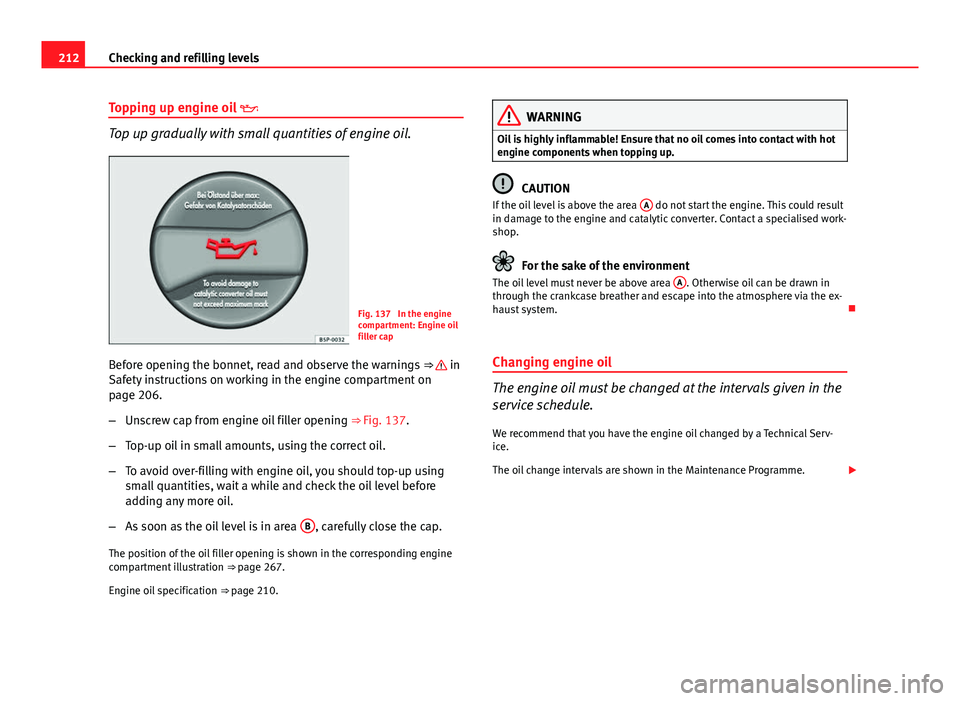
– Unscrew cap from engine oil filler opening ⇒ Fig. 137.
– Top-up oil in small amounts, using the correct oil.
– To avoid over-filling with engine oil, you should top-up using
small quantities, wait a while and check the oil level before
adding any more oil.
– As soon as the oil level is in area B
, carefully close the cap.
The position of the oil filler opening is shown in the corresponding engine
compartment illustration ⇒ page 267.
Engine oil specification ⇒ page 210.
WARNING
Oil is highly inflammable! Ensure that no oil comes into contact with hot
engine components when topping up.
CAUTION
If the oil level is above the area A do not start the engine. This could result
in damage to the engine and catalytic converter. Contact a specialised work-
shop.
For the sake of the environment
The oil level must never be above area A. Otherwise oil can be drawn in
through the crankcase breather and escape into the atmosphere via the ex-
haust system.
Changing engine oil
The engine oil must be changed at the intervals given in the
service schedule. We recommend that you have the engine oil changed by a Technical Serv-
ice.
The oil change intervals are shown in the Maintenance Programme.
Page 221 of 294
219
Checking and refilling levels
Brake fluid Checking the brake fluid level
The brake fluid is checked at the intervals given in the serv-
ice schedule.
Fig. 144 In the engine
compartment: Brake fluid
reservoir cover
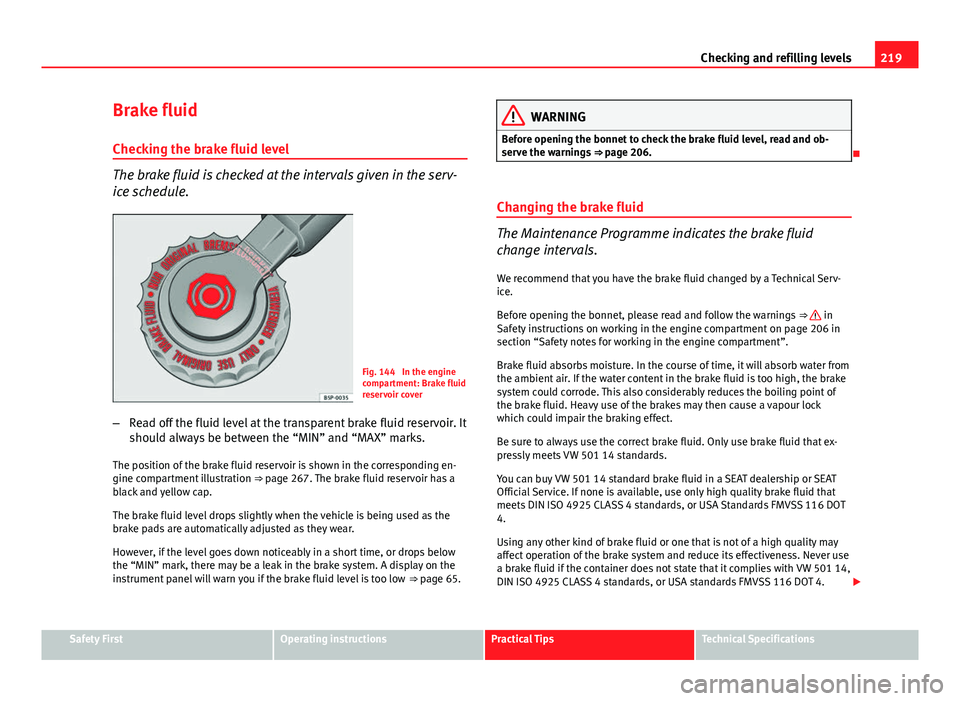
– Read off the fluid level at the transparent brake fluid reservoir. It
should always be between the “MIN” and “MAX” marks.
The position of the brake fluid reservoir is shown in the corresponding en-
gine compartment illustration ⇒ page 267. The brake fluid reservoir has a
black and yellow cap.
The brake fluid level drops slightly when the vehicle is being used as the
brake pads are automatically adjusted as they wear.
However, if the level goes down noticeably in a short time, or drops below
the “MIN” mark, there may be a leak in the brake system. A display on the
instrument panel will warn you if the brake fluid level is too low ⇒ page 65.
WARNING
Before opening the bonnet to check the brake fluid level, read and ob-
serve the warnings ⇒ page 206.
Changing the brake fluid
The Maintenance Programme indicates the brake fluid
change intervals. We recommend that you have the brake fluid changed by a Technical Serv-
ice.
Before opening the bonnet, please read and follow the warnings ⇒
in
Safety instructions on working in the engine compartment on page 206 in
section “Safety notes for working in the engine compartment”.
Brake fluid absorbs moisture. In the course of time, it will absorb water from
the ambient air. If the water content in the brake fluid is too high, the brake
system could corrode. This also considerably reduces the boiling point of
the brake fluid. Heavy use of the brakes may then cause a vapour lock
which could impair the braking effect.
Be sure to always use the correct brake fluid. Only use brake fluid that ex-
pressly meets VW 501 14 standards.
You can buy VW 501 14 standard brake fluid in a SEAT dealership or SEAT
Official Service. If none is available, use only high quality brake fluid that
meets DIN ISO 4925 CLASS 4 standards, or USA Standards FMVSS 116 DOT
4.
Using any other kind of brake fluid or one that is not of a high quality may
affect operation of the brake system and reduce its effectiveness. Never use
a brake fluid if the container does not state that it complies with VW 501 14,
DIN ISO 4925 CLASS 4 standards, or USA standards FMVSS 116 DOT 4.
Safety FirstOperating instructionsPractical TipsTechnical Specifications
Page 222 of 294
220Checking and refilling levels
WARNING
Brake fluid is poisonous. Old brake fluid impairs the braking effect.
● Before opening the bonnet to check the brake fluid level, read and ob-
serve the warnings ⇒ page 206.
● Brake fluid should be stored in the closed original container in a safe
place out of reach of children. There is a toxic risk.
● Complete the brake fluid change according to the Maintenance Pro-
gramme. Heavy use of the brakes may cause a vapour lock if the brake
fluid is left in the brake system for too long. This would seriously affect
the effectiveness of the brakes and the safety of the vehicle. This may
cause an accident.
CAUTION
Brake fluid damages the vehicle paintwork. Wipe off any brake fluid from
the paintwork immediately.
For the sake of the environment
The brake pads and brake fluid must be collected and disposed of accord-
ing the applicable regulations. The SEAT Technical Service network has the
necessary equipment and qualified personnel for collecting and disposing
of this waste material. Vehicle battery
Warnings on handling the battery
Wear eye protection
Battery acid is extremely corrosive. Wear protective gloves and
eye protection!
Fires, sparks, open flames and smoking are prohibited!
A highly explosive mixture of gases is released when the battery
is under charge.
Keep children away from acid and batteries!
WARNING
Always be aware of the danger of injury and chemical burns as well as
the risk of accident or fire when working on the battery and the electrical
system:
● Wear eye protection. Protect your eyes, skin and clothing from acid
and particles containing lead.
● Battery acid is extremely corrosive. Wear protective gloves and eye
protection. Do not tilt the batteries. This could spill acid through the
vents. Rinse battery acid from eyes immediately for several minutes with
clear water. Then seek medical care immediately. Neutralise any acid
splashes on the skin or clothing with a soapy solution, and rinse off with
plenty of water. If acid is swallowed by mistake, consult a doctor immedi-
ately.
Page 224 of 294
222Checking and refilling levels
There are two different colours:
● Black: correct charge status.
● Transparent/clear yellow: the battery must be replaced. Contact a speci-
alised workshop.
Charging and changing the vehicle battery
The battery is maintenance-free and is checked during the
inspection service. All work on the vehicle battery requires
specialist knowledge.
If you often drive short distances or if the vehicle is not driven for long peri-
ods, the battery should be checked by a specialised workshop between the
scheduled services.
If the battery has discharged and you have problems starting the vehicle,
the battery might be damaged. If this happens, we recommend you have
the vehicle battery checked by a Technical Service where it will be re-charg-
ed or replaced.
Charging the battery
The vehicle battery should be charged by a specialised workshop only, as
batteries using special technology have been installed and they must be
charged in a controlled environment.
Replacing a vehicle battery
The battery has been developed to suit the conditions of its location and
has special safety features.
Genuine SEAT batteries fulfil the maintenance, performance and safety
specifications of your vehicle.
WARNING
● We recommend you use only maintenance-free or cycle free leak-proof
batteries which comply with standards T 825 06 and VW 7 50 73. This
standard applies as of 2001.
● Before starting any work on the batteries, you must read and observe
the warnings ⇒
in Warnings on handling the battery on page 220.
For the sake of the environment
Batteries contain toxic substances such as sulphuric acid and lead. They
must be disposed of appropriately and must not be disposed of with ordi-
nary household waste.
Wheels
General notes
Avoiding damage
– If you have to drive over a kerb or similar obstacle, drive very
slowly and at a right angle.
– Keep grease, oil and fuel off the tyres.
– Inspect the tyres regularly for damage (cuts, cracks or blisters,
etc.). Remove any foreign objects embedded in the treads.
Storing tyres
– When you remove the tyres, mark them in order to maintain the
same direction of rotation when they are installed again.
Page 265 of 294
263
Description of specifications
Vehicle identification data
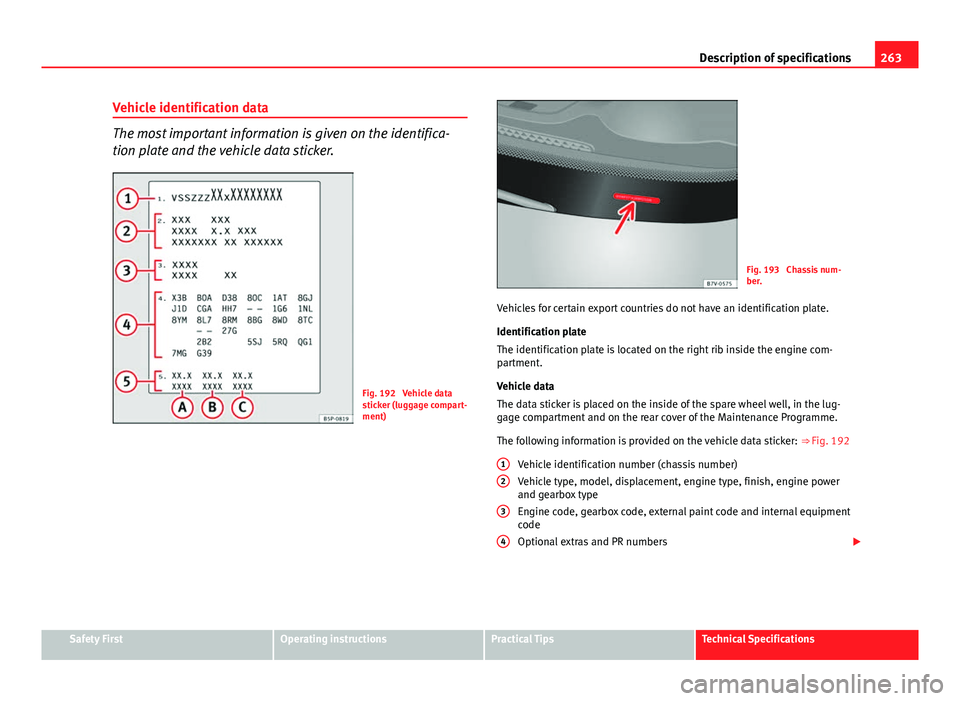
The most important information is given on the identifica-
tion plate and the vehicle data sticker.
Fig. 192 Vehicle data
sticker (luggage compart-
ment)
Fig. 193 Chassis num-
ber.
Vehicles for certain export countries do not have an identification plate.
Identification plate
The identification plate is located on the right rib inside the engine com-
partment.
Vehicle data
The data sticker is placed on the inside of the spare wheel well, in the lug-
gage compartment and on the rear cover of the Maintenance Programme.
The following information is provided on the vehicle data sticker: ⇒ Fig. 192
Vehicle identification number (chassis number)
Vehicle type, model, displacement, engine type, finish, engine power
and gearbox type
Engine code, gearbox code, external paint code and internal equipment
code
Optional extras and PR numbers
1
2
3
4
Safety FirstOperating instructionsPractical TipsTechnical Specifications
Page 266 of 294
264Description of specifications
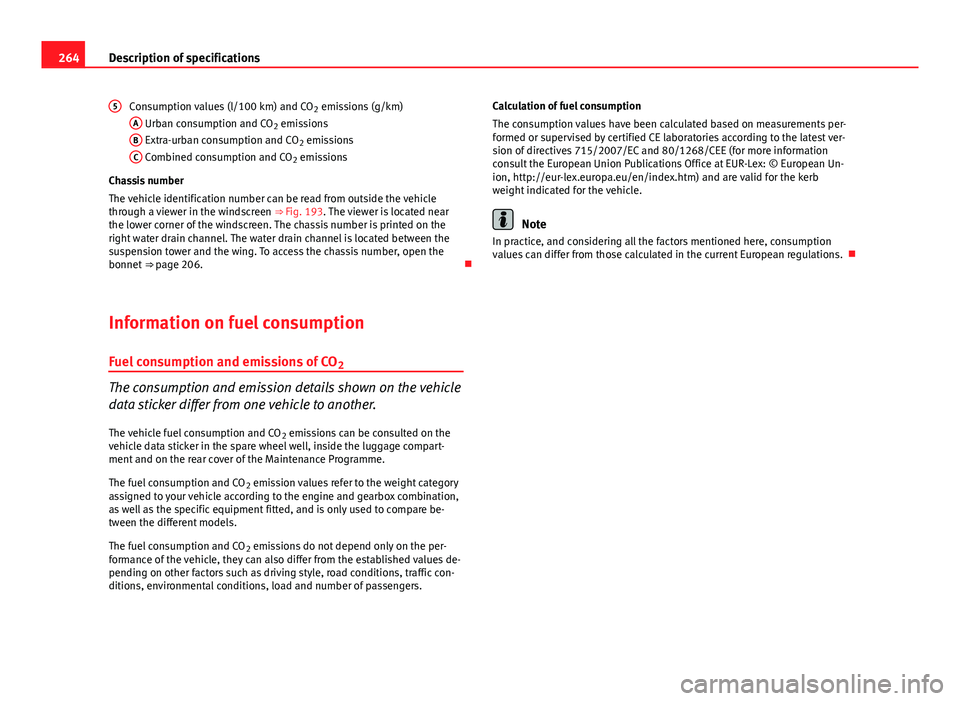
Consumption values (l/100 km) and CO 2 emissions (g/km)
A
Urban consumption and CO 2 emissions
B Extra-urban consumption and CO 2 emissions
C Combined consumption and CO 2 emissions
Chassis number
The vehicle identification number can be read from outside the vehicle
through a viewer in the windscreen ⇒ Fig. 193. The viewer is located near
the lower corner of the windscreen. The chassis number is printed on the
right water drain channel. The water drain channel is located between the
suspension tower and the wing. To access the chassis number, open the
bonnet ⇒ page 206.
Information on fuel consumption
Fuel consumption and emissions of CO 2
The consumption and emission details shown on the vehicle
data sticker differ from one vehicle to another.
The vehicle fuel consumption and CO 2 emissions can be consulted on the
vehicle data sticker in the spare wheel well, inside the luggage compart-
ment and on the rear cover of the Maintenance Programme.
The fuel consumption and CO 2 emission values refer to the weight category
assigned to your vehicle according to the engine and gearbox combination,
as well as the specific equipment fitted, and is only used to compare be-
tween the different models.
The fuel consumption and CO 2 emissions do not depend only on the per-
formance of the vehicle, they can also differ from the established values de-
pending on other factors such as driving style, road conditions, traffic con-
ditions, environmental conditions, load and number of passengers. 5
Calculation of fuel consumption
The consumption values have been calculated based on measurements per-
formed or supervised by certified CE laboratories according to the latest ver-
sion of directives 715/2007/EC and 80/1268/CEE (for more information
consult the European Union Publications Office at EUR-Lex: © European Un-
ion, http://eur-lex.europa.eu/en/index.htm) and are valid for the kerb
weight indicated for the vehicle.
Note
In practice, and considering all the factors mentioned here, consumption
values can differ from those calculated in the current European regulations.
Page 289 of 294
I
Identification plate . . . . . . . . . . . . . . . . . . . . . . 263
Ignition key . . . . . . . . . . . . . . . . . . . . . . . . . . . . 148
Ignition lock . . . . . . . . . . . . . . . . . . . . . . . . . . . 148
Information in the multifunction display Memory displays . . . . . . . . . . . . . . . . . . . . . 61
Instrument and switch lighting . . . . . . . . . . . . 103
Instrument lighting . . . . . . . . . . . . . . . . . . . . . . 55
Instrument panel Service interval display . . . . . . . . . . . . . . . . 63
Instruments . . . . . . . . . . . . . . . . . . . . . . . . . . . . 57
Interior rear vision mirror . . . . . . . . . . . . . . . . . 114
Interval wipe, windscreen . . . . . . . . . . . . . . . . 111
ISOFIX system . . . . . . . . . . . . . . . . . . . . . . . . . . . 49
J Jump-starting . . . . . . . . . . . . . . . . . . . . . . . . . . 256
Jump leads . . . . . . . . . . . . . . . . . . . . . . . . . . . . 256
K
Keys . . . . . . . . . . . . . . . . . . . . . . . . . . . . . . . . . . . 87
L
Leather cleaning . . . . . . . . . . . . . . . . . . . . . . . . 194
Leaving Home function . . . . . . . . . . . . . . . . . . 105
Lights . . . . . . . . . . . . . . . . . . . . . . . . . . . . . . . . 101 Load compartment in the luggage compart-
ment
see Loading the luggage compartment . . . 16
Loading the luggage compartment . . . . . . . . . . 16
Locks . . . . . . . . . . . . . . . . . . . . . . . . . . . . . . . . . 191
LPG . . . . . . . . . . . . . . . . . . . . . . . . . . 58, 152, 202
LPG system Driving . . . . . . . . . . . . . . . . . . . . . . . . . . . . . 152
Filler neck adapter . . . . . . . . . . . . . . . . . . . 203
Level indicator . . . . . . . . . . . . . . . . . . . . . . . 58
Refuelling . . . . . . . . . . . . . . . . . . . . . . . . . . 202
Luggage compartment . . . . . . . . . . . . . . . . . . . 132 Fastening rings . . . . . . . . . . . . . . . . . . . . . . 133
Loading . . . . . . . . . . . . . . . . . . . . . . . . . . . . 132
Luggage net . . . . . . . . . . . . . . . . . . . . . . . . 134
see also Loading the luggage compartment . .16
Luggage compartment light . . . . . . . . . . 110, 256
M
Main beam . . . . . . . . . . . . . . . . . . . . . . . . 101, 108
Main beam headlights control lamp . . . . . . . . . . . . . . . . . . . . . . . . . 75
Maintenance Airbags . . . . . . . . . . . . . . . . . . . . . . . . . . . . . 32
Maintenance and cleaning . . . . . . . . . . . . . . . 187
Manual gearbox . . . . . . . . . . . . . . . . . . . . . . . . 156
Manual heating . . . . . . . . . . . . . . . . . . . . . . . . 138 controls . . . . . . . . . . . . . . . . . . . . . . . . . . . . 137 Manual heating system
Defrosting the windscreen . . . . . . . . . . . . . 138
Demisting the windscreen and side win-dows . . . . . . . . . . . . . . . . . . . . . . . . . . . . . 138
MFI . . . . . . . . . . . . . . . . . . . . . . . . . . . . . . . . . . . . 61
Mirrors Exterior mirrors . . . . . . . . . . . . . . . . . . . . . . 115
Interior rear vision mirror . . . . . . . . . . . . . . 114
vanity mirror . . . . . . . . . . . . . . . . . . . . . . . . 110
Mobile phone . . . . . . . . . . . . . . . . . . . . . . . . . . 197
Multifunction display . . . . . . . . . . . . . . . . . . . . . 61
N
Number of seats . . . . . . . . . . . . . . . . . . . . . . . . . 19
O
Observations . . . . . . . . . . . . . . . . . . . . . . . . . . 184
Octane number . . . . . . . . . . . . . . . . . . . . . . . . . 205
Odometer . . . . . . . . . . . . . . . . . . . . . . . . . . . . . . 63
Oil change . . . . . . . . . . . . . . . . . . . . . . . . . . . . . 212
Oil properties . . . . . . . . . . . . . . . . . . . . . . . . . . 210
One-touch opening and closing Electric windows . . . . . . . . . . . . . . . . . . . . . . 97
Opening and locking . . . . . . . . . . . . . . . . . . . . . 93
Operation when a fault occurs panoramic/tilting sunroof . . . . . . . . . . . . . 100
Outside temperature display . . . . . . . . . . . . . . . 60
Outside temperature indicator . . . . . . . . . . . . . 62
287
Index
Page 290 of 294
Overviewcontrol lamps . . . . . . . . . . . . . . . . . . . . . . . . 67
Control lamps . . . . . . . . . . . . . . . . . . . . . . . . 65
Dash panel . . . . . . . . . . . . . . . . . . . . . . . . . . 55
Instruments . . . . . . . . . . . . . . . . . . . . . . . . . 57
warning lamps . . . . . . . . . . . . . . . . . . . . . . . 67
Warning lamps . . . . . . . . . . . . . . . . . . . . . . . 65
P Paintwork Polishing . . . . . . . . . . . . . . . . . . . . . . . . . . . 190
Panoramic sunroof . . . . . . . . . . . . . . . . . . . . . . . 99
Parking . . . . . . . . . . . . . . . . . . . . . . . . . . . . . . . 165
Parking aid . . . . . . . . . . . . . . . . . . . . . . . . . . . . 166
Parking lights . . . . . . . . . . . . . . . . . . . . . . . . . . 108
Passenger see Correct sitting position . . . . . . . 10, 11, 12
Pedals . . . . . . . . . . . . . . . . . . . . . . . . . . . . . . . . . 16
Petrol . . . . . . . . . . . . . . . . . . . . . . . . . . . . . . . . . 205 Driving abroad . . . . . . . . . . . . . . . . . . . . . . 184
Petrol additives . . . . . . . . . . . . . . . . . . . . . . . . 205
Physical principles of a frontal collision . . . . . . 21
Plastic parts . . . . . . . . . . . . . . . . . . . . . . . . . . . 190
Plastic parts cleaning . . . . . . . . . . . . . . . . . . . . 193
Pollen filter . . . . . . . . . . . . . . . . . . . . . . . . . . . . 145
Pollution filter . . . . . . . . . . . . . . . . . . . . . . . . . . 145
Power socket in the luggage compartment . . . . . . . . . . . 130
Power sockets . . . . . . . . . . . . . . . . . . . . . . . . . . 129
Products for vehicle maintenance . . . . . . . . . . 187 R
Radio frequency remote control . . . . . . . . . . . . 88 Changing the battery . . . . . . . . . . . . . . . . . . 89
Rain sensor . . . . . . . . . . . . . . . . . . . . . . . . . . . . 112
Rear drink holder . . . . . . . . . . . . . . . . . . . . . . . 128
Rear fog light control lamp . . . . . . . . . . . . . . . . . . . . . . . . . 71
Control lamp . . . . . . . . . . . . . . . . . . . . . . . . 101
Rear head restraints . . . . . . . . . . . . . . . . . . . . . . 14
Rear lid . . . . . . . . . . . . . . . . . . . . . . . . . . . . . . . . 93 Control lamp . . . . . . . . . . . . . . . . . . . . . . . . . 74
Emergency opening . . . . . . . . . . . . . . . . . . . 94
Rear parking aid . . . . . . . . . . . . . . . . . . . . . . . . . . . . . . . . 167
Rear seat folding down . . . . . . . . . . . . . . . . . . . . . . . . 123
Rear seats . . . . . . . . . . . . . . . . . . . . . . . . . . . . . 123
Rear shelf . . . . . . . . . . . . . . . . . . . . . . . . . . . . . 134
Rear shelf with storage compartment Storage compartment . . . . . . . . . . . . . . . . 135
Rear view mirrors . . . . . . . . . . . . . . . . . . . . . . . 114
Rear window automatic wiper/washer . . . . . . 113
Rear window wiper . . . . . . . . . . . . . . . . . . . . . . 113
Recommended gear display . . . . . . . . . . . . . . . 60
Refuelling . . . . . . . . . . . . . . . . . . . . . . . . . . . . . 200
Remote control key Buttons . . . . . . . . . . . . . . . . . . . . . . . . . . . . . 88
Synchronising . . . . . . . . . . . . . . . . . . . . . . . . 89
Removing and fitting the wheel . . . . . . . . . . . 234
Repairs Airbags . . . . . . . . . . . . . . . . . . . . . . . . . . . . . 32 Replacement keys . . . . . . . . . . . . . . . . . . . . . . . 87
Replacement of parts . . . . . . . . . . . . . . . . . . . . 196
Rev counter . . . . . . . . . . . . . . . . . . . . . . . . . . . . . 58
Reverse gear
Manual gearbox . . . . . . . . . . . . . . . . . . . . . 156
Roll-back function panoramic/tilting sunroof . . . . . . . . . . . . . 100
Windows . . . . . . . . . . . . . . . . . . . . . . . . . . . . 98
Roof aerial . . . . . . . . . . . . . . . . . . . . . . . . . . . . . 197
Roof rack . . . . . . . . . . . . . . . . . . . . . . . . . . . . . . 136
Rubber seals . . . . . . . . . . . . . . . . . . . . . . . . . . . 191
Running in Brake pads . . . . . . . . . . . . . . . . . . . . . . . . . 179
Engine . . . . . . . . . . . . . . . . . . . . . . . . . . . . . 179
Tyres . . . . . . . . . . . . . . . . . . . . . . . . . . . . . . 179
Running in tyres . . . . . . . . . . . . . . . . . . . . . . . . 179
S Safe . . . . . . . . . . . . . . . . . . . . . . . . . . . . . . . . . . . 82
Safe driving . . . . . . . . . . . . . . . . . . . . . . . . . . . . . 7
Safety . . . . . . . . . . . . . . . . . . . . . . . . . . . . . . . . . . 8
Safety equipment . . . . . . . . . . . . . . . . . . . . . . . . . 7
Safety instructions Coolant temperature . . . . . . . . . . . . . . . . . . 76
Safety notes Airbags . . . . . . . . . . . . . . . . . . . . . . . . . . . . . 32
Deactivating front passenger airbag . . . . . . 42
Front airbags . . . . . . . . . . . . . . . . . . . . . . . . 37
Seat belt tensioners . . . . . . . . . . . . . . . . . . . 28
Side airbags . . . . . . . . . . . . . . . . . . . . . . . . . 39
288 Index