change wheel Seat Ibiza 5D 2013 Owner's manual
[x] Cancel search | Manufacturer: SEAT, Model Year: 2013, Model line: Ibiza 5D, Model: Seat Ibiza 5D 2013Pages: 294, PDF Size: 4.05 MB
Page 6 of 294
Accessories, replacement of parts and
modifications . . . . . . . . . . . . . . . . . . . . . . . . . . . . . 196
Accessories and spare parts . . . . . . . . . . . . . . . . 196
Technical modifications . . . . . . . . . . . . . . . . . . . . 196
Roof aerial* . . . . . . . . . . . . . . . . . . . . . . . . . . . . . . 197
Mobile telephones and two-way radios . . . . . . . . 197
Fitting a towing bracket* . . . . . . . . . . . . . . . . . . . 198
Checking and refilling levels . . . . . . . . . . . . . . . 200
Refuelling . . . . . . . . . . . . . . . . . . . . . . . . . . . . . . . 200
LPG system* . . . . . . . . . . . . . . . . . . . . . . . . . . . . . 202
Petrol . . . . . . . . . . . . . . . . . . . . . . . . . . . . . . . . . . . 205
Diesel . . . . . . . . . . . . . . . . . . . . . . . . . . . . . . . . . . . 205
Working in the engine compartment . . . . . . . . . . 206
Engine oil . . . . . . . . . . . . . . . . . . . . . . . . . . . . . . . . 209
Coolant . . . . . . . . . . . . . . . . . . . . . . . . . . . . . . . . . 213
Washer fluid and windscreen wiper blades . . . . 215
Brake fluid . . . . . . . . . . . . . . . . . . . . . . . . . . . . . . . 219
Vehicle battery . . . . . . . . . . . . . . . . . . . . . . . . . . . 220
Wheels . . . . . . . . . . . . . . . . . . . . . . . . . . . . . . . . . . 222
If and when . . . . . . . . . . . . . . . . . . . . . . . . . . . . . . . 229
Vehicle tools, spare wheel . . . . . . . . . . . . . . . . . . 229
Wheel change . . . . . . . . . . . . . . . . . . . . . . . . . . . . 230
Tyre repair kit* (Tyre Mobility-System) . . . . . . . . . 235
Fuses . . . . . . . . . . . . . . . . . . . . . . . . . . . . . . . . . . . 237
Bulb change . . . . . . . . . . . . . . . . . . . . . . . . . . . . . 239
Single headlight bulb change . . . . . . . . . . . . . . . 241
Double headlight bulb change . . . . . . . . . . . . . . . 243
Changing the bulbs of AFS headlights . . . . . . . . 247
Changing the fog light bulbs . . . . . . . . . . . . . . . . 248
Changing rear bulbs . . . . . . . . . . . . . . . . . . . . . . . 249
Changing the rear lights (on the wing) . . . . . . . . 251
Changing the rear lights (on the rear lid) . . . . . . 253
Changing the side and interior light bulbs . . . . . 254
Jump-starting . . . . . . . . . . . . . . . . . . . . . . . . . . . . . 256
Towing and tow-starting . . . . . . . . . . . . . . . . . . . . 259 Technical Specifications
. . . . . . . . . . . 262
Description of specifications . . . . . . . . . . . . . . . 262
Important information . . . . . . . . . . . . . . . . . . . . . 262
Information on fuel consumption . . . . . . . . . . . . 264
Towing a trailer . . . . . . . . . . . . . . . . . . . . . . . . . . . 265
Wheels . . . . . . . . . . . . . . . . . . . . . . . . . . . . . . . . . . 265
Technical specifications . . . . . . . . . . . . . . . . . . . . 267
Checking fluid levels . . . . . . . . . . . . . . . . . . . . . . . 267
Petrol engine 1.2 44 kW (60 PS) . . . . . . . . . . . . . 268
Petrol engine 1.2 51 kW (70 PS) . . . . . . . . . . . . . 269
Petrol engine/LPG 1.6 60 kW (81 PS) . . . . . . . . . 270
Petrol engine 1.2 TSI 63 kW (85 PS) . . . . . . . . . . 271
Petrol engine 1.4 63 kW (85 PS) . . . . . . . . . . . . . 272
Petrol engine 1.2 TSI 77 kW (105 PS) . . . . . . . . . 273
Petrol engine 1.2 TSI 77 kW (105 PS) Start-Stop 274
Petrol engine 1.6 77 kW (105 PS) . . . . . . . . . . . . 275
Petrol engine 1.4 TSI 110 kW (150 PS) . . . . . . . . 276
Petrol engine 1.4 132 kW (180 PS) - Cupra . . . . . 277
Diesel engine 1.2 TDI CR 55 kW (75 PS) . . . . . . . 278
Diesel engine 1.6 TDI CR 66 kW (90 PS) DPF . . . . 279
Diesel engine 1.6 TDI CR 77 kW (105 PS) with/
without DPF . . . . . . . . . . . . . . . . . . . . . . . . . . . . . . 280
Diesel engine 2.0 TDI CR 105 kW (143 PS) DPF . 281
Dimensions . . . . . . . . . . . . . . . . . . . . . . . . . . . . . . 282
Capacities . . . . . . . . . . . . . . . . . . . . . . . . . . . . . . . 282
Index . . . . . . . . . . . . . . . . . . . . . . . . . . . . . . . . . . . 283
4Table of Contents
Page 60 of 294
58Cockpit
Rev counter
The rev counter displays the engine speed in revolutions per
minute.
The start of the red zone ⇒ Fig. 30 1
indicates the maximum engine speed
operating at service temperature. However, it is advisable to change up into
a higher gear, move the selector lever to D or lift your foot off the accelerator
before the needle reaches the red zone.
CAUTION
To prevent possible engine malfunctions, the rev counter needle should not
reach the red zone. The start of the red zone on the dial is different for some
engine versions.
For the sake of the environment
Changing up into higher gears sooner, following the recommended gear in-
dications ⇒ Fig. 33 will help you to reduce fuel consumption, emissions and
also engine noise.
Speedometer
The speedometer is equipped with a digital odometer and a trip recorder, in
addition to a service intervals display.
During the running-in period, the instructions shown on ⇒ page 179
should be followed. LPG system*
LPG gauge
Fig. 31 Instrument pan-
el: gas gauge.
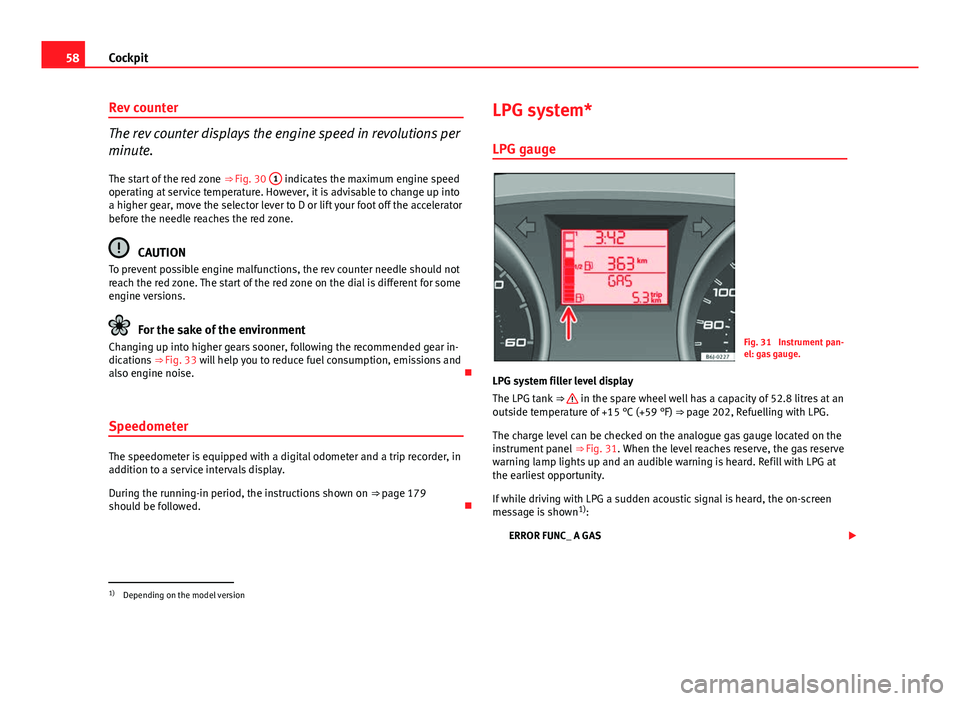
LPG system filler level display
The LPG tank ⇒
in the spare wheel well has a capacity of 52.8 litres at an
outside temperature of +15 °C (+59 °F) ⇒ page 202, Refuelling with LPG.
The charge level can be checked on the analogue gas gauge located on the
instrument panel ⇒ Fig. 31. When the level reaches reserve, the gas reserve
warning lamp lights up and an audible warning is heard. Refill with LPG at
the earliest opportunity.
If while driving with LPG a sudden acoustic signal is heard, the on-screen
message is shown 1)
:
ERROR FUNC_ A GAS
1)
Depending on the model version
Page 75 of 294
73
Cockpit
Brake system*
This warning lamp lights up if the brake fluid level is too low
or if there is a fault in the system.
This warning lamp lights up if
● the brake fluid level is too low ⇒ page 219.
● there is a fault in the brake system.
This warning lamp can light up together with the ABS system warning lamp.
WARNING
● If the brake warning lamp does not go out, or if it lights up when driv-
ing, the brake fluid level ⇒ page 219, Brake fluid in the reservoir is too
low. Risk of accident. Stop the vehicle and do not drive on. Obtain techni-
cal assistance.
● If the brake warning lamp lights up together with the ABS warning
lamp , the control function of the ABS could be out of action. This could
cause the rear wheels to lock quickly when you brake. This could cause
the rear to break away. Risk of skidding. Stop the vehicle and seek tech-
nical assistance.
Cruise speed (Cruise control)*
The warning lamp comes on when the cruise control system
is switched on.
The warning lamp lights up when the cruise control system is switched
on. For further information on the cruise control system, see ⇒ page 171.Tyre pressure*
Fig. 40 Centre console:
tyre monitor system but-
ton
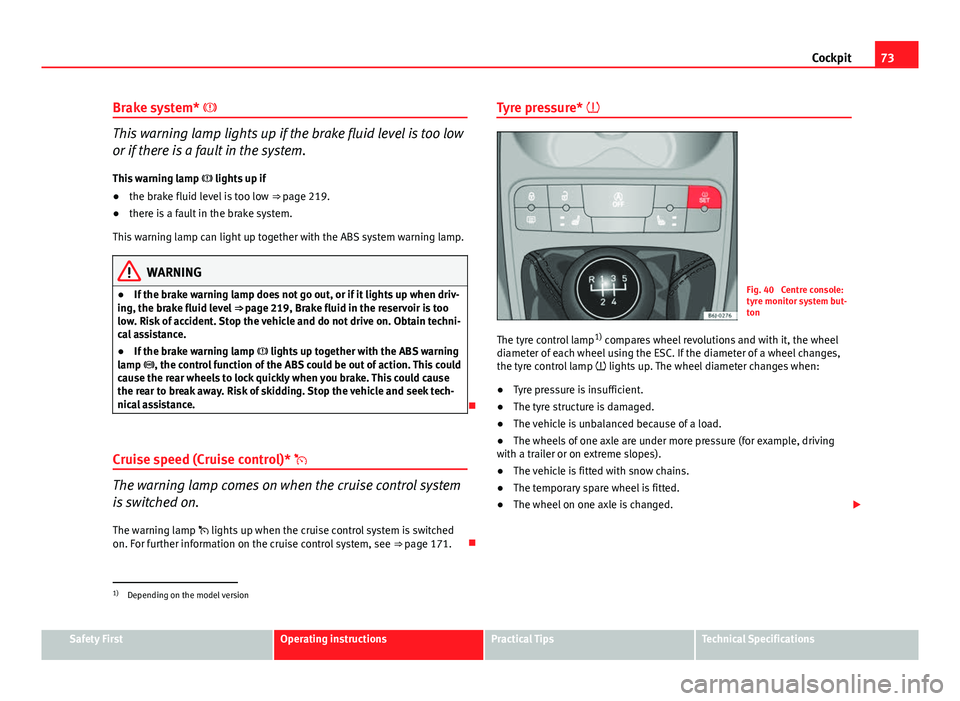
The tyre control lamp 1)
compares wheel revolutions and with it, the wheel
diameter of each wheel using the ESC. If the diameter of a wheel changes,
the tyre control lamp lights up. The wheel diameter changes when:
● Tyre pressure is insufficient.
● The tyre structure is damaged.
● The vehicle is unbalanced because of a load.
● The wheels of one axle are under more pressure (for example, driving
with a trailer or on extreme slopes).
● The vehicle is fitted with snow chains.
● The temporary spare wheel is fitted.
● The wheel on one axle is changed.
1)
Depending on the model version
Safety FirstOperating instructionsPractical TipsTechnical Specifications
Page 80 of 294
78Cockpit
Steering column controls*
General information
The column incorporates multifunctional modules from which to control au-
dio and telephone functions on the vehicle.
There are two versions of the multifunction module:
● Audio version, to control the available audio functions from the steering
wheel.
● Audio version+ Telephone version, to control the available audio func-
tions and the telephone system from the steering wheel.
Both versions can be used to control the Audio system (Radio, Audio CD,
MP3 CD, iPod 1)
/USB 1)
/PND 1)
).
The PND (portable navigation device) reproduces audio files through a mi-
cro SD card and Bluetooth audio-streaming, and tracks may be changed
through the control on the steering column.
1)
If fitted in the vehicle.
Page 110 of 294
108Lights and visibility
Signalling a lane change
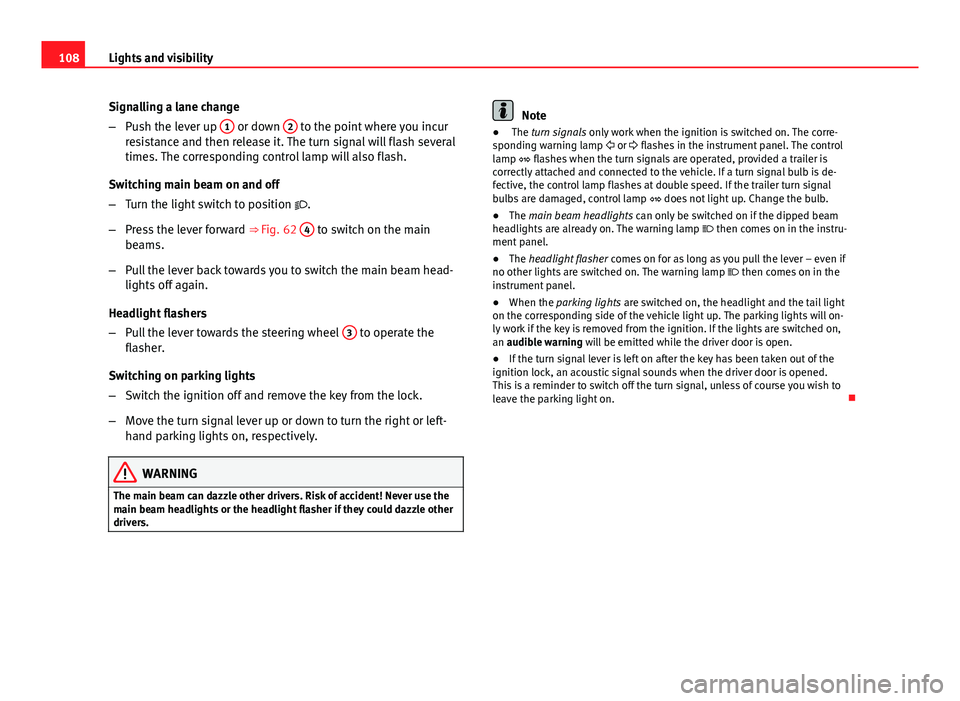
–Push the lever up 1
or down 2 to the point where you incur
resistance and then release it. The turn signal will flash several
times. The corresponding control lamp will also flash.
Switching main beam on and off
– Turn the light switch to position .
– Press the lever forward ⇒ Fig. 62 4
to switch on the main
beams.
– Pull the lever back towards you to switch the main beam head-
lights off again.
Headlight flashers
– Pull the lever towards the steering wheel 3
to operate the
flasher.
Switching on parking lights
– Switch the ignition off and remove the key from the lock.
– Move the turn signal lever up or down to turn the right or left-
hand parking lights on, respectively.
WARNING
The main beam can dazzle other drivers. Risk of accident! Never use the
main beam headlights or the headlight flasher if they could dazzle other
drivers.
Note
● The turn signals only work when the ignition is switched on. The corre-
sponding warning lamp or flashes in the instrument panel. The control
lamp flashes when the turn signals are operated, provided a trailer is
correctly attached and connected to the vehicle. If a turn signal bulb is de-
fective, the control lamp flashes at double speed. If the trailer turn signal
bulbs are damaged, control lamp does not light up. Change the bulb.
● The main beam headlights can only be switched on if the dipped beam
headlights are already on. The warning lamp then comes on in the instru-
ment panel.
● The headlight flasher comes on for as long as you pull the lever – even if
no other lights are switched on. The warning lamp then comes on in the
instrument panel.
● When the parking lights are switched on, the headlight and the tail light
on the corresponding side of the vehicle light up. The parking lights will on-
ly work if the key is removed from the ignition. If the lights are switched on,
an audible warning will be emitted while the driver door is open.
● If the turn signal lever is left on after the key has been taken out of the
ignition lock, an acoustic signal sounds when the driver door is opened.
This is a reminder to switch off the turn signal, unless of course you wish to
leave the parking light on.
Page 154 of 294
152Driving
temperature increases due to the heat accumulated in the engine compart-
ment or due to its prolonged exposure to solar radiation.
WARNING
● Never switch the engine off until the vehicle is completely stationary.
● The brake servo works only when the engine is running. With the en-
gine switched off, more strength is needed to brake. As normal brake op-
eration cannot be performed, risk of accidents and serious injury may ex-
ist.
● The steering lock can be immediately blocked once the key is re-
moved from the ignition. The vehicle cannot be steered. Risk of accident.
CAUTION
When the engine has been running under a heavy load for a long period,
heat can accumulate in the engine compartment and cause engine damage.
For this reason, you should idle the engine for approx. 2 minutes before you
switch it off. Driving with LPG*Fig. 111 Centre console:
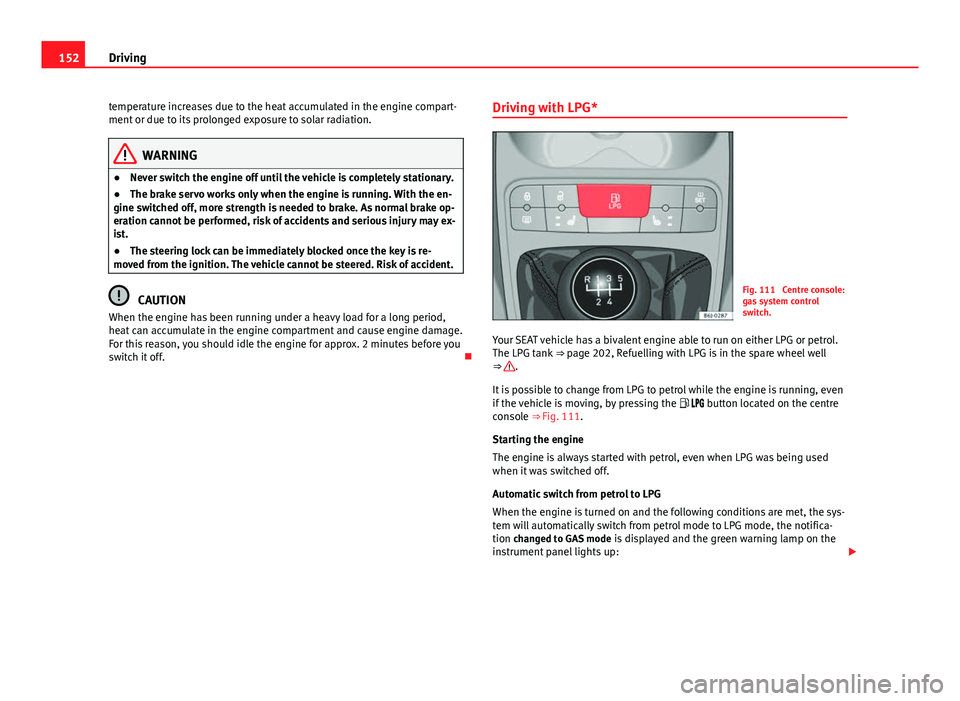
gas system control
switch.
Your SEAT vehicle has a bivalent engine able to run on either LPG or petrol.
The LPG tank ⇒ page 202, Refuelling with LPG is in the spare wheel well
⇒
.
It is possible to change from LPG to petrol while the engine is running, even
if the vehicle is moving, by pressing the button located on the centre
console ⇒ Fig. 111.
Starting the engine
The engine is always started with petrol, even when LPG was being used
when it was switched off.
Automatic switch from petrol to LPG
When the engine is turned on and the following conditions are met, the sys-
tem will automatically switch from petrol mode to LPG mode, the notifica-
tion changed to GAS mode is displayed and the green warning lamp on the
instrument panel lights up:
Page 162 of 294
160Driving
WARNING (Continued)
● Never accelerate when moving the selector lever or you may cause an
accident.
● Never move the selector lever to R or P when driving. Risk of accident!
● Before driving down a long, steep slope, it is advisable to reduce
speed and change into a lower gear.
● If you stop the vehicle up hill, always hold the foot brake strongly de-
pressed down to stop it from rolling back.
● Never allow the brake to rub and do not use the brake pedal too often
or for long periods. Constant braking will cause the brakes to overheat
and will considerably reduce the brake effect. This increases the braking
distance and could cause the brake system to fail.
● Never allow the vehicle to roll down a mountain or a slope with the
lever in the N or D position, regardless of whether the engine is running
or not.
CAUTION
● If you stop the vehicle up hills, do not attempt to stop it from rolling
back by depressing the accelerator when a gear has been selected. Other-
wise, the automatic gearbox may overheat causing damage. Pull the hand-
brake up or fully depress the brake pedal to prevent the vehicle from rolling
away.
● If you allow the vehicle to roll when the engine is not running, or with
the selector lever in position N, a lack of lubrication in the automatic gear-
box will damage it. Changing gear in tiptronic mode*
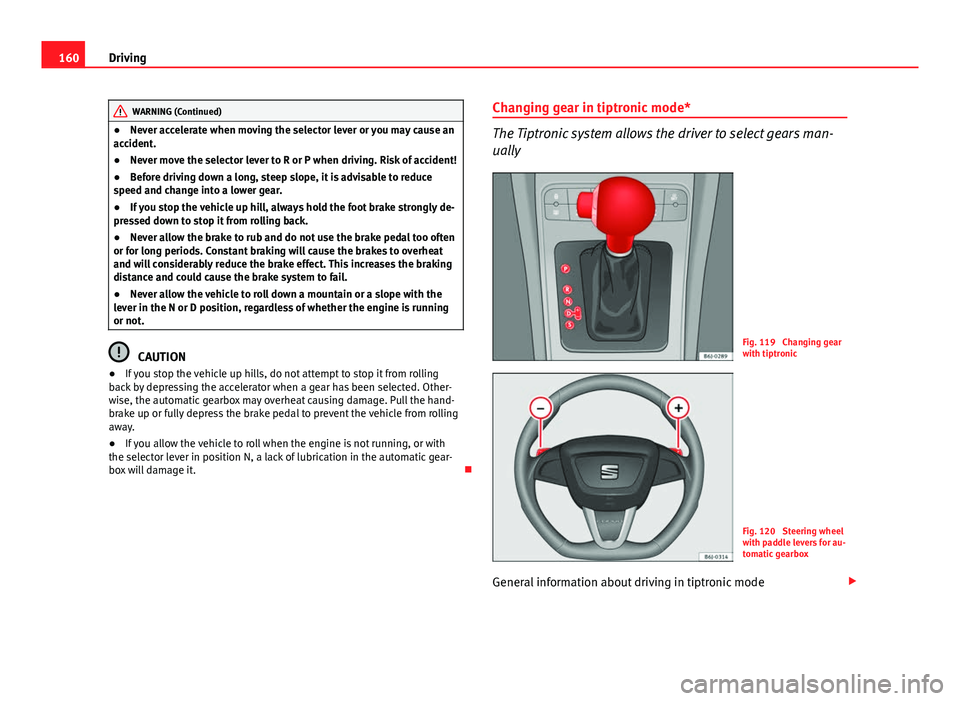
The Tiptronic system allows the driver to select gears man-
ually
Fig. 119 Changing gear
with tiptronic
Fig. 120 Steering wheel
with paddle levers for au-
tomatic gearbox
General information about driving in tiptronic mode
Page 163 of 294
161
Driving
Changing gear in tiptronic mode
– Press the selector lever from position D to the right into the tip-
tronic selector gate.
– Lightly press the selector lever forward + to change up into high
gears.
– Lightly press the selector lever backwards - to change down into
low gears.
Changing gear with the steering wheel paddle levers*
– Press the right paddle lever +
towards the steering wheel to
change up ⇒ Fig. 120.
– Press the left paddle lever -
towards the steering wheel to
change down ⇒ Fig. 120.
Using the paddle levers on the steering wheel, you can access manual driv-
ing mode regardless of the pre-selected driving mode.
General information about driving in tiptronic mode
When accelerating, the automatic gearbox / DSG automatic gearbox goes
into a higher gear a little before the engine reaches its maximum permitted
revolutions.
If a lower gear is selected, the automatic gearbox / DSG automatic gearbox
will only change down when the engine cannot go over its maximum permit-
ted revolutions.
If tiptronic is selected whilst the vehicle is in motion and the automatic
gearbox / DSG automatic gearbox is in third gear and selector lever position
D, tiptronic mode will then also be in third gear. Changing gears in the normal or sport programme using the steering wheel
paddle levers
If the paddle levers
⇒ Fig. 120 are used in the normal or sport programme,
the system switches temporarily to tiptronic mode. To exit “tiptronic” mode
again, press the right paddle lever +
towards the steering wheel for approx-
imately one second. You will also leave tiptronic mode if the paddle levers
are not moved for a certain time.
Note
● The gear paddle levers on the steering wheel can be operated with the
selector lever in any position and with the vehicle in motion.
Selector lever positions
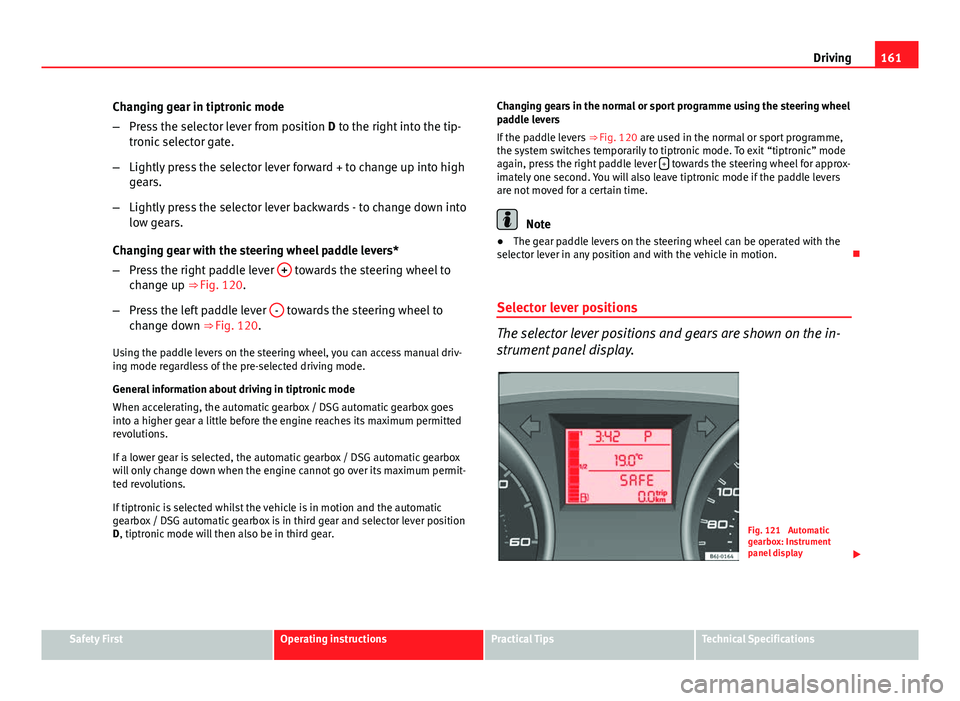
The selector lever positions and gears are shown on the in-
strument panel display.
Fig. 121 Automatic
gearbox: Instrument
panel display
Safety FirstOperating instructionsPractical TipsTechnical Specifications
Page 164 of 294
162Driving
Selector lever positions
The selected gear is displayed on the side of the selector lever and on the
instrument panel display. The currently selected gear for the automatic
gearbox will also be shown on the display.
Tiptronic gear indicator
If the automatic gearbox is shifted manually, the selected gears are shown
on the screen.
P - parking lock
When the selector lever is in this position, the driven wheels are locked me-
chanically.
Position P on the lever must only be selected if the vehicle is stationary.
To move selector lever from position P, the locking button on the selector
lever handle must be pressed and the brake pedal depressed at the same
time while the ignition is switched on.
To put the selector lever in position P, simply press the lock button down
and, if necessary, depress the brake pedal down.
R - Reverse gear
The reverse gear is engaged in this position.
Reverse gear must be engaged only when the vehicle is stationary and the
engine is idling.
To move the selector lever to position R, press the lock button down and, at
the same time, press the brake pedal down, with the ignition switched on.
With the selector lever in position R and the ignition switched on the follow-
ing occurs:
● Reverse lights light up.
● The air conditioner automatically changes the air recirculation mode. ●
The wiper starts if the windscreen washer is on.
● The parking distance warning system* switches on.
N - Neutral (idling)
If this position is selected, the gearbox is in neutral. Power is not transmit-
ted to the wheels and the engine does not have a braking function.
Never use the N position to drive down a long hill. There is no engine brak-
ing and the brakes are subjected to excessive stain.
You could damage the automatic gearbox if you drive down hills with the
gearbox lever in position N and the engine switched off.
D - Drive (forward)
In this position the gearbox automatically changes to a lower or higher gear,
according to the engine's requirements, the driving style and speed. The
braking effect of the engine when driving downhill is very limited when the
selector is in this position. The instrument panel display shows the selected
gear as well as the selector lever in position D.
If position N has been selected and you wish to select D, you must press the
foot brake if the vehicle is stationary, or travelling at under 5 km/h (3 mph).
S - Standard driving position (Sport programme)
When the selector lever is in position S, it will automatically change up into
a higher gear later, and change down into a low gear, if compared with posi-
tion D. This way, it is possible to take full advantage of the engine reserve
power, depending on the engine demand, driving style and speed. The
braking effect of the engine when driving downhill is very limited. On the
instrument panel display the selected gear is shown as well as the selector
lever to position S.
To select gear range S, press the lock button on the selector lever.
Page 165 of 294
163
Driving
WARNING
If the vehicle moves with no control, an accident and serious injury may
occur.
● As a driver, you should never leave your vehicle if the engine is run-
ning and a gear range is engaged. If you have to leave your vehicle while
the engine is running, you must always apply the handbrake and engage
the parking lock position P.
● With the engine running and D or R engaged, you must hold the vehi-
cle stopped by pressing the brake pedal. Even while idling, the power
transmission is not fully interrupted and the vehicle could keep moving
forward.
● Never accelerate when moving the selector lever or you may cause an
accident.
● Never move the selector lever to “R” or “P” when driving. Risk of acci-
dent.
● Before driving down a very steep slope, reduce your speed and shift
to first gear.
● Always hold the vehicle on the foot brake if you stop on hills. Other-
wise, the vehicle could roll back.
● Never allow the brake to rub and do not use the brake pedal too often
or for long periods. Constant braking will cause the brakes to overheat
and will considerably reduce the brake effect. This increases the braking
distance and could cause the brake system to fail.
WARNING
Never switch the engine off until the vehicle is stationary. You could lose
control of your vehicle. This could cause an accident and serious injury.
● The airbags and belt tensioners do not work when the ignition is
switched off.
WARNING (Continued)
● The brake servo does not work with the engine off. You need more
force to stop the vehicle.
● Power steering does not work when the engine is not running. That is
why it is much more difficult to turn the steering wheel.
● Never remove the key from the ignition if the vehicle is in motion. The
steering lock could suddenly engage, and you would not be able to steer
the vehicle.
● Never allow the vehicle to roll downhill with the selector lever in “N”,
regardless of whether the engine is running or not.
CAUTION
If you allow the vehicle to move when the engine is switched off or with the
selector lever in position “N”, take your foot off the accelerator and wait un-
til the engine starts idling before returning to position “D”.
Gear-change indicator
The recommended gear for saving fuel is indicated on the dash screen of
certain vehicles during driving.
displayMeaning
The optimal gear is selected.
Changing to a higher gear is recommended.
Changing to a lower gear is recommended.
Safety FirstOperating instructionsPractical TipsTechnical Specifications