height Seat Ibiza 5D 2014 User Guide
[x] Cancel search | Manufacturer: SEAT, Model Year: 2014, Model line: Ibiza 5D, Model: Seat Ibiza 5D 2014Pages: 240, PDF Size: 4.89 MB
Page 103 of 240
Seats and head restraints
●
To move the seat lengthways, pull upwards
and not sideways on the lever, as the force
exerted on it in this position could damage it. Folding and opening the front seat
backrests
3 Applies to vehicles with 3 doors:
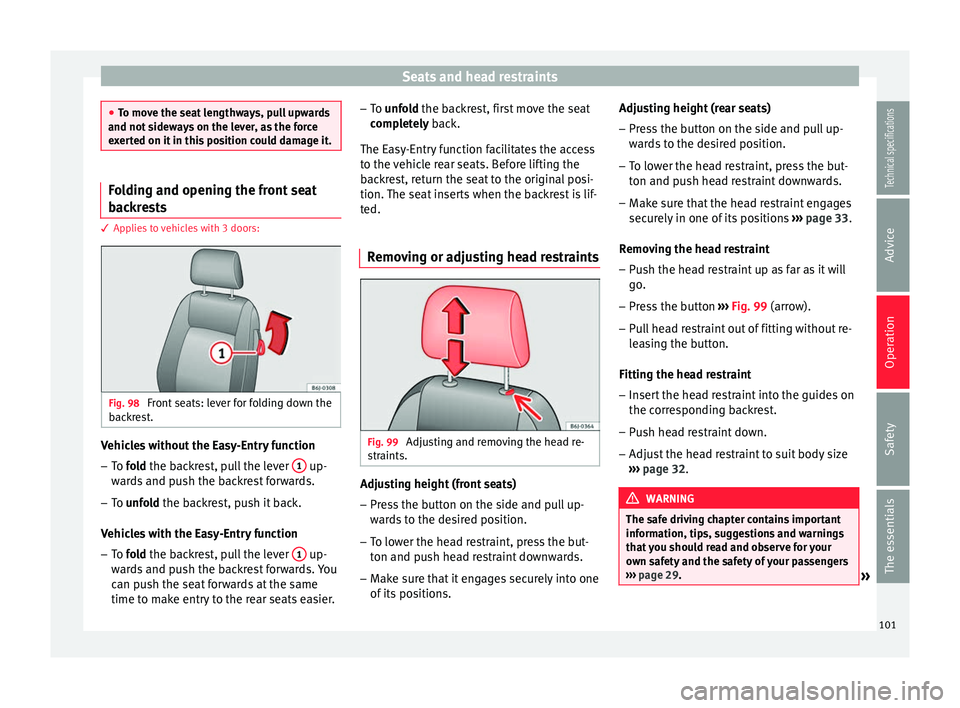
Fig. 98
Front seats: lever for folding down the
backrest. Vehicles without the Easy-Entry function
– To fold
the backrest, pull the lever 1 up-
wards and push the backrest forwards.
– To unfold
the backrest, push it back.
V
ehicles with the Easy-Entry function
– To fold the backrest, pull the lever 1 up-
wards and push the backrest forwards. You
can push the seat forwards at the same
time to make entry to the rear seats easier. –
To unfold the backrest, first move the seat
c
ompletely back.
The Ea
sy-Entry function facilitates the access
to the vehicle rear seats. Before lifting the
backrest, return the seat to the original posi-
tion. The seat inserts when the backrest is lif-
ted.
Removing or adjusting head restraints Fig. 99
Adjusting and removing the head re-
straints. Adjusting height (front seats)
– Press the button on the side and pull up-
wards to the desired position.
– To lower the head restraint, press the but-
ton and push head restraint downwards.
– Make sure that it engages securely into one
of its positions. Adjusting height (rear seats)
– Press the button on the side and pull up-
wards to the desired position.
– To lower the head restraint, press the but-
ton and push head restraint downwards.
– Make sure that the head restraint engages
securely in one of its positions ››› page 33.
Removing the head restraint – Push the head restraint up as far as it will
go.
– Press the button ››› Fig. 99 (arrow).
– Pull head restraint out of fitting without re-
leasing the button.
Fitting the head restraint
– Insert the head restraint into the guides on
the corresponding backrest.
– Push head restraint down.
– Adjust the head restraint to suit body size
››› page 32 . WARNING
The safe driving chapter contains important
information, tips, suggestions and warnings
that you should read and observe for your
own safety and the safety of your passengers
››› page 29.
» 101
Technical specifications
Advice
Operation
Safety
The essentials
Page 104 of 240
Operation
WARNING
● Never drive if the head restraints have been
removed. Risk of injury.
● Never drive if the head restraints are in an
unsuitable position, there is a risk of serious
injury.
● After refitting the head restraint, you must
always adjust it properly for height to achieve
optimal protection.
● Please observe the safety warnings in ››› in Correct adjustment of front head restraints
on page 33.
Note
● To fit and remove the rear head restraints,
gently tilt the seat backrest forwards.
● When fitting the head restraints again, in-
sert the tubes as far as possible into the
guides without pressing the button. Seat functions
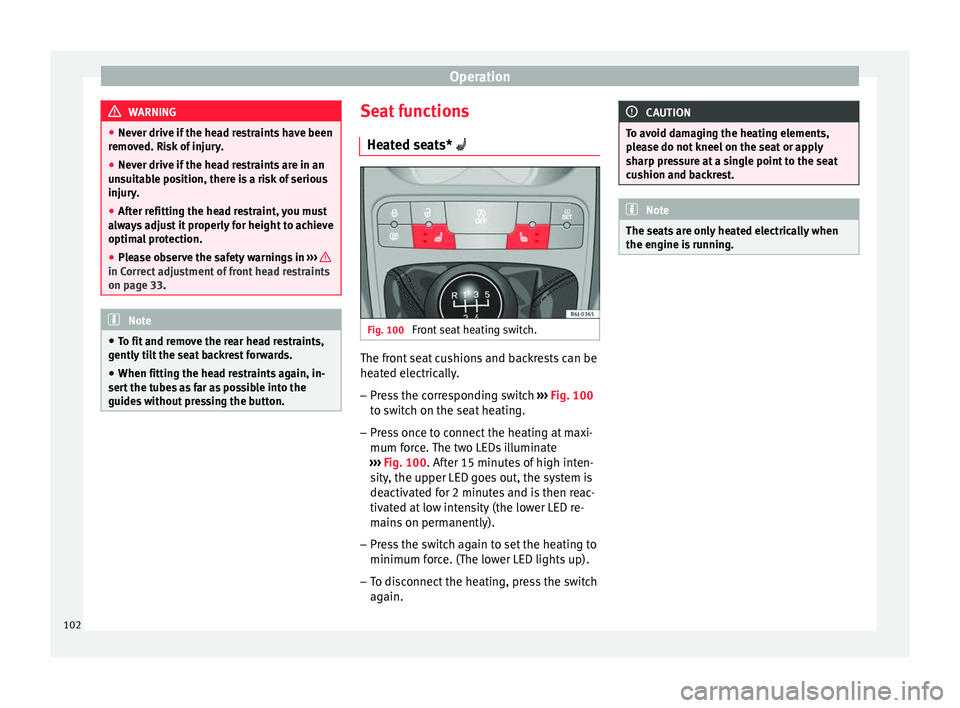
Heated seats* Fig. 100
Front seat heating switch. The front seat cushions and backrests can be
heated electrically.
– Press the corresponding switch ››› Fig. 100
to switch on the seat heating.
– Press once to connect the heating at maxi-
mum force. The two LEDs illuminate
››› Fig. 100 . After 15 minutes of high inten-
s ity
, the upper LED goes out, the system is
deactivated for 2 minutes and is then reac-
tivated at low intensity (the lower LED re-
mains on permanently).
– Press the switch again to set the heating to
minimum force. (The lower LED lights up).
– To disconnect the heating, press the switch
again. CAUTION
To avoid damaging the heating elements,
please do not kneel on the seat or apply
sharp pressure at a single point to the seat
cushion and backrest. Note
The seats are only heated electrically when
the engine is running. 102
Page 105 of 240
Seats and head restraints
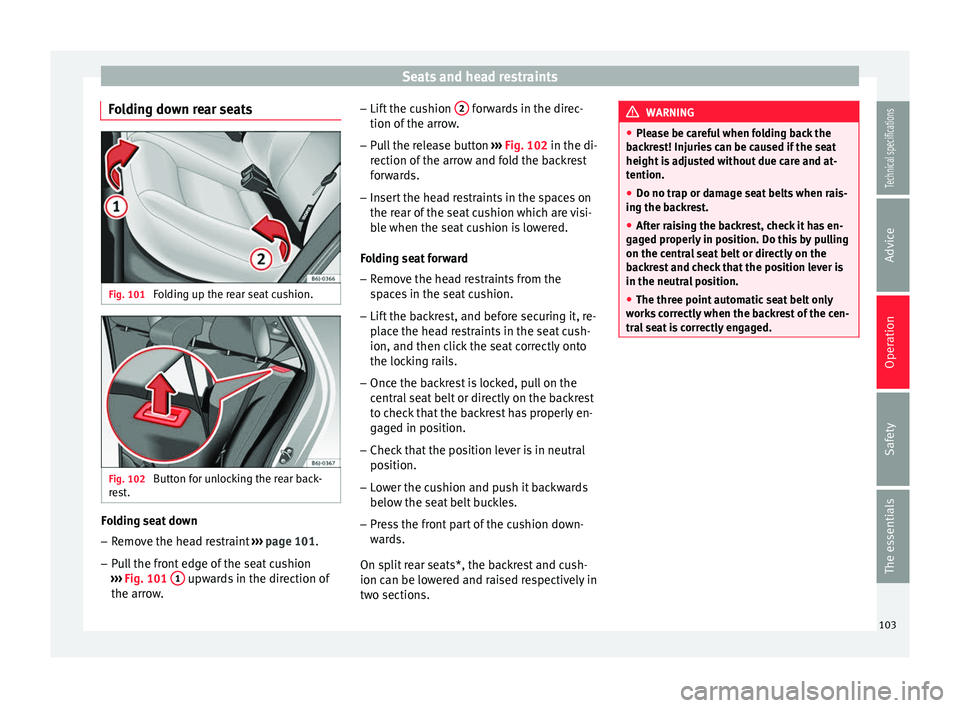
Folding down rear seats Fig. 101
Folding up the rear seat cushion. Fig. 102
Button for unlocking the rear back-
rest. Folding seat down
– Remove the head restraint ››› page 101.
– Pull the front edge of the seat cushion
››› Fig. 101 1 upwards in the direction of
the arrow. –
Lift the cushion 2 forwards in the direc-
tion of the arrow.
– Pull the release button ››› Fig. 102 in the di-
rection of the arrow and fold the backrest forwards.
– Insert the head restraints in the spaces on
the rear of the seat cushion which are visi-
ble when the seat cushion is lowered.
Folding seat forward
– Remove the head restraints from the
spaces in the seat cushion.
– Lift the backrest, and before securing it, re-
place the head restraints in the seat cush-
ion, and then click the seat correctly onto
the locking rails.
– Once the backrest is locked, pull on the
central seat belt or directly on the backrest
to check that the backrest has properly en-
gaged in position.
– Check that the position lever is in neutral
position.
– Lower the cushion and push it backwards
below the seat belt buckles.
– Press the front part of the cushion down-
wards.
On split rear seats*, the backrest and cush-
ion can be lowered and raised respectively in
two sections. WARNING
● Please be careful when folding back the
backrest! Injuries can be caused if the seat
height is adjusted without due care and at-
tention.
● Do no trap or damage seat belts when rais-
ing the backrest.
● After raising the backrest, check it has en-
gaged properly in position. Do this by pulling
on the central seat belt or directly on the
backrest and check that the position lever is
in the neutral position.
● The three point automatic seat belt only
works correctly when the backrest of the cen-
tral seat is correctly engaged. 103Technical specifications
Advice
Operation
Safety
The essentials
Page 169 of 240
Checking and refilling levels
support the vehicle, there is a risk of acci-
dent!. A hydraulic jack is insufficient for se-
curing the vehicle and there is a risk of injury.
●
If any work has to be performed when the
engine is started or with the engine running,
there is an additional, potentially fatal, safety
risk from the rotating parts, such as the drive
belts, alternator, radiator fan, etc., and from
the high-voltage ignition system. You should
also observe the following:
– Never touch the electrical wiring of the
ignition system.
– Ensure that jewellery, loose clothing and
long hair do not get trapped in rotating
engine parts. Danger of death. Before
starting any work remove jewellery, tie
back and cover hair, and wear tight-fit-
ting clothes.
– Never accelerate with a gear engaged
without taking the necessary precau-
tions. The vehicle could move, even if the
handbrake is applied. Danger of death.
● If work has to be carried out on the fuel
system or on electrical components, you
must observe the following safety notes in
addition to the above warnings:
– Always disconnect the battery from the
on-board network. The vehicle must be
unlocked when this is done, otherwise
the alarm will be triggered.
– Do not smoke.
– Never work near naked flames.
– Always have a fire extinguisher on hand. CAUTION
When topping up service fluids, make sure
not to mistake them. Using the wrong fluids
could cause serious malfunctions and engine
damage! For the sake of the environment
Service fluids leaks are harmful to the envi-
ronment. For this reason you should make
regular checks on the ground underneath
your vehicle. If you find spots of oil or other
fluids, have your vehicle inspected in a speci-
alised workshop. Opening the bonnet
Read the additional information carefully
››› page 10
The bonnet is released from inside the vehi-
cle.
Before opening the bonnet ensure that the
windscreen wipers are in rest position. WARNING
Hot coolant can scald!
● Never open the bonnet if you see steam,
smoke or coolant escaping from the engine
compartment. ●
Wait until no more steam, smoke or coolant
is emitted from the bonnet, then carefully
open the bonnet.
● When working in the engine compartment,
always observe the safety warnings
››› page 166. Closing the bonnet
–
Slightly lift the bonnet.
– Release the bonnet stay and replace it in its
support.
– At a height of approximately 30 cm let it fall
so it locks.
If the bonnet does not close, do not press
downwards. Open it again and let it fall as
mentioned above. WARNING
If the bonnet is not closed properly, it could
open while you are driving and completely
obscure your view of the road. Risk of acci-
dent.
● After closing the bonnet, always check that
it is properly secured. The bonnet must be
flush with the surrounding body panels.
● If you notice that the bonnet latch is not se-
cured when the vehicle is moving, stop the
vehicle immediately and close the bonnet
properly. Risk of accident. 167Technical specifications
Advice
Operation
Safety
The essentials
Page 180 of 240
Advice
Depending on the make, there will be 6 to 8
of them evenly spaced around the tyre. Mark-
ings on the tyre sidewall (for instance the let-
ters “TWI” or other symbols) indicate the po-
sitions of the tread wear indicators. The mini-
mum tread depth required by law is 1.6 mm
(measured in the tread grooves next to the
tread wear indicators). Worn tyres must be re-
placed. Different figures may apply in export
countries ››› .
Tyre pressure
Incorrect tyre pressure causes premature
wear and could cause tyre blow-out. For this
reason, the tyre pressure should be checked
at least once per month ››› page 177.
Driving style
Fast cornering, heavy acceleration and hard
braking all increase tyre wear.
Changing wheels around
If the front tyres are worn considerably more
than the rear ones it is advisable to change
them around as shown ››› Fig. 155 . The use-
f u
l life of all the tyres will then be about the
same time.
Wheel balance
The wheels on new vehicles are balanced.
However, various factors encountered in nor-
mal driving can cause them to become unbal-
anced, which results in steering vibration. Unbalanced wheels should be rebalanced, as
they otherwise cause excessive wear on
steering, suspension and tyres. A wheel must
also be rebalanced when a new tyre is fitted.
Incorrect wheel alignment
Incorrect wheel alignment causes excessive
tyre wear, impairing the safety of the vehicle.
If tyres show excessive wear, you should
have the wheel alignment checked by a Tech-
nical Service.
WARNING
There is a serious danger of accidents if a tyre
bursts during driving!
● The tyres must be replaced at the latest
when the tread wear indicators are worn
››› page 177. Failure to follow this instruction
could result in an accident. Worn tyres do not
grip well at high speeds on wet roads. There
is also a greater risk of “aquaplaning”.
● At continuously high speeds, a tyre with in-
sufficient pressure flexes more. This causes it
to overheat. This can cause tread separation
and tyre blow-out. Risk of accident. Always
observe the recommended tyre pressures.
● If tyres show excessive wear, you should
have the running gear checked by a Technical
Service.
● Keep chemicals such as oil, fuel and brake
fluid away from tyres.
● Damaged wheels and tyres must be re-
placed immediately! For the sake of the environment
Under-inflated tyres will increase fuel con-
sumption. New tyres and wheels
New tyres and wheels have to be run in.
The tyres and wheel rims are an essential
part of the vehicle's design. Those approved
by SEAT are specially matched to the charac-
teristics of the vehicle and make a major con-
tribution to good road-holding and safe han-
dling
››› .
Tyres should be replaced at least in pairs and
not individually (i.e. both front tyres or both
rear tyres together). A knowledge of tyre des-
ignations makes it easier to choose the cor-
rect tyres. Radial tyres have the tyre designa-
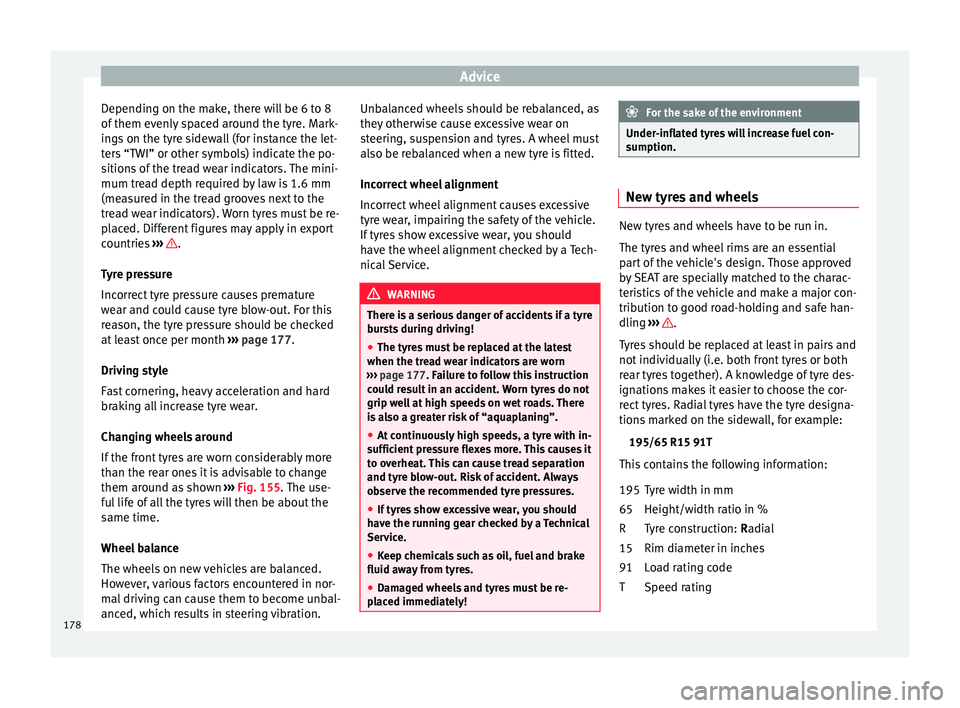
tions marked on the sidewall, for example: 195/65 R15 91T
This contains the following information:
Tyre width in mm
Height/width ratio in %
Tyre construction: R
adial
Rim di
ameter in inches
Load rating code
Speed rating
195
65
R
15
91
T
178
Page 228 of 240
Technical specifications
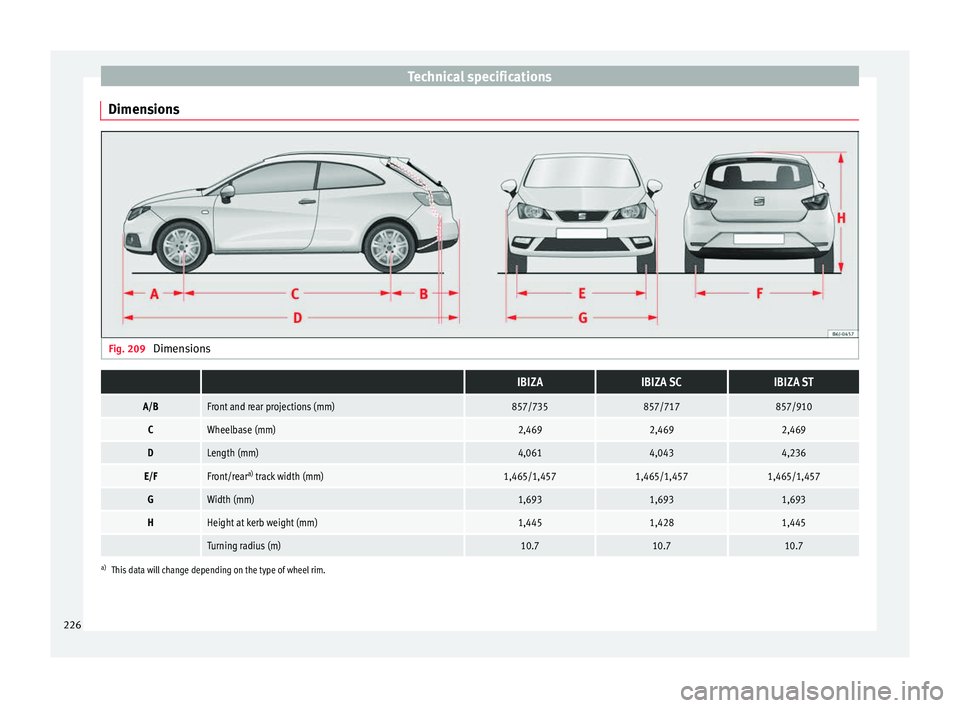
Dimensions Fig. 209
Dimensions IBIZAIBIZA SCIBIZA ST
A/BFront and rear projections (mm)857/735857/717857/910
CWheelbase (mm)2,4692,4692,469
DLength (mm)4,0614,0434,236
E/FFront/rear a)
track width (mm)1,465/1,4571,465/1,4571,465/1,457
GWidth (mm)1,6931,6931,693
HHeight at kerb weight (mm)1,4451,4281,445
Turning radius (m)10.710.710.7
a) This data will change depending on the type of wheel rim.
226
Page 236 of 240
Index
Remote control key Buttons . . . . . . . . . . . . . . . . . . . . . . . . . . . . . . . . 83
Synchronising . . . . . . . . . . . . . . . . . . . . . . . . . . . 84
Removing and fitting the wheel . . . . . . . . . . . . . 185
Replacement keys . . . . . . . . . . . . . . . . . . . . . . . . . 82
Replacement of parts . . . . . . . . . . . . . . . . . . . . . . 155
Rev counter . . . . . . . . . . . . . . . . . . . . . . . . . . . . . . . 56
Roll-back function panoramic/tilting sunroof . . . . . . . . . . . . . . . . . 90
Windows . . . . . . . . . . . . . . . . . . . . . . . . . . . . . . . 88
Roof aerial . . . . . . . . . . . . . . . . . . . . . . . . . . . . . . . 155
Roof carrier . . . . . . . . . . . . . . . . . . . . . . . . . . . . . . 111
Roof carrier system . . . . . . . . . . . . . . . . . . . . . . . . 111
Rubber seals . . . . . . . . . . . . . . . . . . . . . . . . . . . . . 160
Running in Brake pads . . . . . . . . . . . . . . . . . . . . . . . . . . . . 134
Engine . . . . . . . . . . . . . . . . . . . . . . . . . . . . . . . . 134
Tyres . . . . . . . . . . . . . . . . . . . . . . . . . . . . . . . . . 134
Running in tyres . . . . . . . . . . . . . . . . . . . . . . . . . . 134
S Safe . . . . . . . . . . . . . . . . . . . . . . . . . . . . . . . . . . . . . 79
Safe driving . . . . . . . . . . . . . . . . . . . . . . . . . . . . . . 29
Safe Security system . . . . . . . . . . . . . . . . . . . . . . . 79
Safety . . . . . . . . . . . . . . . . . . . . . . . . . . . . . . . . . . . 29 child safety . . . . . . . . . . . . . . . . . . . . . . . . . . . . . 46
child seats . . . . . . . . . . . . . . . . . . . . . . . . . . . . . . 46
Safety equipment . . . . . . . . . . . . . . . . . . . . . . . . . . 29
Safety information Front passenger airbag deactivation . . . . . . . . 46
Safety instructions Coolant temperature . . . . . . . . . . . . . . . . . . . . . 63
front airbags . . . . . . . . . . . . . . . . . . . . . . . . . . . . 43
side airbags . . . . . . . . . . . . . . . . . . . . . . . . . . . . 44
Safety notes Seat belt tensioners . . . . . . . . . . . . . . . . . . . . . . 39
Using seat belts . . . . . . . . . . . . . . . . . . . . . . . . . 36 Seals . . . . . . . . . . . . . . . . . . . . . . . . . . . . . . . . . . . 160
Seat belt
Adjusting . . . . . . . . . . . . . . . . . . . . . . . . . . . . . . . 12
Seat belt cleaning . . . . . . . . . . . . . . . . . . . . . . . . 163
Seat belt control lamp . . . . . . . . . . . . . . . . . . . . . . 35
Seat belt position for pregnant women . . . . . . . . . . . . . . . . . . . . . . 38
Seat belts . . . . . . . . . . . . . . . . . . . . . . . . . . . . . . 38
Seat belt protection . . . . . . . . . . . . . . . . . . . . . . . . 35
Seat belt release . . . . . . . . . . . . . . . . . . . . . . . . . . 38
Seat belts . . . . . . . . . . . . . . . . . . . . . . . . . . . . . . . . 34 Adjustment . . . . . . . . . . . . . . . . . . . . . . . . . . . . . 37
control lamp . . . . . . . . . . . . . . . . . . . . . . . . . . . . 35
Safety notes . . . . . . . . . . . . . . . . . . . . . . . . . . . . 36
unfastened . . . . . . . . . . . . . . . . . . . . . . . . . . . . . 36
Seat belt tensioner control lamp . . . . . . . . . . . . . . . . . . . . . . . . . . . . 42
Seat heating . . . . . . . . . . . . . . . . . . . . . . . . . . . . . 102
Selecting a gear . . . . . . . . . . . . . . . . . . . . . . . . . . 128
Selective opening . . . . . . . . . . . . . . . . . . . . . . . . . 80
Semiautomatic air conditioning controls . . . . . . . . . . . . . . . . . . . . . . . . . . . . . . . 118
Service interval display . . . . . . . . . . . . . . . . . . . . . 67
Side airbags . . . . . . . . . . . . . . . . . . . . . . . . . . . . . . 43 safety instructions . . . . . . . . . . . . . . . . . . . . . . . 44
Single headlight bulbs . . . . . . . . . . . . . . . . . . . . 198
Sitting position driver . . . . . . . . . . . . . . . . . . . . . . . . . . . . . . . . . . 30
Sitting position, occupants . . . . . . . . . . . . . . . . . . 30
Snow chains . . . . . . . . . . . . . . . . . . . . . . . . 180, 210
Soot accumulation in the diesel engine particu- late filter
control lamp . . . . . . . . . . . . . . . . . . . . . . . . . . . . 59
Spanner symbol . . . . . . . . . . . . . . . . . . . . . . . . . . . 67
Spare parts . . . . . . . . . . . . . . . . . . . . . . . . . . . . . . 155
Spare wheel . . . . . . . . . . . . . . . . . . . . . . . . . . . . . 182
Speedometer . . . . . . . . . . . . . . . . . . . . . . . . . . . . . 57 Speed selector lever lock
control lamp . . . . . . . . . . . . . . . . . . . . . . . . . . . . 62
Start-Stop Activating and deactivating . . . . . . . . . . . . . . . 143
functioning . . . . . . . . . . . . . . . . . . . . . . . . . . . . 142
Starting petrol engines . . . . . . . . . . . . . . . 124, 125
Starting the engine . . . . . . . . . . . . . . . . . . 124, 125 after the fuel tank has been run dry . . . . . . . . 125
Starting the vehicle . . . . . . . . . . . . . . . . . . . . . . . . 13
Steam jets . . . . . . . . . . . . . . . . . . . . . . . . . . . . . . . 158
Steering . . . . . . . . . . . . . . . . . . . . . . . . . . . . . . . . . 31 steering lock . . . . . . . . . . . . . . . . . . . . . . . . . . . 123
Steering wheel . . . . . . . . . . . . . . . . . . . . . . . . . . . . 13
Steering wheel height adjustment . . . . . . . . . . . . 31
Storage compartment . . . . . . . . . . . . . . . . . . . . . 110 Front passenger side . . . . . . . . . . . . . . . . . . . . 104
right front seat . . . . . . . . . . . . . . . . . . . . . . . . . 105
Sunroof . . . . . . . . . . . . . . . . . . . . . . . . . . . . . . . . . . 10
Sun visor Sliding/tilting sunroof . . . . . . . . . . . . . . . . . . . . 89
Sun visors . . . . . . . . . . . . . . . . . . . . . . . . . . . . . . . . 97
Switch Hazard warning lights . . . . . . . . . . . . . . . . . . . . 95
Heated rear window . . . . . . . . . . . . . . . . . . . . . . 96
Light switch . . . . . . . . . . . . . . . . . . . . . . . . . . . . . 90
Switches Electric windows . . . . . . . . . . . . . . . . . . . . . . . . . 87
Switching off the engine . . . . . . . . . . . . . . . . . . . 125
T
Tail lights . . . . . . . . . . . . . . . . . . . . . . . . . . . . . . . 203
Tank Fuel level . . . . . . . . . . . . . . . . . . . . . . . . . . . . . . . 64
Reserve indicator . . . . . . . . . . . . . . . . . . . . . . . . 64
Tank capacity . . . . . . . . . . . . . . . . . . . . . . . . . . . 64
Technical modifications . . . . . . . . . . . . . . . . . . . . 155
The PND (portable navigation device) . . . . . . . . . 69
234