warning light Seat Ibiza 5D 2014 User Guide
[x] Cancel search | Manufacturer: SEAT, Model Year: 2014, Model line: Ibiza 5D, Model: Seat Ibiza 5D 2014Pages: 240, PDF Size: 4.89 MB
Page 46 of 240
Safety
In conjunction with the seat belts, the side
airbag system gives the front seat occupants
additional protection for the upper body in
the event of a severe side collision.
In a side collision, the side airbags reduce
the risk of injury to passengers on the front
seats to the areas of the body facing the im-
pact. In addition to the normal protection
they offer, the seat belts on the front seats al-
so hold the passengers' bodies in place in
the event of a side collision so that the side
airbags can provide maximum protection. WARNING
● If you do not wear a seat belt, if you lean
forward, or are not seated correctly while the
vehicle is in motion, you are at a greater risk
of injury if the side airbag system is triggered
in an accident.
● In order for the side airbags to provide their
maximum protection, the prescribed sitting
position must always be maintained with
seat belts fastened while travelling.
● Occupants of the outer seats must never
carry any objects or pets in the deployment
space between them and the airbags, or al-
low children or other passengers to travel in
this position. It is also important not to at-
tach any accessories (such as cup holders) to
the doors. This would impair the protection
offered by the side airbags. ●
The built-in coat hooks should be used only
for lightweight clothing. Do not leave any
heavy or sharp-edged objects in the pockets.
● Great forces, such as hard blows or kicks,
must not be exerted upon the backrest bol-
ster because the system may be damaged. In
this case, the side airbags would not be trig-
gered.
● Under no circumstances should protective
covers be fitted over seats with side airbags
unless the covers have been approved for use
in your vehicle. Because the airbag deploys
from the side of the backrest, the use of con-
ventional seat covers would obstruct the side
airbag, seriously reducing the airbag's effec-
tiveness.
● Any damage to the original seat upholstery
or around the seams of the side airbag units
must be repaired immediately by a special-
ised workshop.
● The airbags provide protection for just one
accident; replace them once they have de-
ployed.
● Any work on the side airbag system or re-
moval and installation of the airbag compo-
nents for other repairs (such as removal of
the front seat) should only be performed by a
specialised workshop. Otherwise, faults may
occur during the airbag system operation.
● Do not attempt to modify components of
the airbag system in any way.
● The side and head airbags are managed
through sensors located in the interior of the
front doors. To ensure the correct operation of
the side and curtain (head) airbags neither the doors nor the door panels should be
modified in any way (e.g. fitting loudspeak-
ers). If the front door is damaged, the airbag
system may not work correctly. All work car-
ried out on the front door must be done in a
specialised workshop.
●
In a side-on collision the side airbags will
not work if the sensors do not correctly meas-
ure the pressure increase on the interior of
the doors, due to air escaping through the
areas with holes or openings in the door pan-
el.
● Never drive if the interior door panels have
been removed or if the panels have not been
correctly fitted.
● Never drive the vehicle if the loudspeakers
in the door panels have been removed, un-
less the holes left by the loudspeakers have
been closed properly.
● Always check that the openings are closed
or covered if additional loudspeakers or other
equipment are fitted inside the door panels.
● Any work carried out to the doors should be
made in an authorised specialised workshop. 44
Page 47 of 240
Airbag system
Head-protection airbags* Fig. 60
Location and deployment area of the
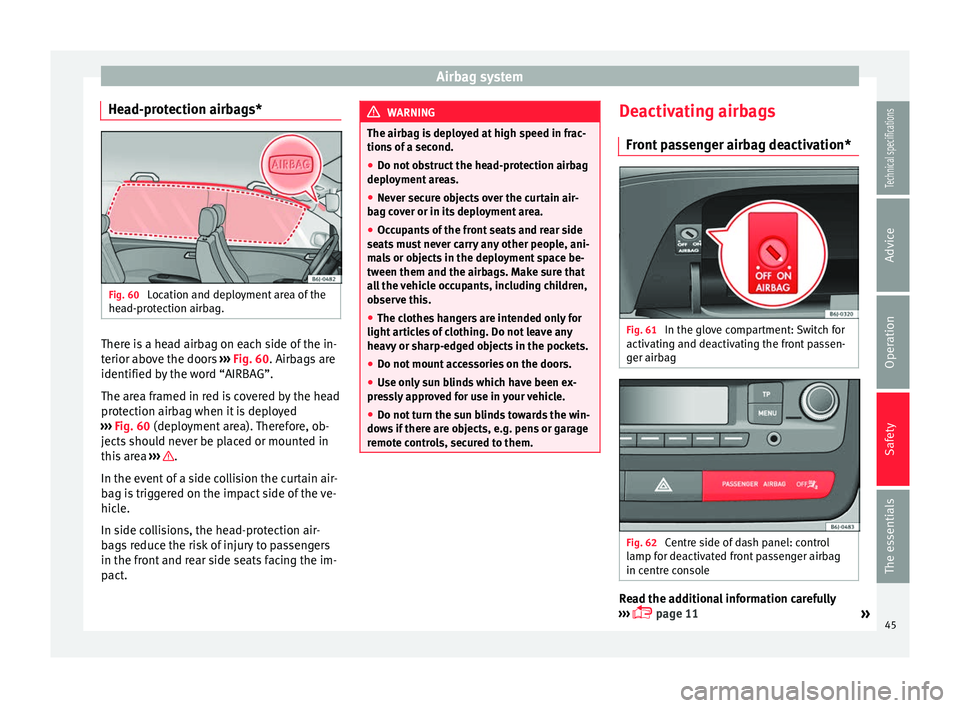
head-protection airbag. There is a head airbag on each side of the in-
terior above the doors
››› Fig. 60 . Airbags are
identified b y
the word “AIRBAG”.
The area framed in red is covered by the head
protection airbag when it is deployed
››› Fig. 60 (deployment area). Therefore, ob-
jects
should never be placed or mounted in
this area ››› .
In the event of a side collision the curtain air-
bag is triggered on the impact side of the ve-
hicle.
In side collisions, the head-protection air-
bags reduce the risk of injury to passengers
in the front and rear side seats facing the im-
pact. WARNING
The airbag is deployed at high speed in frac-
tions of a second.
● Do not obstruct the head-protection airbag
deployment areas.
● Never secure objects over the curtain air-
bag cover or in its deployment area.
● Occupants of the front seats and rear side
seats must never carry any other people, ani-
mals or objects in the deployment space be-
tween them and the airbags. Make sure that
all the vehicle occupants, including children,
observe this.
● The clothes hangers are intended only for
light articles of clothing. Do not leave any
heavy or sharp-edged objects in the pockets.
● Do not mount accessories on the doors.
● Use only sun blinds which have been ex-
pressly approved for use in your vehicle.
● Do not turn the sun blinds towards the win-
dows if there are objects, e.g. pens or garage
remote controls, secured to them. Deactivating airbags
Front passenger airbag deactivation* Fig. 61
In the glove compartment: Switch for
activating and deactivating the front passen-
ger airbag Fig. 62
Centre side of dash panel: control
lamp for deactivated front passenger airbag
in centre console Read the additional information carefully
››› page 11
»
45
Technical specifications
Advice
Operation
Safety
The essentials
Page 48 of 240
Safety
If you fit a rear-facing child seat to the front
passenger seat, the front passenger front air-
bag must be de-activated.
When the front passenger airbag is deactiva-
ted , this means that only the front passenger
fr ont
airbag is deactivated. All the other air-
bags in the vehicle remain activated.
Activating the front passenger front airbag
– Switch the ignition off.
– Open the glove compartment on the front
passenger side.
– Insert the key into the slot of the switch for
deactivating the front passenger airbag
››› Fig. 61. About 3/4 of the key should en-
ter
, as far as it will go.
– Then turn the key gently to the position.
Do not force it if you feel resistance, and
make sure you have inserted the key fully.
– When the ignition is switched on, check
whether the control lamp
on the dash panel does ››› Fig. 62 not
light
up ››› .
WARNING
● It is the driver's responsibility to ensure
that the key operated switch is set to the cor-
rect position.
● You should deactivate the front passenger
front airbag only if you have to use a rear-fac- ing child seat in exceptional cases
››› page 46, Transporting children safety.
● Never install a child seat facing backwards
on the front passenger seat unless the front
passenger front airbag has been disabled.
Otherwise, there is a risk of death.
● As soon as the child seat is no longer nee-
ded on the front passenger seat, enable the
front passenger front airbag again.
● Only deactivate the front passenger front
airbag when the ignition is off, otherwise a
fault may occur in the airbag system, which
could cause the airbag to not deploy properly
or not deploy at all in case of an accident.
● Never leave the key in the airbag disabling
switch as it could get damaged or enable or
disable the airbag during driving.
● When the passenger airbag is deactivated,
if the control lamp is not
continuously lit up when the front passenger
airbag is disabled, there may be a fault in the
airbag system:
–Have the airbag system inspected imme-
diately by a specialised workshop.
– Do not use a child seat on the front pas-
senger seat! The front passenger front
airbag could be triggered in the event of
an accident, even if there is a fault in the
system and, as a result, a child could sus-
tain serious or fatal injuries.
– It is unpredictable whether the front pas-
senger airbag will deploy in the event of
an accident. Warn all your passengers of
this. Transporting children safety
Safety for children Introduction For safety reasons, as we have learned from
accident statistics, we recommend that chil-
dren under 12 years of age travel in the rear
seats. Depending on their age, height and
weight, children travelling in rear seats must
use a child seat or a seat belt. For safety rea-
sons, the child seat should be installed in the
rear seat, behind the front passenger seat or
in the centre back seat.
The physical laws involved and the forces
acting in a collision apply also to children
››› page 36 . But unlike adults, children do not
h av
e fully developed muscle and bone struc-
tures. This means that children are subject to
a greater risk of injury.
To reduce the risk of injuries, children must
always use special child restraint systems
when travelling in the vehicle.
We recommend the use of child safety prod-
ucts from the SEAT Original Accessories Pro-
gramme, which includes systems for all ages
made by “Peke” (not for all countries).
These systems have been especially de-
signed and approved, complying with the
ECE-R44. regulation.
46
Page 57 of 240
Dash panel
Operation
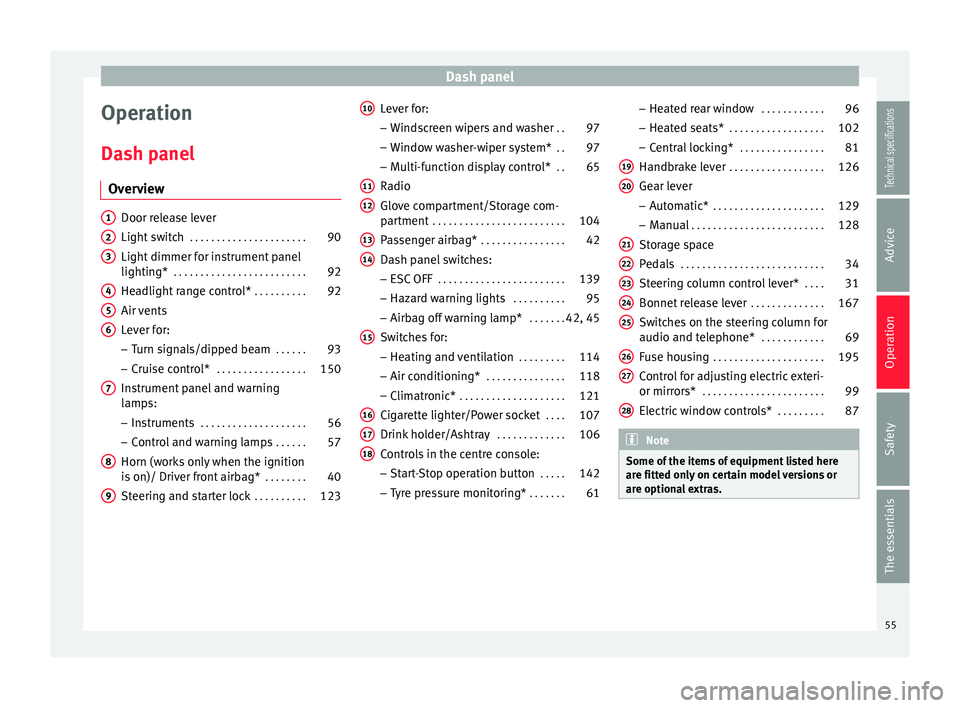
Dash panel Overview Door release lever
Light switch
. . . . . . . . . . . . . . . . . . . . . . 90
Light dimmer for instrument panel
lighting* . . . . . . . . . . . . . . . . . . . . . . . . . 92
Headlight range control* . . . . . . . . . .92
Air vents
Lever for: – Turn signals/dipped beam . . . . . .93
– Cruise control* . . . . . . . . . . . . . . . . . 150
Instrument panel and warning
lamps: – Instruments . . . . . . . . . . . . . . . . . . . . 56
– Control and warning lamps . . . . . .57
Horn (works only when the ignition
is on)/ Driver front airbag* . . . . . . . .40
Steering and starter lock . . . . . . . . . .123
1 2
3
4
5
6
7
8
9 Lever for:
– Windscreen wipers and washer . .97
– Window washer-wiper system* . .97
– Multi-function display control* . .65
Radio
Glove compartment/Storage com-
partment . . . . . . . . . . . . . . . . . . . . . . . . . 104
Passenger airbag* . . . . . . . . . . . . . . . . 42
Dash panel switches: – ESC OFF . . . . . . . . . . . . . . . . . . . . . . . . 139
– Hazard warning lights . . . . . . . . . .95
– Airbag off warning lamp* . . . . . . .42, 45
Switches for: – Heating and ventilation . . . . . . . . .114
– Air conditioning* . . . . . . . . . . . . . . . 118
– Climatronic* . . . . . . . . . . . . . . . . . . . . 121
Cigarette lighter/Power socket . . . .107
Drink holder/Ashtray . . . . . . . . . . . . .106
Controls in the centre console:
– Start-Stop operation button . . . . .142
– Tyre pressure monitoring* . . . . . . .61
10 11
12
13
14
15
16
17
18 –
Heated rear window . . . . . . . . . . . .96
– Heated seats* . . . . . . . . . . . . . . . . . . 102
– Central locking* . . . . . . . . . . . . . . . . 81
Handbrake lever . . . . . . . . . . . . . . . . . . 126
Gear lever – Automatic* . . . . . . . . . . . . . . . . . . . . . 129
– Manual . . . . . . . . . . . . . . . . . . . . . . . . . 128
Storage space
Pedals . . . . . . . . . . . . . . . . . . . . . . . . . . . 34
Steering column control lever* . . . .31
Bonnet release lever . . . . . . . . . . . . . .167
Switches on the steering column for
audio and telephone* . . . . . . . . . . . .69
Fuse housing . . . . . . . . . . . . . . . . . . . . . 195
Control for adjusting electric exteri-
or mirrors* . . . . . . . . . . . . . . . . . . . . . . . 99
Electric window controls* . . . . . . . . .87 Note
Some of the items of equipment listed here
are fitted only on certain model versions or
are optional extras. 19
20
21
22
23
24
25
26
27
28
55Technical specifications
Advice
Operation
Safety
The essentials
Page 59 of 240
Dash panel
For the sake of the environment
Changing up a gear early will help you to save
fuel and minimise emissions and engine
noise. Speedometer
The speedometer is equipped with a digital
odometer and a trip odometer, in addition to
a service intervals display.
During the running-in period, the instructions
shown on
›››
page 134 should be followed.
W arnin
g lamps
Overview of the warning lamps Read the additional information carefully
››› page 18 WARNING
● Failure to observe control lamps and warn-
ing messages can result in serious personal
injuries or damage to your vehicle.
● The risk of an accident increases if your ve-
hicle breaks down. Use a warning triangle to
draw the attention of other road users in or-
der to prevent danger to third parties. ●
The engine compartment is a dangerous
area. Before you open the bonnet to work on
the engine or in the engine compartment,
switch the engine off and allow it to cool to
reduce the risk of burns or other injuries.
Read and observe the relevant warnings
››› page 166. Note
● The appropriate control lamp for a fault will
light up in vehicles without warning or infor-
mation messages in the display.
● In vehicles with warning or information
messages on the screen, the appropriate con-
trol lamp for a fault will light up and a warn-
ing or information message will also appear
on the screen. Warning symbols
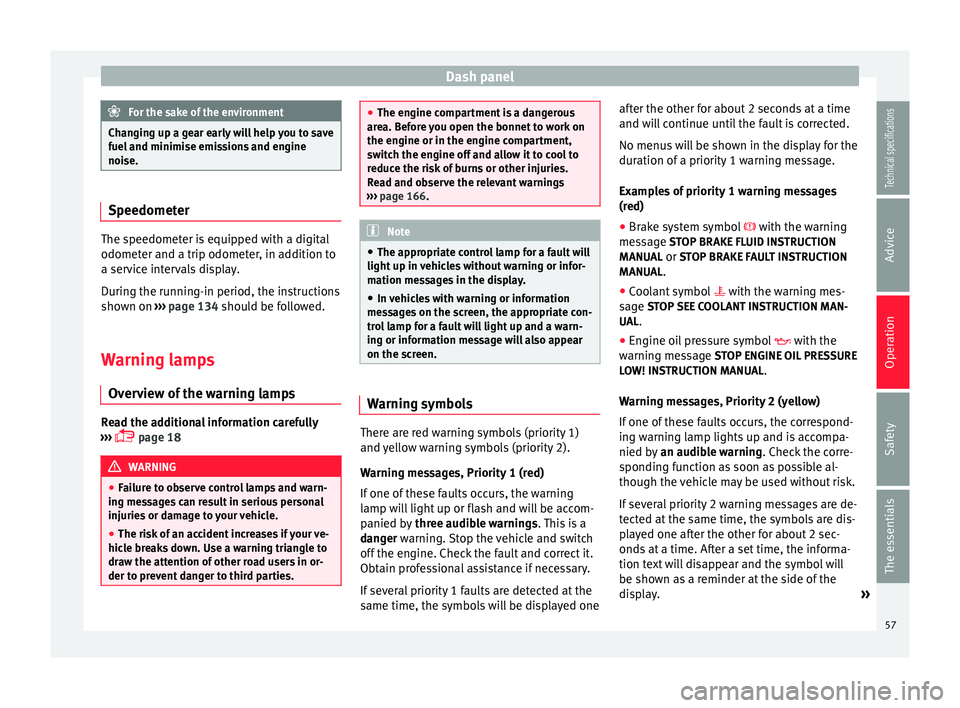
There are red warning symbols (priority 1)
and yellow warning symbols (priority 2).
Warning messages, Priority 1 (red)
If one of these faults occurs, the warning
lamp will light up or flash and will be accom-
panied by
three audible warnings. This is a
danger warning. Stop the vehicle and switch
off the en
gine. Check the fault and correct it.
Obtain professional assistance if necessary.
If several priority 1 faults are detected at the
same time, the symbols will be displayed one after the other for about 2 seconds at a time
and will continue until the fault is corrected.
No menus will be shown in the display for the
duration of a priority 1 warning message.
Examples of priority 1 warning messages
(red)
● Brake system symbol
with the warning
message STOP BRAKE FLUID INSTRUCTION
MANUAL or STOP BRAKE FAULT INSTRUCTION MANUAL.
● Coolant symbol with the warning mes-
sage STOP SEE COOLANT INSTRUCTION MAN-
UAL.
● Engine oil pressure symbol with the
warning message STOP ENGINE OIL PRESSURE
LOW! INSTRUCTION MANUAL.
Warning messages, Priority 2 (yellow)
If one of these faults occurs, the correspond-
ing warning lamp lights up and is accompa-
nied by an audible warning. Check the corre-
sponding function as soon as possible al-
though the vehicle may be used without risk.
If several priority 2 warning messages are de-
tected at the same time, the symbols are dis-
played one after the other for about 2 sec-
onds at a time. After a set time, the informa-
tion text will disappear and the symbol will
be shown as a reminder at the side of the
display. »
57
Technical specifications
Advice
Operation
Safety
The essentials
Page 60 of 240
Operation
Priority 2 warning messages will not be
shown until all Priority 1 warning messages
have been dealt with!
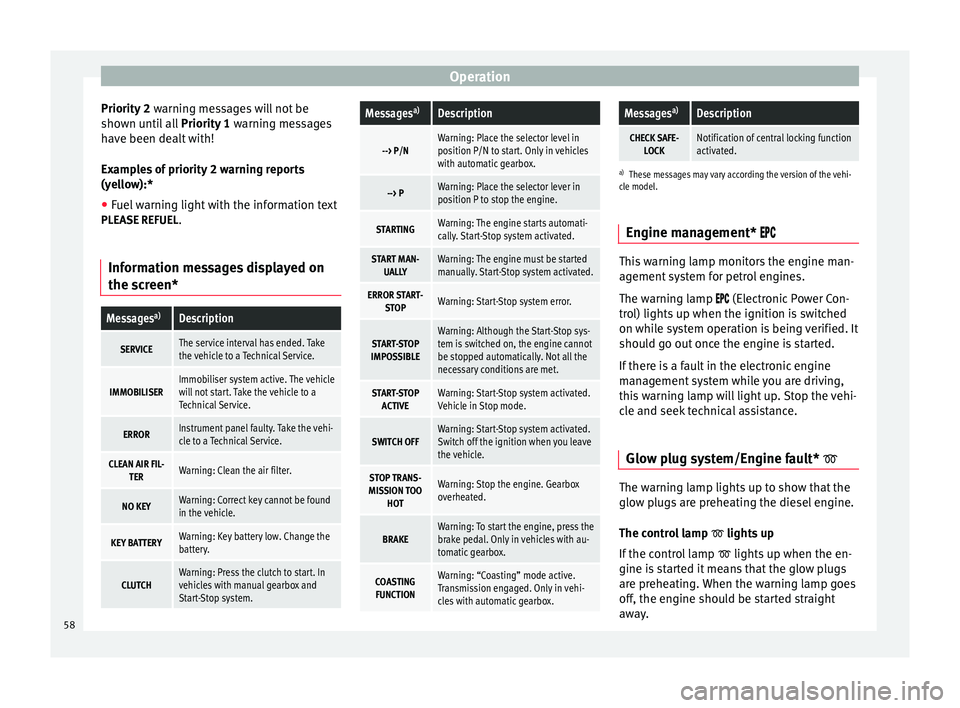
Examples of priority 2 warning reports
(yellow):*
● Fuel warning light with the information text
PLEASE REFUEL .
Information messages displayed on
the screen*Messages a)Description
SERVICEThe service interval has ended. Take
the vehicle to a Technical Service.
IMMOBILISERImmobiliser system active. The vehicle
will not start. Take the vehicle to a
Technical Service.
ERRORInstrument panel faulty. Take the vehi-
cle to a Technical Service.
CLEAN AIR FIL-
TERWarning: Clean the air filter.
NO KEYWarning: Correct key cannot be found
in the vehicle.
KEY BATTERYWarning: Key battery low. Change the
battery.
CLUTCHWarning: Press the clutch to start. In
vehicles with manual gearbox and
Start-Stop system.
Messages a)Description
--> P/NWarning: Place the selector level in
position P/N to start. Only in vehicles
with automatic gearbox.
--> PWarning: Place the selector lever in
position P to stop the engine.
STARTINGWarning: The engine starts automati-
cally. Start-Stop system activated.
START MAN-
UALLYWarning: The engine must be started
manually. Start-Stop system activated.
ERROR START- STOPWarning: Start-Stop system error.
START-STOP
IMPOSSIBLEWarning: Although the Start-Stop sys-
tem is switched on, the engine cannot
be stopped automatically. Not all the
necessary conditions are met.
START-STOP ACTIVEWarning: Start-Stop system activated.
Vehicle in Stop mode.
SWITCH OFFWarning: Start-Stop system activated.
Switch off the ignition when you leave
the vehicle.
STOP TRANS-
MISSION TOO HOTWarning: Stop the engine. Gearbox
overheated.
BRAKEWarning: To start the engine, press the
brake pedal. Only in vehicles with au-
tomatic gearbox.
COASTINGFUNCTIONWarning: “Coasting” mode active.
Transmission engaged. Only in vehi-
cles with automatic gearbox.
Messages a)Description
CHECK SAFE-
LOCKNotification of central locking function
activated.
a)These messages may vary according the version of the vehi-
cle model.
Engine management* This warning lamp monitors the engine man-
agement system for petrol engines.
The warning lamp (Electronic Power Con-
trol) lights up when the ignition is switched
on while system operation is being verified. It
should go out once the engine is started.
If there is a fault in the electronic engine
management system while you are driving,
this warning lamp will light up. Stop the vehi-
cle and seek technical assistance.
Glow plug system/Engine fault* The warning lamp lights up to show that the
glow plugs are preheating the diesel engine.
The control lamp
lights up
If the control lamp lights up when the en-
gine is started it means that the glow plugs
are preheating. When the warning lamp goes
off, the engine should be started straight
away.
58
Page 61 of 240
Dash panel
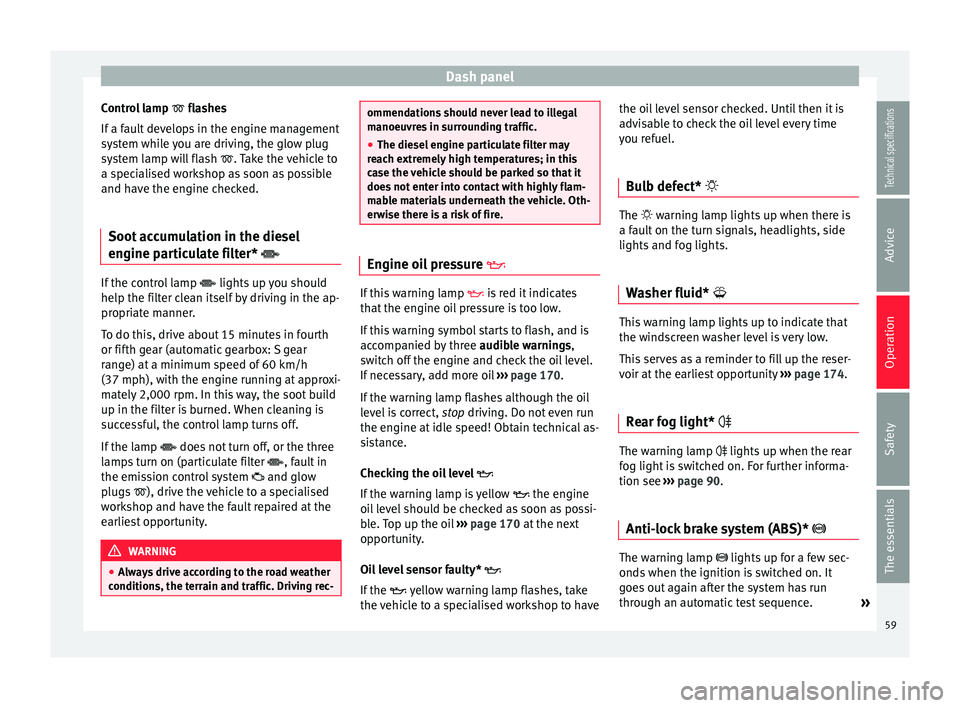
Control lamp flashes
If a f
ault develops in the engine management
system while you are driving, the glow plug
system lamp will flash
. Take the vehicle to
a specialised workshop as soon as possible
and have the engine checked.
Soot accumulation in the diesel
engine particulate filter* If the control lamp
lights up you should
help the filter clean itself by driving in the ap-
propriate manner.
To do this, drive about 15 minutes in fourth
or fifth gear (automatic gearbox: S gear
range) at a minimum speed of 60 km/h
(37 mph), with the engine running at approxi-
mately 2,000 rpm. In this way, the soot build
up in the filter is burned. When cleaning is
successful, the control lamp turns off.
If the lamp does not turn off, or the three
lamps turn on (particulate filter , fault in
the emission control system and glow
plugs ), drive the vehicle to a specialised
workshop and have the fault repaired at the
earliest opportunity. WARNING
● Always drive according to the road weather
conditions, the terrain and traffic. Driving rec- ommendations should never lead to illegal
manoeuvres in surrounding traffic.
●
The diesel engine particulate filter may
reach extremely high temperatures; in this
case the vehicle should be parked so that it
does not enter into contact with highly flam-
mable materials underneath the vehicle. Oth-
erwise there is a risk of fire. Engine oil pressure
If this warning lamp
is red it indicates
that the engine oil pressure is too low.
If this warning symbol starts to flash, and is
accompanied by three audible warnings,
switch off the engine and check the oil level.
If necessary, add more oil ››› page 170.
If the warning lamp flashes although the oil
level is correct, stop driving. Do not even run
the en gine at
idle speed! Obtain technical as-
sistance.
Checking the oil level
If the warning lamp is yellow the engine
oil level should be checked as soon as possi-
ble. Top up the oil ››› page 170 at the next
opportunity.
Oil level sensor faulty*
If the yellow warning lamp flashes, take
the vehicle to a specialised workshop to have the oil level sensor checked. Until then it is
advisable to check the oil level every time
you refuel.
Bulb defect* The
warning lamp lights up when there is
a f
ault on the turn signals, headlights, side
lights and fog lights.
Washer fluid* This warning lamp lights up to indicate that
the windscreen washer level is very low.
This serves as a reminder to fill up the reser-
voir at the earliest opportunity
›››
page 174.
Rear fog light* The warning lamp
lights up when the rear
fog light is switched on. For further informa-
tion see ›››
page 90 .
Anti-loc k
brake system (ABS)* The warning lamp lights up for a few sec-
onds when the ignition is switched on. It
goes out again after the system has run
through an automatic test sequence.
»
59
Technical specifications
Advice
Operation
Safety
The essentials
Page 62 of 240
Operation
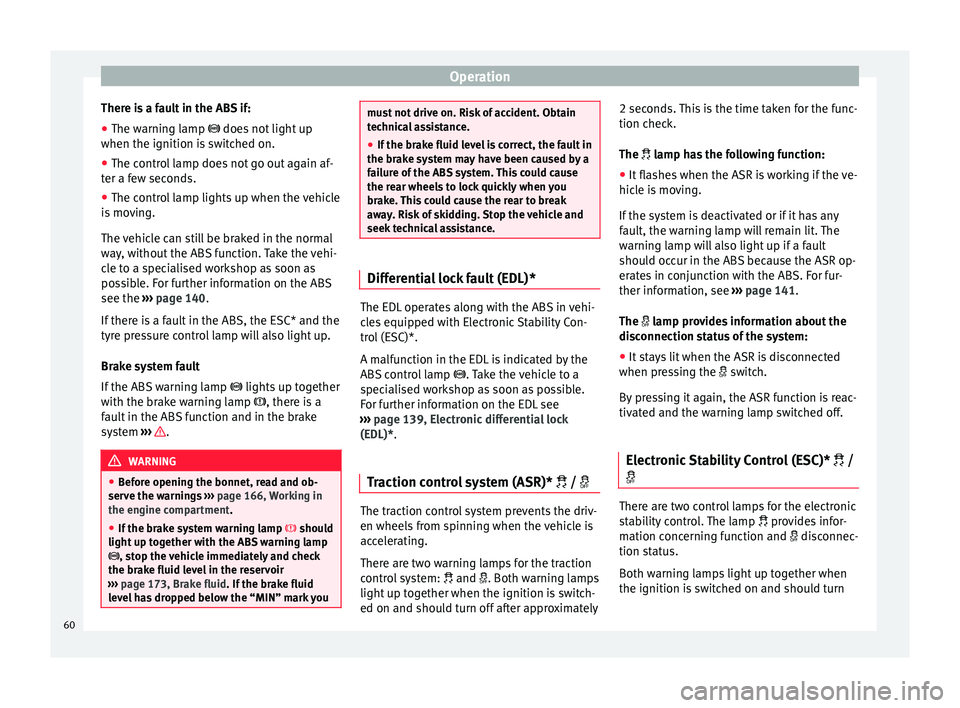
There is a fault in the ABS if:
● The warning lamp
does not light up
when the ignition i
s switched on.
● The control lamp does not go out again af-
ter a few seconds.
● The control lamp lights up when the vehicle
is moving.
The vehicle can still be braked in the normal
way, without the ABS function. Take the vehi-
cle to a specialised workshop as soon as
possible. For further information on the ABS
see the ››› page 140
.
If there is a fault in the ABS, the ESC* and the
tyre pressure control lamp will also light up.
Brake system fault
If the ABS warning lamp lights up together
with the brake warning lamp , there is a
fault in the ABS function and in the brake
system ››› .
WARNING
● Before opening the bonnet, read and ob-
serve the warnings ››› page 166, Working in
the engine compartment.
● If the br
ake system warning lamp should
light up together with the ABS warning lamp
, stop the vehicle immediately and check
the brake fluid level in the reservoir
››› page 173, Brake fluid. If the brake fluid
lev
el has dropped below the “MIN” mark you must not drive on. Risk of accident. Obtain
technical assistance.
●
If the brake fluid level is correct, the fault in
the brake system may have been caused by a
failure of the ABS system. This could cause
the rear wheels to lock quickly when you
brake. This could cause the rear to break
away. Risk of skidding. Stop the vehicle and
seek technical assistance. Differential lock fault (EDL)*
The EDL operates along with the ABS in vehi-
cles equipped with Electronic Stability Con-
trol (ESC)*.
A malfunction in the EDL is indicated by the
ABS control lamp
. Take the vehicle to a
specialised workshop as soon as possible.
For further information on the EDL see
››› page 139, Electronic differential lock
(EDL)* .
T r
action control system (ASR)* / The traction control system prevents the driv-
en wheels from spinning when the vehicle is
accelerating.
There are two warning lamps for the traction
control system:
and . Both warning lamps
light up together when the ignition is switch-
ed on and should turn off after approximately 2 seconds. This is the time taken for the func-
tion check.
The
lamp has the following function:
● It
flashes when the ASR is working if the ve-
hicle is moving.
If the system is deactivated or if it has any
fault, the warning lamp will remain lit. The
warning lamp will also light up if a fault
should occur in the ABS because the ASR op-
erates in conjunction with the ABS. For fur-
ther information, see ››› page 141.
The lamp provides information about the
disconnection status of the system:
● It stays lit when the ASR is disconnected
when pressing the switch.
By pressing it again, the ASR function is reac-
tivated and the warning lamp switched off.
Electronic Stability Control (ESC)* /
There are two control lamps for the electronic
stability control. The lamp
provides infor-
mation concerning function and disconnec-
tion status.
Both warning lamps light up together when
the ignition is switched on and should turn
60
Page 63 of 240
Dash panel
off after approximately 2 seconds. This is the
time taken for the function check.
This programme includes the ABS, EDL and
ASR. It also includes emergency braking as-
sistance (BAS).
The warning lamp
has the following
f
unctions:
● It flashes whilst driving when the ASR/ESC
is activated.
● It will light up if there is a fault in the ESC.
● As the ESC operates in conjunction with the
ABS, the ESC light will also come on if a fault
should occur in the ABS.
If the ESC control lamp lights up and stays
on after the engine is started, this may mean
that the control system has temporarily
switched off the ESC. In this case the ESC can
be reactivated by switching the ignition off
and then on again. If the control lamp goes
out, this means the system is fully functional.
The lamp provides information about the
disconnection status of the system:
● It stays lit when the ASR is disconnected
when pressing the switch. Brake system* Situations in which the warning lamp lights
up
● the br ak
e fluid level is too low
››› page 173.
● there i
s a fault in the brake system.
This warning lamp can light up together with
the ABS system warning lamp. WARNING
● If the brake warning lamp does not go out
or if it lights up when driving, the brake fluid
level in the reservoir is too low so there is a
risk of an accident ››› page 173, Brake fluid.
Stop the vehicle and do not drive on. Obtain
technical assistance.
● If the brake warning lamp lights up to-
gether with the ABS lamp this could be
due to an ABS fault. This could cause the rear
wheels to lock quickly when you brake. This
could cause the rear to break away. Risk of
skidding. Stop the vehicle and seek technical
assistance. Cruise speed (cruise control)*
The warning lamp comes on when the
cruise control system is switched on. For fur-
ther information on the cruise control system
please see
›››
page 150 . T
y
re pressure
Fig. 71
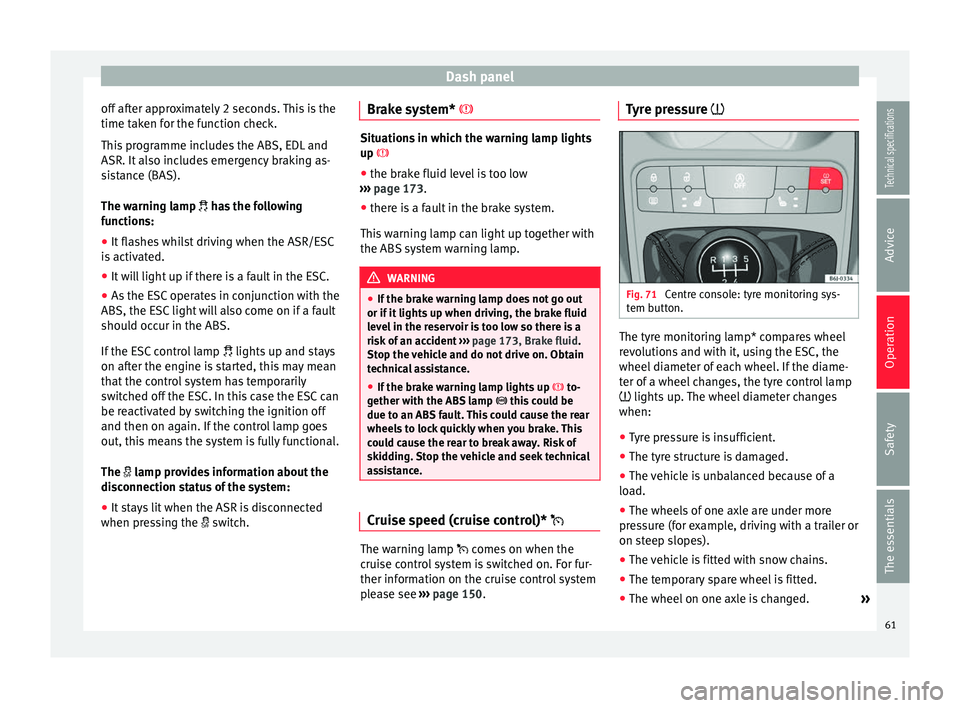
Centre console: tyre monitoring sys-
tem button. The tyre monitoring lamp* compares wheel
revolutions and with it, using the ESC, the
wheel diameter of each wheel. If the diame-
ter of a wheel changes, the tyre control lamp
lights up. The wheel diameter changes
when:
● Tyre pressure is insufficient.
● The tyre structure is damaged.
● The vehicle is unbalanced because of a
load.
● The wheels of one axle are under more
pressure (for example, driving with a trailer or
on steep slopes).
● The vehicle is fitted with snow chains.
● The temporary spare wheel is fitted.
● The wheel on one axle is changed. »
61
Technical specifications
Advice
Operation
Safety
The essentials
Page 64 of 240
Operation
Tyre pressure adjustment
On adjusting tyre pressure or changing one
or more wheels, the ››› Fig. 71 button must be
k ept
pressed down, with the ignition on, until
an acoustic signal is heard.
If the wheels are under excessive load (for ex-
ample, driving with a trailer or heavy load),
the tyre pressure must be increased to the
recommended value for a full load (see the
sticker on the inside of the fuel flap). If the
tyre monitor system button is pressed down,
the new tyre pressures are confirmed.
The tyre pressure control lamp lights up
If the tyre pressure of a wheel is much lower
than the value set by the driver, then the tyre
pressure control lamp ››› will light up.
WARNING
● When the tyre pressure control lamp lights
up, reduce speed immediately and avoid any
sudden turning or braking manoeuvre. Stop
when possible, and check the tyre pressure
and status.
● The driver is responsible for maintaining
correct tyre pressures. For this reason, tyre
pressure must be regularly checked.
● Under certain circumstances (e.g. when
driving in a sporty manner, in winter condi-
tions or on a dirt track) the tyre control lamp
may light up belatedly or may function incor-
rectly. Note
If the battery is disconnected, the yellow
warning lamp lights up after turning the
ignition on.
This should turn off after a brief
journey. Speed selector lever lock*
The brake pedal must be depressed when
this warning lamp lights up. This is necessary
when the automatic gearbox* selector lever
is moved out of the positions
P
or N
.
Fuel level/reserve It lights up when only 7 litres of fuel remain
in the tank, and an
acoustic signal*
al
so
sou
nds. It reminds you to fuel up the fuel
tank as soon as possible ›››
page 163.
Door open display* This warning lamp lights up if one of the
doors is open.
The warning light
should go off when all
the doors are closed correctly. Rear lid open* The warning lamp
should switch off when
the r
ear lid is fully closed.
Main beam headlights The warning lamp lights up when the main
beams are on or when the headlight flasher
is operated.
For further information see
››› page 93.
Electro-hydraulic steering* The level of steering assistance depends on
the vehicle speed and on the steering wheel
turning speed.
The warning lamp should light up for a few
seconds when the ignition is switched on. It
should go out once the engine is started.
There is a fault in the electro-hydraulic steer-
ing system if the lamp does not go out or
lights up whilst the vehicle is in motion. Take
the vehicle to technical services as soon as
possible.
62