heating Seat Ibiza 5D 2014 Owner's Guide
[x] Cancel search | Manufacturer: SEAT, Model Year: 2014, Model line: Ibiza 5D, Model: Seat Ibiza 5D 2014Pages: 240, PDF Size: 4.89 MB
Page 124 of 240
Operation
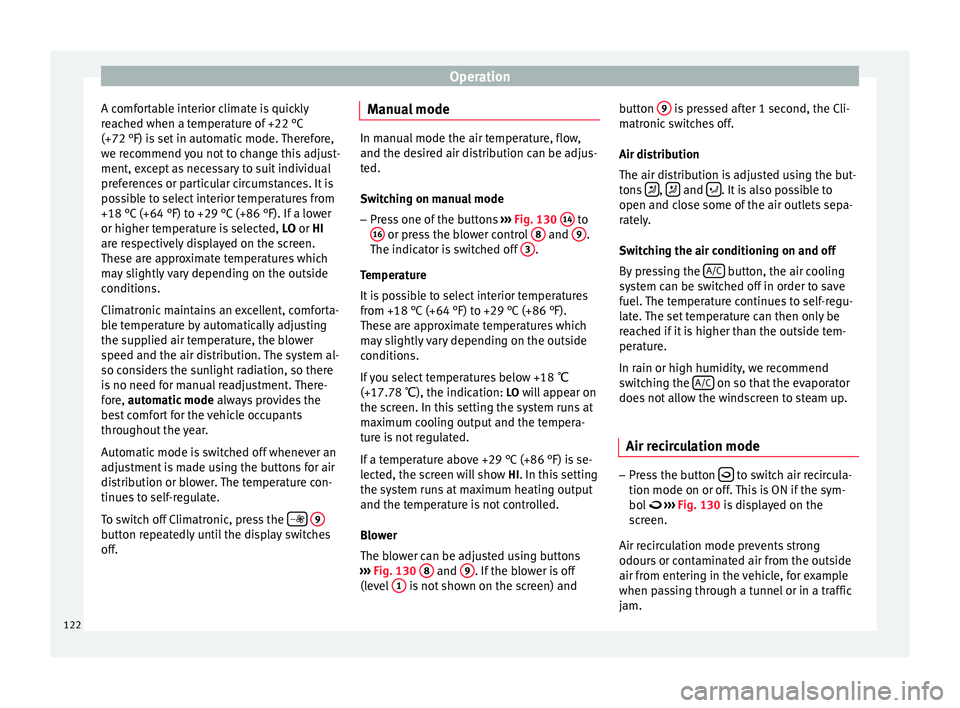
A comfortable interior climate is quickly
reached when a temperature of +22 °C
(+72 °F) is set in automatic mode. Therefore,
we recommend you not to change this adjust-
ment, except as necessary to suit individual
preferences or particular circumstances. It is
possible to select interior temperatures from
+18 °C (+64 °F) to +29 °C (+86 °F). If a lower
or higher temperature is selected, LO or
HI
ar
e respectively displayed on the screen.
These are approximate temperatures which
may slightly vary depending on the outside
conditions.
Climatronic maintains an excellent, comforta-
ble temperature by automatically adjusting
the supplied air temperature, the blower
speed and the air distribution. The system al-
so considers the sunlight radiation, so there
is no need for manual readjustment. There-
fore, automatic mode alwa
ys provides the
best comfort for the vehicle occupants
throughout the year.
Automatic mode is switched off whenever an
adjustment is made using the buttons for air
distribution or blower. The temperature con-
tinues to self-regulate.
To switch off Climatronic, press the –
9 button repeatedly until the display switches
off. Manual mode In manual mode the air temperature, flow,
and the desired air distribution can be adjus-
ted.
Switching on manual mode
– Press one of the buttons ››› Fig. 130 14 to
16 or press the blower control
8 and
9 .
The indicator is switched off 3 .
Temperature
It is possible to select interior temperatures
from +18 °C (+64 °F) to +29 °C (+86 °F).
These are approximate temperatures which
may slightly vary depending on the outside
conditions.
If you select temperatures below +18 ℃
(+17.78 ℃), the indication: L O
will appear on
the screen. In this setting the system runs at
maximum cooling output and the tempera-
ture is not regulated.
If a temperature above +29 °C (+86 °F) is se-
lected, the screen will show HI
. In this setting
the system runs at maximum heating output
and the temperature is not controlled.
Blower
The blower can be adjusted using buttons
››› Fig. 130 8 and
9 . If the blower is off
(level 1 is not shown on the screen) andbutton
9 is pressed after 1 second, the Cli-
matronic switches off.
Air distribution
The air distribution is adjusted using the but-
tons ,
and
. It is also possible to
open and close some of the air outlets sepa-
rately.
Switching the air conditioning on and off
By pressing the A/C button, the air cooling
system can be switched off in order to save
fuel. The temperature continues to self-regu-
late. The set temperature can then only be
reached if it is higher than the outside tem-
perature.
In rain or high humidity, we recommend
switching the A/C on so that the evaporator
does not allow the windscreen to steam up.
Air recirculation mode –
Press the button to switch air recircula-
tion mode on or off. This is ON if the sym-
bol ›››
Fig. 130 is displayed on the
s c
reen.
Air recirculation mode prevents strong
odours or contaminated air from the outside
air from entering in the vehicle, for example
when passing through a tunnel or in a traffic
jam.
122
Page 125 of 240
Driving
When the outside temperature is low, air re-
circulation mode improves heating perform-
ance by heating air from the interior instead
of cold air from the outside.
When the outside temperature is high, air re-
circulation mode improves cooling perform-
ance by cooling air from the interior instead
of warm air from outside.
For safety reasons, the air recirculation
should not be switched on when the air dis-
tribution control is set to the windscreen set-
ting . WARNING
In air recirculation mode, no cold air from the
outside enters the vehicle interior. If the air
conditioner is switched off, the windows can
quickly mist over. Therefore, never leave the
air recirculation mode switched on for a long
time (risk of accident). Note
When engaging reverse gear, the air recircu-
lation is connected automatically to prevent
the entrance of exhaust gases into the vehi-
cle upon travelling backwards. In this case
the symbol for air recirculation is not dis-
played. Driving
Starting and stopping the
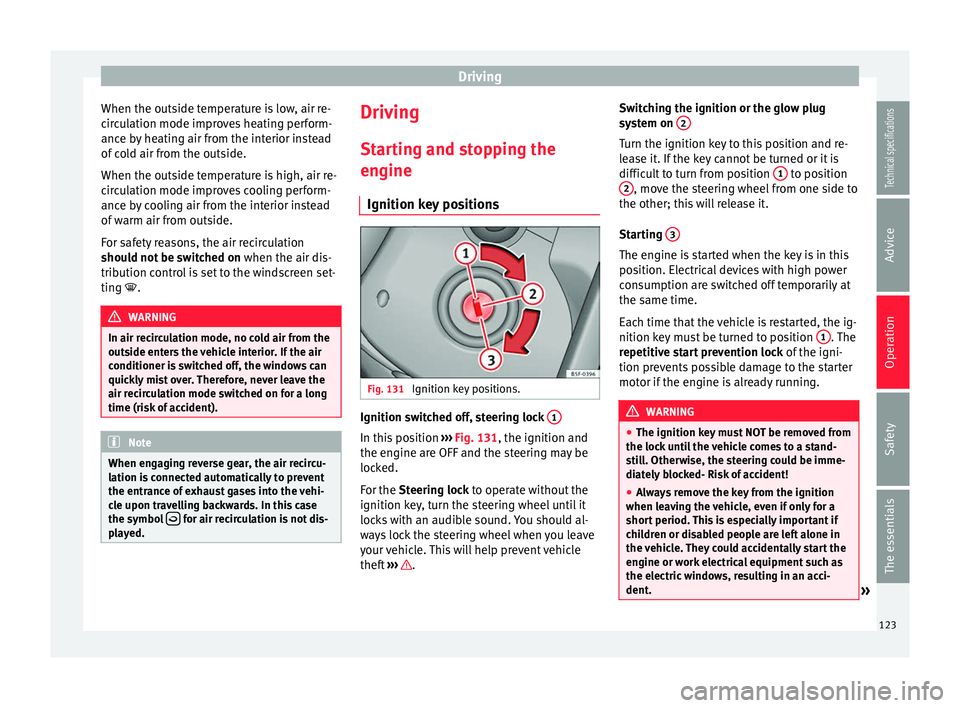
engine Ignition key positions Fig. 131
Ignition key positions. Ignition switched off, steering lock
1 In this position
››› Fig. 131, the ignition and
the engine are OFF and the steering may be
locked.
For the Steering lock
to operate without the
ignition k
ey, turn the steering wheel until it
locks with an audible sound. You should al-
ways lock the steering wheel when you leave
your vehicle. This will help prevent vehicle
theft ››› .Switching the ignition or the glow plug
system on
2 Turn the ignition key to this position and re-
lease it. If the key cannot be turned or it is
difficult to turn from position
1 to position
2 , move the steering wheel from one side to
the other; this will release it.
Starting 3 The engine is started when the key is in this
position. Electrical devices with high power
consumption are switched off temporarily at
the same time.
Each time that the vehicle is restarted, the ig-
nition key must be turned to position
1 . The
repetitive start prevention lock of the igni-
tion prevents possible damage to the starter
motor if the engine is already running. WARNING
● The ignition key must NOT be removed from
the lock until the vehicle comes to a stand-
still. Otherwise, the steering could be imme-
diately blocked- Risk of accident!
● Always remove the key from the ignition
when leaving the vehicle, even if only for a
short period. This is especially important if
children or disabled people are left alone in
the vehicle. They could accidentally start the
engine or work electrical equipment such as
the electric windows, resulting in an acci-
dent. » 123
Technical specifications
Advice
Operation
Safety
The essentials
Page 137 of 240
Driving
WARNING
● At first, new tyres do not give maximum
grip, and require running-in. This may cause
an accident. Drive particularly carefully in the
first 500 km.
● New brake pads must be “run in” and do
not have the correct friction properties during
the first 200 km. However, the reduced brak-
ing capacity may be compensated by press-
ing on the brake pedal a little harder. Environmental friendliness
Environmental protection is a top priority in
the design, choice of materials and manufac-
ture of your new SEAT.
Constructive measures to encourage
recycling
● Joints and connections designed for easy
dismantling
● Modular construction to facilitate disman-
tling
● Increased use of single-grade materials.
● Plastic parts and elastomers are marked in
accordance with ISO 1043, ISO 11469 and
ISO 1629.
Choice of materials
● Use of recycled materials. ●
Use of compatible plastics in the same part
if its components are not easily separated.
● Use of recycled materials and/or materials
originating from renewable sources.
● Reduction of volatile components, includ-
ing odour, in plastic materials.
● Use of CFC-free coolants.
Ban on heavy metals, with the exceptions
dictated by law (Annex II of ELV Directive
2000/53/EC): cadmium, lead, mercury, hexa-
v al
ent chromium.
Manufacturing methods
● Reduction of the quantity of thinner in the
protective wax for cavities.
● Use of plastic film as protection during ve-
hicle transport.
● Use of solvent-free adhesives.
● Use of CFC-free coolants in cooling sys-
tems.
● Recycling and energy recovery from resi-
dues (RDF).
● Improvement in the quality of waste water.
● Use of systems for the recovery of residual
heat (thermal recovery, enthalpy wheels,
etc.).
● The use of water-soluble paints. Catalytic converter To maintain the useful life of the catalytic
converter
– Use only unleaded petrol with petrol en-
gines, as lead damages the catalytic con-
verter.
– Do not let the fuel get too low in the tank.
– For engine oil changes, do not replenish
with too much engine oil ››› page 170, Top-
ping up engine oil .
– Nev er t
ow the vehicle to start it, use jump
leads if necessary ›››
page 188.
If you notice misfiring, uneven running or
loss of power when the vehicle is moving, re-
duce speed immediately and have the vehi-
cle inspected at the nearest specialised
workshop. In general, the exhaust warning
lamp will light up when any of the described
symptoms occur ›››
page 57. If this happens,
unburnt fuel can enter the exhaust system
and escape into the environment. The cata-
lytic converter can also be damaged by over-
heating. WARNING
The catalytic converter reaches very high
temperatures! Risk of fire!
● Never park where the catalytic converter
could come into contact with dry grass or
flammable materials under the vehicle. » 135
Technical specifications
Advice
Operation
Safety
The essentials
Page 138 of 240
Operation
●
Do not apply additional underseal or anti-
corrosion coatings to the exhaust pipes, cata-
lytic converter or the heat shields on the ex-
haust system. These materials could catch
fire when the vehicle is being driven. CAUTION
Never run the fuel tank completely dry be-
cause the irregularity of the fuel supply may
cause ignition problems. This allows unburnt
fuel to enter the exhaust system, which could
cause overheating and damage the catalytic
converter. For the sake of the environment
Even when the emission control system is
working perfectly, there may be a smell of
sulphur from the exhaust gas under some
conditions. This depends on the sulphur con-
tent of the fuel used. Quite often the problem
can be solved by changing to another brand
of fuel. Diesel engine particulate filter*
Fig. 139
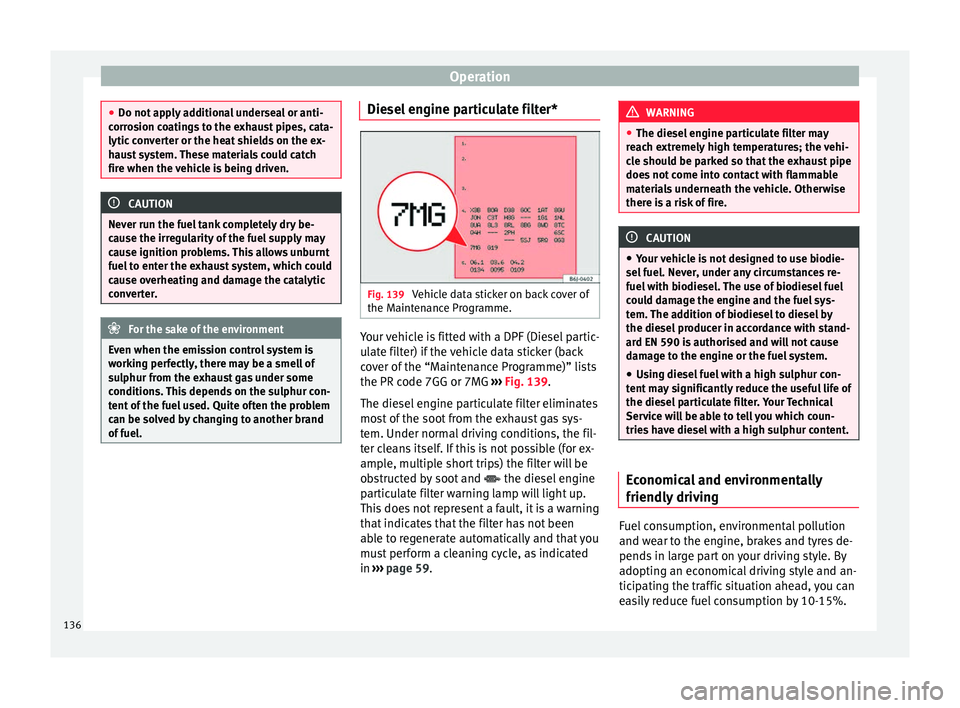
Vehicle data sticker on back cover of
the Maintenance Programme. Your vehicle is fitted with a DPF (Diesel partic-
ulate filter) if the vehicle data sticker (back
cover of the “Maintenance Programme)” lists
the PR code 7GG or 7MG
››› Fig. 139 .
The die sel
engine particulate filter eliminates
most of the soot from the exhaust gas sys-
tem. Under normal driving conditions, the fil-
ter cleans itself. If this is not possible (for ex-
ample, multiple short trips) the filter will be
obstructed by soot and the diesel engine
particulate filter warning lamp will light up.
This does not represent a fault, it is a warning
that indicates that the filter has not been
able to regenerate automatically and that you
must perform a cleaning cycle, as indicated
in ››› page 59
. WARNING
● The diesel engine particulate filter may
reach extremely high temperatures; the vehi-
cle should be parked so that the exhaust pipe
does not come into contact with flammable
materials underneath the vehicle. Otherwise
there is a risk of fire. CAUTION
● Your vehicle is not designed to use biodie-
sel fuel. Never, under any circumstances re-
fuel with biodiesel. The use of biodiesel fuel
could damage the engine and the fuel sys-
tem. The addition of biodiesel to diesel by
the diesel producer in accordance with stand-
ard EN 590 is authorised and will not cause
damage to the engine or the fuel system.
● Using diesel fuel with a high sulphur con-
tent may significantly reduce the useful life of
the diesel particulate filter. Your Technical
Service will be able to tell you which coun-
tries have diesel with a high sulphur content. Economical and environmentally
friendly driving
Fuel consumption, environmental pollution
and wear to the engine, brakes and tyres de-
pends in large part on your driving style. By
adopting an economical driving style and an-
ticipating the traffic situation ahead, you can
easily reduce fuel consumption by 10-15%.
136
Page 142 of 240
Operation
the warning light for ABS lights up
››› page 59 .
At s
peeds of up to approximately 80 km/h
(50 mph), it is able to balance out differences
in the speed of the driven wheels of approxi-
mately 100 rpm/min caused by a partially
slippery road surface. It does this by braking
the wheel which has lost traction and distrib-
uting more driving force to the other driven
wheel via the differential.
To prevent the disc brake of the braking
wheel from overheating, the EDL cuts out au-
tomatically if subjected to excessive loads.
The vehicle will continue to function normally
without EDL. For this reason, the driver is not
informed that the EDL has been switched off.
The EDL will switch on again automatically
when the brake has cooled down. WARNING
● When accelerating on a slippery surface,
for example on ice and snow, press the accel-
erator carefully. Despite EDL, the driven
wheels may start to spin. This could impair
the vehicle's stability.
● Always adapt your driving style to suit road
conditions and the traffic situation. Do not let
the extra safety afforded by EDL tempt you in-
to taking any risks when driving, this can
cause accidents. CAUTION
Modifications to the vehicle (e.g. to the en-
gine, the brake system, running gear or any
components affecting the wheels and tyres)
could affect the efficiency of the EDL
››› page 155. Hydraulic Brake Assist (HBA)*
The function (Hydraulic Brake Assist HBA) is
only included in vehicles with ESC.
In an emergency, most drivers brake in time,
but not with maximum force. This results in
unnecessarily long braking distances.
This is when the brake assist system comes
into action. When pressing the brake pedal
rapidly, the assistant interprets it as an emer-
gency. It very quickly builds up the full brake
pressure so that the ABS can be activated
more quickly and efficiently, thus reducing
braking distance.
Do not reduce the pressure on the brake ped-
al, since the brake assist system switches off
automatically as soon as you release the
brake.
Automatic hazard warning lights activation
The brake lights flash automatically to indi-
cate that the vehicle is braking suddenly or in
an emergency situation. If the emergency
braking continues until the vehicle comes toa standstill, the hazard warning lights will
then come on and the brake lights will re-
main on permanently from that moment. The
warning lights will automatically switch off
when the vehicle begins to move again or
when the "warning" light button is pressed.
WARNING
● The risk of accident is higher if you drive
too fast, if you do not keep your distance from
the vehicle in front, and when the road sur-
face is slippery or wet. The increased acci-
dent risk cannot be reduced by the brake as-
sist system.
● The brake assist system cannot defy the
laws of physics. Slippery and wet roads are
dangerous even with the brake assist system!
Therefore, it is essential that you adjust your
speed to suit the road and traffic conditions.
Do not let the extra safety features tempt you
into taking any risks when driving. Anti-lock brake system (ABS)
The anti-lock brake (ABS) system prevents
the wheels from locking during braking and
is an important part of the vehicle's active
safety system.
How the ABS works
If one of the wheels turns too slowly in rela-
tion to the vehicle's speed, and is close to
locking, the system will reduce the braking
140
Page 155 of 240
Towing bracket device
WARNING
The towing bracket ball coupling must be
stored securely in the luggage compartment
to prevent them being flung through the vehi-
cle and causing injury. Note
● By law, the ball coupling must be removed
if a trailer is not being towed if it obscures
the number plate. Driving tips
Driving with a trailer always requires extra
care.
Weight distribution
The weight distribution of a loaded trailer
with an unladen vehicle is very unfavourable.
However, if this cannot be avoided, drive ex-
tra slowly to allow for the unbalanced weight
distribution.
Speed
The stability of the vehicle and trailer is re-
duced with increasing speed. For this reason,
it is advisable not to drive at the maximum
permissible speed in an unfavourable road,
weather or wind conditions. This applies es-
pecially when driving downhill. You should always reduce speed immediately
if the trailer shows the slightest sign of
snak-
ing . Never try to stop the “snaking” by in-
c r
easing speed.
Always brake in due course. If the trailer has
an
overrun brake, apply the brakes gently at
first and then, firmly. This will prevent the
jerking that can be caused by locking of trail-
er wheels. Select a low gear in due course
before going down a steep downhill. This en-
ables you to use the engine braking to slow
down the vehicle.
Reheating
At very high temperatures and during pro-
longed slopes, driving with a low gear and
high engine speed; always monitor whether
the excessive coolant temperature gauge is
activated ››› page 63
.
Electronic Stability Control*
The ESC* system helps to stabilise the trailer
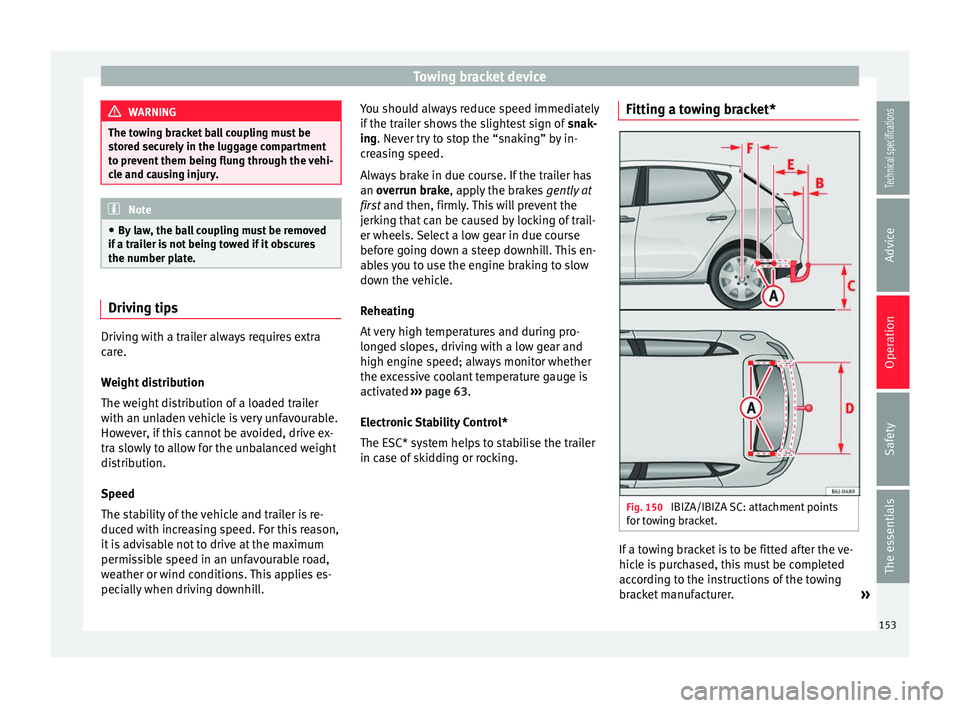
in case of skidding or rocking. Fitting a towing bracket*
Fig. 150
IBIZA/IBIZA SC: attachment points
for towing bracket. If a towing bracket is to be fitted after the ve-
hicle is purchased, this must be completed
according to the instructions of the towing
bracket manufacturer.
»
153
Technical specifications
Advice
Operation
Safety
The essentials
Page 162 of 240
Advice
●
The heating element for the rear window is
located on the inner side of the window. To
prevent damage, do not put stickers over the
heating elements on the inside of the win-
dow. Cleaning windscreen wiper blades
Clean wiper blades improve visibility.
1. Use a soft cloth to remove dust and dirt
from the windscreen wiper blades.
2. Use window cleaner to clean the wind- screen wiper blades. Use a sponge or a
cloth to remove stubborn dirt.
Rubber seals maintenance If rubber seals are well looked after, they will
not freeze so quickly.
1. Use a soft cloth to remove dust and dirt
from the rubber seals.
2. Apply a specialist care product to the rub- ber seals.
The rubber strips on the doors, windows, etc.
will remain pliable and last longer if they are
treated with a suitable rubber care product
from time to time (for example silicone
spray). Caring for rubber seals will also prevent pre-
mature ageing and leaks. The doors will be
easier to open. If rubber seals are well looked
after, they will not freeze so quickly in winter.
Door lock cylinders The door lock cylinders can freeze up in win-
ter.
To de-ice the lock cylinders you should only
use spray with lubricating and anti-corrosive
properties.
Cleaning chrome parts 1. Clean chrome parts with a damp cloth.
2. Polish chrome parts with a soft, dry cloth.
If this does not provide satisfying results, use
a specialist
chrome cleaning product.
Chrome cleaning products will remove stains
from the surface. CAUTION
To prevent scratching chrome surfaces:
● Never use an abrasive cleaning product on
chrome.
● Do not clean or polish chrome parts in a
sandy or dusty environment. Steel wheel rims
–
Clean steel wheel rims regularly using a
separate sponge.
Use an industrial cleaner to remove brake
dust. Any damage to the paint on steel wheel
rims should be repaired before starting to
rust. WARNING
● Never wash tyres with a cylindrical jet. Even
at large spraying distances and short clean-
ing times, damage can occur to the tyres.
This may cause an accident.
● Water, ice and salt on the brake system can
reduce braking effectiveness. Risk of acci-
dent. Directly after washing, avoid sudden
and sharp braking. “Dry” the brakes by brak-
ing several times ››› page 126, Braking ca-
pacity and braking distance . Alloy wheel rims
Every two weeks
– Wash salt and brake dust from alloy
wheels.
– Use an acid free detergent to clean the
wheel rims.
Every 3 months
– Apply a hard wax compound to the wheels.
160
Page 189 of 240
Emergencies
●
Avoid heavy acceleration, hard braking and
fast cornering.
● Drive for only 10 minutes at a maximum
speed of 80 km/h (50 mph) and then check
the tyre. For the sake of the environment
Dispose of used or expired sealant observing
any legal requirements. Note
● A new bottle of sealant can be purchased at
SEAT dealerships.
● Take into account the separate instruction
manual of the tyre mobility set* manufactur-
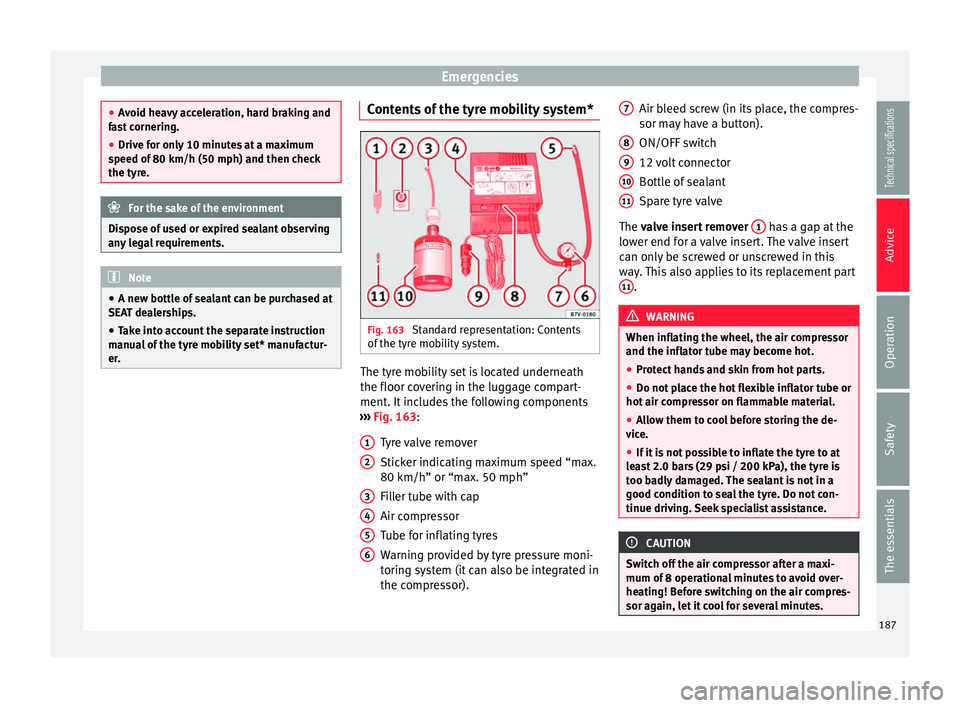
er. Contents of the tyre mobility system*
Fig. 163
Standard representation: Contents
of the tyre mobility system. The tyre mobility set is located underneath
the floor covering in the luggage compart-
ment. It includes the following components
››› Fig. 163 :
T y
re valve remover
Sticker indicating maximum speed “max.
80 km/h” or “max. 50 mph”
Filler tube with cap
Air compressor
Tube for inflating tyres
Warning provided by tyre pressure moni-
toring system (it can also be integrated in
the compressor).
1 2
3
4
5
6 Air bleed screw (in its place, the compres-
sor may have a button).
ON/OFF switch
12 volt connector
Bottle of sealant
Spare tyre valve
The valve insert remover
1 has a gap at the
lower end for a valve insert. The valve insert
can only be screwed or unscrewed in this
way. This also applies to its replacement part 11 .
WARNING
When inflating the wheel, the air compressor
and the inflator tube may become hot.
● Protect hands and skin from hot parts.
● Do not place the hot flexible inflator tube or
hot air compressor on flammable material.
● Allow them to cool before storing the de-
vice.
● If it is not possible to inflate the tyre to at
least 2.0 bars (29 psi / 200 kPa), the tyre is
too badly damaged. The sealant is not in a
good condition to seal the tyre. Do not con-
tinue driving. Seek specialist assistance. CAUTION
Switch off the air compressor after a maxi-
mum of 8 operational minutes to avoid over-
heating! Before switching on the air compres-
sor again, let it cool for several minutes. 7
8
9
10
11
187
Technical specifications
Advice
Operation
Safety
The essentials
Page 234 of 240
Index
Front seat Adjustment . . . . . . . . . . . . . . . . . . . . . . . . . . . . . 11
Front towline anchorage . . . . . . . . . . . . . . . . . . . 191
Fuel . . . . . . . . . . . . . . . . . . . . . . . . . . . . . . . . . . . . . 23 Diesel . . . . . . . . . . . . . . . . . . . . . . . . . . . . . . . . 165
Petrol . . . . . . . . . . . . . . . . . . . . . . . . . . . . . . . . . 164
Fuel consumption . . . . . . . . . . . . . . . . . . . . 136, 209
Fuel level Indicator . . . . . . . . . . . . . . . . . . . . . . . . . . . . . . . 64
Fuel reserve . . . . . . . . . . . . . . . . . . . . . . . . . . . . . . 62
Fuel tank Opening the fuel tank flap . . . . . . . . . . . . . . . . 163
see also Fuel reserve . . . . . . . . . . . . . . . . . . . . . 62
F uel
tank flap . . . . . . . . . . . . . . . . . . . . . . . . . . . . 163
Fuel: saving . . . . . . . . . . . . . . . . . . . . . . . . . . . . . . 136
Fuses . . . . . . . . . . . . . . . . . . . . . . . . . . . . . . . 25, 195 Fuse box . . . . . . . . . . . . . . . . . . . . . . . . . . . . . . 195
Identifying blown fuses . . . . . . . . . . . . . . . . . . 196
Identifying by colours . . . . . . . . . . . . . . . . . . . . 196
Preparation before replacing . . . . . . . . . . . . . . 196
Replacement . . . . . . . . . . . . . . . . . . . . . . . . . . . 196
G Gear-change indicator . . . . . . . . . . . . . . . . . . . . . 134
Gear lever . . . . . . . . . . . . . . . . . . . . . . . . . . . . . . . . 19
Gear shift pattern . . . . . . . . . . . . . . . . . . . . . . . . . 128
General overview of the engine compartment . . 168
Glove compartment . . . . . . . . . . . . . . . . . . . . . . . 104
Glove compartment light . . . . . . . . . . . . . . . . . . . . 96
Glow plug system . . . . . . . . . . . . . . . . . . . . . . . . . 125 control lamp . . . . . . . . . . . . . . . . . . . . . . . . . . . . 58
H
Handbrake . . . . . . . . . . . . . . . . . . . . . . . . . . . . . . 126 warning lamp . . . . . . . . . . . . . . . . . . . . . . . . . . 127
Hazard warning lights . . . . . . . . . . . . . . . . . . . 15, 95
HBA . . . . . . . . . . . . . . . . . . . . . . . . . . . . . . . . . . . . 140 Head-on collisions and the laws of physics . . . . . 36
Headlight range control . . . . . . . . . . . . . . . . . . . . . 92
Headlights
Driving abroad . . . . . . . . . . . . . . . . . . . . . . . . . 138
fog lights . . . . . . . . . . . . . . . . . . . . . . . . . . . . . . . 90
Headlight washer . . . . . . . . . . . . . . . . . . . . . . . . 98
Head restraints . . . . . . . . . . . . . . . . . . . . . . . . . . . . 12 adjusting . . . . . . . . . . . . . . . . . . . . . . . . . . . . . . 101
angle adjustment . . . . . . . . . . . . . . . . . . . . . . . 101
removing . . . . . . . . . . . . . . . . . . . . . . . . . . . . . . 101
Headrests . . . . . . . . . . . . . . . . . . . . . . . . . . . . . . . . 12
Head rests adjusting . . . . . . . . . . . . . . . . . . . . . . . . . . . . . . 101
angle adjustment . . . . . . . . . . . . . . . . . . . . . . . 101
removing . . . . . . . . . . . . . . . . . . . . . . . . . . . . . . 101
Heated exterior mirrors . . . . . . . . . . . . . . . . . . . . . 99
Heated front seats . . . . . . . . . . . . . . . . . . . . . . . . 102
Heated rear window heating element wires . . . . . . . . . . . . . . . . . . . 160
Heating . . . . . . . . . . . . . . . . . . . . . . . . . . . . . 23, 114
Heating system . . . . . . . . . . . . . . . . . . . . . . . . . . . 116
High pressure cleaners . . . . . . . . . . . . . . . . . . . . 158
Hill driving assistant . . . . . . . . . . . . . . . . . . . . . . 127
Horn . . . . . . . . . . . . . . . . . . . . . . . . . . . . . . . . . . . . 55
How to jump start description . . . . . . . . . . . . . . . 188
Hydraulic Brake Assist Automatic hazard warning lights activation . . 140
I
Identification plate . . . . . . . . . . . . . . . . . . . . . . . . 209
Ignition . . . . . . . . . . . . . . . . . . . . . . . . . . . . . 13, 123
Ignition key . . . . . . . . . . . . . . . . . . . . . . . . . . . . . . 123
Ignition lock . . . . . . . . . . . . . . . . . . . . . . . . . 13, 123
Importance of the correct adjustment of head re- straints . . . . . . . . . . . . . . . . . . . . . . . . . . . . . . . . 32
Instrument and switch lighting . . . . . . . . . . . . . . . 92
Instrument lighting . . . . . . . . . . . . . . . . . . . . . . . . 55 Instrument panel . . . . . . . . . . . . . . . . . . . . . . . . . . 55
Service interval display . . . . . . . . . . . . . . . . . . . 67
Instruments . . . . . . . . . . . . . . . . . . . . . . . . . . . . . . 56
Interior lights . . . . . . . . . . . . . . . . . . . . . . . . . . . . . 15
Interior rear vision mirror . . . . . . . . . . . . . . . . . . . . 99
Interior view . . . . . . . . . . . . . . . . . . . . . . . . . . . . . . . 7
ISOFIX system . . . . . . . . . . . . . . . . . . . . . . . . . . . . . 50
J Jack Mounting points . . . . . . . . . . . . . . . . . . . . . . . . 184
Jump-starting . . . . . . . . . . . . . . . . . . . . . . . . . . . . 188
Jump leads . . . . . . . . . . . . . . . . . . . . . . . . . . . . . . 188
K Keys . . . . . . . . . . . . . . . . . . . . . . . . . . . . . . . . . . . . . 82
L Leather cleaning . . . . . . . . . . . . . . . . . . . . . . . . . . 162
Leaving Home Function . . . . . . . . . . . . . . . . . . . . . 94
Level control . . . . . . . . . . . . . . . . . . . . . . . . . . . . . . 23
Lifting the vehicle . . . . . . . . . . . . . . . . . . . . . . . . . 184
Light Switch . . . . . . . . . . . . . . . . . . . . . . . . . . . . . . . . . 14
Lights . . . . . . . . . . . . . . . . . . . . . . . . . . . . . . . . 14, 90 Automatic lighting . . . . . . . . . . . . . . . . . . . . . . . 91
Load compartment in the luggage compartment see Loading the luggage compartment . . . . . 108
Lo
ading the luggage compartment . . . . . . . . . . . 108
Loading the vehicle luggage compartment . . . . . . . . . . . . . . . . . . . . . 9
Luggage compartment . . . . . . . . . . . . . . . . . . . 9, 108 Fastening rings . . . . . . . . . . . . . . . . . . . . . . . . . 109
Loading . . . . . . . . . . . . . . . . . . . . . . . . . . . . . . . 108
Luggage net . . . . . . . . . . . . . . . . . . . . . . . . . . . 109
see also Loading the luggage compartment . 108
L ug
gage compartment light . . . . . . . . . . . . 96, 207
232
Page 235 of 240
Index
M Main beam . . . . . . . . . . . . . . . . . . . . . . . . . . . . . . . 14
Main beam headlights control lamp . . . . . . . . . . . . . . . . . . . . . . . . . . . . 62
Maintenance and cleaning . . . . . . . . . . . . . . . . . 155
Manual Release of the selector lever . . . . . . . . . . . . . . 192
Manual gearbox . . . . . . . . . . . . . . . . . . . . . . 19, 128
Manual heating . . . . . . . . . . . . . . . . . . . . . . . . . . 116 controls . . . . . . . . . . . . . . . . . . . . . . . . . . . . . . . 114
Manual heating system Defrosting the windscreen . . . . . . . . . . . . . . . . 116
Demisting the windscreen and side windows 116
MFI . . . . . . . . . . . . . . . . . . . . . . . . . . . . . . . . . . . . . . 65
Mirrors Exterior mirrors . . . . . . . . . . . . . . . . . . . . . . . . . . 99
Interior rear vision mirror . . . . . . . . . . . . . . . . . . 99
vanity mirror . . . . . . . . . . . . . . . . . . . . . . . . . . . . 97
Mobile phone . . . . . . . . . . . . . . . . . . . . . . . . . . . . 156
Mounting points (jack) . . . . . . . . . . . . . . . . . . . . . 184
Multi-function display . . . . . . . . . . . . . . . . . . . . . . 16 Memories . . . . . . . . . . . . . . . . . . . . . . . . . . . . . . 16
Multi-function display (MFI) . . . . . . . . . . . . . . . . . . 65 Memory displays . . . . . . . . . . . . . . . . . . . . . . . . 65
N Notes . . . . . . . . . . . . . . . . . . . . . . . . . . . . . . . . . . . 138
Number of seats . . . . . . . . . . . . . . . . . . . . . . . . . . . 34
O Octane number . . . . . . . . . . . . . . . . . . . . . . . . . . . 164
Odometer . . . . . . . . . . . . . . . . . . . . . . . . . . . . . . . . 67
Oil . . . . . . . . . . . . . . . . . . . . . . . . . . . . . . . . . . . . . . 24
Oil change . . . . . . . . . . . . . . . . . . . . . . . . . . . . . . . 171
Oil properties . . . . . . . . . . . . . . . . . . . . . . . . . . . . 169 One-touch opening and closing
Electric windows . . . . . . . . . . . . . . . . . . . . . . . . . 88
Opening and closing . . . . . . . . . . . . . . . . . . . . . 9, 86
Operation when a fault occurs panoramic/tilting sunroof . . . . . . . . . . . . . . . . . 90
Outside temperature . . . . . . . . . . . . . . . . . . . . . . . 66
Outside temperature display . . . . . . . . . . . . . . . . . 66
Overview . . . . . . . . . . . . . . . . . . . . . . . . . . . . . . . . . 55 Control lamps . . . . . . . . . . . . . . . . . . . . . . . . . . . 57
Instruments . . . . . . . . . . . . . . . . . . . . . . . . . . . . . 56
Warning lamps . . . . . . . . . . . . . . . . . . . . . . . . . . 57
P
Panoramic sunroof . . . . . . . . . . . . . . . . . . . . . . . . . 89
Parking . . . . . . . . . . . . . . . . . . . . . . . . . . . . . . . . . 127
Parking aid . . . . . . . . . . . . . . . . . . . . . . . . . . . . . . 146
Parking lights . . . . . . . . . . . . . . . . . . . . . . . . . . . . . 93
Passenger see Correct sitting position . . . . . . . . . 30, 31, 32
P ed
als . . . . . . . . . . . . . . . . . . . . . . . . . . . . . . . . . . . 34
Petrol . . . . . . . . . . . . . . . . . . . . . . . . . . . . . . . . . . . 164 driving abroad . . . . . . . . . . . . . . . . . . . . . . . . . 138
Petrol additives . . . . . . . . . . . . . . . . . . . . . . . . . . 165
Plastic parts . . . . . . . . . . . . . . . . . . . . . . . . . . . . . 159
Pollution filter . . . . . . . . . . . . . . . . . . . . . . . . . . . . 113
Power . . . . . . . . . . . . . . . . . . . . . . . . . . . . . . . . . . 107
Power socket in the luggage compartment . . . . . . . . . . . . . . 107
Power sockets . . . . . . . . . . . . . . . . . . . . . . . . . . . . 107
Products for vehicle maintenance . . . . . . . 156, 157
PTT . . . . . . . . . . . . . . . . . . . . . . . . . . . . . . . . . . . . . . 76
Puncture . . . . . . . . . . . . . . . . . . . . . . . . . . . . . . . . . 26 With anti-puncture kit . . . . . . . . . . . . . . . . . . . . 26
With a spare wheel . . . . . . . . . . . . . . . . . . . . . . . 27
Puncture repair . . . . . . . . . . . . . . . . . . . . . . . . . . . 186
Push To Talk (PTT) . . . . . . . . . . . . . . . . . . . . . . . . . . 76 R
Radio frequency remote control . . . . . . . . . . . . . . 83 Changing the battery . . . . . . . . . . . . . . . . . . . . . 84
Raising the vehicle . . . . . . . . . . . . . . . . . . . . . . . . 184
Rear head restraints . . . . . . . . . . . . . . . . . . . . . . . . . . 33
Rear Assist . . . . . . . . . . . . . . . . . . . . . . . . . . . . . . 144 instructions for use . . . . . . . . . . . . . . . . . . . . . 145
parking . . . . . . . . . . . . . . . . . . . . . . . . . . . . . . . 146
screen . . . . . . . . . . . . . . . . . . . . . . . . . . . . . . . . 145
special features . . . . . . . . . . . . . . . . . . . . . . . . 145
Rear Assist System . . . . . . . . . . . . . . . . . . . . . . . . . . . . . . . . . . . . . . 144
Rear drink holder . . . . . . . . . . . . . . . . . . . . . . . . . 106
Rear fog light control lamp . . . . . . . . . . . . . . . . . . . . . . . . . 59, 90
Rear head restraints . . . . . . . . . . . . . . . . . . . . . . . . 33
Rear lid . . . . . . . . . . . . . . . . . . . . . . . . . . . 9, 62, 192 control lamp . . . . . . . . . . . . . . . . . . . . . . . . . . . . 62
Emergency opening . . . . . . . . . . . . . . . . . . . . . 192
Rear parking aid . . . . . . . . . . . . . . . . . . . . . . . . . . . . . . . . . . . 147
Rear seats lowering . . . . . . . . . . . . . . . . . . . . . . . . . . . . . . 103
Rear shelf . . . . . . . . . . . . . . . . . . . . . . . . . . . . . . . 110
Rear shelf with storage compartment Storage compartment . . . . . . . . . . . . . . . . . . . 110
Rear towline anchorage . . . . . . . . . . . . . . . . . . . . 191
Rear view mirror Adjusting . . . . . . . . . . . . . . . . . . . . . . . . . . . . . . . 13
Rear view mirrors . . . . . . . . . . . . . . . . . . . . . . . . . . 99
Rear window automatic wiper/washer . . . . . . . . . 98
Rear window wiper . . . . . . . . . . . . . . . . . . . . . . . . . 98
Recommended gear . . . . . . . . . . . . . . . . . . . . . . . . 64
Recommended gear display . . . . . . . . . . . . . . . . . 64
Refuelling . . . . . . . . . . . . . . . . . . . . . . . . . . . . . . . 163
233