seats Seat Ibiza 5D 2014 Owner's Guide
[x] Cancel search | Manufacturer: SEAT, Model Year: 2014, Model line: Ibiza 5D, Model: Seat Ibiza 5D 2014Pages: 240, PDF Size: 4.89 MB
Page 54 of 240
Safety
Top Tether retainer straps* Fig. 67
Position of the Top Tether rings on the
back of the rear seat. Child seats with the Top Tether system come
with a strap for securing the seat to the vehi-
cle anchor point, located at the back of the
rear seat backrest and provide greater re-
straint.
The objective of this strap is to reduce the
forward movement of the child seat in a
crash, to reduce the risk of injuries to the
head from hitting the inside of the vehicle.
Using the Top Tether in rear-facing mounted
seats
Currently, there are very few rear-facing child
safety seats that have Top Tether. Please
carefully read and follow the seat manufac-
turer instructions to learn the proper way to
install the Top Tether strap. WARNING
An undue installation of the safety seat will
increase the risk of injury in the event of a
crash.
● Never tie the retainer strap to a hook in the
luggage compartment.
● Never secure or tie luggage or other items
to the lower anchorages (ISOFIX) or the upper
ones (Top Tether). Fitting the Top Tether* child restraint
to the anchoring point
Fig. 68
Retainer strap: correct adjustment
and fitting. Securing the Top Tether child restraint to the
anchor point situated on the rear of the
backrest
– Pull out the fastening belt of the child re-
straint seat according to the manufacturer's
instructions. –
Guide the Top Tether fastening belt under
the rear seat head restraint ››› Fig. 68 (lift
the he a
d restraint where necessary).
– Slide the belt so that the Top Tether belt of
the child restraint seat is correctly secured
to the anchor on the back of the rear seat.
– Firmly tighten the Top Tether belt following
the child restraint seat manufacturer's in-
structions.
Releasing the retaining strap
– Release the retainer strap in line with the
instructions given by the manufacturer.
– Push the lock and release it from the an-
choring support. WARNING
An undue installation of the safety seat will
increase the risk of injury in the event of a
crash.
● Never tie the retainer strap to a hook in the
luggage compartment.
● Never secure or tie luggage or other items
to the lower anchorages (ISOFIX) or the upper
ones (Top Tether). 52
Page 57 of 240
Dash panel
Operation
Dash panel Overview Door release lever
Light switch
. . . . . . . . . . . . . . . . . . . . . . 90
Light dimmer for instrument panel
lighting* . . . . . . . . . . . . . . . . . . . . . . . . . 92
Headlight range control* . . . . . . . . . .92
Air vents
Lever for: – Turn signals/dipped beam . . . . . .93
– Cruise control* . . . . . . . . . . . . . . . . . 150
Instrument panel and warning
lamps: – Instruments . . . . . . . . . . . . . . . . . . . . 56
– Control and warning lamps . . . . . .57
Horn (works only when the ignition
is on)/ Driver front airbag* . . . . . . . .40
Steering and starter lock . . . . . . . . . .123
1 2
3
4
5
6
7
8
9 Lever for:
– Windscreen wipers and washer . .97
– Window washer-wiper system* . .97
– Multi-function display control* . .65
Radio
Glove compartment/Storage com-
partment . . . . . . . . . . . . . . . . . . . . . . . . . 104
Passenger airbag* . . . . . . . . . . . . . . . . 42
Dash panel switches: – ESC OFF . . . . . . . . . . . . . . . . . . . . . . . . 139
– Hazard warning lights . . . . . . . . . .95
– Airbag off warning lamp* . . . . . . .42, 45
Switches for: – Heating and ventilation . . . . . . . . .114
– Air conditioning* . . . . . . . . . . . . . . . 118
– Climatronic* . . . . . . . . . . . . . . . . . . . . 121
Cigarette lighter/Power socket . . . .107
Drink holder/Ashtray . . . . . . . . . . . . .106
Controls in the centre console:
– Start-Stop operation button . . . . .142
– Tyre pressure monitoring* . . . . . . .61
10 11
12
13
14
15
16
17
18 –
Heated rear window . . . . . . . . . . . .96
– Heated seats* . . . . . . . . . . . . . . . . . . 102
– Central locking* . . . . . . . . . . . . . . . . 81
Handbrake lever . . . . . . . . . . . . . . . . . . 126
Gear lever – Automatic* . . . . . . . . . . . . . . . . . . . . . 129
– Manual . . . . . . . . . . . . . . . . . . . . . . . . . 128
Storage space
Pedals . . . . . . . . . . . . . . . . . . . . . . . . . . . 34
Steering column control lever* . . . .31
Bonnet release lever . . . . . . . . . . . . . .167
Switches on the steering column for
audio and telephone* . . . . . . . . . . . .69
Fuse housing . . . . . . . . . . . . . . . . . . . . . 195
Control for adjusting electric exteri-
or mirrors* . . . . . . . . . . . . . . . . . . . . . . . 99
Electric window controls* . . . . . . . . .87 Note
Some of the items of equipment listed here
are fitted only on certain model versions or
are optional extras. 19
20
21
22
23
24
25
26
27
28
55Technical specifications
Advice
Operation
Safety
The essentials
Page 102 of 240
Operation
– The mirrors demist for some minutes to
prevent draining the battery unnecessarily.
– If necessary, press the button again to re-
peat the function.
– The exterior mirror heating is not activated
in temperatures above approximately
+20 °C (+68 °F).
Folding in exterior mirrors* – Turn the control ››› Fig. 97 to position
t
o
f
old in the exterior mirrors. You should al-
ways fold in the exterior mirrors if you are
driving through an automatic car wash.
This will help prevent damage.
Folding exterior mirrors back out to the
extended position*
– Turn the knob to position L or R to return
the exterior mirrors to their original posi-
tion ››› .
WARNING
● Convex or aspheric mirrors increase the
field of vision however the objects appear
smaller and further away in the mirrors. If you
use these mirrors to estimate the distance to
vehicles behind you when changing lane, you
could make a mistake. Risk of accident.
● If possible, use the rear vision mirror to es-
timate distances to vehicles behind you.
● Make sure that you do not get your finger
trapped between the mirror and the mirror base when folding back the mirrors. Risk of
injury!
For the sake of the environment
The exterior mirror heating should be switch-
ed off when it is no longer needed. Other-
wise, it is an unnecessary fuel waste. Note
● If the electrical adjustment ever fails to op-
erate, the mirrors can be adjusted by hand by
lightly pressing the edge of the mirror glass.
● In vehicles with electric exterior mirrors,
the following points should be observed: if, due to an external force (e.g. being knocked
while manoeuvring), the adjustment of the
mirror housing is altered, the mirror will have
to be fully folded electrically. Do not readjust
the rear vision mirror housing by hand, as
this will interfere with the mirror adjuster
function.
● The rear vision mirrors can be adjusted sep-
arately or simultaneously, as described
above.
● The fold-in function on the exterior mirrors
will not activate at speeds over 40 km/h
(25 mph). Seats and head restraints
Adjusting the seat and head
restraints
Adjusting the front seats Read the additional information carefully
››› page 11 WARNING
● Never adjust the driver or front passenger
seat while the vehicle is in motion. While ad-
justing your seat, you will assume an incor-
rect sitting position. Risk of fatal accidents.
Adjust the driver or front passenger seat only
when the vehicle is stationary.
● To reduce the risk of injury to the driver and
front passenger in case of a sudden braking
or an accident, never drive with the backrest
tilted towards the rear. The maximum protec-
tion of the seat belt can be achieved only
when the backrests are in an upright position
and the driver and front passenger have prop-
erly adjusted their seat belts. The further the
backrests are tilted to the rear, the greater
the risk of injury due to improper positioning
of the belt web!
● Exercise caution when securing the seat
height into forwards/backwards position. In-
juries can be caused if the seat height is ad-
justed without due care and attention. 100
Page 103 of 240
Seats and head restraints
●
To move the seat lengthways, pull upwards
and not sideways on the lever, as the force
exerted on it in this position could damage it. Folding and opening the front seat
backrests
3 Applies to vehicles with 3 doors:
Fig. 98
Front seats: lever for folding down the
backrest. Vehicles without the Easy-Entry function
– To fold
the backrest, pull the lever 1 up-
wards and push the backrest forwards.
– To unfold
the backrest, push it back.
V
ehicles with the Easy-Entry function
– To fold the backrest, pull the lever 1 up-
wards and push the backrest forwards. You
can push the seat forwards at the same
time to make entry to the rear seats easier. –
To unfold the backrest, first move the seat
c
ompletely back.
The Ea
sy-Entry function facilitates the access
to the vehicle rear seats. Before lifting the
backrest, return the seat to the original posi-
tion. The seat inserts when the backrest is lif-
ted.
Removing or adjusting head restraints Fig. 99
Adjusting and removing the head re-
straints. Adjusting height (front seats)
– Press the button on the side and pull up-
wards to the desired position.
– To lower the head restraint, press the but-
ton and push head restraint downwards.
– Make sure that it engages securely into one
of its positions. Adjusting height (rear seats)
– Press the button on the side and pull up-
wards to the desired position.
– To lower the head restraint, press the but-
ton and push head restraint downwards.
– Make sure that the head restraint engages
securely in one of its positions ››› page 33.
Removing the head restraint – Push the head restraint up as far as it will
go.
– Press the button ››› Fig. 99 (arrow).
– Pull head restraint out of fitting without re-
leasing the button.
Fitting the head restraint
– Insert the head restraint into the guides on
the corresponding backrest.
– Push head restraint down.
– Adjust the head restraint to suit body size
››› page 32 . WARNING
The safe driving chapter contains important
information, tips, suggestions and warnings
that you should read and observe for your
own safety and the safety of your passengers
››› page 29.
» 101
Technical specifications
Advice
Operation
Safety
The essentials
Page 104 of 240
Operation
WARNING
● Never drive if the head restraints have been
removed. Risk of injury.
● Never drive if the head restraints are in an
unsuitable position, there is a risk of serious
injury.
● After refitting the head restraint, you must
always adjust it properly for height to achieve
optimal protection.
● Please observe the safety warnings in ››› in Correct adjustment of front head restraints
on page 33.
Note
● To fit and remove the rear head restraints,
gently tilt the seat backrest forwards.
● When fitting the head restraints again, in-
sert the tubes as far as possible into the
guides without pressing the button. Seat functions
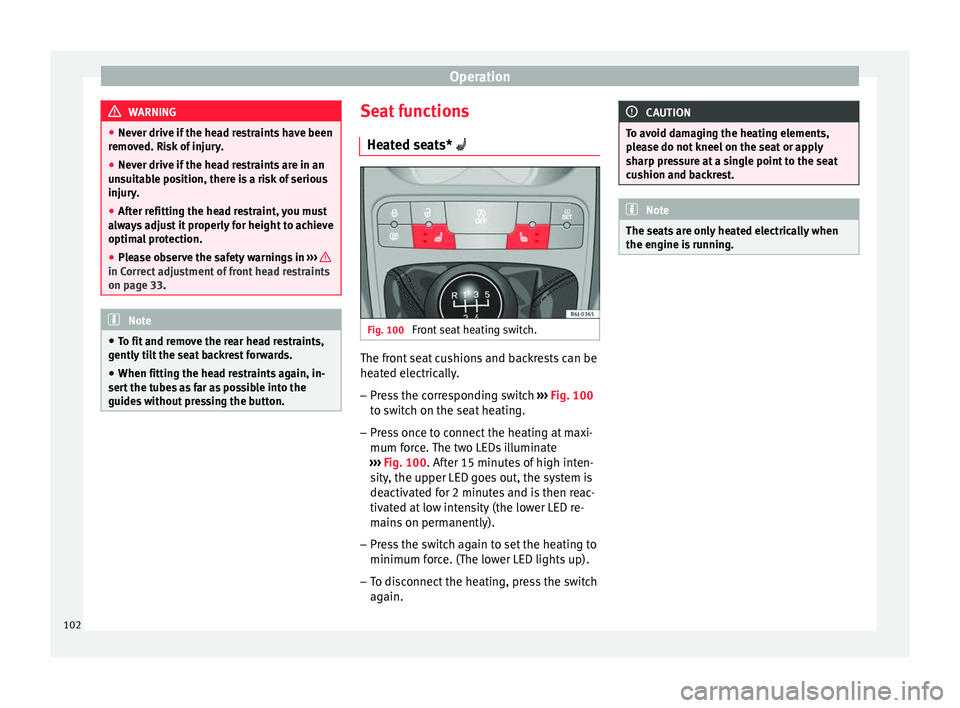
Heated seats* Fig. 100
Front seat heating switch. The front seat cushions and backrests can be
heated electrically.
– Press the corresponding switch ››› Fig. 100
to switch on the seat heating.
– Press once to connect the heating at maxi-
mum force. The two LEDs illuminate
››› Fig. 100 . After 15 minutes of high inten-
s ity
, the upper LED goes out, the system is
deactivated for 2 minutes and is then reac-
tivated at low intensity (the lower LED re-
mains on permanently).
– Press the switch again to set the heating to
minimum force. (The lower LED lights up).
– To disconnect the heating, press the switch
again. CAUTION
To avoid damaging the heating elements,
please do not kneel on the seat or apply
sharp pressure at a single point to the seat
cushion and backrest. Note
The seats are only heated electrically when
the engine is running. 102
Page 105 of 240
Seats and head restraints
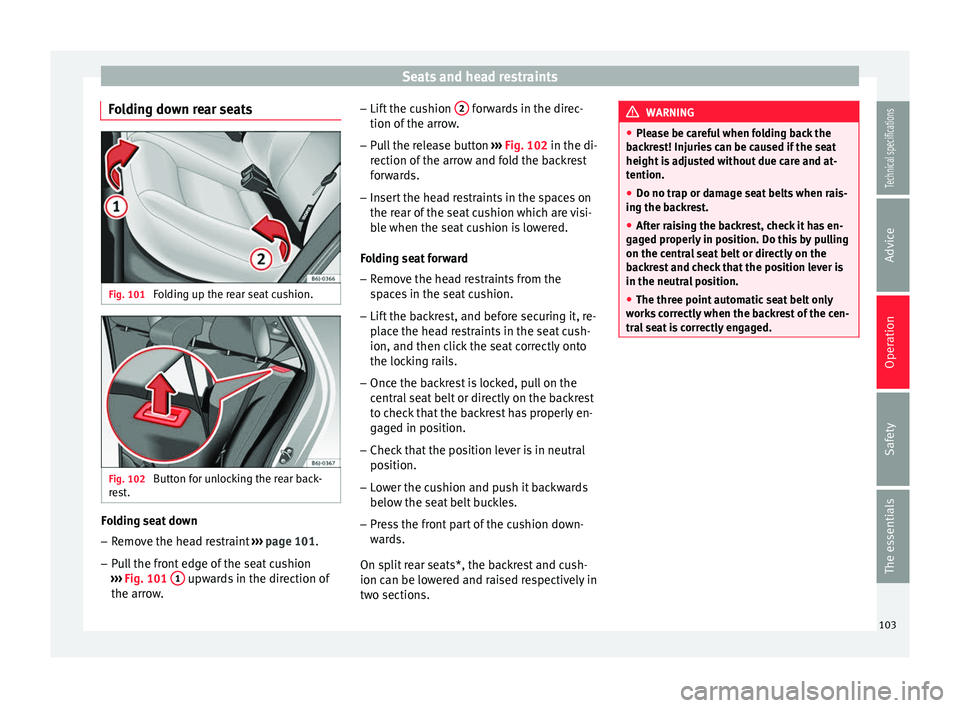
Folding down rear seats Fig. 101
Folding up the rear seat cushion. Fig. 102
Button for unlocking the rear back-
rest. Folding seat down
– Remove the head restraint ››› page 101.
– Pull the front edge of the seat cushion
››› Fig. 101 1 upwards in the direction of
the arrow. –
Lift the cushion 2 forwards in the direc-
tion of the arrow.
– Pull the release button ››› Fig. 102 in the di-
rection of the arrow and fold the backrest forwards.
– Insert the head restraints in the spaces on
the rear of the seat cushion which are visi-
ble when the seat cushion is lowered.
Folding seat forward
– Remove the head restraints from the
spaces in the seat cushion.
– Lift the backrest, and before securing it, re-
place the head restraints in the seat cush-
ion, and then click the seat correctly onto
the locking rails.
– Once the backrest is locked, pull on the
central seat belt or directly on the backrest
to check that the backrest has properly en-
gaged in position.
– Check that the position lever is in neutral
position.
– Lower the cushion and push it backwards
below the seat belt buckles.
– Press the front part of the cushion down-
wards.
On split rear seats*, the backrest and cush-
ion can be lowered and raised respectively in
two sections. WARNING
● Please be careful when folding back the
backrest! Injuries can be caused if the seat
height is adjusted without due care and at-
tention.
● Do no trap or damage seat belts when rais-
ing the backrest.
● After raising the backrest, check it has en-
gaged properly in position. Do this by pulling
on the central seat belt or directly on the
backrest and check that the position lever is
in the neutral position.
● The three point automatic seat belt only
works correctly when the backrest of the cen-
tral seat is correctly engaged. 103Technical specifications
Advice
Operation
Safety
The essentials
Page 107 of 240
Transport and practical equipment
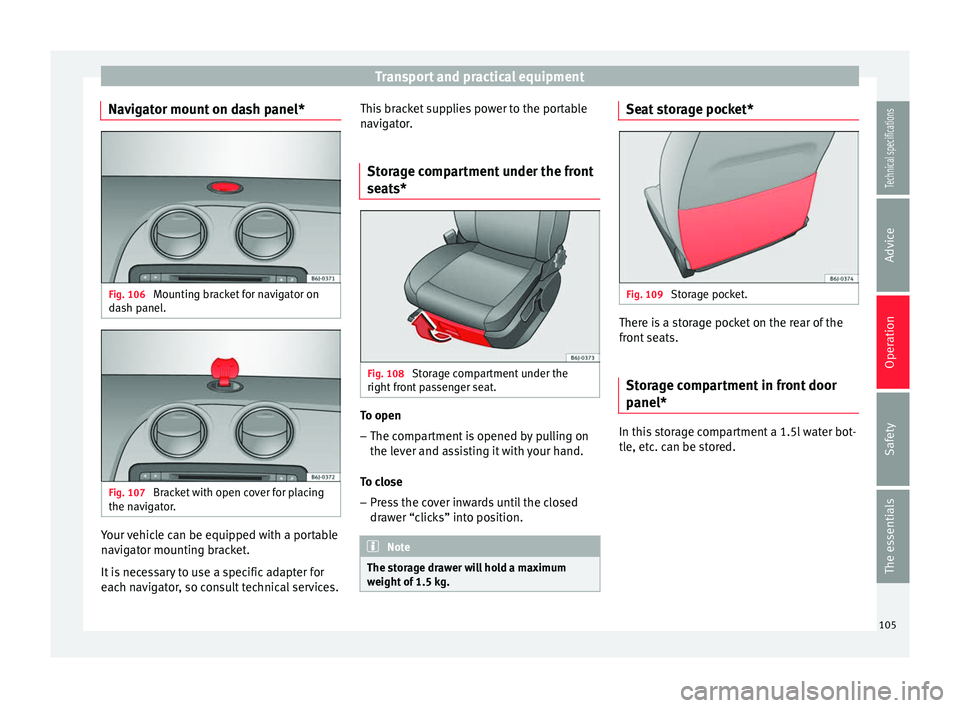
Navigator mount on dash panel* Fig. 106
Mounting bracket for navigator on
dash panel. Fig. 107
Bracket with open cover for placing
the navigator. Your vehicle can be equipped with a portable
navigator mounting bracket.
It is necessary to use a specific adapter for
each navigator, so consult technical services. This bracket supplies power to the portable
navigator.
Storage compartment under the front
seats* Fig. 108
Storage compartment under the
right front passenger seat. To open
– The compartment is opened by pulling on
the lever and assisting it with your hand.
To close – Press the cover inwards until the closed
drawer “clicks” into position. Note
The storage drawer will hold a maximum
weight of 1.5 kg. Seat storage pocket*
Fig. 109
Storage pocket. There is a storage pocket on the rear of the
front seats.
Storage compartment in front door
panel* In this storage compartment a 1.5l water bot-
tle, etc. can be stored.
105Technical specifications
Advice
Operation
Safety
The essentials
Page 113 of 240
Transport and practical equipment
The storage compartment can be accessed
from the rear seats by lifting the front part of
the rear shelf ››› Fig. 122. WARNING
Do not place heavy or hard objects on the
rear shelf, because they will endanger the ve-
hicle occupants in case of sudden braking. CAUTION
● Before closing the rear lid, ensure that the
rear shelf is correctly fitted.
● An overloaded luggage compartment could
mean that the rear shelf is not correctly seat-
ed and it may be bent or damaged.
● If the luggage compartment is overloaded,
remove the tray.
● The load in the storage compartment
should not exceed 3 kg. Note
● Ensure that, when placing items of clothing
on the luggage compartment cover, rear visi-
bility is not reduced.
● If your vehicle has a storage compartment*,
only place light objects inside. Roof carrier system*
Introduction Please observe the following points if you in-
tend to carry loads on the roof:
● For safety reasons, only luggage racks and
accessories supplied by SEAT Official Serv-
ices are recommended.
● It is essential that you follow the assembly
instructions included with the bars exactly,
being especially careful to position front and
rear luggage compartment cover bars on the
special housings in the longitudinal bars.
You must also respect their position accord-
ing to the direction of travel indicated in the
assembly manual. Not following these in-
structions may damage the bodywork.
● Pay special attention to the tightening tor-
que of the attachment bolts and check them
following a short journey. If necessary, re-
tighten the bolts and check them at regular
intervals.
● Distribute the load evenly. A maximum load
of 40 kg is permitted for each roof rack sys-
tem support bar, the load must be distrib-
uted evenly along the entire length. However,
the maximum load permitted for the entire
roof (including the support system) of 75 kg
must not be exceeded nor the total weight
recommended for the entire vehicle. See the
“Technical Data” section. ●
When transporting heavy or large objects
on the roof, any change in the normal vehicle
behaviour due to a change in the centre of
gravity or an increased wind resistance must
be taken into account. For this reason, a suit-
able speed and driving style must be used.
● On vehicles fitted with a sliding/tilting sun-
roof*, make sure it does not hit the load on
the roof upon opening.
111Technical specifications
Advice
Operation
Safety
The essentials
Page 128 of 240
Operation
CAUTION
When the engine has been running under a
heavy load for a long period, heat can accu-
mulate in the engine compartment and cause
engine damage. For this reason, idle the en-
gine for approximately 2 minutes before
switching it off. Braking and parking
Braking capacity and braking distance The efficiency of the brakes depends directly
on the
brake pad
wear. This wear depends to
a gr
eat extent on the conditions under which
the vehicle is operated and the way the vehi-
cle is driven. If you often drive in town, drive
short distances or have a sporty driving style,
we recommend that you have the thickness
of your brake pads checked by technical serv-
ices more frequently than recommended in
the Maintenance Programme.
If you drive with wet brakes, for example, af-
ter crossing areas of water, on days of heavy
rainfall or even after washing the car, the ef-
fect of the brakes is reduced as the brake
discs are wet or even frozen (in winter): in
this case, the brakes should be “dried” by
pressing the brake pedal several times. WARNING
Longer braking distances and faults in the
brake system increase the risk of accidents.
● New brake pads must be run in and do not
have the correct friction during the first
200 km. This reduced braking capacity may
be compensated for by pressing on the brake
pedal a little harder, which also applies when
the brake pads have to be changed further
on.
● If brakes are wet or frozen, or if you are
driving on roads which have been salted,
braking power may be lower than normal.
● On steep slopes, if brakes are excessively
used, they will overheat. Before driving down
a long steep slope, it is advisable to reduce
speed and change down into a lower gear or
range (depending on the type of transmis-
sion). Thus, make use of engine braking and
relieve the brakes.
● Never let the brakes “drag” by applying
light pressure. Continuous braking will cause
the brakes to overheat and the braking dis-
tance will increase. Apply and then release
the brakes alternately.
● Never let the vehicle run with the engine
switched off. The braking distance is in-
creased considerably when the brake servo is
not active.
● If the brake fluid loses its viscosity and is
subjected to heavy use, vapour bubbles can
form in the brake system. This reduces the ef-
ficiency of the brakes. ●
Non-standard or damaged front spoilers
could restrict the airflow to the brakes and
cause them to overheat. Before purchasing
accessories please observe the relevant in-
structions ››› page 155, Technical modifica-
tions.
● If a br
ake system circuit fails, the braking
distance will be increased considerably. Con-
tact a specialised workshop immediately and
avoid unnecessary journeys. Handbrake
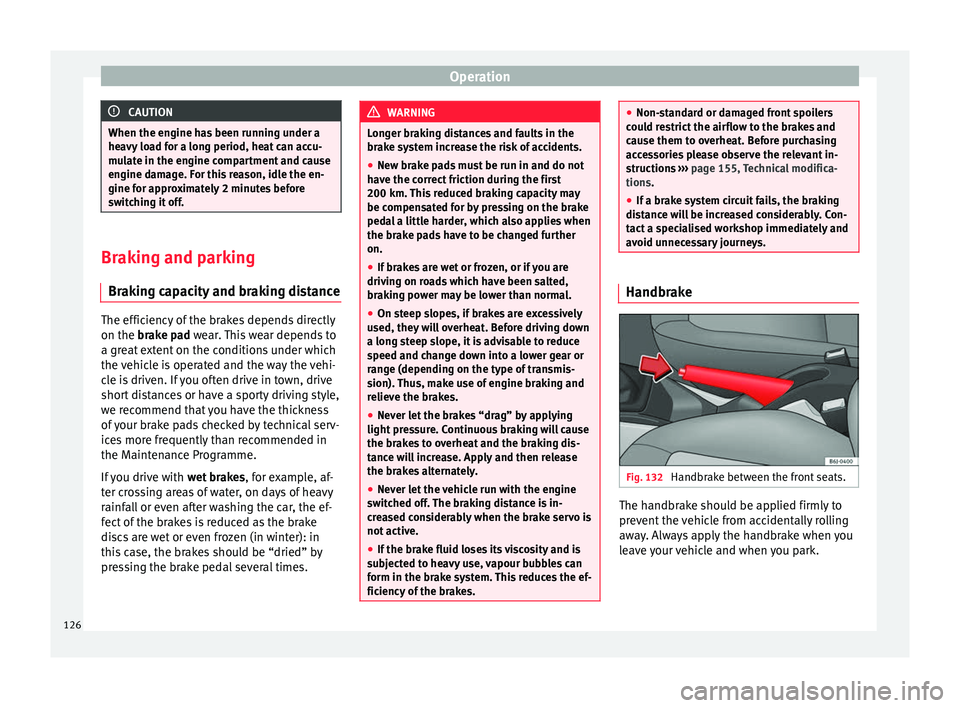
Fig. 132
Handbrake between the front seats. The handbrake should be applied firmly to
prevent the vehicle from accidentally rolling
away. Always apply the handbrake when you
leave your vehicle and when you park.
126
Page 231 of 240
Index
Index
A
ABS . . . . . . . . . . . . . . . . . . . . . . . . . . . . . . . . . . . . 140 control lamp . . . . . . . . . . . . . . . . . . . . . . . . . . . . 59
Accessories . . . . . . . . . . . . . . . . . . . . . . . . . . . . . . 155
Acoustic warning . . . . . . . . . . . . . . . . . . . . . . . . . 123
Adaptive headlights . . . . . . . . . . . . . . . . . . . . . . . . 94
Adjusting the front seats Adjusting the lumbar support . . . . . . . . . . . . . 100
Adjusting the seat . . . . . . . . . . . . . . . . . . . . . . . . 100
AFS headlight bulbs . . . . . . . . . . . . . . . . . . . . . . . 201
Airbag covers . . . . . . . . . . . . . . . . . . . . . . . . . . . . . 42
Airbags description . . . . . . . . . . . . . . . . . . . . . . . . . . . . . 40
Airbag system . . . . . . . . . . . . . . . . . . . . . . . . . . . . . 40 activation . . . . . . . . . . . . . . . . . . . . . . . . . . . . . . 41
control lamp . . . . . . . . . . . . . . . . . . . . . . . . . . . . 42
front airbags . . . . . . . . . . . . . . . . . . . . . . . . . . . . 42
functioning . . . . . . . . . . . . . . . . . . . . . . . . . . . . . 41
Head-protection airbag . . . . . . . . . . . . . . . . . . . 45
side airbags . . . . . . . . . . . . . . . . . . . . . . . . . . . . 43
Air conditioner Climatronic . . . . . . . . . . . . . . . . . . . . . . . . . . . . 121
General notes . . . . . . . . . . . . . . . . . . . . . . . . . . 113
Air conditioning . . . . . . . . . . . . . . . . . . . 21, 22, 118
Air outlets . . . . . . . . . . . . . . . . . . . . . . . . . . . . . . . 117
Air recirculation Semi-automatic air conditioning . . . . . . . . . . . 120
Air recirculation mode Climatronic . . . . . . . . . . . . . . . . . . . . . . . . . . . . 122
Alarm system Switching off . . . . . . . . . . . . . . . . . . . . . . . . . . . . 85
Alternator Warning lamp . . . . . . . . . . . . . . . . . . . . . . . . . . . 63 Anti-lock brake system . . . . . . . . . . . . . . . . . . . . . 140
control lamp . . . . . . . . . . . . . . . . . . . . . . . . . . . . 59
Anti-puncture . . . . . . . . . . . . . . . . . . . . . . . . . . . . . 26
Anti-puncture kit . . . . . . . . . . . . . . . . . . . . . . . . . . . 26
Anti-theft alarm system . . . . . . . . . . . . . . . . . . . . . 84 Switching off . . . . . . . . . . . . . . . . . . . . . . . . . . . . 85
Anti-theft wheel bolts . . . . . . . . . . . . . . . . . . . . . 184
Antifreeze . . . . . . . . . . . . . . . . . . . . . . . . . . . . . . . 171
Aquaplaning . . . . . . . . . . . . . . . . . . . . . . . . . . . . . 178
Aspects to note before setting off . . . . . . . . . . . . . 29
ASR . . . . . . . . . . . . . . . . . . . . . . . . . . . . . . . . . . . . 141
ASR (Traction control system) Control lamp . . . . . . . . . . . . . . . . . . . . . . . . . . . . 60
Audible warning signal . . . . . . . . . . . . . . . . . . . . . 35
Automatic anti-dazzle interior rear vision mirror Activating the anti-dazzle function . . . . . . . . . . 99
Deactivating the anti-dazzle function . . . . . . . . 99
Automatic car washing tunnel . . . . . . . . . . . . . . . 157
Automatic gearbox . . . . . . . . . . . . . . . . . . . . 20, 129 Kick-down feature . . . . . . . . . . . . . . . . . . . . . . . 133
manual release of the selector lever . . . . . . . . 192
Selector lever positions . . . . . . . . . . . . . . . . . . 132
Automatic lighting . . . . . . . . . . . . . . . . . . . . . . . . . 91
Automatic windscreen wiper/washer . . . . . . . . . . 97
Auxiliary audio connection (AUX) . . . . . . . . . . . . 108
B Ball coupling . . . . . . . . . . . . . . . . . . . . . . . . . . . . . 152
Battery . . . . . . . . . . . . . . . . . . . . . . . . . . . . . . . . 26, 84 Changing . . . . . . . . . . . . . . . . . . . . . . . . . . . . . . 175
Charging . . . . . . . . . . . . . . . . . . . . . . . . . . . . . . 175
Winter conditions . . . . . . . . . . . . . . . . . . . . . . . 174
Before setting off . . . . . . . . . . . . . . . . . . . . . . . . . . 29
Belt pretensioners . . . . . . . . . . . . . . . . . . . . . . . . . 39
Biodiesel . . . . . . . . . . . . . . . . . . . . . . . . . . . . . . . . 165
Biodiesel fuel . . . . . . . . . . . . . . . . . . . . . . . . . . . . 165 Bluetooth system . . . . . . . . . . . . . . . . . . . . . . . . . . 72
pairing the mobile phone . . . . . . . . . . . . . . . . . 74
system components . . . . . . . . . . . . . . . . . . . . . . 74
user profile . . . . . . . . . . . . . . . . . . . . . . . . . . . . . 74
voice control . . . . . . . . . . . . . . . . . . . . . . . . . . . . 76
Bonnet . . . . . . . . . . . . . . . . . . . . . . . . . . . . . 10, 167
Boot hatch . . . . . . . . . . . . . . . . . . . . . . . . . . . . . . . 86
Boot lid . . . . . . . . . . . . . . . . . . . . . . . . . . . . . . . . . . 86
Brake fluid . . . . . . . . . . . . . . . . . . . . . . . . . . 25, 173 Changing . . . . . . . . . . . . . . . . . . . . . . . . . . . . . . 173
Brake pads . . . . . . . . . . . . . . . . . . . . . . . . . 126, 134
Brakes . . . . . . . . . . . . . . . . . . . . . . . . . . . . . . . . . . 126
Brake servo . . . . . . . . . . . . . . . . . . . . . . . . . 126, 142
Brake system . . . . . . . . . . . . . . . . . . . . . . . . . . . . 173 warning lamp . . . . . . . . . . . . . . . . . . . . . . . . . . . 61
Braking distance . . . . . . . . . . . . . . . . . . . . . . . . . 126
Bulb defect Control lamp . . . . . . . . . . . . . . . . . . . . . . . . . . . . 59
Bulbs Changing . . . . . . . . . . . . . . . . . . . . . . . . . . . . . . 196
Buzzer . . . . . . . . . . . . . . . . . . . . . . . . . . . . . . 93, 123
C
Car care Exterior . . . . . . . . . . . . . . . . . . . . . . . . . . . . . . . 157
Car telephone . . . . . . . . . . . . . . . . . . . . . . . . . . . . 156
Catalytic converter . . . . . . . . . . . . . . . . . . . . . . . . 135
CCS . . . . . . . . . . . . . . . . . . . . . . . . . . . . . . . . 16, 150
Central lock button Locking . . . . . . . . . . . . . . . . . . . . . . . . . . . . . . . . 81
Unlocking . . . . . . . . . . . . . . . . . . . . . . . . . . . . . . 81
Central locking . . . . . . . . . . . . . . . . . . . . . . . . . . . . 78 Automatic speed-dependent locking . . . . . . . . 80
Locking system to prevent involuntary unlock-ing . . . . . . . . . . . . . . . . . . . . . . . . . . . . . . . . . . 80
Selective unlocking system . . . . . . . . . . . . . . . . 80
Unlocking system . . . . . . . . . . . . . . . . . . . . . . . . 80
229