brakes Seat Ibiza 5D 2015 User Guide
[x] Cancel search | Manufacturer: SEAT, Model Year: 2015, Model line: Ibiza 5D, Model: Seat Ibiza 5D 2015Pages: 248, PDF Size: 4.77 MB
Page 198 of 248

Advice
WARNING
● Never w a
sh tyres with a cylindrical jet. Even
at large spraying distances and short clean-
ing times, damage can occur to the tyres.
This may cause an accident.
● Water, ice and salt on the brake system can
reduce br
aking effectiveness. Risk of acci-
dent. Directly after washing, avoid sudden
and sharp braking. “Dry” the brakes by brak-
ing several times ››› page 156, Braking ca-
pacity and braking distance .Alloy wheel rims
Every two weeks
– Wash salt and brake dust from alloy
wheel s.
– Use an ac
id free detergent to clean the
wheel rims.
Ev
ery 3 months
– Apply a hard wax compound to the wheels.
Allo
y wheels require regular attention to pre-
serve their appearance. If road salt and brake
dust are not often removed, the aluminium
finish will be impaired.
Always use an acid-free detergent for alloy
wheel rims.
Car polish or other abrasive agents should
not be used for maintaining the rims. If the protective coating is damaged, e.g. by flying
stone
s, the damaged area should be re-
paired immediately. WARNING
Observe the safety warnings ›››
in Steel
wheel rims on p
age 196. Vehicle underbody protection
The vehicle underbody is coated to protect it
from c
hemic
al and mechanical damage.
The protective coating can be damaged when
driving. We recommend that you check the
protective coating under the body and on the
running gear, and retouch it if necessary, be-
fore and after the winter season.
We recommend that you go to your Technical
Service to carry out repair work and addition-
al anti-corrosion work. WARNING
Do not apply underseal or anti-corrosion
co atin
gs to the exhaust pipes, catalytic con-
verter or the heat shields on the exhaust sys-
tem. The heat of the exhaust system or the
engine could cause them to ignite. Risk of
fire. Cleaning engine compartment
Take special care when cleaning the engine
comp
ar
tment.
Anti-corrosion treatment
The engine compartment and the surface of
the power unit are given anti-corrosion treat-
ment at the factory.
Good corrosion protection is particularly im-
portant in winter when the vehicle is fre-
quently driven on salted roads. To prevent
the salt corroding the vehicle, the entire en-
gine compartment should be thoroughly
cleaned before and after winter.
Technical Services have the proper products
for cleaning and preservation as well as the
necessary workshop equipment. For this rea-
son, we recommend having this work per-
formed by them.
The anti-corrosion protection is usually re-
moved if the engine compartment is cleaned
with grease removing solutions, or if you
have the engine cleaned. On commissioning
this work, ensure that all surfaces, seams,
joints and components in the engine com-
partment are given anti-corrosion treatment. WARNING
● When work in
g in the engine compartment,
always observe the safety warnings
››› page 201.196
Page 210 of 248
Advice
●
If w ork
ing inside the engine compartment,
remember that, even when the ignition is
switched off, the radiator fan may start up au-
tomatically, and therefore there is a risk of in-
jury. WARNING
If there is not enough anti-freeze in the cool-
ant sys
tem, the engine may fail leading to se-
rious damage.
● Please make sure that the percentage of
additiv
e is correct with respect to the lowest
expected ambient temperature in the zone in
which the vehicle is to be used.
● When the outside temperature is very low,
the cool
ant could freeze and the vehicle
would be immobilised. In this case, the heat-
ing would not work either and inadequately
dressed passengers could die of cold. CAUTION
Do not top up the expansion tank with cool-
ant fluid if it
is empty! Air could enter the
cooling system. In this case, stop driving.
Seek specialist assistance. Otherwise, there
is a risk of engine damage. CAUTION
The original additives should never be mixed
with c oo
lants which are not approved by
SEAT. Otherwise, you run the risk of causing severe damage to the engine and the engine
coo
lin
g system.
● If the fluid in the expansion tank is not pur-
ple b
ut is, for example, brown, this indicates
that the G13 additive has been mixed with an
inadequate coolant. The coolant must be
changed as soon as possible if this is the
case! This could result in serious faults and
engine damage. For the sake of the environment
Coolants and additives can contaminate the
en vir
onment. If any fluids are spilled, they
should be collected and correctly disposed
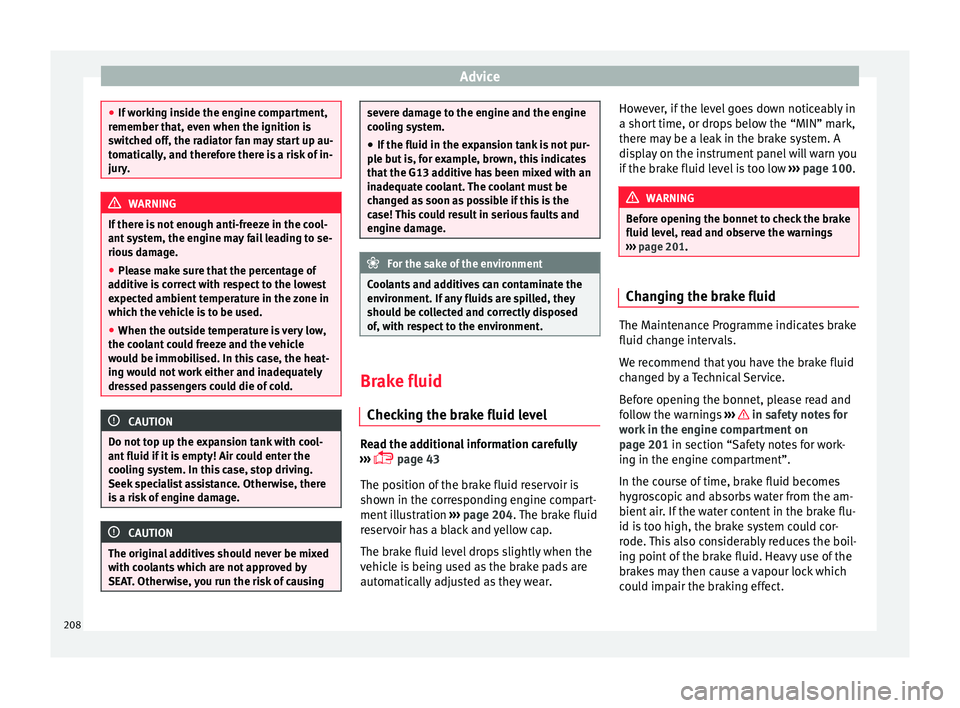
of, with respect to the environment. Brake fluid
Chec k
in
g the brake fluid level Read the additional information carefully
› ›
›
page 43
The position of the brake fluid reservoir is
shown in the corresponding engine compart-
ment illustration ››› page 204. The brake fluid
reservoir has a black and yellow cap.
The brake fluid level drops slightly when the
vehicle is being used as the brake pads are
automatically adjusted as they wear. However, if the level goes down noticeably in
a short time, or dr
ops below the “MIN” mark,
there may be a leak in the brake system. A
display on the instrument panel will warn you
if the brake fluid level is too low ››› page 100. WARNING
Before opening the bonnet to check the brake
fluid lev el, r
ead and observe the warnings
››› page 201. Changing the brake fluid
The Maintenance Programme indicates brake
fluid c
h
an
ge intervals.
We recommend that you have the brake fluid
changed by a Technical Service.
Before opening the bonnet, please read and
follow the warnings ››› in safety notes for
w ork
in the en
gine compartment on
page 201 in section “Safety notes for work-
ing in the engine compartment”.
In the course of time, brake fluid becomes
hygroscopic and absorbs water from the am-
bient air. If the water content in the brake flu-
id is too high, the brake system could cor-
rode. This also considerably reduces the boil-
ing point of the brake fluid. Heavy use of the
brakes may then cause a vapour lock which
could impair the braking effect.
208
Page 211 of 248

Checking and refilling levels
Be sure to always use the correct brake fluid.
On ly
u
se brake fluid that expressly meets the
VW 501 14 standard.
You can buy VW 501 14 standard brake fluid
in a SEAT dealership or a SEAT Official Serv-
ice. If none is available, use only high-quality
brake fluid that meets DIN ISO 4925 CLASS 4
standards, or USA Standards FMVSS 116 DOT
4.
Using any other kind of brake fluid or one
that is not of a high quality may affect opera-
tion of the brake system and reduce its effec-
tiveness. Never use a brake fluid if the con-
tainer does not state that it complies with VW
501 14, DIN ISO 4925 CLASS 4 standards, or
USA standards FMVSS 116 DOT 4. WARNING
Brake fluid is poisonous. Old brake fluid im-
pair s
the braking effect.
● Before opening the bonnet to check the
brake fluid l
evel, read and observe the warn-
ings ››› page 201.
● Brake fluid should be stored in the closed
original
container in a safe place out of reach
of children. There is a toxic risk.
● Perform the brake fluid change according to
the Mainten
ance Programme. Heavy use of
the brakes may cause a vapour lock if the
brake fluid is left in the brake system for too
long. This would seriously affect the effec-
tiveness of the brakes and the safety of the
vehicle. This may cause an accident. CAUTION
Brake fluid damages the vehicle paintwork.
Wipe off an
y brake fluid from the paintwork
immediately. For the sake of the environment
The brake pads and brake fluid must be col-
lect ed and di
sposed of according the applica-
ble regulations. The SEAT Technical Service
network has the necessary equipment and
qualified personnel for collecting and dispos-
ing of this waste material. Windscreen washer reservoir
Top pin
g up the windscreen washer
reservoir water Read the additional information carefully
› ›
›
page 43
The windscreen washer and the headlight
washers are supplied with fluid from the
windscreen washer fluid container in the en-
gine compartment. The container holds ap-
prox. 3 litres; in vehicles with headlight
washers* it holds approx. 4.5 litres.
The tank is in the engine compartment.
Plain water is not enough to clean the wind-
screen and headlights. We recommend that
you always add a product to the windscreen washer fluid. Approved windscreen cleaning
products e
xist on the market with high deter-
gent and anti-freeze properties, these may be
added all-year-round. Please follow the dilu-
tion instructions on the packaging. WARNING
Any work carried out in the engine compart-
ment or on the en gine mu
st be carried out
cautiously.
● When working in the engine compartment,
alwa
ys observe the safety warnings
››› page 201. CAUTION
● Never p ut
radiator anti-freeze or other addi-
tives into the windscreen washer fluid.
● Always use approved windscreen cleansing
products
diluted as per instructions. If you
use other washer fluids or soap solutions,
the tiny holes in the fan-shaped nozzles
could become blocked. Vehicle battery
S ymbo
l
s and warnings on handling
the battery Read the additional information carefully
› ›
›
page 43 »
209
Technical data
Advice
Operation
Emergencies
Safety
Page 217 of 248

Wheels
for your model. Failure to do so could impair
vehic
l
e handling. Risk of accident.
● Avoid running the vehicle on tyres that are
more than 6
years old. If you have no alterna-
tive, you should drive slowly and with extra
care at all times.
● Never use old tyres or those with an un-
known “his
tory of use”.
● If wheel trims are retrofitted, you must en-
sure th
at the flow of air to the brakes is not
restricted. This could cause the brake system
to overheat.
● All four wheels must be fitted with radial
tyre
s of the same type, size (rolling circumfer-
ence) and the same tread pattern. For the sake of the environment
Old tyres must be disposed of according to
the la w
s in the country concerned. Note
● For t ec
hnical reasons, it is not generally
possible to use the wheels from other vehi-
cles. This can also apply to wheels of the
same model. The use of wheels or tyres
which have not been approved by SEAT for
use with your model may invalidate the vehi-
cle's type approval for use on public roads.
● If the spare tyre is not the same as the
tyre
s that are mounted on the vehicle (e.g.
winter tyres) you should only use the spare
tyre for a short period of time and drive with extra care. Refit the normal road wheel as
soon as
po
ssible. Wheel bolts
The design of wheel bolts is matched to the
rims. If diff
er
ent wheel rims are fitted, the
correct wheel bolts with the right length and
correctly shaped bolt heads must be used.
This ensures that wheels are fitted securely
and that the brake system functions correctly.
In certain circumstances, you should not use
wheel bolts from a different vehicle, even if it
is the same model ››› page 190. WARNING
If the wheel bolts are not tightened correctly,
the wheel c ou
ld become loose while driving.
Risk of accident.
● The wheel bolts must be clean and turn
eas
ily. Never apply grease or oil to them.
● Use only wheel bolts which belong to the
wheel.
● If the pr
escribed torque of the wheel bolts
is t
oo low, they could loosen whilst the vehi-
cle is in motion. Risk of accident! If the tight-
ening torque is too high, the wheel bolts and
threads can be damaged. CAUTION
The prescribed tightening torque for wheel
bolt s
for steel and alloy wheels is 120 Nm. Winter service
Wint er ty
res In winter conditions winter tyres will consid-
erab
ly
improve the vehicle's handling. The
design of summer tyres (width, rubber com-
pound, tread pattern) gives less grip on ice
and snow.
Winter tyres must be inflated to a pressure of
0.2 bar (2.9 psi/20 kPa) higher than the pres-
sures specified for summer tyres (see sticker
on fuel tank flap).
Winter tyres must be fitted on all four wheels.
Information on permitted winter tyre sizes
can be found in the vehicle's registration
documentation. Use only radial winter tyres.
All tyre sizes listed in the vehicle documenta-
tion also apply to winter tyres.
Winter tyres lose their effectiveness when the
tread is worn down to a depth of 4 mm.
The speed rating code ›››
page 214, New
tyres and wheels determines the following
speed limits for winter tyres: ››› max. 160 km/h (99 mph)
»
Q
215
Technical data
Advice
Operation
Emergencies
Safety
Page 223 of 248
Technical specifications
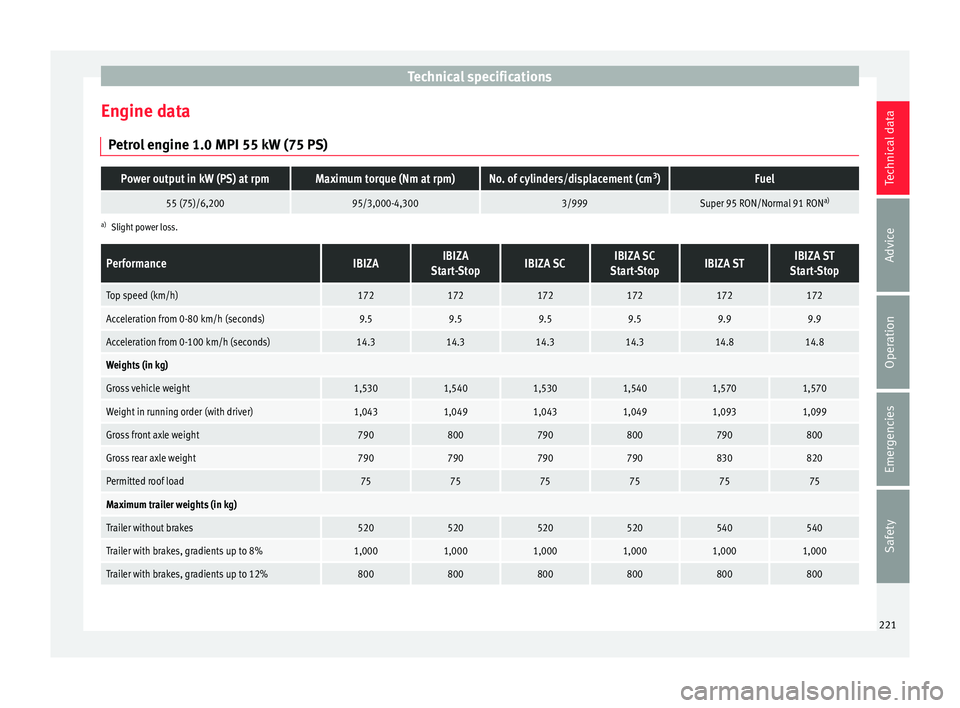
Engine data P etr
o
l engine 1.0 MPI 55 kW (75 PS)
Power output in kW (PS) at rpmMaximum torque (Nm at rpm)No. of cylinders/displacement (cm 3
)Fuel
55 (75)/6,20095/3,000-4,3003/999Super 95 RON/Normal 91 RON a)
a)
Slight power loss.
PerformanceIBIZAIBIZA
Start-StopIBIZA SCIBIZA SC
Start-StopIBIZA STIBIZA ST
Start-Stop
Top speed (km/h)172172172172172172
Acceleration from 0-80 km/h (seconds)9.59.59.59.59.99.9
Acceleration from 0-100 km/h (seconds)14.314.314.314.314.814.8
Weights (in kg)
Gross vehicle weight1,5301,5401,5301,5401,5701,570
Weight in running order (with driver)1,0431,0491,0431,0491,0931,099
Gross front axle weight790800790800790800
Gross rear axle weight790790790790830820
Permitted roof load757575757575
Maximum trailer weights (in kg)
Trailer without brakes520520520520540540
Trailer with brakes, gradients up to 8%1,0001,0001,0001,0001,0001,000
Trailer with brakes, gradients up to 12%800800800800800800 221
Technical data
Advice
Operation
Emergencies
Safety
Page 224 of 248
Technical data
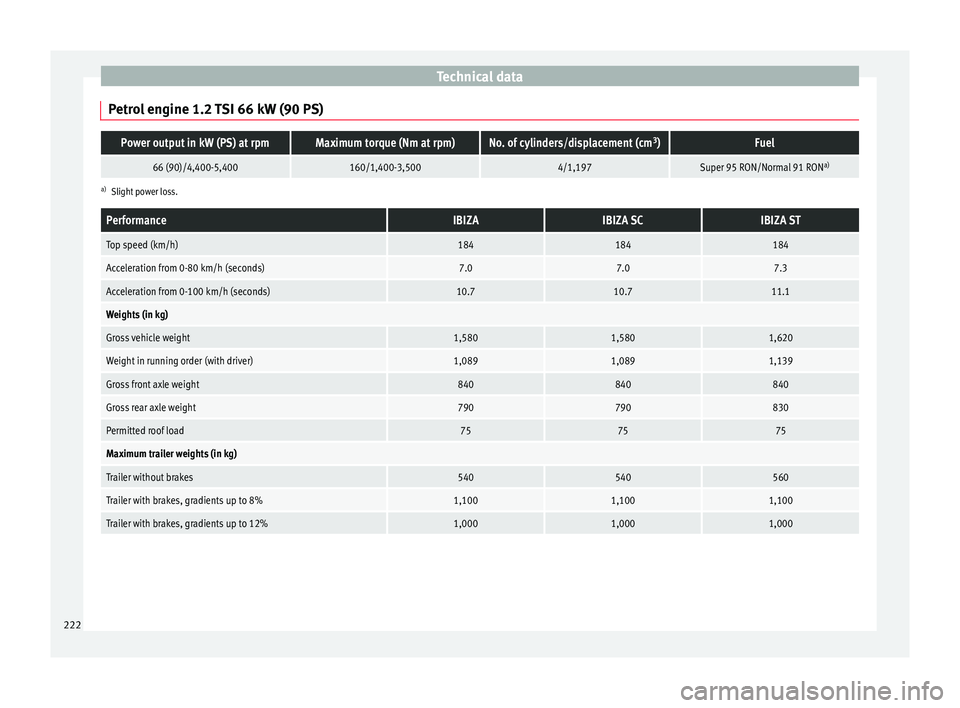
Petrol engine 1.2 TSI 66 kW (90 PS)Power output in kW (PS) at rpmMaximum torque (Nm at rpm)No. of cylinders/displacement (cm 3
)Fuel
66 (90)/4,400-5,400160/1,400-3,5004/1,197Super 95 RON/Normal 91 RON a)
a)
Slight power loss.
PerformanceIBIZAIBIZA SCIBIZA ST
Top speed (km/h)184184184
Acceleration from 0-80 km/h (seconds)7.07.07.3
Acceleration from 0-100 km/h (seconds)10.710.711.1
Weights (in kg)
Gross vehicle weight1,5801,5801,620
Weight in running order (with driver)1,0891,0891,139
Gross front axle weight840840840
Gross rear axle weight790790830
Permitted roof load757575
Maximum trailer weights (in kg)
Trailer without brakes540540560
Trailer with brakes, gradients up to 8%1,1001,1001,100
Trailer with brakes, gradients up to 12%1,0001,0001,000 222
Page 225 of 248

Technical specifications
Petrol engine 1.6 MPI 66 kW (90 PS)Power output in kW (PS) at rpmMaximum torque (Nm at rpm)No. of cylinders/displacement (cm 3
)Fuel
66 (90)/4,250-6,000155/3,800-4,0004/1,598Super 95 RON/Normal 91 RON a)
a)
Slight power loss.
PerformanceIBIZAIBIZA SCIBIZA ST
Top speed (km/h)185185185
Acceleration from 0-80 km/h (seconds)7.07.07.0
Acceleration from 0-100 km/h (seconds)10.610.611
Weights (in kg)
Gross vehicle weight1,5701,5701,610
Weight in running order (with driver)1,0791,0791,129
Gross front axle weight830830830
Gross rear axle weight790790830
Permitted roof load757575
Maximum trailer weights (in kg)
Trailer without brakes530530560
Trailer with brakes, gradients up to 8%1,0001,0001,000
Trailer with brakes, gradients up to 12%1,0001,0001,000 223
Technical data
Advice
Operation
Emergencies
Safety
Page 226 of 248
Technical data
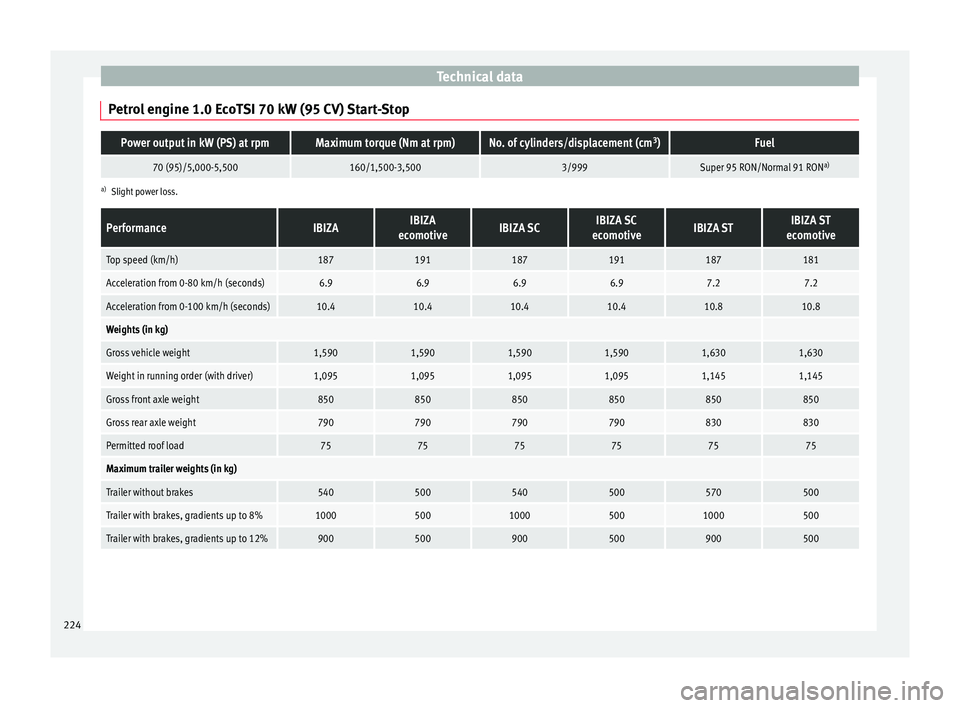
Petrol engine 1.0 EcoTSI 70 kW (95 CV) Start-StopPower output in kW (PS) at rpmMaximum torque (Nm at rpm)No. of cylinders/displacement (cm 3
)Fuel
70 (95)/5,000-5,500160/1,500-3,5003/999Super 95 RON/Normal 91 RON a)
a)
Slight power loss.
PerformanceIBIZAIBIZA
ecomotiveIBIZA SCIBIZA SC
ecomotiveIBIZA STIBIZA ST
ecomotive
Top speed (km/h)187191187191187181
Acceleration from 0-80 km/h (seconds)6.96.96.96.97.27.2
Acceleration from 0-100 km/h (seconds)10.410.410.410.410.810.8
Weights (in kg)
Gross vehicle weight1,5901,5901,5901,5901,6301,630
Weight in running order (with driver)1,0951,0951,0951,0951,1451,145
Gross front axle weight850850850850850850
Gross rear axle weight790790790790830830
Permitted roof load757575757575
Maximum trailer weights (in kg)
Trailer without brakes540500540500570500
Trailer with brakes, gradients up to 8%100050010005001000500
Trailer with brakes, gradients up to 12%900500900500900500 224
Page 227 of 248
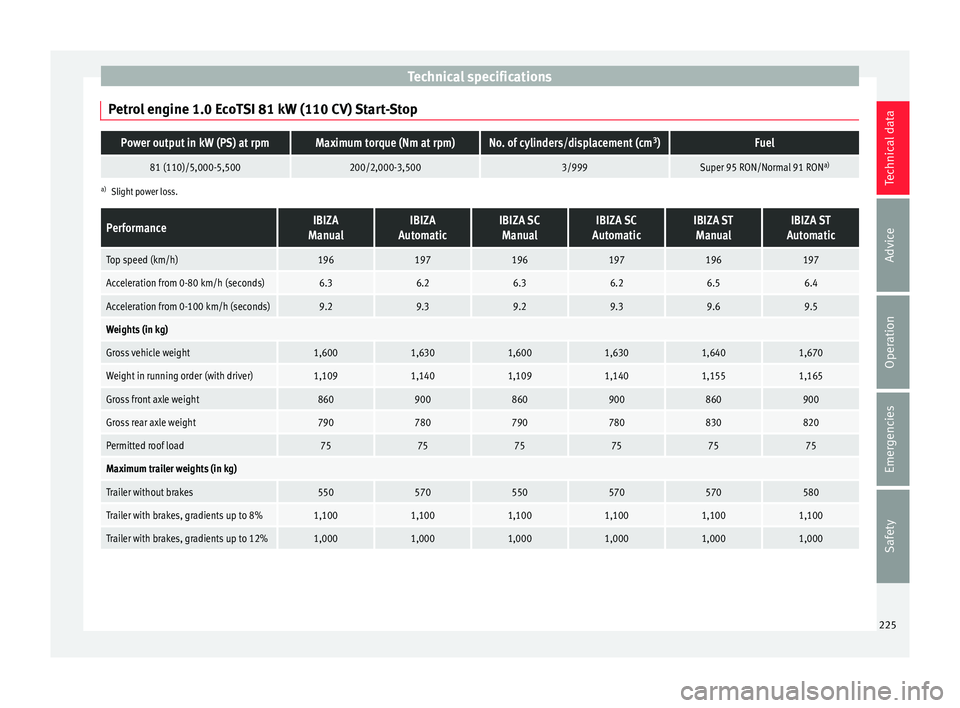
Technical specifications
Petrol engine 1.0 EcoTSI 81 kW (110 CV) Start-StopPower output in kW (PS) at rpmMaximum torque (Nm at rpm)No. of cylinders/displacement (cm 3
)Fuel
81 (110)/5,000-5,500200/2,000-3,5003/999Super 95 RON/Normal 91 RON a)
a)
Slight power loss.
PerformanceIBIZA
ManualIBIZA
AutomaticIBIZA SC ManualIBIZA SC
AutomaticIBIZA ST ManualIBIZA ST
Automatic
Top speed (km/h)196197196197196197
Acceleration from 0-80 km/h (seconds)6.36.26.36.26.56.4
Acceleration from 0-100 km/h (seconds)9.29.39.29.39.69.5
Weights (in kg)
Gross vehicle weight1,6001,6301,6001,6301,6401,670
Weight in running order (with driver)1,1091,1401,1091,1401,1551,165
Gross front axle weight860900860900860900
Gross rear axle weight790780790780830820
Permitted roof load757575757575
Maximum trailer weights (in kg)
Trailer without brakes550570550570570580
Trailer with brakes, gradients up to 8%1,1001,1001,1001,1001,1001,100
Trailer with brakes, gradients up to 12%1,0001,0001,0001,0001,0001,000 225
Technical data
Advice
Operation
Emergencies
Safety
Page 228 of 248

Technical data
Petrol engine 1.2 TSI 81 kW (110 PS)Power output in kW (PS) at rpmMaximum torque (Nm at rpm)No. of cylinders/displacement (cm 3
)Fuel
81 (110)/4,600-5,600175/1,400-4,0004/1,197Super 95 RON/Normal 91 RON a)
a)
Slight power loss.
PerformanceIBIZAIBIZA SCIBIZA ST
Top speed (km/h)197197197
Acceleration from 0-80 km/h (seconds)6.26.26.5
Acceleration from 0-100 km/h (seconds)9.19.19.7
Weights (in kg)
Gross vehicle weight1,5901,5901,630
Weight in running order (with driver)1,1021,1021,152
Gross front axle weight860860850
Gross rear axle weight780780830
Permitted roof load757575
Maximum trailer weights (in kg)
Trailer without brakes550550570
Trailer with brakes, gradients up to 8%1,1001,1001,100
Trailer with brakes, gradients up to 12%1,1001,0001,100 226