stop start Seat Ibiza 5D 2015 Owner's Guide
[x] Cancel search | Manufacturer: SEAT, Model Year: 2015, Model line: Ibiza 5D, Model: Seat Ibiza 5D 2015Pages: 248, PDF Size: 4.77 MB
Page 176 of 248
Operation
● If in an inc
r
ease in airflow is not requested.
● The temperature must not be set to HI or
LO .
● The driver door must be closed.
● The diesel particulate filter must not be in
reg
eneration mode, for diesel engines.
● The battery charge must not be low for the
next s
tart.
● Battery temperature must be between -1°C
(+30°F) and +55°C (+131°F).
Star
t-Stop function interruption
In the following situations, the Start-Stop
function will be interrupted and the engine
will automatically start:
● The vehicle starts moving.
● The brake pedal is pressed several times in
a row
.
● The battery has been discharged excessive-
ly.
● The St
art-Stop System is manually deacti-
vated.
● The w
indscreen de-mist function is turned
on.
● The temperature of the interior exceeds the
comfor
t limits ( A/C button).
● If the airflow is increased by more than 3
pr e
s
ses.
● Temperature setting HI or LO is sel
ected.●
The engine coo
lant temperature is insuffi-
cient.
● The alternator is faulty, for example the V-
belt ha
s ruptured.
● If any of the conditions described in the
previou
s section are not fulfilled.
When the engine is turned off by the Start-
Stop function, this is displayed on the instru-
ment panel.
If the Start-Stop system is not switched on,
the warning lamp will appear on the instru-
ment panel. WARNING
Never allow the vehicle to move with the en-
gine off f or an
y reason. You could lose control
of your vehicle. This could cause an accident
and serious injury.
● The brake servo does not work with the en-
gine off. Y
ou need more force to stop the vehi-
cle.
● Power steering does not work when the en-
gine is not
running. That is why it is much
more difficult to turn the steering wheel.
● Turn off the Start-Stop system when driving
through wat
er (fording streams, etc.). Note
● For v
ehicles with the Start-Stop function
and a manual gearbox, when the engine is
started, the clutch must be pressed. ●
When the condition s
for the Start-Stop
function are not fulfilled, the instrument pan-
el displays the Start-Stop indicator dimmed.
● If the steering wheel is turned more than
270°, it wi
ll not be possible to start the vehi-
cle again. To start the vehicle, straighten the
steering wheel so that it is turned less than
270°.
● There are different versions of the dash
panel; the dis
play of indications on the
screen may differ. Activating and deactivating the Start-
St
op f
u
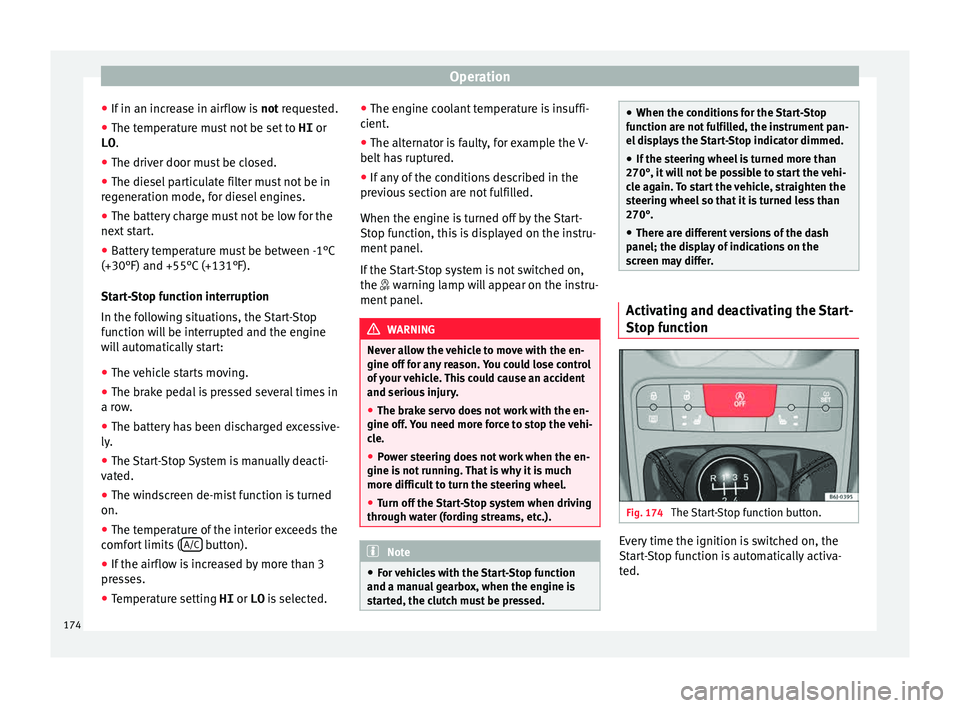
nction Fig. 174
The Start-Stop function button. Every time the ignition is switched on, the
St
ar
t
-Stop function is automatically activa-
ted.
174
Page 177 of 248
Driver assistance systems
Manually deactivating the Start-Stop func-
tion
– Press the
› ››
Fig. 174
b utton located on
the centre console. When the Start-Stop
function is switched off, the warning lamp
comes on.
– If the Start-Stop function is operating then
the engine st
arts immediately.
Switching the Start-Stop function on manual-
ly – Press the
› ›
› Fig. 174
button located on
the centre console. The warning lamp will
switch off.
Tiredness detection (break rec-
ommendation)* Introduction
›› ›
table on page 2
The Tiredness detection informs the driver
when their driving behaviour shows signs of
fatigue. WARNING
Do not let the comfort afforded by the Tired-
nes s
detection system tempt you into taking
any risks when driving. Take regular breaks, sufficient in length when making long jour-
neys.
●
The driv er a
lways assumes the responsibil-
ity of driv
ing to their full capacity.
● Never drive if you are tired.
● The system does not detect the tiredness of
the driver in al
l circumstances. Consult the in-
formation in the section ››› page 176, System
limitations.
● In some situations, the system may incor-
rectly int
erpret an intended driving manoeu-
vre as driver tiredness.
● No warning is given in the event of the ef-
fect c
alled microsleep!
● Please observe the indications on the in-
strument p
anel and act as is necessary. Note
● Tiredne s
s detection has been developed for
driving on motorways and well paved roads
only.
● If there is a fault in the system, have it
check
ed by a specialised workshop. Function and operation
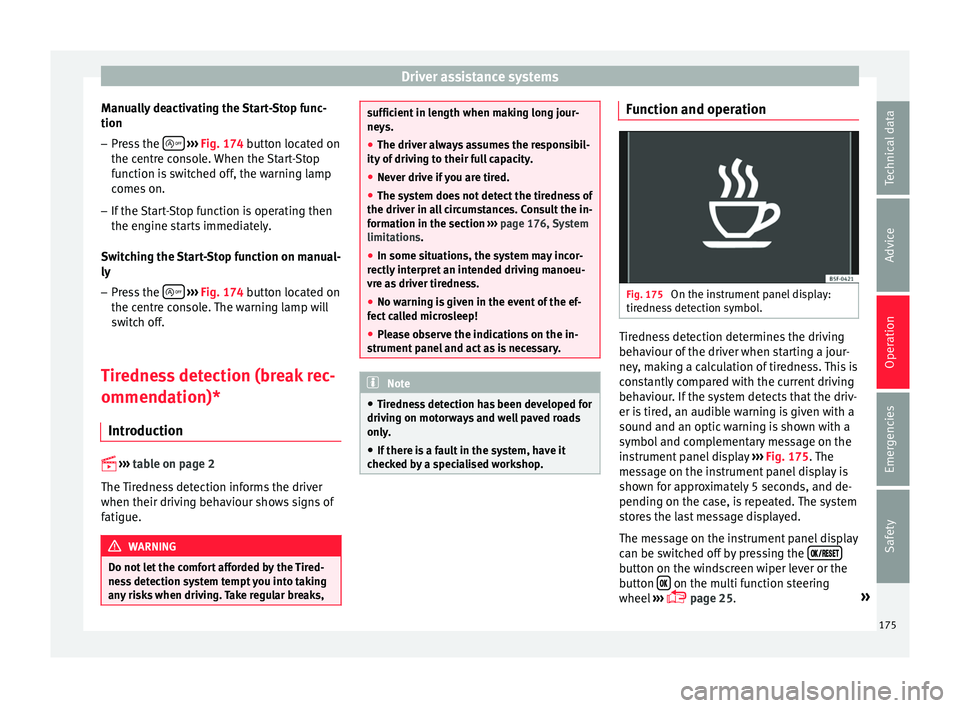
Fig. 175
On the instrument panel display:
tir edne
s
s detection symbol. Tiredness detection determines the driving
beh
av
iour of
the driver when starting a jour-
ney, making a calculation of tiredness. This is
constantly compared with the current driving
behaviour. If the system detects that the driv-
er is tired, an audible warning is given with a
sound and an optic warning is shown with a
symbol and complementary message on the
instrument panel display ››› Fig. 175. The
message on the instrument panel display is
shown for approximately 5 seconds, and de-
pending on the case, is repeated. The system
stores the last message displayed.
The message on the instrument panel display
can be switched off by pressing the button on the windscreen wiper lever or the
b
utt
on on the multi function steering
wheel
›
›
› page 25. »
175
Technical data
Advice
Operation
Emergencies
Safety
Page 188 of 248
Operation
Selecting the system setting
● If necessary, switch on the ignition.
● To select SPORT mode, press the
›››
Fig. 183 b utt
on u ntil it lights up.
The CONVENIENCE mode is active when the button is not lit. The set mode remains
sel ect
ed af
ter the ignition is switched off.
CUPRA vehicle version
The modes of operation for the CUPRA are
Normal and Sport rather than Comfort and
Sport. The vehicle always starts up in Nor-
mal. The last selection does not remain once
the vehicle is turned off. WARNING
Adjusting the “SEAT Drive Profile” modifies
drivin g pr
operties. The “SEAT Drive Profile”
system should never encourage you to take
risks.
● Adapt your speed and driving style at all
times t
o suit visibility, weather, road and traf-
fic conditions. WARNING
If the warning lamps and the corresponding
mes s
ages are ignored when they light up, the
vehicle may stall in traffic and cause acci-
dents and severe injuries.
● Never ignore the warning lamps or messag-
es. ●
Stop the v
ehicle at the next opportunity
and in a safe place. CAUTION
Failure to heed the control lamps and corre-
s pondin g t
ext messages when they light up
may result in damage to the vehicle. Note
If the “SEAT Drive Profile” system presents a
fau lt, the
symbol appears on the instrument
panel, with the message Fault: Damping
setting . Indication on the display and warning
l
amp
There is a fault in the “SEAT Drive Pro-
file” suspension.
See a specialised workshop immediately and have the
“SEAT Drive Profile” suspension checked.
If the yellow warning lamp does not light up again after
the engine is restarted and the vehicle has travelled a
short distance, you do not need to take it to a special-
ised workshop. Some warning and indication lamps will light
up briefly
when the ignition i
s
switched on to
check certain functions. They will switch off
after a few seconds. WARNING
If the warning lamps and the corresponding
mes s
ages are ignored when they light up, the
vehicle may stall in traffic and cause acci-
dents and severe injuries.
● Never ignore the warning lamps or messag-
es. WARNING
Changing the “SEAT Drive Profile” settings
whil e the
vehicle is in motion can distract you
from the road and lead to accidents. CAUTION
Failure to heed the control lamps when they
light up and the c orr
esponding messages
may result in damage to the vehicle. Note
If the “SEAT Drive Profile” system does not
work a
s described in this chapter, have it
checked immediately by a specialised work-
shop. 186
Page 204 of 248
Advice
fluids and consumables replaced by a Techni-
c al
Service. Please observe the relevant in-
structions ››› page 190. The engine compart-
ment of the vehicle is a hazardous area ››› .
WARNING
All work on the engine or in the engine com-
par tment, e.
g. checking and refilling fluids,
involves the danger of injury and burns, acci-
dents and even fire.
● Never open the bonnet if you see steam,
smoke or coo
lant escaping from the engine
compartment. Otherwise, there is a risk of
sustaining burns. Wait until no more steam or
coolant is emitted, then allow the engine to
cool before carefully opening the bonnet.
● Switch off the engine and remove the key
from the ignition.
● App
ly the handbrake and move the gear
lever t
o neutral or selector lever to position P.
● Keep children away from the vehicle.
● Never touch hot engine parts. There is a
risk of
burns.
● Never spill liquids on a hot engine or on a
hot exh
aust gas system. This is a fire hazard.
● Avoid causing short-circuits in the electri-
cal
system, particularly at the points where
the jump leads are attached ›››
page 52.
The battery could explode.
● Never touch the radiator fan. It is tempera-
ture c
ontrolled and could start automatically,
even when the engine has been switched off
and the key removed from the ignition! ●
Never c o
ver the engine with additional in-
sulating materials such as a blanket. Risk of
fire!
● Do not unscrew the cap on the coolant ex-
pans
ion tank when the engine is hot. If the
coolant is hot, the cooling system will be
pressurised!
● Protect face, hands and arms by covering
the cap with a l
arge, thick cloth to protect
against escaping coolant and steam.
● Always make sure you have not left any ob-
jects, s
uch as cleaning cloths or tools, in the
engine compartment.
● If you have to work underneath the vehicle,
you mus
t use suitable stands additionally to
support the vehicle, there is a risk of acci-
dent!. A hydraulic jack is insufficient for se-
curing the vehicle and there is a risk of injury.
● If any work has to be performed when the
engine is
started or with the engine running,
there is an additional, potentially fatal, safety
risk from the rotating parts, such as the drive
belts, alternator, radiator fan, etc., and from
the high-voltage ignition system. You should
also observe the following:
– Never touch the electrical wiring of the
ignition system.
– Ensure that jewellery, loose clothing and
long hair do not get trapped in rotating
engine parts. Danger of death. Before
starting any work remove jewellery, tie
back and cover hair, and wear tight-fit-
ting clothes. –
Never ac c
elerate with a gear engaged
without taking the necessary precau-
tions. The vehicle could move, even if the
handbrake is applied. Danger of death.
● If work has to be carried out on the fuel
syst
em or on electrical components, you
must observe the following safety notes in
addition to the above warnings:
– Always disconnect the battery from the
on-board network. The vehicle must be
unlocked when this is done, otherwise
the alarm will be triggered.
– Do not smoke.
– Never work near naked flames.
– Always have a fire extinguisher on hand. WARNING
If the bonnet is not correctly closed, it could
sud den
ly open while driving leaving the driv-
er without visibility. This could result in a se-
rious accident.
● After closing the bonnet, always check that
it is
properly secured by the locking mecha-
nism in the lock carrier piece. The bonnet
must be flush with the surrounding body pan-
els.
● While driving, if you notice that the bonnet
is not
correctly closed then stop immediately
and close it correctly.
● Only open and close the bonnet when there
is no
body within its range.202
Page 210 of 248
Advice
●
If w ork
ing inside the engine compartment,
remember that, even when the ignition is
switched off, the radiator fan may start up au-
tomatically, and therefore there is a risk of in-
jury. WARNING
If there is not enough anti-freeze in the cool-
ant sys
tem, the engine may fail leading to se-
rious damage.
● Please make sure that the percentage of
additiv
e is correct with respect to the lowest
expected ambient temperature in the zone in
which the vehicle is to be used.
● When the outside temperature is very low,
the cool
ant could freeze and the vehicle
would be immobilised. In this case, the heat-
ing would not work either and inadequately
dressed passengers could die of cold. CAUTION
Do not top up the expansion tank with cool-
ant fluid if it
is empty! Air could enter the
cooling system. In this case, stop driving.
Seek specialist assistance. Otherwise, there
is a risk of engine damage. CAUTION
The original additives should never be mixed
with c oo
lants which are not approved by
SEAT. Otherwise, you run the risk of causing severe damage to the engine and the engine
coo
lin
g system.
● If the fluid in the expansion tank is not pur-
ple b
ut is, for example, brown, this indicates
that the G13 additive has been mixed with an
inadequate coolant. The coolant must be
changed as soon as possible if this is the
case! This could result in serious faults and
engine damage. For the sake of the environment
Coolants and additives can contaminate the
en vir
onment. If any fluids are spilled, they
should be collected and correctly disposed
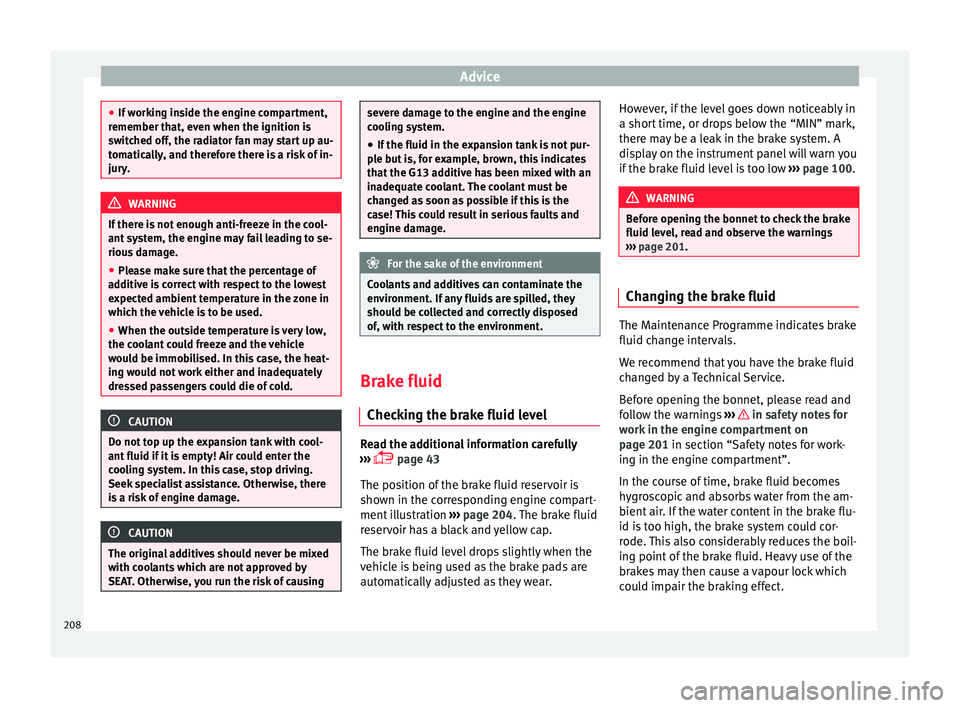
of, with respect to the environment. Brake fluid
Chec k
in
g the brake fluid level Read the additional information carefully
› ›
›
page 43
The position of the brake fluid reservoir is
shown in the corresponding engine compart-
ment illustration ››› page 204. The brake fluid
reservoir has a black and yellow cap.
The brake fluid level drops slightly when the
vehicle is being used as the brake pads are
automatically adjusted as they wear. However, if the level goes down noticeably in
a short time, or dr
ops below the “MIN” mark,
there may be a leak in the brake system. A
display on the instrument panel will warn you
if the brake fluid level is too low ››› page 100. WARNING
Before opening the bonnet to check the brake
fluid lev el, r
ead and observe the warnings
››› page 201. Changing the brake fluid
The Maintenance Programme indicates brake
fluid c
h
an
ge intervals.
We recommend that you have the brake fluid
changed by a Technical Service.
Before opening the bonnet, please read and
follow the warnings ››› in safety notes for
w ork
in the en
gine compartment on
page 201 in section “Safety notes for work-
ing in the engine compartment”.
In the course of time, brake fluid becomes
hygroscopic and absorbs water from the am-
bient air. If the water content in the brake flu-
id is too high, the brake system could cor-
rode. This also considerably reduces the boil-
ing point of the brake fluid. Heavy use of the
brakes may then cause a vapour lock which
could impair the braking effect.
208
Page 223 of 248
Technical specifications
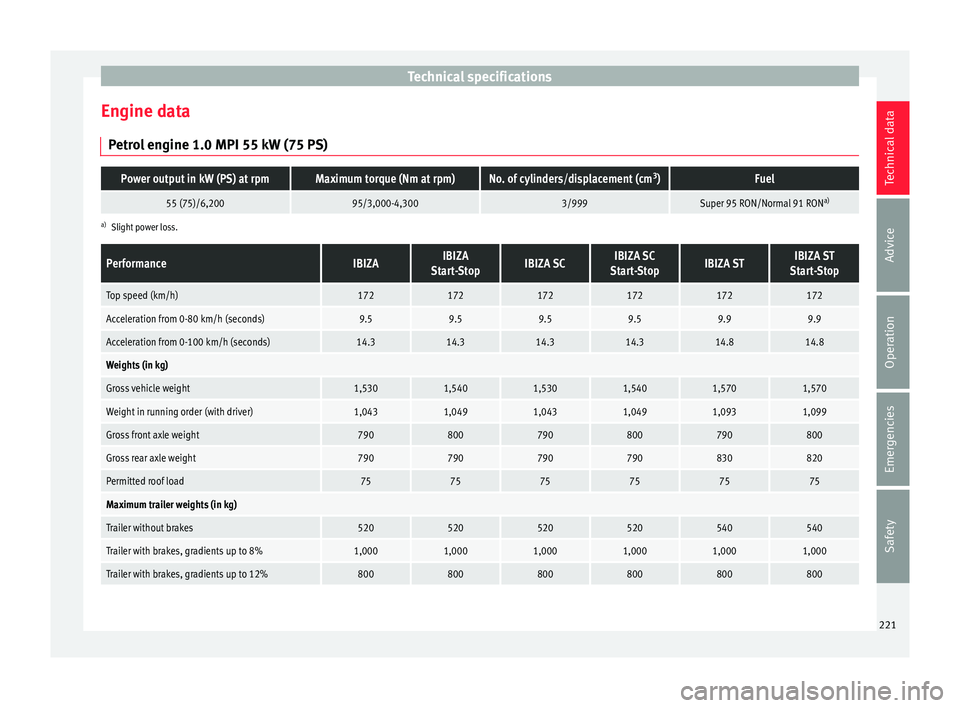
Engine data P etr
o
l engine 1.0 MPI 55 kW (75 PS)
Power output in kW (PS) at rpmMaximum torque (Nm at rpm)No. of cylinders/displacement (cm 3
)Fuel
55 (75)/6,20095/3,000-4,3003/999Super 95 RON/Normal 91 RON a)
a)
Slight power loss.
PerformanceIBIZAIBIZA
Start-StopIBIZA SCIBIZA SC
Start-StopIBIZA STIBIZA ST
Start-Stop
Top speed (km/h)172172172172172172
Acceleration from 0-80 km/h (seconds)9.59.59.59.59.99.9
Acceleration from 0-100 km/h (seconds)14.314.314.314.314.814.8
Weights (in kg)
Gross vehicle weight1,5301,5401,5301,5401,5701,570
Weight in running order (with driver)1,0431,0491,0431,0491,0931,099
Gross front axle weight790800790800790800
Gross rear axle weight790790790790830820
Permitted roof load757575757575
Maximum trailer weights (in kg)
Trailer without brakes520520520520540540
Trailer with brakes, gradients up to 8%1,0001,0001,0001,0001,0001,000
Trailer with brakes, gradients up to 12%800800800800800800 221
Technical data
Advice
Operation
Emergencies
Safety
Page 226 of 248
Technical data
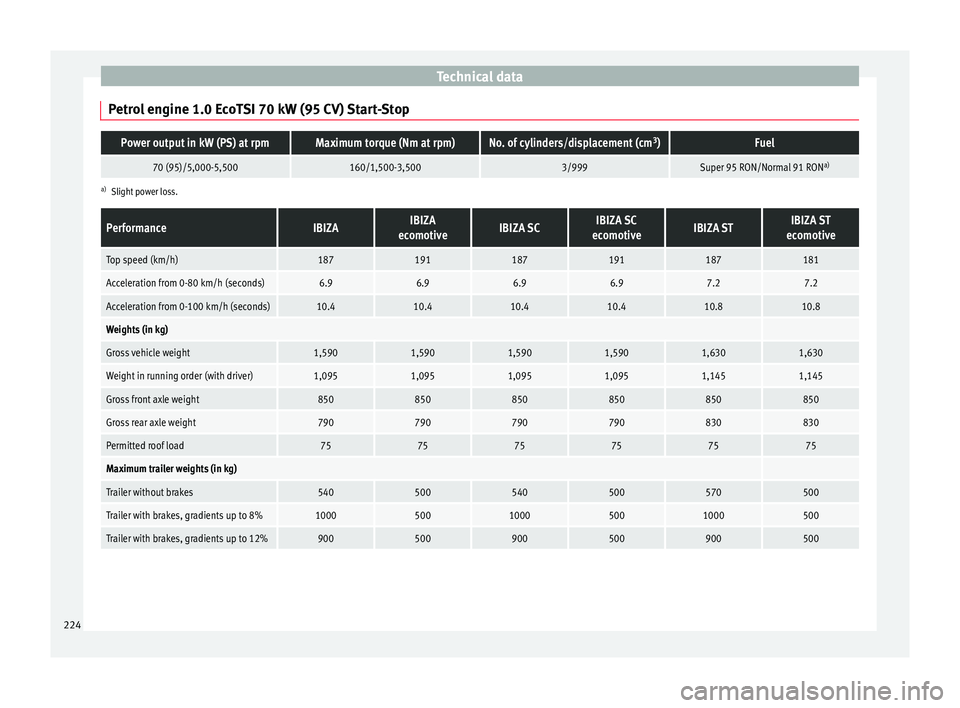
Petrol engine 1.0 EcoTSI 70 kW (95 CV) Start-StopPower output in kW (PS) at rpmMaximum torque (Nm at rpm)No. of cylinders/displacement (cm 3
)Fuel
70 (95)/5,000-5,500160/1,500-3,5003/999Super 95 RON/Normal 91 RON a)
a)
Slight power loss.
PerformanceIBIZAIBIZA
ecomotiveIBIZA SCIBIZA SC
ecomotiveIBIZA STIBIZA ST
ecomotive
Top speed (km/h)187191187191187181
Acceleration from 0-80 km/h (seconds)6.96.96.96.97.27.2
Acceleration from 0-100 km/h (seconds)10.410.410.410.410.810.8
Weights (in kg)
Gross vehicle weight1,5901,5901,5901,5901,6301,630
Weight in running order (with driver)1,0951,0951,0951,0951,1451,145
Gross front axle weight850850850850850850
Gross rear axle weight790790790790830830
Permitted roof load757575757575
Maximum trailer weights (in kg)
Trailer without brakes540500540500570500
Trailer with brakes, gradients up to 8%100050010005001000500
Trailer with brakes, gradients up to 12%900500900500900500 224
Page 227 of 248
Technical specifications
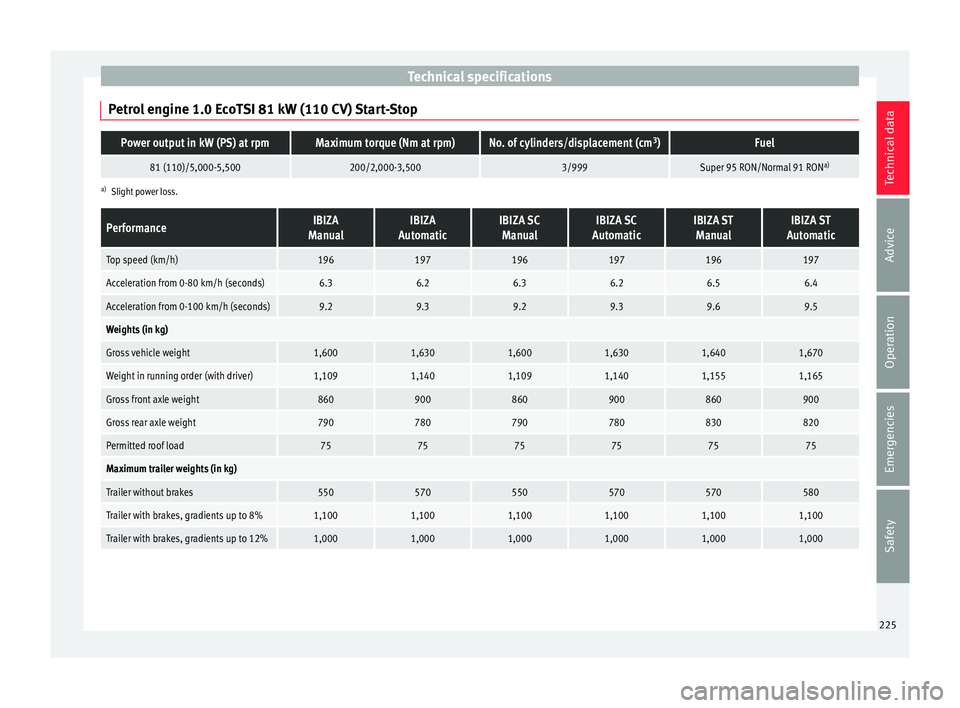
Petrol engine 1.0 EcoTSI 81 kW (110 CV) Start-StopPower output in kW (PS) at rpmMaximum torque (Nm at rpm)No. of cylinders/displacement (cm 3
)Fuel
81 (110)/5,000-5,500200/2,000-3,5003/999Super 95 RON/Normal 91 RON a)
a)
Slight power loss.
PerformanceIBIZA
ManualIBIZA
AutomaticIBIZA SC ManualIBIZA SC
AutomaticIBIZA ST ManualIBIZA ST
Automatic
Top speed (km/h)196197196197196197
Acceleration from 0-80 km/h (seconds)6.36.26.36.26.56.4
Acceleration from 0-100 km/h (seconds)9.29.39.29.39.69.5
Weights (in kg)
Gross vehicle weight1,6001,6301,6001,6301,6401,670
Weight in running order (with driver)1,1091,1401,1091,1401,1551,165
Gross front axle weight860900860900860900
Gross rear axle weight790780790780830820
Permitted roof load757575757575
Maximum trailer weights (in kg)
Trailer without brakes550570550570570580
Trailer with brakes, gradients up to 8%1,1001,1001,1001,1001,1001,100
Trailer with brakes, gradients up to 12%1,0001,0001,0001,0001,0001,000 225
Technical data
Advice
Operation
Emergencies
Safety
Page 230 of 248
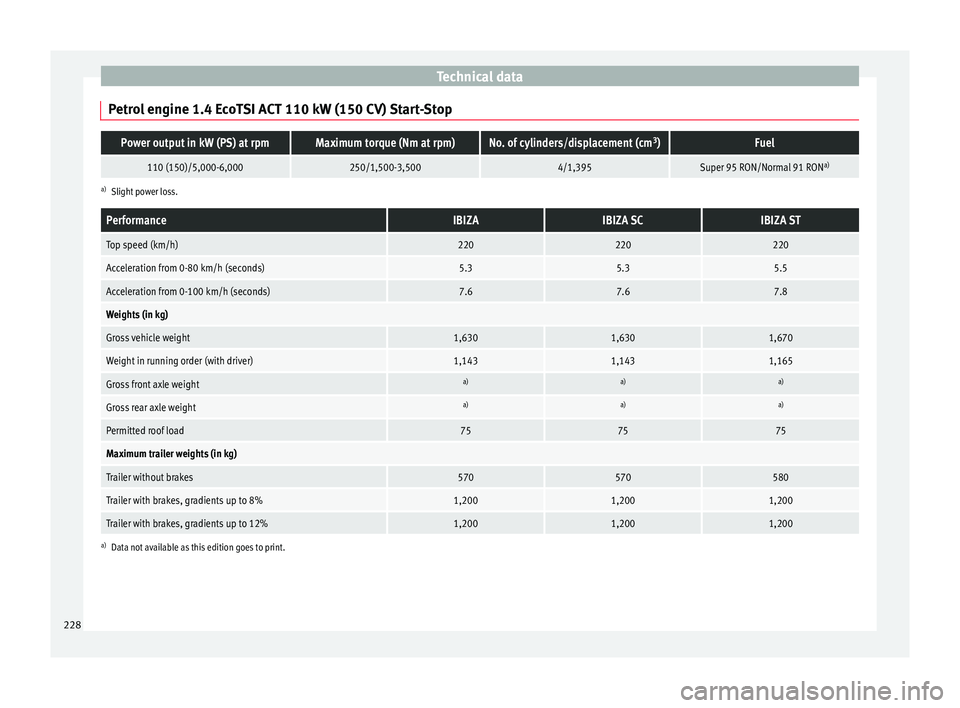
Technical data
Petrol engine 1.4 EcoTSI ACT 110 kW (150 CV) Start-StopPower output in kW (PS) at rpmMaximum torque (Nm at rpm)No. of cylinders/displacement (cm 3
)Fuel
110 (150)/5,000-6,000250/1,500-3,5004/1,395Super 95 RON/Normal 91 RON a)
a)
Slight power loss.
PerformanceIBIZAIBIZA SCIBIZA ST
Top speed (km/h)220220220
Acceleration from 0-80 km/h (seconds)5.35.35.5
Acceleration from 0-100 km/h (seconds)7.67.67.8
Weights (in kg)
Gross vehicle weight1,6301,6301,670
Weight in running order (with driver)1,1431,1431,165
Gross front axle weighta)a)a)
Gross rear axle weighta)a)a)
Permitted roof load757575
Maximum trailer weights (in kg)
Trailer without brakes570570580
Trailer with brakes, gradients up to 8%1,2001,2001,200
Trailer with brakes, gradients up to 12%1,2001,2001,200
a)Data not available as this edition goes to print. 228
Page 231 of 248
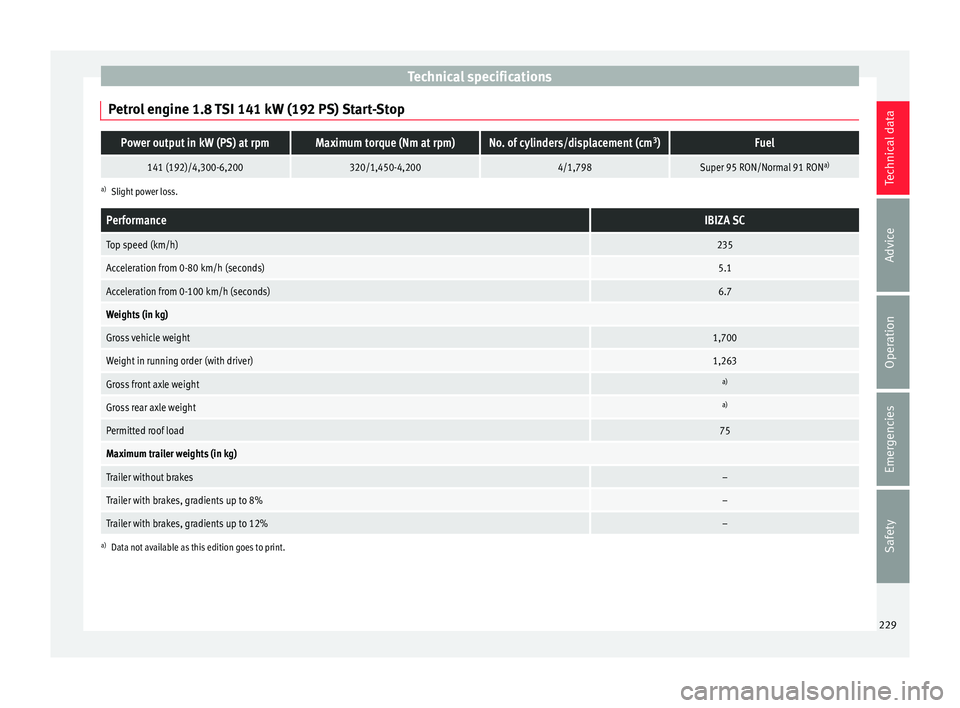
Technical specifications
Petrol engine 1.8 TSI 141 kW (192 PS) Start-StopPower output in kW (PS) at rpmMaximum torque (Nm at rpm)No. of cylinders/displacement (cm 3
)Fuel
141 (192)/4,300-6,200320/1,450-4,2004/1,798Super 95 RON/Normal 91 RON a)
a)
Slight power loss.
PerformanceIBIZA SC
Top speed (km/h)235
Acceleration from 0-80 km/h (seconds)5.1
Acceleration from 0-100 km/h (seconds)6.7
Weights (in kg)
Gross vehicle weight1,700
Weight in running order (with driver)1,263
Gross front axle weighta)
Gross rear axle weighta)
Permitted roof load75
Maximum trailer weights (in kg)
Trailer without brakes–
Trailer with brakes, gradients up to 8%–
Trailer with brakes, gradients up to 12%–
a)Data not available as this edition goes to print. 229
Technical data
Advice
Operation
Emergencies
Safety