ECO mode SEAT IBIZA 5D 2017 Owner's Manual
[x] Cancel search | Manufacturer: SEAT, Model Year: 2017, Model line: IBIZA 5D, Model: SEAT IBIZA 5D 2017Pages: 248, PDF Size: 5.24 MB
Page 167 of 248
Driving
● Reduction of
volatile components, includ-
ing odour, in plastic materials.
● Use of CFC-free coolants.
Ban on heavy
metals, with the exceptions
dictated by law (Annex II of ELV Directive
2000/53/EC): cadmium, lead, mercury, hexa-
valent chromium.
Manufacturing methods
● Reduction of the quantity of thinner in the
protectiv
e wax for cavities.
● Use of plastic film as protection during ve-
hicle tr
ansport.
● Use of solvent-free adhesives.
● Use of CFC-free coolants in cooling sys-
tems.
● Recy
cling and energy recovery from resi-
dues (RDF).
● Impr
ovement in the quality of waste water.
● Use of systems for the recovery of residual
heat (therm
al recovery, enthalpy wheels,
etc.).
● The use of water-soluble paints.
Economical and environmentally-
friendly drivin
gFuel consumption, environmental pollution
and w
e
ar t
o the engine, brakes and tyres de- pends in large part on your driving style. By
adopting an ec
onomical driving style and an-
ticipating the traffic situation ahead, you can
easily reduce fuel consumption by 10-15%.
Some tips on how to help you reduce pollu-
tion while saving money are listed below.
Active cylinder management (ACT ®
)
Depending on the equipment, the vehicle
may have active cylinder management
(ACT ®
).
The active cylinder management (ACT ®
) may
automatically deactivate some of the engine
cylinders if the driving situation does not re-
quire too much power. When it is switched
off, no fuel is injected into these cylinders,
hence total fuel consumption may be re-
duced. The number of active cylinders can be
seen on the instrument panel display
››› page 30.
Drive anticipating the traffic situation
A vehicle uses most fuel when accelerating.
When you anticipate situations, you have to
brake less often and, thus, accelerate less. If
it is possible, let the vehicle roll with a gear
engaged, for example, if you see a red light
ahead. The braking effect achieved in this
way helps to reduce the wear of brakes and
tyres; emissions and fuel consumption are
reduced to zero (disconnection due to iner-
tia). Change gear early to save energy
An effective w
ay of saving fuel is to change
up quickly through the gears. Running the
engine at high rpm in the lower gears uses
an unnecessary amount of fuel.
Manual gearbox: shift up from first to second
gear as soon as possible. We recommend
that, whenever possible, you change to a
higher gear upon reaching 2000 rpm. Follow
the “recommended gear” indication that ap-
pears on the instrument panel ››› page 158.
Avoid driving at high speed
We advise you not to drive at the top speed
permitted by the vehicle. Fuel consumption,
exhaust emissions and noise levels all in-
crease very rapidly at higher speeds. Driving
at moderate speeds will help to save fuel.
Avoid idling
It is worthwhile switching off the engine
when waiting in a traffic jam, at level cross-
ings or at traffic lights with a long red phase.
The fuel saved after only 30 - 40 seconds is
greater than the amount of fuel needed to re-
start the engine.
The engine takes a long time to warm up
when it is idling. Mechanical wear and pollu-
tant emissions are also especially high dur-
ing this initial warm-up phase. It is therefore
best to drive off immediately after starting »
165
Technical data
Advice
Operation
Emergencies
Safety
Page 185 of 248
Towing bracket device and trailer
●
Stop the v
ehicle at the next opportunity
and in a safe place. CAUTION
Failure to heed the control lamps and corre-
s pondin g t
ext messages when they light up
may result in damage to the vehicle. Note
If the “SEAT Drive Profile” system presents a
fau lt, the
symbol appears on the instrument
panel, with the message Fault: Damping
setting . Indication on the display and warning
l
amp
There is a fault in the “SEAT Drive Pro-
file” suspension.
See a specialised workshop immediately and have the
“SEAT Drive Profile” suspension checked.
If the yellow warning lamp does not light up again after
the engine is restarted and the vehicle has travelled a
short distance, you do not need to take it to a special-
ised workshop. Some warning and control lamps will light up
briefly
when the ignition i
s
switched on to
check certain functions. They will switch off
after a few seconds. WARNING
If the warning lamps and the corresponding
mes s
ages are ignored when they light up, the
vehicle may stall in traffic and cause acci-
dents and severe injuries.
● Never ignore the warning lamps or messag-
es. WARNING
Changing the “SEAT Drive Profile” settings
whil e the
vehicle is in motion can distract you
from the road and lead to accidents. CAUTION
Failure to heed the control lamps when they
light up and the c orr
esponding messages
may result in damage to the vehicle. Note
If the “SEAT Drive Profile” system does not
work a
s described in this chapter, have it
checked immediately by a specialised work-
shop. Towing bracket device and
tr
ai
l
er
Trailer mode What do you need to bear in mind
when towing a trailer? Your vehicle may be used to tow a trailer
when fitted w
ith the c
orrect equipment.
If the car is supplied with a factory-fitted tow-
ing bracket it will already have the necessary
technical modifications and meet the statuto-
ry requirements for towing a trailer. If you
wish to retrofit a towing bracket, consult
››› page 185.
Connectors
Your vehicle is fitted with a 12-pin connector
for the electrical connection between the
trailer and the vehicle.
If the trailer has a 7-pin plug you will need to
use an adapter cable. It is available at any
Technical Service.
Trailer weight/drawbar load
Never exceed the authorised trailer weight. If
you do not load the trailer up to the maxi-
mum permitted trailer weight, you can then
climb correspondingly steeper slopes. »
183
Technical data
Advice
Operation
Emergencies
Safety
Page 186 of 248
Operation
The maximum trailer weights listed are only
ap p
lic
able for altitudes up to 1000 m above
sea level. With increasing altitude the engine
power and therefore the vehicle climbing
ability are impaired because of the reduced
air density. The maximum trailer weight has
to be reduced accordingly. The weight of the
vehicle and trailer combination must be re-
duced by 10% for every further 1000 m (or
part thereof). The gross combination weight
is the actual weight of the laden vehicle plus
the actual weight of the laden trailer. When
possible, operate the trailer with the maxi-
mum permitted drawbar load on the ball joint
of the towing bracket, but do not exceed the
specified limit.
The figures for trailer weights and drawbar
loads that are given on the data plate of the
towing bracket are for certification purposes
only. The correct figures for your specific
model, which may be lower than these fig-
ures for the towing bracket, are given in the
vehicle documentation or in ››› chapter Tech-
nical Data .
Distributing the load
Distribute loads in the trailer so that heavy
objects are as near to the axle as possible.
Loads carried in the trailer must be secured
to prevent them moving. Tyre pressure
Set tyr
e pressure to the maximum permissi-
ble pressure shown on the sticker on the in-
side of the fuel tank flap. Set the tyre pres-
sure of the trailer tyres in accordance with the
trailer manufacturer's recommendations.
Exterior mirrors
Check whether you can see enough of the
road behind the trailer with the standard rear
vision mirrors. If this is not the case, you
should have additional exterior mirrors fitted.
Both exterior mirrors should be mounted on
hinged extension brackets. Adjust the mirrors
to give sufficient vision to the rear. WARNING
Never transport people in a trailer. This could
re s
ult in fatal accidents. Note
● To w
ing a trailer places additional demands
on the vehicle. We recommend additional
services between the normal inspection inter-
vals if the vehicle is used frequently for tow-
ing a trailer.
● Find out whether special regulations apply
to to
wing a trailer in your country. Ball coupling of towing bracket*
The ball coupling is provided with instruc-
tions
on fittin
g and removing the ball cou-
pling of the towing bracket. WARNING
The towing bracket ball coupling must be
st or
ed securely in the luggage compartment
to prevent them being flung through the vehi-
cle and causing injury. Note
● By l
aw, the ball coupling must be removed
if a trailer is not being towed if it obscures
the number plate. Driving tips
Driving with a trailer always requires extra
c
ar
e.
W
eight distribution
The weight distribution of a loaded trailer
with an unladen vehicle is very unfavourable.
However, if this cannot be avoided, drive ex-
tra slowly to allow for the unbalanced weight
distribution.
184
Page 199 of 248
Checking and refilling levels
Super unleaded 95 octane or normal 91 oc-
t ane u
n
leaded petrol
We recommend you use super 95 octane pet-
rol. If this is not available: normal 91 octane
petrol, with a slight decrease in power.
Super unleaded petrol with a minimum of 95
octanes
You should use super petrol with a minimum
of 95 octanes.
If super is not available, in an emergency you
may refuel with normal 91 octane petrol. In
this case only use moderate engine speeds
and a light throttle. Refuel with super as soon
as possible.
Super unleaded 98 octane or super 95 oc-
tane unleaded petrol
We recommend you use super plus 98 octane
petrol. If this is not available: super 95 oc-
tane petrol, with a slight decrease in power.
If super is not available, in an emergency you
may refuel with normal 91 octane petrol. In
this case only use moderate engine speeds
and a light throttle. Refuel with super as soon
as possible.
Petrol additives
The quality of the fuel influences the behav-
iour, power and service life of the engine.
This is why the petrol you use should carry
suitable additives already included by the petrol industry, free of metals. These addi-
tives
will help to prevent corrosion, keep the
fuel system clean and prevent deposits from
building up in the engine.
If good-quality petrol with metal-free addi-
tives is not available or engine problems
arise, the necessary additives must be added
when refuelling ››› .
Not al
l
petrol additives have been shown to
be effective. The use of unsuitable petrol ad-
ditives may cause significant damage to the
engine and the catalytic converter. Metal ad-
ditives should never be used. Metal additives
may also be contained in petrol additives for
improving anti-detonation ratings or octane
ratings ››› .
S EA
T r
ecommends “genuine Volkswagen
Group Fuel Additives for petrol engines”.
These additives can be bought at SEAT deal-
ers, where information on how to use them
can also be obtained. CAUTION
● Do not r ef
uel if the filler indicates that the
fuel contains metal. LRP ( lead replacement
petrol) fuels contain high concentrations of
metal additives. Using them may damage the
engine!
● Never refuel with fuels containing a large
proportion of
ethanol (for example, E50, E85).
This could damage the fuel system. ●
Jus t
filling one full tank of leaded fuel or
fuel containing other metal additives would
seriously impair the efficiency of the catalytic
converter.
● Only use fuel additives that have been ap-
prov
ed by SEAT. Octane boosting or anti-
knock additives may contain metal additives
that could seriously damage the engine or
the catalytic converter. These additives must not be used.
● High engine speed and full throttle can
damag
e the engine when using petrol with an
octane rating lower than the correct grade for
the engine. Note
● You m a
y use petrol with a high octane num-
ber than the one recommended for your en-
gine.
● In those countries where unleaded petrol is
not avai
lable, you may refuel with a fuel with
a low lead content. Diesel fuel
Please note the information on the inside of
the f
uel
t
ank flap.
We recommend the use of diesel fuel which
complies to European standard EN 590. If
diesel fuel which meets European standard
EN 590 is not available, the Cetane number
(CZ) must, at minimum, be 51. If the engine »
197
Technical data
Advice
Operation
Emergencies
Safety
Page 214 of 248
Advice
Unbalanced wheels should be rebalanced, as
they other
w
ise cause excessive wear on
steering, suspension and tyres. A wheel must
also be rebalanced when a new tyre is fitted.
Incorrect wheel alignment
Incorrect running gear alignment causes ex-
cessive tyre wear, impairing the safety of the
vehicle. If tyres show excessive wear, you
should have the wheel alignment checked by
a Technical Service. WARNING
There is a serious danger of accidents if a tyre
bur s
ts during driving!
● The tyres must be replaced at the latest
when the trea
d wear indicators are worn
››› page 211. Failure to follow this instruction
could result in an accident. Worn tyres do not
grip well at high speeds on wet roads. There
is also a greater risk of “aquaplaning”.
● At continuously high speeds, a tyre with in-
sufficient
pressure flexes more. This causes it
to overheat. This can cause tread separation
and tyre blow-out. Risk of accident. Always
observe the recommended tyre pressures.
● If tyres show excessive wear, you should
have the ru
nning gear checked by a Technical
Service.
● Keep chemicals such as oil, fuel and brake
fluid awa
y from tyres.
● Damaged wheels and tyres must be re-
plac
ed immediately! For the sake of the environment
Under-inflated tyres will increase fuel con-
sumption. New tyres and wheels
New tyres and wheels have to be run in.
The tyr
e
s and wheel rims are an essential
part of the vehicle's design. Those approved
by SEAT are specially matched to the charac-
teristics of the vehicle and make a major con-
tribution to good road-holding and safe han-
dling ››› .
T y
r
es should be replaced at least in pairs and
not individually (i.e. both front tyres or both
rear tyres together). A knowledge of tyre des-
ignations makes it easier to choose the cor-
rect tyres. Radial tyres have the tyre designa-
tions marked on the sidewall, for example:
195/65 R15 91T
This contains the following information:
Tyre width in mm
Height/width ratio in %
Tyre construction: Radial
Rim diameter in inches
Load rating code
Speed rating
195
65
R
15
91
T The tyres could also have the following infor-
mation:
● A direction of
rotation symbol
● “Reinforced” denotes heavy-duty tyres.
The manufact
uring date is also indicated on
the tyre sidewall (possibly only on the inner
side of the wheel).
“DOT ... 1103 ...” means, for example, that
the tyre was produced in the 11th week of
2003.
We recommend that work on tyres and
wheels be carried out by a Technical Service.
They are familiar with the procedure and
have the necessary special tools and spare
parts as well as the proper facilities for dis-
posing of the old tyres.
Any technical service has full information on
the technical requirements when installing or
changing tyres, wheels or wheel trims. WARNING
● We r ec
ommend that you use only wheels
and tyres which have been approved by SEAT
for your model. Failure to do so could impair
vehicle handling. Risk of accident.
● Avoid running the vehicle on tyres that are
more than 6
years old. If you have no alterna-
tive, you should drive slowly and with extra
care at all times. 212
Page 215 of 248
Wheels
●
Never u se o
ld tyres or those with an un-
known “history of use”.
● If wheel trims are retrofitted, you must en-
sure th
at the flow of air to the brakes is not
restricted. This could cause the brake system
to overheat.
● All four wheels must be fitted with radial
tyre
s of the same type, size (rolling circumfer-
ence) and the same tread pattern. For the sake of the environment
Old tyres must be disposed of according to
the l aw
s in the country concerned. Note
● A S EA
T Service Centre should be consulted
to find out whether wheels or tyres of differ-
ent sizes to those originally fitted by SEAT
can be fitted, and to find out about the com-
binations allowed between the front axle
(axle 1) and the rear axle (axle 2).
● For technical reasons, it is not generally
poss
ible to use the wheels from other vehi-
cles. This can also apply to wheels of the
same model. The use of wheels or tyres
which have not been approved by SEAT for
use with your model may invalidate the vehi-
cle's type approval for use on public roads.
● If the spare tyre is not the same as the
tyre
s that are mounted on the vehicle (e.g.
winter tyres) you should only use the spare
tyre for a short period of time and drive with extra care. Refit the normal road wheel as
soon as
po
ssible. Wheel bolts
The design of wheel bolts is matched to the
rims. If diff
er
ent wheel rims are fitted, the
correct wheel bolts with the right length and
correctly shaped bolt heads must be used.
This ensures that wheels are fitted securely
and that the brake system functions correctly.
In certain circumstances, you should not use
wheel bolts from a different vehicle, even if it
is the same model ››› page 187. WARNING
If the wheel bolts are not tightened correctly,
the wheel c ou
ld become loose while driving.
Risk of accident.
● The wheel bolts must be clean and turn
eas
ily. Never apply grease or oil to them.
● Use only wheel bolts which belong to the
wheel.
● If the pr
escribed torque of the wheel bolts
is t
oo low, they could loosen whilst the vehi-
cle is in motion. Risk of accident! If the tight-
ening torque is too high, the wheel bolts and
threads can be damaged. CAUTION
The prescribed tightening torque for wheel
bolt s
for steel and alloy wheels is 120 Nm. Tyre pressure
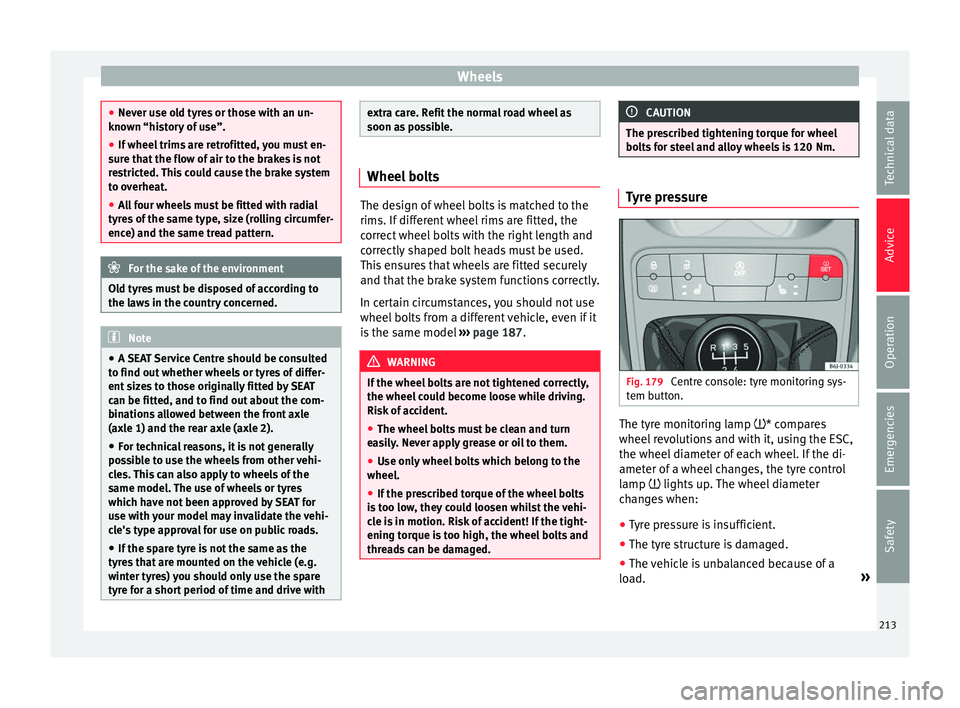
Fig. 179
Centre console: tyre monitoring sys-
t em b
utt
on. The tyre monitoring lamp * c
omp
ar
es
wheel revolutions and with it, using the ESC,
the wheel diameter of each wheel. If the di-
ameter of a wheel changes, the tyre control
lamp lights up. The wheel diameter
changes when:
● Tyre pressure is insufficient.
● The tyre structure is damaged.
● The vehicle is unbalanced because of a
load. »
213
Technical data
Advice
Operation
Emergencies
Safety
Page 238 of 248
Index
Driving abroad he a
dlights
. . . . . . . . . . . . . . . . . . . . . . . . . . . . . 169
petrol . . . . . . . . . . . . . . . . . . . . . . . . . . . . . . . . . 169
Driving assistance systems cruise control . . . . . . . . . . . . . . . . . . . . . . . . . . 180
Driving data data summary . . . . . . . . . . . . . . . . . . . . . . . . . . . 30
memory . . . . . . . . . . . . . . . . . . . . . . . . . . . . . . . . 29
Driving on flooded roads . . . . . . . . . . . . . . . . . . . 169
Driving safety . . . . . . . . . . . . . . . . . . . . . . . . . . . . . 56
Driving with a trailer . . . . . . . . . . . . . . . . . . . . . . . 183
DSG . . . . . . . . . . . . . . . . . . . . . . . . . . . . . . . . . . . . 158
Duplicate keys . . . . . . . . . . . . . . . . . . . . . . . . . . . 110
Dust and pollen filter . . . . . . . . . . . . . . . . . . . . . . 137
Dynamic headlight range control . . . . . . . . . . . . 121
E E10 see Ethanol (fuel) . . . . . . . . . . . . . . . . . . . . . . . 196
Easy Connect . . . . . . . . . . . . . . . . . . . . . . . . . . 24, 99
EDL see Electronic differential lock . . . . . . . . . . . . . 154
EDS . . . . . . . . . . . . . . . . . . . . . . . . . . . . . . . . . . . . 154
Efficiency programme additional electrical appliances . . . . . . . . . . . . 31
saving tips . . . . . . . . . . . . . . . . . . . . . . . . . . . . . . 31
Electrical power socket . . . . . . . . . . . . . . . . . . . . 133
Electric windows . . . . . . . . . . . . . . . . . . . . . . 11, 114 convenience opening/closing . . . . . . . . . . . . . 116
Electrolyte . . . . . . . . . . . . . . . . . . . . . . . . . . . . . . . 209
Electronic differential lock . . . . . . . . . . . . . 152, 154 control lamp . . . . . . . . . . . . . . . . . . . . . . 155, 156
Electronic differential lock (XDS) . . . . . . . . . . . . . 156
Electronic immobiliser . . . . . . . . . . . . . . . . . . . . . 147
Electronic stability control (ESC) . . . . . . . . . . . . . 154
Electronic Stability Control (ESC) . . . . . . . . . . . . 152 Emergencies . . . . . . . . . . . . . . . . . . . . . . . . . . . . . . 75
bul bs . . . . . . . . . . . . . . . . . . . . . . . . . . . . . . . . . . 45
changing a wheel . . . . . . . . . . . . . . . . . . . . . . . . 47
changing the battery . . . . . . . . . . . . . . . . . . . . 209
emergency towing of the vehicle . . . . . . . . . . . . 51
emergency warning triangle . . . . . . . . . . . . . . . 75
fire extinguisher . . . . . . . . . . . . . . . . . . . . . . . . . 75
first-aid kit . . . . . . . . . . . . . . . . . . . . . . . . . . . . . . 75
fuses . . . . . . . . . . . . . . . . . . . . . . . . . . . . . . . . . . 44
hazard warning lights . . . . . . . . . . . . . . . . . . . 121
Jump leads . . . . . . . . . . . . . . . . . . . . . . . . . . . . . 52
panoramic/tilting sunroof . . . . . . . . . . . . . . . . . 11
puncture . . . . . . . . . . . . . . . . . . . . . . . . . . . . . . . 45
replacing a blown fuse . . . . . . . . . . . . . . . . . . . . 44
spare wheel . . . . . . . . . . . . . . . . . . . . . . . . . . . . 75
vehicle tools . . . . . . . . . . . . . . . . . . . . . . . . . . . . 75
Emergency operation selector lever . . . . . . . . . . . . . . . . . . . . . . . . . . . 38
Emergency warning triangle . . . . . . . . . . . . . . . . . 75
Emission control system control lamp . . . . . . . . . . . . . . . . . . . . . . . . . . . 168
Emissions data . . . . . . . . . . . . . . . . . . . . . . . . . . . 216
Engine assisted starting . . . . . . . . . . . . . . . . . . . . . . . . . 52
running in . . . . . . . . . . . . . . . . . . . . . . . . . . . . . 164
Start-Stop system . . . . . . . . . . . . . . . . . . . . . . . 170
Engine compartment . . . . . . . . . . . . . . 10, 198, 201 battery . . . . . . . . . . . . . . . . . . . . . . . . . . . . . . . . 207
brake fluid . . . . . . . . . . . . . . . . . . . . . . . . . . . . . 206
closing . . . . . . . . . . . . . . . . . . . . . . . . . . . . . . . . 200
coolant . . . . . . . . . . . . . . . . . . . . . . . . . . 204, 205
engine oil . . . . . . . . . . . . . . . . . . . . . . . . . . . . . 203
opening . . . . . . . . . . . . . . . . . . . . . . . . . . . . . . . 199
safety notes . . . . . . . . . . . . . . . . . . . . . . . . . . . 198
windscreen washer liquid . . . . . . . . . . . . . . . . 207 Engine coolant . . . . . . . . . . . . . . . . . . . . . . . . . . . . 42
check ing level . . . . . . . . . . . . . . . . . . . . . . . . . . 204
G12 plus-plus . . . . . . . . . . . . . . . . . . . . . . . . . . . 42
G13 . . . . . . . . . . . . . . . . . . . . . . . . . . . . . . . . . . . 42
specifications . . . . . . . . . . . . . . . . . . . . . . . . . . . 42
Engine data . . . . . . . . . . . . . . . . . . . . . . . . . . . . . . 219
Engine fault control lamp . . . . . . . . . . . . . . . . . . . . . . . . . . . 168
Engine management . . . . . . . . . . . . . . . . . . . . . . 166 control lamp . . . . . . . . . . . . . . . . . . . . . . . . . . . 168
Engine oil . . . . . . . . . . . . . . . . . . . . . . . . . . . 41, 201 changing . . . . . . . . . . . . . . . . . . . . . . . . . 201, 204
check oil level . . . . . . . . . . . . . . . . . . . . . . . . . . 203
consumption . . . . . . . . . . . . . . . . . . . . . . . . . . . 203
diesel . . . . . . . . . . . . . . . . . . . . . . . . . . . . . . . . . 201
engine oil dipstick . . . . . . . . . . . . . . . . . . . . . . 203
inspection service . . . . . . . . . . . . . . . . . . . . . . 201
maintenance intervals . . . . . . . . . . . . . . . . . . . 201
oil properties . . . . . . . . . . . . . . . . . . . . . . . . . . . 41
specifications . . . . . . . . . . . . . . . . . . . . . . . . . . 201
temperature display . . . . . . . . . . . . . . . . . . . . . . 31
topping up . . . . . . . . . . . . . . . . . . . . . . . . . . . . 203
Engine oil pressure control lamp . . . . . . . . . . . . . . . . . . . . . . . . . . . 202
Environment ecological driving . . . . . . . . . . . . . . . . . . . . . . . 165
environmental compatibility . . . . . . . . . . . . . . 164
Environmental tips refuelling . . . . . . . . . . . . . . . . . . . . . . . . . . . . . . 196
Equipment . . . . . . . . . . . . . . . . . . . . . . . . . . . . . . 187
ESC . . . . . . . . . . . . . . . . . . . . . . . . . . . . . . . . . . . . 152 electronic stability control . . . . . . . . . . . 152, 154
sport mode . . . . . . . . . . . . . . . . . . . . . . . . . . . . 154
see also Electronic Stability Control (ESC) . . . 152
Ethanol (fuel) . . . . . . . . . . . . . . . . . . . . . . . . . . . . 196
Exhaust gas emission control system . . . . . . . . . 167
236
Page 242 of 248
Index
screen . . . . . . . . . . . . . . . . . . . . . . . . . . . . . . . . 178
s pec
i
al characteristics . . . . . . . . . . . . . . . . . . . 179
Rear Assist system . . . . . . . . . . . . . . . . . . . . . . . . 177
Rear drink holder . . . . . . . . . . . . . . . . . . . . . . . . . 132
Rear fog light control lamp . . . . . . . . . . . . . . . . . . . . . . . . . . . 117
Rear lid . . . . . . . . . . . . . . . . . . . . . . . . . . . . . . . . 9, 10
Rear seat passengers see Correct sitting position . . . . . . . . . 57, 58, 59
Rear shelf store . . . . . . . . . . . . . . . . . . . . . . . . . . . . . . . . . 135
Rear View Camera . . . . . . . . . . . . . . . . . . . . . . . . . 177
Rear view mirror . . . . . . . . . . . . . . . . . . . . . . . . . . 125
Rear view mirrors . . . . . . . . . . . . . . . . . . . . . . . . . 125
Rear window automatic wiper-washer . . . . . . . . 124
Rear window wiper . . . . . . . . . . . . . . . . . . . . . . . . 124
Rear Window wiper . . . . . . . . . . . . . . . . . . . . . . . . 123
Rear window wiper blade changing . . . . . . . . . . . . . . . . . . . . . . . . . . . . . . . 54
cleaning . . . . . . . . . . . . . . . . . . . . . . . . . . . . . . . 54
Refuelling . . . . . . . . . . . . . . . . . . . . . . . . . . . . . . . 196 opening fuel tank flap . . . . . . . . . . . . . . . . . . . 196
Repair work . . . . . . . . . . . . . . . . . . . . . . . . . . . . . . 187
Replacement parts . . . . . . . . . . . . . . . . . . . . . . . . . . . . . . . . . 187
Replacement keys . . . . . . . . . . . . . . . . . . . . . . . . 110
Replacement parts . . . . . . . . . . . . . . . . . . . . . . . . 187
Replacing the battery of the vehicle key . . . . . . . . . . . . . . . . . . . . . . . 111
Reset the trip recorder . . . . . . . . . . . . . . . . . . . . . . 97
Rev counter . . . . . . . . . . . . . . . . . . . . . . . . . . . . 94, 95
Rims changing a wheel . . . . . . . . . . . . . . . . . . . . . . . . 47
Roll-back function tilting panoramic sunroof . . . . . . . . . . . . . . . . 117
windows . . . . . . . . . . . . . . . . . . . . . . . . . . . . . . 115
Roof aerial . . . . . . . . . . . . . . . . . . . . . . . . . . . . . . . 187 Roof carrier system . . . . . . . . . . . . . . . . . . . . . . . . 135
Roof lug
gage rack . . . . . . . . . . . . . . . . . . . . . . . . 135
attach the cross bars . . . . . . . . . . . . . . . . . . . . 136
Roof rack . . . . . . . . . . . . . . . . . . . . . . . . . . . . . . . . 135
Rubber seals care . . . . . . . . . . . . . . . . . . . . . . . . . . . . . . . . . . 192
Run-in . . . . . . . . . . . . . . . . . . . . . . . . . . . . . . . . . . 210 brake pads . . . . . . . . . . . . . . . . . . . . . . . . . . . . 164
tyres . . . . . . . . . . . . . . . . . . . . . . . . . . . . . . . . . . 164
Running in engine . . . . . . . . . . . . . . . . . . . . . . . . . . . . . . . . 164
S safe driving safe . . . . . . . . . . . . . . . . . . . . . . . . . . . . . 56
Safe . . . . . . . . . . . . . . . . . . . . . . . . . . . . . . . . . . . . 106
Safe Security system . . . . . . . . . . . . . . . . . . . . . . 106
Safety . . . . . . . . . . . . . . . . . . . . . . . . . . . . . . . . . . . 56 child safety . . . . . . . . . . . . . . . . . . . . . . . . . . . . . 72
child seats . . . . . . . . . . . . . . . . . . . . . . . . . . . . . . 72
deactivating the front passenger airbag . . . . . . 14
Safe driving . . . . . . . . . . . . . . . . . . . . . . . . . . . . . 56
Safety equipment . . . . . . . . . . . . . . . . . . . . . . . . . . 56
Safety instructions coolant temperature . . . . . . . . . . . . . . . . . . . . . 205
front airbags . . . . . . . . . . . . . . . . . . . . . . . . . . . . 69
head-protection airbags . . . . . . . . . . . . . . . . . . 15
side airbags . . . . . . . . . . . . . . . . . . . . . . . . . . . . 69
using child seats . . . . . . . . . . . . . . . . . . . . . 16, 72
Safety notes seat belt tensioners . . . . . . . . . . . . . . . . . . . . . . 66
using seat belts . . . . . . . . . . . . . . . . . . . . . . . . . 63
Saving tips (efficiency programme) . . . . . . . . . . . 31
Seat heating . . . . . . . . . . . . . . . . . . . . . . . . . . . . . . . 128 Seat belt position
for pre gnant women . . . . . . . . . . . . . . . . . . . . . . 12
seat belts . . . . . . . . . . . . . . . . . . . . . . . . . . . . . . 12
Seat belts . . . . . . . . . . . . . . . . . . . . . . . . . . . . . . . . 61 adjustment . . . . . . . . . . . . . . . . . . . . . . . . . . 12, 64
control lamp . . . . . . . . . . . . . . . . . . . . . . . . . . . . 62
protective function . . . . . . . . . . . . . . . . . . . . . . . 62
purpose . . . . . . . . . . . . . . . . . . . . . . . . . . . . . 61, 66
safety notes . . . . . . . . . . . . . . . . . . . . . . . . . . . . 63
unfastened . . . . . . . . . . . . . . . . . . . . . . . . . . . . . 63
Seat belt tensioners . . . . . . . . . . . . . . . . . . . . . . . . 13 control lamp . . . . . . . . . . . . . . . . . . . . . . . . . . . . 68
SEAT Drive Profile . . . . . . . . . . . . . . . . . . . . . . . . . 182 indications on the display . . . . . . . . . . . . . . . . 183
SEAT Drive Profile System . . . . . . . . . . . . . . . . . . 182
Seat heating . . . . . . . . . . . . . . . . . . . . . . . . . . . . . 128
Selective opening . . . . . . . . . . . . . . . . . . . . . . . . 107
Selector lever (automatic gearbox) manual release . . . . . . . . . . . . . . . . . . . . . . . . . . 38
positions . . . . . . . . . . . . . . . . . . . . . . . . . . . . . . 159
Service intervals . . . . . . . . . . . . . . . . . . . . . . . . . . . 33
Service notification: read . . . . . . . . . . . . . . . . . . . . 34
Side airbags description . . . . . . . . . . . . . . . . . . . . . . . . . . . . . 15
safety instructions . . . . . . . . . . . . . . . . . . . . . . . 69
Side and interior bulbs . . . . . . . . . . . . . . . . . . . . . 89
Signal lever . . . . . . . . . . . . . . . . . . . . . . . . . . . . . . . 22
Single headlight bulbs . . . . . . . . . . . . . . . . . . . . . 84
Sitting position driver . . . . . . . . . . . . . . . . . . . . . . . . . . . . . . . . . . 57
Snow chains . . . . . . . . . . . . . . . . . . . . . . . . . 50, 218
Spanner symbol . . . . . . . . . . . . . . . . . . . . . . . . . . . 33
Spare wheel . . . . . . . . . . . . . . . . . . . . . . . . . . . . . . 75
Speed limiter . . . . . . . . . . . . . . . . . . . . . . . . . . . . 180
Speed warning . . . . . . . . . . . . . . . . . . . . . . . . . . . . 32
Speed warning device . . . . . . . . . . . . . . . . . . . . . . 32
Sport Mode . . . . . . . . . . . . . . . . . . . . . . . . . . . . . . 154
240