lock SEAT IBIZA 5D 2017 Repair Manual
[x] Cancel search | Manufacturer: SEAT, Model Year: 2017, Model line: IBIZA 5D, Model: SEAT IBIZA 5D 2017Pages: 248, PDF Size: 5.24 MB
Page 187 of 248
Towing bracket device and trailer
Speed
The s t
ab
ility of the vehicle and trailer is re-
duced with increasing speed. For this reason,
it is advisable not to drive at the maximum
permissible speed in an unfavourable road,
weather or wind conditions. This applies es-
pecially when driving downhill.
You should always reduce speed immediately
if the trailer shows the slightest sign of snak-
ing. Never try to stop the “snaking” by in-
creasing speed.
Always brake in due course. If the trailer has
an overrun brake, apply the brakes gently at
first and then, firmly. This will prevent the
jerking that can be caused by locking of trail-
er wheels. Select a low gear in due course
before going down a steep downhill. This en-
ables you to use the engine braking to slow
down the vehicle.
Reheating
At very high temperatures and during pro-
longed slopes, driving with a low gear and
high engine speed; always monitor whether
the excessive coolant temperature gauge is
activated ››› page 204. Retrofitting a towing bracket*
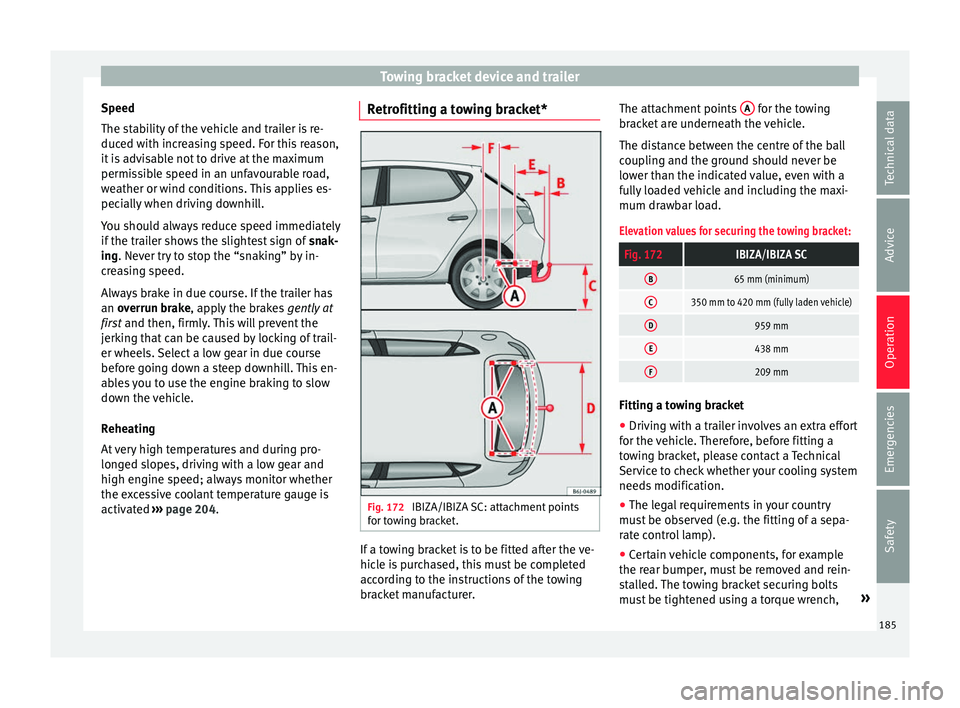
Fig. 172
IBIZA/IBIZA SC: attachment points
f or t
o
wing bracket. If a towing bracket is to be fitted after the ve-
hic
l
e i
s purchased, this must be completed
according to the instructions of the towing
bracket manufacturer. The attachment points
A for the towing
br ac
k
et are underneath the vehicle.
The distance between the centre of the ball
coupling and the ground should never be
lower than the indicated value, even with a
fully loaded vehicle and including the maxi-
mum drawbar load.
Elevation values for securing the towing bracket:
Fig. 172IBIZA/IBIZA SC
B65 mm (minimum)
C350 mm to 420 mm (fully laden vehicle)
D959 mm
E438 mm
F209 mm Fitting a towing bracket
●
Driving with a trailer involves an extra effort
f or the
v
ehicle. Therefore, before fitting a
towing bracket, please contact a Technical
Service to check whether your cooling system
needs modification.
● The legal requirements in your country
must
be observed (e.g. the fitting of a sepa-
rate control lamp).
● Certain vehicle components, for example
the rear b
umper, must be removed and rein-
stalled. The towing bracket securing bolts
must be tightened using a torque wrench, »
185
Technical data
Advice
Operation
Emergencies
Safety
Page 192 of 248
Advice
– Rin se the
v
ehicle thoroughly with water.
– Dry the vehicle surface gently with a cha-
mois l
eather.
– In cold temperature, dry the rubber seals
and their sur
faces to prevent them from
freezing. Apply silicone spray to the rubber
seals.
After washing the vehicle – After washing, avoid sudden and sharp
brakin
g. “Dry” the brakes by braking sever-
al times. WARNING
● Wa sh
your vehicle with the ignition switch-
ed off.
● Protect your hands and arms from cuts on
sharp meta
l edges when cleaning the under-
body, the inside of the wheel housings etc.
Risk of injury.
● Water, ice and salt on the brake system can
reduce br
aking effectiveness. Risk of acci-
dent. CAUTION
● Never r emo
ve dirt, mud or dust if the vehi-
cle surface is dry. Never use a dry cloth or
sponge for cleaning purposes. This could
scratch the paintwork or glass on your vehi-
cle. ●
Wa shin
g the vehicle in low temperatures:
when washing the vehicle with a hose, do not
direct water into the lock cylinders or the
gaps around the doors, rear lid, or sunroof.
Risk of freezing. For the sake of the environment
To protect the environment, the vehicle
shou ld be w
ashed only in specially provided
wash bays, to prevent toxic, oil-laden waste
water from entering the sewer system. In
some places, washing vehicles outside wash
bays is prohibited. Note
Do not wash the vehicle in direct sunlight. Washing the vehicle with a high pres-
s
ur
e c
leaner Be particularly careful when using a high
pr
e
s
sure cleaner!
– Always observe the instructions for the
high-pres
sure cleaner, particularly those
concerning the pressure and the spraying
distance.
– Increase the spraying distance for soft ma-
terial
s and painted bumpers. –
Do not use a high pr
essure cleaner to re-
move ice or snow from windows
››› page 192.
– Never use concentrated jet nozzles (“rotat-
ing jets”) ›
›› .
– After washing, avoid sudden and sharp
br ak
in
g. “Dry” the brakes by braking sever-
al times ››› page 149. WARNING
● Never w a
sh tyres with a concentrated jet
(“rotating nozzle”). Even at large spraying
distances and short cleaning times, damage
can occur to the tyres. This may cause an ac-
cident.
● Water, ice and salt on the brake system can
reduce br
aking effectiveness. Risk of acci-
dent. CAUTION
● Do not u se w
ater hotter than +60°C
(+140°F). This could damage the vehicle.
● To avoid damage to the vehicle, keep a suf-
ficient di
stance from sensitive materials such
as flexible hoses, plastic, soundproofing ma-
terial, etc. This also applies to bumpers pain-
ted in the colour of the bodywork. The closer
the nozzle is to the surface, the greater the
wear on the material. 190
Page 194 of 248
Advice
Cleaning of windows and mirrors Cleaning windows
– Moisten the windows with commercially
avai l
able, alcohol based glass cleaner.
– Dry the windows with a clean chamois
leather or a lint
-free cloth.
Removing snow – Use a small brush to remove snow from the
window
s and mirrors.
Removing ice
– Use a de-icer spray.
Use a c l
ean cloth or chamois leather to dry
the windows. The chamois leathers used on
painted surfaces are not suitable to clean
windows because they are soiled with wax
deposits which could smear the windows.
If possible, use a de-icing spray to remove
ice. If you use an ice scraper, push it in one
direction only without swinging it.
Use window cleaner or a silicone remover to
clean rubber, oil, grease and silicone depos-
its off.
Wax deposits can only be removed with a
special cleaner available at your Technical
Service. Wax deposits on the windscreen
could cause the wiper blades to judder. Add-
ing a window cleaner that dissolves wax to the windscreen washer fluid prevents wiper
bla
des from juddering, but wax deposits are
not removed. CAUTION
● Never u se w
arm or hot water to remove
snow and ice from windows and mirrors. This
could cause the glass to crack!
● The heating element for the rear window is
located on the inner s
ide of the window. To
prevent damage, do not put stickers over the
heating elements on the inside of the win-
dow. Cleaning windscreen wiper blades
Clean wiper blades improve visibility.
1. Use a soft cloth to remove dust and dirt
from the w
ind
screen wiper blades.
2. Use window cleaner to clean the wind- scr
een wiper blades. Use a sponge or a
cloth to remove stubborn dirt.
Care of rubber seals If rubber seals are well looked after, they will
not
fr
eez
e so quickly.
1. Use a soft cloth to remove dust and dirt from the rubber seal
s. 2. Apply a specialist care product to the rub-
ber seals.
The rubber s
trips on the doors, windows, etc.
will remain pliable and last longer if they are
treated with a suitable rubber care product
from time to time (for example silicone
spray).
Caring for rubber seals will also prevent pre-
mature ageing and leaks. The doors will be
easier to open. If rubber seals are well looked
after, they will not freeze so quickly in winter.
Door lock cylinder The door lock cylinders can freeze up in win-
t
er
.
T
o de-ice the lock cylinders you should only
use spray with lubricating and anti-corrosive
properties.
Cleaning chrome parts 1. Clean chrome parts with a damp cloth.
2. Polish chrome parts with a soft, dry cloth.
If
thi s
does not provide satisfying results, use
a specialist chrome cleaning product.
Chrome cleaning products will remove stains
from the surface.
192
Page 201 of 248
Checking and refilling levels
●
Never t ouc
h hot engine parts. There is a
risk of burns.
● Never spill liquids on a hot engine or on a
hot exh
aust gas system. This is a fire hazard.
● Avoid causing short-circuits in the electri-
cal
system, particularly at the points where
the jump leads are attached ›››
page 52.
The battery could explode.
● Never touch the radiator fan. It is tempera-
ture c
ontrolled and could start automatically,
even when the engine has been switched off
and the key removed from the ignition!
● Never cover the engine with additional in-
sul
ating materials such as a blanket. Risk of
fire!
● Do not unscrew the cap on the coolant ex-
pans
ion tank when the engine is hot. If the
coolant is hot, the cooling system will be
pressurised!
● Protect face, hands and arms by covering
the cap with a l
arge, thick cloth to protect
against escaping coolant and steam.
● Always make sure you have not left any ob-
jects, s
uch as cleaning cloths or tools, in the
engine compartment.
● If you have to work underneath the vehicle,
you mus
t use suitable stands additionally to
support the vehicle, there is a risk of acci-
dent!. A hydraulic jack is insufficient for se-
curing the vehicle and there is a risk of injury.
● If any work has to be performed when the
engine is
started or with the engine running,
there is an additional, potentially fatal, safety
risk from the rotating parts, such as the drive belts, alternator, radiator fan, etc., and from
the high-v
o
ltage ignition system. You should
also observe the following:
– Never touch the electrical wiring of the
ignition system.
– Ensure that jewellery, loose clothing and
long hair do not get trapped in rotating
engine parts. Danger of death. Before
starting any work remove jewellery, tie
back and cover hair, and wear tight-fit-
ting clothes.
– Never accelerate with a gear engaged
without taking the necessary precau-
tions. The vehicle could move, even if the
handbrake is applied. Danger of death.
● If work has to be carried out on the fuel
syst
em or on electrical components, you
must observe the following safety notes in
addition to the above warnings:
– Always disconnect the battery from the
on-board network. The vehicle must be
unlocked when this is done, otherwise
the alarm will be triggered.
– Do not smoke.
– Never work near naked flames.
– Always have a fire extinguisher on hand. WARNING
If the bonnet is not correctly closed, it could
sud den
ly open while driving leaving the driv-
er without visibility. This could result in a se-
rious accident. ●
Aft er c
losing the bonnet, always check that
it is properly secured by the locking mecha-
nism in the lock carrier piece. The bonnet
must be flush with the surrounding body pan-
els.
● While driving, if you notice that the bonnet
is not
correctly closed then stop immediately
and close it correctly.
● Only open and close the bonnet when there
is no
body within its range. CAUTION
When topping up service fluids, make sure
not to mi
stake them. Using the wrong fluids
could cause serious malfunctions and engine
damage! For the sake of the environment
Service fluids leaks are harmful to the envi-
ronment . F
or this reason you should make
regular checks on the ground underneath
your vehicle. If you find spots of oil or other
fluids, have your vehicle inspected in a speci-
alised workshop. Opening the bonnet
Read the additional information carefully
› ›
›
page 10
The bonnet is released from inside the vehi-
cle. »
199
Technical data
Advice
Operation
Emergencies
Safety
Page 202 of 248
Advice
Before opening the bonnet ensure that the
w ind
s
creen wipers are in rest position. WARNING
Hot coolant can scald!
● Never open the bonnet if you see steam,
smoke or c oo
lant escaping from the engine
compartment.
● Wait until no more steam, smoke or coolant
is emitt
ed from the bonnet, then carefully
open the bonnet.
● When working in the engine compartment,
alwa
ys observe the safety warnings
››› page 198. Closing the bonnet
–
Slightly lift the bonnet.
– Release the bonnet stay and replace it in its
sup
por
t.
– At a height of approximately 30 cm let it fall
so it lock
s.
If the bonnet does not close, do not press
downwards. Open it again and let it fall as
mentioned above. WARNING
If the bonnet is not closed properly, it could
open whil e
you are driving and completely obscure your view of the road. Risk of acci-
dent.
●
Af t
er closing the bonnet, always check that
it is
properly secured. The bonnet must be
flush with the surrounding body panels.
● If you notice that the bonnet latch is not se-
cured when the
vehicle is moving, stop the
vehicle immediately and close the bonnet
properly. Risk of accident. 200
Page 208 of 248
Advice
CAUTION
Do not top up the expansion tank with cool-
ant fluid if it
is empty! Air could enter the
cooling system. In this case, stop driving.
Seek specialist assistance. Otherwise, there
is a risk of engine damage. CAUTION
The original additives should never be mixed
with c oo
lants which are not approved by
SEAT. Otherwise, you run the risk of causing
severe damage to the engine and the engine
cooling system.
● If the fluid in the expansion tank is not pur-
ple b
ut is, for example, brown, this indicates
that the G13 additive has been mixed with an
inadequate coolant. The coolant must be
changed as soon as possible if this is the
case! This could result in serious faults and
engine damage. For the sake of the environment
Coolants and additives can contaminate the
env ir
onment. If any fluids are spilled, they
should be collected and correctly disposed
of, with respect to the environment. Brake fluid
Chec k
in
g the brake fluid level Read the additional information carefully
›› ›
page 43
The position of the brake fluid reservoir is
shown in the corresponding engine compart-
ment illustration ››› page 201. The brake fluid
reservoir has a black and yellow cap.
The brake fluid level drops slightly when the
vehicle is being used as the brake pads are
automatically adjusted as they wear.
However, if the level goes down noticeably in
a short time, or drops below the “MIN” mark,
there may be a leak in the brake system. A
display on the instrument panel will warn you
if the brake fluid level is too low ›››
page 98. WARNING
Before opening the bonnet to check the brake
fluid lev el, r
ead and observe the warnings
››› page 198. Changing the brake fluid
The Maintenance Programme indicates brake
fluid c
h
an
ge intervals.
We recommend that you have the brake fluid
changed by a Technical Service. Before opening the bonnet, please read and
fol
low the warnings ››› in safety notes for
w ork
in the en
gine compartment on
page 198 in section “Safety notes for work-
ing in the engine compartment”.
In the course of time, brake fluid becomes
hygroscopic and absorbs water from the am-
bient air. If the water content in the brake flu-
id is too high, the brake system could cor-
rode. This also considerably reduces the boil-
ing point of the brake fluid. Heavy use of the
brakes may then cause a vapour lock which
could impair the braking effect.
Be sure to always use the correct brake fluid.
Only use brake fluid that expressly meets the
VW 501 14 standard.
You can buy VW 501 14 standard brake fluid
in a SEAT dealership or a SEAT Official Serv-
ice. If none is available, use only high-quality
brake fluid that meets DIN ISO 4925 CLASS 4
standards, or USA Standards FMVSS 116 DOT
4.
Using any other kind of brake fluid or one
that is not of a high quality may affect opera-
tion of the brake system and reduce its effec-
tiveness. Never use a brake fluid if the con-
tainer does not state that it complies with VW
501 14, DIN ISO 4925 CLASS 4 standards, or
USA standards FMVSS 116 DOT 4.
206
Page 209 of 248

Checking and refilling levels
WARNING
Brake fluid is poisonous. Old brake fluid im-
pair s
the braking effect.
● Before opening the bonnet to check the
brake fluid l
evel, read and observe the warn-
ings ››› page 198.
● Brake fluid should be stored in the closed
original
container in a safe place out of reach
of children. There is a toxic risk.
● Perform the brake fluid change according to
the Mainten
ance Programme. Heavy use of
the brakes may cause a vapour lock if the
brake fluid is left in the brake system for too
long. This would seriously affect the effec-
tiveness of the brakes and the safety of the
vehicle. This may cause an accident. CAUTION
Brake fluid damages the vehicle paintwork.
Wipe off an
y brake fluid from the paintwork
immediately. For the sake of the environment
The brake pads and brake fluid must be col-
lect ed and di
sposed of according the applica-
ble regulations. The SEAT Technical Service
network has the necessary equipment and
qualified personnel for collecting and dispos-
ing of this waste material. Windscreen washer reservoir
Top
pin
g up the windscreen washer
reservoir water Read the additional information carefully
›› ›
page 43
The windscreen washer and the headlight
washers are supplied with fluid from the
windscreen washer fluid container in the en-
gine compartment. The container holds ap-
prox. 3 litres; in vehicles with headlight
washers* it holds approx. 4.5 litres.
The tank is in the engine compartment.
Plain water is not enough to clean the wind-
screen and headlights. We recommend that
you always add a product to the windscreen
washer fluid. Approved windscreen cleaning
products exist on the market with high deter-
gent and anti-freeze properties, these may be
added all-year-round. Please follow the dilu-
tion instructions on the packaging. WARNING
Any work carried out in the engine compart-
ment or on the en gine mu
st be carried out
cautiously.
● When working in the engine compartment,
alwa
ys observe the safety warnings
››› page 198. CAUTION
● Never p ut
radiator anti-freeze or other addi-
tives into the windscreen washer fluid.
● Always use approved windscreen cleansing
products
diluted as per instructions. If you
use other washer fluids or soap solutions,
the tiny holes in the fan-shaped nozzles
could become blocked. Vehicle battery
Symbo l
s and warnings on handling
the battery Read the additional information carefully
› ›
›
page 43
Wear eye protection
Battery acid is extremely corrosive. Wear protec-
tive gloves and eye protection!
Fires, sparks, open flames and smoking are pro-
hibited!
A highly explosive mixture of gases is released
when the battery is under charge.
Keep children away from acid and batteries!»
207
Technical data
Advice
Operation
Emergencies
Safety
Page 210 of 248
Advice
WARNING
Always be aware of the danger of injury and
chemic a
l burns as well as the risk of accident
or fire when working on the battery and the
electrical system:
● Wear eye protection. Protect your eyes,
skin and clothin
g from acid and particles con-
taining lead.
● Battery acid is extremely corrosive. Wear
protectiv
e gloves and eye protection. Do not
tilt the batteries. This could spill acid through
the vents.
● Rinse battery acid from eyes immediately
for sever
al minutes with clear water. Then
seek medical care immediately. Neutralise
any acid splashes on the skin or clothing
with a soapy solution, and rinse off with plen-
ty of water. If acid is swallowed by mistake,
consult a doctor immediately.
● Fires, sparks, open flames and smoking are
prohibit
ed. When handling cables and electri-
cal equipment, avoid causing sparks and
electrostatic charge. Never short the battery
terminals. High-energy sparks can cause in-
jury.
● A highly explosive mixture of gases is re-
lea
sed when the battery is under charge. The
batteries should be charged in a well-ventila-
ted room only.
● Keep children away from acid and batteries.
● Before working on the electrical system,
you mus
t switch off the engine, the ignition
and all electrical devices. The negative cable on the battery must be disconnected. When a
light b
u
lb is changed, you need only switch
off the light.
● Deactivate the anti-theft alarm by unlock-
ing the v
ehicle before you disconnect the bat-
tery! The alarm will otherwise be triggered.
● When disconnecting the battery from the
vehicl
e on-board network, disconnect first
the negative cable and then the positive ca-
ble.
● Switch off all electrical devices before re-
connecting the b
attery. Reconnect first the
positive cable and then the negative cable.
Never reverse the polarity of the connections.
This could cause an electrical fire.
● Never charge a frozen battery, or one which
has
thawed. This could result in explosions
and chemical burns. Always replace a battery
which has frozen. A flat battery can also
freeze at temperatures close to 0°C (+32°F).
● Ensure that the vent hose is always connec-
ted to the b
attery.
● Never use a defective battery. This could
cause an e
xplosion. Replace a damaged bat-
tery immediately.
● For vehicles with the battery in the luggage
compar
tment: Check that the battery gas
ventilation hose is securely attached. CAUTION
● Never di s
connect the battery if the ignition
is switched on or if the engine is running. This could damage the electrical system or
electr
onic
components.
● Do not expose the battery to direct sunlight
over a lon
g period of time, as the intense ul-
traviolet radiation can damage the battery
housing.
● If the vehicle is left standing in cold condi-
tions f
or a long period, protect the battery
from “freezing”. If it freezes it will be dam-
aged. Warning lamp
It lights up
Alternator fault.
The control lamp
lights up when the igni-
tion i s
switched on. It should go out when the
engine has started running.
If the control lamp lights up while driving,
the alternator is no longer charging the bat-
tery. You should immediately drive to the
nearest specialised workshop.
You should avoid using electrical equipment
that is not absolutely necessary because this
will drain the battery.
208
Page 235 of 248
Index
Index
A
ABS . . . . . . . . . . . . . . . . . . . . . . . . . . . . . . . . . . . .
155
c ontr
ol lamp . . . . . . . . . . . . . . . . . . . . . . . . . . . 156
Accessories . . . . . . . . . . . . . . . . . . . . . . . . . . . . . . 187
Additional electrical appliances (efficiency pro- gramme) . . . . . . . . . . . . . . . . . . . . . . . . . . . . . . . 31
Adjusting front head restraints . . . . . . . . . . . . . . . . . 60, 128
lights . . . . . . . . . . . . . . . . . . . . . . . . . . . . . . . . . 121
rear head restraints . . . . . . . . . . . . . . . . . . . . . . 60
Adjusting the front seats adjusting the lumbar support . . . . . . . . . . . . . 127
Adjusting the head restraints front head restraints . . . . . . . . . . . . . . . . . . . . . 128
rear head restraints . . . . . . . . . . . . . . . . . . . . . . 60
Adjusting the seat . . . . . . . . . . . . . . . . . . . . . . . . 127
Adjustment CAR menu . . . . . . . . . . . . . . . . . . . . . . . . . . . . . . 99
seats . . . . . . . . . . . . . . . . . . . . . . . . . . . . . . . . . . 57
AFS headlight bulbs . . . . . . . . . . . . . . . . . . . . . . . . 87
Airbag covers . . . . . . . . . . . . . . . . . . . . . . . . . . . . . 14
Airbags . . . . . . . . . . . . . . . . . . . . . . . . . . . . . . . . . . 66 description . . . . . . . . . . . . . . . . . . . . . . . . . . . . . 67
Airbag system . . . . . . . . . . . . . . . . . . . . . . . . . . 14, 66 activation . . . . . . . . . . . . . . . . . . . . . . . . . . . . . . 68
control lamp . . . . . . . . . . . . . . . . . . . . . . . . . . . . 68
deactivation of front airbag . . . . . . . . . . . . . . . . 70
description . . . . . . . . . . . . . . . . . . . . . . . . . . . . . 67
front airbags . . . . . . . . . . . . . . . . . . . . . . . . . 14, 69
functioning . . . . . . . . . . . . . . . . . . . . . . . . . . . . . 68
head-protection airbags . . . . . . . . . . . . . . . . . . 15
side airbags . . . . . . . . . . . . . . . . . . . . . . . . . . . . 15 Air conditioning . . . . . . . . . . . . . . . . . . . . . . 39, 141
climatr onic . . . . . . . . . . . . . . . . . . . . . . . . . . . . 143
controls . . . . . . . . . . . . . . . . . . . . . . . . . . . . . . . 141
general notes . . . . . . . . . . . . . . . . . . . . . . . . . . 137
manual air conditioning . . . . . . . . . . . . . . . . . . . 40
Air outlets . . . . . . . . . . . . . . . . . . . . . . . . . . . . . . . 138
Air recirculation air conditioning . . . . . . . . . . . . . . . . . . . . . . . . 142
heating and fresh air . . . . . . . . . . . . . . . . . . . . 139
Alarm system . . . . . . . . . . . . . . . . . . . . . . . . . . . . 111 switching off . . . . . . . . . . . . . . . . . . . . . . . . . . . 112
Alloy wheel rims . . . . . . . . . . . . . . . . . . . . . . . . . . 193
Alternator warning lamp . . . . . . . . . . . . . . . . . . . . . . . . . . 208
Ambient lighting . . . . . . . . . . . . . . . . . . . . . . . . . 122
Anti-freeze . . . . . . . . . . . . . . . . . . . . . . . . . . . . . . . 42
Anti-lock brake system . . . . . . . . . . . . 152, 154, 155 control lamp . . . . . . . . . . . . . . . . . . . . . . . . . . . 156
Anti-puncture . . . . . . . . . . . . . . . . . . . . . . . . . . 46, 76
Anti-puncture kit . . . . . . . . . . . . . . . . . . . . . . . . 46, 76 check after 10 minutes . . . . . . . . . . . . . . . . . . . . 78
Anti-puncture set . . . . . . . . . . . . . . . . . . . . . . . . . . 76
Anti-theft alarm . . . . . . . . . . . . . . . . . . . . . . . . . . 111
Anti-theft alarm system . . . . . . . . . . . . . . . . . . . . 111 switching off . . . . . . . . . . . . . . . . . . . . . . . . . . . 112
Aquaplaning . . . . . . . . . . . . . . . . . . . . . . . . . . . . . 212
Aspects to note before setting off . . . . . . . . . . . . . 56
ASR . . . . . . . . . . . . . . . . . . . . . . . . . . . . . . . . . . . . 153 control lamp . . . . . . . . . . . . . . . . . . . . . . . . . . . 153
Assistance systems parking aid . . . . . . . . . . . . . . . . . . . . . . . 173, 174
Assistance Systems fatigue detection . . . . . . . . . . . . . . . . . . . . . . . 171
Assisted starting . . . . . . . . . . . . . . . . . . . . . . . . . . 52
Audible warning signal seat belt not fastened . . . . . . . . . . . . . . . . . . . . 62
warning and control lamps . . . . . . . . . . . . . . . . 98 Automatic car wash tunnel . . . . . . . . . . . . . . . . . 189
Automatic
gearbox . . . . . . . . . . . . . . . . . . . . . . . . 158
driving programmes . . . . . . . . . . . . . . . . . . . . . 158
driving tips . . . . . . . . . . . . . . . . . . . . . . . . . . . . 162
kick-down device . . . . . . . . . . . . . . . . . . . . . . . 163
manual release of selector lever . . . . . . . . . . . . 38
selecting gears with Tiptronic . . . . . . . . . . . . . 161
selector lever lock . . . . . . . . . . . . . . . . . . . . . . . 161
selector lever positions . . . . . . . . . . . . . . . . . . 159
tiptronic . . . . . . . . . . . . . . . . . . . . . . . . . . . . . . . 158
Automatic lighting . . . . . . . . . . . . . . . . . . . . . . . . 118
AUX-IN . . . . . . . . . . . . . . . . . . . . . . . . . . . . . . . . . . 105
B Back seat folding down and raising the back seat back-rest . . . . . . . . . . . . . . . . . . . . . . . . . . . . . . . . . 129
Ball coupling . . . . . . . . . . . . . . . . . . . . . . . . . . . . . 184
Battery . . . . . . . . . . . . . . . . . . . . . . . . . . . . . . . . . . 111
Before setting off . . . . . . . . . . . . . . . . . . . . . . . . . . 56
Belt pretensioners . . . . . . . . . . . . . . . . . . . . . . . . . 65
Biodiesel . . . . . . . . . . . . . . . . . . . . . . . . . . . . . . . . 197
Bonnet . . . . . . . . . . . . . . . . . . . . . . . . . 10, 198, 201 closing . . . . . . . . . . . . . . . . . . . . . . . . . . . . . . . . 200
opening . . . . . . . . . . . . . . . . . . . . . . . . . . . . . . . 199
Boot hatch . . . . . . . . . . . . . . . . . . . . . . . . . . . . . . 113
Boot lid . . . . . . . . . . . . . . . . . . . . . . . . . . . . . . . . . 113
Brake assist . . . . . . . . . . . . . . . . . . . . . . . . . . . . . 152
Brake fluid . . . . . . . . . . . . . . . . . . . . . . . . . . 43, 206 changing . . . . . . . . . . . . . . . . . . . . . . . . . . . . . . 206
Brake pads . . . . . . . . . . . . . . . . . . . . . . . . . 149, 164
Brakes brake fluid . . . . . . . . . . . . . . . . . . . . . . . . . . . . . 206
new Brake pads . . . . . . . . . . . . . . . . . . . . . . . . 149
Brake servo . . . . . . . . . . . . . . . . . . . . . . . . . 149, 157
Brake system . . . . . . . . . . . . . . . . . . . . . . . . . . . . 206
233
Page 236 of 248
Index
Braking brak
e a
ssist . . . . . . . . . . . . . . . . . . . . . . . . . . . . 152
Braking distance . . . . . . . . . . . . . . . . . . . . . . . . . 149
Braking system warning lamp . . . . . . . . . . . . . . . . . . . . . . . . . . 150
Bulbs changing the bulbs . . . . . . . . . . . . . . . . . . . . . . 83
Buzzer . . . . . . . . . . . . . . . . . . . . . . . . . . . . . . . . . . 119
C Capacities . . . . . . . . . . . . . . . . . . . . . . . . . . . . . . . . 40 fuel tank . . . . . . . . . . . . . . . . . . . . . . . . . . . . . . . 98
Car care exterior . . . . . . . . . . . . . . . . . . . . . . . . . . . . . . . 189
Catalytic converter . . . . . . . . . . . . . . . . . . . 166, 167 malfunction . . . . . . . . . . . . . . . . . . . . . . . . . . . . 167
CCS . . . . . . . . . . . . . . . . . . . . . . . . . . . . . . . . . . . . . 34
Central locking anti-theft alarm . . . . . . . . . . . . . . . . . . . . . . . . . 111
automatic speed-dependent locking . . . . . . . 108
central locking button . . . . . . . . . . . . . . . . . . . 108
electric windows . . . . . . . . . . . . . . . . . . . . . . . . 116
key by remote control . . . . . . . . . . . . . . . . . . . . 110
selective unlocking system . . . . . . . . . . . . . . . 107
self-locking system to prevent involuntary un-locking . . . . . . . . . . . . . . . . . . . . . . . . . . . . . . 107
unlocking system . . . . . . . . . . . . . . . . . . . . . . . 108
Central locking system . . . . . . . . . . . . . . . . . . . . . 106 safe security system . . . . . . . . . . . . . . . . . . . . . 106
Cetane number (diesel fuel) . . . . . . . . . . . . . . . . 197
Changing a DRL light bulb . . . . . . . . . . . . . . . . . . . . . . . . . . . 84
Changing a bulb additional brake light . . . . . . . . . . . . . . . . . . . . . 90
luggage compartment light . . . . . . . . . . . . . . . . 90
tail light bulbs . . . . . . . . . . . . . . . . . . . . . . . . . . . 88
turn signal light . . . . . . . . . . . . . . . . . . . . . . . . . 86 Changing a double headlight bulb
dipped beam he adlights . . . . . . . . . . . . . . . . . . 86
double headlight bulbs . . . . . . . . . . . . . . . . . . . 85
Changing an AFS headlight bulb . . . . . . . . . . . . . . 87 turn signal light . . . . . . . . . . . . . . . . . . . . . . . . . 87
xenon light . . . . . . . . . . . . . . . . . . . . . . . . . . . . . 87
Changing a single headlight bulb side light . . . . . . . . . . . . . . . . . . . . . . . . . . . . . . . 85
single headlight bulbs . . . . . . . . . . . . . . . . . . . . 84
turn signal light . . . . . . . . . . . . . . . . . . . . . . . . . 84
Changing a wheel . . . . . . . . . . . . . . . . . . . . . . . . . 47 subsequent work . . . . . . . . . . . . . . . . . . . . . . . . 50
Changing double headlight bulb side light . . . . . . . . . . . . . . . . . . . . . . . . . . . . . . . 85
Changing settings CAR menu . . . . . . . . . . . . . . . . . . . . . . . . . . . . . . 24
Changing the blades . . . . . . . . . . . . . . . . . . . . . . . 78
Changing the bulbs AFS headlight bulbs . . . . . . . . . . . . . . . . . . . . . . 87
fog light bulbs . . . . . . . . . . . . . . . . . . . . . . . . . . 87
general notes . . . . . . . . . . . . . . . . . . . . . . . . . . . 83
interior light and reading light . . . . . . . . . . . . . 90
number plate light . . . . . . . . . . . . . . . . . . . . . . . 90
turn signals . . . . . . . . . . . . . . . . . . . . . . . . . . . . . 89
Changing the double headlight bulb main beam . . . . . . . . . . . . . . . . . . . . . . . . . . . . . 86
Changing the single headlight bulbs dipped/main beam . . . . . . . . . . . . . . . . . . . . . . 84
Charging the battery . . . . . . . . . . . . . . . . . . . . . . . 52
Checking levels engine compartment . . . . . . . . . . . . . . . . . . . . 201
Child-proof locking electric windows . . . . . . . . . . . . . . . . . . . . . . . . 114
Child seat categorisation in groups . . . . . . . . . . . . . . . . . . 73 Child seats . . . . . . . . . . . . . . . . . . . . . . . . . . . . 16, 73
ISOFIX sys tem . . . . . . . . . . . . . . . . . . . . . . . . . . . 18
safety instructions . . . . . . . . . . . . . . . . . . . . 16, 72
securing with the seat belt . . . . . . . . . . . . . . . . 17
Top Tether system . . . . . . . . . . . . . . . . . . . . . 18, 20
Chrome parts cleaning . . . . . . . . . . . . . . . . . . . . . . . . . . . . . . 192
Cigarette lighter . . . . . . . . . . . . . . . . . . . . . . . . . . 132
Cleaning . . . . . . . . . . . . . . . . . . . . . . . . . . . . . . . . 188 alloy wheel rims . . . . . . . . . . . . . . . . . . . . . . . . 193
chrome parts . . . . . . . . . . . . . . . . . . . . . . . . . . . 192
engine compartment . . . . . . . . . . . . . . . . . . . . 193
fabric . . . . . . . . . . . . . . . . . . . . . . . . . . . . . . . . . 194
high pressure cleaners . . . . . . . . . . . . . . . . . . . 190
leather . . . . . . . . . . . . . . . . . . . . . . . . . . . . . . . . 195
plastic parts . . . . . . . . . . . . . . . . . . . . . . 191, 194
radio and climate controls . . . . . . . . . . . . . . . . 194
rubber seals . . . . . . . . . . . . . . . . . . . . . . . . . . . 192
seat belts . . . . . . . . . . . . . . . . . . . . . . . . . . . . . 195
steel wheel rims . . . . . . . . . . . . . . . . . . . . . . . . 193
stickers . . . . . . . . . . . . . . . . . . . . . . . . . . . . . . . 191
upholstery . . . . . . . . . . . . . . . . . . . . . . . . . . . . . 194
washing the vehicle . . . . . . . . . . . . . . . . . . . . . 189
windows and exterior mirrors . . . . . . . . . . . . . 192
windscreen wiper blades . . . . . . . . . . . . . . . . . 192
wooden trim . . . . . . . . . . . . . . . . . . . . . . . . . . . 194
Climatronic . . . . . . . . . . . . . . . . . . . . . . . . . . . . . . . 39 adjusting the temperature . . . . . . . . . . . . . . . . 144
air recirculation . . . . . . . . . . . . . . . . . . . . . . . . . 144
automatic mode . . . . . . . . . . . . . . . . . . . . . . . . 144
blower selection . . . . . . . . . . . . . . . . . . . . . . . . 144
controls . . . . . . . . . . . . . . . . . . . . . . . . . . . . . . . 143
general notes . . . . . . . . . . . . . . . . . . . . . . . . . . 137
windscreen defrost . . . . . . . . . . . . . . . . . . . . . . 145
Close . . . . . . . . . . . . . . . . . . . . . . . . . . . . . . . . . . . 106
234