low beam SEAT IBIZA 5D 2017 Owners Manual
[x] Cancel search | Manufacturer: SEAT, Model Year: 2017, Model line: IBIZA 5D, Model: SEAT IBIZA 5D 2017Pages: 248, PDF Size: 5.24 MB
Page 36 of 248
The essentials
Reading a service notification
W ith the ignition sw
it
ched on, the engine off
and the vehicle at a standstill, the current
service notification can be read:
Press and hold the button 4 for more than 5
sec ond
s
to consult the service message.
When the service date has passed , a minus
sign is displayed in front of the number of kil-
ometres or days.
Vehicles with text messages : the following
message is displayed: Service --- km
(miles) or --- days ago .
The time can also be set via the key and
Set up function button in the Easy Connect
sy s
t
em ›››
page 99.
Resetting service interval display
If the service was not carried out by a SEAT
dealership, the display can be reset as fol-
lows: ● Switch off the ignition, press and hold but-
ton ››
› Fig. 113
4 .
● Switch ignition back on.
● Release the 4
› ›
›
Fig. 113
button and
press it again for the next 20 seconds. Note
● The serv ic
e message disappears after a few
seconds, when the engine is started or when OK/RESET
is pressed on the windscreen wiper
lev er
, or OK on the multifunction steering
wheel.
● In v
ehicles with the LongLife system in
which the batt
ery has been disconnected for
a long period of time, it is not possible to cal-
culate the date of the next service. Therefore
the service interval display may not be cor-
rect. In this case, bear in mind the maximum
service intervals permitted in the ››› Book-
let Maintenance Programme. Cruise control
Oper atin
g the c
ruise control system
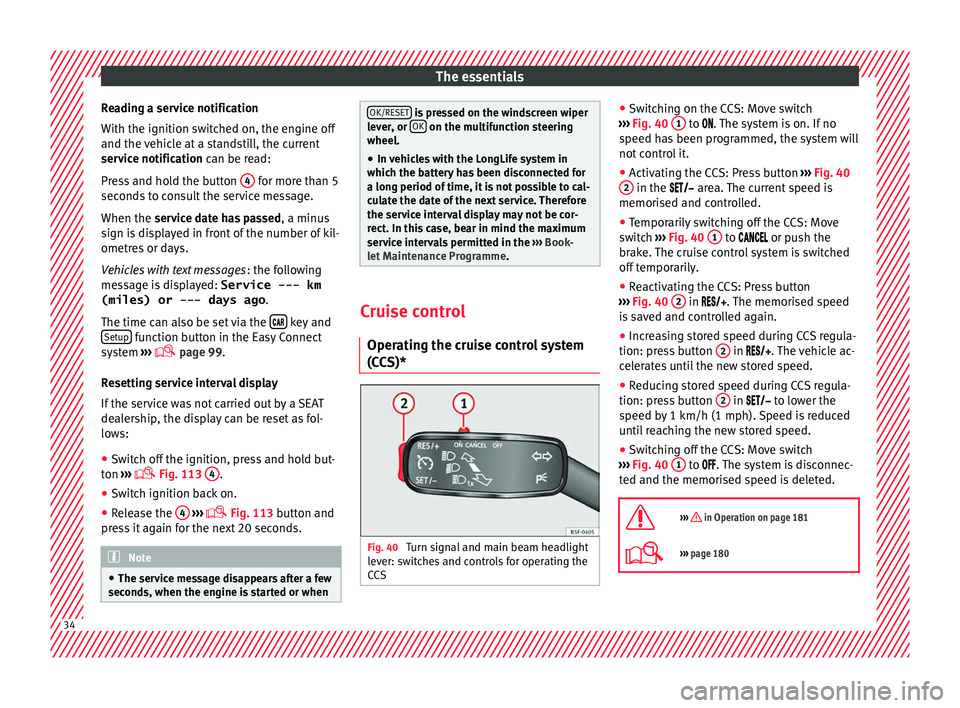
(CCS)* Fig. 40
Turn signal and main beam headlight
l ev
er: sw
itches and controls for operating the
CCS ●
Sw it
c
hing on the CCS: Move switch
››› Fig. 40 1 to .
The system is on. If no
s peed h
as been programmed, the system will
not control it.
● Activating the CCS: Press button ›››
Fig. 40
2 in the ar
e
a. The current speed is
memorised and controlled.
● Temporarily switching off the CCS: Move
switc
h ››› Fig. 40 1 to
or push the
br ak
e. The cruise control system is switched
off temporarily.
● Reactivating the CCS: Press button
›››
Fig. 40 2 in
. The memorised speed
i
s saved and controlled again.
● Increasing stored speed during CCS regula-
tion: pres
s button 2 in
. The vehicle ac-
c
elerates until the new stored speed.
● Reducing stored speed during CCS regula-
tion: pres
s button 2 in t
o lower the
s peed b
y 1 km/h (1 mph). Speed is reduced
until reaching the new stored speed.
● Switching off the CCS: Move switch
›››
Fig. 40 1 to .
The system is disconnec-
t ed and the memori
sed speed is deleted.
››› in Operation on page 181
››› page 180 34
Page 38 of 248
The essentials
Front brake pads worn.
›››
page
152
it lights up:
Fault in the ESC, or dis-
connection caused by the system.
flashes: ESC or ASR activated.
ASR manually deactivated.
Or else
: ESC in Sport mode.
ABS faulty or does not work.
Front fog lights switched on.›››
page
21
Rear fog light switched on.›››
page
21
lights up or flashes:
fault in the
emission control system.››› page
168
it lights up:
pre-heating of diesel
engine.
››› page
168
flashes: fault in the diesel engine
management.
fault in the petrol engine manage-
ment.›››
page
168
lights up or flashes:
fault in the
steering system.››› page
145
Tyre pressure too low, or fault in
the tyre pressure monitoring sys-
tem.›››
page
213
Fuel tank almost empty.›››
page
98
Fault in airbag system and seat
belt tensioners.›››
page
66 Other warning lamps
Left or right turn signal.›››
page
22
Hazard warning lights on.››› page
121
Trailer turn signals›››
page
183
it lights up:
Press the foot brake!
flashes: the selector lever locking
button has not engaged.››› page
158
it lights up:
cruise control activated
or speed limiter switched on and
active.
››› page
34
flashes: the speed set by the
speed limiter has been exceeded.
Main beam on or flasher on.›››
page
22 On the instrument panel display
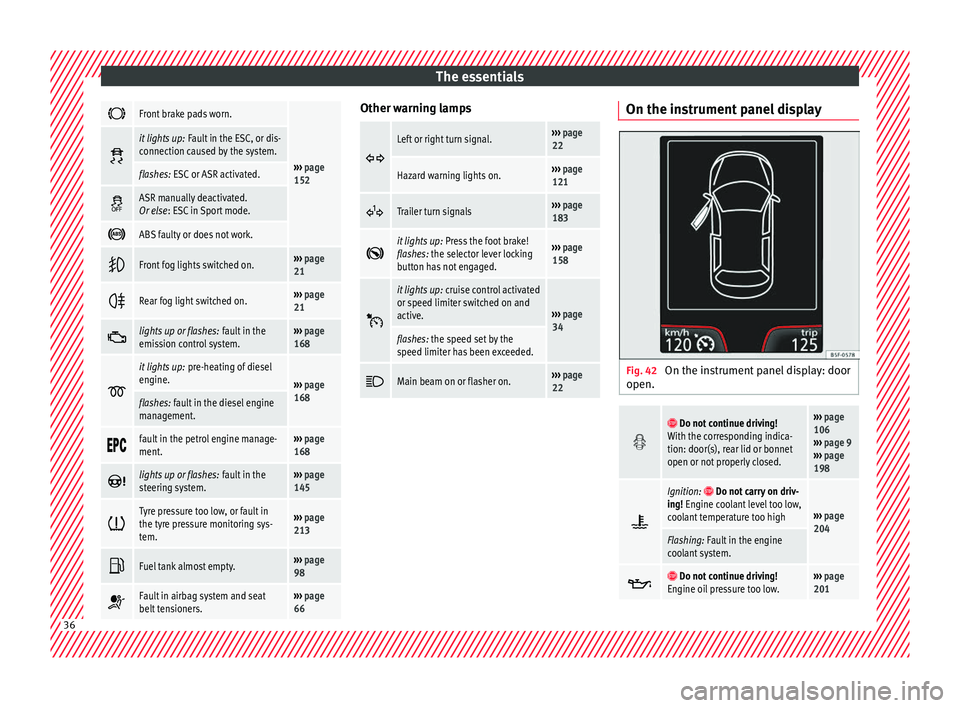
Fig. 42
On the instrument panel display: door
open.
Do not continue driving!
With the corresponding indica-
tion: door(s), rear lid or bonnet
open or not properly closed.››› page
106
››› page 9
››› page
198
Ignition: Do not carry on driv-
ing! Engine coolant level too low,
coolant temperature too high
››› page
204
Flashing: Fault in the engine
coolant system.
Do not continue driving!
Engine oil pressure too low.››› page
201 36
Page 47 of 248
The essentials
Identifying a blown fuse
A f u
se i
s blown if its metal strip is ruptured
››› Fig. 58.
● Point a lamp at the fuse to see if it has
blown.
T
o replace a fuse
● Remove the fuse.
● Replace the blown fuse by one with an
identica
l amperage rating (same colour and
markings) and identical size.
● Replace the cover again or close the fuse
box lid.
B
ulbs
Bul
bs (12 V)
Light source used for each function
Double headlightsType
Dipped beam headlightsH7 Long Life
Main beam headlightsH7
Side lightsW5W Long Life
Turn signalPY 21W
Double headlightsType
DRL (day light)LEDa)
a)
In case of a LED failure, go to an authorised workshop to have
it replaced.
Single headlightType
Dipped/main beam headlightsH4 Long Life
Side lightsW5W Long Life
Turn signalPY 21W
DRL (day light)P21W SLL
Xenon/adaptive head-
lights*Type
Dipped/main beam headlightsD1S a)
Side lightsLEDb)
Turn signalPY 21W
DRL (day light)LEDb)
a)
This light should be changed by an Authorised Service.
b) In case of a LED failure, go to an authorised workshop to have
it replaced.
››› page 83 Action in the event of a punc-
t
ur
e
Wh
at to do first ●
Park the vehicle on a horizontal surface
and in a saf e p
lace as far away from traffic as
possible.
● Apply the handbrake.
● Switch on the hazard warning lights.
● Manual gearbox: select the 1s
t gear.
● Automatic gearbox: Move the sel
ector lever
to position P.
● If you are towing a trailer, unhitch it from
your v
ehicle.
● Have the vehicle tool kit* ›››
page 47 and
the spare wheel ›››
page 75 ready.
● Observe the applicable legislation for each
countr
y (reflective vest, warning triangles,
etc.).
● All occupants should leave the vehicle and
wait in a s
afe place (for instance behind the
roadside crash barrier). WARNING
● Alw a
ys observe the above steps and pro-
tect yourself and other road users.
● If you change the wheel on a slope, block
the wheel on the oppo
site side of the car with
a stone or similar to prevent the vehicle from
moving. 45
Page 83 of 248
Fuses and bulbs
●
Tak e c
are not to cause short circuits in the
electrical system. WARNING
Using unsuitable fuses, repairing fuses or
bridgin g a curr
ent circuit without fuses can
cause a fire and serious injury.
● Never use a fuse with a higher value. Only
repl
ace fuses with a fuse of the same amper-
age (same colour and markings) and size.
● Never repair a fuse.
● Never replace a fuse by a metal strip, staple
or simil
ar. CAUTION
● To pr ev
ent damage to the vehicle's electric
system, before replacing a fuse always turn
off the ignition, the lights and all electrical
elements and remove the key from the igni-
tion.
● If you replace a fuse with higher-rating
fuse,
you could cause damage to another part
of the electrical system.
● Protect the fuse boxes when open to pre-
vent the entr
y of dust or humidity as they can
damage the electrical system.
● Always carefully remove the fuse box cov-
ers and r
efit them correctly to avoid problems
with your vehicle. Note
● One component m
ay have more than one
fuse.
● Several components may run on a single
fuse.
● In the
vehicle, there are more fuses than
those indicat
ed in this chapter. These should
only be changed by a specialised workshop.
● Positions not containing a fuse do not ap-
pear in the fo
llowing tables.
● Some of the equipment listed in the tables
below pert
ain only to certain versions of the
model or are optional extras.
● Please note that the above lists, while cor-
rect at
the time of printing, are subject to
change. Fuses to the left of the instrument
p
anel Read the additional information carefully
› ›
›
page 44
Only replace fuses with a fuse of the same
amperage (same colour and markings) and
size.
Control box 1
No.Consumer/Amps
1Left lights40
2Central locking40
No.Consumer/Amps
3Power C63 (30 Power)30
4PTC Relay (Engine glow)50
5Left pillar connector A pin 22 (motor
for closing window on driver's side)30
6For closing back left window (motor)30
7Horn20
9Panoramic roof30
10Active suspension7.5
11Headlight washer system relay30
12MIB display5
13(RL-15) SIDO Kl.15 supply (inputs 29
and 55)30
14
Removing ignition key, diagnostics,
headlight lever (flashers), switching
on dipped /side beams (rotating
lights)
7.5
15Air and heat control (supply)7.5Automatic gearbox lever
16Instrument panel5
17Dwa Sensor, Alarm horn7.5
23Dual windscreen cleaner pump7.5
24Engine heater, heating control box
(supply)30
2612V Relay socket20» 81
Technical data
Advice
Operation
Emergencies
Safety
Page 85 of 248
Fuses and bulbsNo.Consumer/Amps
16Starter motor30
17Controls motor (MSG KL87)20
18PTC Relays, TOG sensor, engine
valves, PWM fan10
19Lambda sensors15
20
Glow plug relay, Heizrohr5
Ignition coil20
Pre-wired motor (coolant pump, varia-
ble valve distributor, active carbon
solenoid valve filter, pressure valve,
secondary air inlet valve)
10
Changing bulbs
Gener a
l
notesRead the additional information carefully
› ›
›
page 45
Before changing any bulb, first turn off the
failed device.
Do not touch the glass part of the bulb with
your bare hands. The fingerprints left on the
glass will vaporise as a result of the heat gen-
erated by the bulb, reducing bulb life and
causing condensation on the reflector sur-
face, thus reducing effectiveness. A bulb must only be replaced by one of the
same type. The type i
s indicated on the bulb,
either on the glass part or on the base.
Xenon headlights
With this type of headlight, the user can re-
place the turn signal bulb. Replacement of
the dipped/main beam bulb must be done by
Technical Services, given that complex ele-
ments must be removed from the vehicle and
the automatic control system that incorpo-
rates it must be reset.
The Xenon bulbs discharge 2.5 times the
light flux and have an average lifespan of 5
times more than that of halogen bulbs, this
means that, except due to unusual circum-
stances, there is no need to change the bulbs
for the whole life of the vehicle. WARNING
● Tak e p
articular care when working on com-
ponents in the engine compartment if the en-
gine is warm, there is a risk of burns.
● Bulbs are highly sensitive to pressure. The
glas
s can break when you touch the bulb,
causing injury.
● The high voltage element of gas discharge
bul
bs* (xenon light) must be handled correct-
ly. Otherwise, there is a risk of death.
● When changing bulbs, please take care not
to injure
yourself on sharp parts in the head-
light housing. CAUTION
● Remo v
e the ignition key before working on
the electric system. Otherwise, a short circuit
could occur.
● Switch off the lights or parking lights be-
fore
you change a bulb. For the sake of the environment
Please ask your specialist retailer how to dis-
pose of u
sed bulbs in the proper manner. Note
● Dependin g on w
eather conditions (cold or
wet), the front lights, the fog lights, the tail
lights and the turn signals may be temporari-
ly misted. This has no influence on the useful
life of the lighting system. By switching on
the lights, the area through which the beam
of light is projected will quickly be demisted.
However, the edges may continue to be mis-
ted.
● Please check at regular intervals that all
lighting (es
pecially the exterior lighting) on
your vehicle is functioning properly. This is
not only in the interest of your own safety,
but also that of all other road users.
● Before changing a bulb, make sure you
have the c
orrect new bulb.
● Do not touch the glass part of the bulb with
your bar
e hands, use a cloth or paper towel
instead. The residue left by the fingerprints » 83
Technical data
Advice
Operation
Emergencies
Safety
Page 123 of 248
Lights and visibility
Fog lights with cornering function* This is an additional light source to dipped
beam he
a
dlights to light up the road as a
bend is taken.
The cornering light operates with the lights
switched on and when driving at less than
40 Km/h (25 mph). Ignition occurs by turning
the steering or connecting the turn signal.
Forward gear
● If the steering wheel is turned to the right,
or the right-h and t
urn signal operated, the
right-hand fog light turns on.
● If the steering wheel is turned to the left, or
the left
-hand turn signal operated, the left-
hand fog light turns on.
In reverse, both fog lights turn on. Note
When the fog lamps are on, the cornering
fu nction i
s activated and both headlights are
continuously on. Instrument and switch lighting, head-
light
r
an
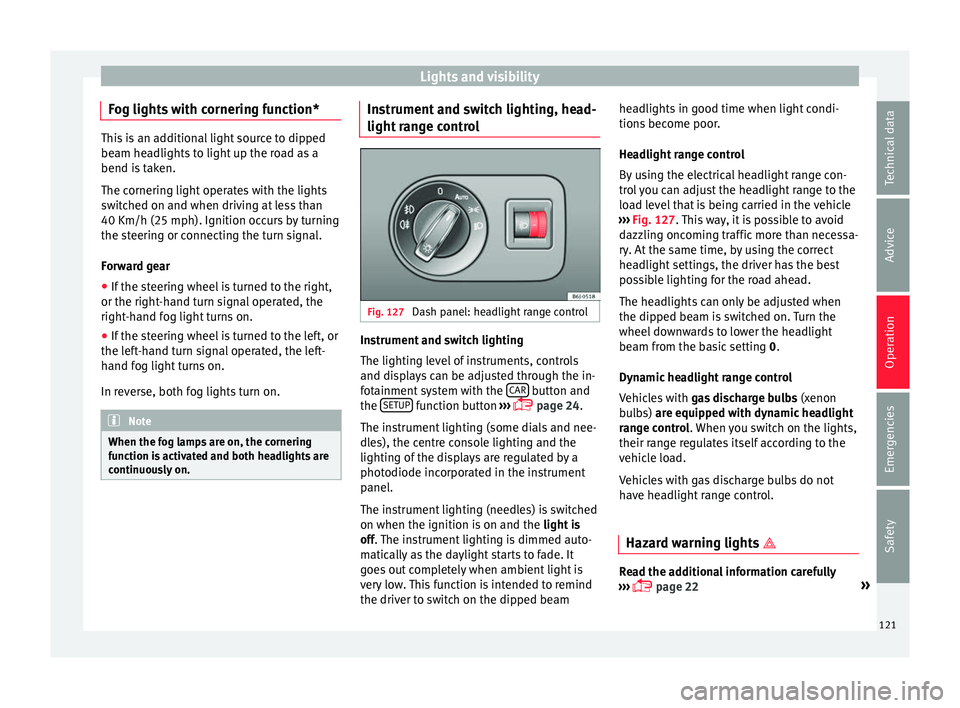
ge control Fig. 127
Dash panel: headlight range control Instrument and switch lighting
The lightin
g l
ev
el of instruments, controls
and displays can be adjusted through the in-
fotainment system with the CAR button and
the S
ETUP function button
››
›
page 24.
The instrument lighting (some dials and nee-
dles), the centre console lighting and the
lighting of the displays are regulated by a
photodiode incorporated in the instrument
panel.
The instrument lighting (needles) is switched
on when the ignition is on and the light is
off. The instrument lighting is dimmed auto-
matically as the daylight starts to fade. It
goes out completely when ambient light is
very low. This function is intended to remind
the driver to switch on the dipped beam headlights in good time when light condi-
tions bec
ome poor.
Headlight range control
By using the electrical headlight range con-
trol you can adjust the headlight range to the
load level that is being carried in the vehicle
››› Fig. 127. This way, it is possible to avoid
dazzling oncoming traffic more than necessa-
ry. At the same time, by using the correct
headlight settings, the driver has the best
possible lighting for the road ahead.
The headlights can only be adjusted when
the dipped beam is switched on. Turn the
wheel downwards to lower the headlight
beam from the basic setting 0.
Dynamic headlight range control
Vehicles with gas discharge bulbs (xenon
bulbs) are equipped with dynamic headlight
range control. When you switch on the lights,
their range regulates itself according to the
vehicle load.
Vehicles with gas discharge bulbs do not
have headlight range control.
Hazard warning lights Read the additional information carefully
› ››
page 22 »
121
Technical data
Advice
Operation
Emergencies
Safety
Page 171 of 248
Driving
Driving tips Driv in
g abr
oadTo drive abroad, the following must be taken
into c
on
sideration:
● For vehicles fitted with a catalytic converter
ensur
e that unleaded petrol is available for
the journey. See the chapter “Refuelling”. Au-
tomobile organisations will have information
about service station networks selling unlea-
ded fuel.
● In some countries, it is possible that your
car model i
s not sold, and therefore some
spare parts are not available or the technical
services may only be able to carry out limited
repairs.
SEAT importers and distributors will gladly
provide information about the technical prep-
aration that your vehicle requires and also
about necessary maintenance and repair
possibilities.
Adhesive strips for headlights
In countries where vehicles drive on the other
side of the road to your home country, the
asymmetric dipped beam may dazzle drivers
of oncoming vehicles.
To prevent dazzling, you must apply stickers
to certain parts of the headlight lenses. Fur- ther information is available at any Technical
Servic
e.
In vehicles with adaptive headlights, the ro-
tation system must previously be disconnec-
ted. To do this, please go to a specialised
workshop.
Driving on flooded roads To prevent damage to the vehicle when driv-
ing thr
ough w
ater, for example, along a floo-
ded road, please observe the following:
● The water should never come above the
low er edg
e of the bodywork.
● Drive at pedestrian speed. WARNING
After driving through water, mud, sludge,
etc ., the br
aking effect can be delayed slight-
ly due to moisture build-up on the discs and
brake pads. Applying the brakes carefully
several times will remove the moisture and
restore the full braking effect. CAUTION
● Drivin g thr
ough flooded areas may severely
damage vehicle components such as the en-
gine, transmission, running gear or electrical
system. ●
Whenever driv in
g through water, the Start-
Stop system* must be switched off
››› page 170. Note
● Chec k the depth of
the water before enter-
ing the flooded zone.
● Do not stop in the water, drive in reverse, or
stop the en
gine in any situation.
● Note that vehicles travelling in the opposite
direction ma
y splash water that could exceed
the maximum permitted water height for your
vehicle.
● Avoid driving through salt water (corro-
sion). 169
Technical data
Advice
Operation
Emergencies
Safety
Page 182 of 248
Operation
In combination with the Parking System Plus
› ›
›
page 173, the camera image will cease to
be transmitted immediately when reverse
gear is disengaged or when the selector lever
is moved from the R position, and the optical
information provided by the Parking Aid sys-
tem will be displayed.
Also in combination with the system, the rear
assist image can also be concealed:
● By pressing one of the Infotainment system
button
s on the display.
● OR: By pressing the miniature vehicle that
appe
ars on the left of the screen (which
switches to the full-screen mode of the Park-
ing System Plus's optical system).
If you wish to display the rear assist image
again:
● Disengage reverse, or change the selector
lever's
position, engage reverse again or
move the selector lever to position R.
● OR: Press the RVC fu
nction button1)
Meaning of the orientation lines
››› Fig. 169 Side lines: exten
sion of the vehicle (the
approximate width of the vehicle plus the
rear view mirrors) on the road surface.
End of the side lines: the area marked in
green ends approximately 2 m behind
the vehicle on the road surface.
Intermediate line: indicates a distance of
approximately 1 m behind the vehicle on
the road surface.
Red horizontal line: indicates a safe dis-
tance of approximately 40 cm at the rear
of the vehicle on the road surface.
Parking manoeuvre
● Place the vehicle in front of the parking
spac
e and engage reverse gear (manual
gearbox) or move the selector to the R posi-
tion (automatic gearbox).
● Reverse slowly, and turn the steering wheel
so that the s
ide orientation lines lead to-
wards the parking space.
● Guide the vehicle into the parking space so
that the s
ide orientation lines run parallel to
it. 1 2
3
4 Cruise speed* (cruise control -
GRA)
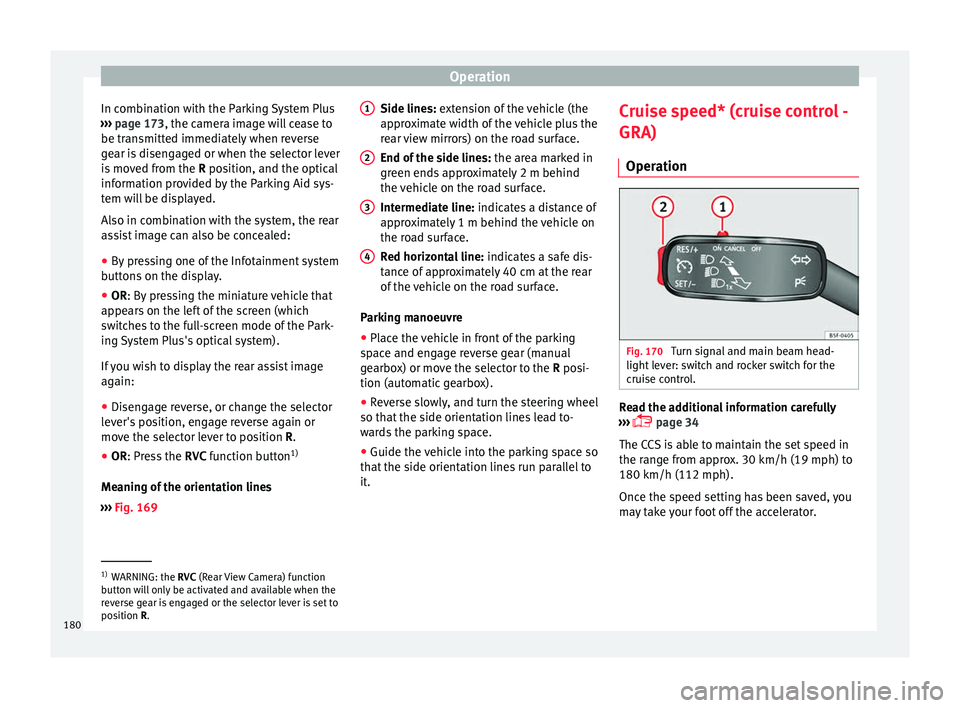
Oper ation Fig. 170
Turn signal and main beam head-
light l
ev
er: switch and rocker switch for the
cruise control. Read the additional information carefully
› ›
›
page 34
The CCS is able to maintain the set speed in
the range from approx. 30 km/h (19 mph) to
180 km/h (112 mph).
Once the speed setting has been saved, you
may take your foot off the accelerator. 1)
WARNING: the RVC (Rear
View Camera) function
button will only be activated and available when the
reverse gear is engaged or the selector lever is set to
position R.
180
Page 236 of 248
Index
Braking brak
e a
ssist . . . . . . . . . . . . . . . . . . . . . . . . . . . . 152
Braking distance . . . . . . . . . . . . . . . . . . . . . . . . . 149
Braking system warning lamp . . . . . . . . . . . . . . . . . . . . . . . . . . 150
Bulbs changing the bulbs . . . . . . . . . . . . . . . . . . . . . . 83
Buzzer . . . . . . . . . . . . . . . . . . . . . . . . . . . . . . . . . . 119
C Capacities . . . . . . . . . . . . . . . . . . . . . . . . . . . . . . . . 40 fuel tank . . . . . . . . . . . . . . . . . . . . . . . . . . . . . . . 98
Car care exterior . . . . . . . . . . . . . . . . . . . . . . . . . . . . . . . 189
Catalytic converter . . . . . . . . . . . . . . . . . . . 166, 167 malfunction . . . . . . . . . . . . . . . . . . . . . . . . . . . . 167
CCS . . . . . . . . . . . . . . . . . . . . . . . . . . . . . . . . . . . . . 34
Central locking anti-theft alarm . . . . . . . . . . . . . . . . . . . . . . . . . 111
automatic speed-dependent locking . . . . . . . 108
central locking button . . . . . . . . . . . . . . . . . . . 108
electric windows . . . . . . . . . . . . . . . . . . . . . . . . 116
key by remote control . . . . . . . . . . . . . . . . . . . . 110
selective unlocking system . . . . . . . . . . . . . . . 107
self-locking system to prevent involuntary un-locking . . . . . . . . . . . . . . . . . . . . . . . . . . . . . . 107
unlocking system . . . . . . . . . . . . . . . . . . . . . . . 108
Central locking system . . . . . . . . . . . . . . . . . . . . . 106 safe security system . . . . . . . . . . . . . . . . . . . . . 106
Cetane number (diesel fuel) . . . . . . . . . . . . . . . . 197
Changing a DRL light bulb . . . . . . . . . . . . . . . . . . . . . . . . . . . 84
Changing a bulb additional brake light . . . . . . . . . . . . . . . . . . . . . 90
luggage compartment light . . . . . . . . . . . . . . . . 90
tail light bulbs . . . . . . . . . . . . . . . . . . . . . . . . . . . 88
turn signal light . . . . . . . . . . . . . . . . . . . . . . . . . 86 Changing a double headlight bulb
dipped beam he adlights . . . . . . . . . . . . . . . . . . 86
double headlight bulbs . . . . . . . . . . . . . . . . . . . 85
Changing an AFS headlight bulb . . . . . . . . . . . . . . 87 turn signal light . . . . . . . . . . . . . . . . . . . . . . . . . 87
xenon light . . . . . . . . . . . . . . . . . . . . . . . . . . . . . 87
Changing a single headlight bulb side light . . . . . . . . . . . . . . . . . . . . . . . . . . . . . . . 85
single headlight bulbs . . . . . . . . . . . . . . . . . . . . 84
turn signal light . . . . . . . . . . . . . . . . . . . . . . . . . 84
Changing a wheel . . . . . . . . . . . . . . . . . . . . . . . . . 47 subsequent work . . . . . . . . . . . . . . . . . . . . . . . . 50
Changing double headlight bulb side light . . . . . . . . . . . . . . . . . . . . . . . . . . . . . . . 85
Changing settings CAR menu . . . . . . . . . . . . . . . . . . . . . . . . . . . . . . 24
Changing the blades . . . . . . . . . . . . . . . . . . . . . . . 78
Changing the bulbs AFS headlight bulbs . . . . . . . . . . . . . . . . . . . . . . 87
fog light bulbs . . . . . . . . . . . . . . . . . . . . . . . . . . 87
general notes . . . . . . . . . . . . . . . . . . . . . . . . . . . 83
interior light and reading light . . . . . . . . . . . . . 90
number plate light . . . . . . . . . . . . . . . . . . . . . . . 90
turn signals . . . . . . . . . . . . . . . . . . . . . . . . . . . . . 89
Changing the double headlight bulb main beam . . . . . . . . . . . . . . . . . . . . . . . . . . . . . 86
Changing the single headlight bulbs dipped/main beam . . . . . . . . . . . . . . . . . . . . . . 84
Charging the battery . . . . . . . . . . . . . . . . . . . . . . . 52
Checking levels engine compartment . . . . . . . . . . . . . . . . . . . . 201
Child-proof locking electric windows . . . . . . . . . . . . . . . . . . . . . . . . 114
Child seat categorisation in groups . . . . . . . . . . . . . . . . . . 73 Child seats . . . . . . . . . . . . . . . . . . . . . . . . . . . . 16, 73
ISOFIX sys tem . . . . . . . . . . . . . . . . . . . . . . . . . . . 18
safety instructions . . . . . . . . . . . . . . . . . . . . 16, 72
securing with the seat belt . . . . . . . . . . . . . . . . 17
Top Tether system . . . . . . . . . . . . . . . . . . . . . 18, 20
Chrome parts cleaning . . . . . . . . . . . . . . . . . . . . . . . . . . . . . . 192
Cigarette lighter . . . . . . . . . . . . . . . . . . . . . . . . . . 132
Cleaning . . . . . . . . . . . . . . . . . . . . . . . . . . . . . . . . 188 alloy wheel rims . . . . . . . . . . . . . . . . . . . . . . . . 193
chrome parts . . . . . . . . . . . . . . . . . . . . . . . . . . . 192
engine compartment . . . . . . . . . . . . . . . . . . . . 193
fabric . . . . . . . . . . . . . . . . . . . . . . . . . . . . . . . . . 194
high pressure cleaners . . . . . . . . . . . . . . . . . . . 190
leather . . . . . . . . . . . . . . . . . . . . . . . . . . . . . . . . 195
plastic parts . . . . . . . . . . . . . . . . . . . . . . 191, 194
radio and climate controls . . . . . . . . . . . . . . . . 194
rubber seals . . . . . . . . . . . . . . . . . . . . . . . . . . . 192
seat belts . . . . . . . . . . . . . . . . . . . . . . . . . . . . . 195
steel wheel rims . . . . . . . . . . . . . . . . . . . . . . . . 193
stickers . . . . . . . . . . . . . . . . . . . . . . . . . . . . . . . 191
upholstery . . . . . . . . . . . . . . . . . . . . . . . . . . . . . 194
washing the vehicle . . . . . . . . . . . . . . . . . . . . . 189
windows and exterior mirrors . . . . . . . . . . . . . 192
windscreen wiper blades . . . . . . . . . . . . . . . . . 192
wooden trim . . . . . . . . . . . . . . . . . . . . . . . . . . . 194
Climatronic . . . . . . . . . . . . . . . . . . . . . . . . . . . . . . . 39 adjusting the temperature . . . . . . . . . . . . . . . . 144
air recirculation . . . . . . . . . . . . . . . . . . . . . . . . . 144
automatic mode . . . . . . . . . . . . . . . . . . . . . . . . 144
blower selection . . . . . . . . . . . . . . . . . . . . . . . . 144
controls . . . . . . . . . . . . . . . . . . . . . . . . . . . . . . . 143
general notes . . . . . . . . . . . . . . . . . . . . . . . . . . 137
windscreen defrost . . . . . . . . . . . . . . . . . . . . . . 145
Close . . . . . . . . . . . . . . . . . . . . . . . . . . . . . . . . . . . 106
234
Page 239 of 248
Index
Exhaust gas purification system cat
alytic
converter . . . . . . . . . . . . . . . . . . . . . . 166
diesel particulate filter . . . . . . . . . . . . . . . . . . . 166
Extending the luggage compartment . . . . . . . . . . . . . . . . 129
exterior lighting changing the bulbs . . . . . . . . . . . . . . . . . . . . . . 83
Exterior mirrors . . . . . . . . . . . . . . . . . . . . . . . . . . . 125 adjusting . . . . . . . . . . . . . . . . . . . . . . . . . . . . . . . 13
control . . . . . . . . . . . . . . . . . . . . . . . . . . . . . . . . 126
folding in electrically . . . . . . . . . . . . . . . . . . . . 126
folding in manually . . . . . . . . . . . . . . . . . . . . . 125
heated . . . . . . . . . . . . . . . . . . . . . . . . . . . . . . . . 126
Exterior view . . . . . . . . . . . . . . . . . . . . . . . . . . . . . 5, 6
F Fabric: cleaning . . . . . . . . . . . . . . . . . . . . . . . . . . 194
Fastening rings . . . . . . . . . . . . . . . . . . . . . . . . . . . 134
Fatigue detection . . . . . . . . . . . . . . . . . . . . . . . . . 171
Fault in electronic differential lock (EDL) control lamp . . . . . . . . . . . . . . . . . . . . . . . . . . . 155
Faulty bulbs changing the bulbs . . . . . . . . . . . . . . . . . . . . . . 83
Filling the fuel tank . . . . . . . . . . . . . . . . . . . . . . . 196
Filling the tank . . . . . . . . . . . . . . . . . . . . . . . . . . . 196 fuel gauge . . . . . . . . . . . . . . . . . . . . . . . . . . . . . . 98
Fire extinguisher . . . . . . . . . . . . . . . . . . . . . . . . . . . 75
First-aid kit . . . . . . . . . . . . . . . . . . . . . . . . . . . . . . . 75
Floor mats . . . . . . . . . . . . . . . . . . . . . . . . . . . . . . . . 61
Fluid Level control . . . . . . . . . . . . . . . . . . . . . . . . . 40
Fog-light bulb FR version . . . . . . . . . . . . . . . . . . . . . . . . . . . . . . 88
Fog light bulb . . . . . . . . . . . . . . . . . . . . . . . . . . . . . 87
Front airbags . . . . . . . . . . . . . . . . . . . . . . . . . . 14, 69 safety instructions . . . . . . . . . . . . . . . . . . . . . . . 69
Front ashtray . . . . . . . . . . . . . . . . . . . . . . . . . . . . . 132
Front drink holder . . . . . . . . . . . . . . . . . . . . . . . . . 131 Front passenger front airbag
contro l lamp . . . . . . . . . . . . . . . . . . . . . . . . . . . . 68
deactivation . . . . . . . . . . . . . . . . . . . . . . . . . . . . 14
Front seat manual adjustment . . . . . . . . . . . . . . . . . . . . . . 12
Front seat backrest folding . . . . . . . . . . . . . . . . . . . . . . . . . . . . . . . . 127
lifting . . . . . . . . . . . . . . . . . . . . . . . . . . . . . . . . . 127
Fuel . . . . . . . . . . . . . . . . . . . . . . . . . . . . . . . . 41, 196 consumption . . . . . . . . . . . . . . . . . . . . . . . . . . . 217
diesel . . . . . . . . . . . . . . . . . . . . . . . . . . . . . . . . . 197
ethanol . . . . . . . . . . . . . . . . . . . . . . . . . . . . . . . 196
fuel gauge . . . . . . . . . . . . . . . . . . . . . . . . . . . . . . 98
refuelling . . . . . . . . . . . . . . . . . . . . . . . . . . . . . . 196
saving . . . . . . . . . . . . . . . . . . . . . . . . . . . . . . . . 165
Fuel consumption . . . . . . . . . . . . . . . . . . . . . . . . . 165 why does fuel consumption increase? . . . . . . 167
Fuel tank cap opening and closing . . . . . . . . . . . . . . . . . . . . . 41
Fuel tank flap opening and closing . . . . . . . . . . . . . . . . . . . . . 41
Fuses . . . . . . . . . . . . . . . . . . . . . . . . . . . . . . . . . 44, 80 fuse box . . . . . . . . . . . . . . . . . . . . . . . . . . . . . . . . 81
identifying blown fuses . . . . . . . . . . . . . . . . . . . 45
identifying by colours . . . . . . . . . . . . . . . . . . . . . 44
preparation before replacing . . . . . . . . . . . . . . . 44
replacing . . . . . . . . . . . . . . . . . . . . . . . . . . . . . . . 44
G
Gear-change indicator . . . . . . . . . . . . . . . . . 28, 158
Gearbox lever . . . . . . . . . . . . . . . . . . . . . . . . . . . . . 37
Gear change . . . . . . . . . . . . . . . . . . . . . . . . . . . . . . 37 automatic . . . . . . . . . . . . . . . . . . . . . . . . . . . . . . 38
changing gears (manual gearbox) . . . . . . . . . 158
manual . . . . . . . . . . . . . . . . . . . . . . . . . . . . . . . . 37
manual gear change . . . . . . . . . . . . . . . . . . . . . 158
Gear engaged . . . . . . . . . . . . . . . . . . . . . . . . . . . . . 37 Gear recommendation . . . . . . . . . . . . . . . . . . . . . . 28
General in
strument panel
controls and displays . . . . . . . . . . . . . . . . . . . . . 93
turn signal and main beam lever . . . . . . . . . . . 119
warning and indication lamps . . . . . . . . . . . . . . 35
General overview of the engine compartment . . 201
Glove compartment . . . . . . . . . . . . . . . . . . . . . . . 130
Glow plug system . . . . . . . . . . . . . . . . . . . . . . . . . 149
H
Handbrake . . . . . . . . . . . . . . . . . . . . . . . . . 149, 150 warning lamp . . . . . . . . . . . . . . . . . . . . . . . . . . 151
Hazard warning lights . . . . . . . . . . . . . . . . . 22, 121
HBA . . . . . . . . . . . . . . . . . . . . . . . . . . . . . . . . . . . . 155
Head-on collisions and the laws of physics . . . . . 63
Head-protection airbags description . . . . . . . . . . . . . . . . . . . . . . . . . . . . . 15
safety instructions . . . . . . . . . . . . . . . . . . . . . . . 15
Headlight range control . . . . . . . . . . . . . . . . . . . . 121
Headlights driving abroad . . . . . . . . . . . . . . . . . . . . . . . . . 169
fog lights . . . . . . . . . . . . . . . . . . . . . . . . . . . . . . 119
headlight washer . . . . . . . . . . . . . . . . . . . . . . . 125
Head restraints . . . . . . . . . . . . . . . . . . . . . . . . . . . . 12 adjustment . . . . . . . . . . . . . . . . . . . . . . . . . . . . 128
front head restraints . . . . . . . . . . . . . . . . . . . . . . 60
rear head restraints . . . . . . . . . . . . . . . . . . . . . . 60
Headrests . . . . . . . . . . . . . . . . . . . . . . . . . . . . . . . . 12 adjustment . . . . . . . . . . . . . . . . . . . . . . . . . . . . 128
front . . . . . . . . . . . . . . . . . . . . . . . . . . . . . . . . . . . 60
rear . . . . . . . . . . . . . . . . . . . . . . . . . . . . . . . . . . . 60
Heated rear window heating element wires . . . . . . . . . . . . . . . . . . . 192
switch . . . . . . . . . . . . . . . . . . . . . . . . . . . . . . . . 123
Heating . . . . . . . . . . . . . . . . . . . . . . . . . . . . . . . . . 140 defrosting the windscreen . . . . . . . . . . . . . . . . 140
demisting the windscreen and side windows 140
237