wheel Seat Ibiza SC 2010 Owner's Guide
[x] Cancel search | Manufacturer: SEAT, Model Year: 2010, Model line: Ibiza SC, Model: Seat Ibiza SC 2010Pages: 266, PDF Size: 7.02 MB
Page 107 of 266
Seats and storage compartments105
Safety First
Operating Instructions
Practical Tips
Technical Specifications
Seats and storage compartmentsThe importance of correct seat adjustmentProper seat adjustment optimises the level of protection
offered by seat belts and airbags.Your vehicle has five seats, two in the front and three in the rear. Each seat is
equipped with a three-point seat belt.
The driver seat and the front passenger seat can be adjusted in many ways to
suit the physical requirements of the vehicle occupants. The correct seat
position is very important for:•a fast and easy operation of all controls on the instrument panel,•a relaxed posture which does not cause drowsiness,•a safe driving ⇒ page 7,•ensuring that the seat belts and airbag system provide maximum protec-
tion ⇒page 16.WARNING
•If the driver and passengers assume improper sitting positions, they
may sustain critical injuries.•More people than available seats must never be transported in your
vehicle.•Every passenger in the vehicle must properly fasten and wear the seat
belt belonging to his or her seat. Chil dren must be protected with an appro-
priate child restraint system ⇒page 39, “Child safety”.•The front seats and all head restraints must always be adjusted to body
size and the seat belt must always be properly adjusted to provide you and
your passengers with optimum protection.
•Always keep your feet on the footwell when the vehicle is moving; never
rest them on the dash panel, out of the window or on the seat. This is also
applied to passengers. An incorrect sitting position exposes you to an
increased risk of injury in case of a sudden braking or an accident. If the
airbag is triggered, you could sustain severe injuries due to an incorrect
sitting position.•It is important for the driver and front passenger to keep a distance of
at least 25 cm from the steering wheel or dash panel. Failure to respect the
minimum distance means that the airbag will not protect you. Risk of fatal
injury. The distance between the driver and the steering wheel or between
the front passenger and the dash panel should always be as great as
possible.•Adjust the driver or front passenger seat only when the vehicle is
stationary. Otherwise, your seat could move unexpectedly while the
vehicle is moving. This could increase the risk of an accident and therefore,
injury. In addition, while adjusting your seat, you will assume an incorrect
sitting position. Risk of fatal accidents.•Special guidelines apply to installing a child seat on the front
passenger seat. When installing a child seat, please observe the warnings
described in ⇒page 39, “Child safety”.WARNING (continued)
IbizaSC_EN.book Seite 105 Donnerstag, 2. September 2010 6:10 18
Page 110 of 266
Seats and storage compartments
108•When fitting the head restraints again, insert the tubes as far as possible
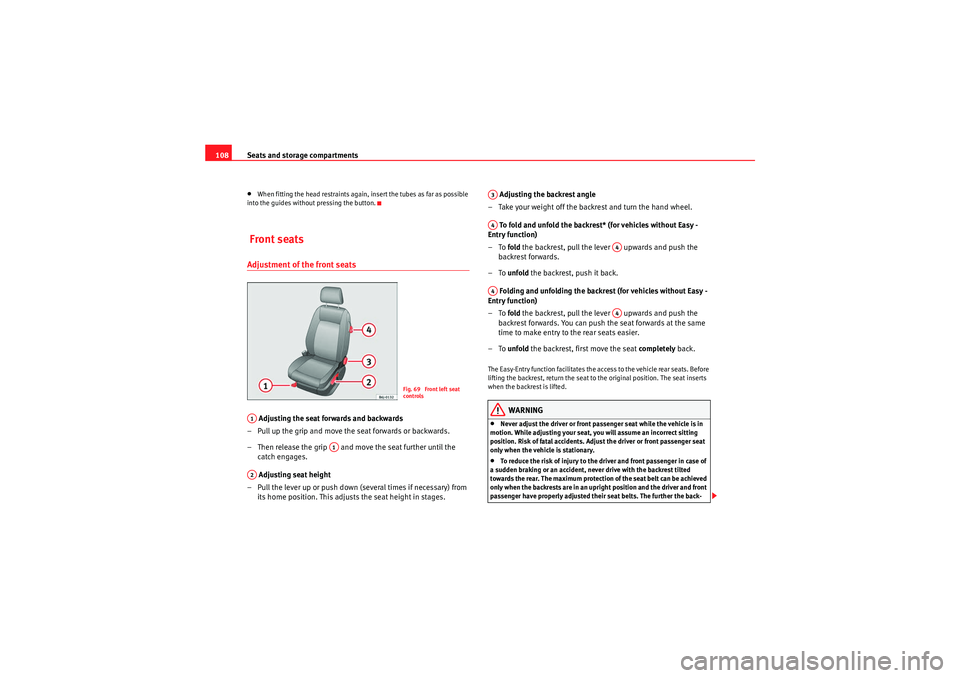
into the guides without pressing the button. Front seatsAdjustment of the front seats Adjusting the seat forwards and backwards
– Pull up the grip and move the seat forwards or backwards.
– Then release the grip and move the seat further until the catch engages.
Adjusting seat height
– Pull the lever up or push down (several times if necessary) from its home position. This adjust s the seat height in stages. Adjusting the backrest angle
– Take your weight off the backrest and turn the hand wheel.
To fold and unfold the backrest* (for vehicles without Easy -
Entry function)
–To fold the backrest, pull the lever upwards and push the
backrest forwards.
–To unfold the backrest, push it back.
Folding and unfolding the backrest (for vehicles without Easy -
Entry function)
–To fold the backrest, pull the lever upwards and push the
backrest forwards. You can push the seat forwards at the same
time to make entry to the rear seats easier.
–To unfold the backrest, first move the seat completely back.
The Easy-Entry function facilitates the access to the vehicle rear seats. Before
lifting the backrest, return the seat to the original position. The seat inserts
when the backrest is lifted.
WARNING
•Never adjust the driver or front passenger seat while the vehicle is in
motion. While adjusting your seat, you will assume an incorrect sitting
position. Risk of fatal accidents. Adjust the driver or front passenger seat
only when the vehicle is stationary.•To reduce the risk of injury to the driver and front passenger in case of
a sudden braking or an accident, never drive with the backrest tilted
towards the rear. The maximum protection of the seat belt can be achieved
only when the backrests are in an upright position and the driver and front
passenger have properly adjusted their seat belts. The further the back-
Fig. 69 Front left seat
controls
A1
A1
A2
A3A4
A4
A4
A4
IbizaSC_EN.book Seite 108 Donnerstag, 2. September 2010 6:10 18
Page 132 of 266
Driving
130DrivingSteeringAdjusting the steering wheel position
The height and reach of the steering wheel can be freely
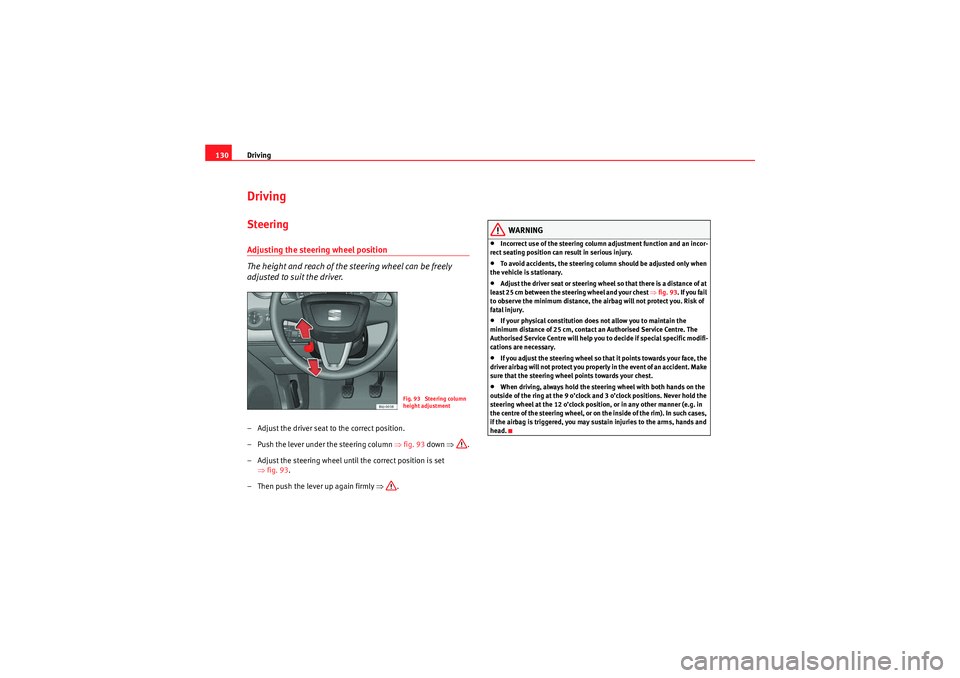
adjusted to suit the driver.– Adjust the driver seat to the correct position.
– Push the lever under the steering column ⇒fig. 93 down ⇒.
– Adjust the steering wheel until the correct position is set ⇒fig. 93 .
– Then push the lever up again firmly ⇒.
WARNING
•Incorrect use of the steering column adjustment function and an incor-
rect seating position can result in serious injury.•To avoid accidents, the steering column should be adjusted only when
the vehicle is stationary.•Adjust the driver seat or steering wheel so that there is a distance of at
least 25 cm between the steering wheel and your chest ⇒fig. 93 . If you fail
to observe the minimum distance, the airbag will not protect you. Risk of
fatal injury.•If your physical constitution does not allow you to maintain the
minimum distance of 25 cm, contact an Authorised Service Centre. The
Authorised Service Centre will help you to decide if special specific modifi-
cations are necessary.•If you adjust the steering wheel so that it points towards your face, the
driver airbag will not protect you properly in the event of an accident. Make
sure that the steering wheel points towards your chest.•When driving, always hold the steering wheel with both hands on the
outside of the ring at the 9 o’clock and 3 o’clock positions. Never hold the
steering wheel at the 12 o’clock position, or in any other manner (e.g. in
the centre of the steering wheel, or on the inside of the rim). In such cases,
if the airbag is triggered, you may sustain injuries to the arms, hands and
head.
Fig. 93 Steering column
height adjustment
IbizaSC_EN.book Seite 130 Donnerstag, 2. September 2010 6:10 18
Page 134 of 266
Driving
132Ignition switched off, steering lock
In this position ⇒page 131, fig. 95 the ignition and the engine are OFF and
the steering may get locked.
For the Steering lock to operate without the ignition key, turn the steering
wheel until it locks with an audible sound. You should always lock the
steering wheel when you leave your vehicle. This will help prevent vehicle
theft ⇒ .
Switching the ignition or the glow plug system on
Turn the ignition key to this position and release it. If the key cannot be turned
or it is difficult to turn from position to position , move the steering
wheel from one side to the other until it is released.
Starting
The engine is started when the key is in this position. Electrical components
with a high power consumption are switched off temporarily.
Every time the vehicle is started again, the ignition key must be turned to
position . The repetitive start prevention lock of the ignition prevents
possible damage to the starter motor if the engine is already running.
WARNING
•The ignition key must NOT be removed from the lock until the vehicle
comes to a standstill. Otherwise, the steering could be immediately
blocked- Risk of accident!•Always remove the key from the ignition when leaving the vehicle, even
for a short period. This is especially important if children or disabled
people are left alone in the vehicle. They could accidentally start the
engine or work electrical equipment such as the electric windows, conse-
quently resulting in an accident.•Unsupervised use of the keys could start the engine or any electrical
system, such as the electric window. This could result in serious injury.
Caution
The starter motor will only work when the engine is stopped (ignition key
position ).Electronic immobiliser
The immobiliser prevents unauthorised persons from driving
the vehicle.Inside the key there is a chip that deactivates the electronic immobiliser auto-
matically when the key is inserted into the ignition.
The immobiliser will be activated again automatically as soon as you pull the
key out of the ignition lock.
The engine can only be started using a genuine SEAT key with its correct code.
Note
A perfect operation of the vehicle is ensured if genuine SEAT keys are used.
A1
A2
A1
A2
A3A1
A3
IbizaSC_EN.book Seite 132 Donnerstag, 2. September 2010 6:10 18
Page 137 of 266
Driving135
Safety First
Operating Instructions
Practical Tips
Technical Specifications
operation cannot be performed, risk
of accidents and serious injury may
exist.
•The steering lock can be immediately blocked once the key is removed
from the ignition. The steering wheel cannot be turned. Risk of accident.Caution
When the engine has been running under a heavy load for a long period, heat
can accumulate in the engine compartment and cause engine damage. For
this reason, you should idle the engine for approx. 2 minutes before you
switch it off.Start-Stop function*Description and operationThe Start-Stop function stops the engine when the vehicle is
stopped and starts it automatically when required.
– When the vehicle is stopped, put it in neutral and release the
clutch pedal. The engine will stop.
– When the clutch pedal is pressed, the engine starts again.
– The instrument panel screen displays information about the status of the Start-Stop function ⇒page 137, fig. 97 .Start-Stop function conditions•The driver seat belt must be buckled.
•The engine hood must be closed.•The engine must be at operating temperature•The steering wheel must be straight.•The vehicle must be on flat ground.•The vehicle must not be in reverse.•A trailer must not be connected.•The temperature of the passenger compartment must be within the
convenience limits ( button should be selected).•The windscreen de-mist function must be off.•If in an increase in airflow is not requested.•The temperature must not be set to HI or LO .•The driver door must be closed.•The diesel particulate filter must not be in regeneration mode, for diesel
engines.•The battery charge must not be low for the next start.•The battery temperature must be between -1 °C and 55 °C.
Start-Stop function interruption
In the following situations, the Start-Stop function will be interrupted and the
engine will automatically start:•The vehicle starts moving.•The brake pedal is pressed several times in a row.•The battery has been discharged excessively.•The Start-Stop System is manually deactivated.•The windscreen de-mist function is turned on.•The temperature of the passenger compartment exceeds the convenience
limits ( button).•If the airflow is increased by more than 3 presses.•Temperature setting HI or LO is selected.
WARNING (continued)
AC
AC
IbizaSC_EN.book Seite 135 Donnerstag, 2. September 2010 6:10 18
Page 138 of 266
Driving
136•The engine coolant temperature is insufficient.•The alternator is faulty, for example the V-belt has ruptured.•If any of the conditions described in the previous section are not fulfilled.WARNING
Never allow the vehicle to move with the engine off for any reason. You
could lose control of your vehicle. This could cause an accident and serious
injury.•The brake ser vo does not work with the engine off. You need more force
to stop the vehicle.•Power steering does not work when the engine is not running. That is
why it is much more difficult to turn the steering wheel.•Disconnect the Start-Stop system when driving through water (fording
streams, etc.).Note
•For vehicles with the Star t-Stop function and a manual gearbox, when the
engine is started, the clutch must be pressed.•When the conditions for the Start-Stop function are not fulfilled, the
instrument panel displays the Start-Stop indicator dimmed.•The vehicle can be restarted by rotating the steering wheel three times,
that is, more than 270°.
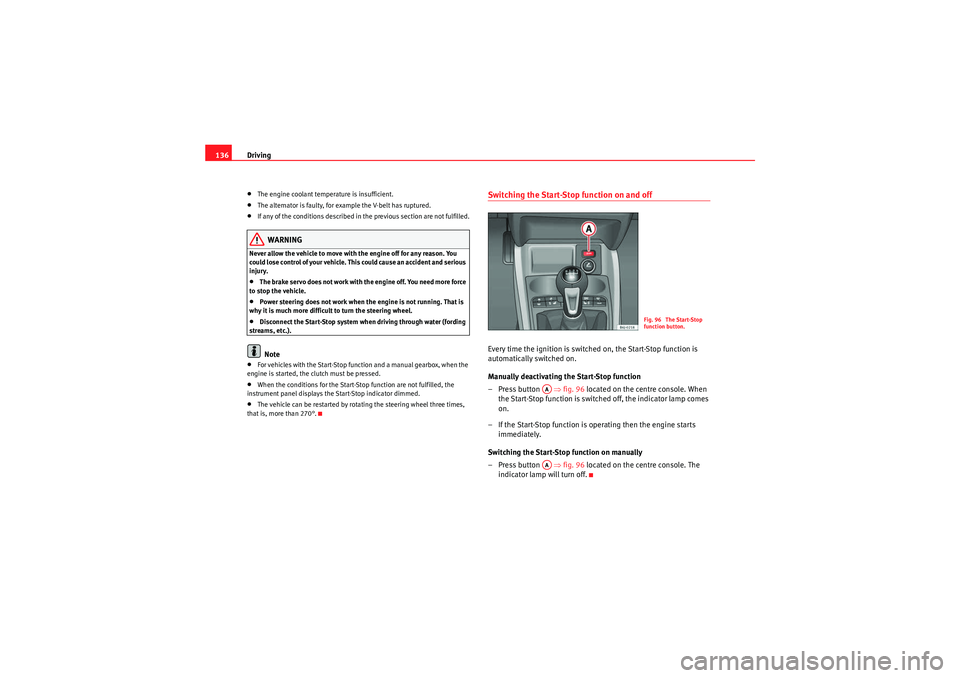
Switching the Start-Stop function on and offEvery time the ignition is switched on, the Start-Stop function is
automatically switched on.
Manually deactivating the Start-Stop function
–Press button ⇒ fig. 96 located on the centre console. When
the Start-Stop function is switched off, the indicator lamp comes
on.
– If the Start-Stop function is operating then the engine starts immediately.
Switching the Start-Stop function on manually
–Press button ⇒ fig. 96 located on the centre console. The
indicator lamp will turn off.
Fig. 96 The Start-Stop
function button.
AAAA
IbizaSC_EN.book Seite 136 Donnerstag, 2. September 2010 6:10 18
Page 144 of 266
Driving
142Changing gear in tiptronic mode*
The tiptronic system allows the driver to select gears manu-
ally
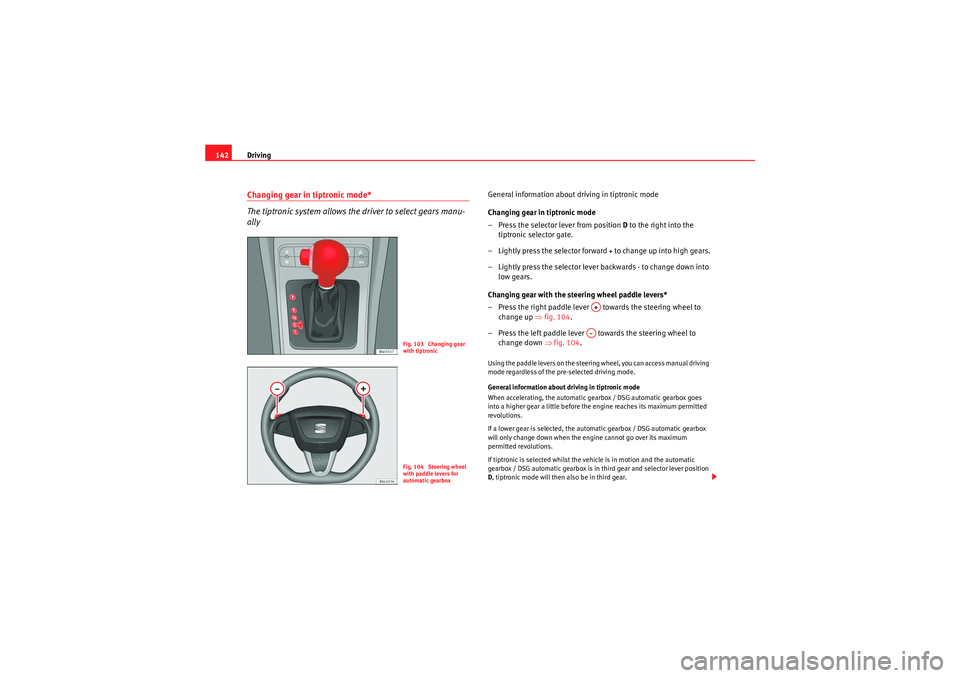
General information about driving in tiptronic mode
Changing gear in tiptronic mode
– Press the selector lever from position D to the right into the
tiptronic selector gate.
– Lightly press the selector forward + to change up into high gears.
– Lightly press the selector lever backwards - to change down into
low gears.
Changing gear with the steering wheel paddle levers*
– Press the right paddle lever towards the steering wheel to change up ⇒ fig. 104.
– Press the left paddle lever towards the steering wheel to change down ⇒ fig. 104.Using the paddle levers on the steering wheel, you can access manual driving
mode regardless of the pre-selected driving mode.
General information about driving in tiptronic mode
When accelerating, the automatic gearbox / DSG automatic gearbox goes
into a higher gear a little before the engine reaches its maximum permitted
revolutions.
If a lower gear is selected, the automatic gearbox / DSG automatic gearbox
will only change down when the engine cannot go over its maximum
permitted revolutions.
If tiptronic is selected whilst the vehicle is in motion and the automatic
gearbox / DSG automatic gearbox is in third gear and selector lever position
D, tiptronic mode will then also be in third gear.
Fig. 103 Changing gear
with tiptronicFig. 104 Steering wheel
with paddle levers for
automatic gearbox
A+A–
IbizaSC_EN.book Seite 142 Donnerstag, 2. September 2010 6:10 18
Page 145 of 266
Driving143
Safety First
Operating Instructions
Practical Tips
Technical Specifications
Changing gears in the normal or sport programme using the steering wheel
paddle levers
If the paddle levers ⇒
page 142, fig. 104 are used in the normal or sport
programme, the system switches temporarily to tiptronic mode. To exit
“tiptronic” mode again, press the right paddle lever towards the steering
wheel for approximately one second. You will also leave tiptronic mode if the
paddle levers are not moved for a certain time.
Note
•The gear paddle levers on the steering wheel can be operated with the
selector lever in any position and with the vehicle in motion.Selector lever positions
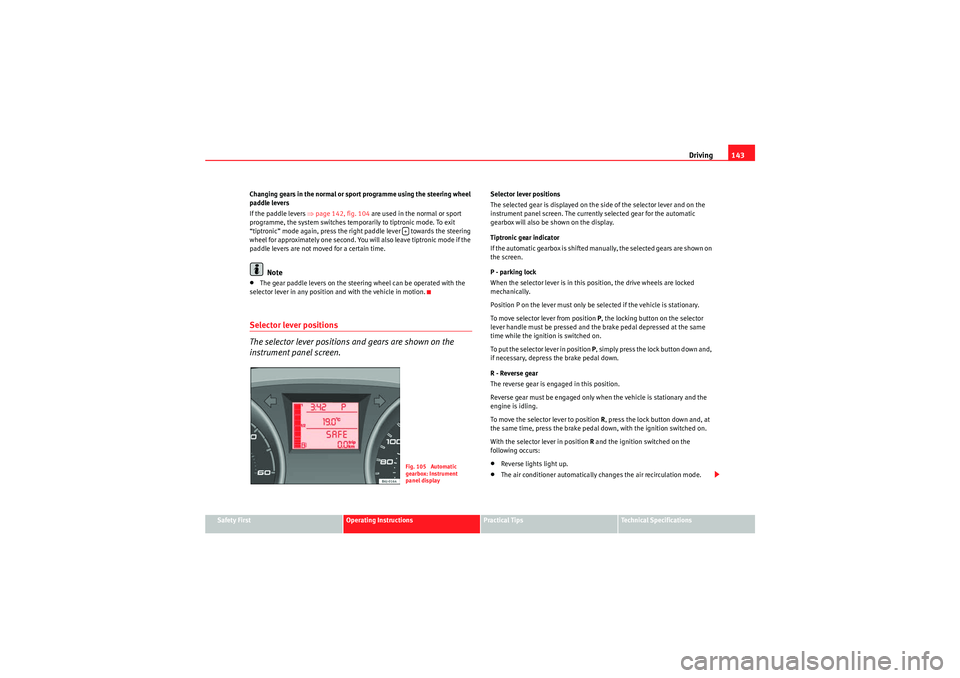
The selector lever positions and gears are shown on the
instrument panel screen.
Selector lever positions
The selected gear is displayed on the side of the selector lever and on the
instrument panel screen. The currently selected gear for the automatic
gearbox will also be shown on the display.
Tiptronic gear indicator
If the automatic gearbox is shifted manually, the selected gears are shown on
the screen.
P - parking lock
When the selector lever is in this position, the drive wheels are locked
mechanically.
Position P on the lever must only be selected if the vehicle is stationary.
To move selector lever from position P, the locking button on the selector
lever handle must be pressed and the brake pedal depressed at the same
time while the ignition is switched on.
To put the selector lever in position P, simply press the lock button down and,
if necessary, depress the brake pedal down.
R - Reverse gear
The reverse gear is engaged in this position.
Reverse gear must be engaged only when the vehicle is stationary and the
engine is idling.
To move the selector lever to position R, press the lock button down and, at
the same time, press the brake pedal down, with the ignition switched on.
With the selector lever in position R and the ignition switched on the
following occurs:•Reverse lights light up.•The air conditioner automatically changes the air recirculation mode.
+Fig. 105 Automatic
gearbox: Instrument
panel display
IbizaSC_EN.book Seite 143 Donnerstag, 2. September 2010 6:10 18
Page 146 of 266
Driving
144•The wiper starts if the windscreen washer is on.•The parking distance warning system switches on.*
N - Neutral (idling)
If this position is selected, the gearbox is in neutral. Power is not transmitted
to the wheels and the engine does not have a braking function.
Never use the N position to drive down a hill. The engine does not function as
a brake and the brakes are subjected to excessive stain.
You could damage the automatic gearbox if you drive down hills with the gear
lever in position N and the engine switched off.
D - Drive (forward)
In this position the gearbox automatically changes to a lower or higher gear,
according to the engine’s requirements, the driving style and speed. The
braking effect of the engine when driving downhill is very limited when the
selector is in this position. The instrument panel displays the selected gear
as well as the selector lever in position D.
If position N has been selected and you wish to select D, you must press the
foot brake if the vehicle is stationary, or travelling at under 5 km/h.
S - Standard driving position (Sport programme)
When the selector lever is in position S, it will automatically change up into a
higher gear later, and change down into a low gear, if compared with position
D . This way, it is possible to take full advantage of the engine reserve power,
depending on the engine demand, driving style and speed. The braking
effect of the engine when driving downhill is very limited. On the instrument
panel display the selected gear is shown as well as the selector lever to posi-
tion S.
To se lec t gea r range S, press the lock button on the selector lever.
WARNING
If the vehicle moves with no control, an accident and serious injury may
occur.•As a driver, you should never leave your vehicle if the engine is running
and a gear is engaged. If you have to leave your vehicle while the engine is
running, you must always apply the handbrake and engage parking lock P.•If the engine is running and if D or R are engaged, you will need to hold
the the vehicle stopped by depressing footbrake down. The car would creep
forward as the power transmission is not fully interrupted even when the
engine is idling.•Never accelerate when moving the selector gear or you may cause an
accident.•Never move the selector lever to “R” or “P” when driving. Risk of acci-
dent.•Before driving down a very steep slope, reduce your speed and shift to
first gear.•Always hold the vehicle on the foot brake if you stop on hills. Other-
wise, the vehicle could roll back.•Never allow the brake to rub and do not use the brake pedal too often
or for long periods. Constant braking will cause the brakes to overheat and
will considerably reduce the brake effect. This increases the braking
distance and could cause the brake system to fail.WARNING
Never switch the engine off until the vehicle is stationary. You could lose
control of your vehicle. This could cause an accident and serious injury.•The airbags and belt tensioners do not work when the ignition is
switched off.•The brake servo does not work with the engine off. You need more force
to stop the vehicle.
IbizaSC_EN.book Seite 144 Donnerstag, 2. September 2010 6:10 18
Page 147 of 266
Driving145
Safety First
Operating Instructions
Practical Tips
Technical Specifications
•Power steering does not work when the engine is not running. That is
why it is much more difficult to turn the steering wheel.•Never remove the key from the ignition if the vehicle is in motion. The
steering lock could suddenly engage, and you would not be able to steer
the vehicle.•Never allow the car to roll downhill with the selector lever in “N”,
regardless of the engine is running or not.Caution
If you allow the vehicle to move when the engine is switched off or with the
selector lever in position “N”, take your foot off the accelerator and wait until
the engine starts idling before returning to position “D”.Kickdown feature
This feature allows maximum acceleration.If you press the accelerator down thoroughly, the gearbox automatically
changes down, depending on speed and e ngine speed, into a lower gear to
take full advantage of give the vehicle maximum acceleration.
The gearbox does not change gear until the engine reaches the maximum
determined engine speed for the gear.
WARNING
You could lose control of the vehicle if you accelerate on slippery road
surfaces. Risk of serious injury.
•Be particularly careful when using the kickdown features on slippery
road surfaces. With a fast acceleration, the vehicle could lose traction and
skid.•You should use the kickdown feature only when traffic and weather
conditions allow it to be used safely.
HandbrakeUsing the handbrake
The handbrake should be applied firmly to prevent the
vehicle from accidentally rolling away.
WARNING (continued)
WARNING (continued)
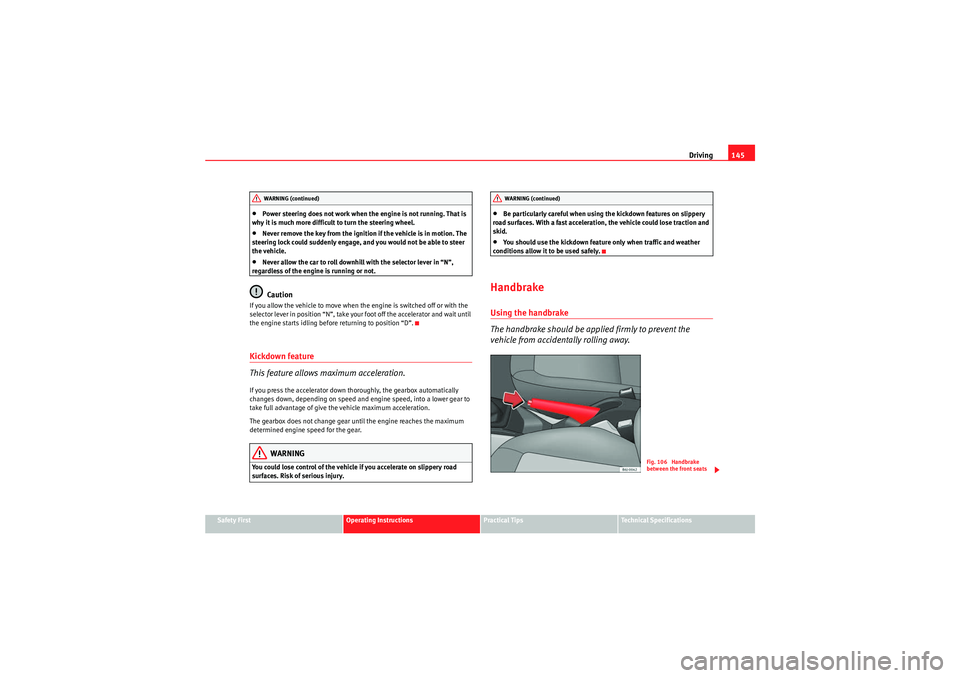
Fig. 106 Handbrake
between the front seats
IbizaSC_EN.book Seite 145 Donnerstag, 2. September 2010 6:10 18