oil change Seat Ibiza SC 2011 User Guide
[x] Cancel search | Manufacturer: SEAT, Model Year: 2011, Model line: Ibiza SC, Model: Seat Ibiza SC 2011Pages: 278, PDF Size: 3.92 MB
Page 213 of 278
211
Checking and refilling levels
Wear indicators
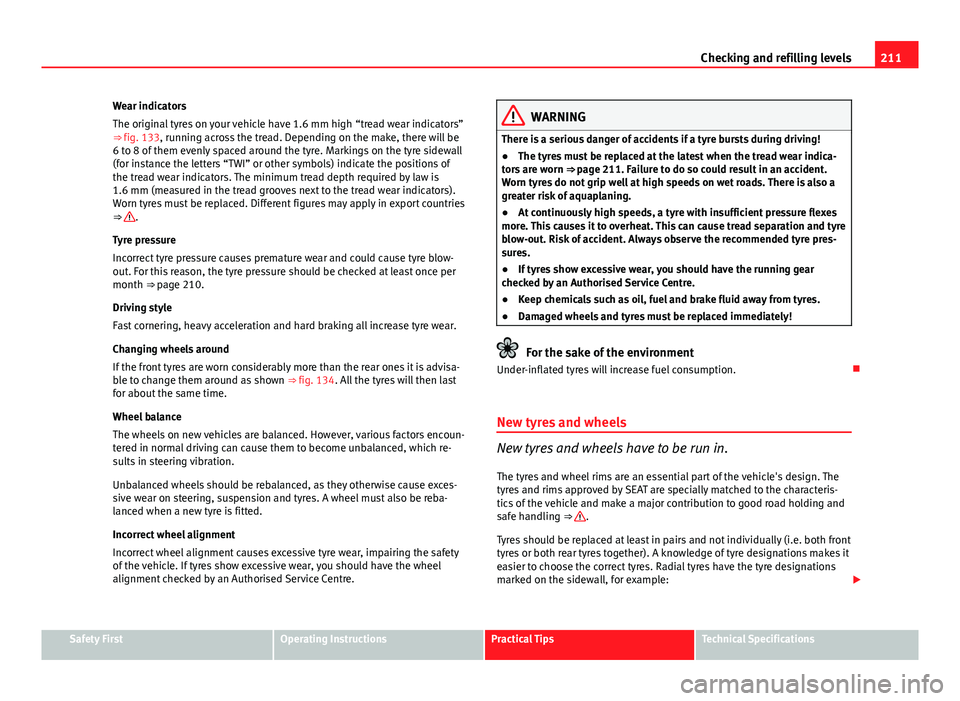
The original tyres on your vehicle have 1.6 mm high “tread wear indicators”
⇒ fig. 133, running across the tread. Depending on the make, there will be
6 to 8 of them evenly spaced around the tyre. Markings on the tyre sidewall
(for instance the letters “TWI” or other symbols) indicate the positions of
the tread wear indicators. The minimum tread depth required by law is
1.6 mm (measured in the tread grooves next to the tread wear indicators).
Worn tyres must be replaced. Different figures may apply in export countries
⇒
.
Tyre pressure
Incorrect tyre pressure causes premature wear and could cause tyre blow-
out. For this reason, the tyre pressure should be checked at least once per
month ⇒ page 210.
Driving style
Fast cornering, heavy acceleration and hard braking all increase tyre wear.
Changing wheels around
If the front tyres are worn considerably more than the rear ones it is advisa-
ble to change them around as shown ⇒ fig. 134. All the tyres will then last
for about the same time.
Wheel balance
The wheels on new vehicles are balanced. However, various factors encoun-
tered in normal driving can cause them to become unbalanced, which re-
sults in steering vibration.
Unbalanced wheels should be rebalanced, as they otherwise cause exces-
sive wear on steering, suspension and tyres. A wheel must also be reba-
lanced when a new tyre is fitted.
Incorrect wheel alignment
Incorrect wheel alignment causes excessive tyre wear, impairing the safety
of the vehicle. If tyres show excessive wear, you should have the wheel
alignment checked by an Authorised Service Centre.
WARNING
There is a serious danger of accidents if a tyre bursts during driving!
● The tyres must be replaced at the latest when the tread wear indica-
tors are worn ⇒ page 211. Failure to do so could result in an accident.
Worn tyres do not grip well at high speeds on wet roads. There is also a
greater risk of aquaplaning.
● At continuously high speeds, a tyre with insufficient pressure flexes
more. This causes it to overheat. This can cause tread separation and tyre
blow-out. Risk of accident. Always observe the recommended tyre pres-
sures.
● If tyres show excessive wear, you should have the running gear
checked by an Authorised Service Centre.
● Keep chemicals such as oil, fuel and brake fluid away from tyres.
● Damaged wheels and tyres must be replaced immediately!
For the sake of the environment
Under-inflated tyres will increase fuel consumption.
New tyres and wheels
New tyres and wheels have to be run in.
The tyres and wheel rims are an essential part of the vehicle's design. The
tyres and rims approved by SEAT are specially matched to the characteris-
tics of the vehicle and make a major contribution to good road holding and
safe handling ⇒
.
Tyres should be replaced at least in pairs and not individually (i.e. both front
tyres or both rear tyres together). A knowledge of tyre designations makes it
easier to choose the correct tyres. Radial tyres have the tyre designations
marked on the sidewall, for example:
Safety FirstOperating InstructionsPractical TipsTechnical Specifications
Page 224 of 278
222If and when
Note
● If sealant should leak out, leave it to dry. This way you can pull it off like
a piece of foil.
● Observe the expiry date stated on the sealing compound can. Have the
sealing compound exchanged by a specialised workshop.
● Seek professional assistance if the repair of a tyre puncture is not possi-
ble with the sealing compound.
What to do first
Certain steps must be taken before repairing a tyre.
– If you have a flat tyre or puncture, park the vehicle as far away
from the flow of traffic as possible.
– Apply the handbrake firmly.
– Engage first gear , or put the selector lever to position P.
– All passengers should leave the vehicle. They should wait in a
safe area (for instance behind the roadside crash barrier).
– Check whether a repair is possible using the Tyre Mobility Sys-
tem “General information and safety notes.”
– Unscrew inflation cap from the affected wheel.
– Take the tyre repair kit out of the luggage compartment.
WARNING
Switch on the hazard warning lights and place the warning triangles in
position. This is for your own safety and also warns other road users.
CAUTION
Take special care if you have to repair a tyre on a slope.
Note
● Please observe legal requirements when doing so.
● Remember to replace the sealing compound as soon as possible.
Tyre repair
The following sections describe the procedures for repairing
a tyre.
Using the sealing compound
– The instructions on the container give detailed information on
how to use the sealing compound.
Inflating the tyre.
– Remove the air compressor and hose from the container.
– Screw the retaining nut onto the valve.
– Plug the compressor cable into a 12 volt power point.
– Turn on compressor and monitor the pressure shown on the
pressure gauge.
Completing the repair
– Remove the compressor hose from the valve.
– Fit the valve cap.
Page 253 of 278
251
Technical specifications
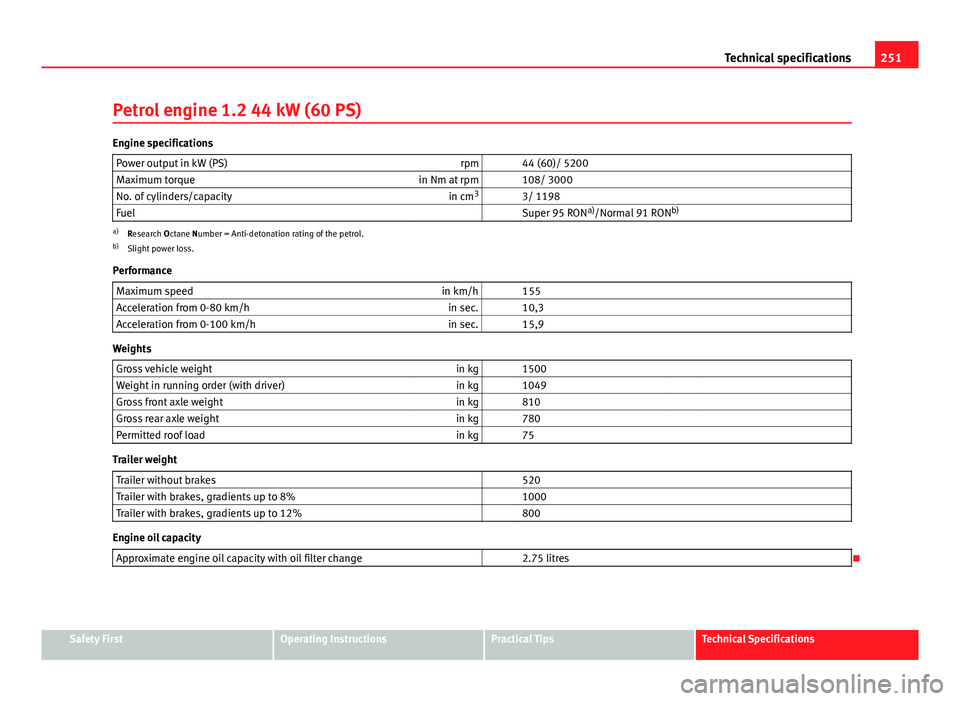
Petrol engine 1.2 44 kW (60 PS)
Engine specifications Power output in kW (PS) rpm 44 (60)/ 5200
Maximum torque in Nm at rpm 108/ 3000
No. of cylinders/capacity in cm3
3/ 1198
Fuel Super 95 RON a)
/Normal 91 RON b)
a)
Research Octane Number = Anti-detonation rating of the petrol.
b) Slight power loss.
Performance Maximum speed in km/h 155
Acceleration from 0-80 km/h in sec. 10,3
Acceleration from 0-100 km/h in sec. 15,9
Weights
Gross vehicle weight in kg 1500
Weight in running order (with driver) in kg 1049
Gross front axle weight in kg 810
Gross rear axle weight in kg 780
Permitted roof load in kg 75
Trailer weight
Trailer without brakes 520
Trailer with brakes, gradients up to 8% 1000
Trailer with brakes, gradients up to 12% 800
Engine oil capacity
Approximate engine oil capacity with oil filter change 2.75 litres
Safety FirstOperating InstructionsPractical TipsTechnical Specifications
Page 254 of 278
252Technical specifications
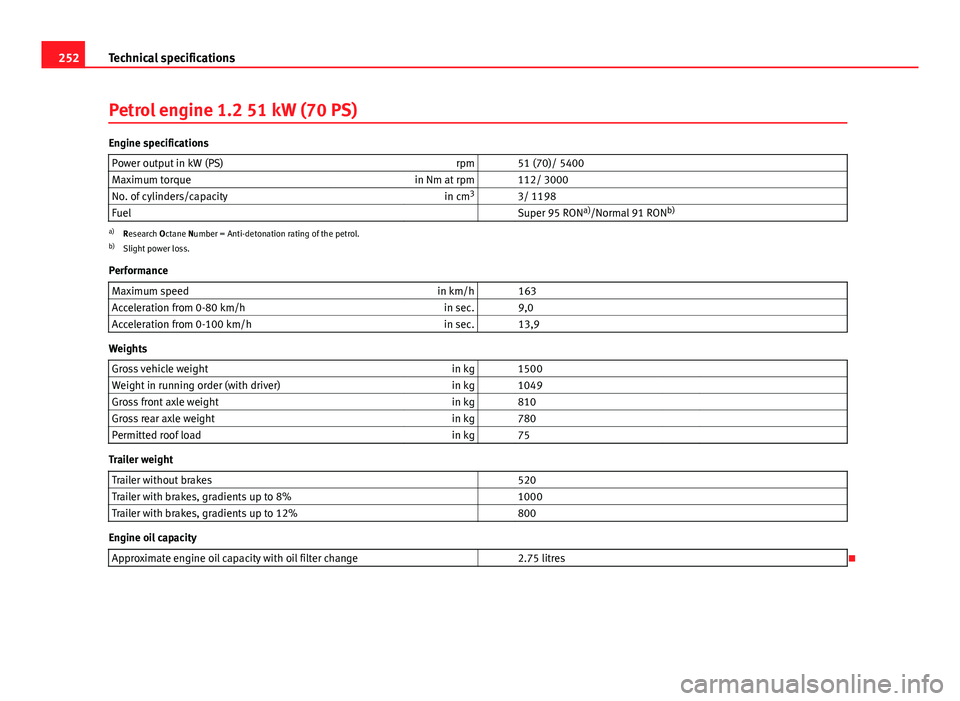
Petrol engine 1.2 51 kW (70 PS)
Engine specifications
Power output in kW (PS) rpm 51 (70)/ 5400
Maximum torque in Nm at rpm 112/ 3000
No. of cylinders/capacity in cm3
3/ 1198
Fuel Super 95 RON a)
/Normal 91 RON b)
a)
Research Octane Number = Anti-detonation rating of the petrol.
b) Slight power loss.
Performance Maximum speed in km/h 163
Acceleration from 0-80 km/h in sec. 9,0
Acceleration from 0-100 km/h in sec. 13,9
Weights
Gross vehicle weight in kg 1500
Weight in running order (with driver) in kg 1049
Gross front axle weight in kg 810
Gross rear axle weight in kg 780
Permitted roof load in kg 75
Trailer weight
Trailer without brakes 520
Trailer with brakes, gradients up to 8% 1000
Trailer with brakes, gradients up to 12% 800
Engine oil capacity
Approximate engine oil capacity with oil filter change 2.75 litres
Page 255 of 278
253
Technical specifications
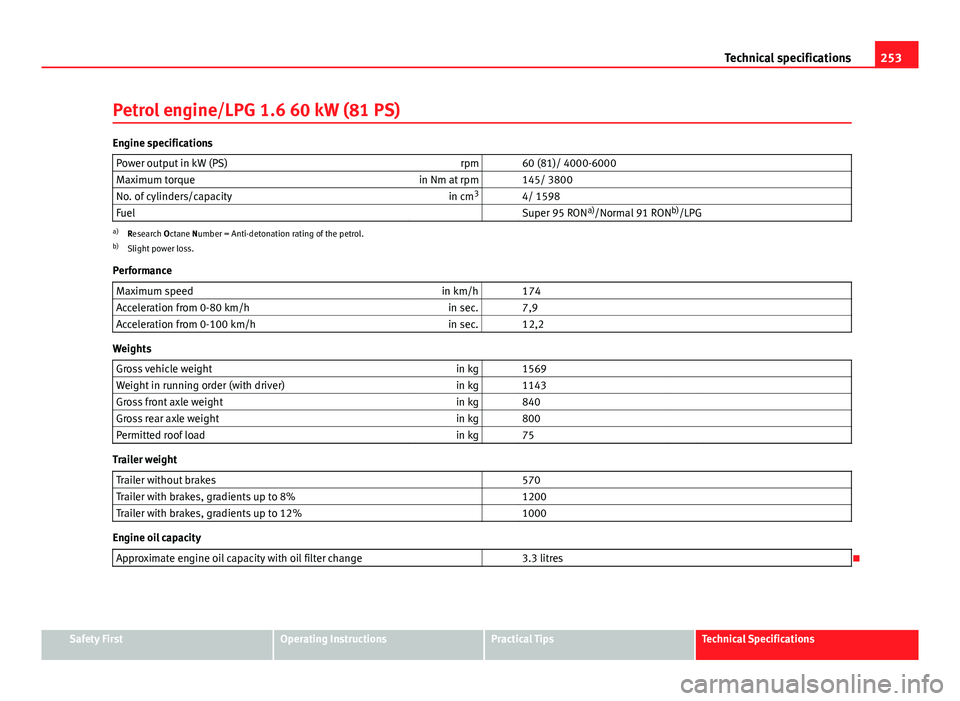
Petrol engine/LPG 1.6 60 kW (81 PS)
Engine specifications Power output in kW (PS) rpm 60 (81)/ 4000-6000
Maximum torque in Nm at rpm 145/ 3800
No. of cylinders/capacity in cm3
4/ 1598
Fuel Super 95 RON a)
/Normal 91 RON b)
/LPG
a) Research Octane Number = Anti-detonation rating of the petrol.
b) Slight power loss.
Performance Maximum speed in km/h 174
Acceleration from 0-80 km/h in sec. 7,9
Acceleration from 0-100 km/h in sec. 12,2
Weights
Gross vehicle weight in kg 1569
Weight in running order (with driver) in kg 1143
Gross front axle weight in kg 840
Gross rear axle weight in kg 800
Permitted roof load in kg 75
Trailer weight
Trailer without brakes 570
Trailer with brakes, gradients up to 8% 1200
Trailer with brakes, gradients up to 12% 1000
Engine oil capacity
Approximate engine oil capacity with oil filter change 3.3 litres
Safety FirstOperating InstructionsPractical TipsTechnical Specifications
Page 256 of 278
254Technical specifications
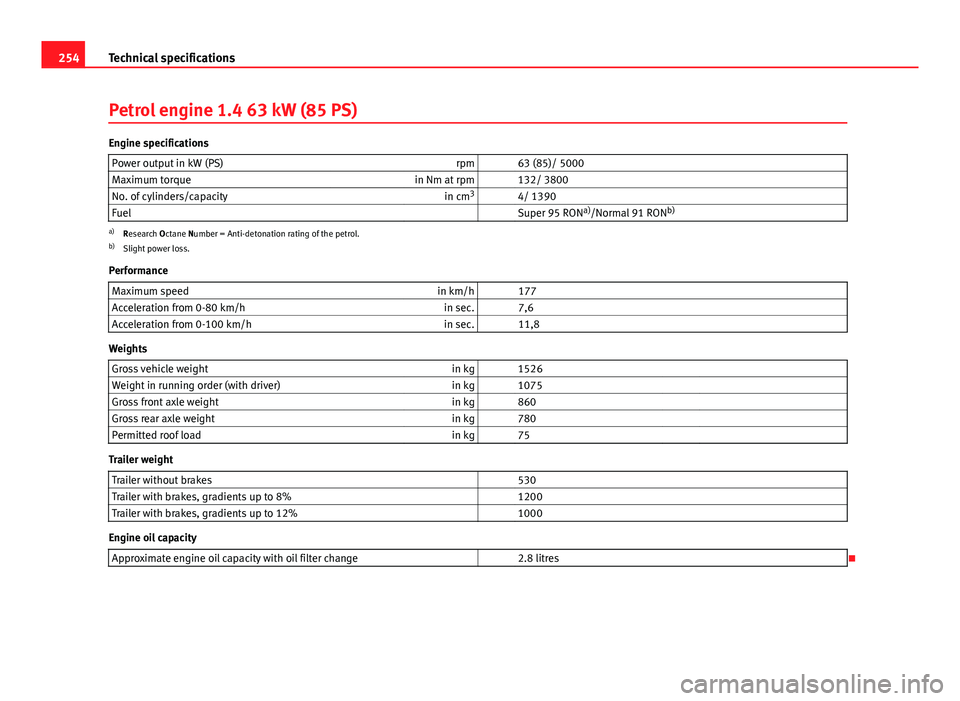
Petrol engine 1.4 63 kW (85 PS)
Engine specifications
Power output in kW (PS) rpm 63 (85)/ 5000
Maximum torque in Nm at rpm 132/ 3800
No. of cylinders/capacity in cm3
4/ 1390
Fuel Super 95 RON a)
/Normal 91 RON b)
a)
Research Octane Number = Anti-detonation rating of the petrol.
b) Slight power loss.
Performance Maximum speed in km/h 177
Acceleration from 0-80 km/h in sec. 7,6
Acceleration from 0-100 km/h in sec. 11,8
Weights
Gross vehicle weight in kg 1526
Weight in running order (with driver) in kg 1075
Gross front axle weight in kg 860
Gross rear axle weight in kg 780
Permitted roof load in kg 75
Trailer weight
Trailer without brakes 530
Trailer with brakes, gradients up to 8% 1200
Trailer with brakes, gradients up to 12% 1000
Engine oil capacity
Approximate engine oil capacity with oil filter change 2.8 litres
Page 258 of 278
256Technical specifications
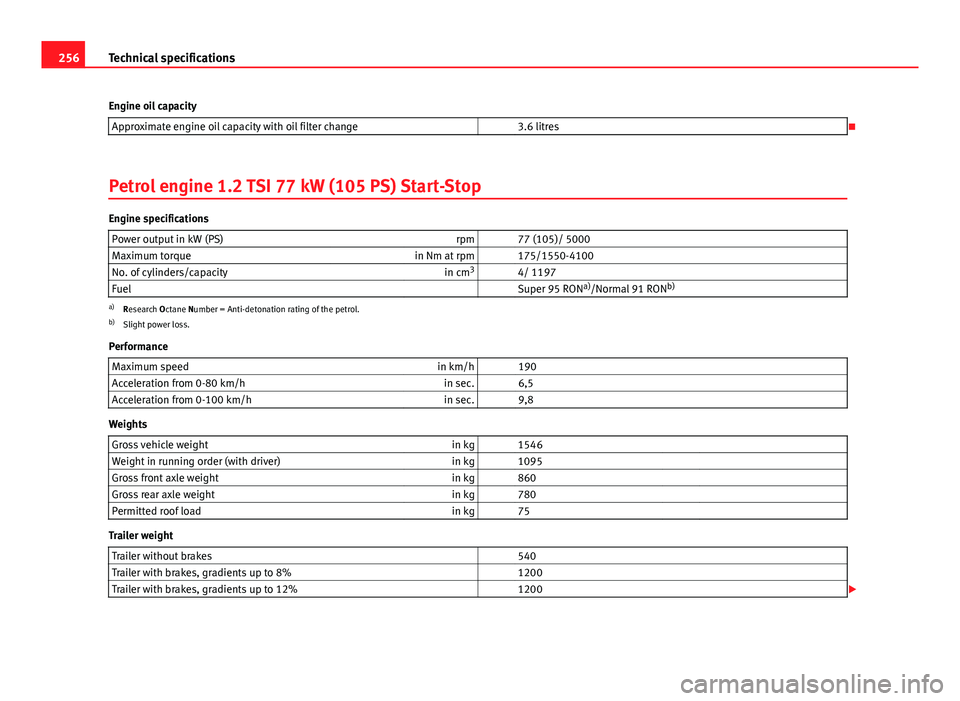
Engine oil capacity Approximate engine oil capacity with oil filter change 3.6 litres
Petrol engine 1.2 TSI 77 kW (105 PS) Start-Stop
Engine specifications Power output in kW (PS) rpm 77 (105)/ 5000
Maximum torque in Nm at rpm 175/1550-4100
No. of cylinders/capacity in cm3
4/ 1197
Fuel Super 95 RON a)
/Normal 91 RON b)
a)
Research Octane Number = Anti-detonation rating of the petrol.
b) Slight power loss.
Performance Maximum speed in km/h 190
Acceleration from 0-80 km/h in sec. 6,5
Acceleration from 0-100 km/h in sec. 9,8
Weights
Gross vehicle weight in kg 1546
Weight in running order (with driver) in kg 1095
Gross front axle weight in kg 860
Gross rear axle weight in kg 780
Permitted roof load in kg 75
Trailer weight
Trailer without brakes 540
Trailer with brakes, gradients up to 8% 1200
Trailer with brakes, gradients up to 12% 1200
Page 259 of 278
257
Technical specifications
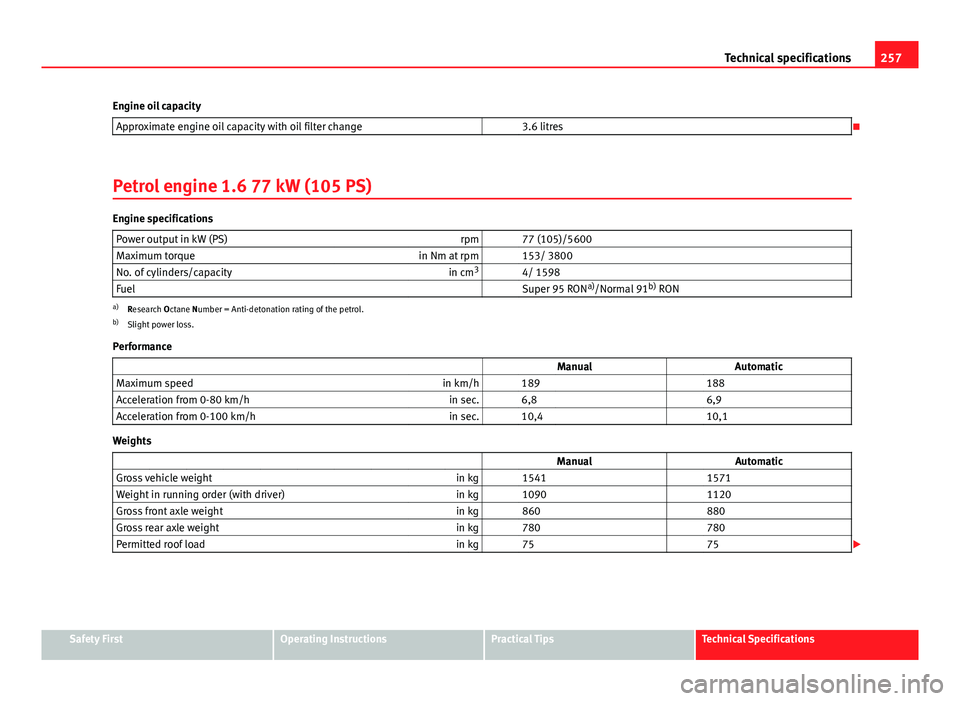
Engine oil capacity Approximate engine oil capacity with oil filter change 3.6 litres
Petrol engine 1.6 77 kW (105 PS)
Engine specifications Power output in kW (PS) rpm 77 (105)/5600
Maximum torque in Nm at rpm 153/ 3800
No. of cylinders/capacity in cm3
4/ 1598
Fuel Super 95 RON a)
/Normal 91 b)
RON
a) Research Octane Number = Anti-detonation rating of the petrol.
b) Slight power loss.
Performance ManualAutomatic
Maximum speed in km/h 189 188
Acceleration from 0-80 km/h in sec. 6,8 6,9
Acceleration from 0-100 km/h in sec. 10,4 10,1
Weights
Manual Automatic
Gross vehicle weight in kg 1541 1571
Weight in running order (with driver) in kg 1090 1120
Gross front axle weight in kg 860 880
Gross rear axle weight in kg 780 780
Permitted roof load in kg 75 75
Safety FirstOperating InstructionsPractical TipsTechnical Specifications
Page 260 of 278
258Technical specifications
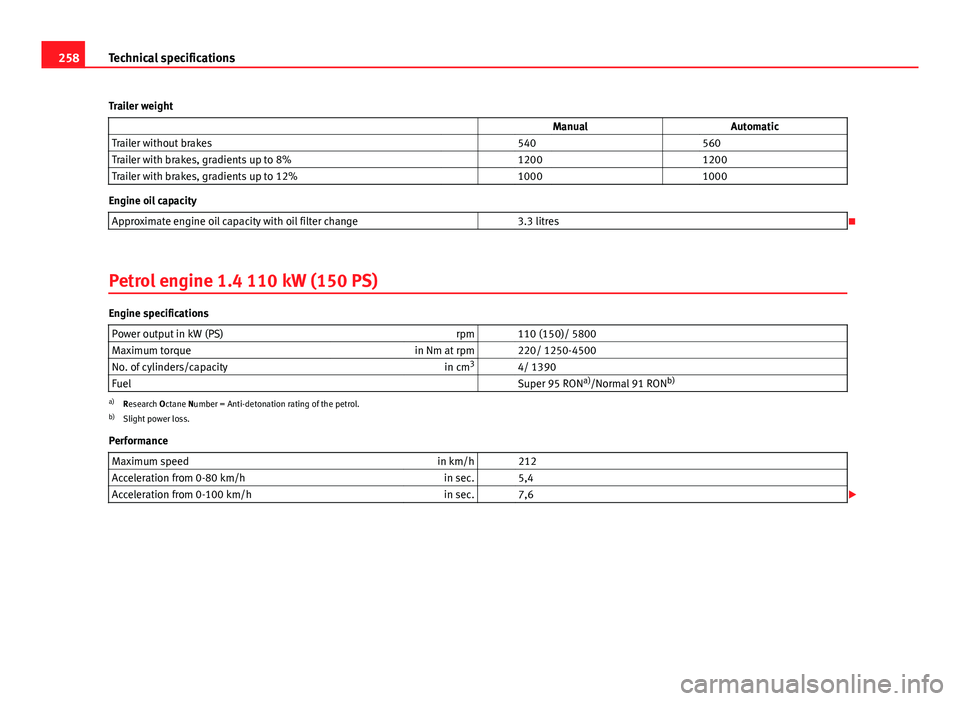
Trailer weight ManualAutomatic
Trailer without brakes 540 560
Trailer with brakes, gradients up to 8% 1200 1200
Trailer with brakes, gradients up to 12% 1000 1000
Engine oil capacity
Approximate engine oil capacity with oil filter change 3.3 litres
Petrol engine 1.4 110 kW (150 PS)
Engine specifications Power output in kW (PS) rpm 110 (150)/ 5800
Maximum torque in Nm at rpm 220/ 1250-4500
No. of cylinders/capacity in cm3
4/ 1390
Fuel Super 95 RON a)
/Normal 91 RON b)
a)
Research Octane Number = Anti-detonation rating of the petrol.
b) Slight power loss.
Performance Maximum speed in km/h 212
Acceleration from 0-80 km/h in sec. 5,4
Acceleration from 0-100 km/h in sec. 7,6
Page 261 of 278
259
Technical specifications
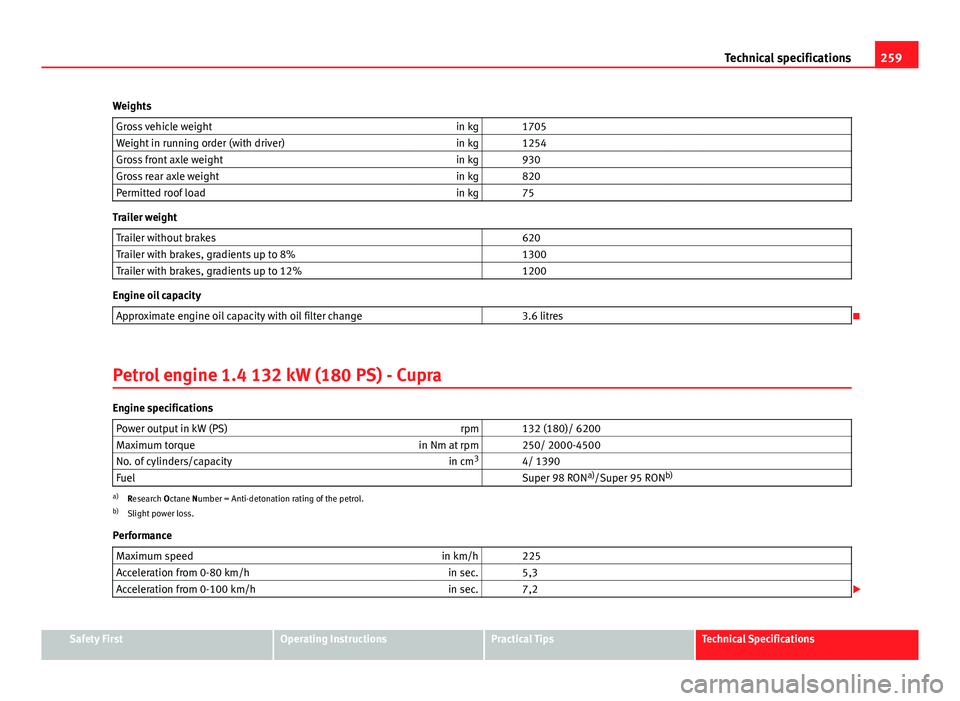
Weights Gross vehicle weight in kg 1705
Weight in running order (with driver) in kg 1254
Gross front axle weight in kg 930
Gross rear axle weight in kg 820
Permitted roof load in kg 75
Trailer weight
Trailer without brakes 620
Trailer with brakes, gradients up to 8% 1300
Trailer with brakes, gradients up to 12% 1200
Engine oil capacity
Approximate engine oil capacity with oil filter change 3.6 litres
Petrol engine 1.4 132 kW (180 PS) - Cupra
Engine specifications Power output in kW (PS) rpm 132 (180)/ 6200
Maximum torque in Nm at rpm 250/ 2000-4500
No. of cylinders/capacity in cm3
4/ 1390
Fuel Super 98 RON a)
/Super 95 RON b)
a)
Research Octane Number = Anti-detonation rating of the petrol.
b) Slight power loss.
Performance Maximum speed in km/h 225
Acceleration from 0-80 km/h in sec. 5,3
Acceleration from 0-100 km/h in sec. 7,2
Safety FirstOperating InstructionsPractical TipsTechnical Specifications