service Seat Ibiza SC 2011 Workshop Manual
[x] Cancel search | Manufacturer: SEAT, Model Year: 2011, Model line: Ibiza SC, Model: Seat Ibiza SC 2011Pages: 278, PDF Size: 3.92 MB
Page 213 of 278
211
Checking and refilling levels
Wear indicators
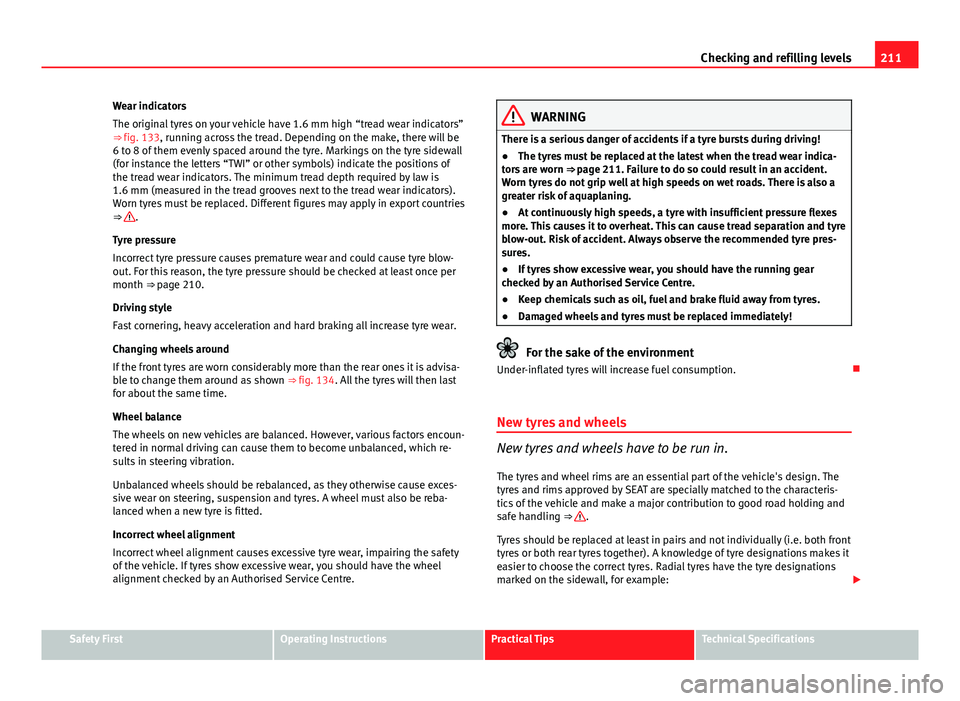
The original tyres on your vehicle have 1.6 mm high “tread wear indicators”
⇒ fig. 133, running across the tread. Depending on the make, there will be
6 to 8 of them evenly spaced around the tyre. Markings on the tyre sidewall
(for instance the letters “TWI” or other symbols) indicate the positions of
the tread wear indicators. The minimum tread depth required by law is
1.6 mm (measured in the tread grooves next to the tread wear indicators).
Worn tyres must be replaced. Different figures may apply in export countries
⇒
.
Tyre pressure
Incorrect tyre pressure causes premature wear and could cause tyre blow-
out. For this reason, the tyre pressure should be checked at least once per
month ⇒ page 210.
Driving style
Fast cornering, heavy acceleration and hard braking all increase tyre wear.
Changing wheels around
If the front tyres are worn considerably more than the rear ones it is advisa-
ble to change them around as shown ⇒ fig. 134. All the tyres will then last
for about the same time.
Wheel balance
The wheels on new vehicles are balanced. However, various factors encoun-
tered in normal driving can cause them to become unbalanced, which re-
sults in steering vibration.
Unbalanced wheels should be rebalanced, as they otherwise cause exces-
sive wear on steering, suspension and tyres. A wheel must also be reba-
lanced when a new tyre is fitted.
Incorrect wheel alignment
Incorrect wheel alignment causes excessive tyre wear, impairing the safety
of the vehicle. If tyres show excessive wear, you should have the wheel
alignment checked by an Authorised Service Centre.
WARNING
There is a serious danger of accidents if a tyre bursts during driving!
● The tyres must be replaced at the latest when the tread wear indica-
tors are worn ⇒ page 211. Failure to do so could result in an accident.
Worn tyres do not grip well at high speeds on wet roads. There is also a
greater risk of aquaplaning.
● At continuously high speeds, a tyre with insufficient pressure flexes
more. This causes it to overheat. This can cause tread separation and tyre
blow-out. Risk of accident. Always observe the recommended tyre pres-
sures.
● If tyres show excessive wear, you should have the running gear
checked by an Authorised Service Centre.
● Keep chemicals such as oil, fuel and brake fluid away from tyres.
● Damaged wheels and tyres must be replaced immediately!
For the sake of the environment
Under-inflated tyres will increase fuel consumption.
New tyres and wheels
New tyres and wheels have to be run in.
The tyres and wheel rims are an essential part of the vehicle's design. The
tyres and rims approved by SEAT are specially matched to the characteris-
tics of the vehicle and make a major contribution to good road holding and
safe handling ⇒
.
Tyres should be replaced at least in pairs and not individually (i.e. both front
tyres or both rear tyres together). A knowledge of tyre designations makes it
easier to choose the correct tyres. Radial tyres have the tyre designations
marked on the sidewall, for example:
Safety FirstOperating InstructionsPractical TipsTechnical Specifications
Page 214 of 278
212Checking and refilling levels
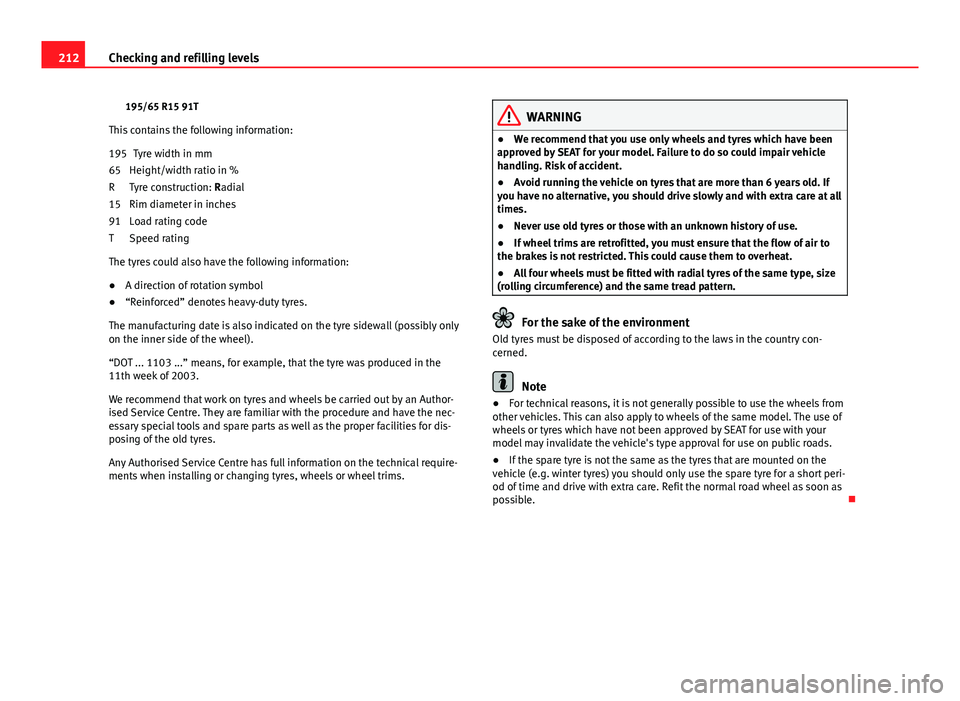
195/65 R15 91T
This contains the following information: Tyre width in mm
Height/width ratio in %
Tyre construction: Radial
Rim diameter in inches
Load rating code
Speed rating
The tyres could also have the following information:
● A direction of rotation symbol
● “Reinforced” denotes heavy-duty tyres.
The manufacturing date is also indicated on the tyre sidewall (possibly only
on the inner side of the wheel).
“DOT ... 1103 ...” means, for example, that the tyre was produced in the
11th week of 2003.
We recommend that work on tyres and wheels be carried out by an Author-
ised Service Centre. They are familiar with the procedure and have the nec-
essary special tools and spare parts as well as the proper facilities for dis-
posing of the old tyres.
Any Authorised Service Centre has full information on the technical require-
ments when installing or changing tyres, wheels or wheel trims. 195
65
R
15
91
T
WARNING
● We recommend that you use only wheels and tyres which have been
approved by SEAT for your model. Failure to do so could impair vehicle
handling. Risk of accident.
● Avoid running the vehicle on tyres that are more than 6 years old. If
you have no alternative, you should drive slowly and with extra care at all
times.
● Never use old tyres or those with an unknown history of use.
● If wheel trims are retrofitted, you must ensure that the flow of air to
the brakes is not restricted. This could cause them to overheat.
● All four wheels must be fitted with radial tyres of the same type, size
(rolling circumference) and the same tread pattern.
For the sake of the environment
Old tyres must be disposed of according to the laws in the country con-
cerned.
Note
● For technical reasons, it is not generally possible to use the wheels from
other vehicles. This can also apply to wheels of the same model. The use of
wheels or tyres which have not been approved by SEAT for use with your
model may invalidate the vehicle's type approval for use on public roads.
● If the spare tyre is not the same as the tyres that are mounted on the
vehicle (e.g. winter tyres) you should only use the spare tyre for a short peri-
od of time and drive with extra care. Refit the normal road wheel as soon as
possible.
Page 215 of 278
213
Checking and refilling levels
Wheel bolts
Wheel bolts must be tightened to the correct torque.
The design of wheel bolts is matched to the rims. If different wheel rims are
fitted, the correct wheel bolts with the right length and correctly shaped
bolt heads must be used. This ensures that wheels are fitted securely and
that the brake system functions correctly.
In certain circumstances, you should not use wheel bolts from a different
vehicle, even if it is the same model ⇒ page 183.
WARNING
If the wheel bolts are not tightened correctly, the wheel could become
loose while driving. Risk of accident.
● The wheel bolts must be clean and turn easily. Never apply grease or
oil to them.
● Use only wheel bolts which belong to the wheel.
● If the prescribed torque of the wheel bolts is too low, they could loos-
en whilst the vehicle is in motion. Risk of accident! If the tightening tor-
que is too high, the wheel bolts and threads can be damaged.
CAUTION
The prescribed torque for wheel bolts for steel and alloy wheels is 120 Nm. Winter tyres
Winter tyres will improve the vehicles handling on snow and
ice.
In winter conditions winter tyres will considerably improve the vehicle's han-
dling. The design of summer tyres (width, rubber compound, tread pattern)
gives less grip on ice and snow.
Winter tyres must be inflated to a pressure 0.2 bar higher than the pres-
sures specified for summer tyres (see sticker on tank flap).
Winter tyres must be fitted on all four wheels.
Information on permitted winter tyre sizes can be found in the vehicle's reg-
istration documents. Use only radial winter tyres. All tyre sizes listed in the
vehicle documentation also apply to winter tyres.
Winter tyres lose their effectiveness when the tread is worn down to a depth
of 4 mm.
The speed rating code ⇒ page 211, New tyres and wheels determines the
following speed limits for winter tyres: ⇒
max. 160 km/h
max. 180 km/h
max. 190 km/h
max. 210 km/h
In some countries, vehicles which can exceed the speed rating of the fitted
tyre must have an appropriate sticker in the driver's field of view. These
stickers are available from your Authorised Service Centre. The legal require-
ments of each country must be followed.
Do not have winter tyres fitted for unnecessarily long periods. Vehicles with
summer tyres handle better when the roads are free of snow and ice.
Q
S
T
H
Safety FirstOperating InstructionsPractical TipsTechnical Specifications
Page 216 of 278
214Checking and refilling levels
If you have a flat tyre, please refer to the notes on the spare wheel
⇒ page 211, New tyres and wheels.
WARNING
The maximum speed for the winter tyres must not be exceeded. Other-
wise, this could lead to tyre damage and risk of accident.
For the sake of the environment
Fit your summer tyres again as soon as possible. They are quieter, do not
wear so quickly and reduce fuel consumption.
Snow chains
Snow chains may be fitted only to the front wheels, and only for the follow-
ing tyres:
175/70R14
185/60R15Chains with links not exceeding 15 mm (including the chain
closure)
215/45R16Chains with links not exceeding 9 mm (including the chain
closure)
215/40R17Chains with links not exceeding 7 mm (including the chain
closure)
Remove wheel hub covers and trim rings before fitting snow chains. For
safety reasons cover caps, available in any Authorised Service Centre, must
then be fitted over the wheel bolts.
WARNING
Snow chains should be correctly tightened in accordance with the manu-
facturer's instructions. This will prevent the chains coming into contact
with the wheel housing.
CAUTION
Remove the snow chains to drive on roads without snow. Otherwise they
will impair handling, damage the tyres and wear out very quickly.
Note
In some countries, the speed limit for using snow chains is 50 km/h. The
legal requirements of the country should be followed.
Page 223 of 278
221
If and when
The code number should be noted and kept in a safe place, as it is only by
using the code number that a duplicate adaptor can be obtained from an
Authorised Service Centre.
Tyres with directional tread pattern
Tyres with directional tread pattern must be fitted so that
they rotate in the correct direction. A directional tread pattern can be identified by arrows on the sidewall that
point in the direction of rotation. Always note the direction of rotation indi-
cated when fitting the wheel. This is important so that these tyres can give
maximum grip and avoid excessive noise, tread wear and aquaplaning.
If, in an emergency, you have to fit the spare wheel so it rotates in the wrong
direction, you must drive extremely carefully. The tyre will not give optimum
performance. This is particularly important when driving on wet roads.
To benefit from the advantages of tyres with this type of tread pattern, the
defective tyre should be replaced as soon as possible so that all tyres again
rotate in the correct direction.
Tyre repair kit (Tyre-Mobility-System)*
General information and safety notes
Your vehicle is equipped with a tyre repair kit: the Tyre Mobility System.
In the event of a tyre puncture, a sealing compound and an air compressor
are located in the luggage compartment under the floor panel. The Tyre Mobility System will reliably seal punctures caused by the penetra-
tion of a foreign body of up to about 4 mm in diameter.
It is not necessary to remove the foreign body from the tyre.
Instructions for the sealing compound are located on the sealing compound
container.
It also contains the instructions for using the compressor.
WARNING
● Do not attempt to repair a puncture with the sealing compound if the
tyre has been damaged by driving the vehicle after the tyre has lost its
air.
● Always observe warnings and follow safety instructions concerning
compressor and sealing compound carefully.
● Do not drive faster than 80 km/h, avoid heavy acceleration, hard
braking and fast cornering.
● Tyres which have been repaired with sealing compound are only suit-
able for temporary use over a short period. Therefore, please drive care-
fully to the next available specialised workshop.
For the sake of the environment
If you have to dispose of a sealant can, go to a specialised waste service or
to a SEAT Technical Service, where the product can be recycled in an appro-
priate waste container.
Safety FirstOperating InstructionsPractical TipsTechnical Specifications
Page 229 of 278
227
If and when
Xenon 1)
/adaptive headlights*
- D1S2)
- LED 3)
- LED 3)
- PY 21W
Fog lights - H11
WARNING
● Take particular care when working on components in the engine com-
partment if the engine is warm - risk of burns!
● Bulbs are highly sensitive to pressure. The glass can break when you
touch the bulb, causing injury.
● The high voltage element of gas discharge bulbs* (xenon light) must
be handled correctly. Otherwise, there is a risk of death.
● When changing bulbs, please take care not to injure yourself on sharp
parts in the headlight housing.
CAUTION
● Remove the ignition key before working on the electric system. If not, a
short circuit could occur.
● Switch off the lights or parking lights before you change a bulb.
Dipped and full beam
Position
DRL (day light)
Turn signals
Fog light/cornering
For the sake of the environment
Please ask your specialist retailer how to dispose of used bulbs in the prop-
er manner.
Note
● Depending on weather conditions (cold or wet), the front lights, the fog
lights, the tail lights and the turn signals may be temporarily misted. This
has no influence on the useful life of the lighting system. By switching on
the lights, the area through which the beam of light is projected will quickly
be demisted. However, the edges may continue to be misted.
● Please check at regular intervals that all lighting (especially the exterior
lighting) on your vehicle is functioning properly. This is not only in the inter-
est of your own safety, but also that of all other road users.
● Before changing a bulb, make sure you have the correct new bulb.
● Do not touch the glass part of the bulb with your bare hands, use a cloth
or paper towel instead. Otherwise, the fingerprints left on the glass will va-
porise as a result of the heat generated by the bulb, they will be deposited
on the reflector and will impair its surface.
1)
With these types of headlights, the user can replace the indicator bulb. Replacement of the
dipped/main beam bulb must be done by a Technical Service, given that complex elements
must be removed from the vehicle and the automatic control system that incorporates it
must be reset.
2) The Xenon bulbs discharge 2.5 times the light flux and have an average lifespan of 5 times
more than that of halogen bulbs, this means that, except due to unusual circumstances,
there is no need to change the bulbs for the whole life of the vehicle.
3) In the event that there is a fault in the LEDs, the complete headlight must be replaced.
Safety FirstOperating InstructionsPractical TipsTechnical Specifications
Page 242 of 278
240If and when
–First fit the glass with the fastening tabs over the frame of the
switch. Next press the front part until the two long tabs click on
the support.
Additional brake light*
Given the difficulty involved in the replacement of this light it should be
done by the Technical Service.
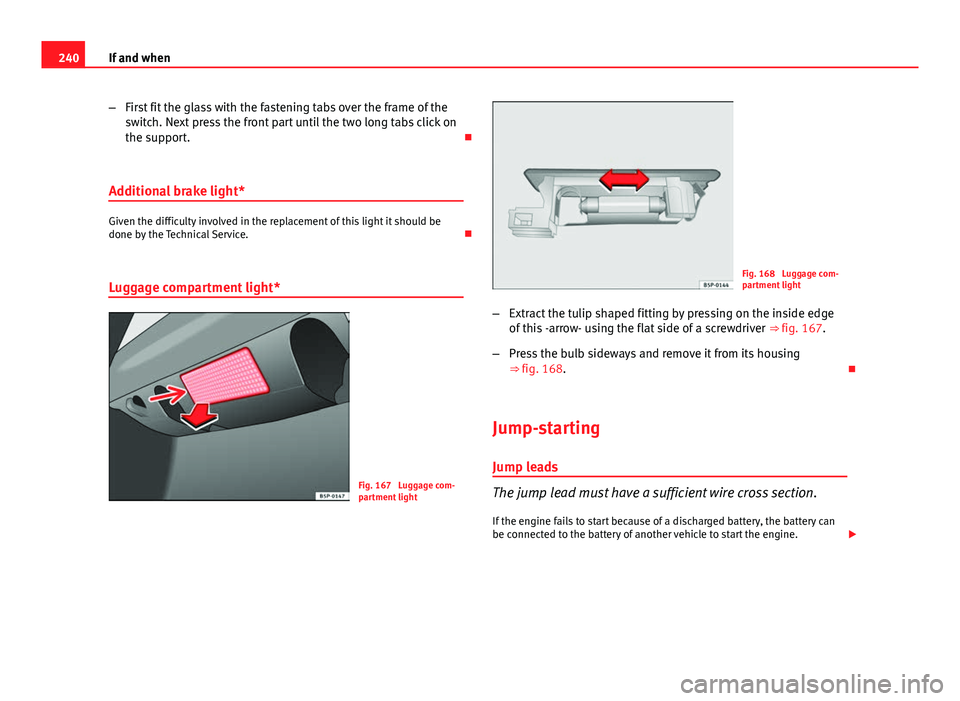
Luggage compartment light*
Fig. 167 Luggage com-
partment light
Fig. 168 Luggage com-
partment light
– Extract the tulip shaped fitting by pressing on the inside edge
of this -arrow- using the flat side of a screwdriver ⇒ fig. 167.
– Press the bulb sideways and remove it from its housing
⇒ fig. 168.
Jump-starting
Jump leads
The jump lead must have a sufficient wire cross section. If the engine fails to start because of a discharged battery, the battery can
be connected to the battery of another vehicle to start the engine.
Page 251 of 278
249
Description of specifications
Drawbar load
The maximum permitted drawbar load on the ball joint of the towing bracket
must not exceed 75 kg.
In the interest of road safety, we recommend that you always tow approach-
ing the maximum drawbar load. The response of the trailer on the road will
be poor if the drawbar load is too small.
If the maximum permissible drawbar load cannot be met (e.g. with small,
empty and light-weight single axle trailers or tandem axle trailers with a
wheelbase of less than 1 metre), a minimum of 4% of the actual trailer
weight is legally required for the drawbar load.
WARNING
● For safety reasons, do not exceed the 80 km/h limit. This is also valid
in countries where higher speeds are permitted.
● Never exceed the maximum trailer weights or the drawbar load. If the
permissible axle load or the permissible total weight is exceeded, the
driving characteristics of the vehicle may change, leading to accidents,
injuries and damage to the vehicle.
Wheels
Tyre pressure, snow chains, wheel bolts
Tyre pressures
The sticker with the tyre pressure values can be found on the inside of the
tank flap. The tyre pressure values given there are for cold tyres. The slightly
raised pressures of warm tyres must not be reduced. ⇒
Snow chains
Snow chains may be fitted only to the front wheels, and only for the follow-
ing tyres:
175/70R14
185/60R15Chains with links not exceeding 15 mm (including the chain
closure)
215/45R16Chains with links not exceeding 9 mm (including the chain
closure)
215/40R17Chains with links not exceeding 7 mm (including the chain
closure)
Wheel bolts
After the wheels have been changed, the tightening torque of the wheel
bolts should be checked as soon as possible with a torque wrench ⇒
.
The tightening torque for steel and alloy wheels is 120 Nm.
WARNING
● Check the tyre pressure at least once per month. Checking the tyre
pressure is very important. If the tyre pressure is too high or too low,
there is an increased danger of accidents, particularly at high speeds.
● If the torque of the wheel bolts is too low, they could loosen while the
vehicle is in motion. Risk of accident! If the tightening torque is too high,
the wheel bolts and threads can be damaged.
Note
We recommend that you ask your Authorised Service Centre for information
about appropriate wheel, tyre and snow chain size.
Safety FirstOperating InstructionsPractical TipsTechnical Specifications
Page 252 of 278
250Technical specifications
Technical specifications
Checking fluid levels
From time to time, the levels of the different fluids in the ve-
hicle must be checked. Never fill with incorrect fluids, other-
wise serious damage to the engine may be caused.
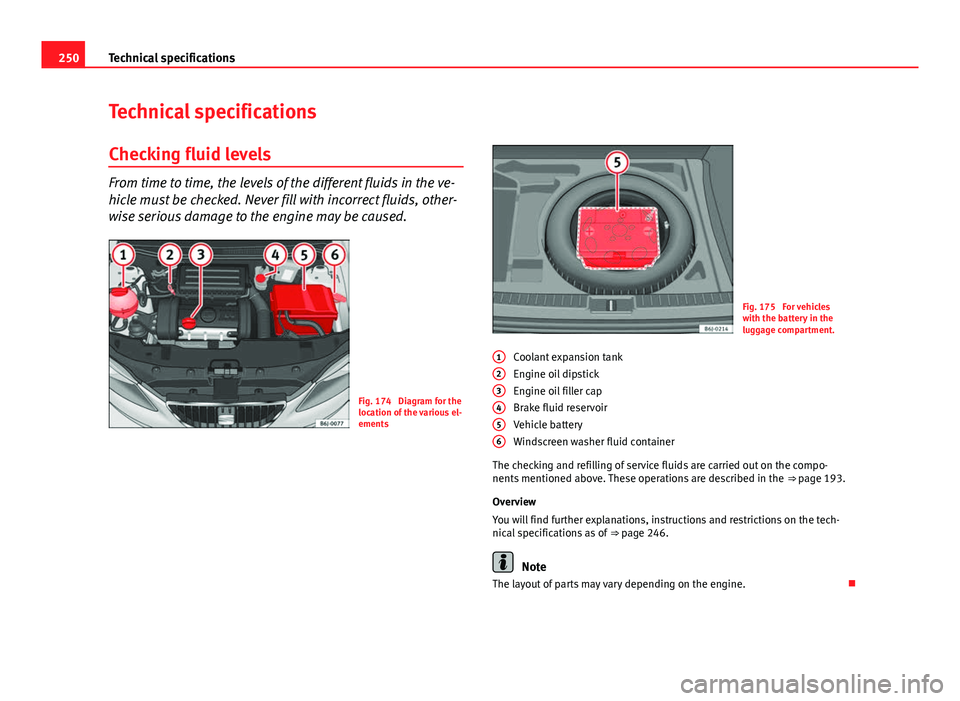
Fig. 174 Diagram for the
location of the various el-
ements
Fig. 175 For vehicles
with the battery in the
luggage compartment.
Coolant expansion tank
Engine oil dipstick
Engine oil filler cap
Brake fluid reservoir
Vehicle battery
Windscreen washer fluid container
The checking and refilling of service fluids are carried out on the compo-
nents mentioned above. These operations are described in the ⇒ page 193.
Overview
You will find further explanations, instructions and restrictions on the tech-
nical specifications as of ⇒ page 246.
Note
The layout of parts may vary depending on the engine.
1
23456
Page 272 of 278
F
Fabric trim cleaning . . . . . . . . . . . . . . . . . . . . . 181
Floor mats . . . . . . . . . . . . . . . . . . . . . . . . . . . . . . 16
Fog lights . . . . . . . . . . . . . . . . . . . . . . . . . . . . . . 94
Fog lights bulb . . . . . . . . . . . . . . . . . . . . . . . . . 235
Fog lights with cornering function . . . . . . . . . . 97
Front airbags . . . . . . . . . . . . . . . . . . . . . . . . . . . 33 Description . . . . . . . . . . . . . . . . . . . . . . . . . . 33
Operation . . . . . . . . . . . . . . . . . . . . . . . . . . . 34
Safety notes . . . . . . . . . . . . . . . . . . . . . . . . . 36
Front ashtray . . . . . . . . . . . . . . . . . . . . . . . . . . . 120
Front cup holder* . . . . . . . . . . . . . . . . . . . . . . . 119
Front interior light . . . . . . . . . . . . . . . . . . . . . . 101
Front passenger airbag deactivation . . . . . . . . 40
Front reading light . . . . . . . . . . . . . . . . . . . . . . 102
Front seat adjustment Lumbar support . . . . . . . . . . . . . . . . . . . . . 113
Fuel Diesel . . . . . . . . . . . . . . . . . . . . . . . . . . . . . 192
Petrol . . . . . . . . . . . . . . . . . . . . . . . . . . . . . . 192
Fuel consumption . . . . . . . . . . . . . . . . . . . . . . . 247
Fuel level Indicator . . . . . . . . . . . . . . . . . . . . . . . . . . . . 55
Fuel reserve . . . . . . . . . . . . . . . . . . . . . . . . . . . . 71
Fuel tank see Fuel reserve . . . . . . . . . . . . . . . . . . . . . . 71
Fuel Tank Opening the fuel tank flap . . . . . . . . . . . . . 187
Fuel: save . . . . . . . . . . . . . . . . . . . . . . . . . . . . . 168
Fuses . . . . . . . . . . . . . . . . . . . . . . . . . . . . . . . . . 223 G
G 12 . . . . . . . . . . . . . . . . . . . . . . . . . . . . . . . . . . 200
Gear shift pattern . . . . . . . . . . . . . . . . . . . . . . . 144
General overview of the engine compartment 250
Glove compartment . . . . . . . . . . . . . . . . . . . . . 117
Glove compartment light . . . . . . . . . . . . . . . . . 102
Glow plug system . . . . . . . . . . . . . . . . . . . . . . . 139 Warning lamp . . . . . . . . . . . . . . . . . . . . . . . . 66
H Handbrake . . . . . . . . . . . . . . . . . . . . . . . . . . . . 152 Warning lamp . . . . . . . . . . . . . . . . . . . . . . . 153
Hazard warning lights . . . . . . . . . . . . . . . . . . . . 99
HBA . . . . . . . . . . . . . . . . . . . . . . . . . . . . . . . . . . 161
Headlight flashers . . . . . . . . . . . . . . . . . . . . . . 100
Headlight range control . . . . . . . . . . . . . . . . . . . 96
Headlights Driving abroad . . . . . . . . . . . . . . . . . . . . . . 171
Fog lights . . . . . . . . . . . . . . . . . . . . . . . . . . . 94
Headlight washer . . . . . . . . . . . . . . . . . . . . 106
Head restraints Adjusting . . . . . . . . . . . . . . . . . . . . . . 111, 112
Adjustment of the head restraint angle . . 112
Removing . . . . . . . . . . . . . . . . . . . . . . . . . . 112
Heated exterior mirrors* . . . . . . . . . . . . . . . . . 108
Heated front seats . . . . . . . . . . . . . . . . . . . . . . 114
Heating . . . . . . . . . . . . . . . . . . . . . . . . . . . . . . . 125
Heating system . . . . . . . . . . . . . . . . . . . . . . . . . 126
High pressure cleaners . . . . . . . . . . . . . . . . . . 176
Hill-start assist . . . . . . . . . . . . . . . . . . . . . . . . . 154 Horn . . . . . . . . . . . . . . . . . . . . . . . . . . . . . . . . . . 51
How to jump start description . . . . . . . . . . . . . 241
Hydraulic Brake Assist
Automatic hazard warning lights activa-tion . . . . . . . . . . . . . . . . . . . . . . . . . . . . . . 161
I
Identification number . . . . . . . . . . . . . . . . . . . 247
Identification plate . . . . . . . . . . . . . . . . . . . . . . 247
Ignition key . . . . . . . . . . . . . . . . . . . . . . . . . . . . 136
Ignition lock . . . . . . . . . . . . . . . . . . . . . . . . . . . 136
Information in the multifunction display Memory displays . . . . . . . . . . . . . . . . . . . . . 57
Instrument and switch lighting . . . . . . . . . . . . . 96
Instrument lighting . . . . . . . . . . . . . . . . . . . . . . 51
Instrument panel Service interval display . . . . . . . . . . . . . . . . 59
Instruments . . . . . . . . . . . . . . . . . . . . . . . . . . . . 53
Interior mirror . . . . . . . . . . . . . . . . . . . . . . . . . . 106
Interior monitoring and anti-towing alarm* Activation . . . . . . . . . . . . . . . . . . . . . . . . . . . 85
Intermittent wipe, windscreen . . . . . . . . . . . . . 103
ISOFIX system . . . . . . . . . . . . . . . . . . . . . . . . . . . 47
J
Jump-starting . . . . . . . . . . . . . . . . . . . . . . . . . . 240
Jump leads . . . . . . . . . . . . . . . . . . . . . . . . . . . . 240
270 Index