alternator belt Seat Ibiza SC 2012 Owner's manual
[x] Cancel search | Manufacturer: SEAT, Model Year: 2012, Model line: Ibiza SC, Model: Seat Ibiza SC 2012Pages: 280, PDF Size: 3.67 MB
Page 66 of 280
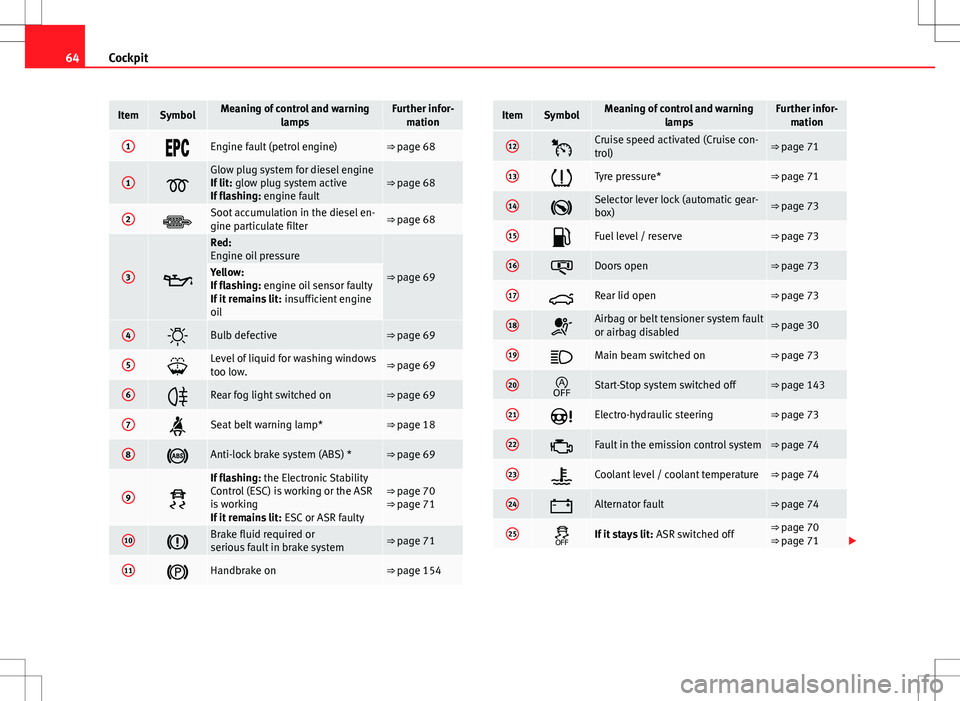
64Cockpit
ItemSymbolMeaning of control and warning
lampsFurther infor-mation
1Engine fault (petrol engine)⇒ page 68
1
Glow plug system for diesel engine
If lit: glow plug system active
If flashing: engine fault⇒ page 68
2Soot accumulation in the diesel en-
gine particulate filter⇒ page 68
3
Red:
Engine oil pressure
⇒ page 69Yellow:
If flashing: engine oil sensor faulty
If it remains lit: insufficient engine
oil
4Bulb defective⇒ page 69
5Level of liquid for washing windows
too low.⇒ page 69
6Rear fog light switched on⇒ page 69
7Seat belt warning lamp*⇒ page 18
8Anti-lock brake system (ABS) *⇒ page 69
9
If flashing: the Electronic Stability
Control (ESC) is working or the ASR
is working
If it remains lit: ESC or ASR faulty⇒ page 70
⇒ page 71
10Brake fluid required or
serious fault in brake system⇒ page 71
11Handbrake on⇒ page 154
ItemSymbolMeaning of control and warning
lampsFurther infor-mation
12Cruise speed activated (Cruise con-
trol)⇒ page 71
13Tyre pressure*⇒ page 71
14Selector lever lock (automatic gear-
box)⇒ page 73
15Fuel level / reserve⇒ page 73
16Doors open⇒ page 73
17Rear lid open⇒ page 73
18Airbag or belt tensioner system fault
or airbag disabled⇒ page 30
19Main beam switched on⇒ page 73
20Start-Stop system switched off⇒ page 143
21Electro-hydraulic steering⇒ page 73
22Fault in the emission control system⇒ page 74
23Coolant level / coolant temperature⇒ page 74
24Alternator fault⇒ page 74
25If it stays lit: ASR switched off⇒ page 70
⇒ page 71
Page 146 of 280
144Driving
Start-Stop function conditions
● The driver seat belt must be buckled.
● The bonnet must be closed.
● The engine must be at operating temperature.
● The steering wheel must be straight.
● The vehicle must be on flat ground.
● The vehicle must not be in reverse.
● A trailer must not be connected.
● The temperature of the interior must be within the convenience limits
( AC
button should be selected).
● The windscreen de-mist function must be off.
● If in an increase in airflow is not requested.
● The temperature must not be set to HI or LO.
● The driver door must be closed.
● The diesel particulate filter must not be in regeneration mode, for diesel
engines.
● The battery charge must not be low for the next start.
● The battery temperature must be between –1°C and 55°C.
Start-Stop function interruption
In the following situations, the Start-Stop function will be interrupted and
the engine will automatically start:
● The vehicle starts moving.
● The brake pedal is pressed several times in a row.
● The battery has been discharged excessively.
● The Start-Stop System is manually deactivated.
● The windscreen de-mist function is turned on.
● The temperature of the interior exceeds the convenience limits ( AC
but-
ton).
● If the airflow is increased by more than 3 presses. ●
Temperature setting HI or LO is selected.
● The engine coolant temperature is insufficient.
● The alternator is faulty, for example the V-belt has ruptured.
● If any of the conditions described in the previous section are not fulfil-
led.
WARNING
Never allow the vehicle to move with the engine off for any reason. You
could lose control of your vehicle. This could cause an accident and seri-
ous injury.
● The brake servo does not work with the engine off. You need more
force to stop the vehicle.
● Power steering does not work when the engine is not running. That is
why it is much more difficult to turn the steering wheel.
● Turn off the Start-Stop system when driving through water (fording
streams, etc.).
Note
● For vehicles with the Start-Stop function and a manual gearbox, when
the engine is started, the clutch must be pressed.
● When the conditions for the Start-Stop function are not fulfilled, the in-
strument panel displays the Start-Stop indicator dimmed.
● If the steering wheel is turned more than 270°, it will not be possible to
start the vehicle again. To start the vehicle, straighten the steering wheel so
that it is turned less than 270°.
Page 196 of 280
194Checking and refilling levels
WARNING
All work on the engine or in the engine compartment, e.g. checking and
refilling fluids, involves the danger of injury and scalding as well as the
risk of accident or fire.
● Never open the bonnet if you see steam, smoke or coolant escaping
from the engine compartment. Otherwise, there is a risk of sustaining
burns. Wait until no more steam or coolant is emitted, then allow the en-
gine to cool before carefully opening the bonnet.
● Switch off the engine and remove the key from the ignition.
● Apply the handbrake and move the gear lever to neutral or selector
lever to position P.
● Keep children away from the vehicle.
● Never touch hot engine parts. There is a risk of burns.
● Never spill liquids on a hot engine or on a hot exhaust gas system.
This is a fire hazard.
● Avoid causing short-circuits in the electrical system, particularly at
the points where the jump leads are attached ⇒ page 242. The battery
could explode.
● Never touch the radiator fan. It is temperature controlled and could
start automatically, even when the engine has been switched off and the
key removed from the ignition!
● Do not unscrew the cap on the coolant expansion tank when the en-
gine is hot. If the coolant is hot, the cooling system will be pressurised!
● Protect face, hands and arms by covering the cap with a large, thick
cloth to protect against escaping coolant and steam.
● Always make sure you have not left any objects, such as cleaning
cloths and tools, in the engine compartment.
● If you have to work underneath the vehicle, you must use suitable
stands additionally to support the vehicle, there is a risk of accident!. A
hydraulic jack is insufficient for securing the vehicle and there is a risk of
injury.WARNING (Continued)
● If any work has to be performed when the engine is started or with
the engine running, there is an additional, potentially fatal, safety risk
from the rotating parts, such as the drive belts, alternator, radiator fan,
etc., and from the high-voltage ignition system. You should also observe
the following points:
–Never touch the electrical wiring of the ignition system.
– Ensure that jewellery, loose clothing and long hair do not get trap-
ped in rotating engine parts. Danger of death. Before starting any
work remove jewellery, tie back and cover hair, and wear tight-fitting
clothes.
– Never accelerate with a gear engaged without taking the necessary
precautions. The vehicle could move, even if the handbrake is ap-
plied. Danger of death.
● If work has to be carried out on the fuel system or on electrical com-
ponents, you must observe the following safety notes in addition to the
above warnings:
–Always disconnect the battery from the on-board network. The ve-
hicle must be unlocked when this is done, otherwise the alarm will be
triggered.
– Do not smoke.
– Never work near naked flames.
– Always have a fire extinguisher on hand.
CAUTION
When topping up service fluids, make sure not to mistake them. Using the
wrong fluids could cause serious malfunctions and engine damage!
Page 271 of 280
Index
A
ABS . . . . . . . . . . . . . . . . . . . . . . . . . . . . . . . . . . 163Control lamp . . . . . . . . . . . . . . . . . . . . . . . . . 69
Accessories . . . . . . . . . . . . . . . . . . . . . . . . . . . . 183
Acoustic warning . . . . . . . . . . . . . . . . . . . . . . . 138
Adaptive headlights . . . . . . . . . . . . . . . . . . . . . 100
AFS headlight bulbs . . . . . . . . . . . . . . . . . . . . . 235
Airbag covers . . . . . . . . . . . . . . . . . . . . . . . . . . . 35
Airbag system . . . . . . . . . . . . . . . . . . . . . . . . . . . 29 control lamp . . . . . . . . . . . . . . . . . . . . . . . . . 30
Front airbags . . . . . . . . . . . . . . . . . . . . . . . . 33
side airbags . . . . . . . . . . . . . . . . . . . . . . . . . 37
Air conditioner Climatronic . . . . . . . . . . . . . . . . . . . . . . . . . 133
General notes . . . . . . . . . . . . . . . . . . . . . . . 135
Air conditioning* . . . . . . . . . . . . . . . . . . . . . . . 130
Air outlets . . . . . . . . . . . . . . . . . . . . . . . . . . . . . 129
Air recirculation Semi-automatic air conditioning . . . . . . . . 132
Air recirculation mode Climatronic . . . . . . . . . . . . . . . . . . . . . . . . . 135
Alarm system Switching off . . . . . . . . . . . . . . . . . . . . . . . . . 87
Alternator Warning lamp . . . . . . . . . . . . . . . . . . . . . . . . 74
Anti-lock brake system . . . . . . . . . . . . . . . . . . . 163 Control lamp . . . . . . . . . . . . . . . . . . . . . . . . . 69 Anti-theft alarm system . . . . . . . . . . . . . . . . . . . 87
Switching off . . . . . . . . . . . . . . . . . . . . . . . . . 87
Anti-theft wheel bolts . . . . . . . . . . . . . . . . . . . 219
Antifreeze . . . . . . . . . . . . . . . . . . . . . . . . . . . . . 200
Aquaplaning . . . . . . . . . . . . . . . . . . . . . . . . . . . 212
Aspects to note before setting off . . . . . . . . . . . . 8
ASR . . . . . . . . . . . . . . . . . . . . . . . . . . . . . . . . . . 163
ASR (Traction control system) Control lamp . . . . . . . . . . . . . . . . . . . . . . . . . 70
Audible warning . . . . . . . . . . . . . . . . . . . . . . . . . 19
Automatic anti-dazzle interior mirror Deactivating the anti-dazzle function . . . . 109
Automatic anti-dazzle interior mirror* Activating the anti-dazzle function . . . . . . 109
Automatic car washing tunnel . . . . . . . . . . . . . 175
Automatic gearbox . . . . . . . . . . . . . . . . . . . . . . 147 Kick-down feature . . . . . . . . . . . . . . . . . . . . 153
Selector lever positions . . . . . . . . . . . . . . . 151
Automatic lighting . . . . . . . . . . . . . . . . . . . . . . . 98
Automatic windscreen wiper/washer . . . . . . . 106
Auxiliary audio input connection: AUX . . . . . . 124
AUX input connection/USB* . . . . . . . . . . . . . . 124
B
Ball coupling . . . . . . . . . . . . . . . . . . . . . . . . . . . 173 Battery
Changing . . . . . . . . . . . . . . . . . . . . . . . . . . 209
Charging . . . . . . . . . . . . . . . . . . . . . . . . . . . 209
Winter conditions . . . . . . . . . . . . . . . . . . . . 207
Before setting off . . . . . . . . . . . . . . . . . . . . . . . . . 8
Belt tensioners . . . . . . . . . . . . . . . . . . . . . . . . . . 27
Biodiesel . . . . . . . . . . . . . . . . . . . . . . . . . . . . . . 192
Biodiesel fuel . . . . . . . . . . . . . . . . . . . . . . . . . . 192
Bonnet . . . . . . . . . . . . . . . . . . . . . . . . . . . . . . . 195
Brake fluid . . . . . . . . . . . . . . . . . . . . . . . . . . . . 206 Changing . . . . . . . . . . . . . . . . . . . . . . . . . . 206
Brake pads . . . . . . . . . . . . . . . . . . . . . . . . . . . . 167
Brakes . . . . . . . . . . . . . . . . . . . . . . . . . . . . . . . . 167
Brake servo . . . . . . . . . . . . . . . . . . . . . . . . 162, 167
Brake system . . . . . . . . . . . . . . . . . . . . . . . . . . 206 warning lamp . . . . . . . . . . . . . . . . . . . . . . . . 71
Braking distance . . . . . . . . . . . . . . . . . . . . . . . 167
Bulb change double headlight . . . . . . . . . . . . . . . . . . . . 231
Single headlight bulb . . . . . . . . . . . . . . . . 229
Bulb changes General notes . . . . . . . . . . . . . . . . . . . . . . . 227
Bulb defect Control lamp . . . . . . . . . . . . . . . . . . . . . . . . . 69
Buzzer . . . . . . . . . . . . . . . . . . . . . . . . . . . . 104, 138
269
Index