washer Seat Ibiza SC 2015 User Guide
[x] Cancel search | Manufacturer: SEAT, Model Year: 2015, Model line: Ibiza SC, Model: Seat Ibiza SC 2015Pages: 248, PDF Size: 4.77 MB
Page 132 of 248
Operation
●
If y
ou stop the vehicle with the windscreen
wiper in position 1 or 2, it will automatically
change to a lower position speed. The set
speed will be resumed when the vehicle pulls
away.
● The windscreen will be wiped again after
appro
ximately five seconds once the “auto-
matic wash/wipe system” has been activa-
ted, provided the vehicle is moving (drip func-
tion). If you activate the wipers less than 3
seconds after the drip function, a new wash
sequence will begin without performing the
last wipe. For the “drip” function to work
again, you have to turn the ignition off and
then on again.
● Do not put stickers on the windscreen in
front of
the rain sensor*. This may cause sen-
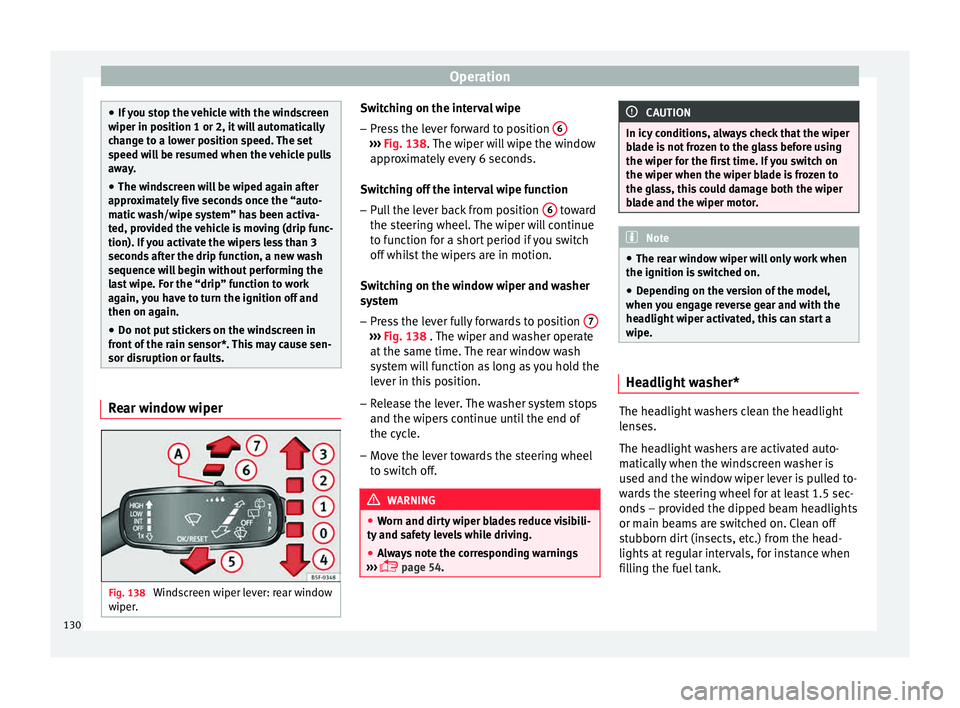
sor disruption or faults. Rear window wiper
Fig. 138
Windscreen wiper lever: rear window
w iper
. Switching on the interval wipe
– Press the lever forward to position 6 ›››
Fig. 138. The w
iper w
ill wipe the window
approximately every 6 seconds.
Switching off the interval wipe function
– Pull the lever back from position 6 toward
the s t
eerin
g wheel. The wiper will continue
to function for a short period if you switch
off whilst the wipers are in motion.
Switching on the window wiper and washer
system – Press the lever fully forwards to position 7 ›››
Fig. 138 . The w iper and w
asher operate
at the same time. The rear window wash
system will function as long as you hold the
lever in this position.
– Release the lever. The washer system stops
and the wiper s
continue until the end of
the cycle.
– Move the lever towards the steering wheel
to swit
ch off. WARNING
● Worn and dir ty
wiper blades reduce visibili-
ty and safety levels while driving.
● Always note the corresponding warnings
›››
page 54. CAUTION
In icy conditions, always check that the wiper
bl a
de is not frozen to the glass before using
the wiper for the first time. If you switch on
the wiper when the wiper blade is frozen to
the glass, this could damage both the wiper
blade and the wiper motor. Note
● The re ar w
indow wiper will only work when
the ignition is switched on.
● Depending on the version of the model,
when you en
gage reverse gear and with the
headlight wiper activated, this can start a
wipe. Headlight washer*
The headlight washers clean the headlight
l
en
se
s.
The headlight washers are activated auto-
matically when the windscreen washer is
used and the window wiper lever is pulled to-
wards the steering wheel for at least 1.5 sec-
onds – provided the dipped beam headlights
or main beams are switched on. Clean off
stubborn dirt (insects, etc.) from the head-
lights at regular intervals, for instance when
filling the fuel tank.
130
Page 133 of 248
Lights and visibility
Note
● To en s
ure that the headlight washers work
properly in winter, keep the nozzle holders in
the bumper free of snow and remove any ice
with a de-icer spray.
● To remove water, the windscreen wipers
wil
l be activated from time to time, the head-
light washers will be activated every three cy-
cles. Rear view mirrors
Int erior mirr
orIt is dangerous to drive if you cannot see
c
l
e
arly through the rear window.
Interior mirror with automatic anti-dazzle
function*
The anti-dazzle function is activated every
time the ignition is switched on.
When the anti-dazzle function is enabled, the
interior rear vision mirror will darken auto-
matically according to the amount of light it
receives. The anti-dazzle function is cancel-
led if reverse gear is engaged. Note
● The autom atic
anti-dazzle function will only
work properly if the sun blind* for the rear window is retracted and there are no other
ob
j
ects preventing light from reaching the in-
terior rear vision mirror.
● If you have to stick any type of sticker on
the winds
creen, do not do so in front of the
sensors. Doing so could prevent the anti-daz-
zle function from working well or even from
working at all. Folding in the exterior mirrors man-
ual
ly The exterior mirrors of the vehicle may be fol-
ded in. F
or thi
s, pr
ess the mirror housing to-
wards the vehicle. Note
Before washing the vehicle with an automatic
car w a
sh, fold in the exterior mirrors to avoid
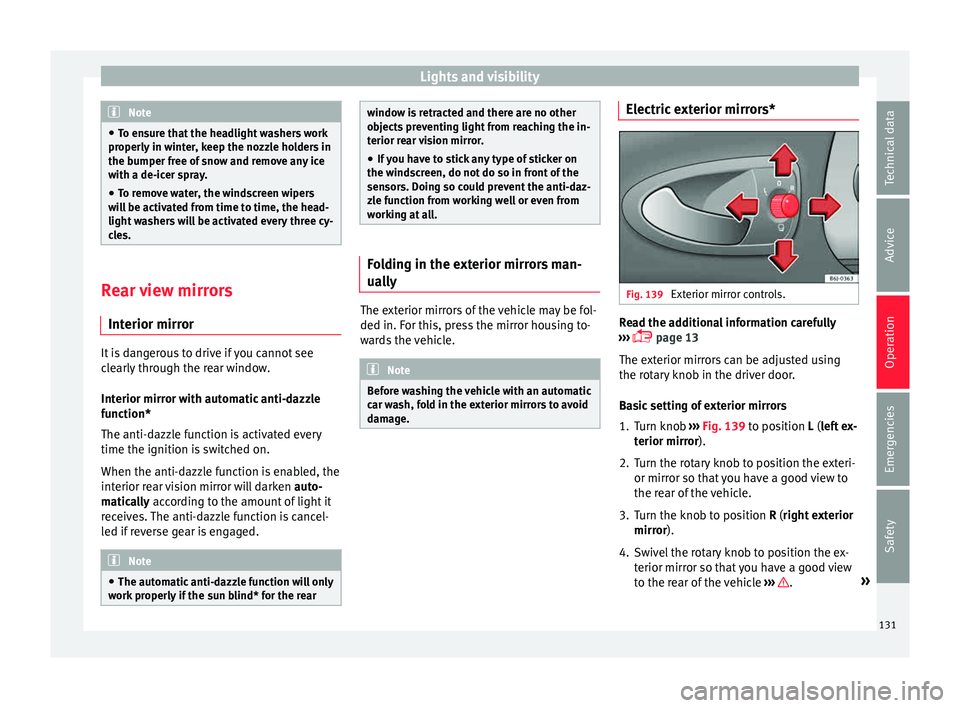
damage. Electric exterior mirrors*
Fig. 139
Exterior mirror controls. Read the additional information carefully
› ›
›
page 13
The exterior mirrors can be adjusted using
the rotary knob in the driver door.
Basic setting of exterior mirrors
1. Turn knob ››› Fig. 139
to position L (left ex-
terior mirror).
2. Turn the rotary knob to position the exteri- or mirror so that
you have a good view to
the rear of the vehicle.
3. Turn the knob to position R (right ext
erior
mirror).
4. Swivel the rotary knob to position the ex- terior mirror so th
at you have a good view
to the rear of the vehicle ››› .
»
131
Technical data
Advice
Operation
Emergencies
Safety
Page 155 of 248
Driving
could be engaged and vehicle steering would
not w
ork. Note
The ignition of the vehicle being towed must
be sw itc
hed on to prevent the steering wheel
from locking and also to allow the use of the
turn signals, horn, windscreen wipers and
washers. Information relating to different vehi-
c
l
e pr
ocesses. In order to make the vehicle more difficult to
s
t
e
al, you should always lock the steering be-
fore leaving the vehicle.
Mechanical steering lock
The steering column is locked when the key
is removed from the ignition lock and the ve-
hicle is stationary.
Activating the steering lock
● Park the vehicle ›››
page 156.
● Remove the ignition key.
● Turn the steering wheel slightly until the
steerin
g lock has engaged. Deactivating the steering lock
●
Turn the steering wheel slightly to release
the lock.
● Inser
t the key in the ignition lock.
● Hold the steering wheel in this position
and switc
h on the ignition.
Electromechanical steering
In vehicles with electromechanical steering,
the assisted steering function automatically
adjusts according to vehicle speed, steering
wheel torque and wheel orientation. The
power steering only works when the engine
is running.
You should take into account that you will
need considerably more power than normal
to steer the vehicle if the power steering is
not working correctly or at all.
Power-assisted steering
Power-assisted steering helps the driver in
critical situations. In counter-steering, it as-
sists by applying additional torque ››› .
WARNING
Power-assisted steering, together with the
ESC, help s
the driver to control vehicle steer-
ing in critical situations. However, the driver
is ultimately responsible for steering the ve-
hicle at all times. Power-assisted steering
does not remove this responsibility. Starting and stopping the en-
gine
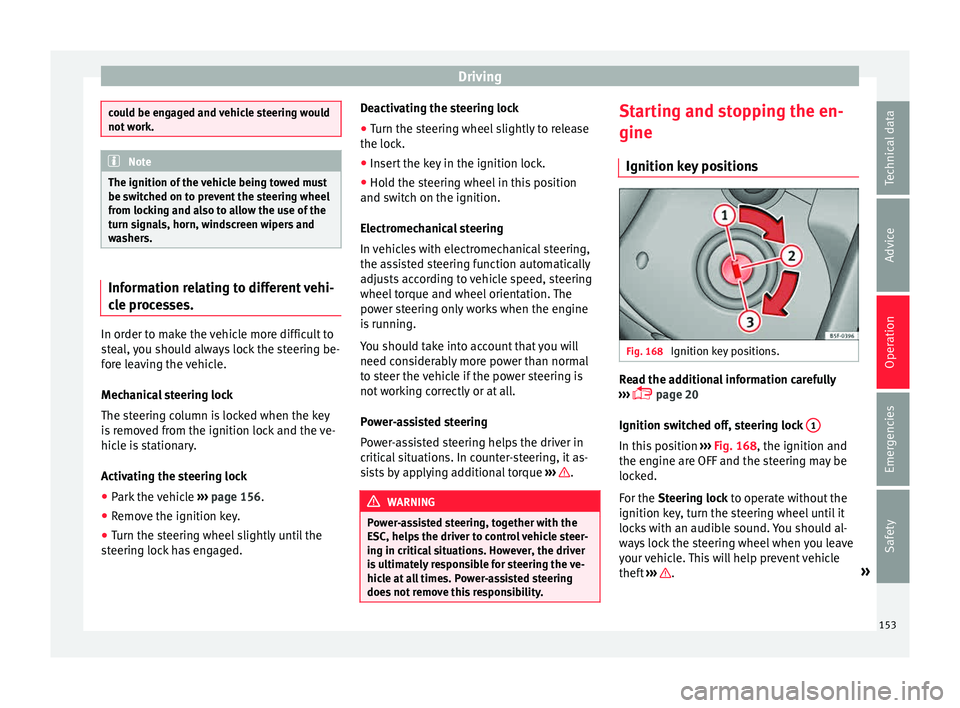
Ignition k ey
po
sitions Fig. 168
Ignition key positions. Read the additional information carefully
› ›
›
page 20
Ignition switched off, steering lock 1 In this position
››
›
Fig. 168, the ignition and
the engine are OFF and the steering may be
locked.
For the Steering lock to operate without the
ignition key, turn the steering wheel until it
locks with an audible sound. You should al-
ways lock the steering wheel when you leave
your vehicle. This will help prevent vehicle
theft ››› .
»
153
Technical data
Advice
Operation
Emergencies
Safety
Page 162 of 248
Operation
Selecting the normal programme
– Put the selector lever into position D.
Sel ectin
g the s
port programme
– Put the selector lever into position S.
If y
ou select the normal programme, D, you
will drive in the economy mode, i.e. the pro-
gramme is designed to reduce fuel consump-
tion. The gearbox changes up into a higher
gear as soon as possible and down into a
lower gear as late as possible.
If you select the sport programme, S, you will
drive in a sporty mode, i.e. a programme in
which shifts into high gears are postponed in
order to use the full power of the engine.
Selector lever positions Read the additional information carefully
› ›
›
page 38
Selector lever positions
The selected gear is displayed on the side of
the selector lever and on the instrument pan-
el display. The currently selected gear for the
automatic gearbox will also be shown on the
display. Tiptronic gear indicator
If the autom
atic gearbox is shifted manually,
the selected gears are shown on the screen.
P - parking lock
When the selector lever is in this position,
the driven wheels are locked mechanically.
Position P on the lever must only be selected
if the vehicle is stationary.
To move selector lever from position P, the
locking button on the selector lever handle
must be pressed and the brake pedal de-
pressed at the same time while the ignition is
switched on.
To put the selector lever in position P, simply
press the lock button down and, if necessary,
depress the brake pedal down.
R - Reverse gear
The reverse gear is engaged in this position.
Reverse gear must be engaged only when the
vehicle is stationary and the engine is idling.
To move the selector lever to position R,
press the lock button down and, at the same
time, press the brake pedal down, with the
ignition switched on.
With the selector lever in position R and the
ignition switched on the following occurs:
● Reverse lights light up. ●
The air conditioner autom atically changes
the air recirculation mode.
● The wiper starts if the windscreen washer is
on.
● The parking distance warning system*
switc
hes on.
N - Neutral (idling)
If this position is selected, the gearbox is in
neutral. Power is not transmitted to the
wheels and the engine does not have a brak-
ing function.
Never use the N position to drive down a long
hill. There is no engine braking and the
brakes are subjected to excessive stain.
You could damage the automatic gearbox if
you drive down hills with the gearbox lever in
position N and the engine switched off.
D - Drive (forward)
In this position the gearbox automatically
changes to a lower or higher gear, according
to the engine's requirements, the driving
style and speed. The braking effect of the en-
gine when driving downhill is very limited
when the selector is in this position. The in-
strument panel display shows the selected
gear as well as the selector lever in position
D.
When travelling at speeds lower than 5 km/h
(3 mph) or when the vehicle is stationary,
160
Page 196 of 248
Advice
Sensors and camera lenses ●
Use a small brush to remove snow and a
de-icer s pr
ay to remove ice.
● Clean the sensors with a solvent-free prod-
uct and a soft, dr
y cloth.
● Moisten the camera lens using a standard
alcohol-b
ased glass cleaning agent and
clean the lens with a dry cloth. CAUTION
● When y ou c
lean the vehicle with a pressure
washer:
–Stay a suitable distance from the sensors
on the front and rear bumpers.
– Do not clean the camera lenses or sur-
rounding area with the pressure washer.
● Never use warm or hot water to remove
snow and ic
e from the reverse camera lens,
as it could crack the lens.
● Never use abrasive cleaning agents on the
lens. Vehicle paint maintenance
Regular waxing protects the paintwork.
Y
ou need t
o ap
ply wax to your vehicle if water
does not form small drops and run off the
paintwork when it is clean.
Good quality hard wax products are available
at your Technical Service. Regular wax applications help to protect the
paintwork
from environmental contaminants
››› page 191. It is also effective in protecting
against minor scratches.
Even if a wax solution is used regularly in the
vehicle washing tunnel, it is advisable to pro-
tect the paint with a hard wax coating at least
twice a year.
Polishing the paintwork Polishing is only necessary if the paint has
lo
s
t
its shine, and the gloss cannot be
brought back by applying wax. Polishing
products can be purchased in your Technical
Service.
The vehicle must be waxed after polishing if
the polish used does not contain wax com-
pounds to seal the paint ››› page 194, Vehicle
paint maintenance . CAUTION
To prevent damage to the paintwork:
● Do not use polishes and hard wax on pain-
ted p ar
ts with a matt finish or on plastic
parts.
● Do not polish your vehicle in a sandy or
dusty
environment. Caring for plastic parts
If normal washing fails to clean plastic parts,
cl
e
an them with approved solvent-free plas-
tic cleaning and care products. CAUTION
● The use of li
quid air freshener directly over
the air vents of the vehicle may damage the
plastic parts if the liquid is accidentally spil-
led.
● Cleaning products which contain solvents
wil
l damage the material. Cleaning of windows and mirrors
Cleaning windows
– Moisten the windows with commercially
av ai
l
able, alcohol based glass cleaner.
– Dry the windows with a clean chamois
leather or a lint
-free cloth.
Removing snow – Use a small brush to remove snow from the
window
s and mirrors.
Removing ice
– Use a de-icer spray.
Use a cl
ean cloth or chamois leather to dry
the windows. The chamois leathers used on
194
Page 197 of 248
Care and maintenance
painted surfaces are not suitable to clean
w indo
w
s because they are soiled with wax
deposits which could smear the windows.
If possible, use a de-icing spray to remove
ice. If you use an ice scraper, push it in one
direction only without swinging it.
Use window cleaner or a silicone remover to
clean rubber, oil, grease and silicone depos-
its off.
Wax deposits can only be removed with a
special cleaner available at your Technical
Service. Wax deposits on the windscreen
could cause the wiper blades to judder. Add-
ing a window cleaner that dissolves wax to
the windscreen washer fluid prevents wiper
blades from juddering, but wax deposits are
not removed. CAUTION
● Never u se w
arm or hot water to remove
snow and ice from windows and mirrors. This
could cause the glass to crack!
● The heating element for the rear window is
located on the inner s
ide of the window. To
prevent damage, do not put stickers over the
heating elements on the inside of the win-
dow. Cleaning windscreen wiper blades
Clean wiper blades improve visibility. 1. Use a soft cloth to remove dust and dirt
from the w
ind
screen wiper blades.
2. Use window cleaner to clean the wind- scr
een wiper blades. Use a sponge or a
cloth to remove stubborn dirt.
Care of rubber seals If rubber seals are well looked after, they will
not fr
eez
e so quickly.
1. Use a soft cloth to remove dust and dirt from the rubber se al
s.
2. Apply a specialist care product to the rub- ber seals.
The rubber s
trips on the doors, windows, etc.
will remain pliable and last longer if they are
treated with a suitable rubber care product
from time to time (for example silicone
spray).
Caring for rubber seals will also prevent pre-
mature ageing and leaks. The doors will be
easier to open. If rubber seals are well looked
after, they will not freeze so quickly in winter.
Door lock cylinder The door lock cylinders can freeze up in win-
t
er
. T
o de-ice the lock cylinders you should only
use spr
ay with lubricating and anti-corrosive
properties.
Cleaning chrome parts 1. Clean chrome parts with a damp cloth.
2. Polish chrome parts with a soft, dry cloth.
If thi
s
does not provide satisfying results, use
a specialist chrome cleaning product.
Chrome cleaning products will remove stains
from the surface. CAUTION
To prevent scratching chrome surfaces:
● Never use an abrasive cleaning product on
chr ome.
● Do not
clean or polish chrome parts in a
sandy or du
sty environment. Steel wheel rims
–
Clean steel wheel rims regularly using a
sep ar
at
e sponge.
Use an industrial cleaner to remove brake
dust. Any damage to the paint on steel wheel
rims should be repaired before starting to
rust. »
195
Technical data
Advice
Operation
Emergencies
Safety
Page 206 of 248
Advice
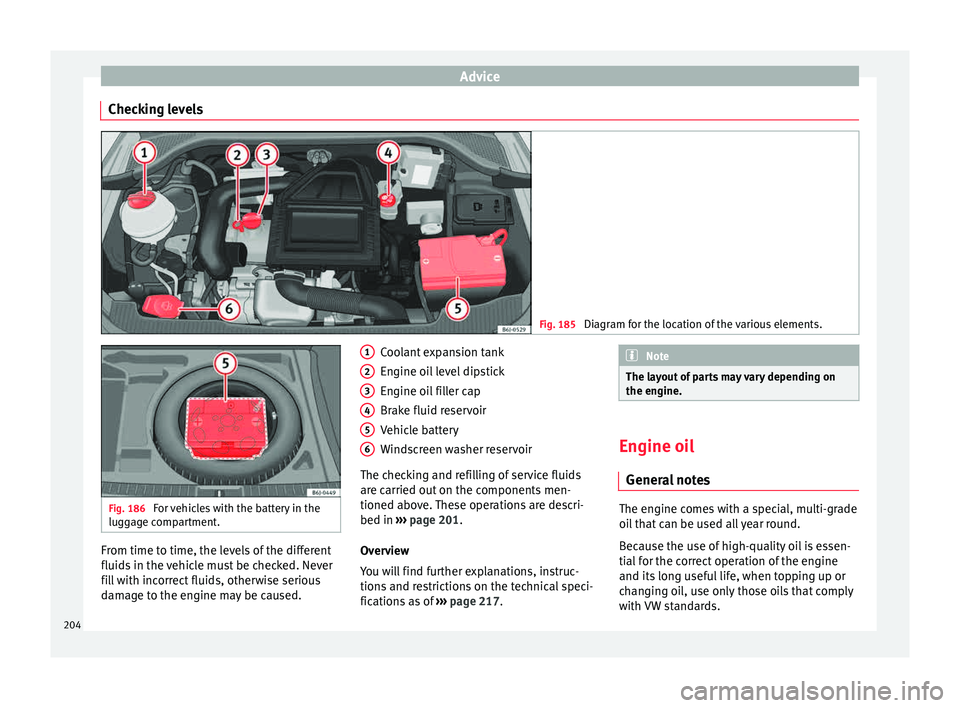
Checking levels Fig. 185
Diagram for the location of the various elements. Fig. 186
For vehicles with the battery in the
lugg ag
e compartment. From time to time, the levels of the different
fluid
s in the
vehicle must be checked. Never
fill with incorrect fluids, otherwise serious
damage to the engine may be caused. Coolant expansion tank
Engine oil
level dipstick
Engine oil filler cap
Brake fluid reservoir
Vehicle battery
Windscreen washer reservoir
The checking and refilling of service fluids
are carried out on the components men-
tioned above. These operations are descri-
bed in ››› page 201.
Overview
You will find further explanations, instruc-
tions and restrictions on the technical speci-
fications as of ››› page 217.
1 2
3
4
5
6 Note
The layout of parts may vary depending on
the engine. Engine oil
Genera l
notes The engine comes with a special, multi-grade
oil
th
at can be used all year round.
Because the use of high-quality oil is essen-
tial for the correct operation of the engine
and its long useful life, when topping up or
changing oil, use only those oils that comply
with VW standards.
204
Page 211 of 248
Checking and refilling levels
Be sure to always use the correct brake fluid.
On ly
u
se brake fluid that expressly meets the
VW 501 14 standard.
You can buy VW 501 14 standard brake fluid
in a SEAT dealership or a SEAT Official Serv-
ice. If none is available, use only high-quality
brake fluid that meets DIN ISO 4925 CLASS 4
standards, or USA Standards FMVSS 116 DOT
4.
Using any other kind of brake fluid or one
that is not of a high quality may affect opera-
tion of the brake system and reduce its effec-
tiveness. Never use a brake fluid if the con-
tainer does not state that it complies with VW
501 14, DIN ISO 4925 CLASS 4 standards, or
USA standards FMVSS 116 DOT 4. WARNING
Brake fluid is poisonous. Old brake fluid im-
pair s
the braking effect.
● Before opening the bonnet to check the
brake fluid l
evel, read and observe the warn-
ings ››› page 201.
● Brake fluid should be stored in the closed
original
container in a safe place out of reach
of children. There is a toxic risk.
● Perform the brake fluid change according to
the Mainten
ance Programme. Heavy use of
the brakes may cause a vapour lock if the
brake fluid is left in the brake system for too
long. This would seriously affect the effec-
tiveness of the brakes and the safety of the
vehicle. This may cause an accident. CAUTION
Brake fluid damages the vehicle paintwork.
Wipe off an
y brake fluid from the paintwork
immediately. For the sake of the environment
The brake pads and brake fluid must be col-
lect ed and di
sposed of according the applica-
ble regulations. The SEAT Technical Service
network has the necessary equipment and
qualified personnel for collecting and dispos-
ing of this waste material. Windscreen washer reservoir
Top pin
g up the windscreen washer
reservoir water Read the additional information carefully
› ›
›
page 43
The windscreen washer and the headlight
washers are supplied with fluid from the
windscreen washer fluid container in the en-
gine compartment. The container holds ap-
prox. 3 litres; in vehicles with headlight
washers* it holds approx. 4.5 litres.
The tank is in the engine compartment.
Plain water is not enough to clean the wind-
screen and headlights. We recommend that
you always add a product to the windscreen washer fluid. Approved windscreen cleaning
products e
xist on the market with high deter-
gent and anti-freeze properties, these may be
added all-year-round. Please follow the dilu-
tion instructions on the packaging. WARNING
Any work carried out in the engine compart-
ment or on the en gine mu
st be carried out
cautiously.
● When working in the engine compartment,
alwa
ys observe the safety warnings
››› page 201. CAUTION
● Never p ut
radiator anti-freeze or other addi-
tives into the windscreen washer fluid.
● Always use approved windscreen cleansing
products
diluted as per instructions. If you
use other washer fluids or soap solutions,
the tiny holes in the fan-shaped nozzles
could become blocked. Vehicle battery
S ymbo
l
s and warnings on handling
the battery Read the additional information carefully
› ›
›
page 43 »
209
Technical data
Advice
Operation
Emergencies
Safety
Page 240 of 248
Index
Electronic Stability Control . . . . . . . . . . . . . . . . . 170
El ectr
onic
Stability Control (ESC) . . . . . . . 103, 169
Emergencies . . . . . . . . . . . . . . . . . . . . . . . . . . . . . . 75 bulbs . . . . . . . . . . . . . . . . . . . . . . . . . . . . . . . . . . 45
changing a wheel . . . . . . . . . . . . . . . . . . . . . . . . 47
changing the battery . . . . . . . . . . . . . . . . . . . . 211
emergency towing of the vehicle . . . . . . . . . . . . 51
emergency warning triangle . . . . . . . . . . . . . . . 75
fire extinguisher . . . . . . . . . . . . . . . . . . . . . . . . . 75
first-aid kit . . . . . . . . . . . . . . . . . . . . . . . . . . . . . . 75
fuses . . . . . . . . . . . . . . . . . . . . . . . . . . . . . . . . . . 44
hazard warning lights . . . . . . . . . . . . . . . . . . . 127
Jump leads . . . . . . . . . . . . . . . . . . . . . . . . . . . . . 52
panoramic/tilting sunroof . . . . . . . . . . . . . . . . . 11
puncture . . . . . . . . . . . . . . . . . . . . . . . . . . . . . . . 45
replacing a blown fuse . . . . . . . . . . . . . . . . . . . . 44
Spare wheel . . . . . . . . . . . . . . . . . . . . . . . . . . . . 76
vehicle tools . . . . . . . . . . . . . . . . . . . . . . . . . . . . 75
Emergency operation selector lever . . . . . . . . . . . . . . . . . . . . . . . . . . . 38
Emergency warning triangle . . . . . . . . . . . . 75, 127
Emission control system control lamp . . . . . . . . . . . . . . . . . . . . . . . . . . . 106
Emissions data . . . . . . . . . . . . . . . . . . . . . . . . . . . 217
Engine assisted starting . . . . . . . . . . . . . . . . . . . . . . . . . 52
Running in . . . . . . . . . . . . . . . . . . . . . . . . . . . . . 165
Start-Stop system . . . . . . . . . . . . . . . . . . . . . . . 173
Engine compartment . . . . . . . . . . . . . . 10, 201, 204 battery . . . . . . . . . . . . . . . . . . . . . . . . . . . . . . . . 209
brake fluid . . . . . . . . . . . . . . . . . . . . . . . . . . . . . 208
closing . . . . . . . . . . . . . . . . . . . . . . . . . . . . . . . . 203
coolant . . . . . . . . . . . . . . . . . . . . . . . . . . . . . . . 207
engine oil . . . . . . . . . . . . . . . . . . . . . . . . . . . . . 206
opening . . . . . . . . . . . . . . . . . . . . . . . . . . . . . . . 203
safety notes . . . . . . . . . . . . . . . . . . . . . . . . . . . 201
windscreen washer liquid . . . . . . . . . . . . . . . . 209 Engine coolant . . . . . . . . . . . . . . . . . . . . . . . . . . . . 42
check ing level . . . . . . . . . . . . . . . . . . . . . . . . . . 207
G12 plus-plus . . . . . . . . . . . . . . . . . . . . . . . . . . . 42
G13 . . . . . . . . . . . . . . . . . . . . . . . . . . . . . . . . . . . 42
specifications . . . . . . . . . . . . . . . . . . . . . . . . . . . 42
Engine data . . . . . . . . . . . . . . . . . . . . . . . . . . . . . . 221
Engine fault control lamp . . . . . . . . . . . . . . . . . . . . . . . . . . . 101
Engine management control lamp . . . . . . . . . . . . . . . . . . . . . . . . . . . 101
Engine oil . . . . . . . . . . . . . . . . . . . . . . . . . . . 41, 204 changing . . . . . . . . . . . . . . . . . . . . . . . . . 204, 206
check oil level . . . . . . . . . . . . . . . . . . . . . . . . . . 206
consumption . . . . . . . . . . . . . . . . . . . . . . . . . . . 206
diesel . . . . . . . . . . . . . . . . . . . . . . . . . . . . . . . . . 204
engine oil dipstick . . . . . . . . . . . . . . . . . . . . . . 206
inspection service . . . . . . . . . . . . . . . . . . . . . . 204
maintenance intervals . . . . . . . . . . . . . . . . . . . 204
oil properties . . . . . . . . . . . . . . . . . . . . . . . . . . . 41
Specifications . . . . . . . . . . . . . . . . . . . . . . . . . . 204
temperature display . . . . . . . . . . . . . . . . . . . . . . 31
topping up . . . . . . . . . . . . . . . . . . . . . . . . . . . . 206
Engine oil pressure warning lamp . . . . . . . . . . . . . . . . . . . . . . . . . . 102
Environment ecological driving . . . . . . . . . . . . . . . . . . . . . . . 167
Environmental compatibility . . . . . . . . . . . . . . 165
Environmental tips refuelling . . . . . . . . . . . . . . . . . . . . . . . . . . . . . . 199
Equipment . . . . . . . . . . . . . . . . . . . . . . . . . . . . . . 190
ESC . . . . . . . . . . . . . . . . . . . . . . . . . . . . . . . 103, 170 electronic stability control . . . . . . . . . . . 103, 169
Sport Mode . . . . . . . . . . . . . . . . . . . . . . . . . . . . 169
see also Electronic Stability Control (ESC) . . . 170
Exhaust gas emission control system . . . . . . . . . 166
Extending the luggage compartment . . . . . . . . . . . . . . . . 135 Exterior lighting
chan ging a bulb . . . . . . . . . . . . . . . . . . . . . . . . . 83
Exterior mirrors . . . . . . . . . . . . . . . . . . . . . . . . . . . 131 adjusting . . . . . . . . . . . . . . . . . . . . . . . . . . . . . . . 13
control . . . . . . . . . . . . . . . . . . . . . . . . . . . . . . . . 131
folding in electrically . . . . . . . . . . . . . . . . . . . . 132
folding in manually . . . . . . . . . . . . . . . . . . . . . 131
heated . . . . . . . . . . . . . . . . . . . . . . . . . . . . . . . . 132
Exterior view . . . . . . . . . . . . . . . . . . . . . . . . . . . . . 5, 6
F Fabric: cleaning . . . . . . . . . . . . . . . . . . . . . . . . . . 197
Fastening rings . . . . . . . . . . . . . . . . . . . . . . . . . . . 140
Faulty bulbs changing a bulb . . . . . . . . . . . . . . . . . . . . . . . . . 83
Filling the tank . . . . . . . . . . . . . . . . . . . . . . . . . . . 199 fuel gauge . . . . . . . . . . . . . . . . . . . . . . . . . . . . . 100
Fire extinguisher . . . . . . . . . . . . . . . . . . . . . . . . . . . 75
First-aid kit . . . . . . . . . . . . . . . . . . . . . . . . . . . . . . . 75
Floor mats . . . . . . . . . . . . . . . . . . . . . . . . . . . . . . . . 61
Fog-light bulb FR version . . . . . . . . . . . . . . . . . . . . . . . . . . . . . . 88
Fog light bulb . . . . . . . . . . . . . . . . . . . . . . . . . . . . . 88
Front headrests . . . . . . . . . . . . . . . . . . . . . . . . . . . . . . 60
Front airbags . . . . . . . . . . . . . . . . . . . . . . . . . . 14, 69 safety instructions . . . . . . . . . . . . . . . . . . . . . . . 69
Front ashtray . . . . . . . . . . . . . . . . . . . . . . . . . . . . . 138
Front drink holder . . . . . . . . . . . . . . . . . . . . . . . . . 137
Front passenger front airbag control lamp . . . . . . . . . . . . . . . . . . . . . . . . . . . . 68
deactivation . . . . . . . . . . . . . . . . . . . . . . . . . . . . 14
Front seat manual adjustment . . . . . . . . . . . . . . . . . . . . . . 12
Front seat backrest folding . . . . . . . . . . . . . . . . . . . . . . . . . . . . . . . . 133
lifting . . . . . . . . . . . . . . . . . . . . . . . . . . . . . . . . . 133
238
Page 241 of 248
Index
Fuel . . . . . . . . . . . . . . . . . . . . . . . . . . . . . . . . . . . . . 41 biodie
sel
. . . . . . . . . . . . . . . . . . . . . . . . . . . . . . 201
consumption . . . . . . . . . . . . . . . . . . . . . . . . . . . 218
Diesel . . . . . . . . . . . . . . . . . . . . . . . . . . . . . . . . 200
fuel gauge . . . . . . . . . . . . . . . . . . . . . . . . . . . . . 100
Petrol . . . . . . . . . . . . . . . . . . . . . . . . . . . . . . . . . 200
saving . . . . . . . . . . . . . . . . . . . . . . . . . . . . . . . . 167
Fuel consumption . . . . . . . . . . . . . . . . . . . . . . . . . 167
Fuel reserve . . . . . . . . . . . . . . . . . . . . . . . . . . . . . 105
Fuel tank see Fuel reserve . . . . . . . . . . . . . . . . . . . . . . . . 105
Fuel tank cap opening and closing . . . . . . . . . . . . . . . . . . . . . 41
Fuel tank flap opening and closing . . . . . . . . . . . . . . . . . . . . . 41
Fuses . . . . . . . . . . . . . . . . . . . . . . . . . . . . . . . . . 44, 81 fuse box . . . . . . . . . . . . . . . . . . . . . . . . . . . . . . . . 81
identifying blown fuses . . . . . . . . . . . . . . . . . . . 45
Identifying by colours . . . . . . . . . . . . . . . . . . . . . 44
Preparation before replacing . . . . . . . . . . . . . . . 44
replacing . . . . . . . . . . . . . . . . . . . . . . . . . . . . . . . 44
G Gear-change indicator . . . . . . . . . . . . . . . . . 28, 159
Gearbox lever . . . . . . . . . . . . . . . . . . . . . . . . . . . . . 37
Gear change . . . . . . . . . . . . . . . . . . . . . . . . . . . . . . 37 automatic . . . . . . . . . . . . . . . . . . . . . . . . . . . . . . 38
changing gears (manual gearbox) . . . . . . . . . 159
manual . . . . . . . . . . . . . . . . . . . . . . . . . . . . . . . . 37
manual gear change . . . . . . . . . . . . . . . . . . . . . 159
Gear engaged . . . . . . . . . . . . . . . . . . . . . . . . . . . . . 37
Gear recommendation . . . . . . . . . . . . . . . . . . . . . . 28
General instrument panel controls and displays . . . . . . . . . . . . . . . . . . . . . 95
turn signal and main beam lever . . . . . . . . . . . 125
warning and indication lamps . . . . . . . . . . . . . . 35
General overview of the engine compartment . . 204 Glass
remov ing ice . . . . . . . . . . . . . . . . . . . . . . . . . . . 194
Glove compartment . . . . . . . . . . . . . . . . . . . . . . . 136
Glow plug system . . . . . . . . . . . . . . . . . . . . . . . . . 155
H
Handbrake . . . . . . . . . . . . . . . . . . . . . . . . . 156, 157 warning lamp . . . . . . . . . . . . . . . . . . . . . . . . . . 157
Hazard warning lights . . . . . . . . . . . . . . . . . 22, 127
HBA . . . . . . . . . . . . . . . . . . . . . . . . . . . . . . . . . . . . 171
Head-on collisions and the laws of physics . . . . . 63
Head-protection airbags description . . . . . . . . . . . . . . . . . . . . . . . . . . . . . 15
safety instructions . . . . . . . . . . . . . . . . . . . . . . . 15
Headlight range control . . . . . . . . . . . . . . . . . . . . 125
Headlights Driving abroad . . . . . . . . . . . . . . . . . . . . . . . . . 169
fog lights . . . . . . . . . . . . . . . . . . . . . . . . . . . . . . 123
Headlight washer . . . . . . . . . . . . . . . . . . . . . . . 130
Head restraints . . . . . . . . . . . . . . . . . . . . . . . . . . . . 12 Adjustment . . . . . . . . . . . . . . . . . . . . . . . . . . . . 133
Front head restraints . . . . . . . . . . . . . . . . . . . . . 60
Rear head restraints . . . . . . . . . . . . . . . . . . . . . . 60
Headrests . . . . . . . . . . . . . . . . . . . . . . . . . . . . . . . . 12 adjustment . . . . . . . . . . . . . . . . . . . . . . . . . . . . 133
Heated rear window heating element wires . . . . . . . . . . . . . . . . . . . 195
switch . . . . . . . . . . . . . . . . . . . . . . . . . . . . . . . . 128
Heating . . . . . . . . . . . . . . . . . . . . . . . . . . . . . . . . . 147 Defrosting the windscreen . . . . . . . . . . . . . . . . 147
Demisting the windscreen and side windows 148
Heating and fresh air . . . . . . . . . . . . . . . . . . 40, 146 controls . . . . . . . . . . . . . . . . . . . . . . . . . . . . . . . 146
Heating system . . . . . . . . . . . . . . . . . . . . . . . . . . . 147
Hill driving assistant . . . . . . . . . . . . . . . . . . . . . . 158
Horn . . . . . . . . . . . . . . . . . . . . . . . . . . . . . . . . . . . . 95 How to jump start . . . . . . . . . . . . . . . . . . . . . . . . . . 52
desc ription . . . . . . . . . . . . . . . . . . . . . . . . . . . . . 52
Hydraulic Brake Assist automatic hazard warning lights activation . . 171
I
Identification plate . . . . . . . . . . . . . . . . . . . . . . . . 218
Identifying letters on engine . . . . . . . . . . . . . . . . 217
Ignition . . . . . . . . . . . . . . . . . . . . . . . . . . . . . . . . . . 20
Ignition lock . . . . . . . . . . . . . . . . . . . . . . . . . 20, 153
Incorrect sitting position . . . . . . . . . . . . . . . . . . . . 59
Indications on the display . . . . . . . . . . . . . . . . . . . 97 assist systems submenu . . . . . . . . . . . . . . . . . . 29
compass . . . . . . . . . . . . . . . . . . . . . . . . . . . . . . . 98
distance travelled . . . . . . . . . . . . . . . . . . . . . . . . 97
doors, bonnet and rear lid open . . . . . . . . . . . . 28
Driver information system . . . . . . . . . . . . . . . . . 25
ECO . . . . . . . . . . . . . . . . . . . . . . . . . . . . . . . . . . . 98
journey data . . . . . . . . . . . . . . . . . . . . . . . . . . . . 29
MKB . . . . . . . . . . . . . . . . . . . . . . . . . . . . . . . . . . . 98
outside temperature . . . . . . . . . . . . . . . . . . . . . . 27
recommended gear . . . . . . . . . . . . . . . . . . . . . . 98
SEAT Drive Profile . . . . . . . . . . . . . . . . . . . . . . . 186
second speed display . . . . . . . . . . . . . . . . . . . . 98
selector lever position . . . . . . . . . . . . . . . . . . . . 98
selector lever positions . . . . . . . . . . . . . . . . . . 160
service intervals . . . . . . . . . . . . . . . . . . . . . . . . . 33
speed warning . . . . . . . . . . . . . . . . . . . . . . . . . . 98
Start-Stop . . . . . . . . . . . . . . . . . . . . . . . . . . . . . . 98
time . . . . . . . . . . . . . . . . . . . . . . . . . . . . . . . . . . . 98
warning and information messages . . . . . . . . . 29
Infotainment system . . . . . . . . . . . . . . . . . . . . . . . 24
Inspection service . . . . . . . . . . . . . . . . . . . . . . . . 204
Instrument cluster . . . . . . . . . . . . . . . . . . . . . . . . . 96
Instrument panel . . . . . . . . . . . . . . . . . . . . . . . . . . 96 display . . . . . . . . . . . . . . . . . . . . . . . . . . . . . . 96, 97
instruments . . . . . . . . . . . . . . . . . . . . . . . . . . . . . 96
239